

Janet Delaney, Too Many Products, EUQINOM Gallery
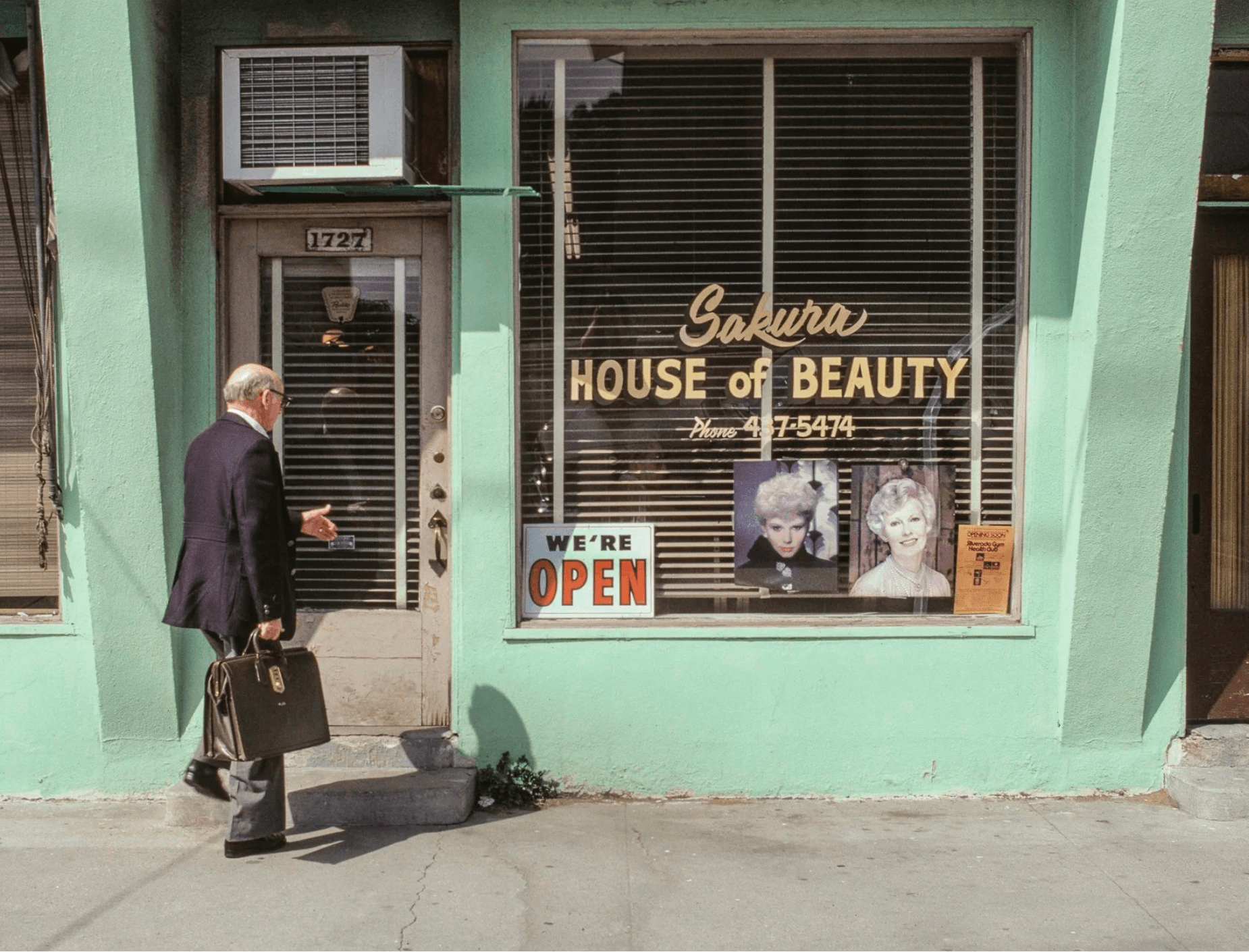
House of Beauty,1980, Archival Pigment Print, 2026, 33 x 41.5 in
The stories we tell ourselves — about our upbringings, our families, our feelings — often change with time, especially with the passage of decades. It's a surreal realization, isn't it?
In early 1980, Janet Delaney used her burgeoning photographic skills to document the doings of her salesman father as he made his rounds of Los Angeles-area beauty salons. Growing up, Delaney had decidedly mixed feelings about her dad's profession in a business that she said represented an "oppressive hold" on women's lives. In that era, an increasing number of women mirrored that view, saying their self-image shouldn't be beholden to the male gaze and certainly not to capitalism's commercial pressure to look pretty. "Growing up in the 1960s and '70s under the aura of second-wave feminism," Delaney has written, "I had a disdain for the products my father peddled."
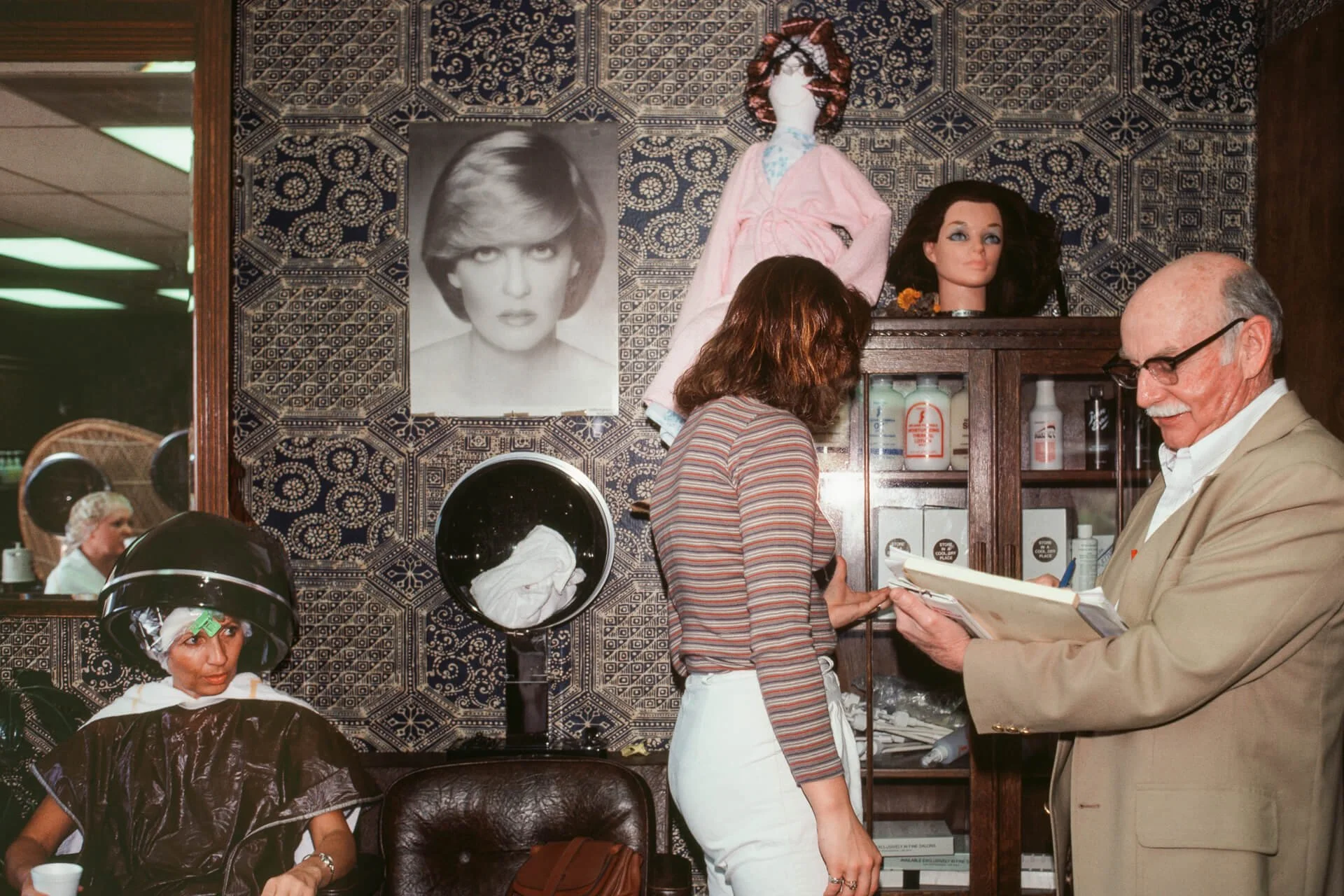
Diana,1980, Archival Pigment Print, 2026, 13x19.5in
How Delaney came to terms with this disdain is one of the many provocative throughlines of Too Many Products, an all-encompassing exhibit at EUQINOM Gallery that challenges the viewer to confront their own feelings about the beauty business, and asks viewers to witness a time of American culture that was on the verge of profound changes. The beauty salons that Delaney's dad frequented weren't glamorous. With names like Sakura House of Beauty and Delberts Hair Stylists and Barber Extraordinaire, they put women in old-fashioned hair rollers, sat them under heat lamps that resembled convoluted Star Wars Fleet Trooper helmets, and surrounded them with dated wood paneling that made the salons seem like basement dwellings. And yet: Women kept coming back, and so did Bill Delaney, who worked strictly on commission. No sales meant no money to feed his family, pay for the family's housing, and support his children's education.
Bill Delaney's profession doesn't exist anymore — at least not in the way that he practiced it, where he'd drive his Plymouth from one neighborhood place to the next, with his "office" essentially the belongings he had in his car. So the images of his movements, his interactions with salon workers, and of customers getting beautified or leaving the premises with a newly coifed hair style reveal a time when the beauty business was much less upscale, much less commercialized, and much less photographed at the working-class level. That's why Too Many Products is such a profound time capsule: It pinpoints an almost-primordial time in beauty culture, when the hurried pace of smart phones and the internet were nonexistent, and when an awareness of fully-maturing feminism was seemingly nowhere to be found in beauty salons — unless it snuck in through the lens of a photographer named Janet Delaney.
Many American feminists still see the beauty business, and by extension beauty salons, as an instrument of society's unbridled pressure on women to chase the unattainable: a level of attractiveness that lasts not just year-round but for a lifetime. The women in Delaney's photos are mostly middle-aged, which was the age that Betty Friedan was when she published her landmark 1963 book, "The Feminine Mystique," which criticized cultural expectations that sequestered women into the roles of housewives and mothers. In its first pages, "The Feminine Mystique" highlights as evidence a "vacuous" woman who proclaimed in a popular advertisement, "If I have only one life, let me live it as a blonde." The only famous blondes in Friedan's era were beauty-salon blondes, and in the decades since Friedan's book came out, other notable feminists have argued that the beauty industry and its embedded outreach — including the kind of beauty salon posters and women's magazines seen in Delaney's Los Angeles photographs — re-indoctrinates women into undergoing expensive treatments. In her 2015 book, "Feminism Is for Everybody," author and social critic bell hooks lambastes "appearance obsession" and says that, despite feminism's progress, "until feminists go back to the beauty industry, go back to fashion, and create an ongoing, sustained revolution, we will not be free."
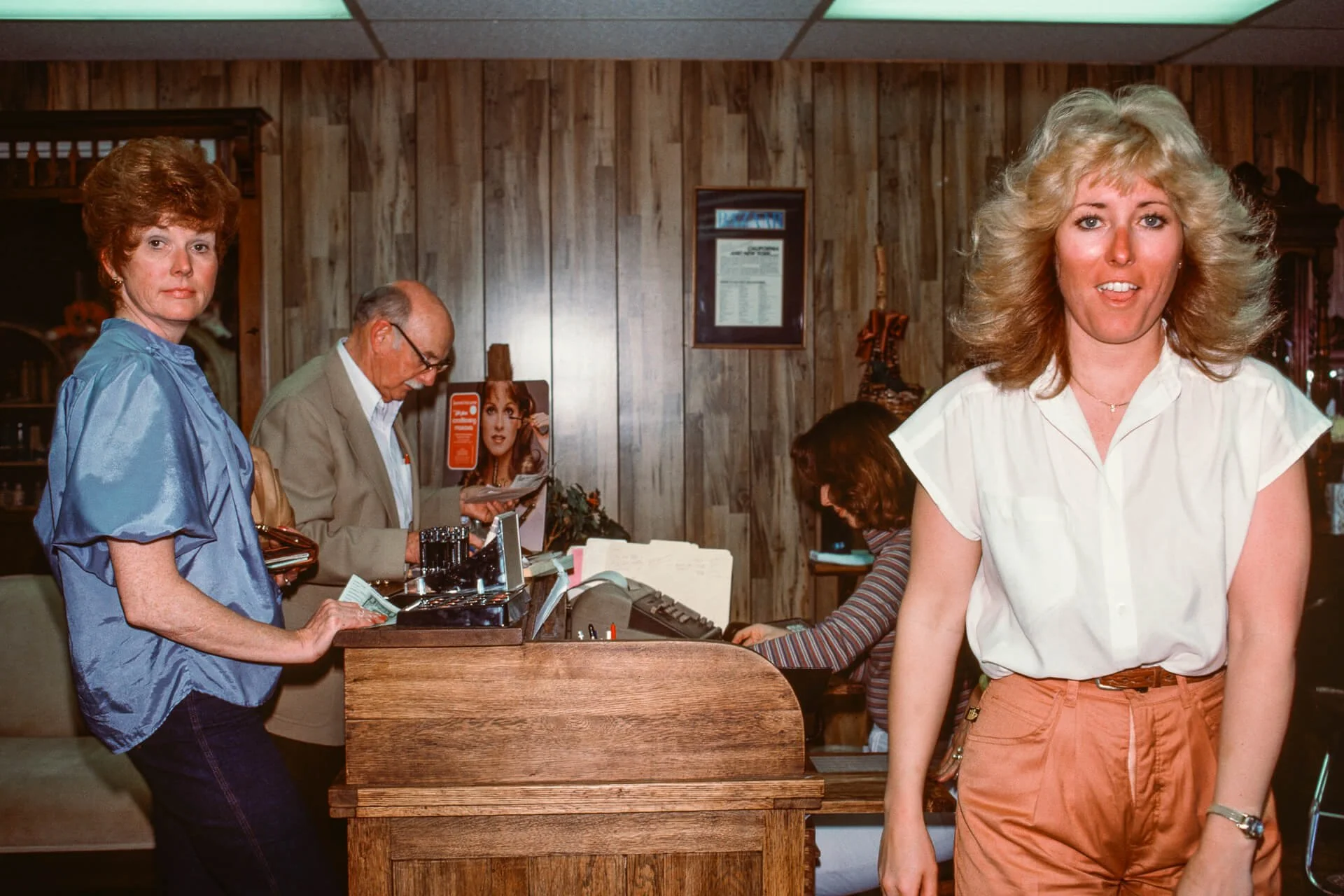
Farrah Fawcett Hairstyle,1980, Archival Pigment Print, 2026, 13 x 19.5 in
To accompany Delaney's photos, EUQINOM Gallery is displaying analog magazines like Cosmopolitan, a 140-year-old publication whose website now proclaims it to be, "The Women's Magazine for Dating Advice, Relationships, and Celebrity News." In the culture at large, so much has changed — and hasn't — since Delaney followed her father around in 1980,
Delaney may be best known for her "South of Market" photos from the 1970s and '80s, when she documented the economic and cultural gentrification of San Francisco's SOMA neighborhoods, where areas populated with residence hotels gave way to downtown skyrises, pricey condominiums, and other manifestations of a changing city. As it happens, a photo from that series is on display at a separate gallery exhibit just feet away from EUQINOM Gallery. Fraenkel Gallery's group exhibit, Slice of the Pie: Fourteen Bay Area Galleries & What Makes Them Different, features a 1981 Delaney photo of a man walking along Howard Street in an atmosphere that I'd describe as "concrete aloneness." Construction barriers line one side while a construction crane rises on the other side as the man moves in the street where cars usually go. Because he's walking away from the viewer, with his dark-clothed back his most visible part, the scene could be something out of a looming apocalypse, where everything is on the verge of disappearing — which is a motif that also underpins Too Many Products, which runs through August 22.
The disappearing is not just the small-town feel of the beauty salons. It's also in the life of Delaney's father, whose professional life was on the verge of ending. Older women often talk about becoming "invisible" in a culture that glorifies younger females. The older women in Delaney's photos are battling that phenomenon, but Bill Delaney is also battling the end of his professional relevance. Among the photos we see are Bill Delaney at home — hugging Janet's mom but also taking a bath by himself, where he's lying on his back as he looks lost in thought. Is that a look of depression we see? Contemplation? It's hard to tell, but we know this from the companion book that accompanies the exhibit: After retiring, Bill Delaney experienced several heart attacks, suffered a stroke, then had dementia for many years, which eventually prompted Janet's mom, Connie Delaney, to put him in a nursing home. He died 19 years after the photos we see in Too Many Products, which capture Bill Delaney at his jovial best as he engages in conversation with salon owners.
The accompanying book, which was published last year, is really a digital element of the exhibit since the publisher uploaded an online video (at https://deadbeatclubpress.com/pages/janet) that includes Bill Delaney talking about his work and his life. Janet Delaney recorded the audio during her 1980 project. "Working in a beauty shop is not the most masculine thing," Bill Delaney says in the video. "In fact, it's very difficult to find men that can go into a beauty salon and handle themselves properly, and not think that every girl wants to be patted here and there and making eyes at him and whatever."
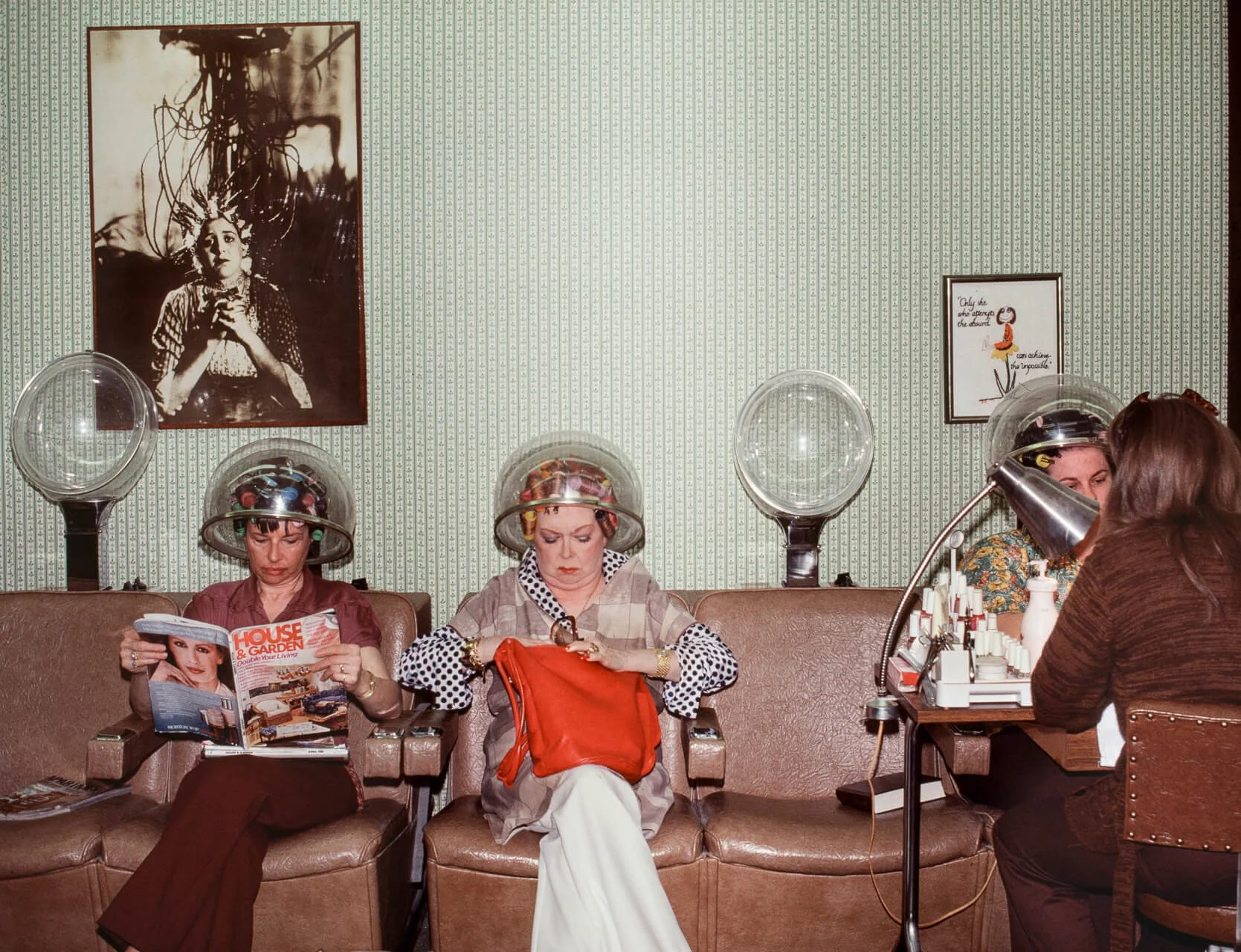
Hair Dryers,1980 Archival Pigment Print, 2026, 13 x 19.5 in
Bill Delaney's use of the word "girl" is a telling embodiment of his views about women. Even in 1980, feminists would have scolded him for that word choice, but Bill Delaney — at least in the exhibit's accompanying audio — is heartedly welcomed into salons by staff that he's engaged with for years. The women seem to love him, not just for his affable nature but for the exclusive products that he has access to. Today, salon owners can get their products at specialized stores or online. And that's another aspect of the exhibit that commands attention: Its focus on salons as places of business that empowered its women owners. Janet Delaney changed her views about beauty salons after visiting them with her dad. "I saw how this business offered women economic independence," she writes in the accompanying book. "And though still questioning the idea of store-bought beauty, I began to understand the feeling of warmth and community beauty shops could provide."
Based in Berkeley, Janet Delaney published these words 45 years after initiating her project, so she had the benefit of time to rethink her views about her dad, the beauty business, and her own aging vis-a-vis Too Many Products. As a photo exhibit, her project absolutely had to feature explanations about the subjects she encountered and explanations about her own thinking. Without that additional context, Too Many Products is just a collection of old photos that show us the hair fashions of the time (as with the woman who sports a Farrah Fawcett cut) and show us other salon doings that feature a balding, graying, mustachioed man. The man had a name. And he had a daughter who, I'm sure, made the women in her photos smile more widely at being captured for posterity, as if they were fashion models on the cover of a popular woman's magazine.
