

Black Spaces: Reclaim & Remain, Oakland Museum of California
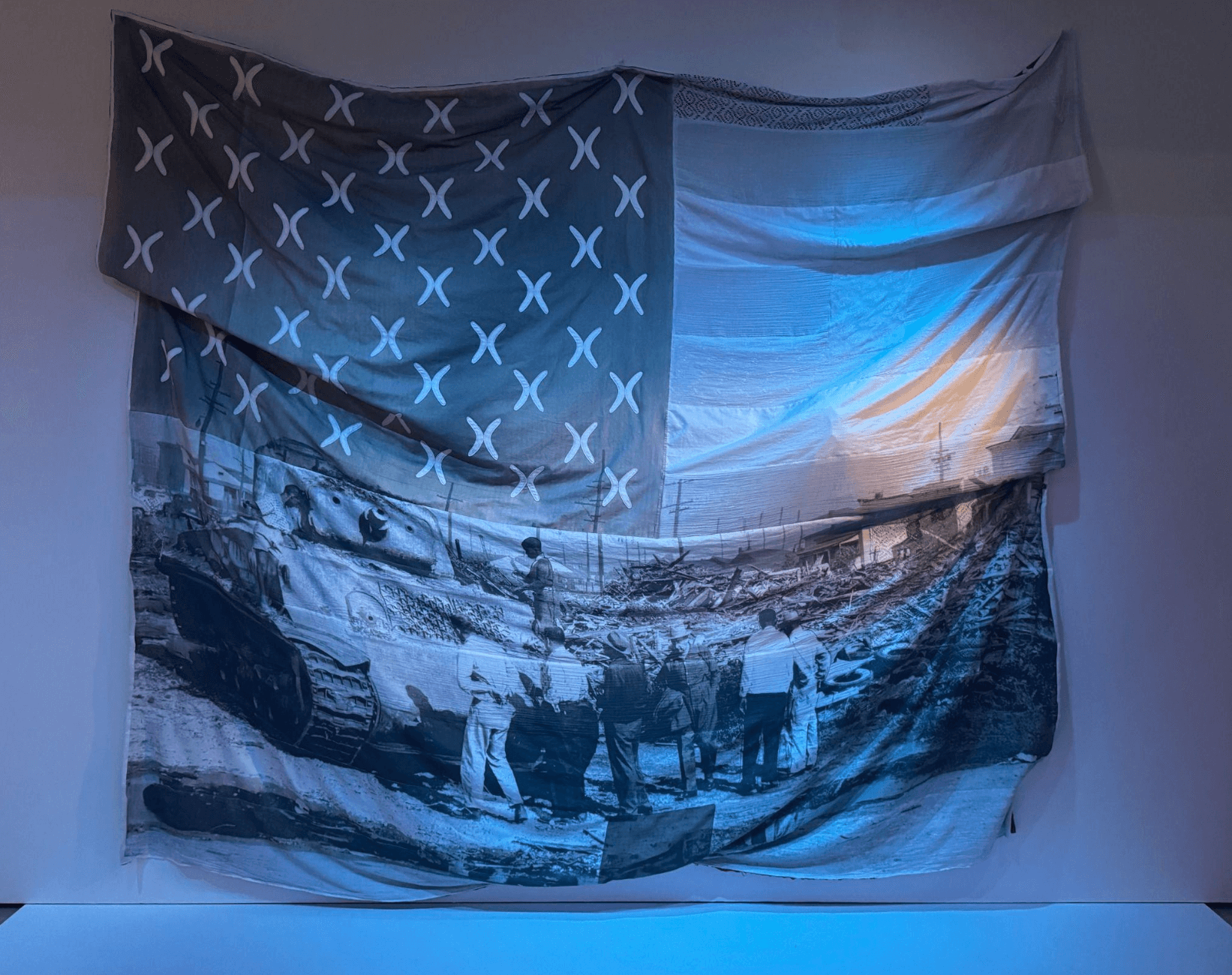
Adrian Burrell, “Imperial Boomerang,” 2025. Quilted flag in carbon print
An Architect, An Archive & an Artist: The Imperativeness of Nuanced Perspectives
Black Spaces: Reclaim & Remain is a reminder that erasure undermines critical thinking and self-awareness. This exhibition is displayed at the Oakland Museum of California and is currently on view: July 18, 2025 - March 1, 2026. It insists on showing why archiving the historical perspectives of Black Oaklanders is vital. The impact of (not) belonging in a society that suppresses Black existence is exquisitely unveiled. But, so is Black innovation and Black beingness. The exhibition explores the concept of “home” from historical, socio-economic, political, and Afrofuturistic perspectives. The underlying historical context is that for Black people in Oakland, “home” has been marred by displacement, disinvestment, economic inequality, and systemic violence.
The works assembled were as magnificent as they were stimulating. One of Adrian Burrell’s artistic creations showcases bulldozers demolishing West Oakland printed over the American flag. June Grant, the Architect, metaphorically uses the Dandelion plant to explore Black innovation in building meaningful spaces. The Archive of Urban Futures elevates grassroots-led efforts by organizations such as Moms 4 Housing, which provide refuge for Black mothers experiencing housing insecurity. This exhibition does not beg for validation, but rather, it insists on recognition. I was immersed in a world that was unabashedly showing its humanity, affirming itself, and asking me as the viewer to remember it. To see Black life and to recognize the human desire we each carry for a safe home.
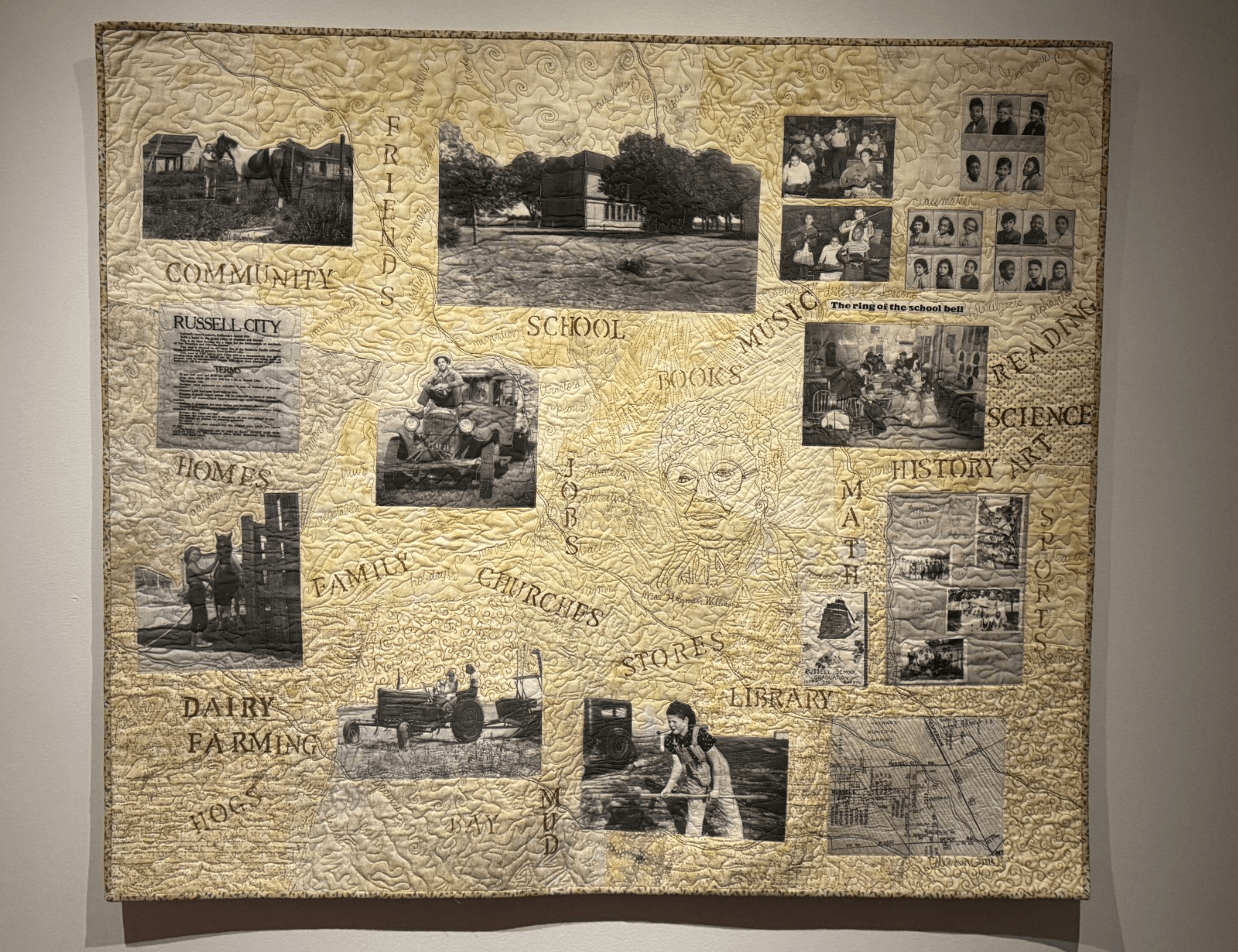
Marion Coleman;Close Ties 2014 - Textile and Mixed Media
The exhibition showcases Oakland as a site of reimagining Black people’s safety and care through artistic expression, architectural foresight, archives, and community institutions. The show traces the long-lasting effects of slavery and segregation on Black Oaklanders. To this day, reimagining freedom within confined spaces is a continual conversation. Moms 4 Housing powerfully depicts this through pictures and testimonials. Through a large-scale recreation of an old property, 2928 Magnolia Street, Black space was created to care for, to affirm, and to fight for Black mothers’ housing rights. June Grant’s thrilling architectural displays also remind the viewer of the ever-present friction between belonging and exclusionary policies like redlining.
The disruptive nature of such policies has not hindered Black people from creating meaningful spaces for themselves. In Russell City, now part of Hayward, the community’s infrastructure, as depicted in the exhibition, was fragile. That included, among many things, the lack of water connections, sewer lines, and not enough local representation within the government. Consequently, communal labor, self-efficacy, grit, plus the desire for a safe space sustained the community in spite of the lack of support. The horrific fate of Russell City residents being forcibly removed from their homes and having their homes replaced by an industrial park was artfully unfurled in this exhibition. Displacement has its own lasting repercussions that are seldom considered when incomplete and convenient inferences are made regarding Black existence. This exhibition shows that archived history humanizes Black Oaklanders and provides necessary context when pushing back against stereotypes and exclusionary policies.

Rashaad Newsome ; Parenting While Black 2020
Russell City and West Oakland are the focal points for this exhibition, but they are a uniquely Oakland story that also reflects a collective Black experience. This exhibition shows how the Black community in Oakland suffered at the hands of those who refused critical thinking - and refused Black humanity. Home is a part of our shared humanity. In Black Skins, White Masks, Frantz Fanon stated that all human beings desire recognition, which is not the same as validation. It follows, then, that when history is not properly archived, it erases humanity by allowing distorted historical narratives to prevail and ultimately impeding critical thinking. Critical thinking that leads to better access to resources, rights, and the freedom to exist as Black people. Nuance is the key to thinking beyond reactivity and moving beyond racial narratives that disguise themselves as common sense, policies, or “the truth”. Nuance allows us to examine language that keeps racial prejudice acceptable. The following epithets still exist in our current vernacular:
Denial of history and harm:
“Give me the facts.”
“Slavery wasn’t so bad for Black people.”
Criminalization and moral judgement:
“If they had just followed the law, they wouldn’t have died.”
“Black single mothers are a plague on society.”
Dismissal and condescension:
“Oh wow, you are smart/pretty for a Black person.”
“Black people are always playing the victim.”
“Welfare Queens!”
“Here we go, playing the race card again.”
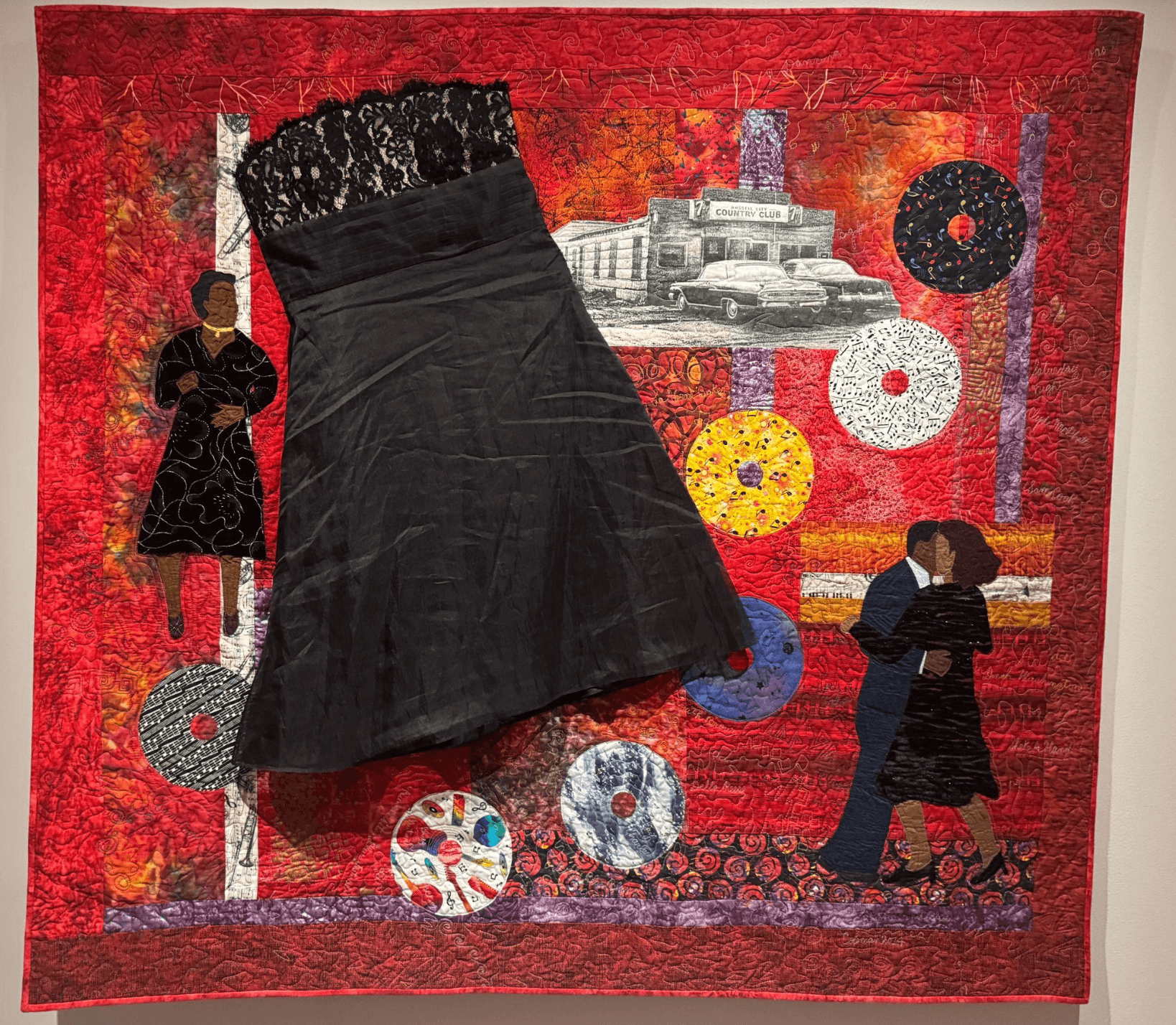
Marion Coleman; Country Club Nights 2014 - Textile and Mixed Media
To think critically is to stand in the middle of a “rhetoric explosion” while drinking a cup of fresh water. It requires the individual to be so grounded and steady in one’s thinking that it briefly suspends time and one’s unchecked hypocrisy. This exhibition points out why archiving Black history matters. The above epithets are based in falsehoods created by the historical erasure of contextual Black life and a lack of nuanced thinking regarding Black people’s perspectives. The exhibition had compilations of the following: home videos of Black homeowners and families in Oakland, successful businesses like barbershops and jazz clubs, Black churches that functioned as community resource centers, and architectural ideas for creating safer homes. Black life that was/is varied, productive, and significant. Life that is not deserving of the inherent condescension embedded in those above-stated epithets.
This exhibition was enthralling because, as the viewer, I wasn’t asked to watch. I was asked to bear witness. I wasn’t asked to debate or validate Black existence; I was asked to engage with it. To think. It asks the viewer to do away with stereotypes, simplistic narratives and disengagement. The viewer is immersed in one of many confronting chapters of American history—one that has replicated itself in many ways throughout the country.
Critical thinking is a matter of life and death—in every sense of the phrase. Nuanced thinking is a perpetual state of self-awareness that refuses the pervasiveness of ‘convenient thinking’. We need reminders such as this and that is why this exhibition was a profound experience for me. It allows for the multifaceted history of Black Oaklanders to relay to us all messages from the not-so-distant past. I do not believe it asks the viewer to collapse into sentimentality or cynicism - this isn’t about guilt or shame regarding the atrocities Black Oaklanders experienced (and still do). We are to remain ever more present to the ethical backbone of it all—nuanced thinking that recognizes another’s perspective and ultimately their freedom to exist - safely. The discourse I witnessed was asking for a disciplined way of thinking that refuses to flatten history by accepting erasure. It refuses to give digestible bites of historical narratives regarding how Black people have been treated in this country. I repeat, recognition is not the same as validation.
