
Amy Trachtenberg and Andy Vogt, The David Ireland House, 500 Cap Street Foundation.
By Lani Asher
David Ireland lived at 500 Capp Street for over thirty years, and the house is filled with his conceptual art installations and sculptures. Ireland purchased 500 Capp Street in 1975 and made the run-down Victorian not only a site for artistic production, but also an artwork. After stripping off the old wallpaper, Ireland emphasized the building wall’s cracks and imperfections by sealing them with polyurethane, giving the space an amber glow. After he died in 2009, Ireland’s house was rescued by artist friends and supporters who thought that 500 Capp Street should be preserved. Paul Greub, the former occupant of 500 Capp Street, was an accordion maker who ran his business out of his home for 45 years, and his hoard of old jars, old brooms, old chairs, and old lamps provided Ireland with a treasure trove of readymades and inspiration.
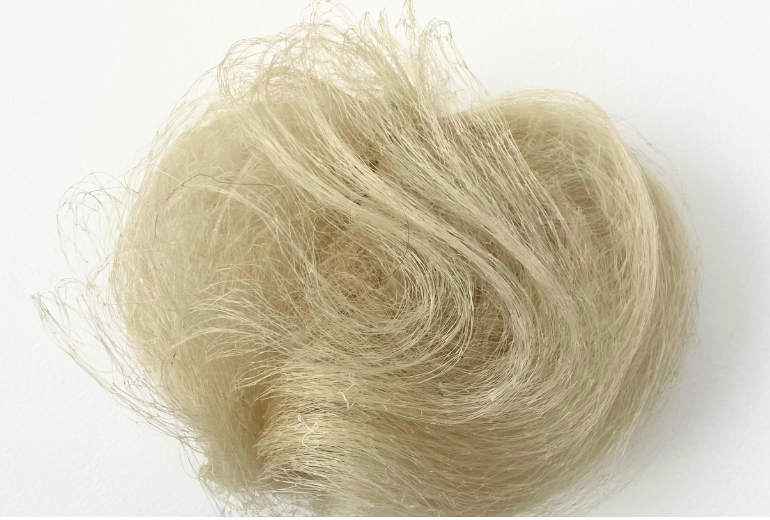
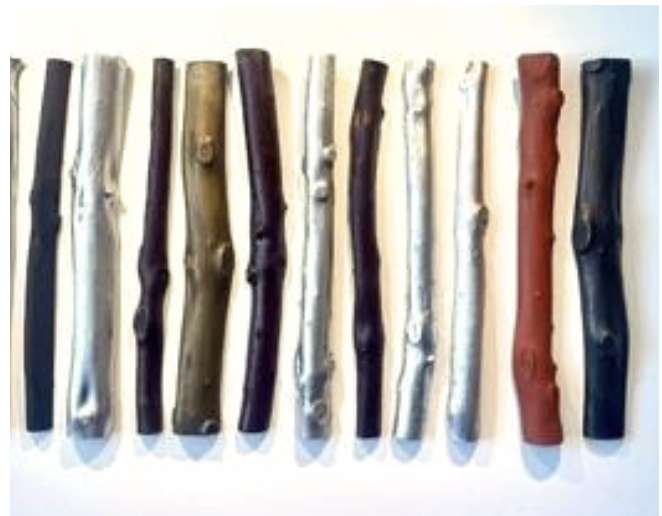
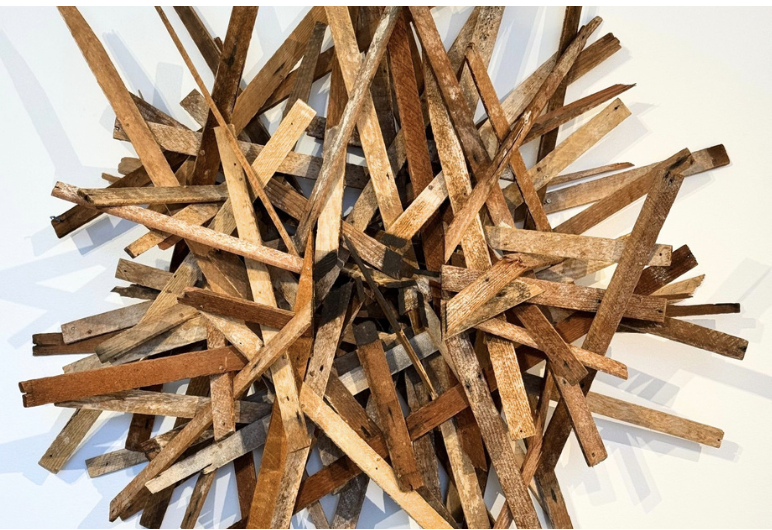
The David Ireland house is a unique setting for two concurrent shows, Abstract Objects of Devotion, featuring the work of Amy Trachtenberg, and The Ringing in My Eyes, featuring the work of Andy Vogt. Both artists share with Ireland a love of recycling, simple materials, and the beauty found in what is lost, forgotten, or overlooked. In the entry hall, Trachtenberg has an installation of found objects: A beautiful swoop of woven hair nets, an oriole’s bird nest from her yard, and a flattened distressed silver colored box found in the parking lot of her studio building. There is an installation of a line of twelve branches, ten painted madrone branches, and two branches cast in bronze that is called 12 Bars. 12 bars can refer to 12 bars of music, keeping time, chord progressions, the color wheel’s 12 basic hues, and the 12 lunar months. Also in the entry way is Vogt’s Searching for the Door, an uneven pile of recycled lath wood anchored to a steel frame hung on the wall, a small sculpture where a section of an acrylic mirror is embedded in concrete, and two cyanotypes imprinted with images of small models of his sculptures. Both artists had permission to remove some of Ireland’s works and leave others. Guest artists are not allowed to permanently alter the house in any way by drilling or nailing into the walls, but must use existing holes.
From left to right:
Amy Trachtenberg, Various Studio Objects, 2026, gold-leafed paper, hairnets, and Orioles nest. Dimensions variable.
Amy Trachtenberg, 12 Bars, 2026, Madrone, aluminum and gouache paint, and cast bronze, 42 x 23.5 x 2.5 inches.
Andy Vogt, Searching for the Door, 2026, wood, atomized steel, 50 x 50 x 18 inches.
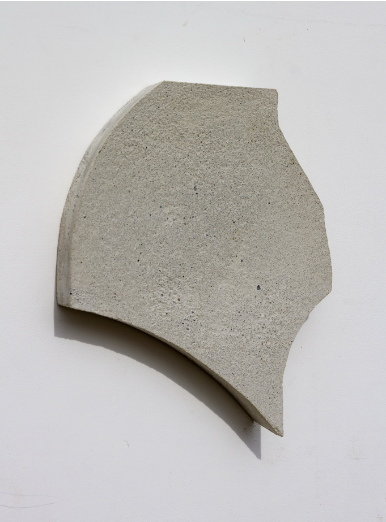
On the first floor is a dining room with a long table which was used for the many dinner parties Ireland hosted there. On the walls are several collages and a painting on porcelain by Trachtenberg, and lined up on a table are Ireland’s dessert glasses with dollops of concrete ice cream. There is a cabinet of Vogt’s untitled small rust drawings where nails or pieces of metal rust through colored plaster. Throughout the house, several cabinets are filled with Ireland’s own work, knickknacks, and as well as Greub’s jars—filled with sawdust or other materials gathered in the house’s reworking. At the bottom of the stairs leading to the second floor, Vogt has a sculpture that he made specifically for the show titled Ear Drum. He wanted to engage with the phenomenon of sound and vibrations in the house in a tactile manner. His small curved piece uses the structure of an eardrum, but is cast in concrete and worked by hand while drying.
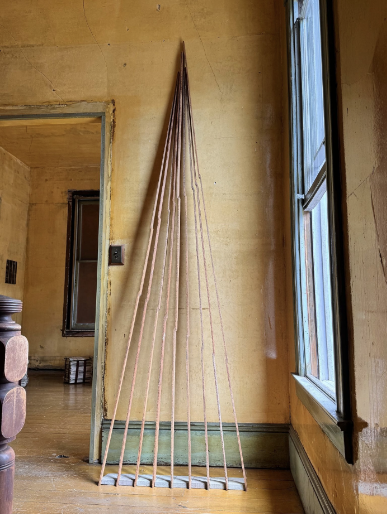
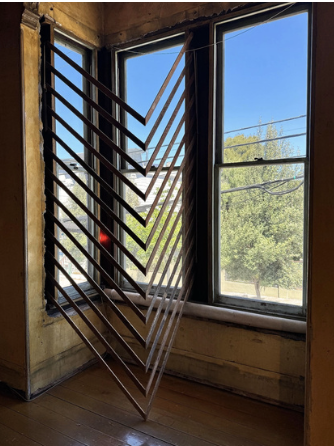
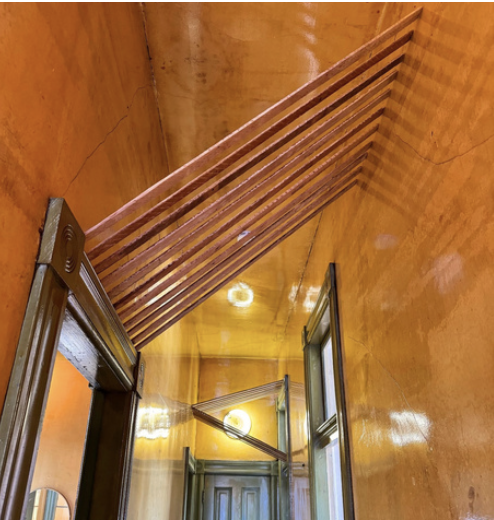
In the second-floor hallway, you encounter Vogt’s piece called Still Ringing. It is made from lath wood and concrete. According to Vogt, the sculpture simply fell into place and collapsed into a triangle shape as he attempted to install it; smaller installations of lath wood are sensitively placed, determined by the architecture of the hallways and the rear parlor. The negative and positive spaces created by the spacing of the lathe installations create three-dimensional drawings. The back parlor has an installation next to a window called One Eye; Vogt says it reminds him of a human face. Thin pieces of repurposed wood form a V shape in front of the window, with one small red light installed behind. Looking up in the center of the room has a cyanotype of one of his sculptures cut into 4 sections underneath Ireland’s chandelier of suspended blow torches, Fire Drawings, as if they were afterimages. In the rear hallway is a piece called Energies #1 #2 that balances lath diagonally from the top of a doorway molding to the ceiling of the hallway.
From left to right:
Andy Vogt, Ear Drum, 2026, concrete, 11 x 13 x 1.75 inches.
Andy Vogt, Still Ringing, 2026, salvaged wood lath, concrete, 32 x 10.5 x 7 inches.
Andy Vogt, One Eye, 2026, salvaged wood lath with red light, 106 x 37 x 29 inches.
Andy Vogt, Energies #1 and #2, 2026, salvaged wood lath balanced, dimensions variable.
Describing his process for making his small concrete sculptures, which are located throughout the house, Vogt said,
“The concrete works are textural transfers from (hand-made wooden) molds… (After the) concrete is poured into the molds and hardens… the final casting retains the wood grain texture from the molds as well as color and toning from mineral paint and steel powder that I often add…”
Vogt’s use of cyanotypes, originally used for architectural drawings, seems like a natural extension of his interests in architecture, afterimages, light, and process. He placed small models of sculptures directly on a paper surface treated with a light sensitive chemical and exposed it to sunlight, and the areas where the sun shined directly turned dark blue. The shadows cast by the sculptures developed in a range of lighter blues, creating three-dimensional reversed images.
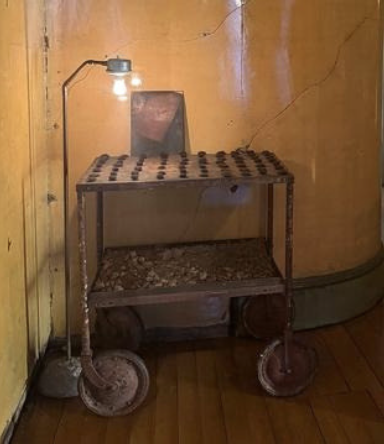
Trachtenberg’s piece in the front hallway is called Everything Is At Least Three Things: The One You See, The One You Know and The One You Remember. This deeply personal piece is about the loss of her hair during cancer treatment. A regimented grouping of seventy small balls of human hair is placed in seven tight rows of ten on the top shelf of a rusted metal cart. The center shelf of the cart is heaped with soil dug out of her backyard. Ireland’s dung like wall pieces made out of balled up wallpaper are stuck to an adjacent wall overhead, and one of his simple metal lamps illuminates the cart. This piece has an unsettling mix of beauty and terror. For Trachtenberg, this piece is both personal and broadly political, evoking her Jewish family ties to memories of the Holocaust, her illness, and the unfolding daily horrors of war in the Middle East and Ukraine.
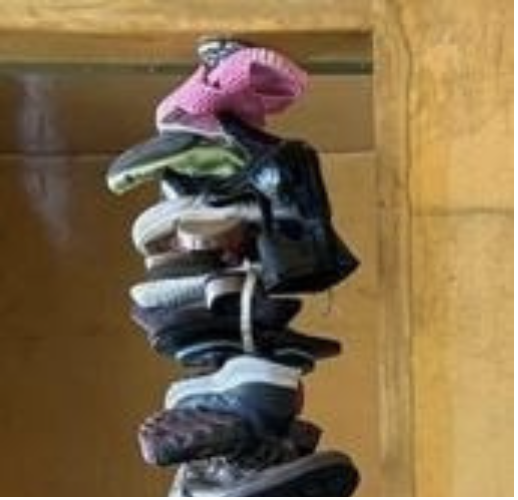
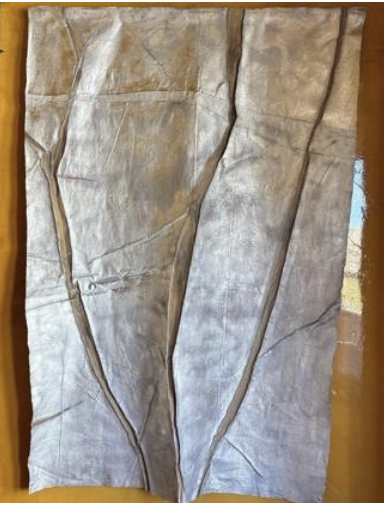
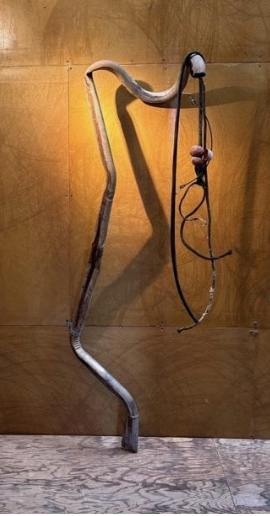
In the front parlor, there is an installation called Shrine in the doorway where Trachtenberg has vertically stacked a collection of lost or abandoned single shoes that she collected from the street. Ireland placed a reflective copper etching plate over one of the windows. There is a vintage tape recorder on the floor where Ireland’s recorded voice describes what you used to be able to see from the covered window. Adjacent to the window is her large silver painting called Say alabaster, Say paradise, which is oil paint and enamel on unstretched Belgian linen. The linen was gifted to her in France where she lived for six years as a young artist. The painted lines in the painting are created by folding the linen many times and stiffening the folds with glue. The painting has a silvery moonlit surface echoing Ireland's copper window piece. Highlighting her magpie aesthetic is her piece hung in the lightwell, in the middle, somewhat elevated, where a twisted tail pipe is combined with a bicycle tube, kelp, rope, and metal thread. The twisted pipe reminded her of a body in motion.
From left to right:
Amy Trachtenberg, Everything is at least three things: the one you see, the one you think you know and the one you remember, 2024-2026, human hair, magnets, soil, copper plate, and painted steel cart, 46.5 x 36 x 21 inches.
Amy Trachtenberg, Shrine, 2026, shoes and steel rod, 91.5 x 15 x 15 inches.
Amy Trachtenberg, Say alabaster, say paradise, 2026, acrylic and enamel on linen, 84.5 x 60 x 7 inches.
Amy Trachtenberg, In the middle, somewhat elevated, 2026, metal, rubber, kelp, rope, and metal thread. 69 x 15 x 16 inches.
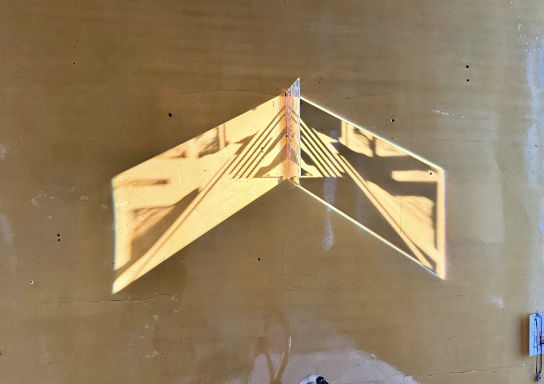
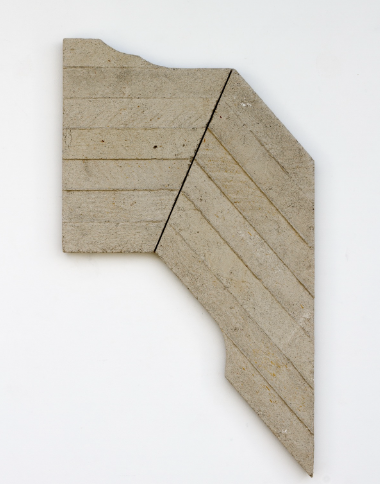
In the bedroom, Vogt’s Ever Diametric is made from an acrylic mirror that has part of the back scraped away so that light can pass through but also be reflected. The mirror hovers in a V-shape over the bed, casting shadows on the walls, lit by an ellipsoidal LED spotlight that is focused and shaped to illuminate a small mirror mounted on the wall. Also in the bedroom is a small concrete wall piece called Cove Corner Break and two cyanotypes with several layers of colors. Next to the bed, Trachtenberg places an offering of colored cullets (glass pieces used for remelting) in an aluminum strainer.
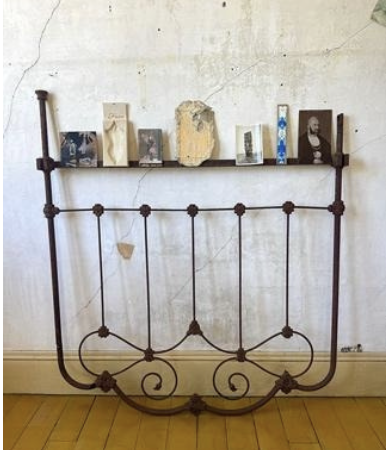
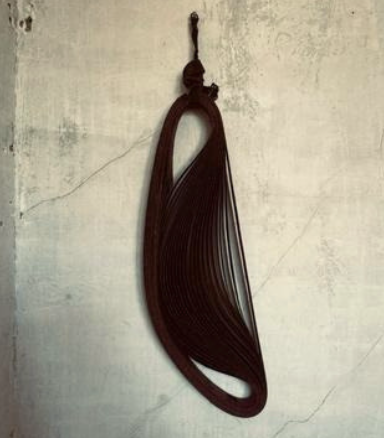
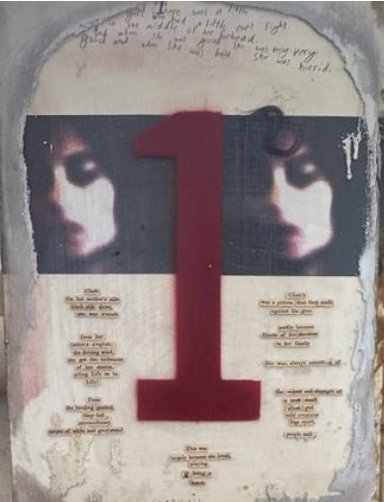
In the guest bedroom is Trachtenberg’s Awash, featuring an ornate metal headboard that she found on a beach in Southern California many years ago. The headboard is turned upside down with a collection of photos and found objects that she plans to change out during the course of the exhibition. Aesthetic Crush is a found bundle of sanding belts that created a beautiful loop shape. One Clare is a double portrait on a found piece of wood made with enamel paint, cut out words, ink and human hair. Ireland has several pieces in this room: an untitled spray foam piece that looks like a human head or large fungus stuck in a concrete base, a small sculpture which takes its shape from concrete poured in a corner, and a basket of dumbballs, his signature handmade concrete balls.
From left to right:
Andy Vogt, Ever Diametric, 2026, projected LED spotlight on altered acrylic mirror, 11.5 x 6 inches.
Andy Vogt, Cove Corner Break, 2024, concrete, 19 x 11 x 0.75 inches.
Amy Trachtenberg, Awash, 2026, wrought iron, photographs, found objects, 61 x 54 x 7 inches.
Amy Trachtenberg, Aesthetic Crush, 2026, Sandpaper and cloth strap with buckle, 34 x 13 x 2.5 inches.
Amy Trachtenberg, One Clare, 1994, Enamel, paper, human hair, photo, ink and plastic on wood panel, 20 x 14 inches.
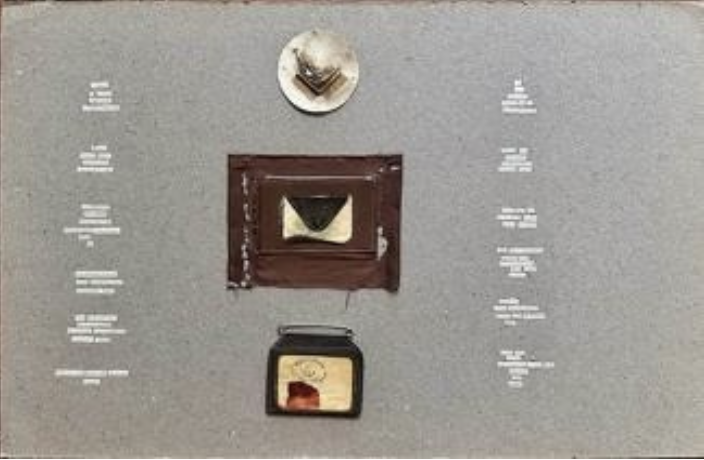
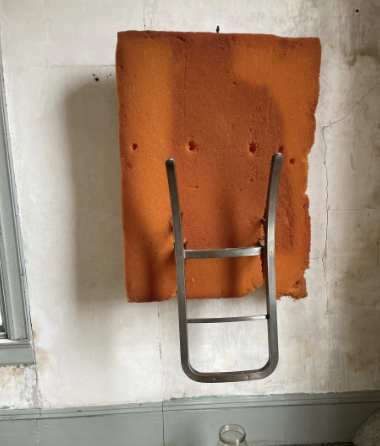
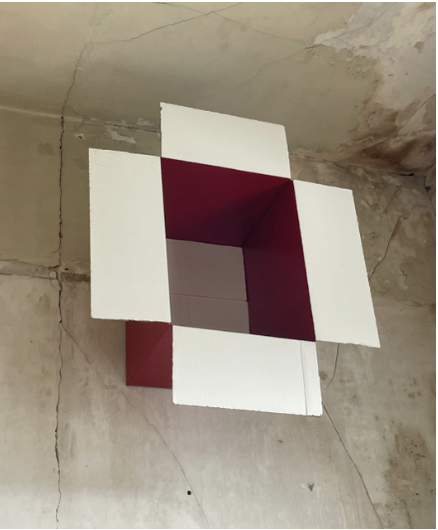
Trachtenberg’s collage Abstract Objects of Devotion (1990 to 2026), with collaged words and old wallets on felt, is hung over David Ireland’s desk next to Ireland’s photo of Marcel Duchamp. There is an assemblage by Trachtenberg called Leverage where a large piece of orange cushion foam is pierced by an upside-down steel chair that belonged to Ireland. Above is Ireland’s The Swiss Fold, a cardboard box painted in the colors of the Swiss national flag and on the floor, another of Ireland’s poured corner sculptures. In the closet is Trachtenberg’s Dreaming with One Eye Open II, a vintage French children’s bed with cobalt cullets attached with wire.
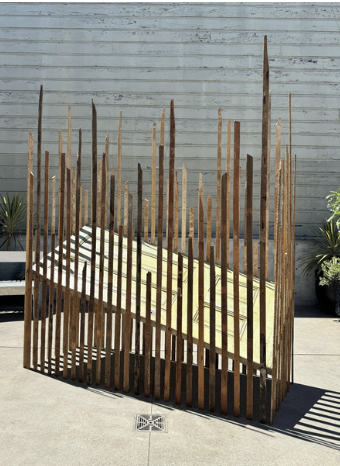
Vogt’s Becoming a Memory is located on an outside patio. A heavy door appears to be floating at an angle, impossibly held in place by thin pieces of lathe wood. Vogt rescued some of the original Victorian doors in the storage area before they went to the dump. Becoming a Memory symbolically functions as a doorway to dreams, memories, while giving us access to other worlds.
From left to right:
Amy Trachtenberg, Abstract Objects of Devotion, 1990/2026, Mixed media, collage, and wallets on felt paper, 25.5 x 35.5 inches.
Amy Trachtenberg, Leverage, 2026, Polyurethane foam on D.I. ’s borrowed steel chair and Mason jar, 59 x 29 x 5 inches.
David Ireland, Swiss Flag, N.D., enamel paint on cardboard, 37 x 27 x 10 inches.
Andy Vogt, Becoming a Memory, 2026, discarded door from 500 Capp guest bedroom, poplar edge, paint, salvaged wood lath, 80 x 95 x 28 inches.
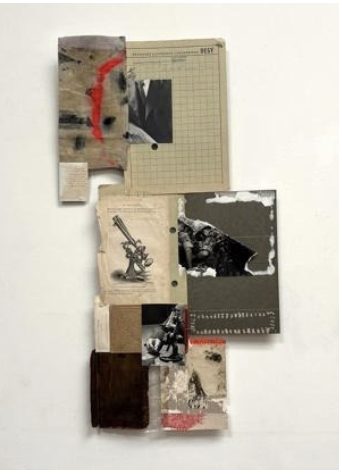
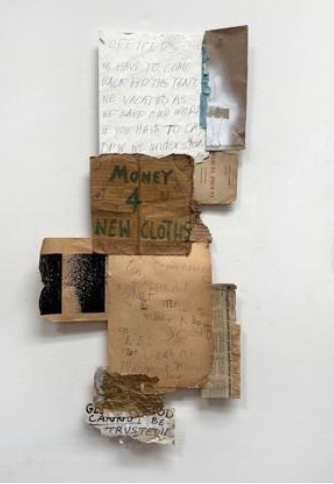
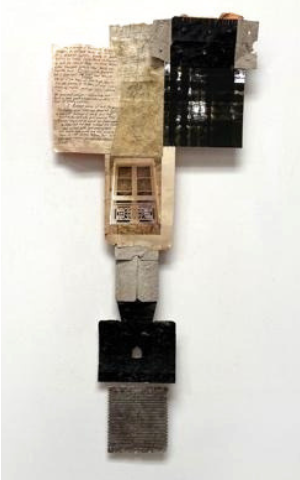
Downstairs is the more recently remodeled Paula Anglim Archive Room, which has clean white walls. A number of personal artifacts from Trachtenberg’s home and studio line a table and shelves: bones, shells, kelp and skulls, architectural shards, embossed book covers, hair, wire and headless plaster figures, found text, and studio notes. During the course of the show, she plans to move them around, and perhaps some of the arrangements may develop later into sculptures, collages or installations. There is also a pile of letters between Trachtenberg and Ireland on the table recounting their lives, travels and projects. They were close friends and shared a similar sense of humor and love of the quotidian. Against one of the walls is her new series of collages titled Plein-Air Elegies, made up of the handwritten signs and texts found on the sidewalks around Mission and Capp Streets where she had studios for decades. There is a cardboard sign made by “starvinmarvin” and a photo of Marvin. Marvin lived unhoused in San Francisco’s Mission District, and like her collection of lost and abandoned shoes, his sign and photo points to the precarity of human existence.
Fro left to right:
Amy Trachtenberg, Plein-air Elegy I, 2026, Leather, cloth, spray paint, plastic tape, found paper and photograph, 33 x 18.5 x 2 inches.
Amy Trachtenberg, Plein-air Elegy II, 2026, Found cardboard and paper, ink, pencil, staples, foil, plastic tape, spray paint, and newspaper, 36.5 x 17.5 x 3 inches.
Amy Trachtenberg, Plein-air Elegy III, 2026, Found paper and cardboard, photographs, metal, wire, staples, and thread, 34.5 x 15.5 x 2 inches.
Trachtenberg, Vogt and Ireland echo each other’s impulses and humor. Ireland was consumed by the reverberations of the houses and the detritus left by its former resident. Vogt’s use of concrete and wooden laths, and his rescue of one of the house's abandoned Victorian doors, shares Ireland’s preoccupation of the house as a metaphysical puzzle to be decoded and reimagined. Vogt’s show title The Ringing in My Eyes refers to both the physical and the worlds outside our sensory experience, as he explores the liminal spaces between light, memory and architecture. Like Ireland, Trachtenberg’s hunt for found objects that resonate with her sensibility, and her absurd poetic juxtapositions of materials, have a devotional quality and humor drawn from rhythms of everyday existence. I found both shows moving and intriguing. The David Ireland House is haunted, inviting, revelatory, mysterious, beautiful, and absurd. It is like a stage set waiting for the actors to arrive and start the performance.
Exhibition runs through July 25–October 17, 2026
Amy Trachtenberg: Abstract Objects of Devotion
Andy Vogt: The Ringing in My Eyes