

mumu, Philippine Sun (13°N, 122°E) // Jennifer Steinkamp, It’s a Nice Day for a White Wedding, Yerba Buena Gardens
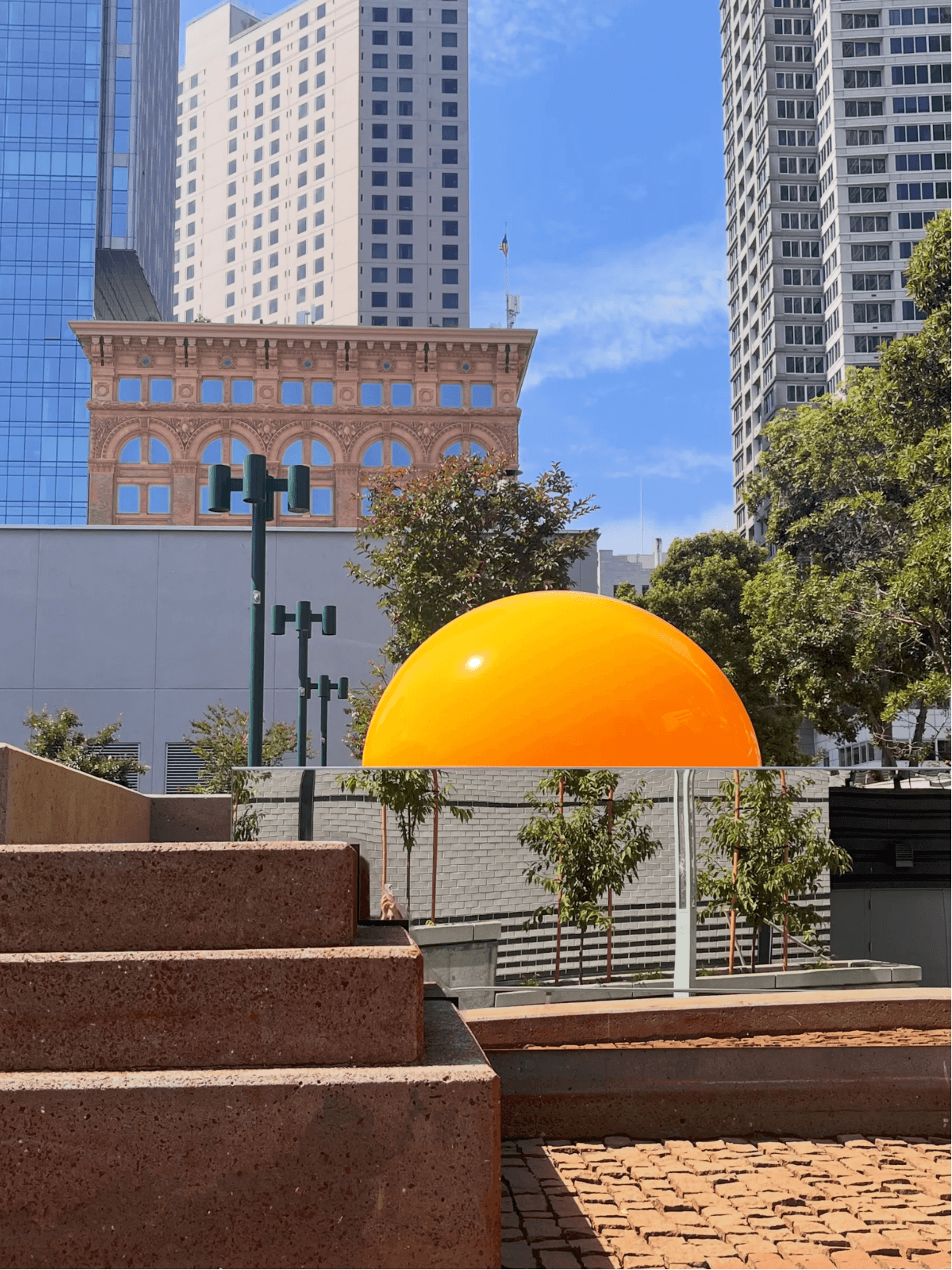
Philippine Sun (13°N, 122°E), 2026
A new sun has risen in the Crepe Myrtle section of Yerba Buena Gardens. Titled, in part, 13°N, 122°E, a reference to the geographic coordinates at the center of the Philippine archipelago, the newly-installed art work consists of an amber-colored acrylic dome that glows from within during daylight hours, Philippine time. Created by Filipino artist collective mumu with lighting design by Sol Light Studio, the work was conceived as a way to honor the Filipinos displaced by the construction of Yerba Buena Gardens as well as the Filipino community currently centered in SoMa.
Philippine Sun (13°N, 122°E) takes on its most dramatic form after dark. Placed at the intersection of Third Street and a path leading into Yerba Buena Gardens, the glowing half-orb, elevated above street level and surrounded by cascading water and hanging greenery, appears to beckon one into a magical realm. During daylight hours, a more subdued dome acts as an anchor to a quiet section of the Gardens; around it, individuals read, sunbathe and FaceTime, often alone.
The urge to inquire “what time is that there?” of a distant conversant linked by phone or video chat is probably universal. By illuminating at Philippine sunrise (which occurs, at the end of the September, at around 2:45 in the afternoon here) and going dark at Philippine sunset (currently around 2:45 am here). 13°N, 122°E attempts to concretize the feeling of being out-of-sync with far-flung family and friends. In two tries, I was unable to see a clear difference in the dome’s lighting before and after Philippine sunrise, a disappointment that may be due to the slowness of the programmed sunrise lighting sequence (scheduled to be sped up in coming weeks), competition from ambient light, or both.
Determined to see the work’s lighting transform, but non-plussed about traveling to the Gardens during San Francisco’s wee hours to catch Philippine sunset, I was excited to learn from Neha Sivaprasad, founder and principal of Sol Light Studios, that the work’s lighting also undergoes programmed changes during San Francisco sunset.
I arrived at the Gardens slightly before San Francisco sunset (as indicated by the iPhone weather app); the dome appeared to be unlit. Then, just before sunset, the hemisphere turned a somewhat darker amber. Thinking that might be everything, I turned away. About ten minutes later, as dusk deepened, I glanced back at the piece and found the hemisphere glowing an intense amber, ringed by bright yellow. A passenger in a car sitting at a red light on Third Street rolled down her window to compliment the work: “so beautiful.”
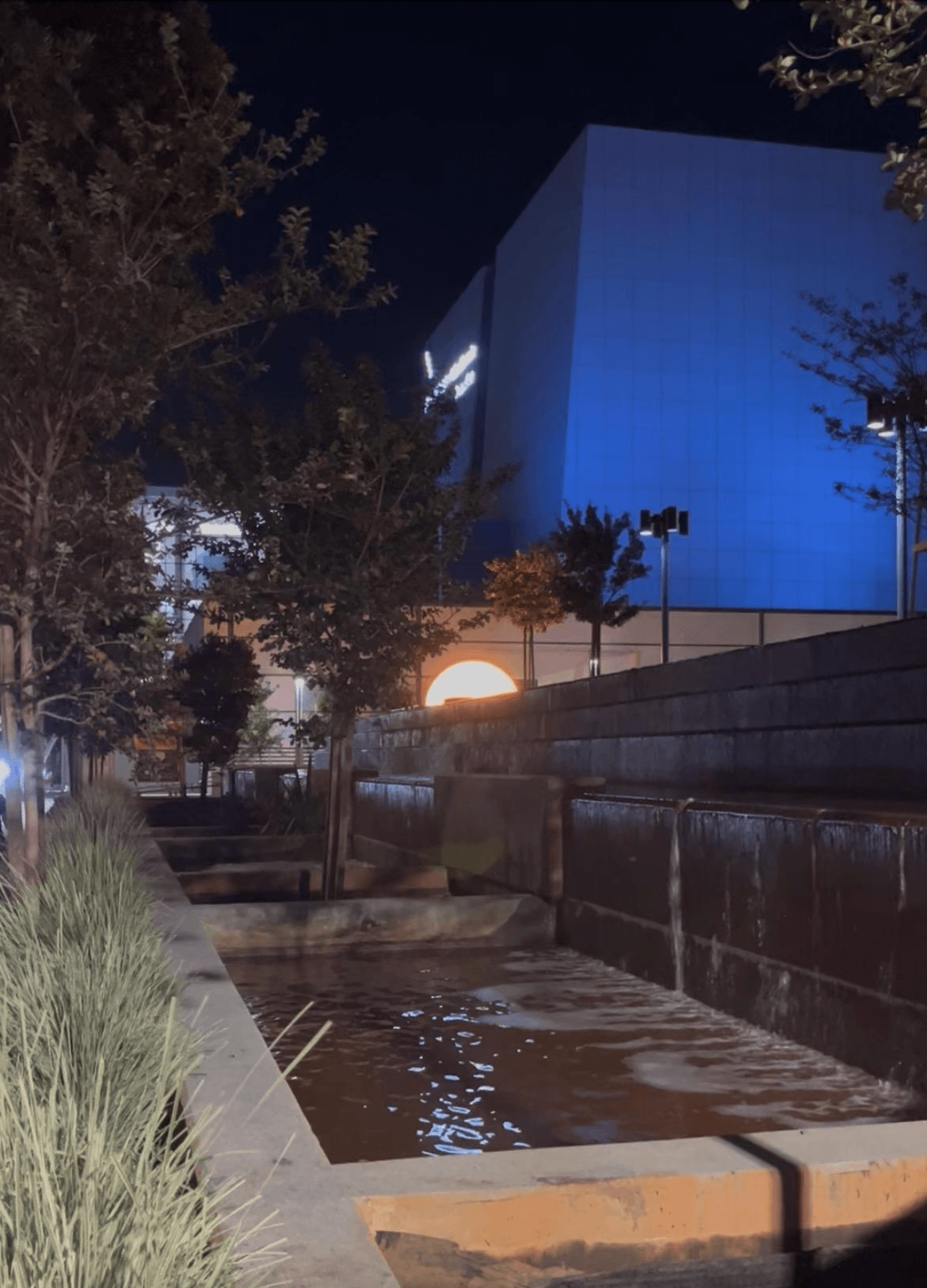
Philippine Sun (13°N, 122°E), 2026
The work’s connection to the Philippines can be sussed out via knowledge of the Philippine flag, which contains a sun, or through the nearby banners inspired by the colorful sails of Philippine vintas. Still, a marker with text explaining the work would be helpful.
Philippine Sun has clearly been designed for its site. The work’s mirrored base reflects the trees and buildings around it as well as the amber dome above it The hemisphere itself, when not fully lit, reflects neighboring buildings and, if you look closely enough, cloud movements. The arched upper windows of two neighboring terra cotta buildings echo the dome’s shape; perhaps it was punched out of one of them.
The seeming simplicity of the work is the result of a huge amount of effort–from the manufacture of the dome in Thailand, to the coatings applied for glossy good looks, lighting fixture invisibility and graffiti resistance to, especially, the innovative interior metal cage that allows the LED lighting strips inside the dome to cast a sourceless, even glow.
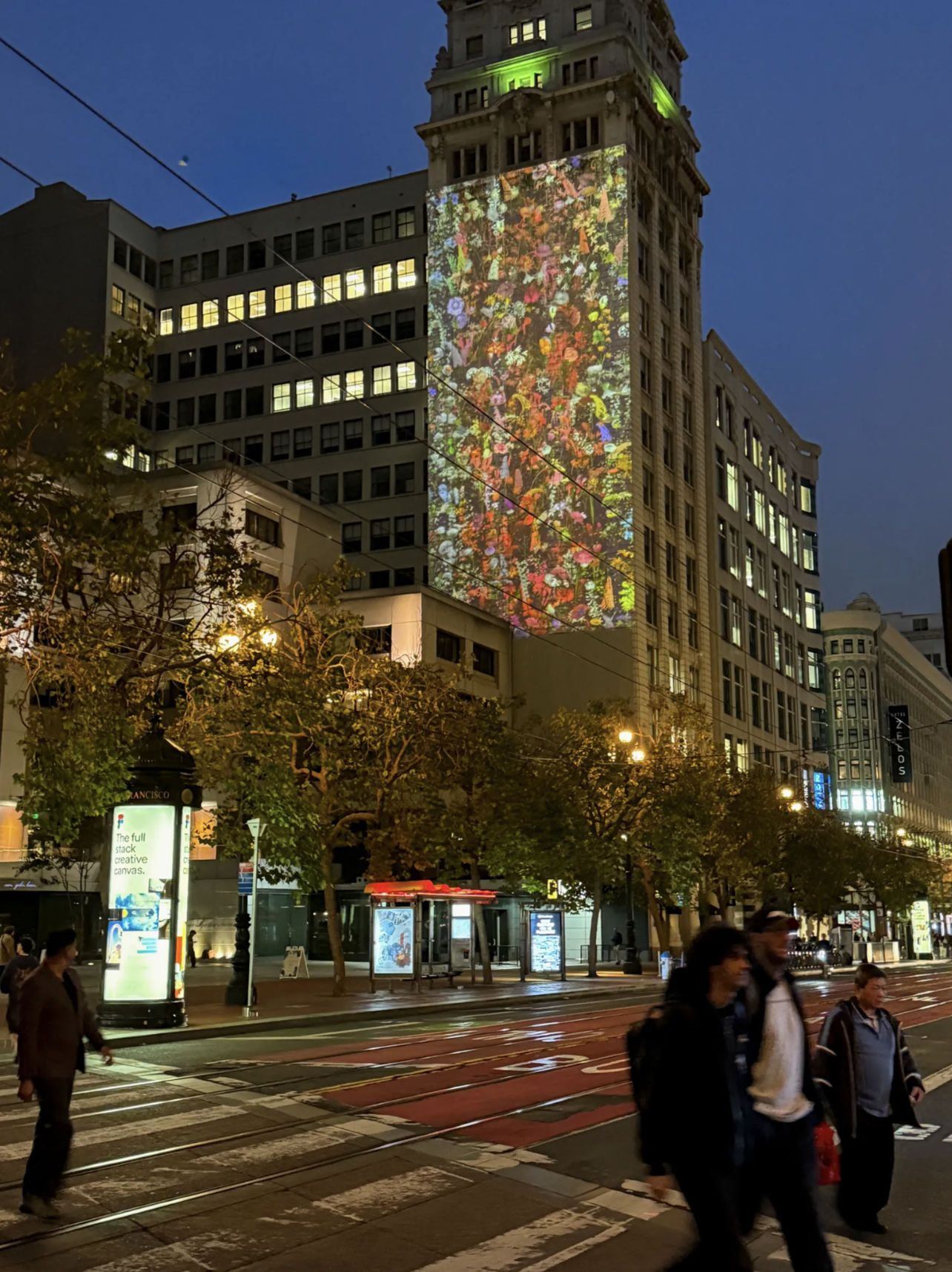
It’s a Nice Day for a White Wedding, 2008
A second art work, Jennifer Steinkamp’s It’s a Nice Day for a White Wedding, has also been installed at Yerba Buena in recent weeks. The digital animation, projected on the Humboldt building at the intersection of Yerba Buena Lane and Market Street, features flowers and inflorescences (groups of flowers) waving, as if in a field. Although the red-tint at the center of the piece is vaguely reminiscent of blood, the work, owned by SFMOMA, remains anodyne, with no clear connection to its location. Every four minutes or so, Yerba Buena promotional material and logos for each of the funding sources are shown.
Current City budget priorities mean that much of the public art in San Francisco is at least partially privately funded. Both of the works discussed here received funding from the Yerba Buena Partnership, a private Community Benefit District, in addition to City funds. That the works diverge radically in their aesthetic appeal, connection to community, and interaction with their setting, is, I believe, a positive thing. Contra the Big Art Loop example, private funding need not spawn sub-par public art. Fittingly, whereas Philippine Sun is expected to become a permanent installation, the projection of Steinkamp’s piece is planned to take an hiatus on December 3 and, after resuming on December 14, finish on January 15, 2027.