

California Bounty Addresses the State’s Halcyon Period of Abundance and Diversity
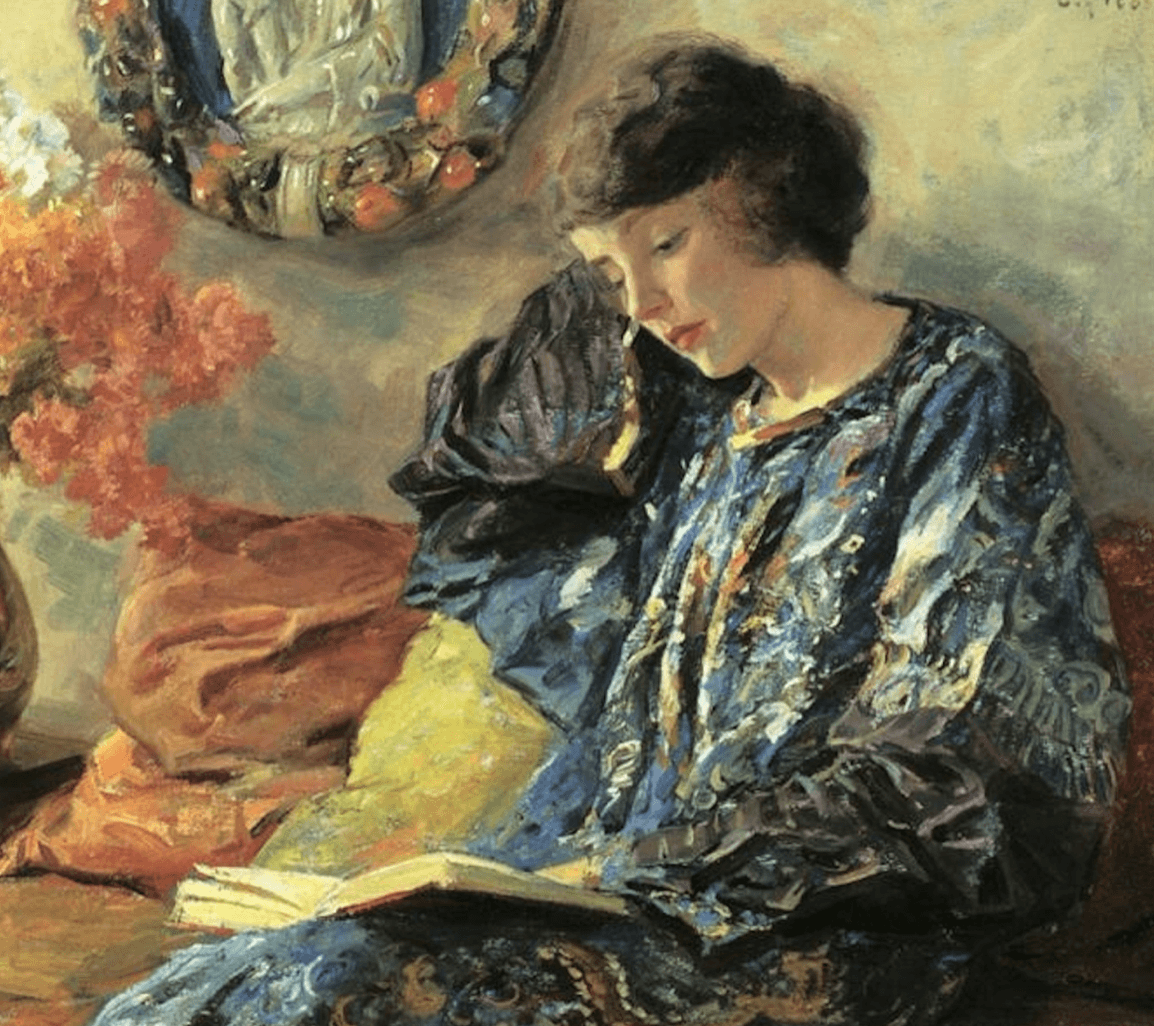
Marguerite, c. 1909, Guy Rose, Oil on canvas
By Liz Goldner
California Bounty at the Bowers Museum, Santa Ana extols the beauty, glamor and prosperity of the Golden State in the early 20th century. The exhibition's historic plein-air landscapes, scenic paintings, portraiture and still lifes are drawn from the museum’s permanent collection. Many of these paintings are on view in the Fluor Family Gallery with its magnificent ceiling murals and mission style architecture.
Historically, after California achieved statehood in 1850, it was regarded as the last American paradise, attracting individuals and businesses from across the continent. After completion of the transcontinental railway in the 1870s, railroads and developers began promoting the region for its climate, beauty, exotic Spanish history, and tourist attractions. Numerous people came westward in the 1880s, a trend continuing into the 20th century.
The visual arts played a significant role in the perception of California as idyllic and abundant, including the work in “California Bounty.” Many of these paintings were acquired by the Bowers in the 1970s, when several SoCal museums, unaware of their unique beauty and value, were auctioning off collections of this work.
While the museum has displayed these important paintings and related objects for decades, this exhibition of nearly 100 art pieces is its largest California display to date. The show has no end date and will remain on view for the pleasure and edification of the many people who visit it.
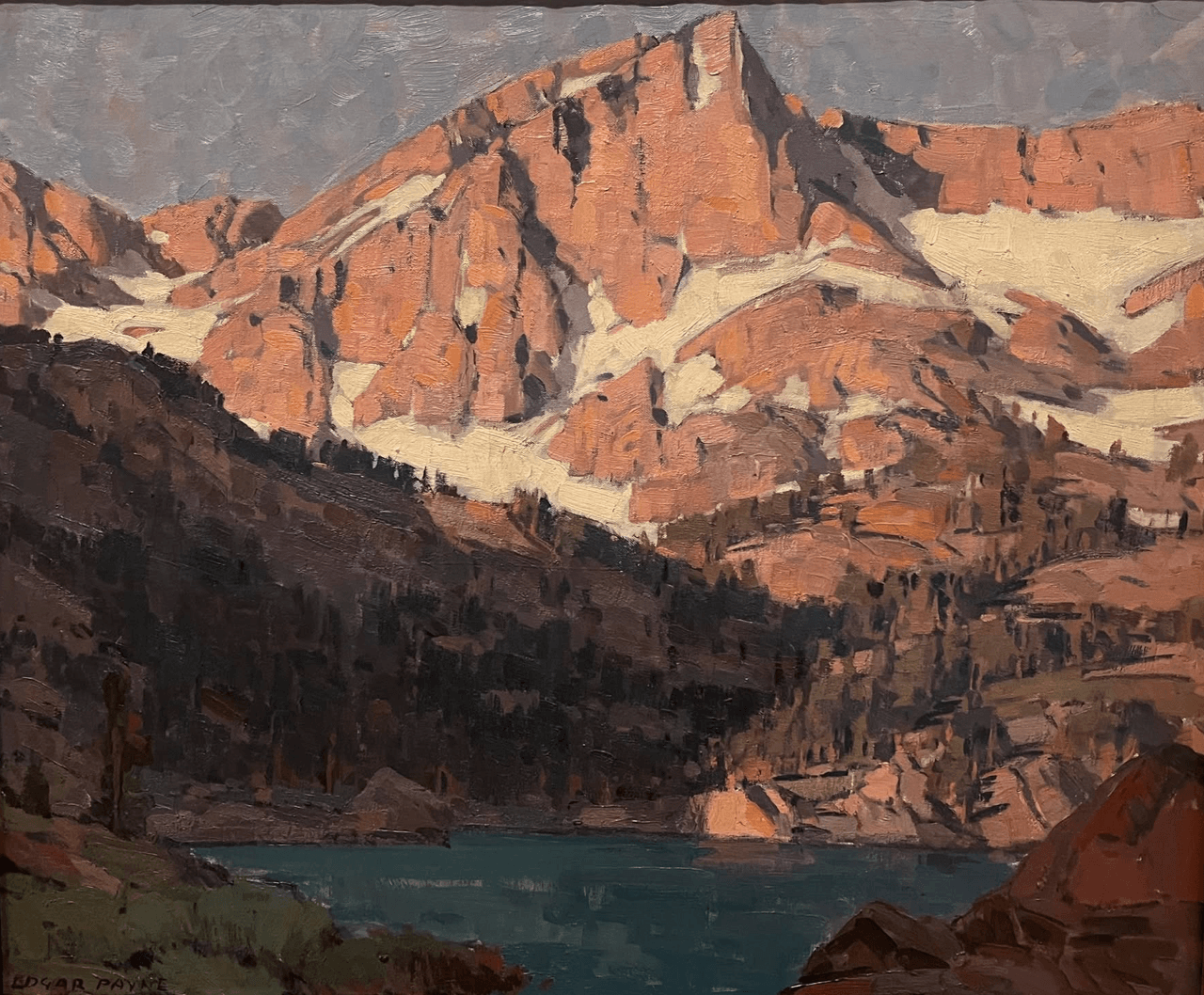
South Sierra Lake, c. 1935, Edgar Alwin Payne, Oil on canvas
The fountainhead of the exhibition is the many early 20th century plein-air or California Impressionist paintings, illustrating coasts, seascapes and canyons. Painters working in this style used the light, broad brush strokes and pure, bright colors of their earlier French counterparts. Yet the California version concentrated on the magic Southland light to depict bucolic landscapes. Several artists came to California from Europe and other parts of the United States, as Impressionism evolved to post-impressionism, cubism and other modern movements.
California Impressionism (late 1880s to 1930s) differs from French Impressionism (1860s to early 1900s) in several ways. The French version focused on narrative scenes in streets, cafes, train stations and the countryside, with artists depicting these with broad brushstrokes and dissolving forms to capture the light. The California plein-air style concentrated on the magnificent unspoiled topography, employing more figurative shapes, while portraying the shimmering Southland light and atmosphere.
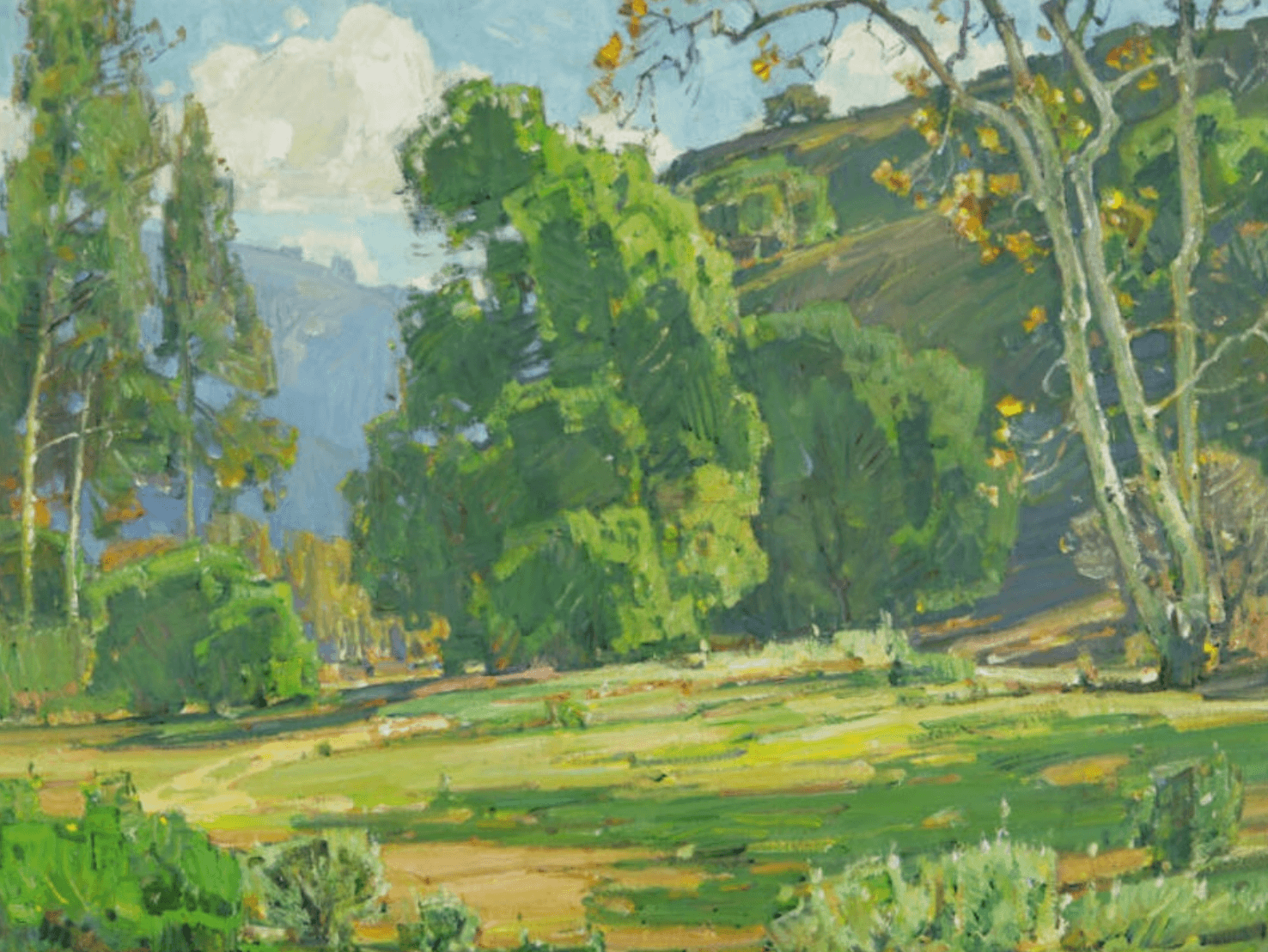
Trees, They Are My Friends, 1936, William Wendt, Oil on canvas
Among the landscapes on view at the Bowers, “South Sierra Lake, ” c. 1935, by Edgar Alwin Payne is dramatic and colorful. The nomadic artist spent long sojourns in mountainous regions, working on his paintings. This masterpiece illustrates brightly colored mountains, darker geological masses and an alpine lake in Bishop, California.
William Wendt’s “Trees, They Are My Friends, ” 1936, a sweeping portrayal of a Southern California landscape, features Eucalyptus and other trees. Wendt, who was considered the dean of Southern California plein air painting, influenced his artist contemporaries to employ impressionist techniques to depict the spiritual nature of the land. He also stressed the importance of locations and the shapes of the land when creating the paintings.
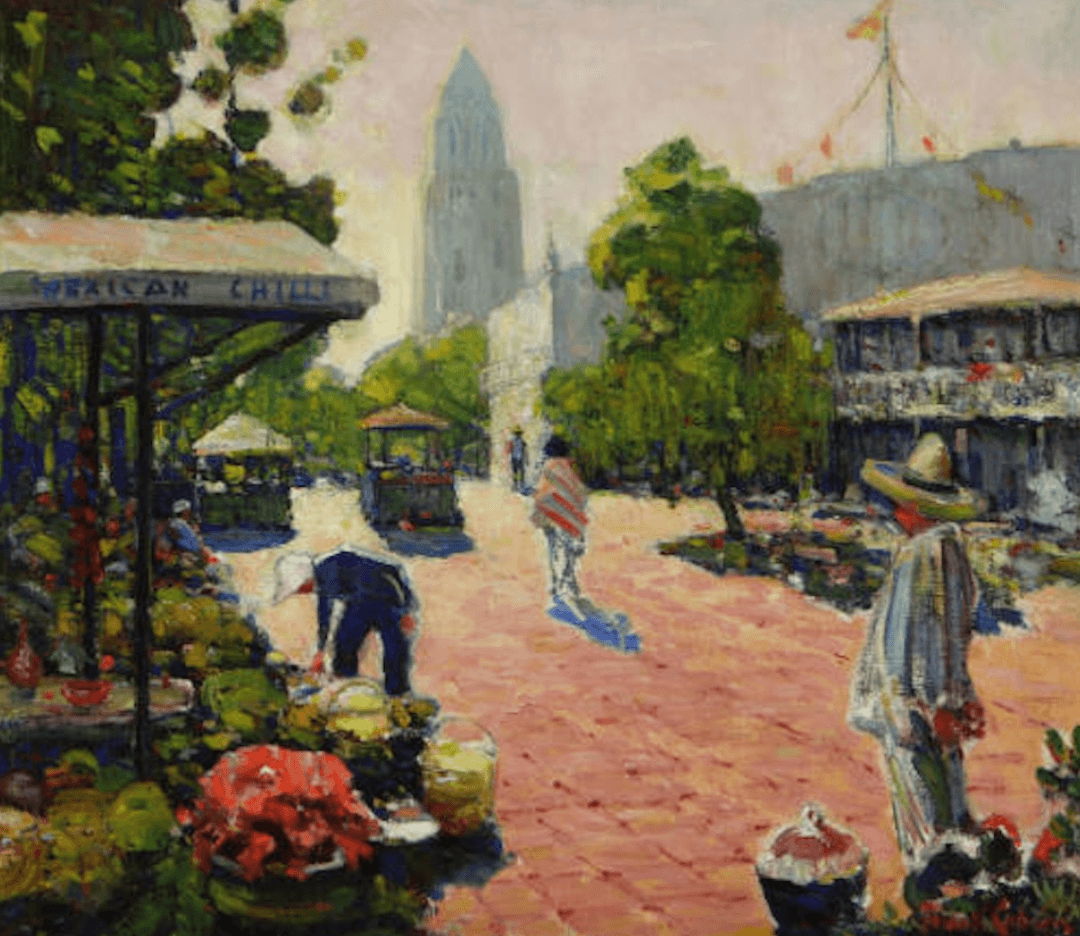
Olvera Street, c. 1928, Frank Coburn, Oil on Masonite
From the 1930s on, artists across the country were depicting everyday scenes in towns and cities, while describing the changes occurring in our civilization—as part of the American Scene Painting movement. It represented a distinctly American approach to art, and a reaction against modern art movements, proliferating in Europe at the time. California artists soon adopted this art style in what became known as California Scene Paintings.
This figurative style, infused with color and harmonious composition, emerged from California’s rapidly developing culture, which included immigration and the growth of the film industry. While all works from this movement in this Bowers show are painted with oils, other artists, including many working for the film industry, created scintillating scenes using watercolors.
Frank Coburn’s “Olvera Street, ” 1928 is a compassionate portrayal of the renowned Mexican marketplace; the location of the first Mexican settlement in Los Angeles. The painting captures the serenity of the tree-lined marketplace with a flower shop, restaurants, and musicians, many wearing sombreros. “Ideal California Day, ” 1921, also by Coburn, depicts a large nursery with abundant blooms, sunshine and with elegantly dressed women admiring the flowers. Los Angeles at that time featured a proliferation of flower shops with plants available from all parts of the world. The shop in this painting was at the corner of Vermont Avenue and Wilshire Boulevard.
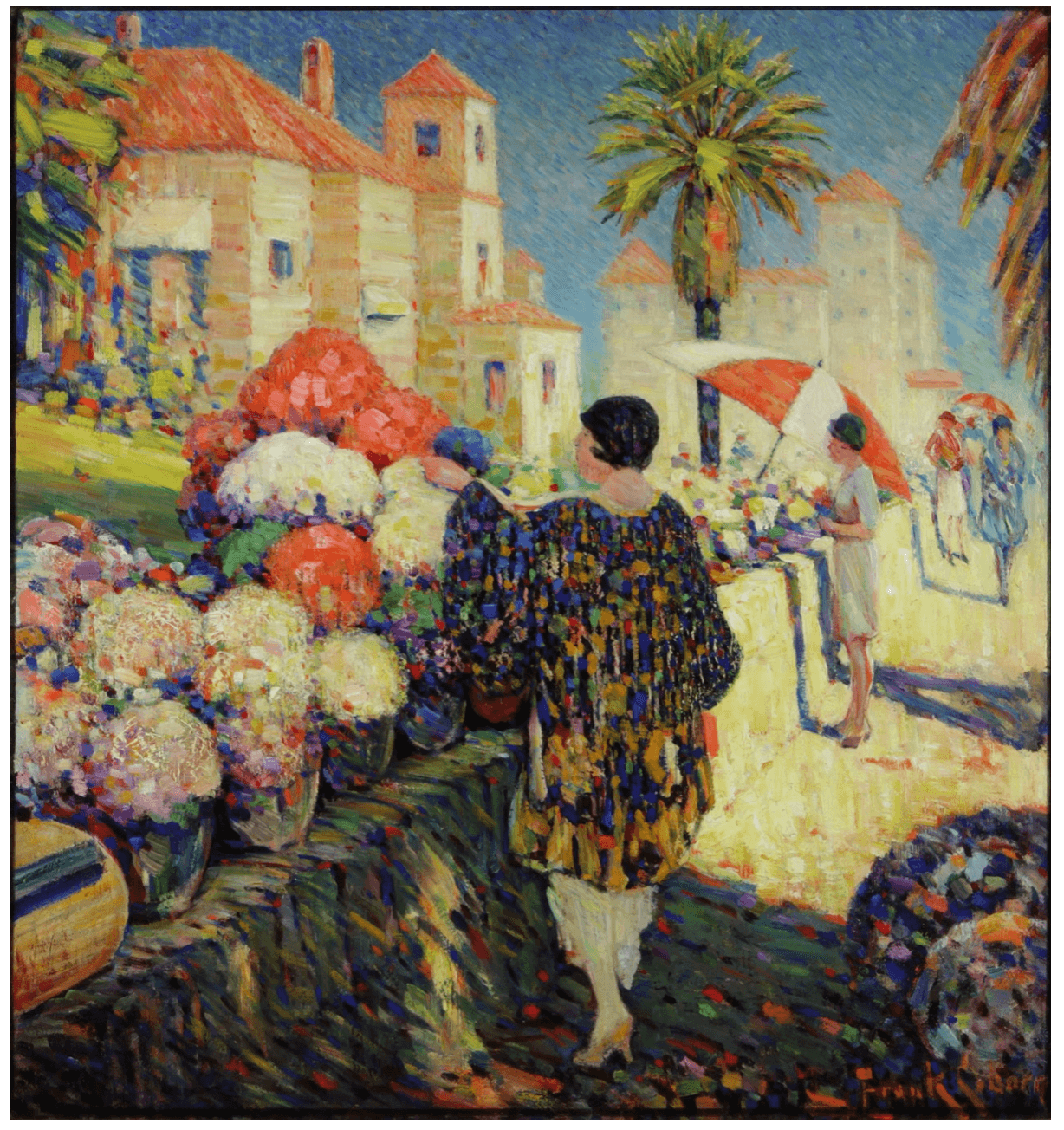
Ideal California Day, c. 1921, Frank Coburn, Oil on canvas
“Summer Night,” 1925 by Aloys Ludwig Bohnen portrays elegantly dressed guests—probably in San Diego where the artist lived—at a lavish gathering in a eucalyptus grove. Lit by lanterns, the painting exemplifies the glamorous lifestyle of that time.
The most illustrative works in this exhibition are portraits, showcasing the diversity of California residents. Many early portraits are of landowners of Mexican ethnicity from the state’s 19th century rancho period. By the turn of the century, with the influx of Japanese and African American people into Los Angeles, and Chinese people into San Francisco, portraits reflected that diversity.
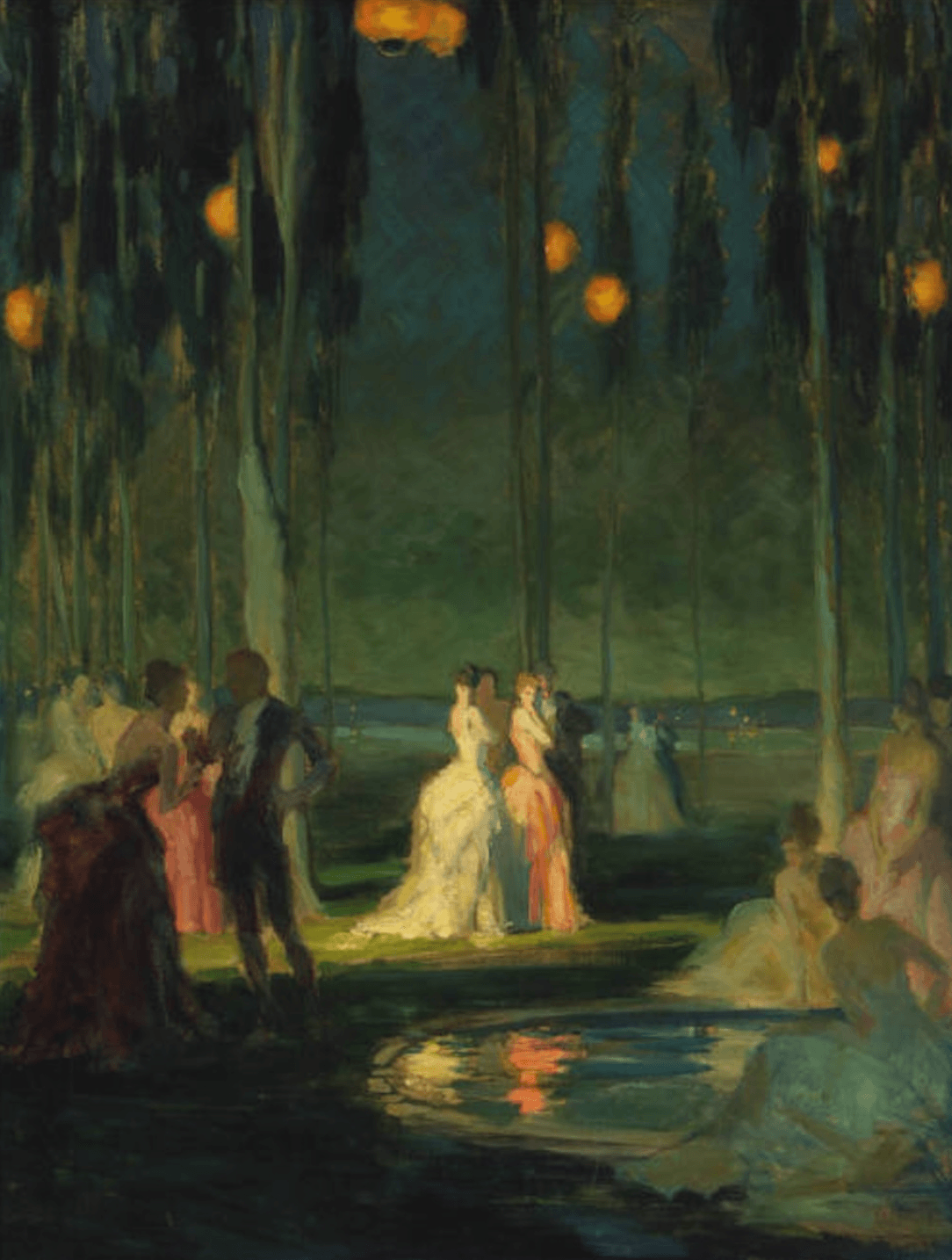
Summer Night, c. 1925, Aloys Bohnen, Oil on canvas
Charles Percy Austin’s “Three Spanish Figures, ” c. 1915, presents a man wearing traditional Spanish clothing—a headscarf, cummerbund, sandals, and serape. Alongside him, an elegant woman wears classic Spanish-influenced attire. A third figure appears to be her lady-in-waiting, with an apron and a large jar on her head. This lucidly staged scene also features an elaborately attired horse and purple mountains.
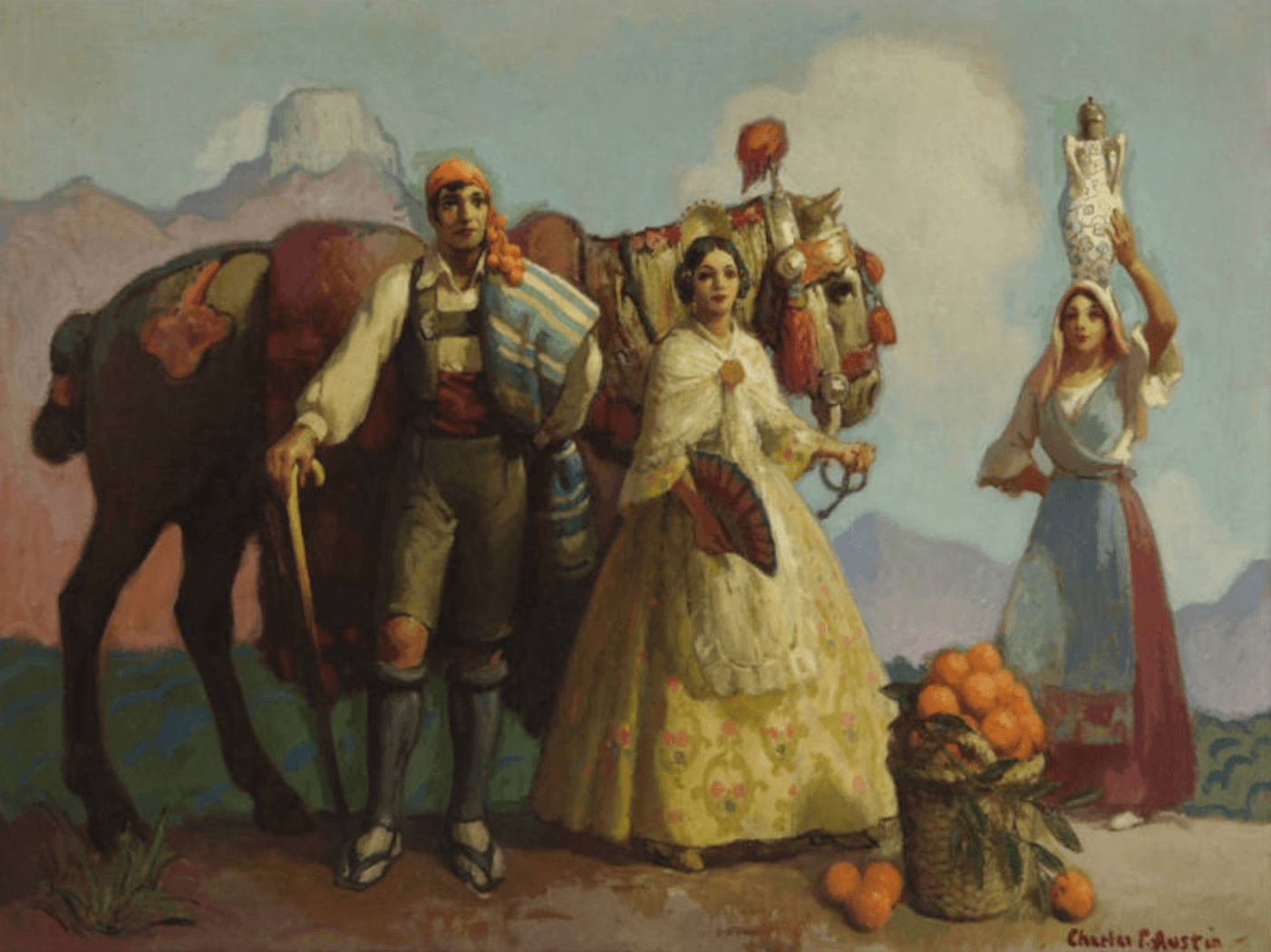
Three Spanish Figures, c. 1915, Charles Percy Austin, Oil on canvas
“Marguerite, ” c. 1909, by California artist Guy Rose, is one of the Bowers’ most treasured art pieces. This portrait of a beautiful woman wearing a colorful kimono, serenely reading a book, was painted while Rose was living in France—where he was a fixture of the American art colony in Giverny.
Supporting these paintings are murals painted onto the gallery ceilings in 1932 by European artist Martin Syvertsen. Illustrations include Spanish padres meeting with Native Americans, and a cowboy avoiding a charging grizzly bear. Another mural shows a wagon train of pioneers crossing the dusty desert expanse en route to California, and miners celebrating the discovery of nuggets of gold, before the majestic Sierra Nevada. Also depicted are the bells of San Juan Capistrano.
The murals document the historic early 20th-century period when architects and decorators created nostalgic and evocative interiors. The murals present meaningful and relevant backdrops for this important exhibition that brings viewers back to a halcyon time in California.
