
Gladys Nilsson, Gleefully Askew, the Crocker Museum
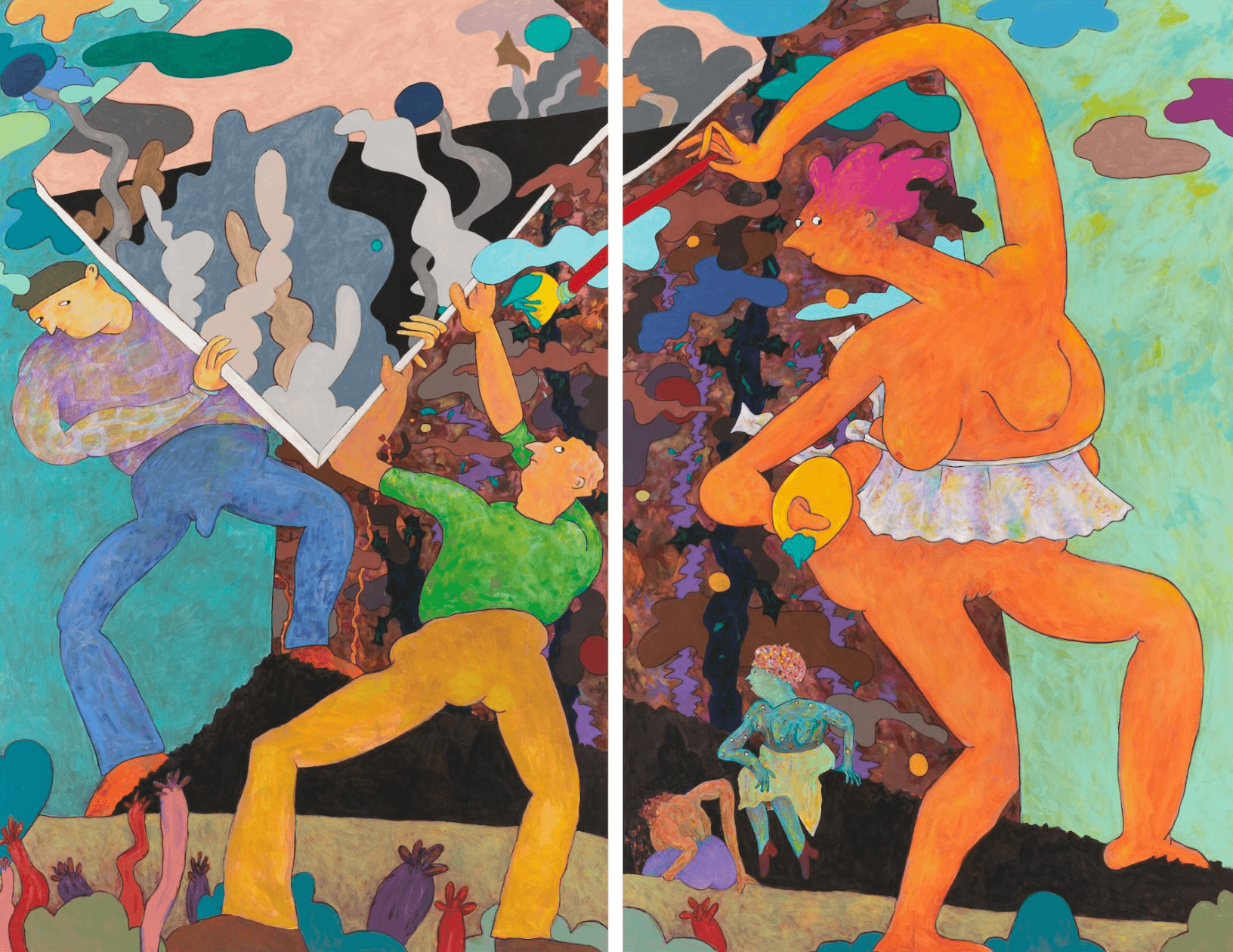
Gladys Nilsson, Gleefully Askew, 2019. Acrylic on canvas, 84 x 54 in. (each); 84 x 112 in.
Gladys Nilsson, “Gleefully Askew”, at the Crocker Museum - July 19-November 29, 2026
By Maria Porges
Selected from six decades of painter Gladys Nilsson’s prolific and highly inventive career, the works in “Gleefully Askew” include dozens of paintings in multiple media, a gallery of prints, videos of her mural work and much, much more. Nilsson, now 86, is a quintessentially Chicago artist: a member of the legendary Hairy Who, a group of six figurative painters who all graduated from the city’s School of the Art Institute in1966. She has spent all but a few years of her working life far from California. Why, then, I wondered, is the artist’s first career retrospective taking place at the Crocker Museum, an institution committed to collecting and presenting work by artists connected to the Golden State?
The answer is both complicated and simple. It begins during the eight years between 1968 and 1976, when-- having relocated West for her husband Jim Nutt’s teaching job at Sacramento State-- Nilsson was living in a Sac’to ranch house, painting in a bedroom and raising the couple’s son Claude. Pregnancy and then parenting had led Nilsson to change her medium to watercolor (and later, acrylic), eschewing the toxicity of oil paint and its various solvents.
Far from having quit working after childbirth-- a frequent fate for women artists in that not-so-distant time-- Nilsson remained hugely productive. During the California years, her work was exhibited nationally and internationally, in a solo show at the Whitney Museum of American Art (1973); in the São Paulo Bienale (also ’73; traveled to Chile and Mexico), as well as in shows in San Francisco, Washington DC, Chicago—and at the Crocker (another solo show, in 1969). It would not be the last time she would show there. Her work was included in group shows in 1972, 1976, 1981, 2010 and 2022. Thus deep ties were forged between artist and institution.
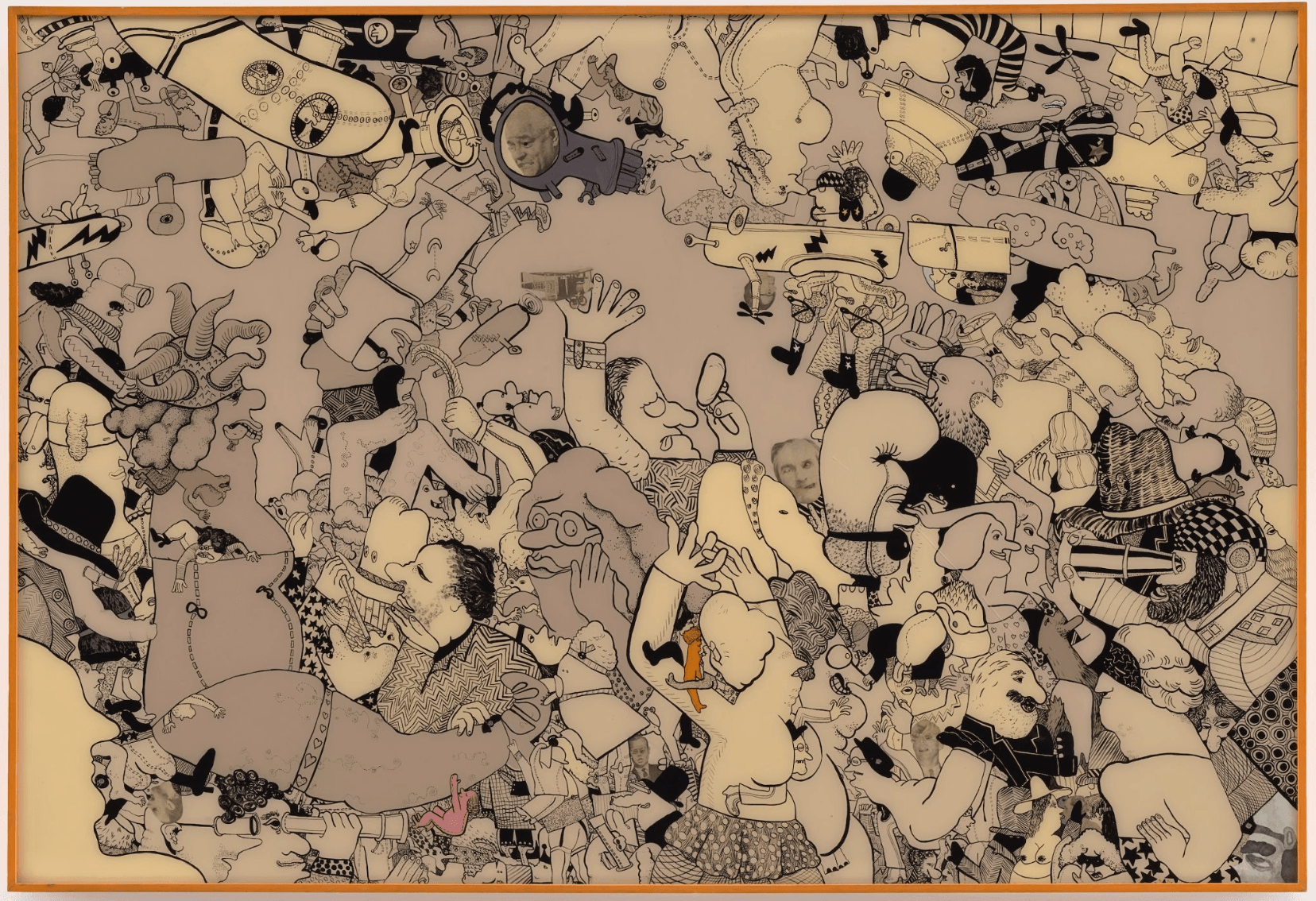
Gladys Nilsson, Very Worldly, 1967. Acrylic and collage on Plexiglas, 51 5/8 x 75 5/8 x 2 1/2 in.
Even before her stay in California, Nilsson had already received substantial recognition for her work, showing with the Hairy Who in various venues (including SFAI!), as well as winning first prize in the Art Institute of Chicago’s Annual Exhibition by Artists of Chicago and Vicinity in both 1967 and 1968. “Very Worldly,” her award-winning work in ‘67, measures over six feet wide and is painted on the reverse side of Plexiglas—a technique investigated around the same time by some of her fellow Hairy Who artists, including her husband Jim Nutt and Karl Wirsum. The centerpiece of the first gallery, it’s filled with a teeming, roiling mass of figures-- exhibiting a horror vacui that Nilsson’s work would continue to explore.
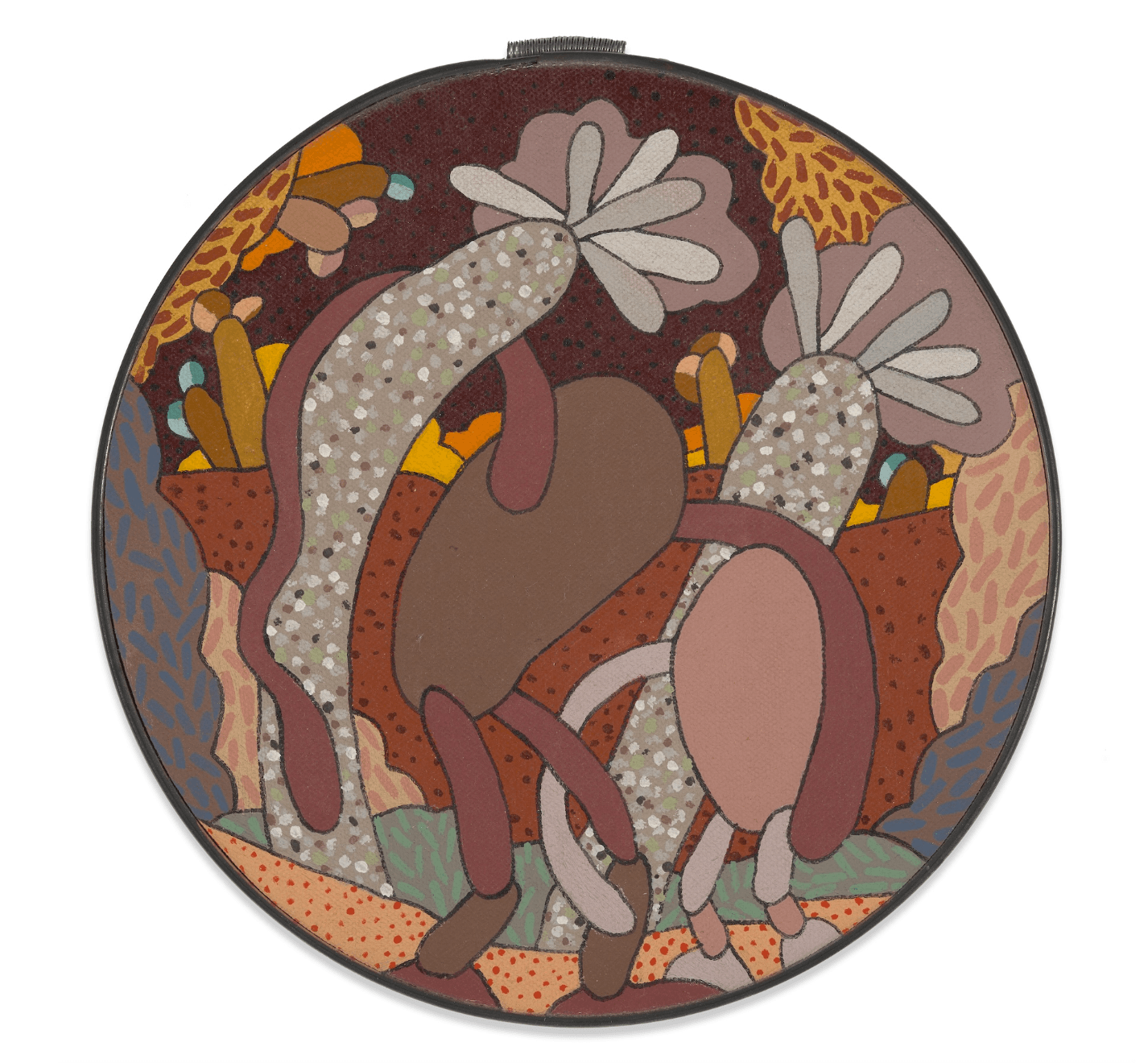
Gladys Nilsson, Little Ape, circa 1972. Acrylic in embroidery hoop frame, 7 1/4 in. (diam.)
Several works from the Whitney show (one of the first given to a woman artist at that institution) can be seen here. Inventive in both format and content, these include both very large paintings and a suite of diminutive works framed with ready-made embroidery hoops. The size and shape of the latter are sometimes described as ‘witty responses’ to the big ponderous rectangles favored by the (male) art world: as reclamations of traditional women’s work and craft practice. Maybe so. Their content definitely subverts traditional gender roles, making jokes about the kind of behavior women were supposed to be modeling, as well as about the traditionally virtuous content of embroidered samplers prepared in advance of virginal marriage. Using acrylic paint to mimic dashes of thread, Nilsson fills the space of compositions like “Little Ape” with figures of parent and child, simplified to bean-like forms with elongated, loopy arms that reveal Nilsson’s affection for Olive Oyl, Popeye’s cartoon spouse, watched by the family on Saturday mornings in the Sacramento rancher.
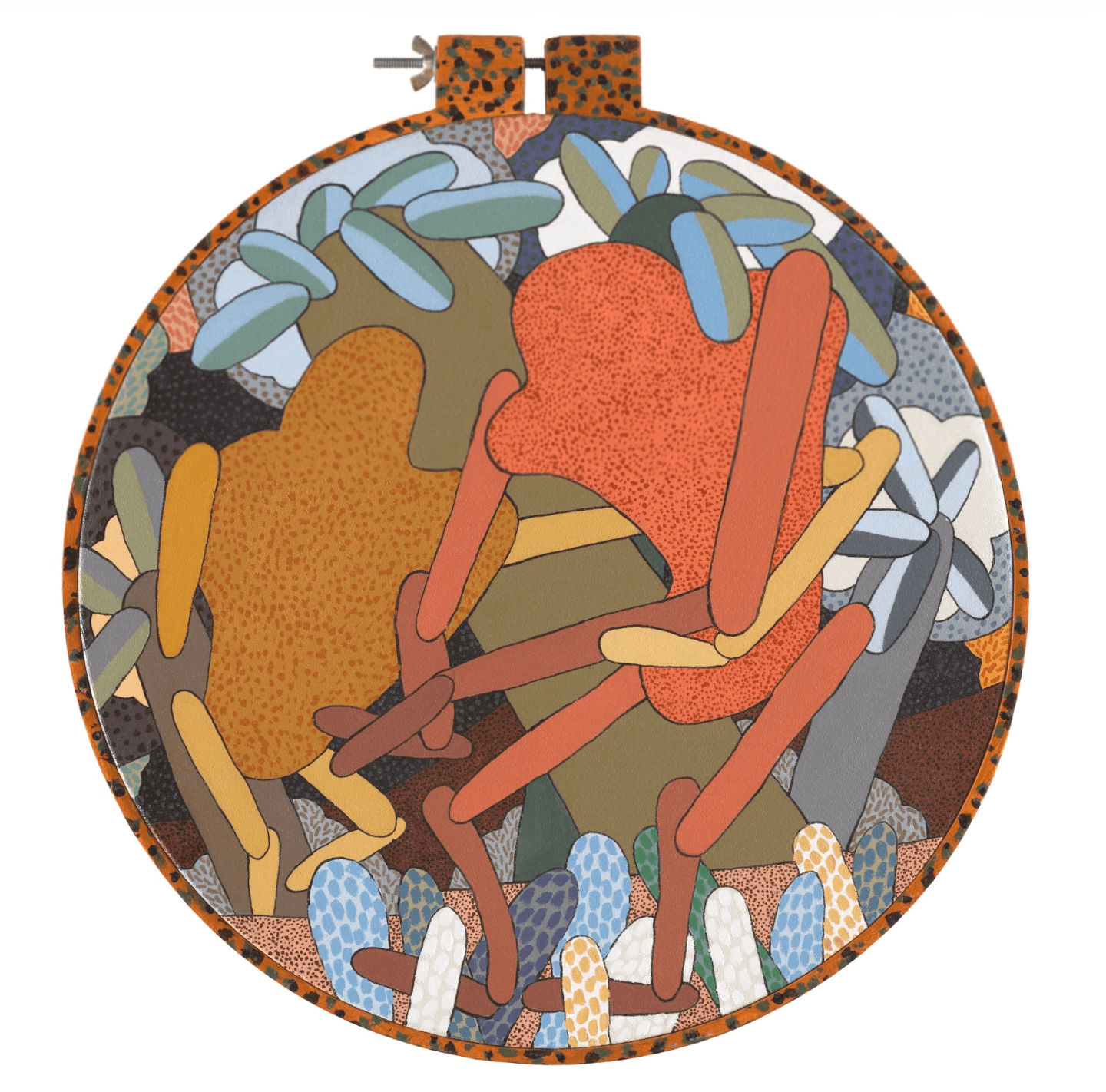
Gladys Nilsson (American, born 1940), To of Them, 1972. Acrylic on canvas in embroidery hoop frame, 14 in. (diam.).
In “To of Them,” though, there is definitely some kind of phallic activity taking place… or are those just balloon animal-like limbs? It seems reasonable to assume that, more often than not, something racy is going on in Nilsson’s hilariously, exuberantly sexed-up compositions.
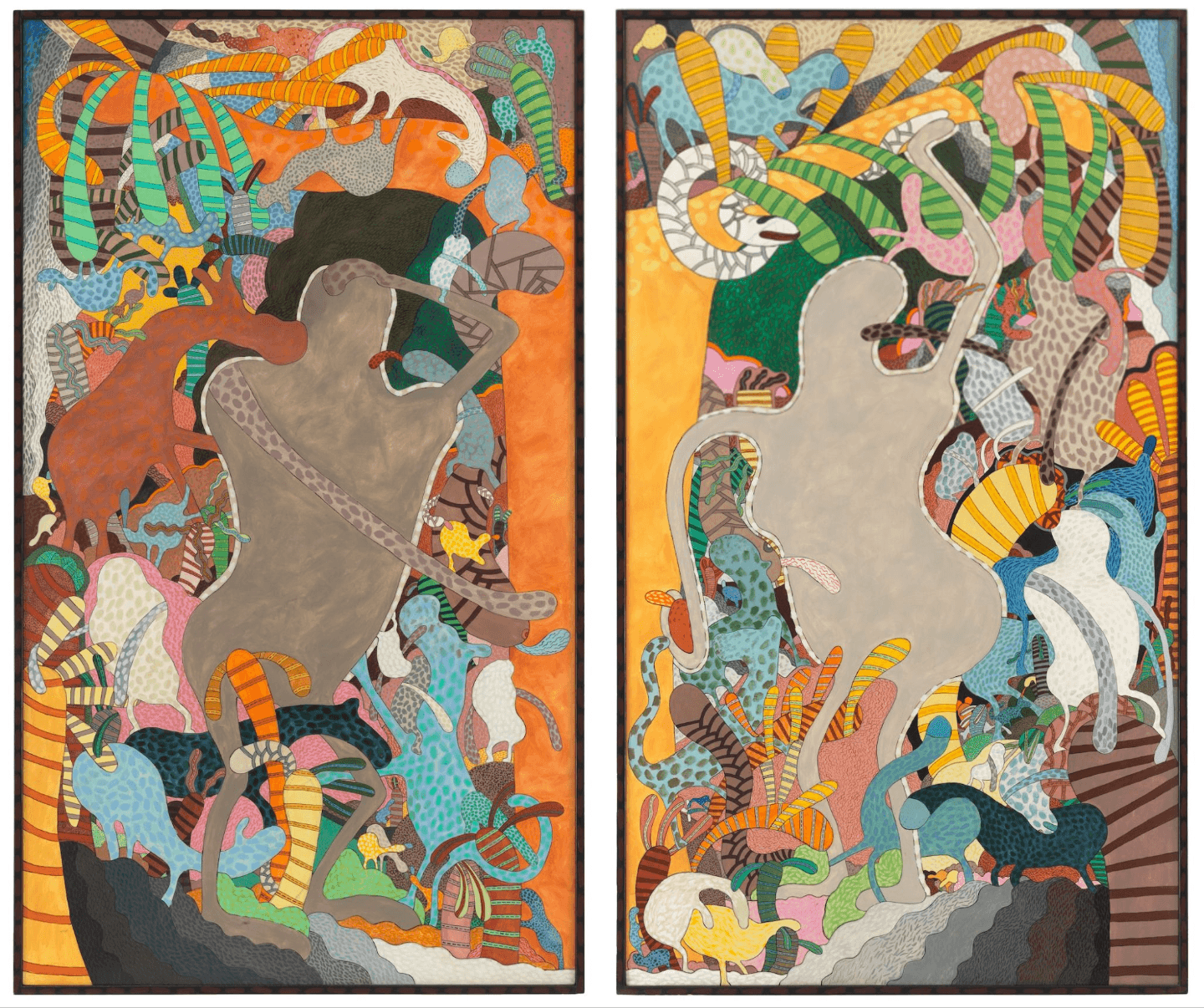
Gladys Nilsson, Dipped Dick: Adam and Eve after Cranach, 1971. Acrylic on canvas in artist's frame, 85 1/2 x 49 1/2 in. (each); 85 1/2 x 99 in. (overall).
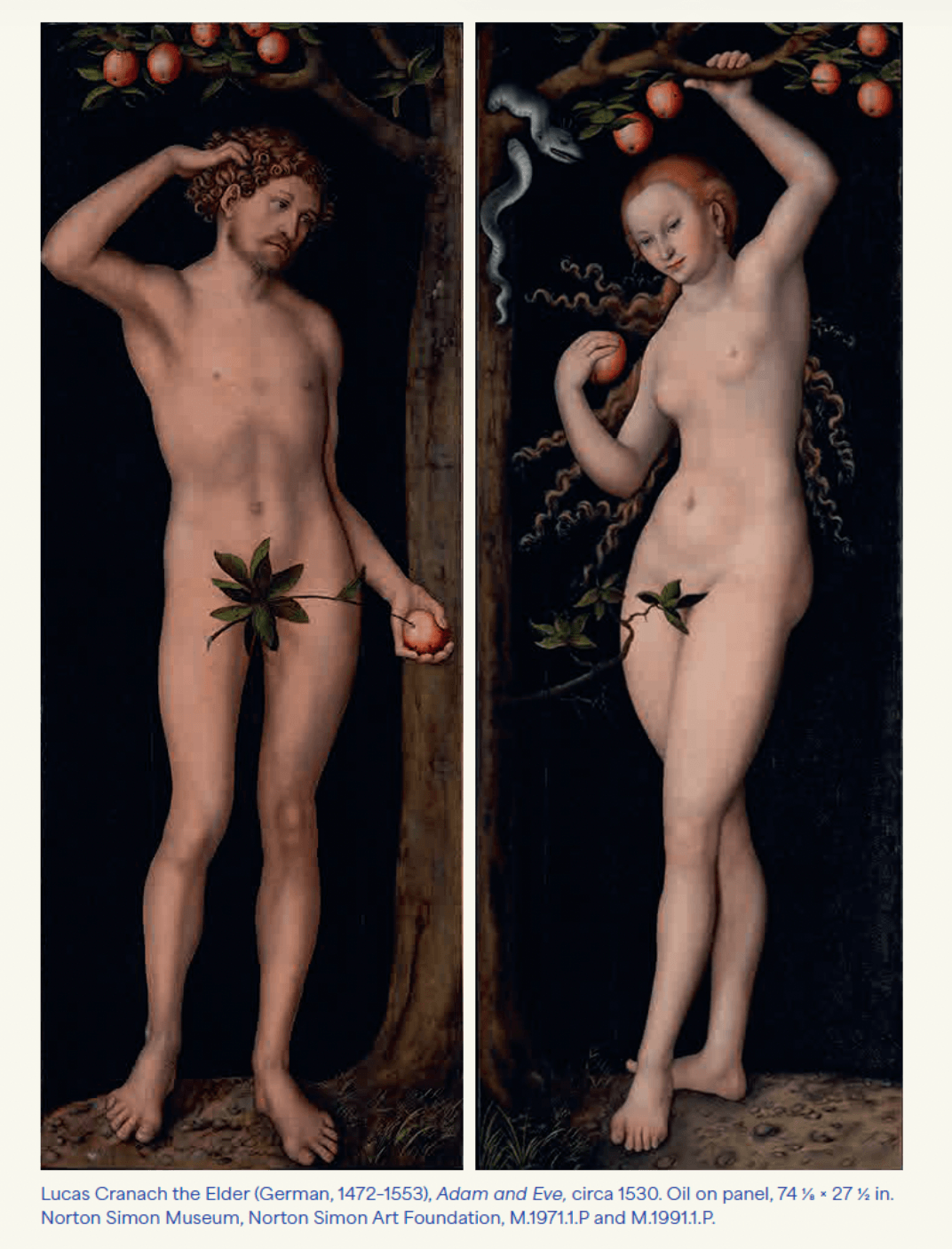
In the Whitney’s installation as described in the catalogue, the embroidery hoop paintings were interspersed among the larger works, offering a bold contrast in scale. For some inexplicable reason, the Crocker show groups them together behind a slab of Plexiglas—presumably, to protect them from some kind of viewer predation, but it’s a shame nonetheless. Still, the centerpiece of the Whitney show was surely the massive diptych titled “Dipped Dick: Adam and Eve After Cranach” (1971), presented here in magnificent isolation. Inspired by Cranach the Elder’s portrayal of mankind’s fall from grace as Eve plucks an apple and offers it to Adam, Nilsson’s version is full of color and pattern and a giant cast of squirming biomorphs, their phallic heads and limbs intertwined. Eve seems to be stroking the grinning serpent with one hand as she readies herself to lob the apple to Adam’s with the other. Between the two- identifiable as humans mainly by their skin color-- a massive orange-colored tree connects the two compositions, a device Nilsson would use again in later diptychs.
The unruly women and men, not to mention the fantastic range of genital-adorned creatures, depicted in Nilsson’s paintings suggests a challenge to any binary notion of gender. Like many other Chicago artists of her generation, her cast of characters draws freely and perceptively from a wide range of influences, from Surrealism to Outsider art, James Ensor and George Grosz to Hieronymus Bosch and Fernand Léger . Other sources have included comics, cartoons and indigenous Australian bark paintings, which inspired a series of works in silver ink on black paper in the early ‘70s.
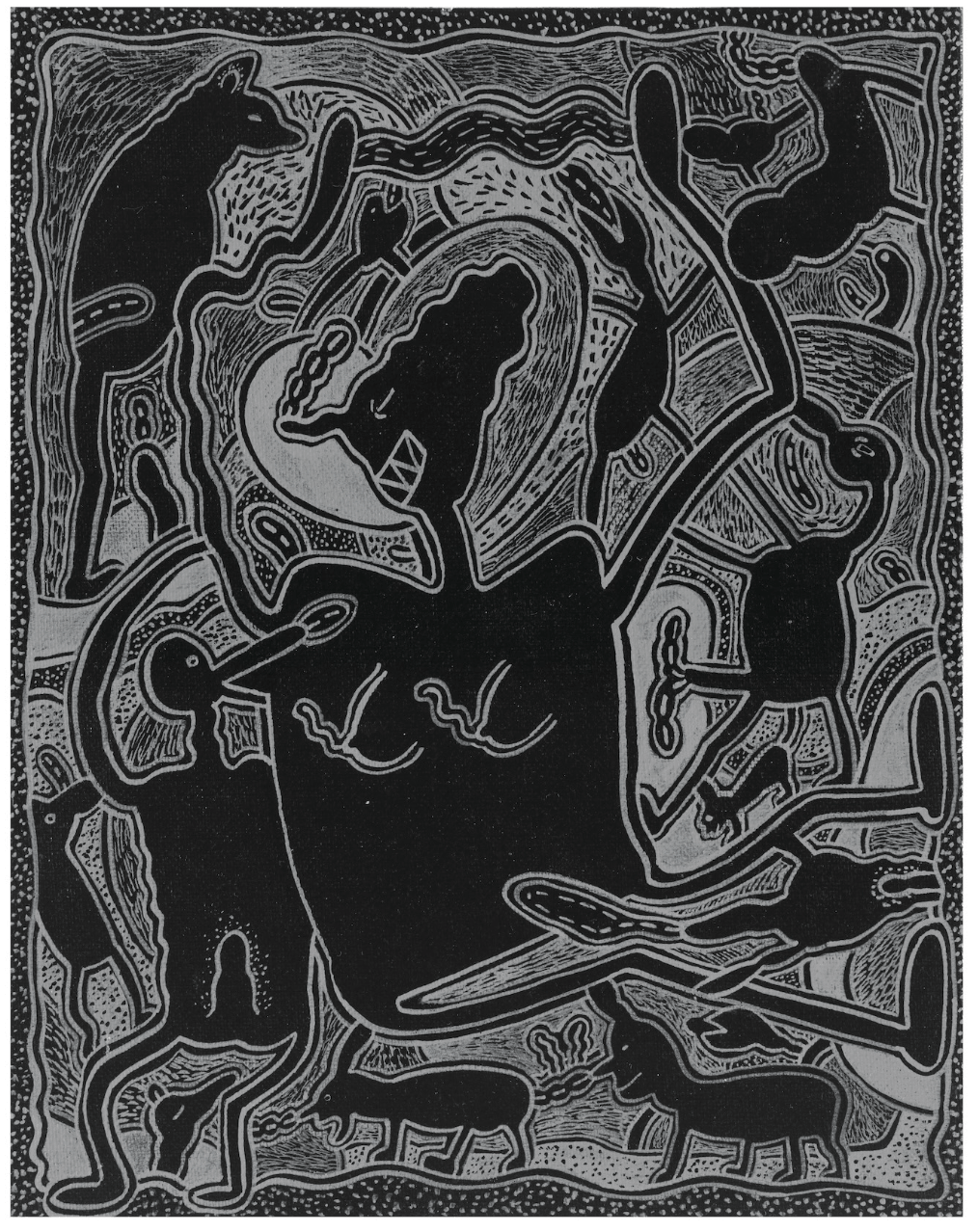
Gladys Nilsson, A Little Duck, 1970. Acrylic on canvas board, 8 x 10 in.
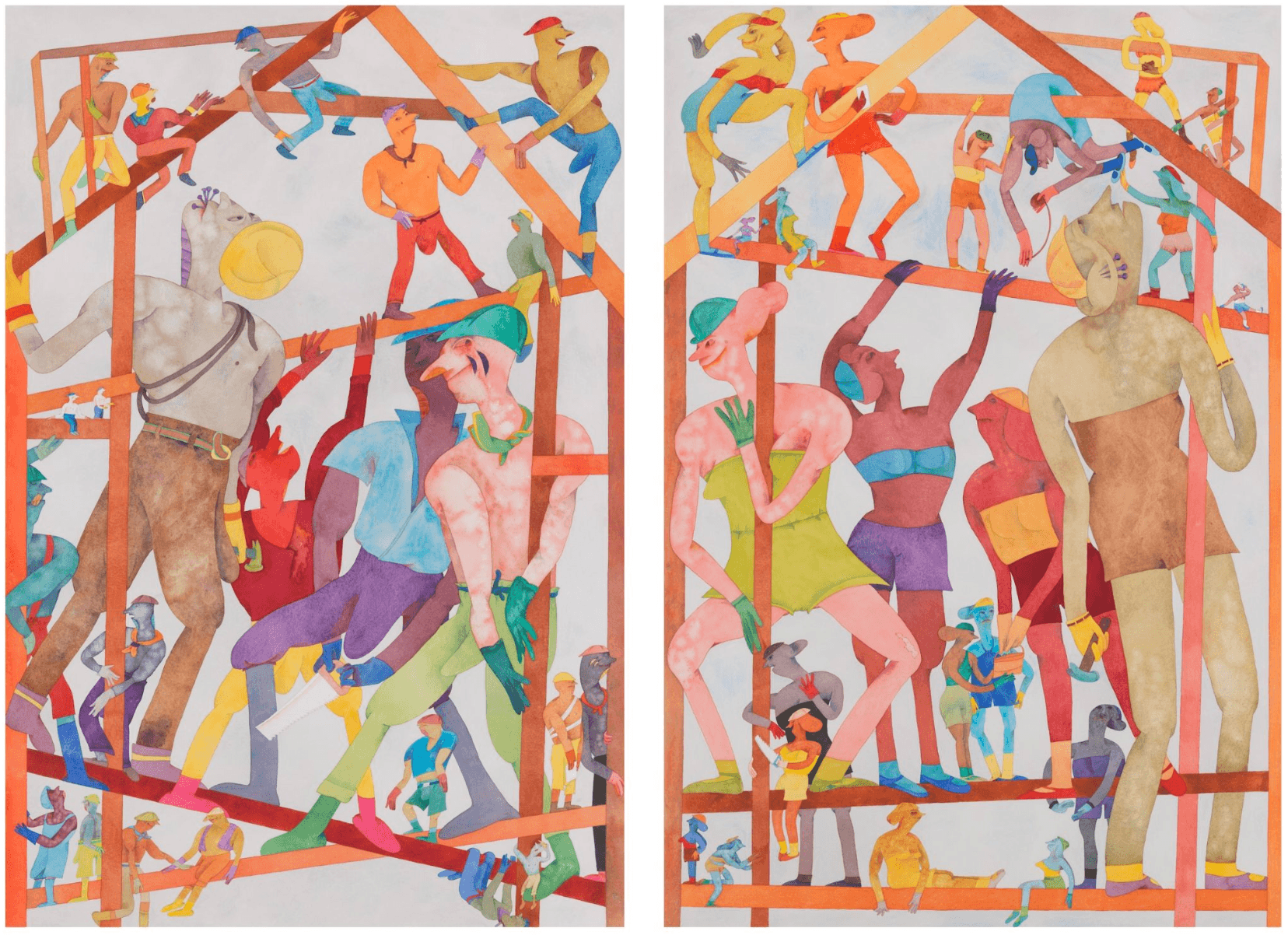
Gladys Nilsson, Léger Faire, 1986–1987. Watercolor on paper, 60 x 40 in. (each); 60 x 80 in. (overall).
There are many exceptional works, but I spent a long time examining a diptych from 1986 that seems both different from many of her paintings and, at the same time, epitomizes her gift for reinterpreting seemingly-unlikely works from art history. Inspired by a building site in her suburban neighborhood, Nilsson borrowed deftly from a series of pictures by Léger featuring construction workers inside a Cubist matrix of lines and architectural grids. In Nilsson’s mesmerizing diptych “Léger Faire” (a wordplay on the expression laissez-faire), men, in the painting on the left, and women, on the right, perch in and on a spare, colorful framework of girders.
Nilsson manipulates not only their noodly, active figures but the space in which they are working, radically shifting the scale of workers seemingly occupying the same girder in a way that (mysteriously) recalls the reduced-scale representation of wealthy donors in religious paintings of the Middle Ages. Hilariously, the men on the left are untroubled by their giant phalluses as they go about their work-- though they seem to be aware of the women grinning at them from the adjacent frame, dressed in what look like bathing costumes from the ‘40s.
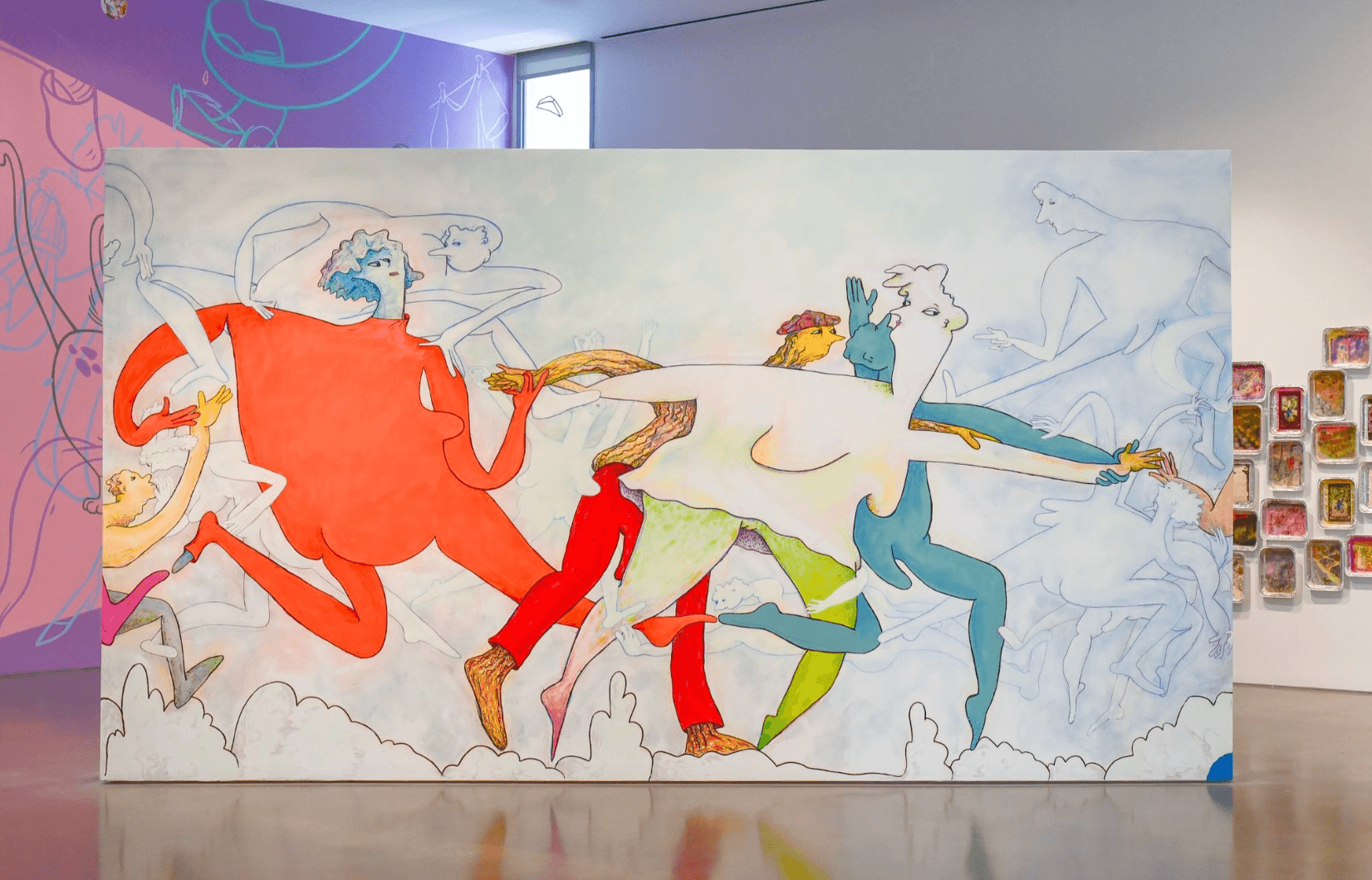
Gladys Nilsson, Rounding Rosie's Ring: Dance, You Fools, Dance , 2024. Charcoal, graphite, chalk, marker, wall paint, 108 x 416 in. Installation view, south wall in Alive & Kicking: Fantastic Installations byThomas Lanigan-Schmidt, Catalina Schliebener Muñoz, and Gladys Nilsson , Colby College Museum of Art, Waterville, Maine
Gladys Nilsson, Rounding Rosie's Ring: Dance, You Fools, Dance, 2024. Charcoal, graphite, chalk, marker, wall paint, 108 x 416 in. Installation view, south wall in Alive & Kicking: Fantastic Installations by Thomas Lanigan-Schmidt, Catalina Schliebener Muñoz, and Gladys Nilsson, Colby College Museum of Art, Waterville, Maine
One of the most compelling aspects of the exhibition is Nilsson’s increasing ambition in terms of scale as she has aged. This has included ever-larger works on canvas, such as Gleefully Askew (2019), a diptych measuring seven feet high by over nine feet wide. Nilsson has also planned and executed wall murals. Projects including temporary works at Colby College, the Art Institute in Chicago as well as at the Menil collection in Houston have given her the opportunity to spread out, so to speak. A video of her working on one of these is entrancing.
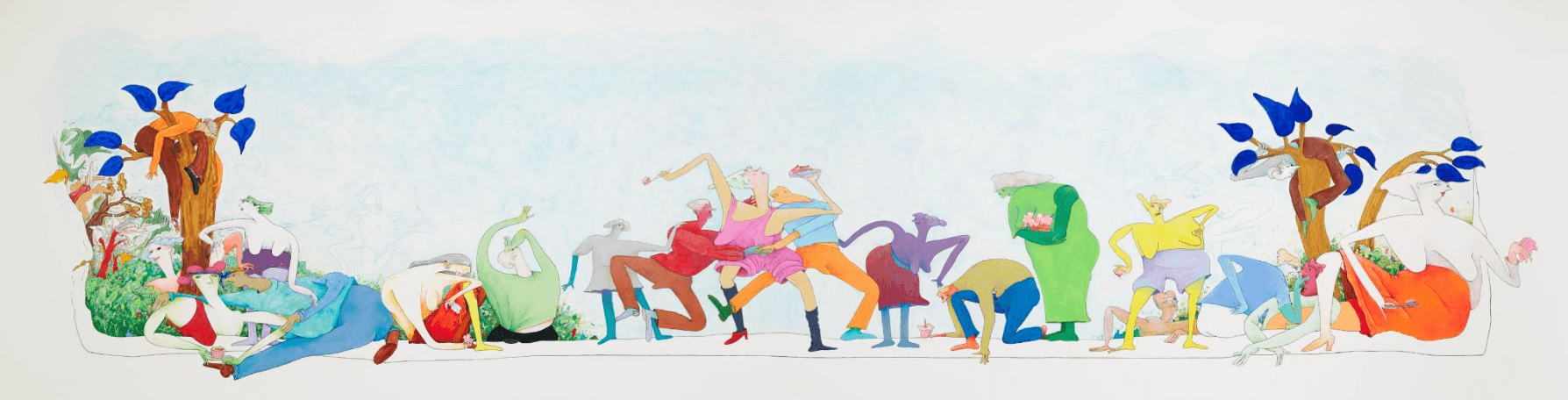
Gladys Nilsson (American, born 1940), Drawing , 2025. Graphite, acrylic, colored charcoal, Conté crayons, and water-soluble pastels, 114 1/2 x 432 in. Installation view, the Menil Drawing Institute, Houston, Texas
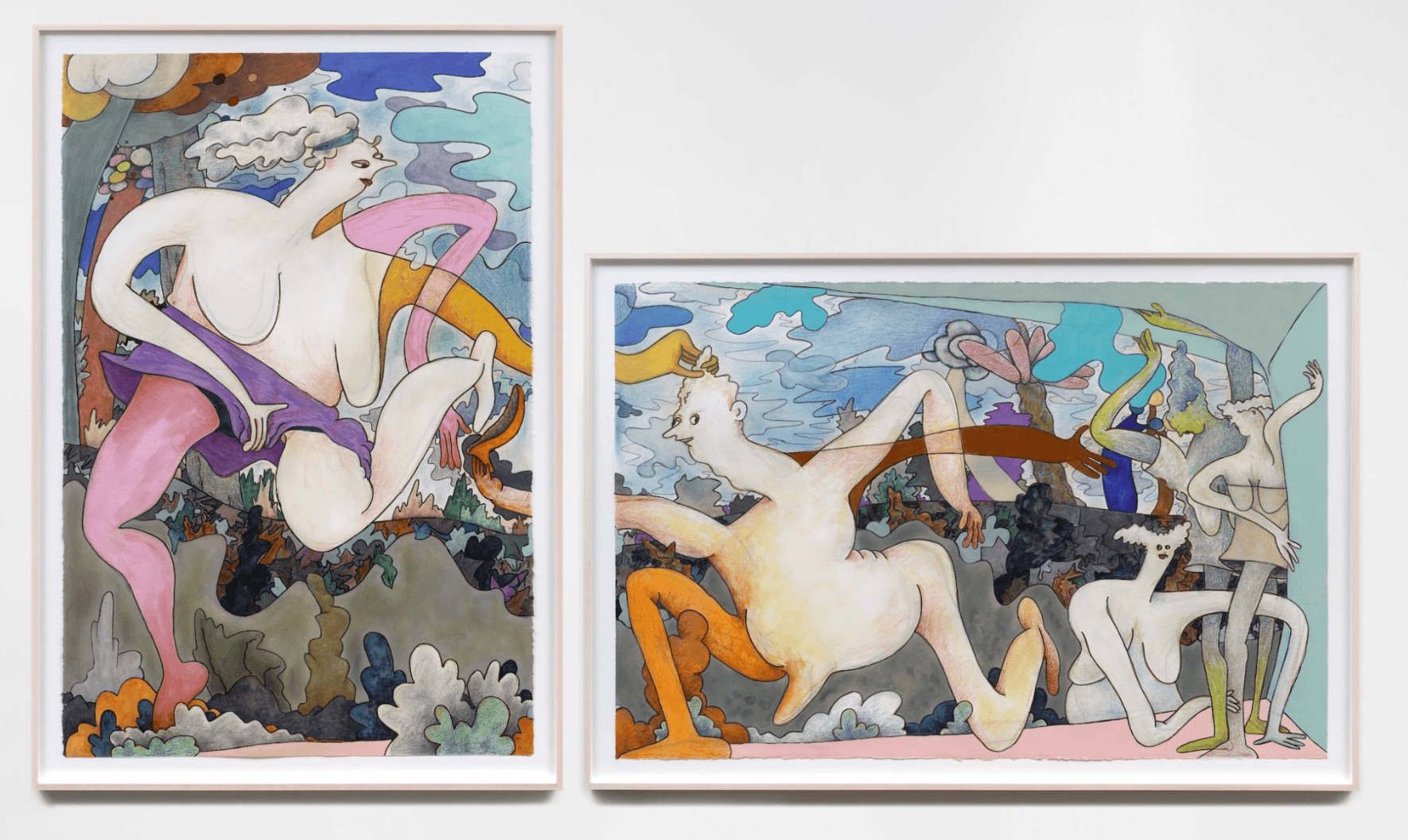
Gladys Nilsson, Shooing, 2023. Watercolor, gouache, graphite, colored pencil, ink, and crayon on paper, 60 1/4 x 40 1/4 in. and 40 1/4 x 60 1/4 in.; 60 1/4 x 100 1/2 in. (overall).
A personal favorite, however, might be “Shooing” (2023), a diptych with a combined overall size of 60 x 100 inches. It doesn’t say so in the catalogue, but to me, the subject appears to be Cinderella, being offered the shoe–thus the punning title– that will determine her future. But it’s a Cinderella with a mop of gray curls, like all of the other figures in the painting. Nilsson’s women have gracefully, humorously aged with her.
