
The Story That Writes Itself, 688 Sutter Street (Academy of Art University)
Editor’s note: we have invited the curator of this exhibition to respond to this review.
I first learned about the student exhibit The Story That Writes Itself at San Francisco’s premier corrupt-real-estate-mogul-disguised-as-an-art-school The Academy of Art University from an Instagram post advertising the opening on August 6th (although they mistakenly, and humorously, called the exhibit The Art That Writes Itself in the text of the post). The exhibit was curated by the Academy’s Executive Director of the School of Photography Timothy Archibald, who also teaches the course “AI for the Visual Artist.” At a time when most of us are being inundated daily with horror stories about the threats of AI–and in San Francisco where the malaise is at an all-time high and we’re constantly swarmed by AI advertisements everywhere from bus stop shelters to billboards–I found it a curious decision to host a generative AI art show amidst such a climate.
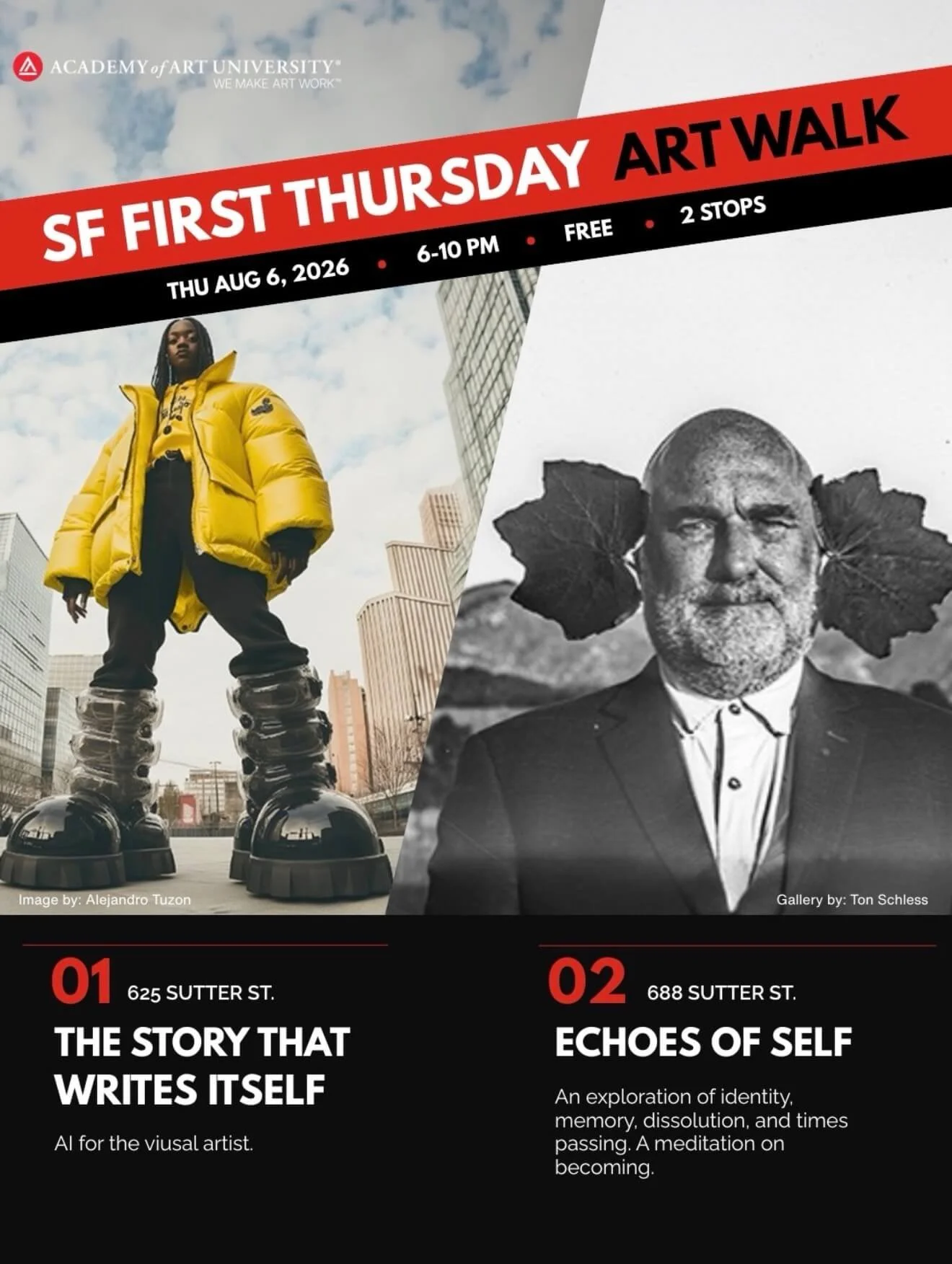
Unable to make it to the opening reception (which appropriately took place as part of the now-under-new-management First Thursday Art Walk, currently being bankrolled by the primary benefactor of San Francisco’s new AI-powered surveillance state himself, Mr. Chris Larsen), I took a walk over to 688 Sutter Street a few days later during the business hours advertised online. To my surprise, a sign on the door informed me that the gallery was closed to the public all summer. I called the number on the sign to inquire about the possibility of seeing the exhibit by appointment, and was called back the next day and told that the only time to see the show would be during the following First Thursday Art Walk, set to take place September 3rd.
Eager to actually see the exhibit before writing this review, I waited out the month for the one opportunity I might have, only to learn the day before that they had deinstalled The Story That Writes Itself and that a new exhibit was going to be on display for that First Thursday Art Walk. My first reaction was disappointment, and uncertainty as to whether I could (or should) proceed with writing a review for an exhibit that I didn’t in fact see–but after thinking about it for a while, I surmised that it was fair, and perhaps even appropriate, considering that none of the artists featured in the exhibit actually made any of the “art” (which will henceforth be referred to as “slop”) themselves. The entire process of generative AI relies on speculation, and I therefore see no issue with basing this review off my own speculative assumptions gathered from the few pieces of slop from the exhibit I was able to find online.
Before proceeding, I should also clarify that my criticisms are not necessarily directed at the students (who may or may not know better) but rather at instructors like Timothy Archibald, and at the Academy of Art University as an institution, for facilitating and normalizing the cognitive offloading of creativity onto AI, and for their attempts to legitimize such asinine garbage as "art." And truth be told, these students already have it bad enough considering most of them were likely duped into enrolling in this sham of a school in the first place and are incurring mountains of debt for a d-list education that includes courses on making AI slop (and that’s if they are even among the small percentile of those that make it through to graduation).
Of the little bit of work I was able to see from The Story That Writes Itself, the first word that comes to mind in trying to describe it is "banal." Banality, however, connotes human mediocrity–which this literally mindless drivel does not fully or accurately entail. What lays at the core of the work is therefore more akin to a simulacrum of banality, and as such it supersedes all previous thresholds of human banality and becomes something so banal the English language has yet to develop the vocabulary to describe it.
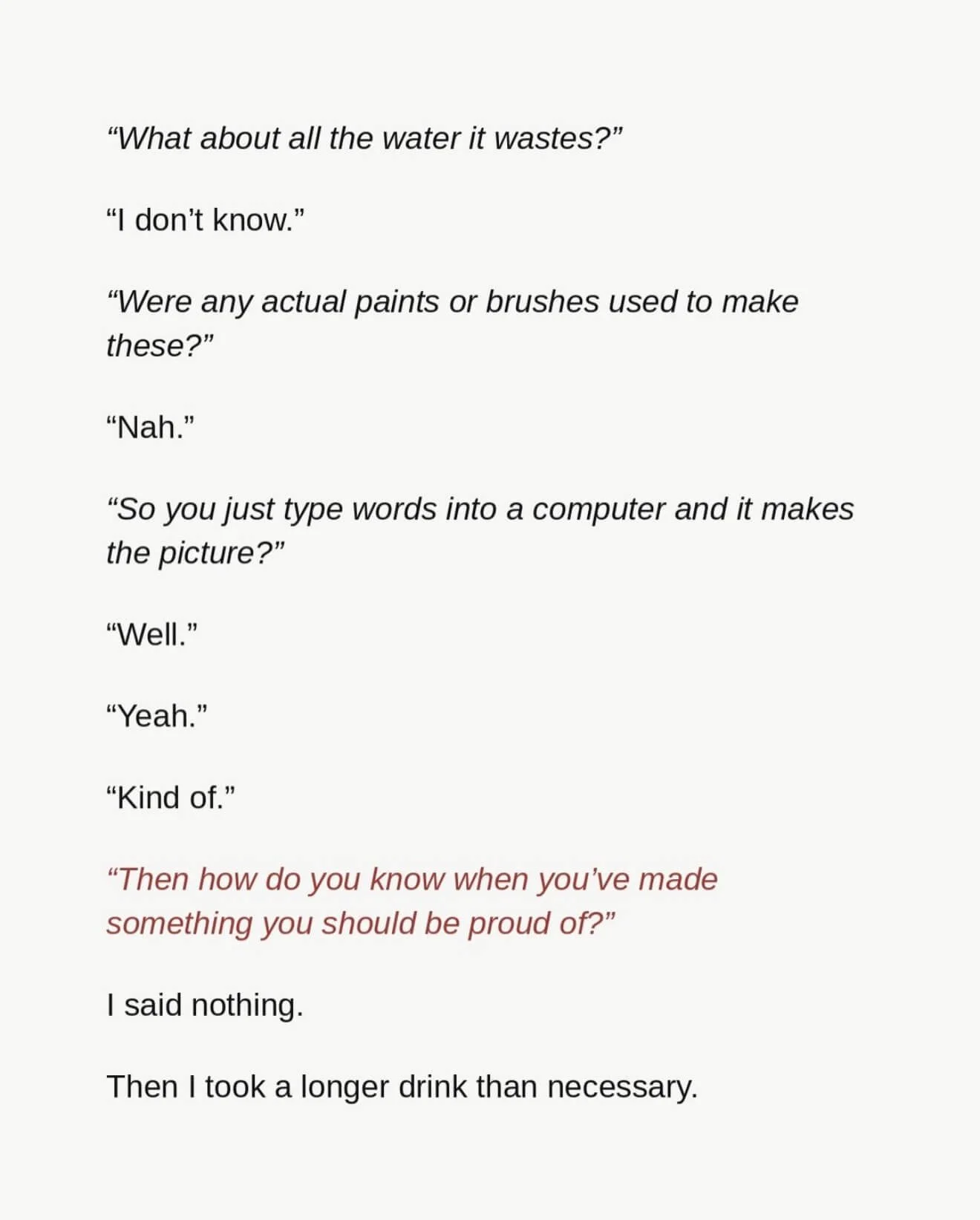
Much of what I’ve been able to gather about The Story That Writes Itself I gleaned from this post from Archibald on Instagram where he (or perhaps an AI bot) talks about his experience at the opening, and appears to be making some sort of shallow, meandering attempt at self reflection–which, much like the work in the show itself, falls short of any substance. Archibald talks about being confronted with some of the ethical ramifications of AI, and like most proponents of these new technologies, his predominantly non-answers are tinged with both apathy and laziness. The images in the post in turn appear to be mostly AI-generated slop depicting homelessness on the streets of San Francisco, while in contrasting slides an avatar of Archibald enjoys the comfort and exclusivity of the art opening he curated. While I’m unsure whether it was actually featured in the exhibit, the 17th slide of his post features a piece of slop I’ve come to regard as emblematic of the entire show.
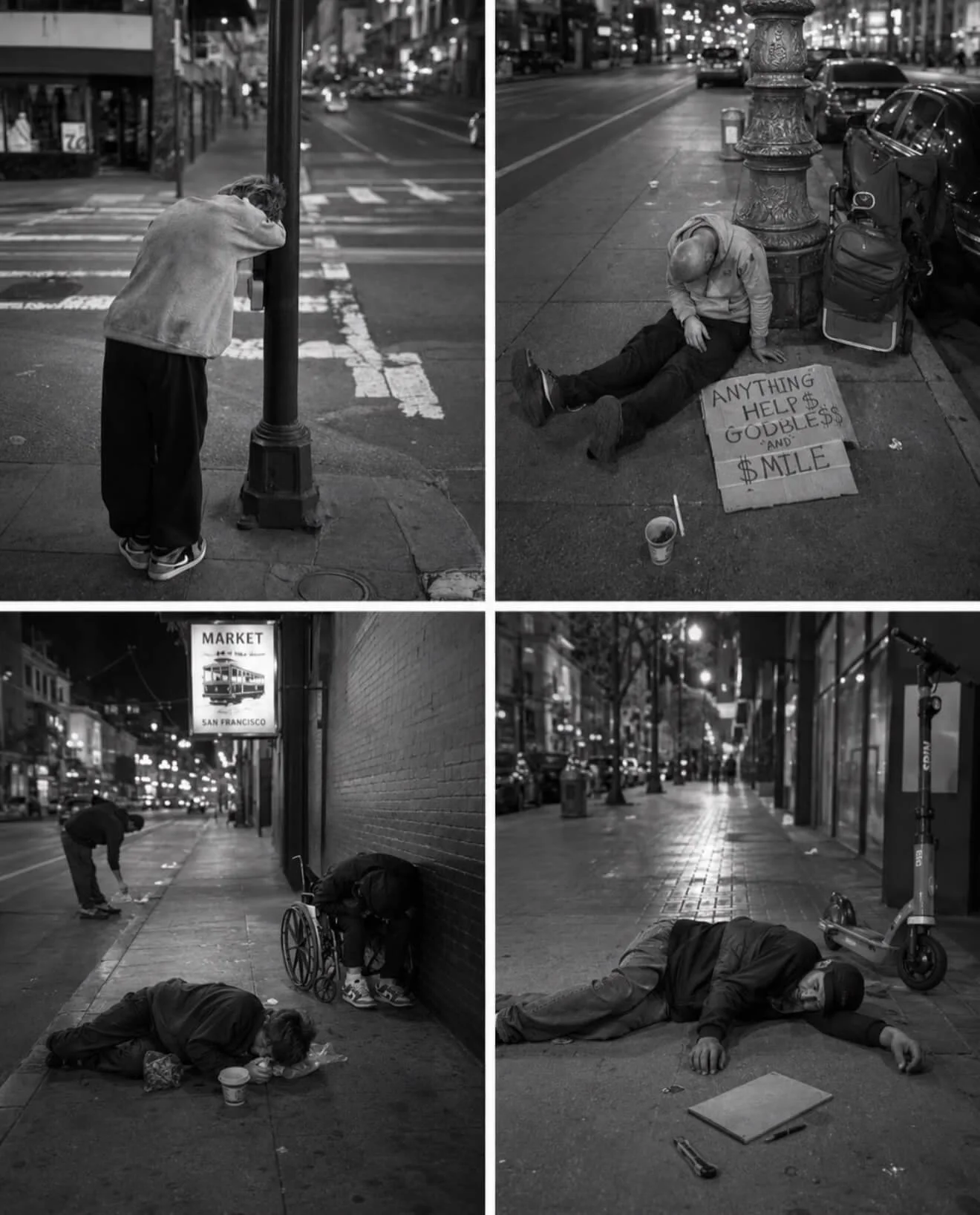
This particular slop (like much of the rest of Archibald’s post) is set in a dystopian version of San Francisco that I wish I could say was a caricature of our city but is unfortunately all too representative of the blight and disparity we are currently facing at the hands of the tech industry and the ensuing gentrification brought to our doorsteps. The setting of the image is one very familiar to downtown SF–abject human misery and street-level crises amidst a sea of corporate branding and the cold disregard of the surrounding metropolis. Only here we additionally have the tired pastiche of superimposed pop-culture icons such as Garfield, Charlie Brown, and Darth Vader in the foreground, along with the brightly lit facade of a gallery where The Story That Writes Itself is on view.
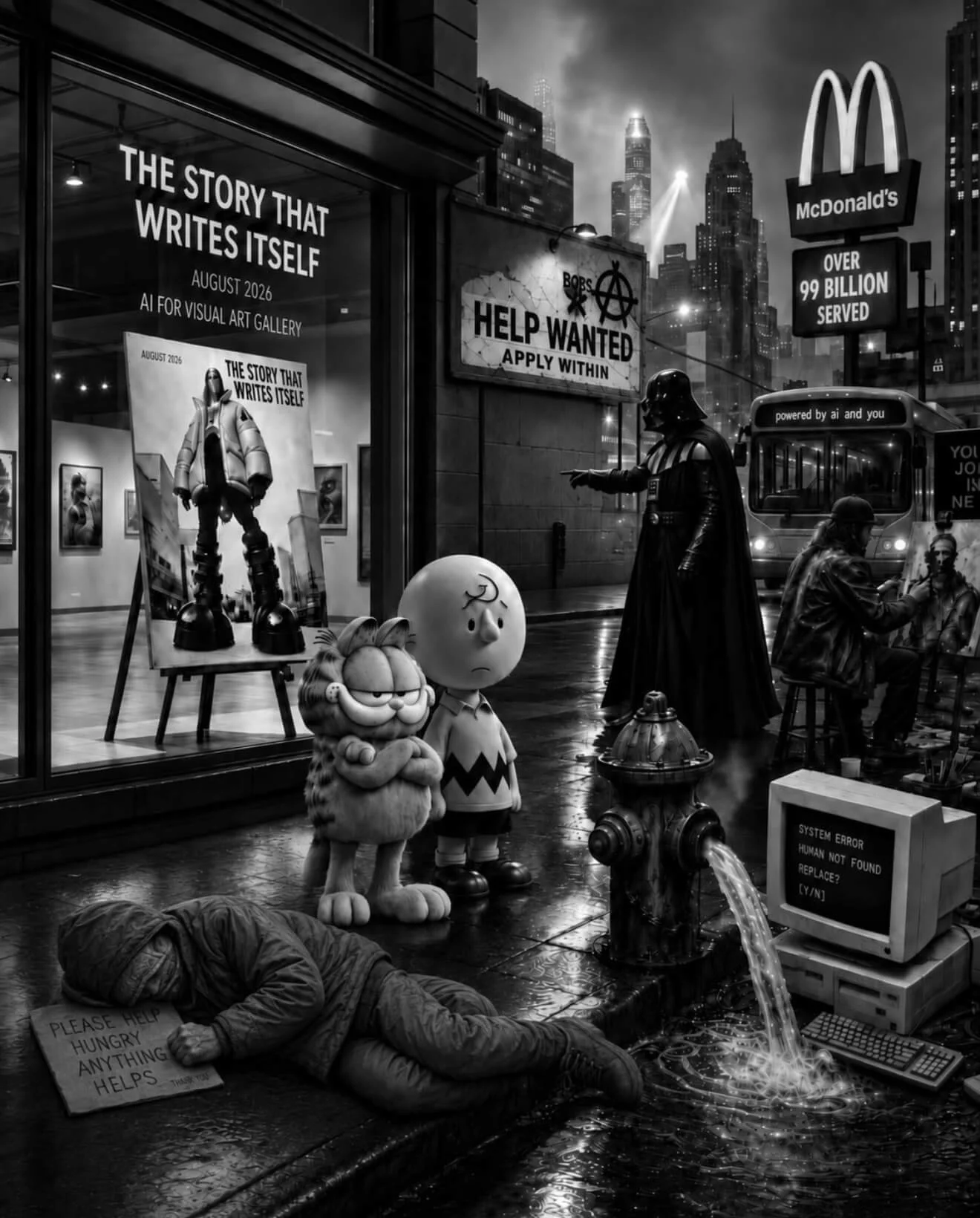
My assumption is that this image was an attempt at irony or self-awareness about the ethical dubiousness of exhibits like The Story That Writes Itself, but the end result only comes off reeking of both indifference and mockery. The inclusion of the mainstream pop-culture menagerie seems to harken back to some of the pop surrealism of the ‘90s and early 2000s, but lacking any of the depth or originality of its predecessors. In short, just about everything about this slop is about as tasteless and soulless as you would expect from "art" being made by AI at the Academy of Art University.
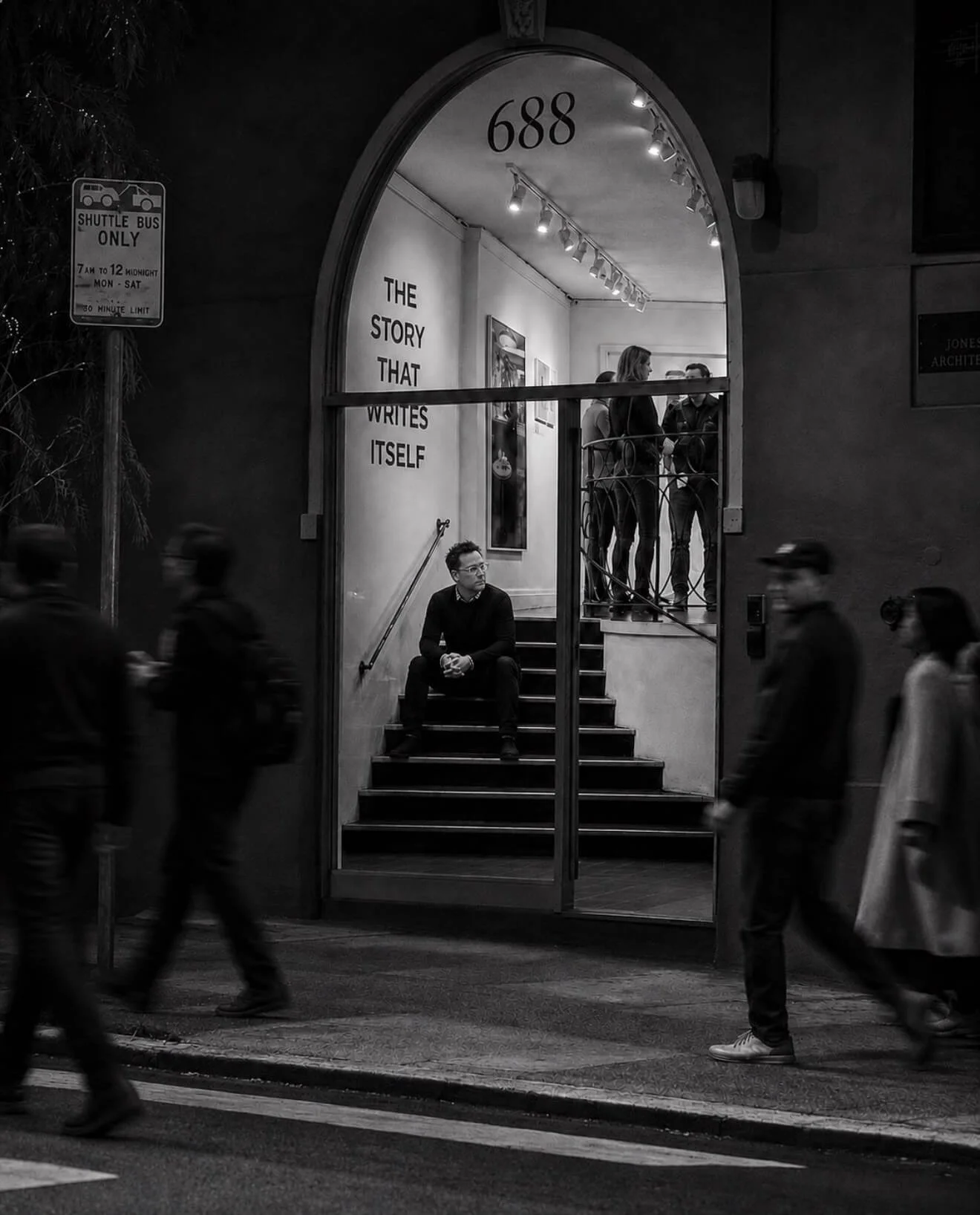
Featured within this image (on an exhibition sign behind the gallery window) is an image of the first graphic I had seen for The Story That Writes Itself–the one that was used for the online flyer and promotions by the school. It shows a worm’s-eye view depiction of a young Black woman, clad in a voluminous yellow puffer and semi-translucent moon boots–both the angle of the shot and her elongated legs make her appear towering and empowered, and the overall vibe is of a slightly futuristic Adidas advertisement. As to why this was chosen for the flyer image, I couldn’t say, but considering the student who prompted it does not appear as either Black or femme, I suspect it may have been an attempt at tokenism or racial shielding to deflect some of the criticism Archibald no doubt feared this exhibit might receive.

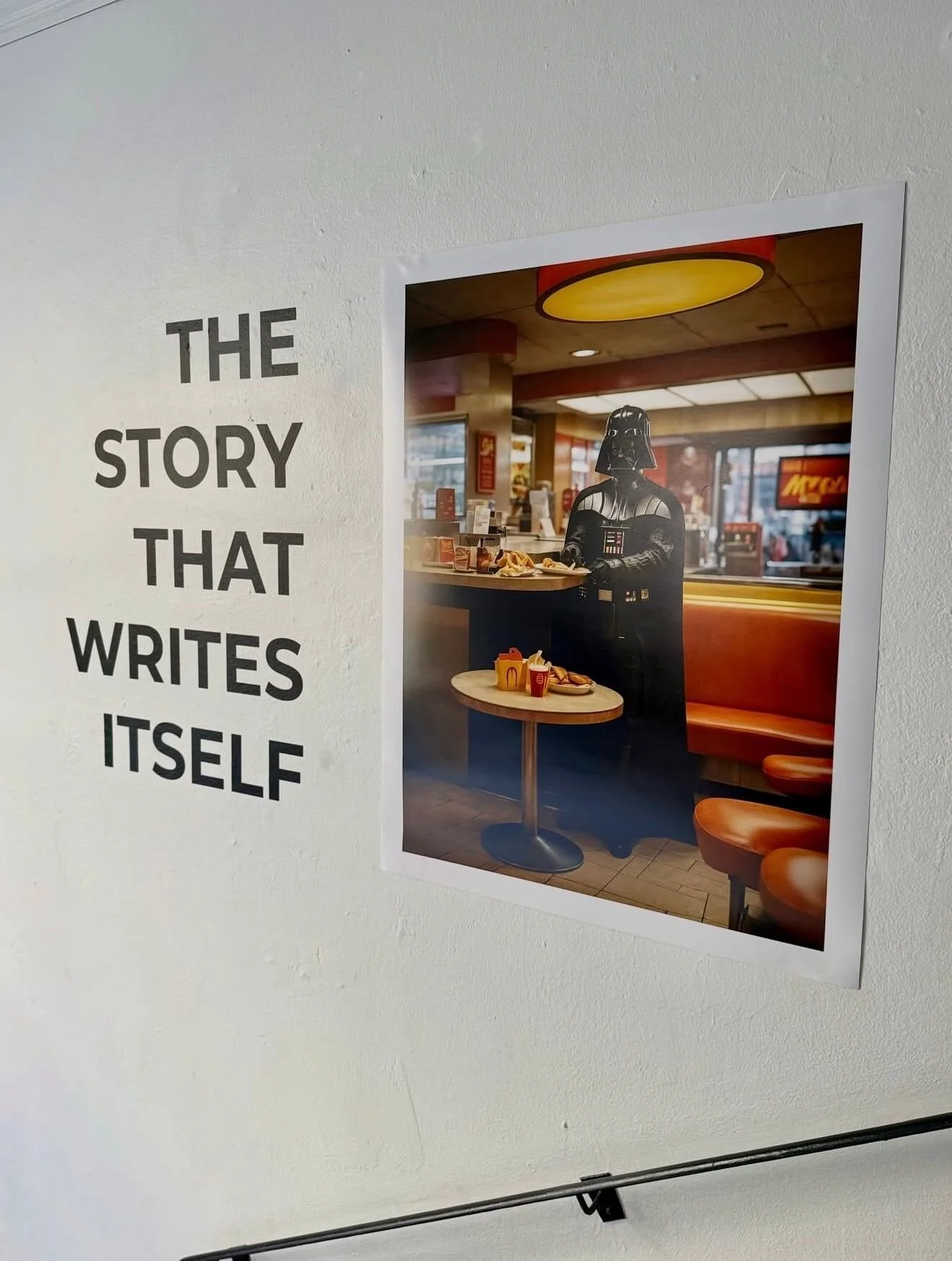
The only other image I saw from the exhibit was of Darth Vader eating a Happy Meal in a retro McDonalds, and I can only assume the rest of the collection was more of the same–trite, nonsensical pop-culture jargon plagiarized off decades of advertisements and other imagery stolen by AI companies. The title of Archibald’s course (and the subheading of the exhibit) “AI for the Visual Artist” would seem to imply the exploration of AI as a tool to supplement artists’ pre-existing practices, but the little bit of work I managed to see from The Story That Writes Itself shows no indication of being anything other than generic, low-grade, generative AI slop.
The question we are now left with is what exactly are the justifications used by professors like Archibald and other AI advocates for its being so thoroughly implemented in the arts? There are of course those who genuinely see the technology as groundbreaking (and view those who oppose it as small-minded luddites). I would agree that exhibits like The Story That Writes Itself are indeed groundbreaking, but only in that they represent milestones in society’s gradual offloading of human thought, ingenuity, and imagination onto machines–which may complete certain tasks like art-making and creative writing with more speed and efficiency, but with absolutely none of the spirit. The other brittle defense of AI lays in claims to its inevitability, and the notion that we all must eventually succumb to the so-called coercive laws of competition. This says to me nothing other than that you subscribe, or at the very least concede, to this extractive culture in which profit is God and every person is left to fend for themselves as our human era gradually destroys life on earth as we know it. It would be remiss of me to describe the individuals who use this excuse as anything other than what they are–cowards and assholes.
I can see, however, why it might be easy for a white, middle-class college professor like Timothy Archibald to maintain such a complacent attitude about AI, as they will likely be among the last to feel the devastating effects that it will wage upon society in the coming decades. The job losses to automation, the widening income gap, and the destruction AI and data centers are wreaking on the natural world will be first and most harshly felt by lower income communities, people of color, and the global south. And to anyone who views the advent of these technologies with a more utopian optimism, I would say that one honest look at the greed, recklessness, and dishonesty of those steering the ship ought to be enough to dispel illusions of any sort of hopeful outcome when it comes to the future of AI and its entwinement with life on earth.
I will end this review by addressing the students who participated in The Story That Writes Itself, and anyone considering taking the course “AI for the Visual Artist” or other such similar shams by grifters like Timothy Archibald–it’s not too late to change course. Like many, I did my experimenting with generative AI when it was in its infancy, before knowing and understanding the narratives surrounding the harmfulness and moral precariousness of these technologies. Even then, those experiments came with a strong uneasiness not just about whether they were good for me as an artist, but whether they were good for art in general–and now, a few years later, I can confidently say they are not.
You are artists and you do not need the help or assistance of corporate plagiarism machines like Midjourney, ChatGPT, or Claude, and it’s only with your refusal to succumb to the false narratives of their inevitability that we can protect human creativity and, more importantly, protect the future of our species and our planet. Perhaps at some point the narratives around AI will shift, its governance will be in more responsible hands and its trajectory won’t be so laden with theft, wastefulness, and destruction, but as of right now I truly and sincerely doubt it.
*Reminder to the reader, the sentiments and opinions expressed in each of the reviews are solely that of the writer and do not reflect the opinions of the publication or its editors unless otherwise stated.