
Shaghayegh Cyrous, Breathe the Sun, Telematic Media Arts
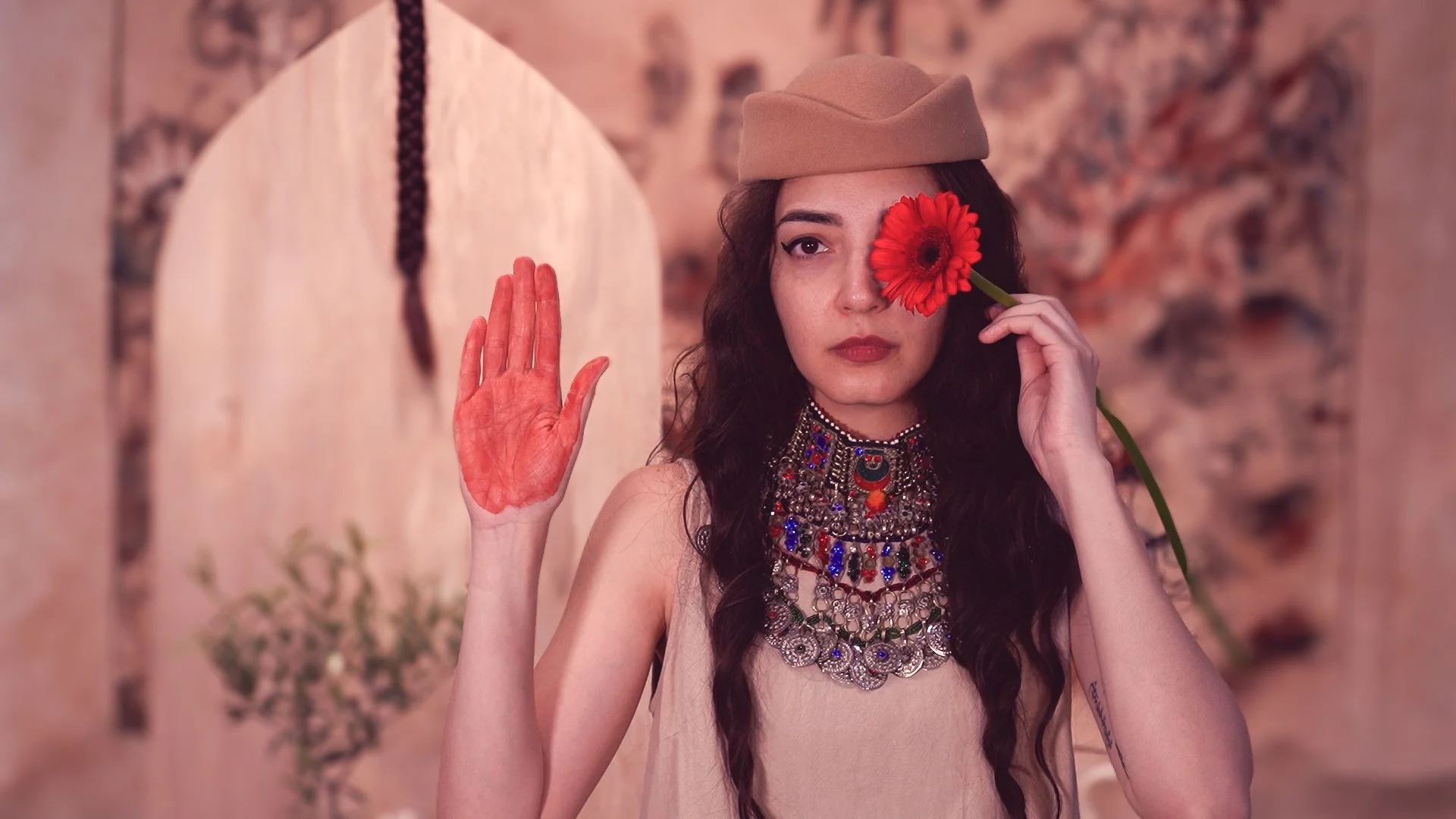
Breathe the Sun, Lead Image, Video Still
The echoes of war and bloodshed have always inspired artists to create what can be categorized as "anti-war art." And the power of their depictions is usually in the gruesomeness of lives on the precipice, as in Goya's The Third of May 1808, which documents the French military's killing of Spanish resistance fighters. More than 200 years after its creation, The Third of May 1808 is among the art world's most mesmerizing paintings because of its microscopic freeze-frame of hell and horror. What Iranian-American artist Shaghayegh Cyrous does at Telematic Media Arts is no less anti-war and just as profound, albeit through a completely counter-intuitive approach: In a video of dance, music, and movement, performers joyously practice the ancestral traditions of a people who are being killed by their own government and by an external war that shows no sign of abating.
Cyrous' video work is her reaction to the ongoing events that are devastating Iran. The people we see are doing things that Persians have orchestrated in ceremonies for some 3,000 years. Through Cyrous' video camera, the colorfully clad men and women in "Breathe the Sun" are exhibiting aspects of Iranian culture that are connected to Zoroastrianism, the pre-Islamic tradition that encouraged dance, song, and mystical displays of revelry. Iran's clerical rulers have essentially banned these kinds of displays in public spaces. Yet at Iranian grave sites in January, after Iranian authorities massacred Iranian citizens, some families openly danced as they remembered their loved ones — a defiant act against Iranian clerical rule, Cyrous says. "Breathe the Sun" is Cyrous' attempt to exhibit that defiance in a San Francisco art space, where visitors can take in two Cyrous videos and surround themselves with physical objects that embody Iran's unique cultural history.
"In Iran, people are fighting with dancing," Cyrous tells me. "Those dances and that playfulness became our resistance."
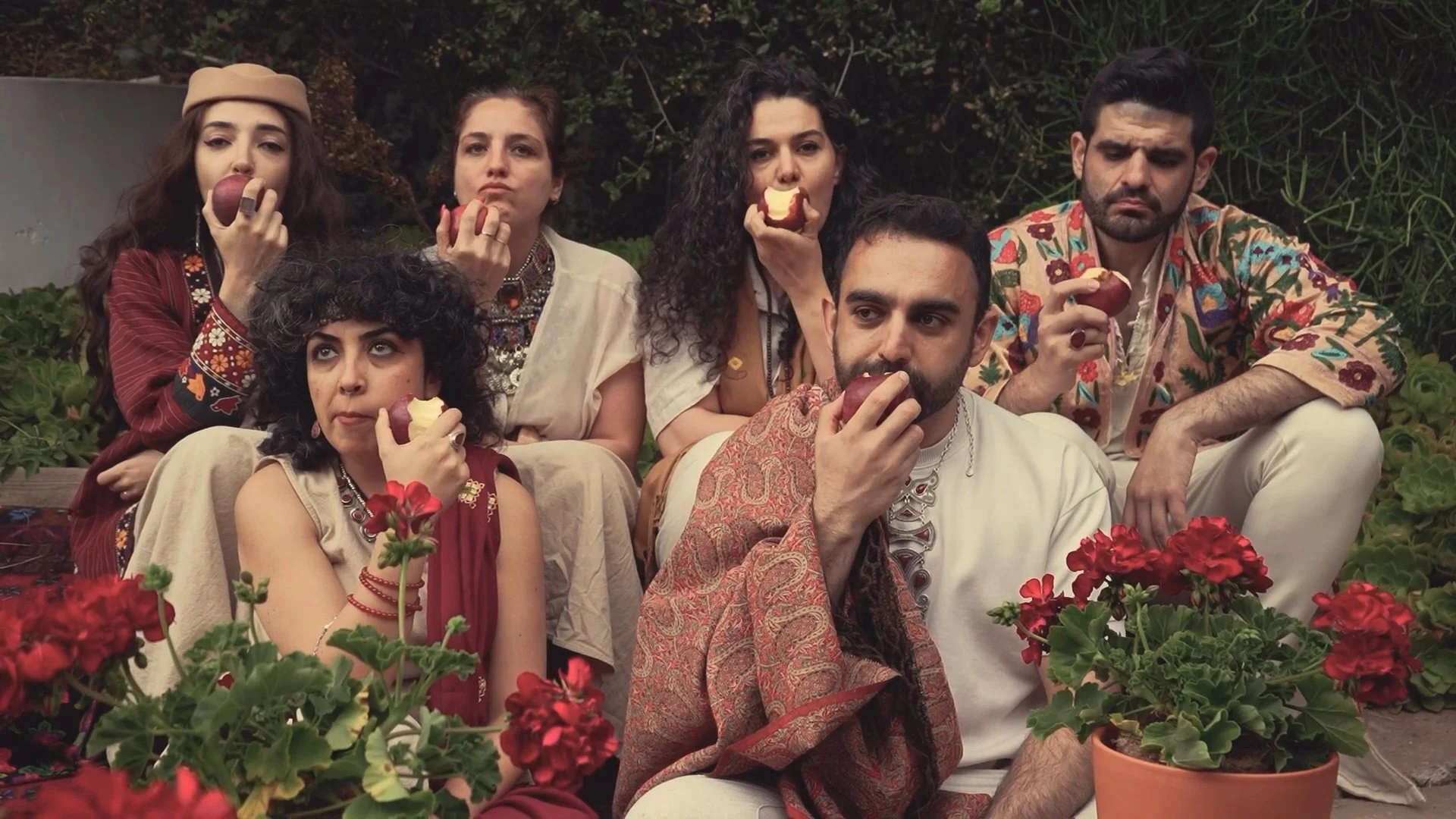
Breathe the Sun, Apples, Video Still
At a time of war when U.S. President Donald Trump has threatened to "annihilate" Iran despite knowing little about the depth and beauty of Iran's culture, and a time when popular podcasts like "Diary of a CEO" entertain guests who talk nonchalantly about the idea that the U.S. could still kill millions of Iranians, "Breathe the Sun" is an art-world antidote to the bellicosity and unknowingness that tinges so much of today's mainstream conversations. Cyrous doesn't resort to demagoguery herself. Instead, "Breathe the Sun" is an invitation to slow down and experience the sounds and symbols of an Iran that has always been there for those who know it's there. Cyrous knows because she grew up in Iran and experienced the culture firsthand, even if Iran's education system discouraged her from embracing Iranian art history that happened before the country's 1979 revolution. Iran's historical art forms included colorful portraiture and, in the 19th and other centuries, women dancing.
A telling example from Cyrous' Iranian education: At Tehran's University of Science and Culture, where Cyrous received her undergraduate degree, she studied Persian miniatures in black and white even though "Persian miniatures are all about color," she said at her exhibit's opening event. "At school we weren't allowed to embrace color."
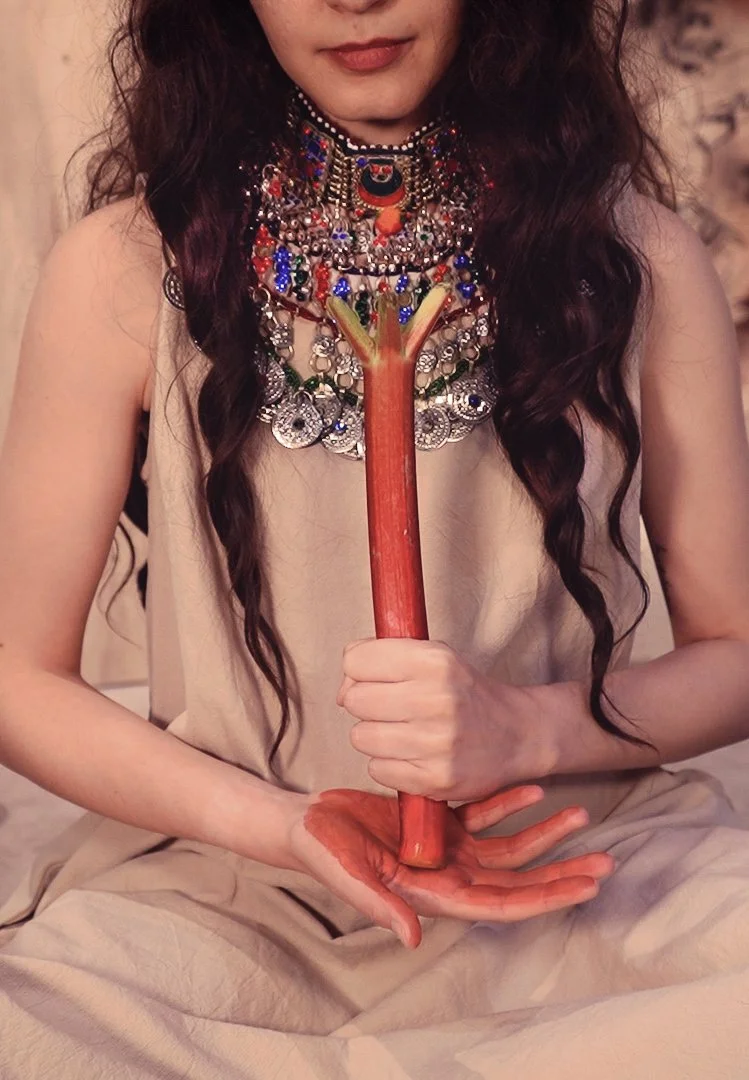
Breathe the Sun, Vertical Rhubarb, Video Still
Color saturates nearly every part of "Breathe the Sun," especially the colors red and burgundy, but Cyrous' exhibit isn't an exercise of "in-your-face" finger-pointing. Few words are even spoken. Instead, video scenes are connected by intertitles that reference a centuries-old Persian book about Zoroastrian cosmology called the Bundahishn ("Creation"), embodied by the book's belief that men and women were created as equals. Some scenes feature actions that people of Persian descent will recognize, Cyrous says, as with people writing Farsi script on hard-shell eggs, then breaking the egg to understand someone's bad intentions and to "break the curse." In Iran's greatest epic poem, the 11th-century Shahnameh, a feature symbolizes a miraculous rescue and hope, and "Breathe the Sun" features a prominent feather.
Still, you don't need to be a Persian scholar to get the vibe that emanates from "Breathe the Sun," which is on view through October 31. At the opening event, Abby Chen, Head of Contemporary Art and Senior Associate Curator at the Asian Art Museum, told Cyrous that she related the exhibit's motifs to her cultural upbringing in China. And Chen said she was surprised by the exhibit's "intimate quietness" and its power to reach the "inner self" of art-goers. In fact, Cyrous tells me that she deliberately toned down the upfront political underpinnings of her work. Before her San Francisco exhibit and a companion Los Angeles exhibit, "I was creating more direct political work, but I came to a position that it wasn't helping me, and I thought it wasn't helping the community," says Cyrous, whose entire family is still in Iran. "We need healing. We need to explore who we are. And I was working on Persian mythology for a while — even back in Iran."
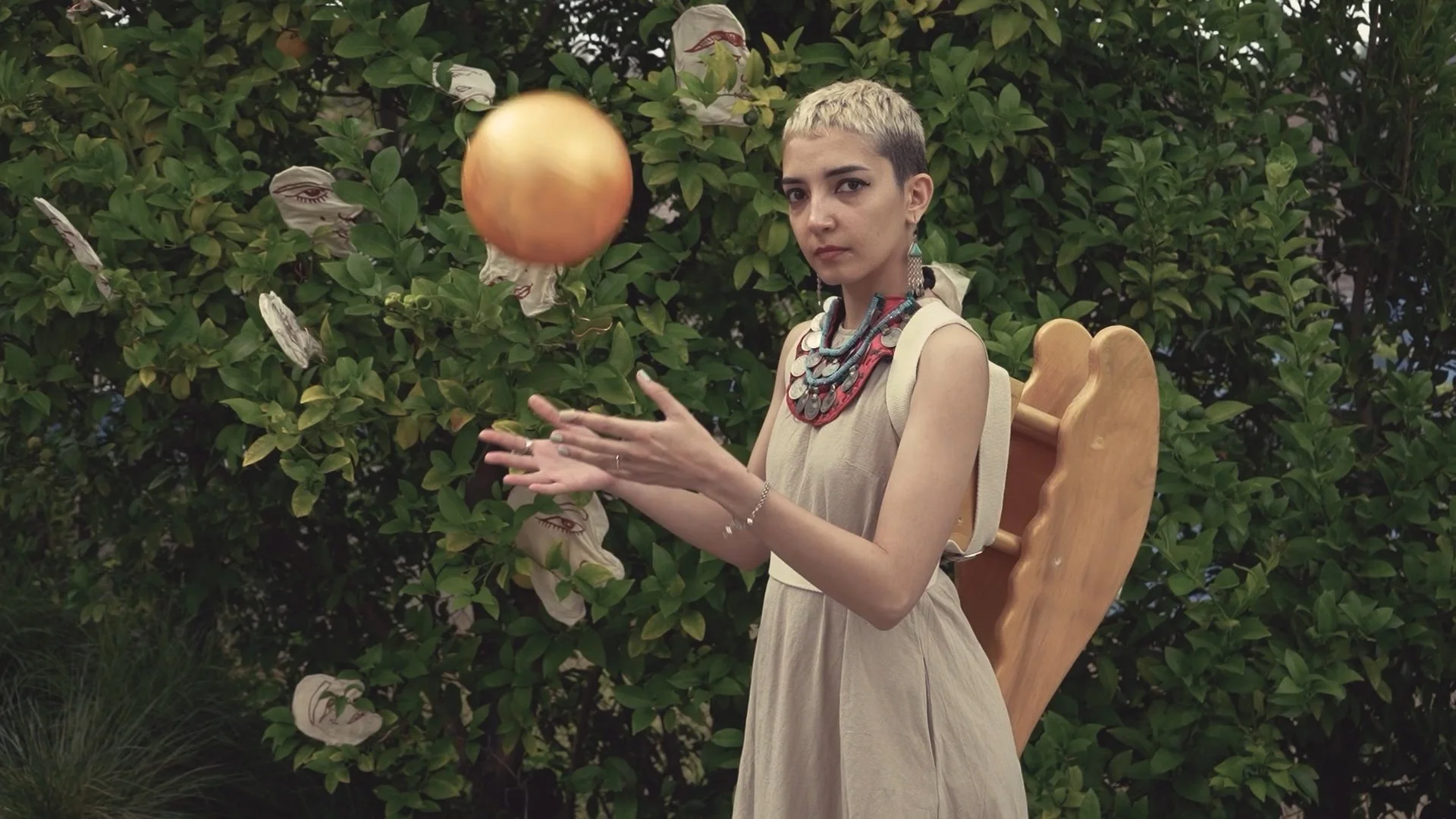
Breathe the Sun, Golden Ball, Video Still
Anyone who's visited Clarion Alley in the Mission District will already know Cyrous' art. In 2015, she painted “In Memory of Forough Farrokhzad, Simin Behbahani, and Simin Daneshvar," a mural that celebrates three prominent women in Iranian literature. Cyrous moved from Iran to San Francisco in 2011 to get her MFA in Social Practice from California College of the Arts. She lived here for a decade before moving a few years ago to Los Angeles. The dancers and musicians in "Breathe the Sun" are other people in Los Angeles from the Iranian diaspora, and their animated expressions and joie de vivre help drive the exhibit’s visceral power. "Breathe the Sun" has been cathartic for Cyrous, who is mindful that art-goers will connect her exhibit to current events.
“As an Iranian, dance is illegal in Iran,” she tells me. “Music is illegal in Iran. As an Iranian, no matter what I do, as a woman, whatever I do is political. . . . . You don’t want to have the label of ‘political,’ but it’s in your face. No matter how far you want to run away from it.”
