
Al Farrow, It’s Not Dark Yet, Catharine Clark Gallery
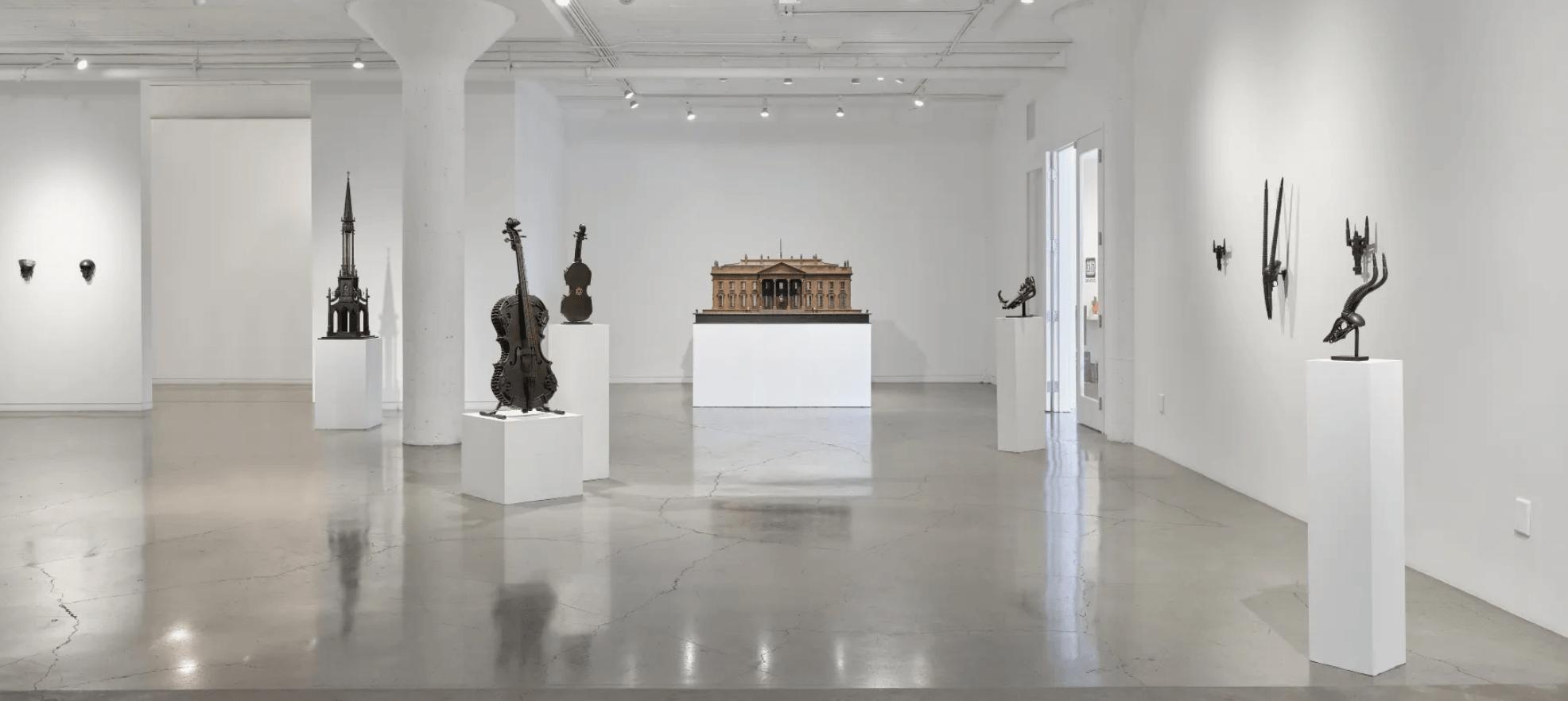
Photo: Chris Grunder
For the past three decades, sculptor Al Farrow has spent countless hours cruising the aisles at gun shows.
Although Farrow can count on one hand the number of times he has actually fired a gun (“I tried it; I hated it,”), he has used all manner of deconstructed weapons and munitions to build exquisite religious reliquaries and intricately detailed places of worship as a commentary on the relationship between religion, violence, and hypocrisy. With this body of work, Farrow is defiantly agnostic: be it a synagogue framed out of revolvers, uzis, machine gun barrels and an Israeli-army-issued tefillin bag; a church bolstered by bayonets with Durer’s Four Horsemen of the Apocalypse visible through the glass windows, or a Shia mosque whose dome—made of gold-leafed shell casings—has been reduced to rubble by a Sunni bomb.
“Of course, I never told the vendors what I was up to—that I’m creating social critiques about how horrific guns are,” said Farrow, a gentle man whose aversion to violence is such that he told his wife early in their marriage that he could not join her in watching true crime dramas.
Although Farrow had previously incorporated toy guns (in work that addressed America’s exploitative sales of weapons to foreign countries), he was struck with the idea of using real armaments—hand guns, machine gun barrels, bullets, rocket launchers, hand grenades—as building materials during a trip to Italy in 1994. “I was in a church in Gubbio when I spotted this silver reliquary housing the bone of a trigger finger—and it triggered something in me,” said Farrow, who observed how reliquaries housing the remains of saints and martyrs were often made from precious metals and adorned with jewels. “I thought, well, what’s precious to Americans? Arms and bullets,” said Farrow, whose work has long been scaffolded by social commentary, including the American fetish for firearms.
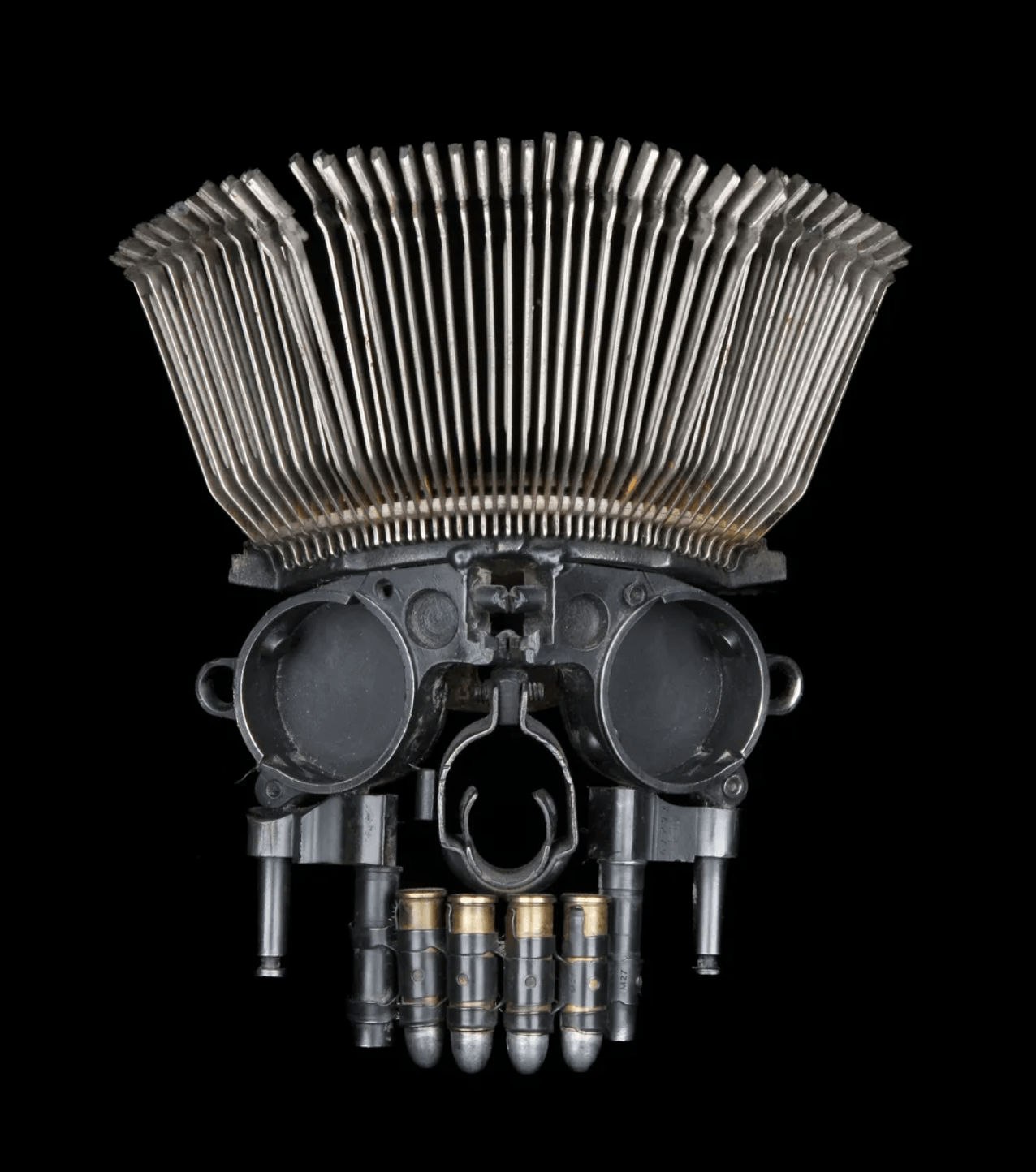
Skull Mask (With Typewriter Parts), 2025 Gun parts, typewriter parts, bullets, steel 8 x 5 1/2 x 3 in
With his current show, It’s Not Dark Yet, on view at the Catharine Clark Gallery through August 15, Farrow continues to pull from his tranche of munitions while pivoting to a more personal and less overtly didactic body of work. “I realized that I’d been addressing the same subject matter for a long time,” said Farrow. “And my pieces kept getting bigger and more complex and frankly, more tedious to build.”
Farrow shares that when Covid hit, he found himself at loose ends, with no shows on the calendar and no sense of when the ordeal might end. “So, I started doing these ink paintings, really fast and loose, just having fun, which I used to do 50 years ago,” said Farrow. “And it reminded me of the joy I used to feel in being spontaneous and creative without a plan or the need to make a million measurements.”
When Farrow was ready to return to sculpture, the world was in a different place, and so was he. “Look, when you get to be in your eighties, as I am, you know in your bones you don’t have a lot of time left. At this point in my life, I don’t want to spend a year or two on a single sculpture, even if it’s wonderful. I want to play and have fun.” So, informed by the recognition that his own days are numbered, Farrow took his language of armament in a new direction—one more akin to bricolage, say, than architecture.
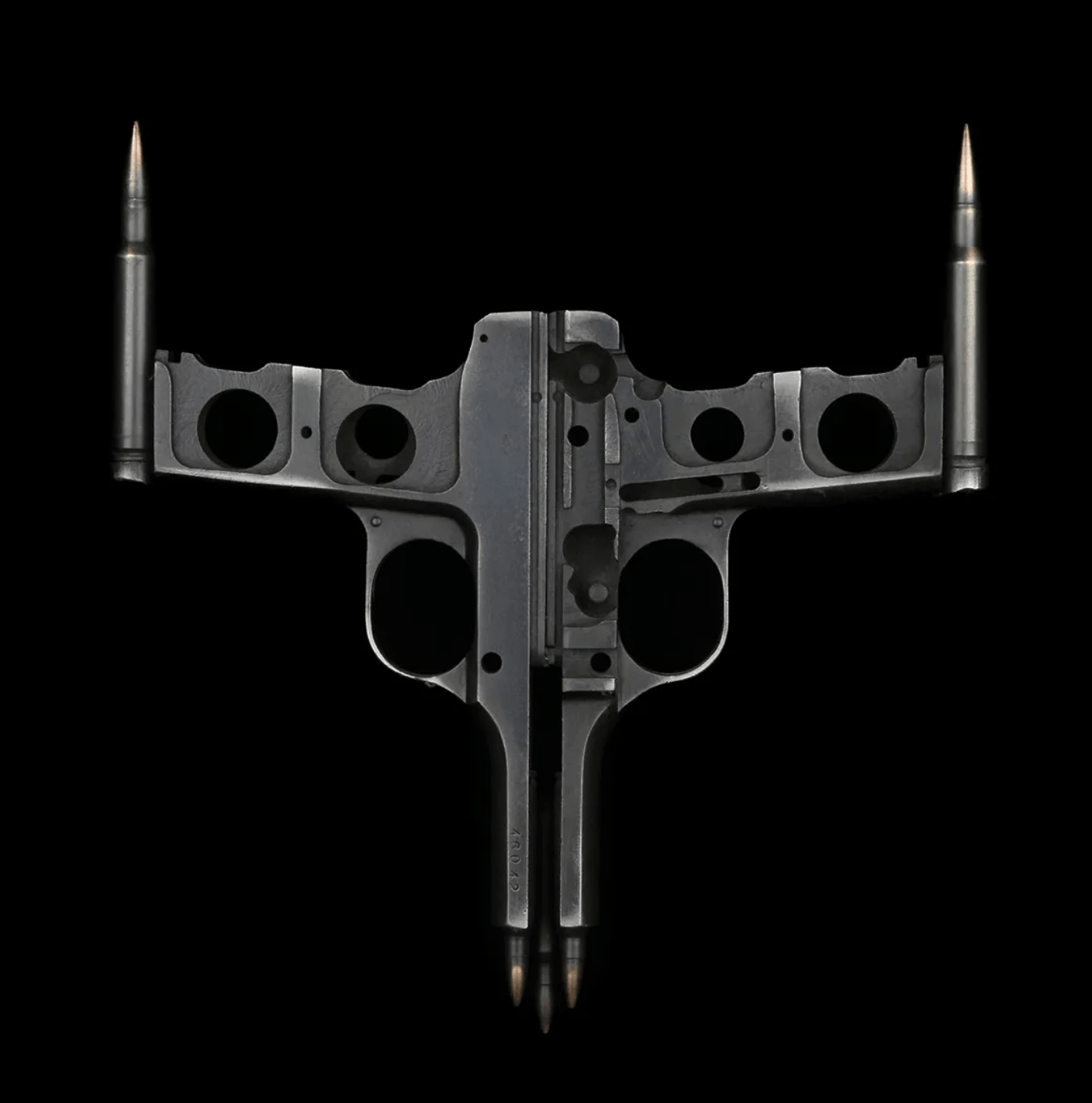
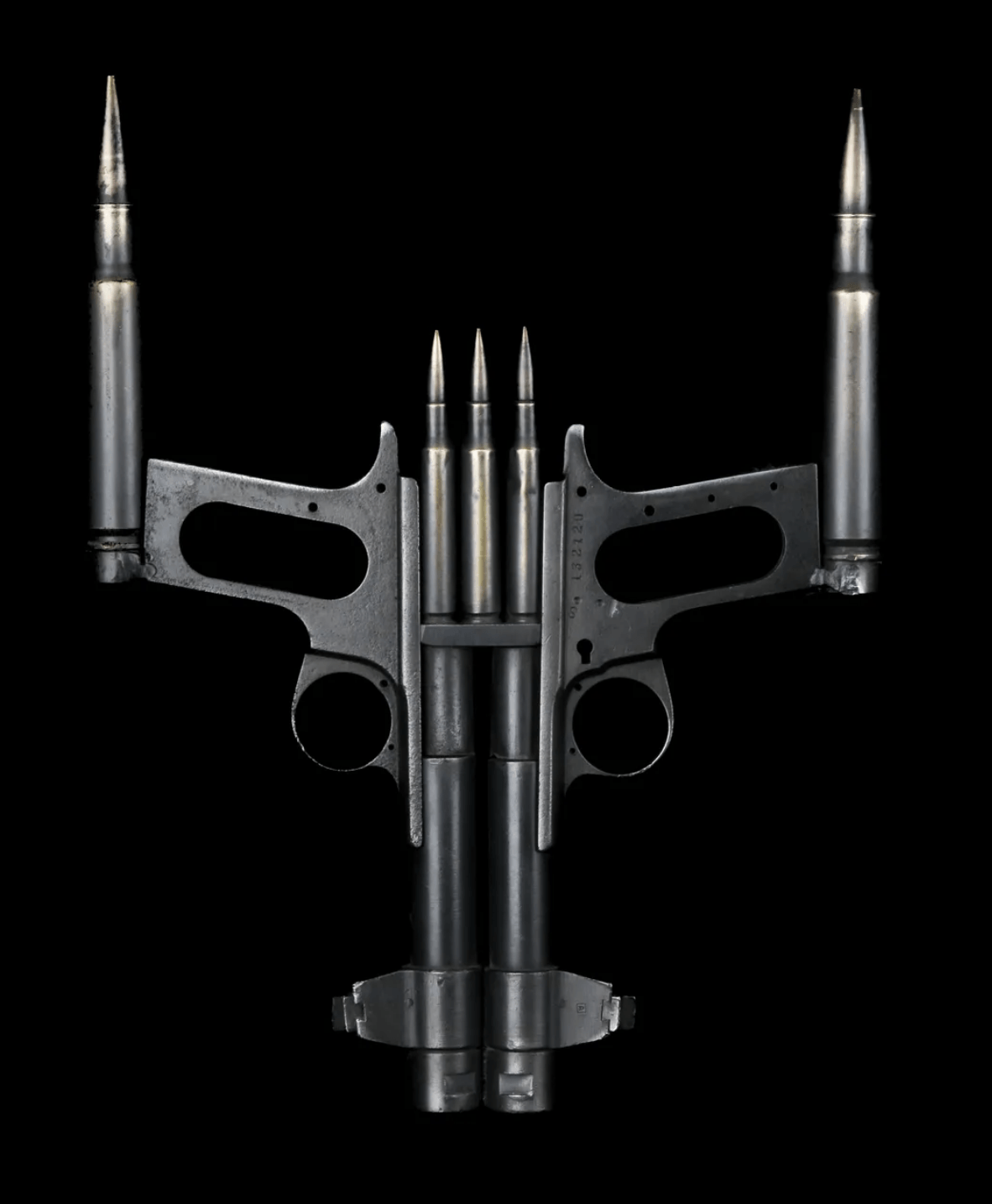
“I looked down and realized that, hey, trigger guards look a lot like eye sockets, and that was my jumping-off point,” said Farrow, who started picking through his stockpile of munitions and essentially riffing—like a musician playing an impromptu improv underpinned by years of practicing scales and perfecting sonatas. Armed with his torch, he began by constructing human heads, skulls, and masks—which are suggestive of steampunk portraits—before depicting animals, some of which are mounted on the walls like hunting trophies while others perch atop pedestals. A shorebird clutches not a fish, but a bullet in a long beak fashioned from repurposed bayonets. Cow Skull (2025) is made from a pair of gun frames and five bullets. “I was pleased with its simplicity, especially after all those complex sculptures of religious edifices,” said Farrow. “A few days later, I realized it reminded me of my favorite Picasso sculpture, Bull’s Head—which consists of only a bicycle seat and handlebars.” As you take in the pieces, your brain toggles between seeing the finished forms and clocking the individual components—assorted implements of death and destruction.
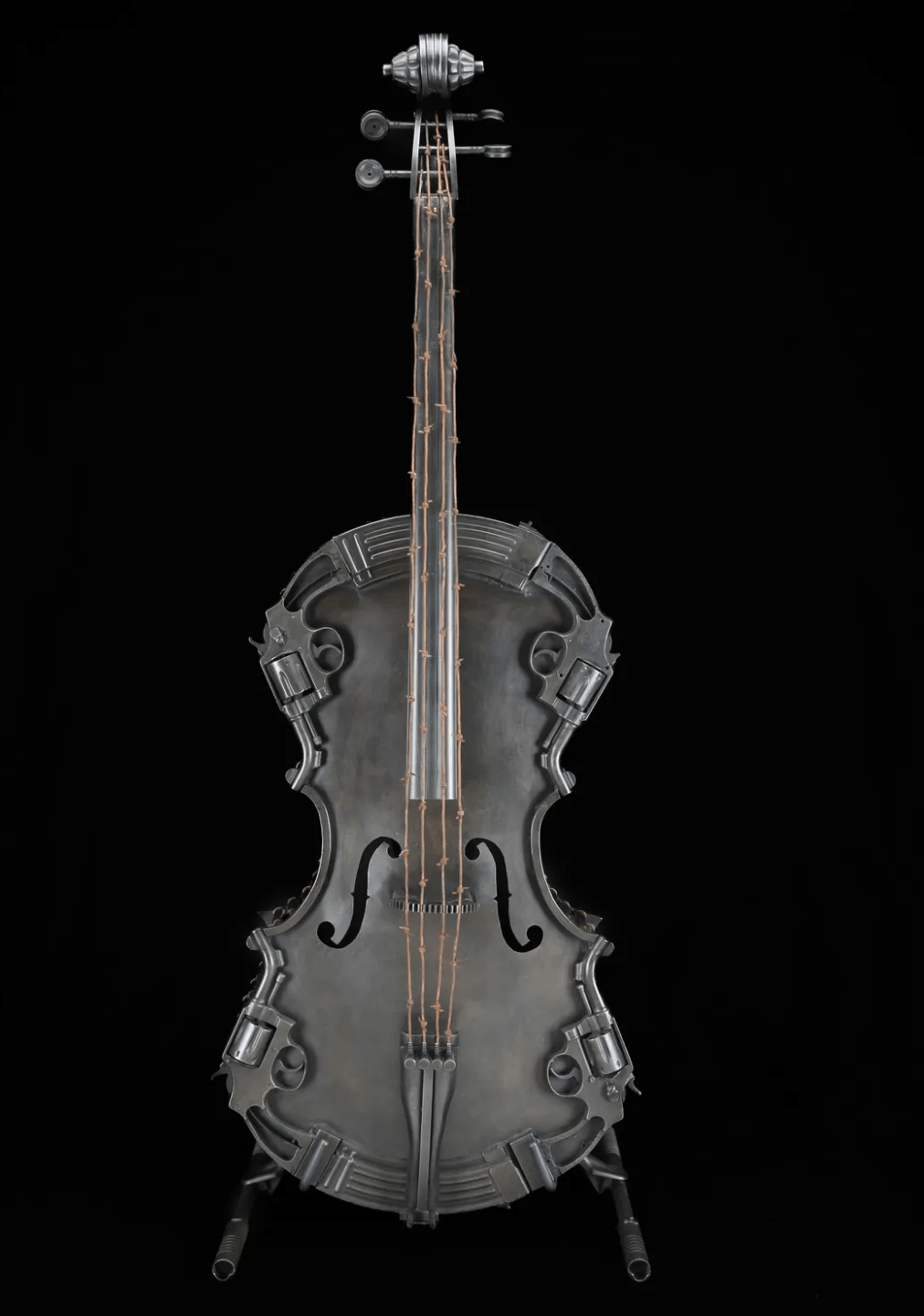
(L) The Black Cello (Inspired by Violins of Hope), Gun parts, gears, gold leaf, hand grenade, barbed wire, AK-47 magazines, bayonets, belted bullets, sub-machine gun barrels, machine gun bipods, steel, guns, cartridge shells 50 x 17 3/4 x 13 inches (including stand)
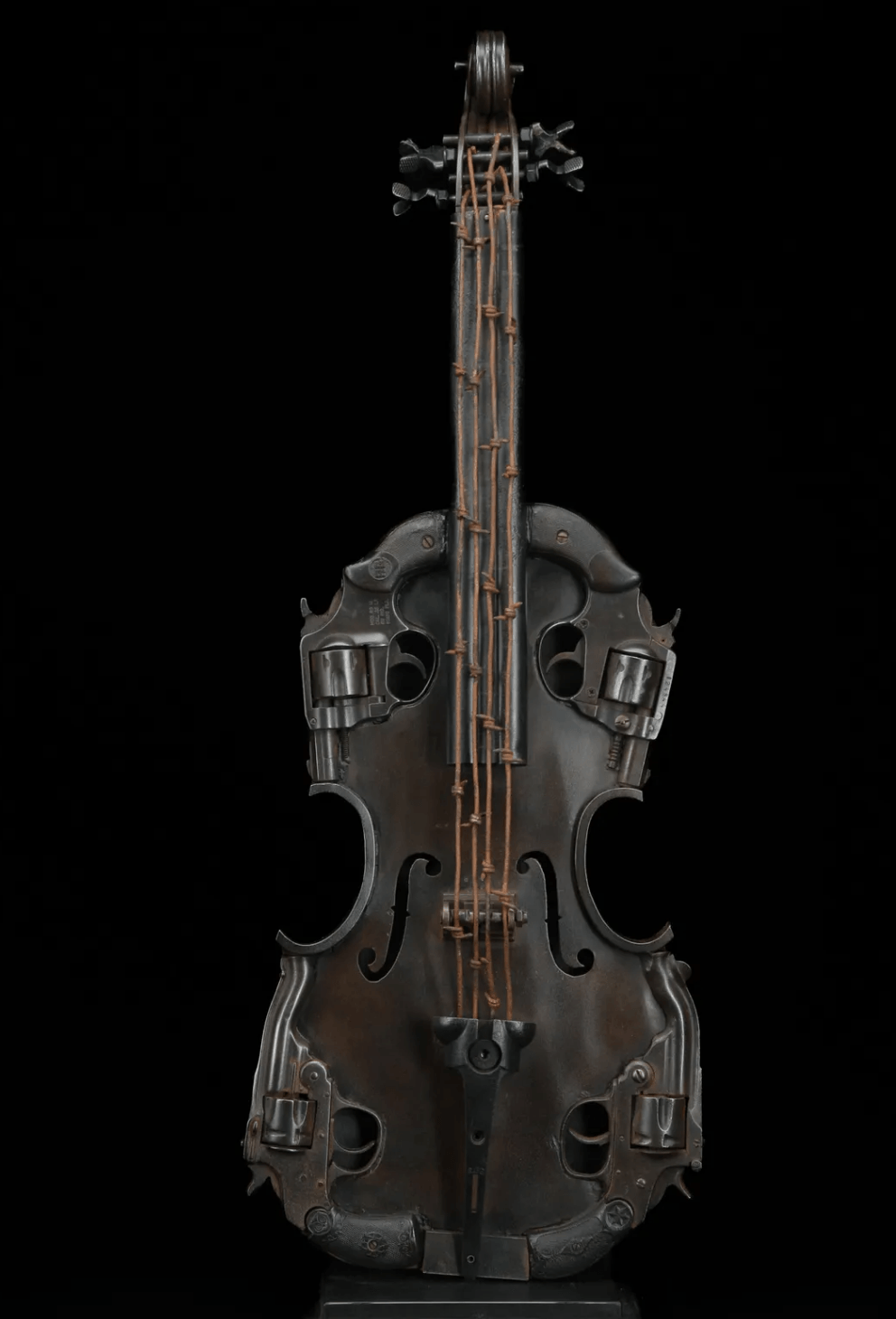
(R) Violin (Inspired by Violins of Hope), 2025 Guns, gun parts, bayonets, steel, barbed wire, gold leaf 27 1/2 x 9 1/2 x 5 inches
As the work shifts into focus, so does the show’s title. It’s Not Dark Yet is a Bob Dylan song from 1997, whose second line goes: “But it’s getting there.” In this show, spurred in part by Farrow’s reckoning with his own mortality (as the arthritis in his fingers attests), every piece is a memento mori of one kind or another, including the two musical instruments placed in the center: The Black Cello (2026) and Violin (2026). Both were inspired by Violins of Hope, a collection of restored string instruments that were rescued from ghettos, concentration camps, and trains and are now used in performances. “I read a really moving book about the people who played them, like resistance fighters in Poland and a kid who watched his family get wiped out and escaped with just his violin,” said Farrow. “My wife and I watch a lot of violin concertos on YouTube, and one night I started noticing how the vertical grain of maple on the side walls resembled bullets. I realized I could use a double-barrel shotgun for the neck, heat up a couple of bayonets and bend them around for the scroll—and there was no stopping.” The instruments embrace the best and worst impulses of mankind, made even more visceral by the barbed wire strings. “I wanted to reference the Holocaust and the camps,” says Farrow. “For me, they are also a reminder that we, as Jewish people, were not long ago in a position that is not unlike what is happening to the Palestinians.”
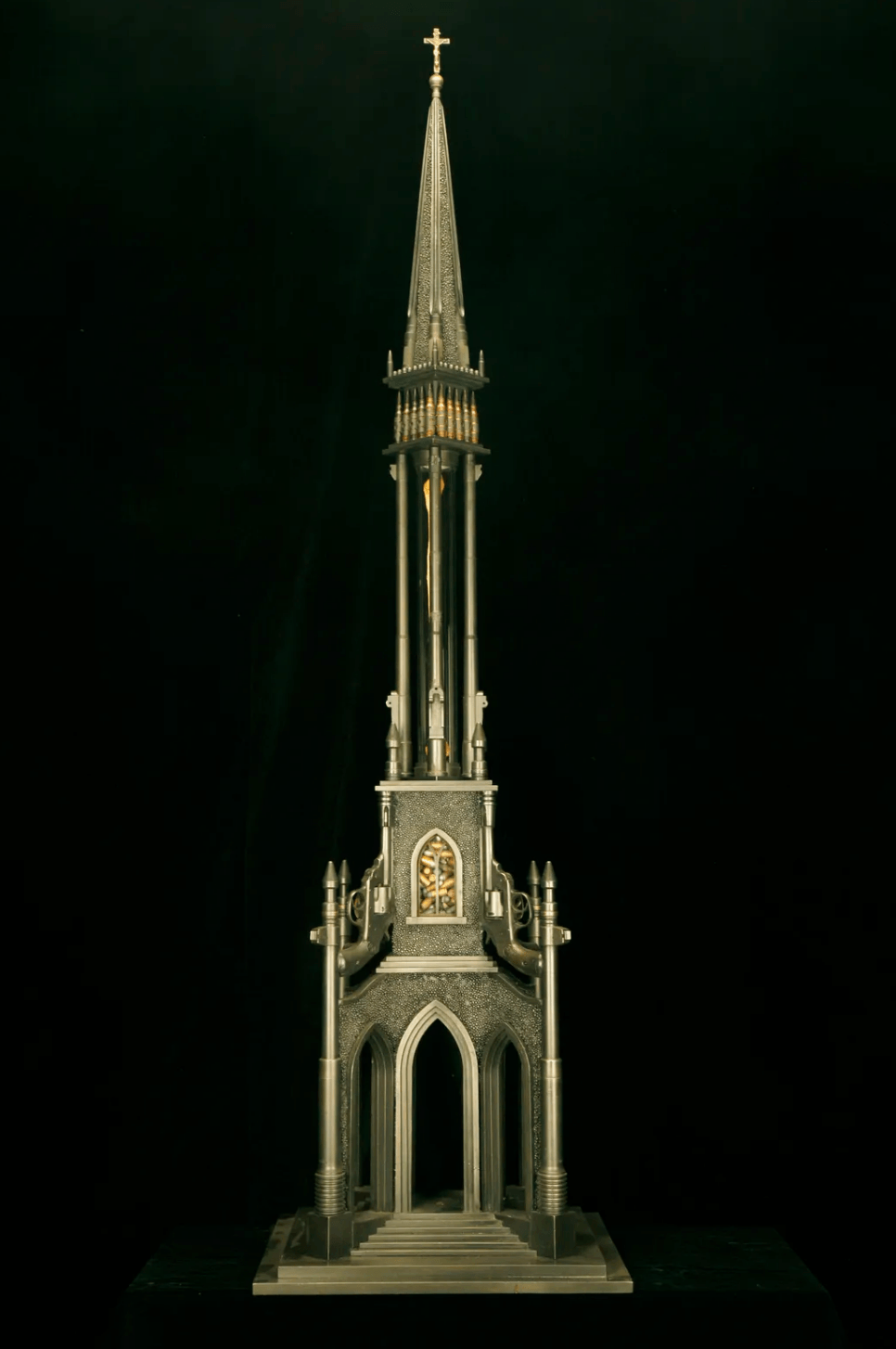
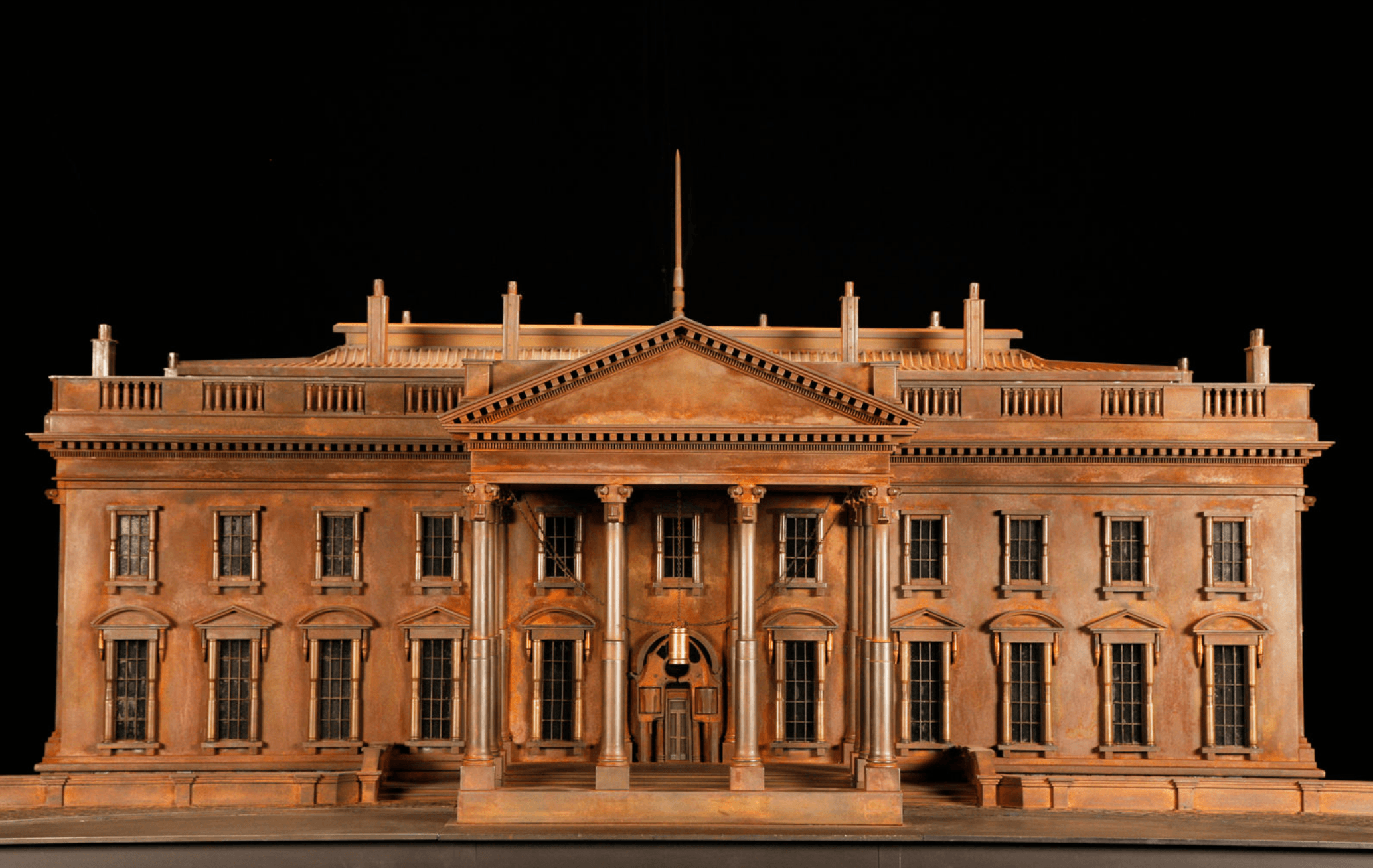
(L) The Last Reliquary (The Fibula and Tooth of Santo Guerro), 2024 Gun parts, bone, glass, bullets, crucifix, bayonets, steel, bullets, tooth
63 x 17 x 17 in
(R) The White House, 2018 Guns, gun parts, shell casings, bullets, steel, glass, patina 77 x 69 x 36 inches
Two older pieces round out the exhibition. Farrow’s final reliquary from 2024, The Last Reliquary (The Fibula and Tooth of Santo Guerro), houses bones of his invented saint of war and sits within whispering distance of The White House, which Farrow began building during the Bush administration as a response to the Iraq War. He hit pause when Obama was elected amidst a surge of hope, then was compelled to complete it during Trump’s first term. Monumental in scale and weighing some 2000 pounds, The White House is constructed of gun parts, bullets, shell casings, and glass, and was scaled not to plan, but rather to the eighteen machine gun barrels that form the columns. Today, its empty rooms and rusted façade embody the erosion of democracy—the literal death of a nation. Although Farrow sees it as a turning point in his work toward more secular themes, at the end of the day, zealotry—be it religious or political—takes no prisoners.
