
In the Company of Still Life, ArtYard, Frenchtown, New Jersey
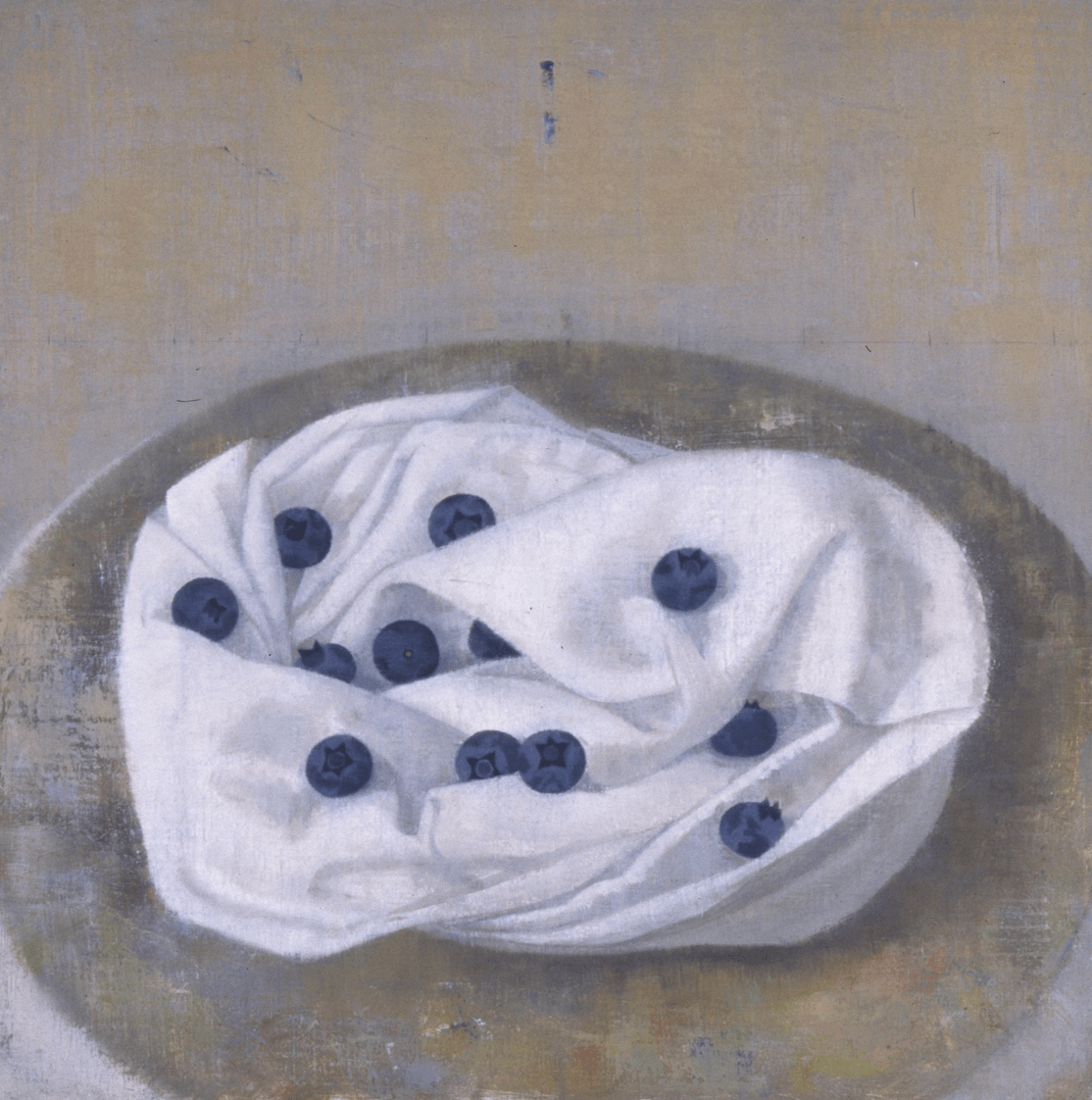
Susan Jane Walp, Blueberries on a White Cloth, oil on linen,1997, 9" x 9". Collection of the Artist. Courtesy of ArtYard/Photo, photo by Paul Warchol
In the Company of Still Life, February 21––May 31, 2026
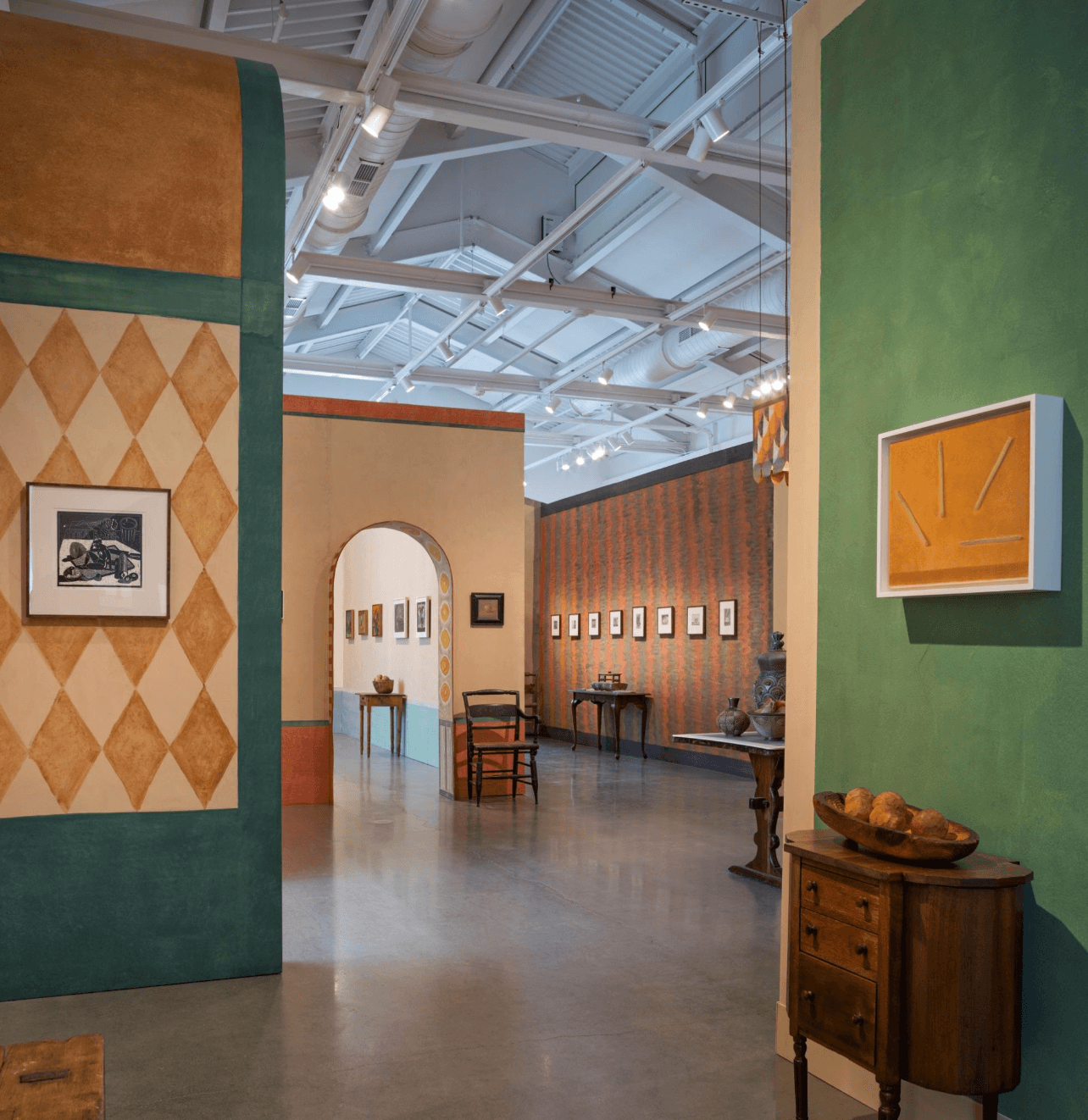
In the Company of Still Life, curated by Clara Weishahn and Alex Cohen, was designed for a gallery at ArtYard, a former brick hatchery on the Delaware River between New Jersey and Pennsylvania. When I visited, local artists, art and antique collectors, flea market buffs, and creatives who incorporate junk/treasure in their own works were visibly smitten. In subtly colored and decorated "rooms," still life paintings, pottery, drawings, photography, collage, prints, found objects, and sculpture are presented with restraint, an effect modeled on Kings Oaks, Weishahn’s and Cohen's passion project and farm in Newtown, Pennsylvania, where they present music, performance, classes, and a highly regarded fall art exhibition.
Weishahn and Cohen take the history of still life seriously, and for this show they researched its evolution through Egypt, China, Italy, and Holland, pivoting with Giorgio Morandi (who, Cohen says, "gives us permission to look"), Cezanne and Bonnard's still-lifes and interiors, and ending with Georges Braque and Phillip Guston. The curators modeled the exhibition's aesthetic on examples of striking and clever attention to domestic beauty: Neapolitan tapestries, frescoes in Herculaneum, Henry Chapman Mercer's rambling Fonthill Castle, Sir John Soane's Museum, Bloomsbury Group homes, Omega Workshops, and the Russian dacha tradition. Because In the Company of Still Life features forty artists, I will highlight works that made me linger on my first visit. The exhibition, a veritable Wunderkammer, demands repeated viewings.
At the Mediterranean-style Courtyard entrance, three inviting portals are interrupted by Gabriele Risso's Still Life Maquettes (2024-25), arid, Morandi-like sculptures situated on a pedestal and in wall niches, and two reliefs, Still life (2023) and Study for Table VIII (2025). He abstracts bottles and other common tabletop shapes as modular, fluid translations between 2-D and 3-D, establishing a baseline that combines the ancient, Cubist, and formal.
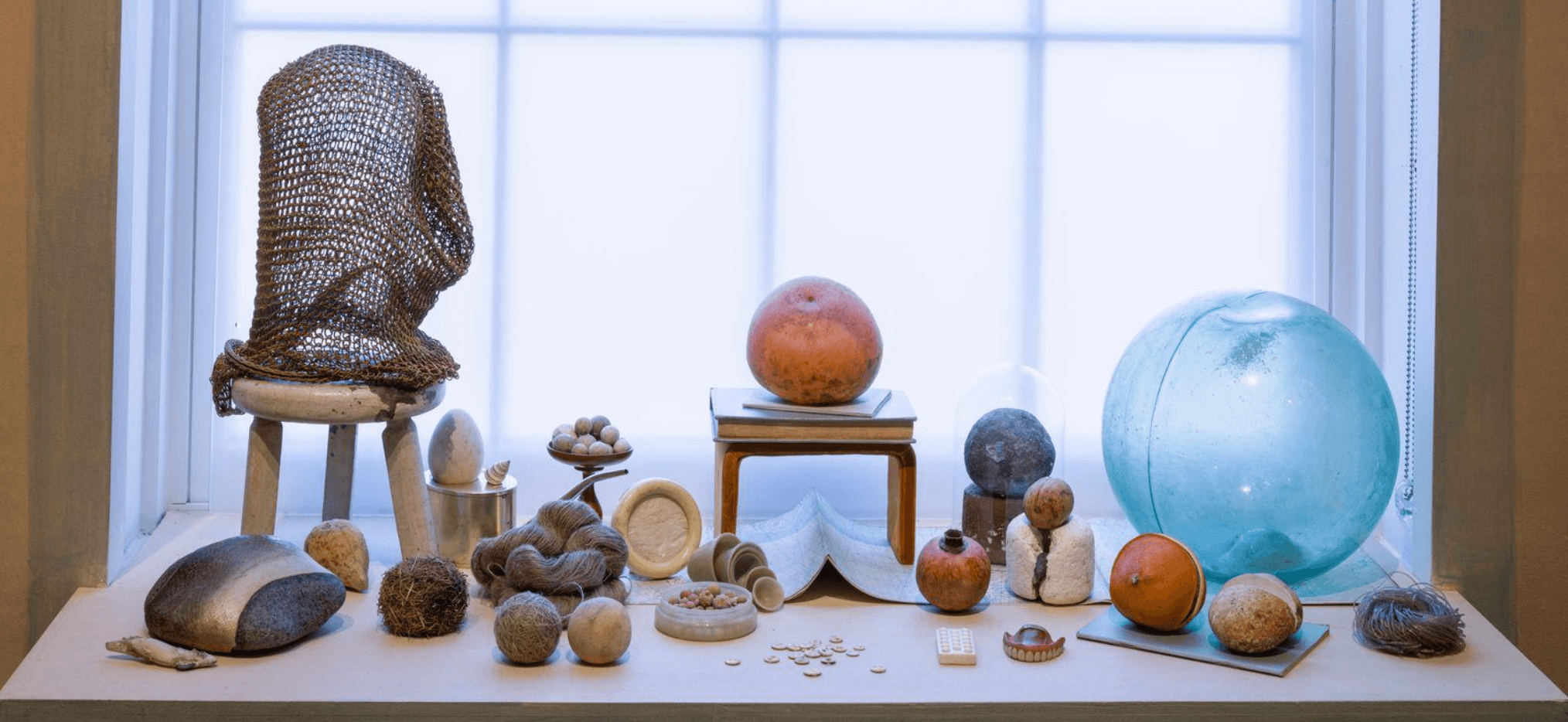
Margaret Parish, Windowsill Installation, 2026, mixed media and found objects, dimensions variable. Courtesy of ArtYard/Photo, photo by Paul Warchol.
The Celadon Room serially organizes realistic still lifes by several artists. The divinity of Susan Jane Walp's Blueberries on a White Cloth (1997) hinges on seeing several of her paintings together. A child's chair in a corner and various wooden furniture create a homey, orderly, unrushed mood for viewing traditional overhead and frontal paintings of flowers and dishes of food. Fragments in E. M. Saniga's painting Soft Paste, Spoons, Wallpaper and Trap Jaws (2011-2014) speak the same language as Margaret Parish's Windowsill Installation (2026) bathed in river light coming through sanded plexiglass. Soft light harmonizes Parish's selections of, to name a few: dried fruit, wooden balls, balls of string, buttons, a head-shaped net, a map, a fossil-like fish, and someone's upper denture plate. Her installation compares "holding," "fixing," and "tasting texture"––albeit tangentially––with faithfully observed and rendered still lifes.
A remarkable thing about this show is that all the work seems destined to take turns as background or centerstage. For example, in the Dining Room and Wall of Windows area, Johnny Izatt-Lowry's 4 Pieces of asparagus, on a table, ii (2021) above Mayumi Sarai's wooden Basket of Oranges After Van Gogh (2025): their combined pieces stop me in my tracks with powerful simplicity, jolting me out of a mental world of tabletop variations. All around me, realism is morphing and flattening via Mariel Capanna's fresco What's Left (2017), Dee Jenkins's Dry Flat (2023), and Ken Kewley's Winter Bouquet Series (2018-19). Serenity––and the protected life of unconscious objects––continues to unravel with Gwen Strahle's Chosen Object (2022) and Allie Webb's Bread, Hand, Onion (2025) that both picture hands as objects. Webb's Escargot, Pepper, Knife (2025) menaces like Margaret Parish's second Windowsill Installation (2026) featuring a disembodied gloved hand, hair comb, epaulette, sunglasses, shoe trees, and jumbo kitchen knife.
Left, Allie Webb, Teabags, 2024, Linocut relief print on Stonehenge, 16" x 15" Maple frame by Alex Cohen.
right, Johnny Izatt-Lowry, 4 Pieces of asparagus, on a table, ii, 2021, pigment and pastel on crepe, 18' x 20"
Collection of Aubrey Levinthal and Alex Kursman. Courtesy of Cooke Latham Gallery.
on table: Mayumi Sarai, Basket of Oranges After Van Gogh, 2025, wood, 12" x 9" x 8".
Courtesy of ArtYard/Photo, photo by Paul Warchol.
Under the curators' custom-made, arch-patterned lampshade on a Dining Room table, David MacDonald's irresistible stoneware pieces Covered Jars, Vases, and Tumblers (2026) continue on into the Fireplace Room that features his Porcelain Carved Tumblers opposite a staged, medicine-green fireplace complete with painted fire screen. On the mantle under Rotem Amizur's painted paper collage, Still Life with Purple Plums (2025), Parish’s working tape dispenser, clothespin holder, metal irons, and a metal-looking vase suggest that "irony" is holding things together. The room gains busy, humorous traction with Clara Kewley's intricate, painted paper collage Albanese Meats and Poultry (2025), sporting "I Got'cha Steaks" signage. Joseph Podlesnik's dusty, timeworn photographs with window-reflected scenes. Still-Life, Phoenix AZ (2015) and Still-Life AZ, II (2016) suggest remembering home from a distance. Elizabeth Endres's lush paintings Gathered Bouquet (2023), Curves and Edges (2025), and Still Life with a Fragment of a Tapestry ("The Visit of the Gypsies") (2025) crowd a wall behind an antique couch: it's difficult to focus on each busy painting, but overabundance could be the curators’ point.
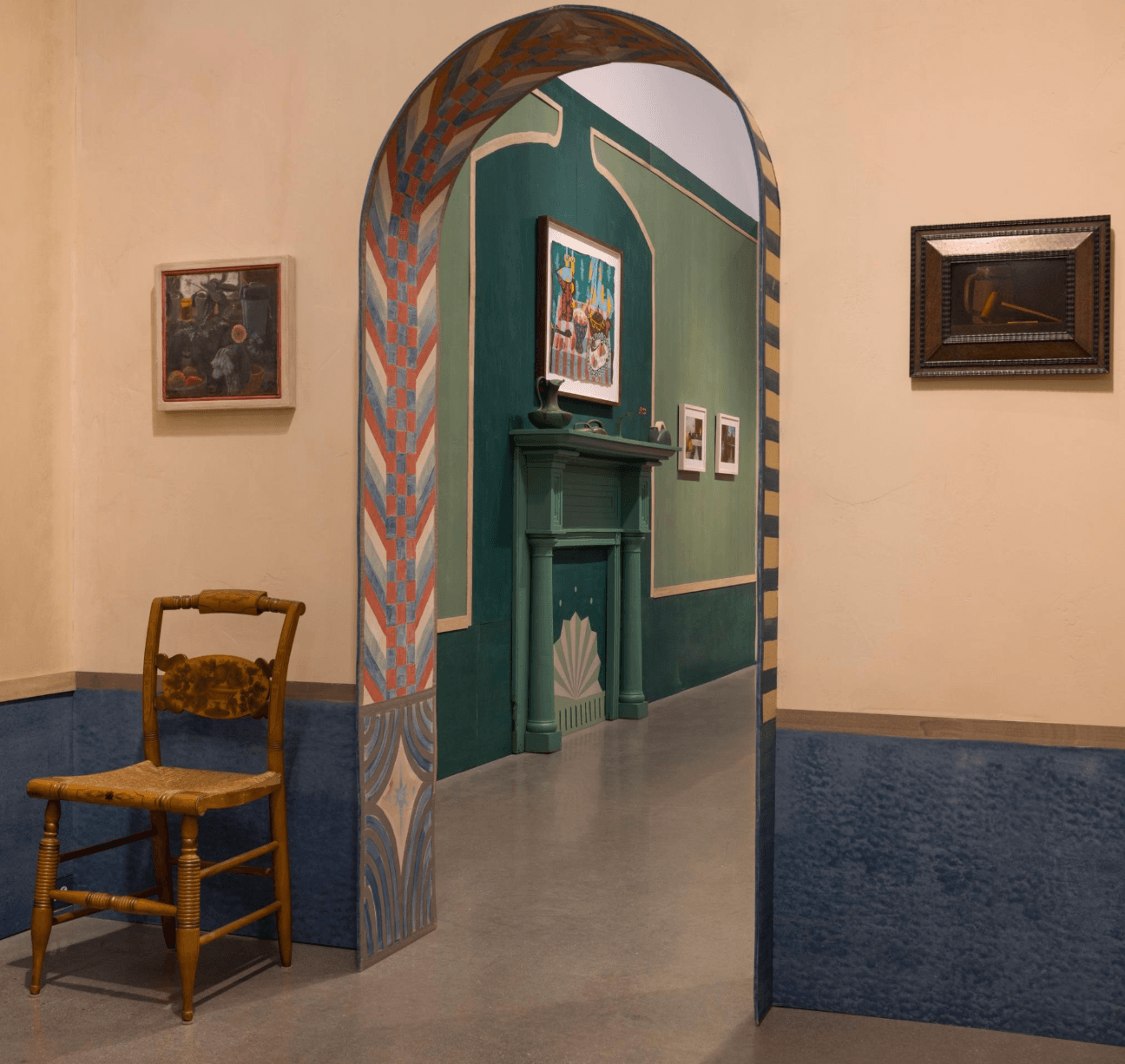
Left Alex Cohen, Still Life with Gerber Daisy, 2022, oil on board, 12" x12". Artist gessoed frame.
John F. Peto, Still Life with Mug, Pipe, and Matchstick, c. 1890's Oil on board, 9" x 6 1/8" Private Collection
Courtesy of ArtYard/Photo, photo by Paul Warchol.
In the Blue Room, John F. Peto's moody Still Life with Mug, Pipe, and Matchstick (c.1890s) and Still Life with Mug, Pipe, Pouch, and Chalkboard (1901) foretell the purposeful, simplified negative space found in Alex Cohen's Delicata (2020) and David Fertig's Ship's Log (2025). The latter is installed over his mixed-media Scrapbook (2022) that is, in turn, the subject of several Scrapbook Paintings (2025) by James Stewart. Kate Powell's painting Damn Her (2024) uses flat, empty, Cubist space to suggest an ambiguous story.
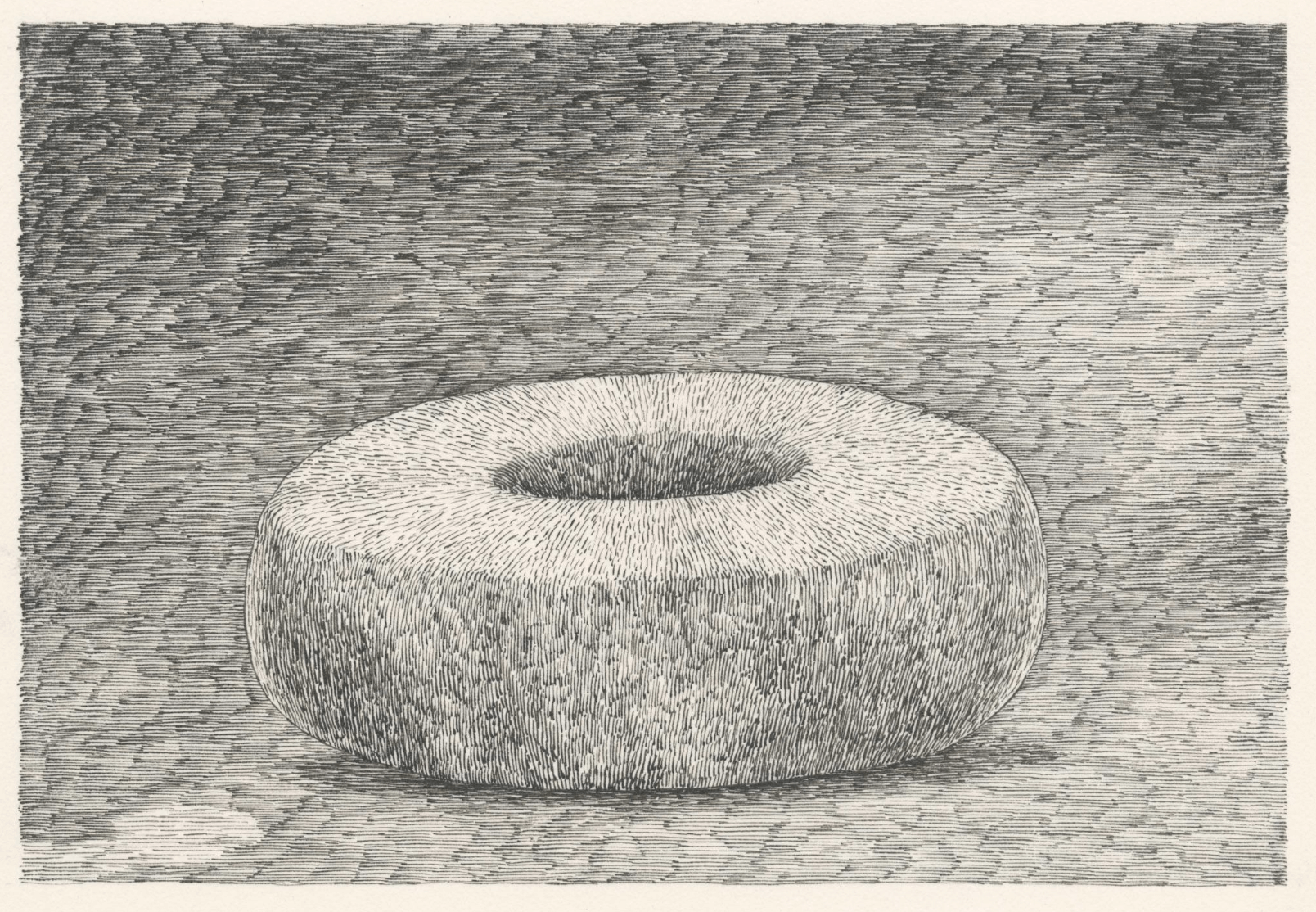
Edward Gorey, Papier maché doughnut (diameter 4') made by D. Guest, from Alms for Oblivion, 1978
Pen and ink on paper, 4.25” x 6.25” Copyright 1978, Maple frame by Alex Cohen. Courtesy of the Edward Gorey Charitable Trust Courtesy of ArtYard/Photo, photo by Paul Warchol.
Wavy-striped orange and grey walls in the Hallway are lined with Edward Gorey's pen and ink drawings and François Dupuis's dense, conceptual witticisms. Gorey's Aunt Edna's Lampshade (1978), and two pieces from Alms for Oblivion (1978), Back of Painting by Mt. Slope and Papier mâché doughnut, (diameter 4') made by D. Guest, and Dupuis's four Rubbish etchings (2020-25) and Le cendrier (The Ash Tray, 2013) are standouts, the nerve center of this show.
The Camera Obscura Room features dark maroon and blue, wavy-striped walls, enhancing gloomy pieces by Gorey, Still Life with Skull Vase & Elephants (1985); Peto, Still Life with Jug and Cakes, (c.1890); and Gwen Strahle's duo of dreamy, Untitled ink on paper paintings (2021). Two working camera obscura installations and the Room's back shelf feature Brian Guerin's diminutive Fruit, Cups and Vessels (2026) atop his pillows made from pink shirts, complete with buttons. The Room's dark, underworld magic deepens as I compare mutable shades of imagery inside the camera obscura with superbly crafted oils by Robert M. Kulicke Still Life with Sweet Williams (1987) and Wedge of Watermelon (1985-86) entombed in massive artist-made frames.
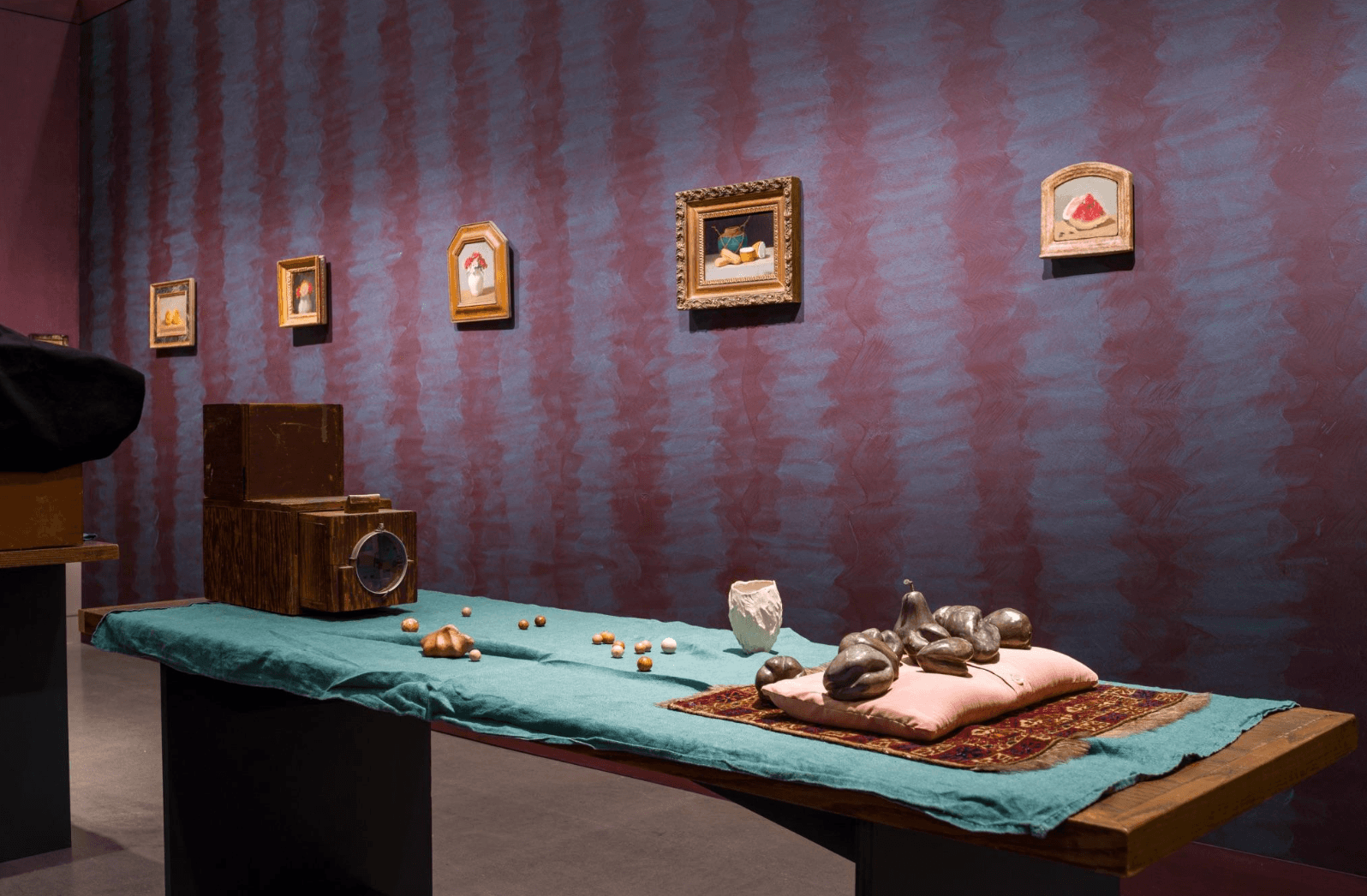
Robert M. Kulicke: Two Peaches, 1988 Oil on gessoed masonite, 6 1/8" x 8 1/2" Artist’s gold leaf and faux marble Casetta frame. Red and Pink Flowers, c. 1980's Oil on museum board, 6" x 6". 22 Karat Gold Louis 14th frame by Pam Sheehan. Still Life with Sweet Williams, 1987 Oil on panel, 7 1/4" x 7" Artist’s fruitwood frame. Wedge of Watermelon, 1985-1986 Oil on panel, 5 1/4" x 5 3/4" Artist’s gessoed cast frame.
John F.Peto, Still life with Jug and Cakes, c. 1980's. Oil on board, 6 1/2" x 9 1/2" Photo by Frank Parisi. Courtesy of John F. Peto Studio Museum.
Brian Guerin: Fruit, 2026, Unfired wild earthenware clay, Pit-fired wild earthenware clay. Cup 1, 2019, Porcelain, 3 3/4 x 2 1/4 x 2 1/4".
Courtesy of ArtYard/Photo, photo by Paul Warchol.
Visitors may lounge, read, and chat on overstuffed armchairs in the expansive Library, where a Persian rug and a teal wall complement Katja Oxman's aquatint etchings If Bird the Silence Contradicts (1997), The Seasons Shift (2011), and Returning As Before (2004). I wish this room had been painted one midtone to unify Susan Lichtman’s bright orange oil Before Dessert (2025), Gwen Strahle's darker oils Chosen White (2025) and Sleeping Shadow (2021-22), and Silas Borsos's sunlit oils Banana & Lemons (2025), Deconstructed Pineapple & Plums (2025), and Grapefruit & Pear (2025). Alisa Maslova's painting A Holiday That is Always With You (2023), in a carved black frame by Alex Cohen, joins plants by Clara Weishahn and metal vessels by Margaret Parish––punctuated by one Daliesque pewter platter dropping over a table edge––make a fitting backstop for this show.
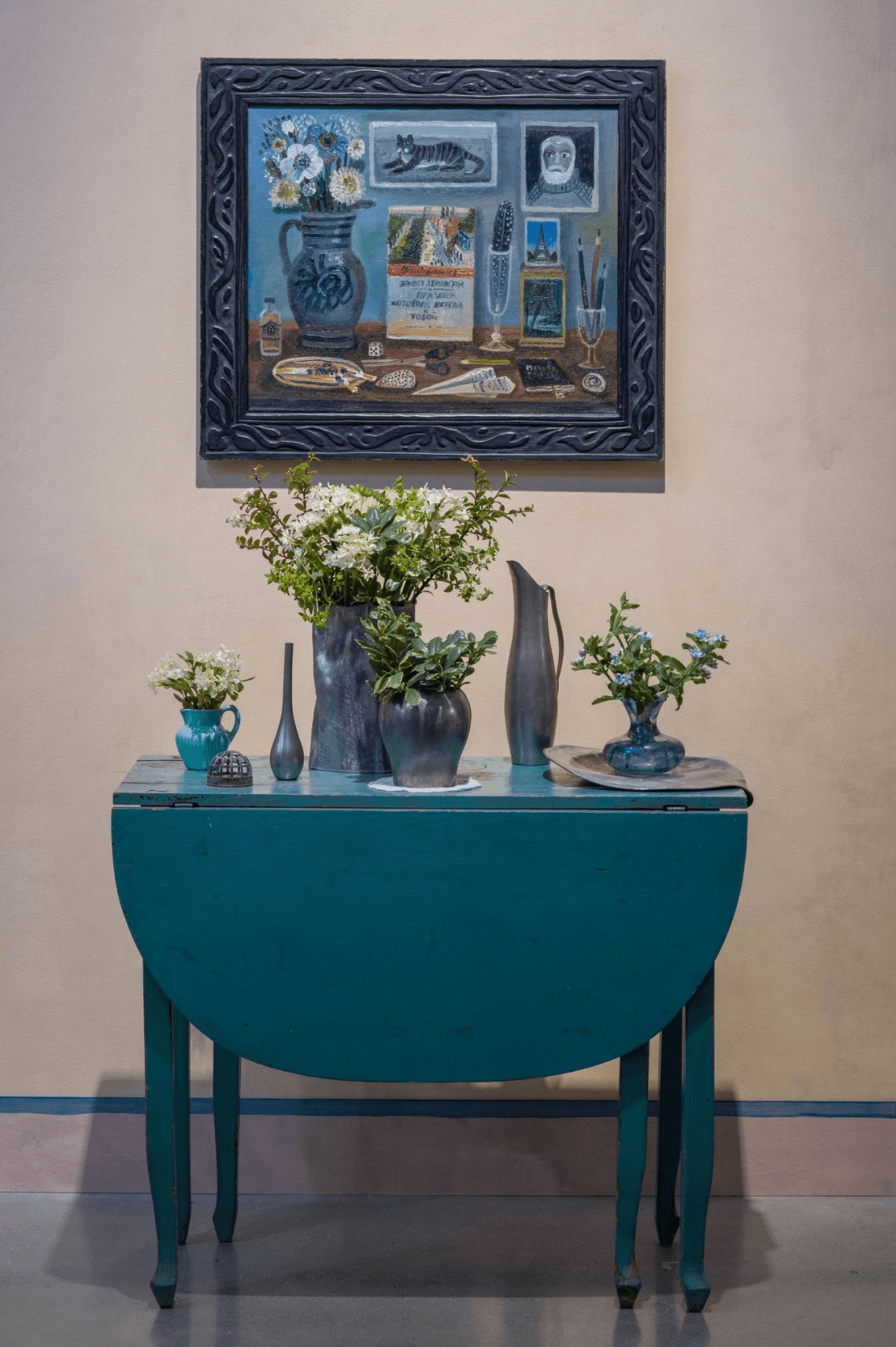
Alisa Maslova, A Holiday That is Always With You, 2023, Oil on canvas, 19.7" x 23.6".
Carved gessoed frame by Alex Cohen. Collection of Alex Cohen and Clara Weishahn
Installation collaboration: flowers: Clara Weishahn, metal vessels: Margaret Parish
Courtesy of ArtYard/Photo, photo by Paul Warchol.
In The Company of Still Life contains many more virtues than limited space allows. A visitor may enter through any of three doors, exemplifying three philosophies regarding still life. You'll encounter staunch realists, collage-based reconstituters, and cerebral parodists of life's basics: home, food, books, flowers, companionship, and privacy. Sculpture, furniture, and collaboration behind the scenes make it all possible. An hour In The Company of Still Life absorbed in history's most modest art form is a balm for turmoil inside and out. Letting oneself wander and get lost and overwhelmed is what keeps us coming back.
Artists: Rotem Amizur, Lennart Anderson, James Bellew, Silas Borsos, Stepan Budulak, Mariel Capanna, Alex Cohen, François Dupuis, Elizabeth Endres, David Fertig, Edward Gorey, Brian Guerin, Johnny Izatt-Lowry, Dee Jenkins, Graesen Joyce, Clara Kewley, Ken Kewley, Robert M. Kulicke, Aubrey Levinthal, Susan Lichtman, David MacDonald, Alisa Maslova, Ruth Miller, Katja Oxman, Margaret Parish, Gillian Pederson-Krag, John F. Peto, Joseph Podlesnik, Charles Ethan Porter, Kate Powell, Gabriele Risso, E.M. Saniga, Mayumi Sarai, Kouta Sasai, James Stewart, Gwen Strahle, Rudolf Stumpf, Ali Sultan, Susan Jane Walp, Allie Webb
