
Who Is America at 250 ?: Artists’ Books on the State of Democracy, San Francisco Center for the Book
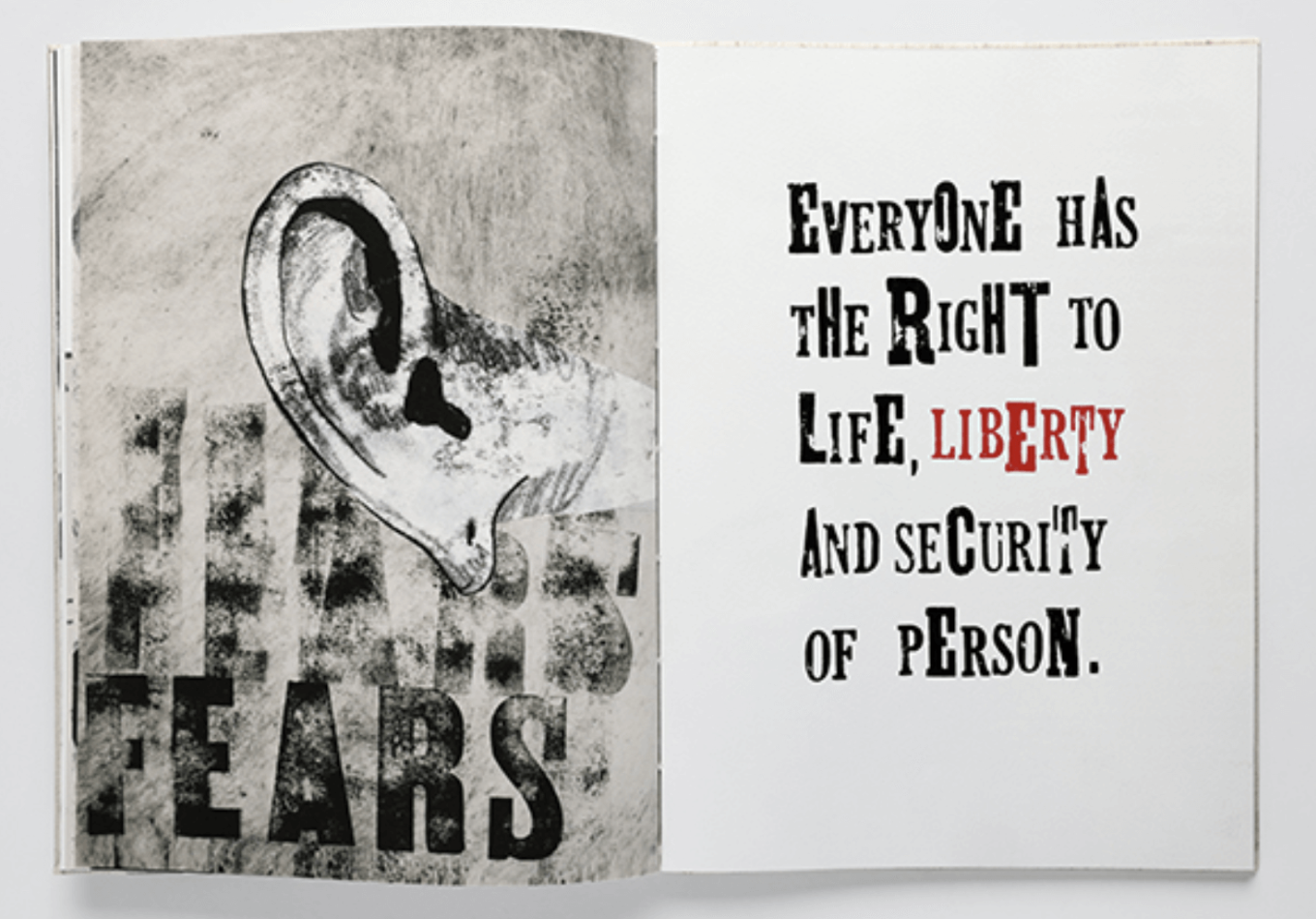
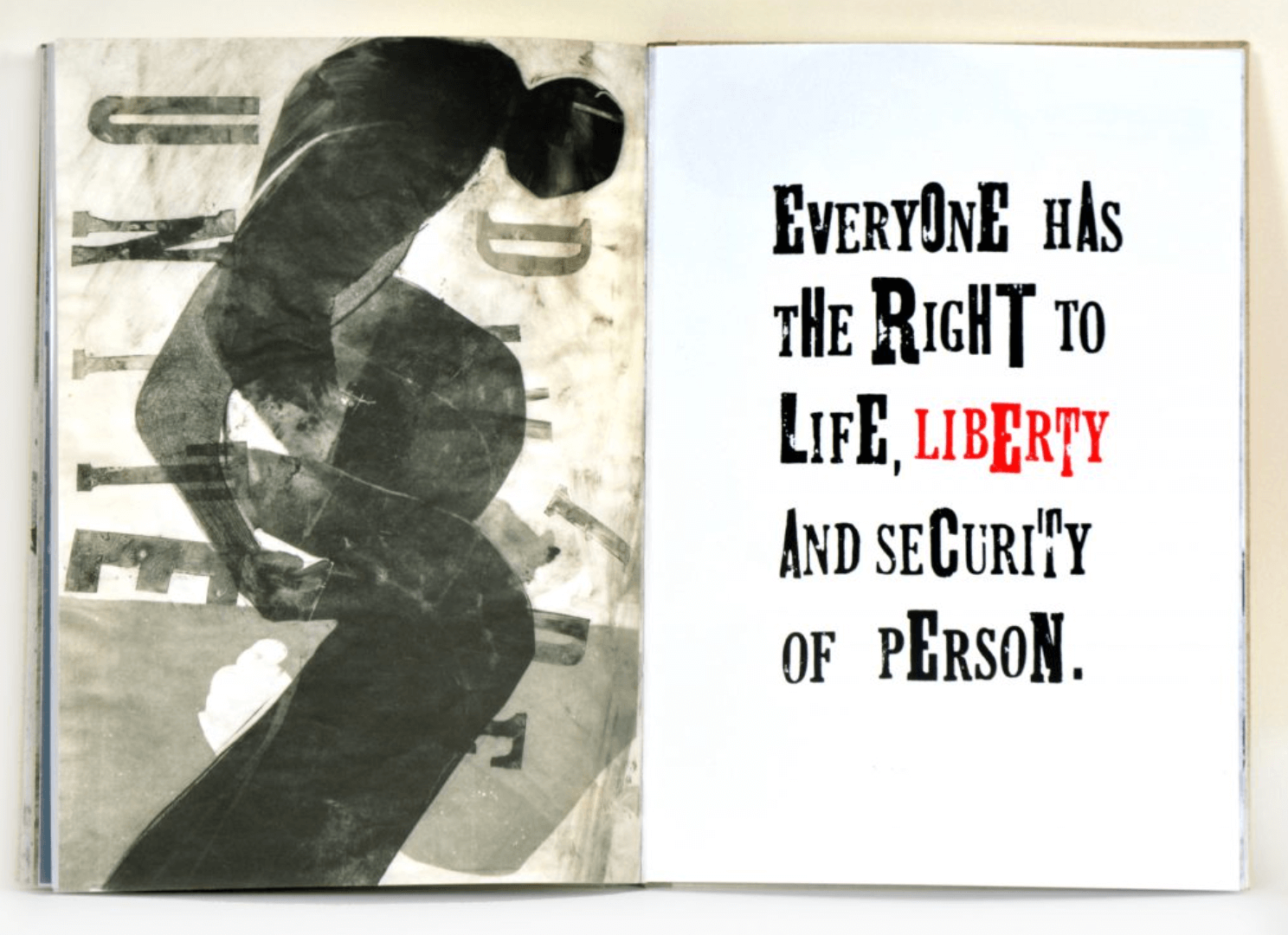
KaKeART (Ann Kalmbach, Tatana Kellner), Whereas We Declare, 2018, coptic bound in hard covers, silkscreen digitally printed on Somerset Book paper, 13 x 18 x 5 (open); Photo: Von Span, 2025
By Terri Cohn
Who Is America at 250?: Artists’ Books on the State of Democracy is a curious and resonant exhibition title. To ask “who” of a country is to personify it—to give it a body, a voice, a conscience. The name of the nation becomes porous, opening outward to include the people who inhabit it. In this framing, America is no longer a fixed idea or a singular story, but a living question, collectively shaped by many hands, many histories, and many acts of imagining.
On view at the San Francisco Center for the Book, Who Is America at 250? insists that the nation is inseparable from its people. The question embedded in the title carries urgency, holding together the singular and the collective, as well as the promise of unity and the reality of schism. It asks viewers to move beyond “America” as an abstraction and to reckon instead with lived experiences of contradiction, struggle, erasure, and resistance. That these ideas are carried through artists’ books is not incidental. Long associated with access, circulation, and dissent, books assert an egalitarian ethos: a medium for knowledge made personal, ideas made public, and stories offered for consideration and debate. Unlike wall-based works encountered at a distance, artist’s books stage a choreography of reading: pages turned, images encountered in sequence, and meanings disclosed somatically and through shifts of scale. The reader becomes an active participant, and the politics of the work unfold physically and temporally.
To mark 250 years of national existence—a duration that suggests legacy and self-knowledge—is also to confront how contested those foundational ideas have become. The curatorial premise calls for renewed scrutiny of America’s founding texts—the Declaration of Independence, the Bill of Rights, and the Constitution—not as fixed narratives but as living documents under strain. Read another way, the title registers bewilderment: a collective unease, a faltering sense of recognition, a question asked because certainty has collapsed.
As Ruth R. Rogers asks in her catalog essay, “Who tells our nation’s story? Through what medium? Who is included?” Beyond official documents, speeches, and textbook accounts, she argues, the “artist’s book becomes an alternative form of truth-telling,” one in which “unknown and overlooked lives are vividly real.” ¹ The works by 39 artists that comprise this exhibition make that claim tangible: some are intimate and fragmentary, whispering their stories in self-contained volumes. Others are imposing and sculptural, appropriating familiar images and language to provoke reassessment. Together, they offer a complicated and polymorphic answer to the question: Who is America?
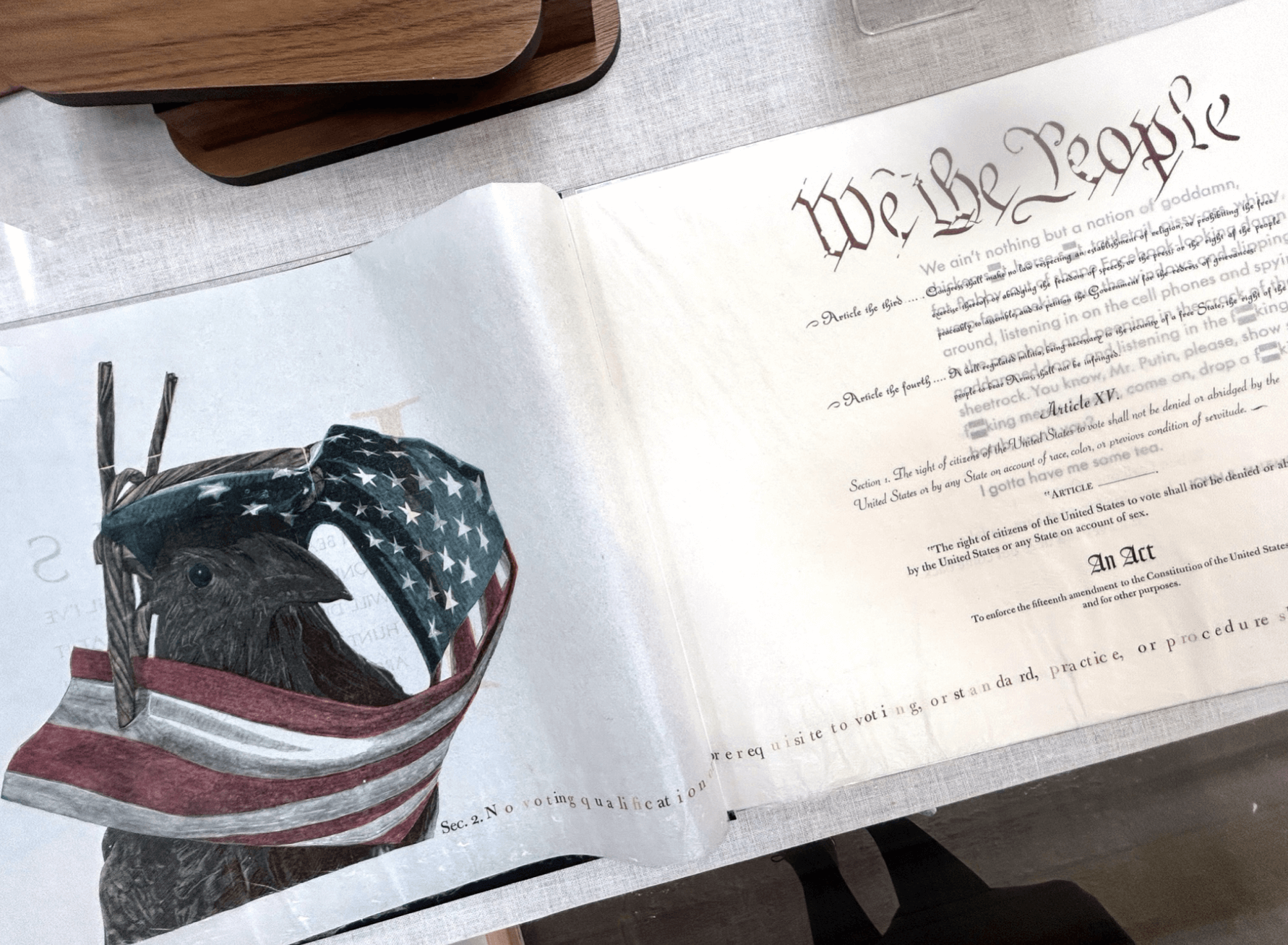
Gaylord Schanilec, American Crow: Report from Quarantine 2021 (2021), ed. 88, wood engravings printed on French folded gampi paper w/typeset in various typefaces; wood, 9-¼ x 12-¼ (individual leaves); 9-½ x 12-⅜” (portfolio, closed), Collection of the artist; Photo: San Francisco Center for the Book
Gaylord Schanilec’s American Crow: Report from Quarantine (2021), a portfolio in seven sections, includes a version of the Preamble to the U.S. Constitution manipulated to reflect the malice and confusion that infused public life during the pandemic. His wood engravings of crows—birds associated with intelligence and liminal passage—soften the work’s unease, translating dread into an image-language of watchfulness and endurance. In a related vein, Russell Maret’s Three Constitutions (2021) experiments with obfuscating typefaces alongside “algorithmic skewing and selective redaction.” Maret expands the project by feeding one of the documents through Google Translate. This gesture reads as both intimate and estranging; it serves as a means of internalizing a foundational text while also reflecting the distortions of contemporary political discourse.
The exhibition is organized into four thematic groupings—Justice/Equality/Rights/Resistance; Belonging/Memory/Compassion/Voice; Truth/Awareness/Responsibility/Questioning; and Hope/Possibility/Transformation/Vision. These categories are necessarily fluid; many works could sit comfortably in more than one section. Still, the structure succeeds in opening multiple paths into language and meaning.
Several artists confront contemporary politics through strategies of absence, omission, and refusal. Anne Covell’s In the Dark (2024) explores grief and justice through the visual language of redaction. For this piece, Covell blacked out passages from the Mueller report, using these graphic omissions as “placeholders for the ongoing miscarriage of justice in American politics.” (catalog 79) The book’s pages, with nearly a thousand cut-out segments, have an ominous physical presence, communicating anger, exhaustion, and a kind of civic mourning.
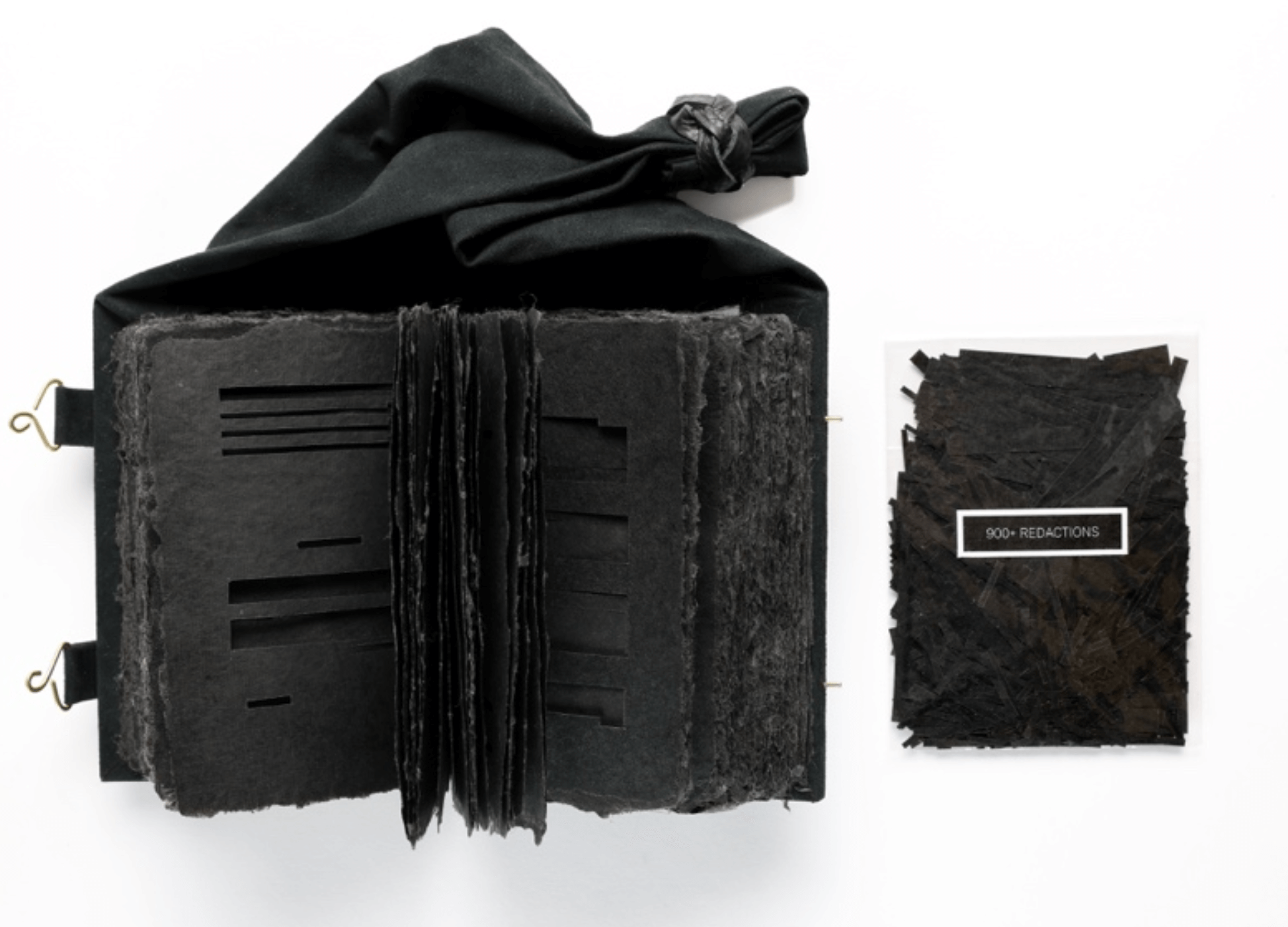
Anne Covell, In the Dark, 2024, wooden boards covered in black suede with brass embellishments, text pages waxed black pigment over beaten handmade paper, 15-1/2 x 4-3/4 x 1-7/8”; Photo: Von Span, 2025
While Covell’s work is defined by opacity, Robert Kalman’s What’s It Like for You to Be an American? (2025) is shaped by encounters. Kalman documents a cross-country trip made in the wake of the January 6 insurrection, during which he asked each person he met and photographed a single question: “What’s it like for you to be an American?” The resulting black-and-white portraits, accompanied by handwritten responses, form a collective self-portrait of the nation. Many participants describe America as a home of contradictions—of freedoms that are visible in rhetoric but unevenly distributed in lived reality.
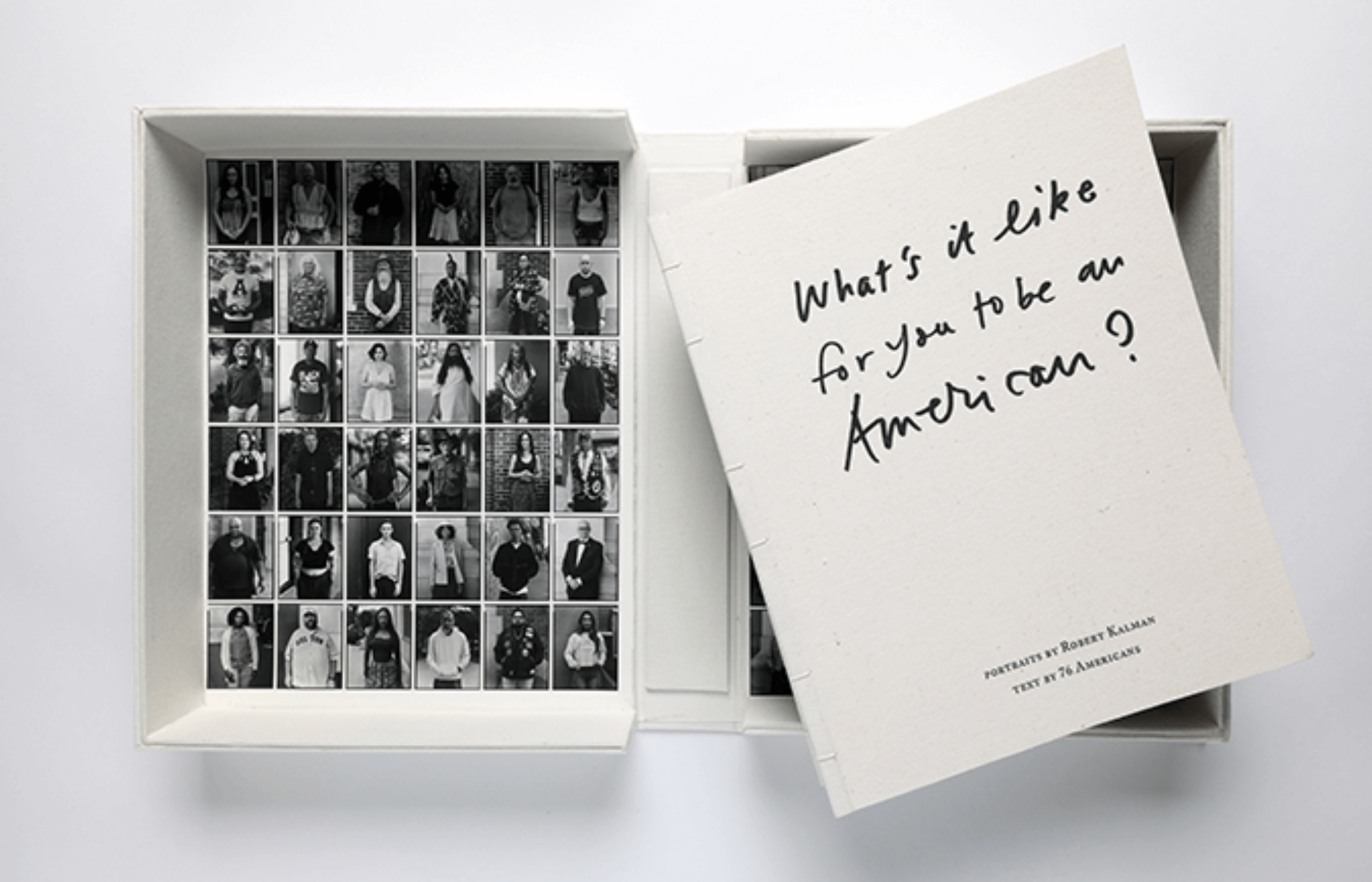
Robert Kalman, What’s it Like for You to be an American? 2025, Archival inkjet prints in clamshell box, Coptic binding, 14 x 11-1-1/2 x 2-1/2”; Photo: Von Span, 2025
Although most of the works in the exhibition do not directly depict the current president, Art Hazelwood’s Tipping Point (2021)—an artist’s book of 29 screen-printed images—places him on the cover and returns to him throughout. Hazelwood’s imagery is satirical, but the work ultimately belongs to the exhibition’s final section: it insists that transformation is possible, and that the “tipping point” might still bend toward something better.
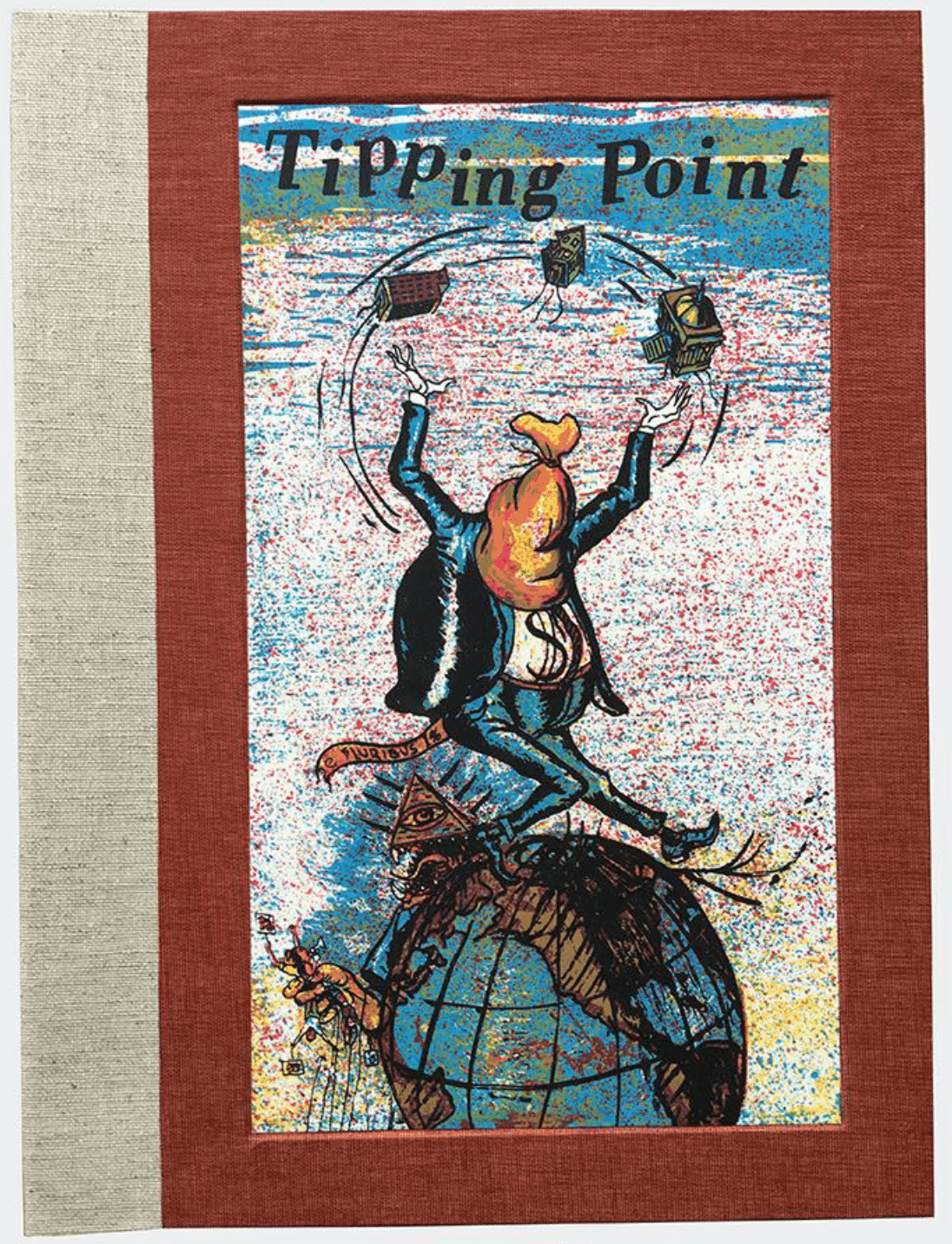
Art Hazelwood, Tipping Point, 2021, silkscreen prints, Drumleaf binding with interactive pull-down mechanism on final page of book, 12 x 9 x 1-3/8” (closed); Photo: Von Span, 2025
Other artists foreground the frictions within democracy through direct quotation and recontextualization. KaKeArt (Ann Kalmbach and Tatana Kellner)’s Whereas We Declare (2018) boldly presents text from the Universal Declaration of Human Rights—proposed to the United Nations by Eleanor Roosevelt in 1948—asserting a vision of dignity and belonging that remains aspirational in the United States. Using a very different visual language, Tyler Starr’s Flags, Placards, and Illicit Climbers of the Capitol Insurrection (January 6, 2021) (2022) isolates cropped images of rioters scaling the walls of the Capitol. Stripped of surrounding context, these figures become semiotic reminders that justice and equality are not inherited truths but demands that must be continually reasserted.
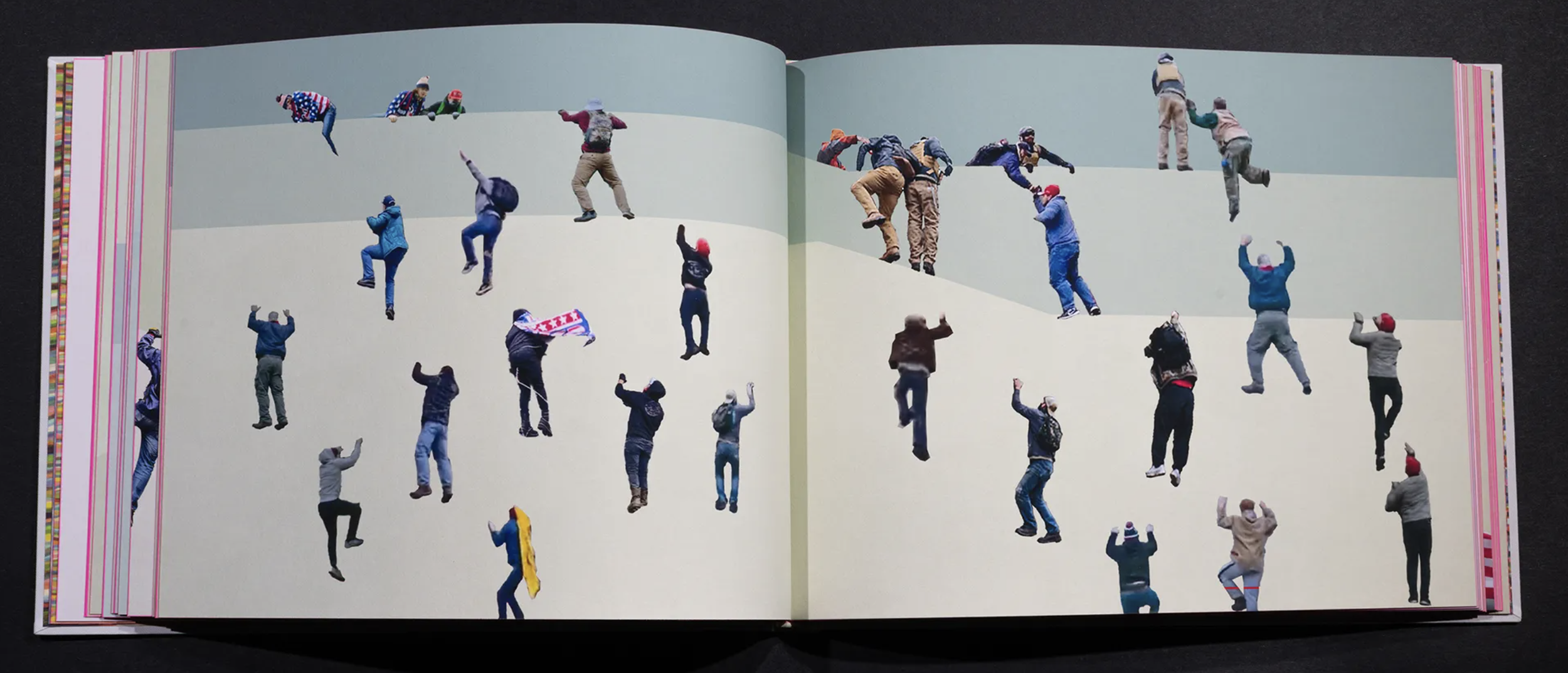
Tyler Starr, Flags, Placards, and Illicit Climbers of the Capital Insurrection (January 6, 2021), 2022, pigment prints on Moab Entrada Rag Bright paper coated with Moab Desert Spray. 9-1/4 x 12” (book, open)
Still others imagine futures shaped by collective transformation, among them Kimi Hanauer, whose Calling All Denizens (2019) summarizes court cases since 1952 that challenged racial prerequisite laws limiting citizenship to “free white aliens.” Her pithy text-based posters, such as “What if All Citizens were Denizens,” serve as thoughtful inquiries into a more compassionate future in which the distinction between citizens and non-citizens might be reimagined.
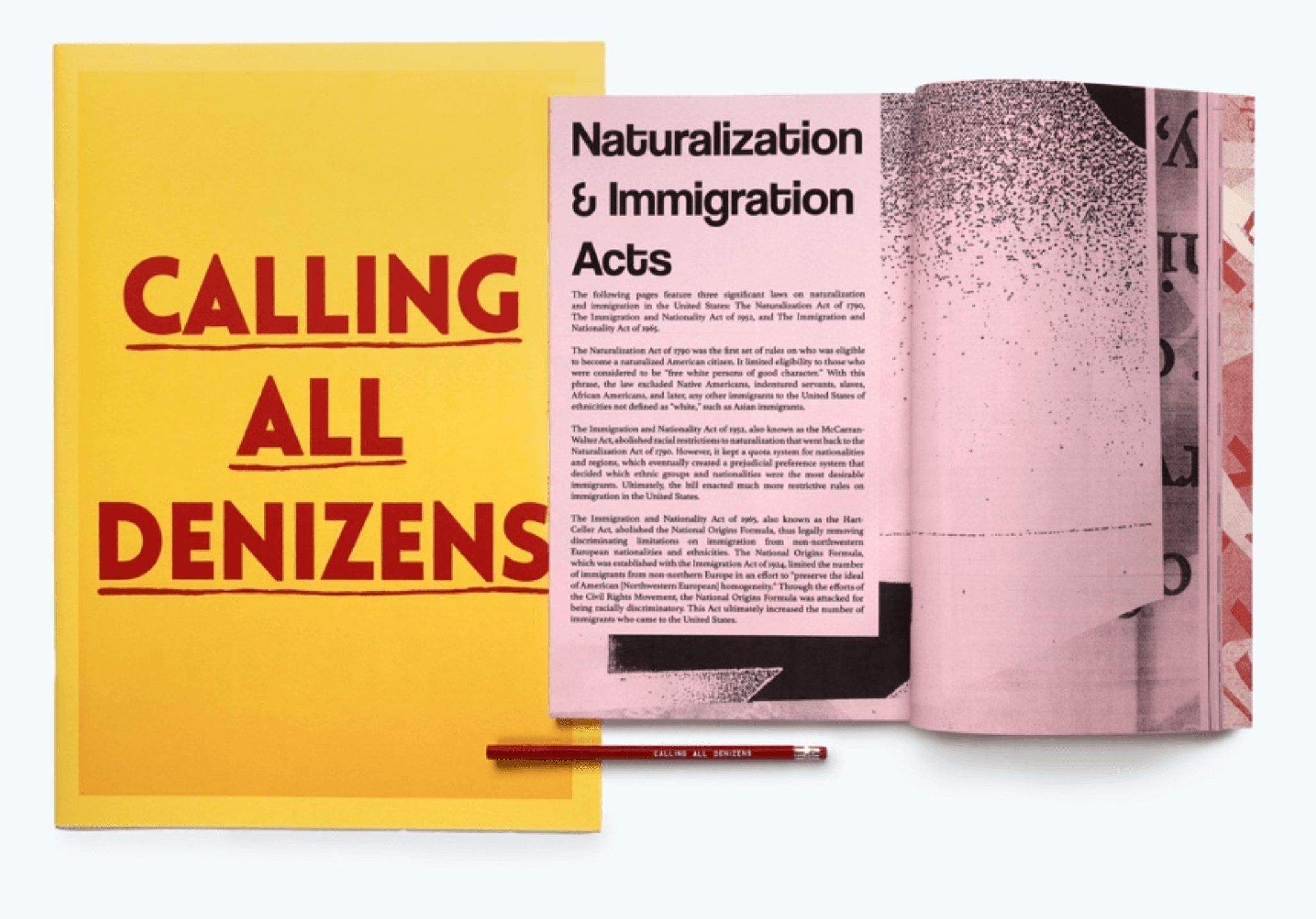
Kimi Hanauer, Calling All Denizens, 2019 (composite image) letterpress and digital printing, silkscreen, dimensions variable; Photo: Von Span, 2025
In the strongest works, form itself carries meaning. Across traditional paginated books, broadsides, and sculptural objects, the physicality of each piece insists that ideas are made tangible—and lived. Jan Owen’s Mending the Stars and Stripes (2020) addresses the omission of female voices in the U.S. Constitution and its amendments by juxtaposing handwritten women’s letters on handmade paper, cross-stitched with red and gold thread and appliqué. Owen intentionally leaves threads hanging, a gesture that suggests both the unfinished nature of domestic labor and the unfinished work of democracy. Inspired by the centennial of the 19th Amendment, the book also includes the dates of each state’s adoption of women’s suffrage, along with key citizenship and voting rights acts. The final page bears two cross-stitched names— “Ruth” and “Kamala”—a double dedication to Ruth Bader Ginsburg and Kamala Harris. As Rogers writes, “the mending and amending continues.” ¹
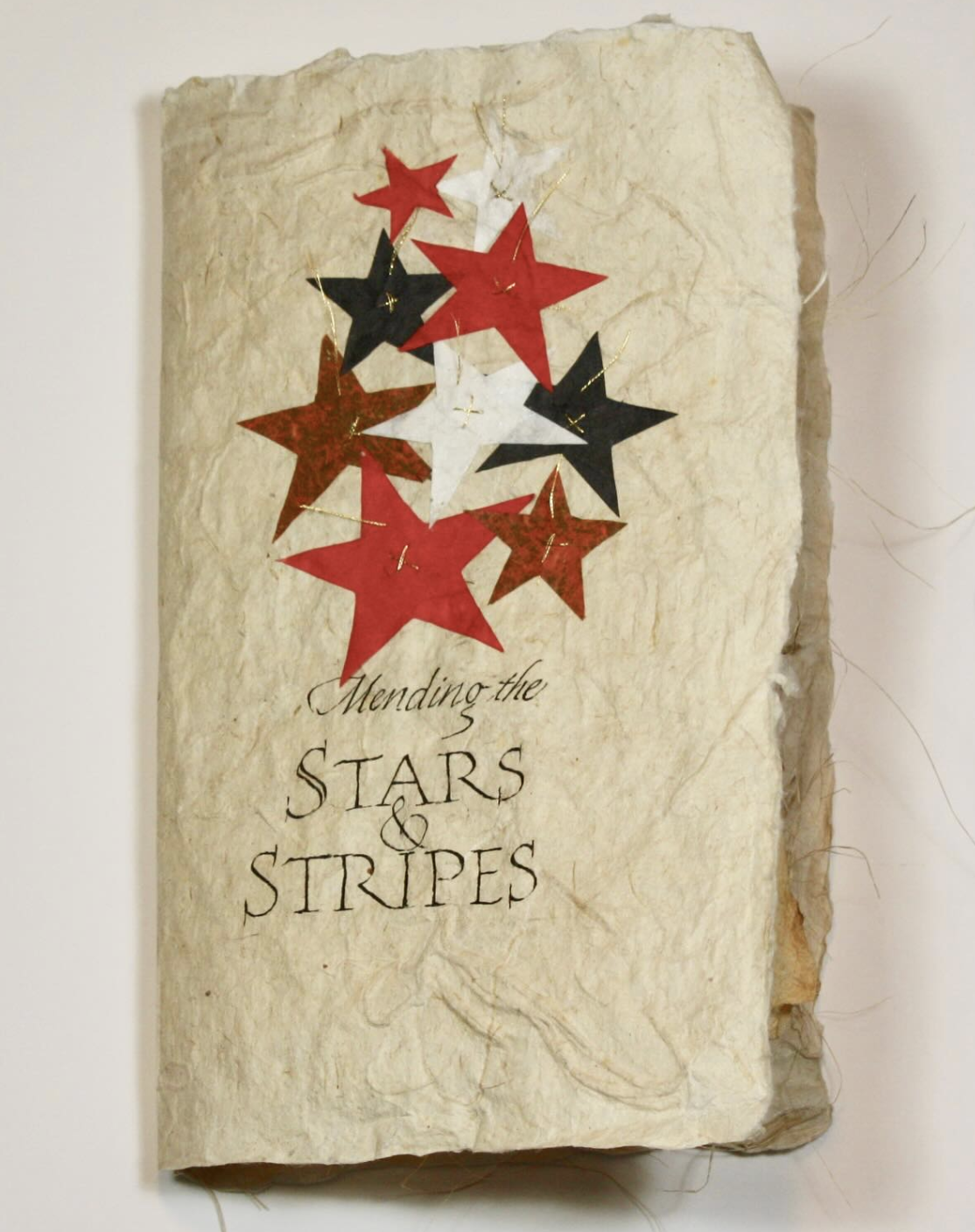
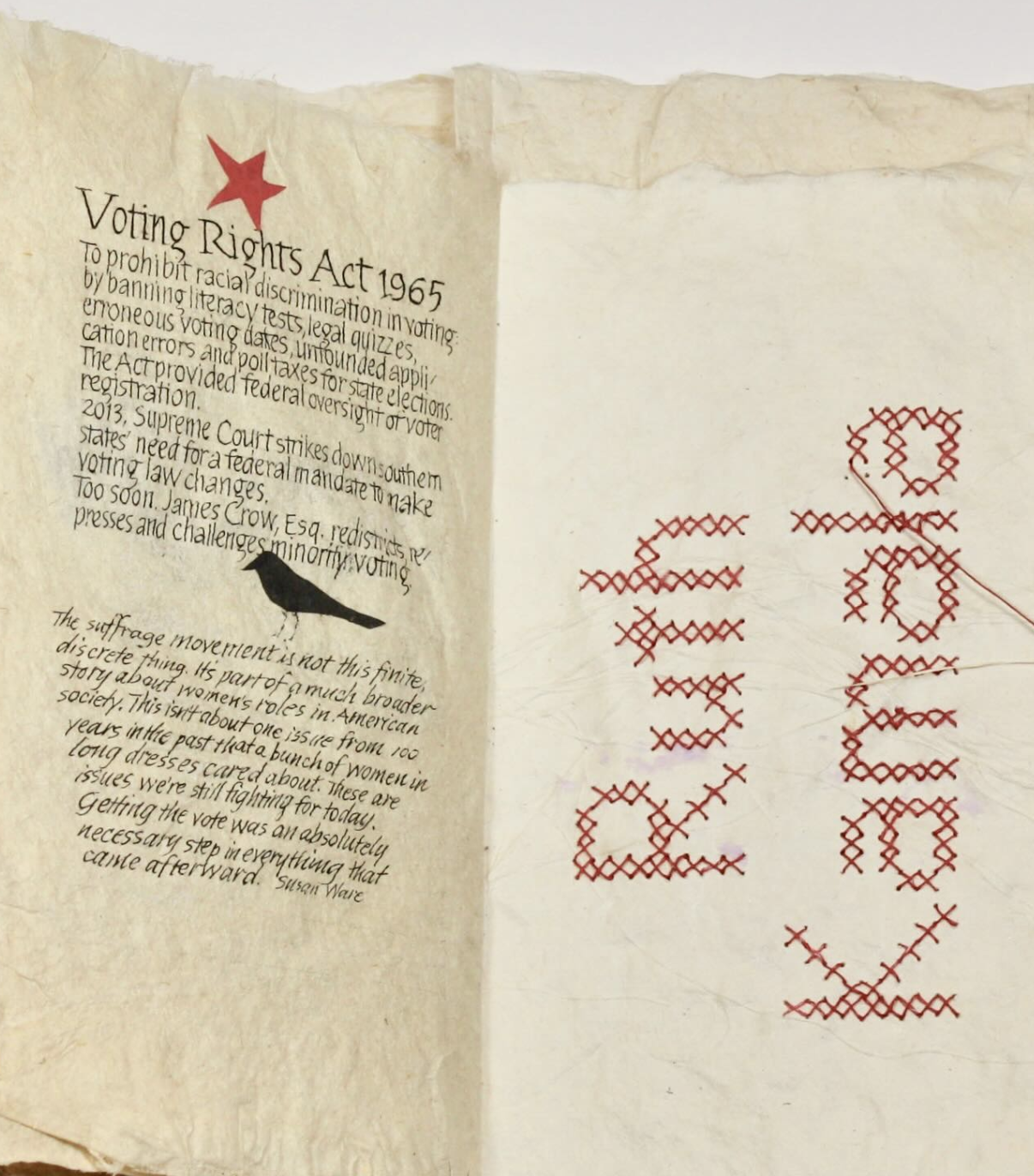
Jan Owen, Mending the Stars and Stripes, 2020, ink, gouache and acrylic, linen thread on Kate Fairchild handmade paper, 11 x 13 x 1” 32 (open); Photo: Von Span, 2025 (R) closed (L) open
Although Who Is America at 250? offers a wealth of visually and intellectually rigorous responses to its central question, some of its most gratifying works are those that reflect the inherently communal nature of “America,” “books,” and “democracy.” Like Kalman’s project, San Francisco–based artist Beth Grossman’s Searching for Democracy is grounded in participation and exchange. Over the past decade, Grossman has pursued this ongoing public performance in which she is transcribing the U.S. Constitution by hand, using a quill pen, onto fifty discarded money bags from banks and the U.S. Mint. Enacted at sites across the country—including the New York Stock Exchange, Philadelphia’s Independence Hall, and Mount Rushmore—and most recently at Minnesota Street Project in San Francisco (2025) --the work engages the public in dialogue about the Constitution and the responsibilities of citizenship.
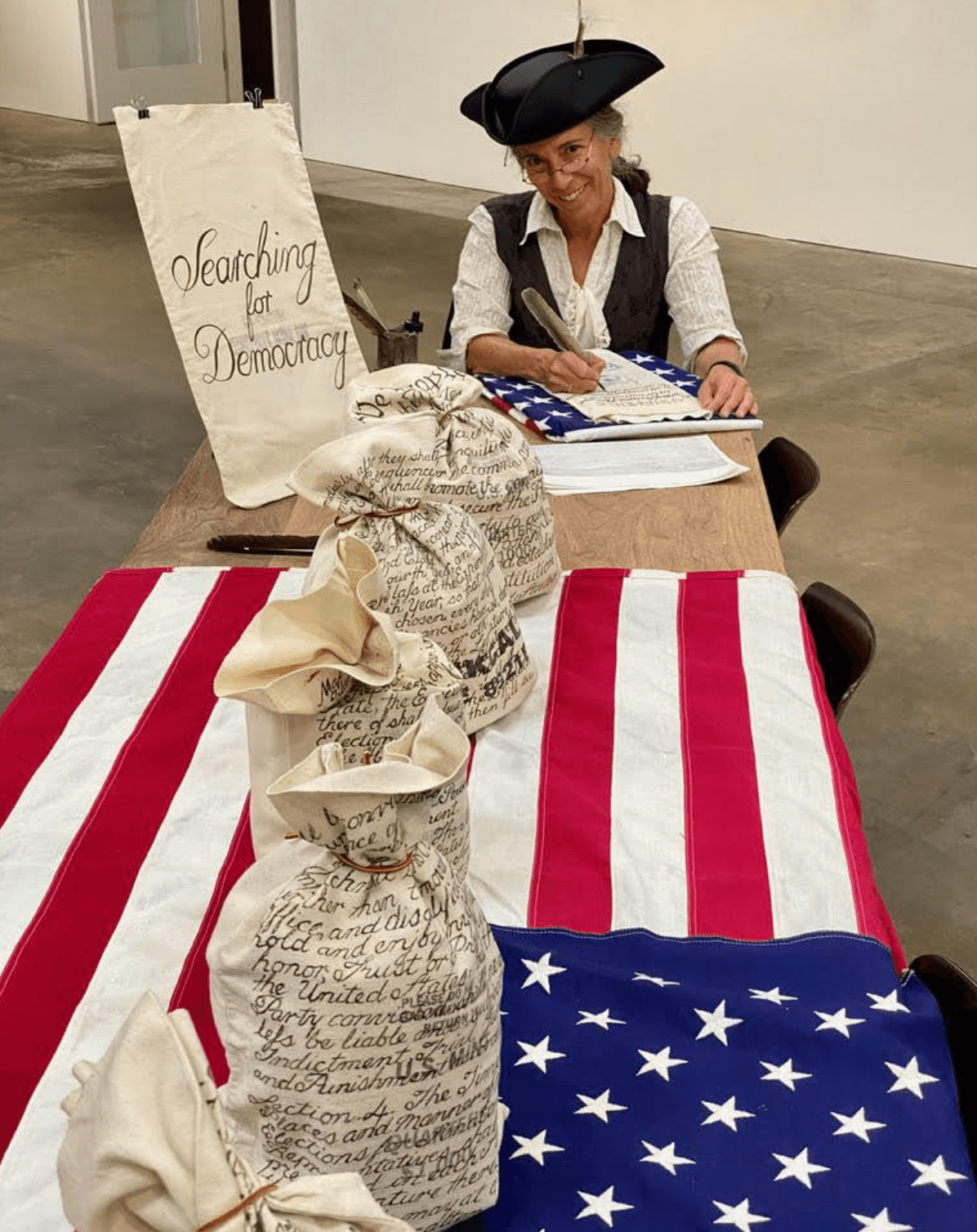
Beth Grossman, Searching for Democracy (cover of J), 2024, performance,
Minnesota Street Project, San Francisco; Photo: Courtesy Beth Grossman
The act is deceptively simple: Grossman publicly writes the Constitution onto the vintage money sacks, inviting viewers to converse with her as she works. Yet the materials carry their own argument. The vintage bags index financial power, and the work quietly insists on the entanglement of money, elections, legislation, and constitutional interpretation. The performance makes visible what is often abstract: that democracy is not only an inheritance but an ongoing practice requiring literacy, caretaking, and collective vigilance.
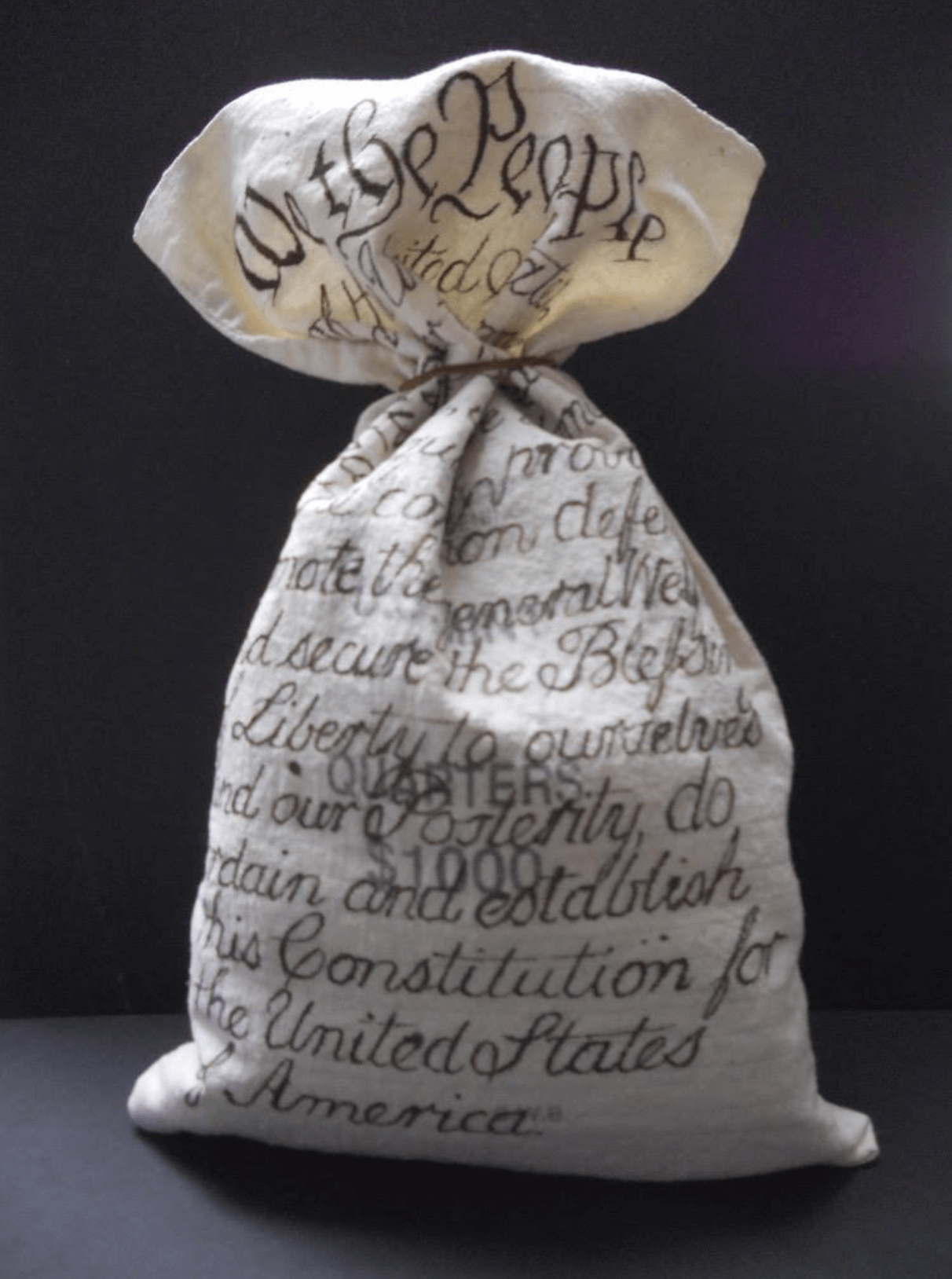
Beth Grossman, The Preamble (money bag), From Searching for Democracy: An Act of Civil Obedience, 2012 - ongoing, ink on deaccessioned money bags, dimensions variable; Photo: Courtesy Beth Grossman
Ultimately, Who Is America at 250? does not resolve the question it poses—nor should it. Instead, it demonstrates how artists’ books can function as civic instruments: repositories of grief, anger, and memory; containers for testimony; and speculative sites for imagining a different—perhaps more just—future. At a moment when the nation’s founding language is continually invoked and continually contested, these artworks remind us that “America” is not a settled entity with a singular definition. It is a field of struggle, made and remade through voices that insist on being heard.
Citation:
¹ Ruth R. Rogers, “Unknown, Overlooked, Overdue,” in Who Is America at 250? Artists’ Books on the State of Democracy (San Francisco Center for the Book, 2025), 68, 71.
