
How to Be a Guerrilla Girl, Getty Research Institute
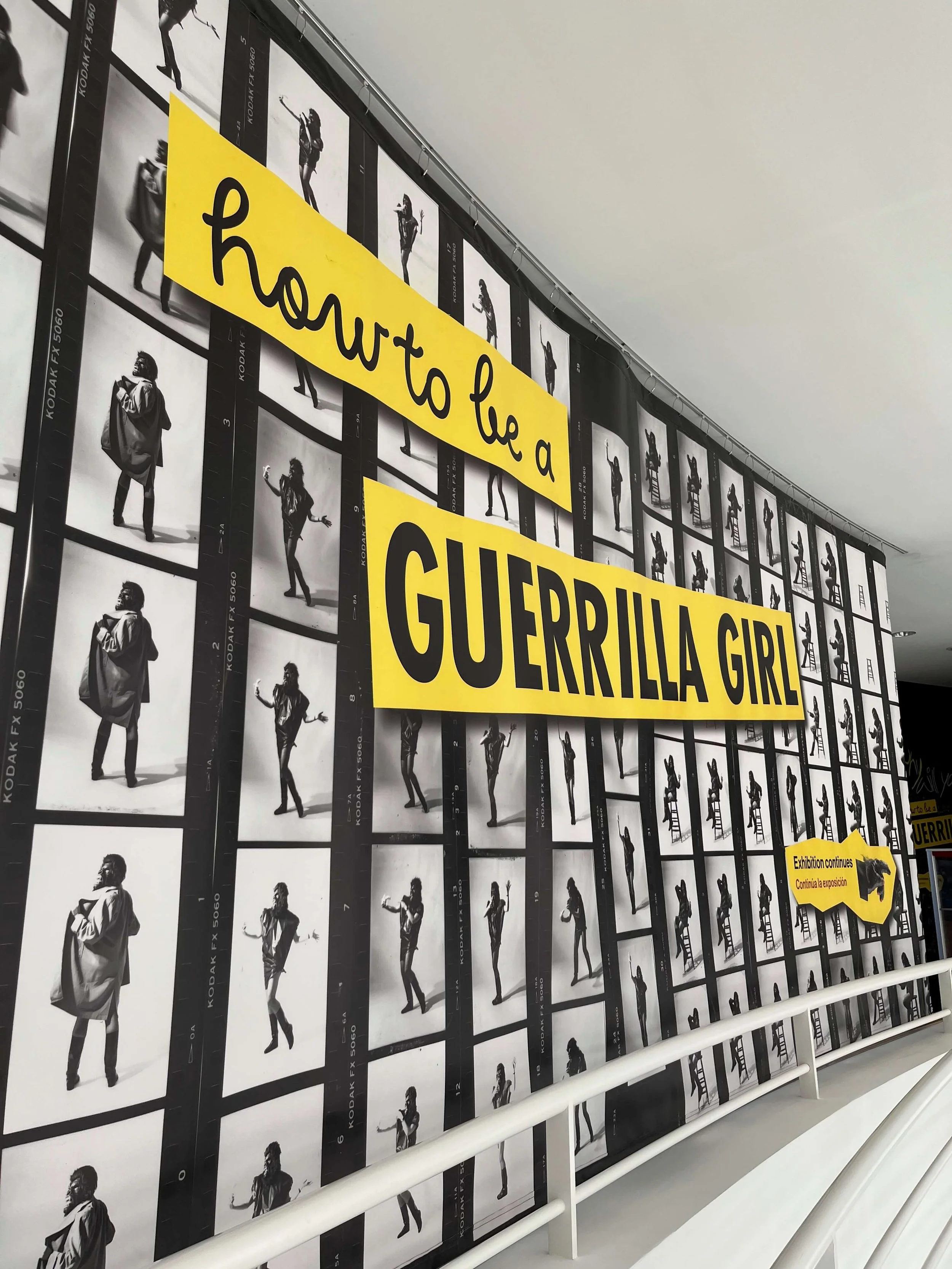
November 18, 2025—April 12, 2026
This is about art, but it is not an art review. It’s the review of a show, but not an art show.
How to Be a Guerrilla Girl is the Getty Research Institute’s (GRI) brilliant take on 40 years of the Guerrilla Girls, a feminist collective that aims, as its motto claims, to be “The Conscience of the Art World.” They act as a conscience by exposing the art world’s failures and biases, focusing on discrimination against women in art and against female artists.
With the GRI holding 100 boxes of archival material from the collective, the institute could have offered a dry series of documents in cases, paired with academic analysis. Instead, six curators – a kind of mirror of the Guerrilla Girls’ collective working approach – collaborated on a display that is thoughtful and eye-catching; colorful and yet data-rich, informative without a text overload.
Above all, it delivers the Guerrilla Girls’ pointed commentary without stifling the collective’s trademark humor. “We definitely wanted to bring the spirit of the Guerrilla Girls into the show,” said Zanna Gilbert, one of the lead curators for the show.
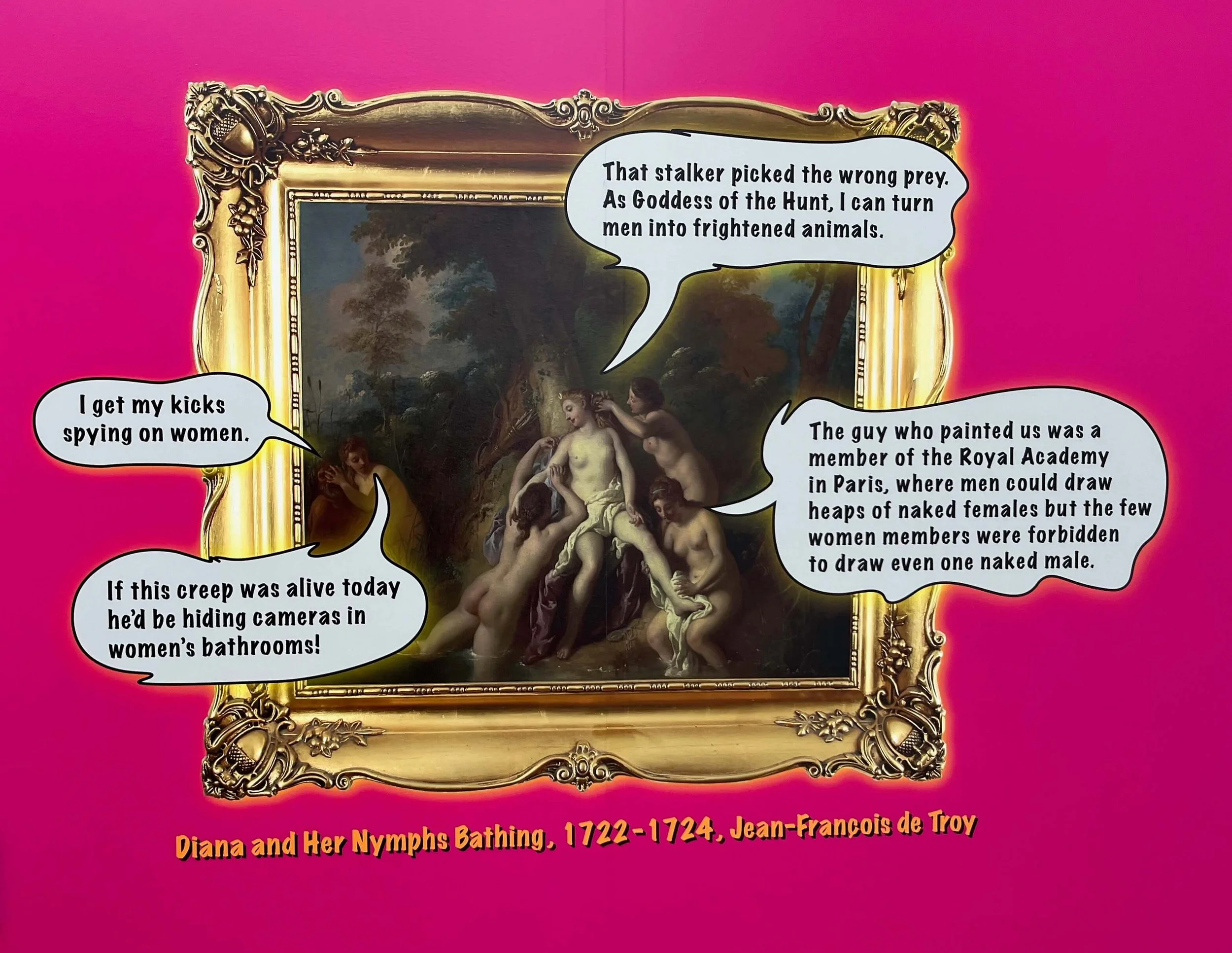
The Guerrilla Girls embellished “Diana and Her Nymphs Bathing,” with a feminist art historical perspective.
It examines “what stories are fostered and perpetuated in art history, particularly around representation and violence against women,” said Kristin Juarez, the other lead curator. “That meant a certain degree of self-reflection,” said Gilbert. “You can’t raise those issues without turning that gaze on yourself.”
The Guerrilla Girls turned their gaze on the Getty with work commissioned for the show. They chose pieces of art in the museum’s own fabled collection and then embellished images of these paintings and sculptures with cartoonish word bubbles.
One of the subjects in Jean-François de Troy’s painting of multiple nudes, for example, is made to speak: “The guy who painted us was a member of the Royal Academy in Paris, where men could draw heaps of naked females, but the few women members were forbidden to draw even one naked male.”
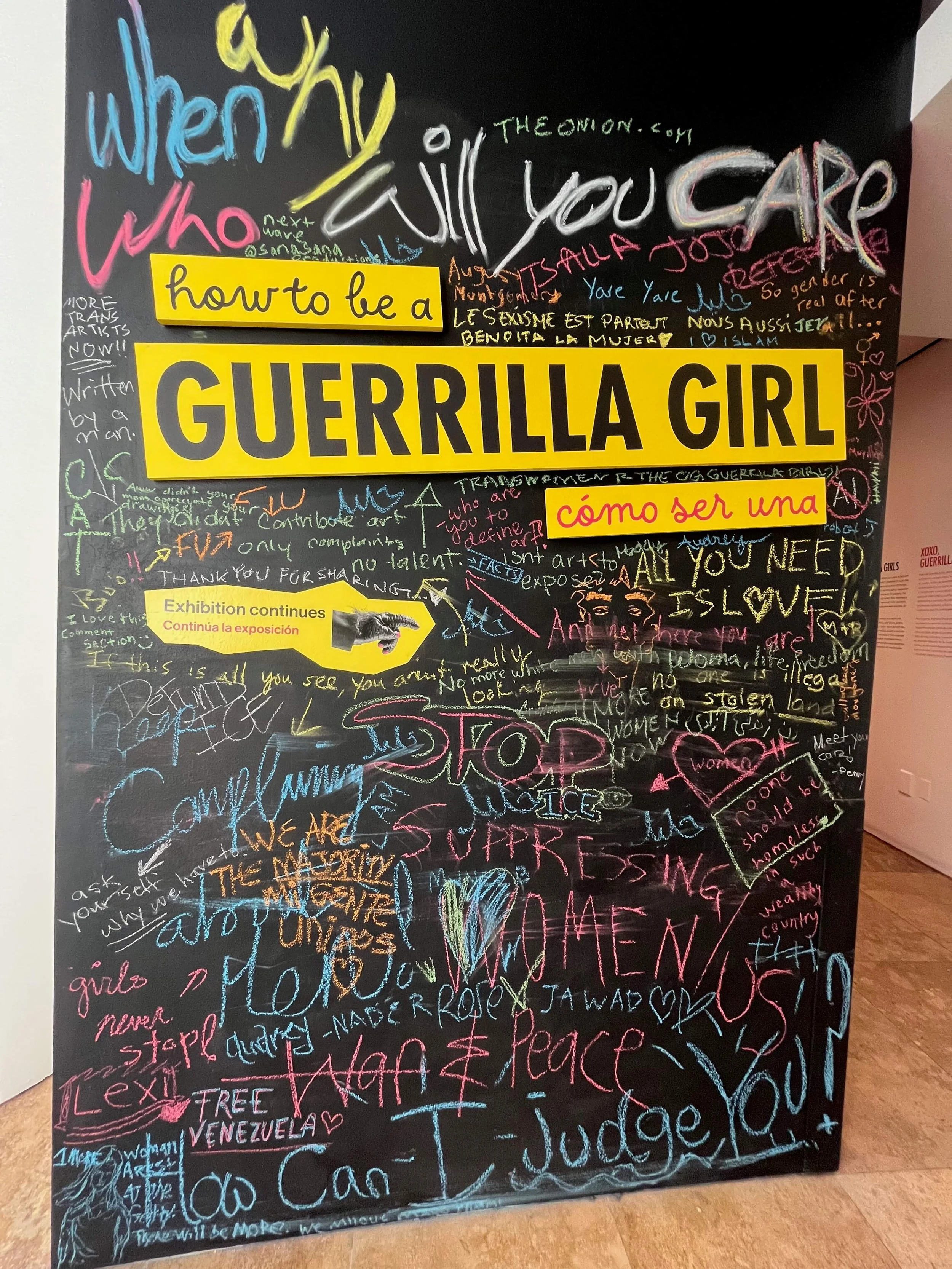
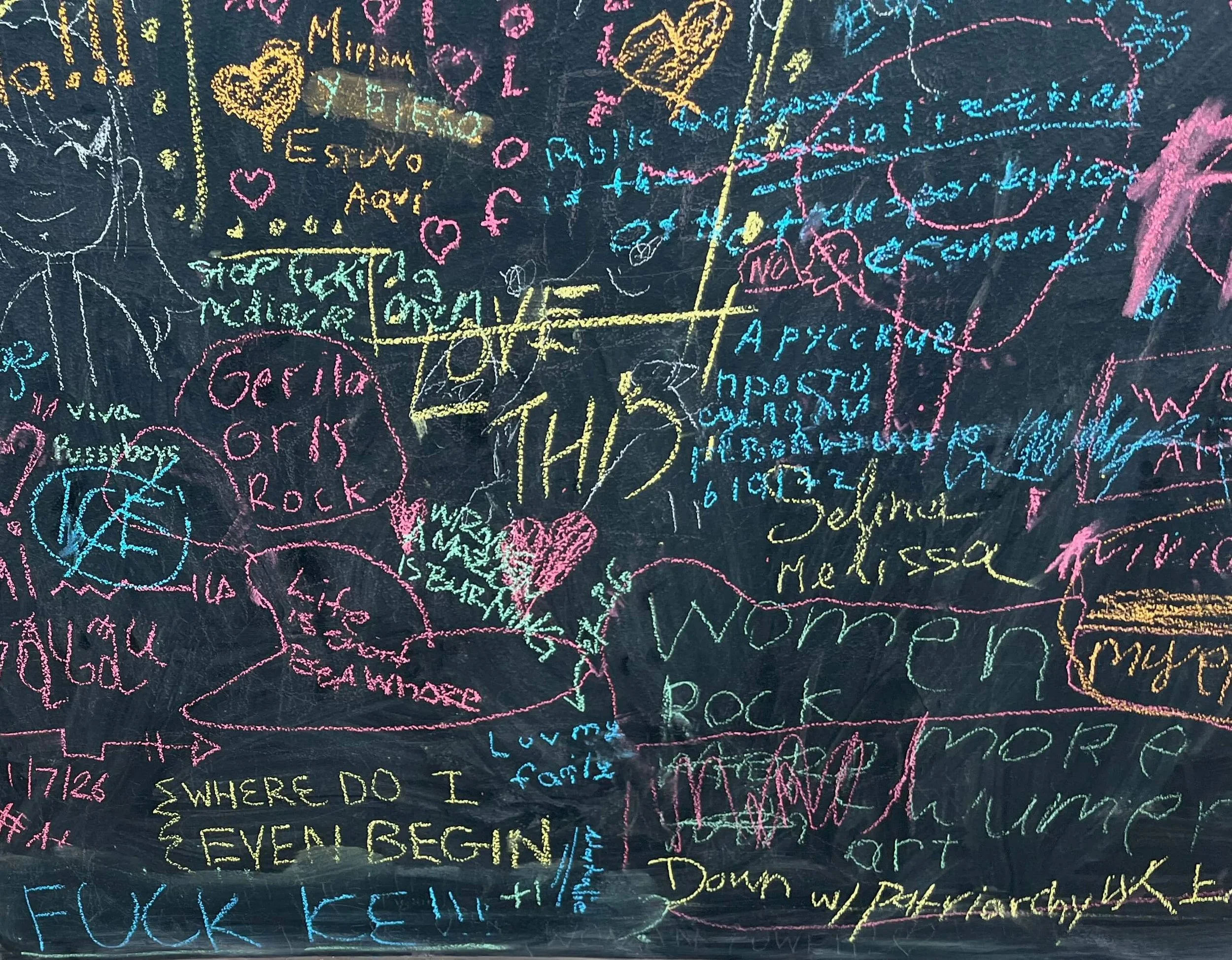
Approachable, didactic, and barbed, the How to be a Guerrilla Girl exhibit follows the same pattern to the very end of the exhibit, where a black wall and colored chalk invite visitors to write on a complaint wall, a standard Guerrilla Girls offering.
Throughout, the curators drew from the archive to provide lessons in what the show’s title says. It both tells how the Guerrilla Girls did it, and carries implied lessons for looking at the art world today. And perhaps at injustices in the world beyond.
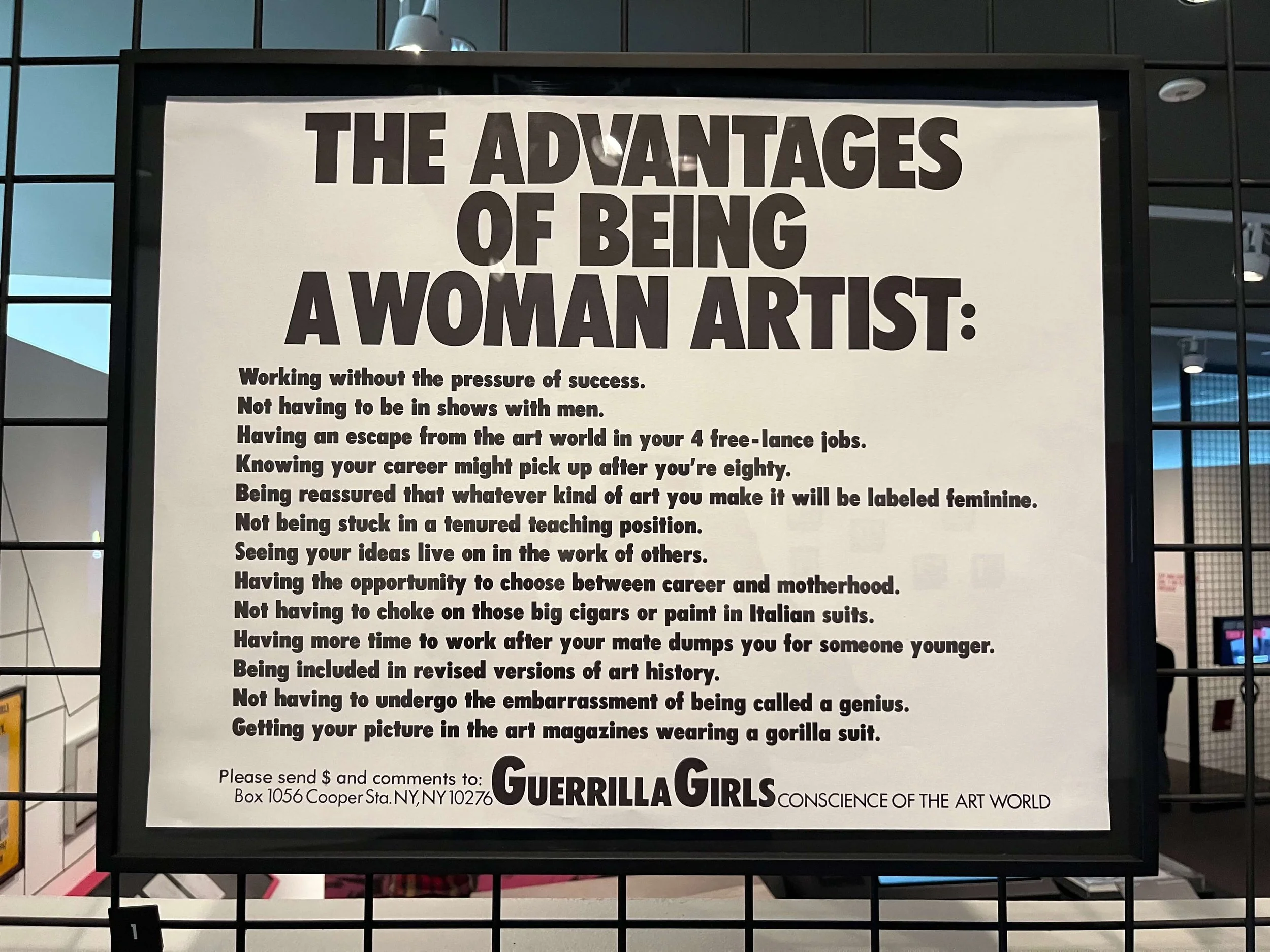
A working list to compare the advantages of being a man or a woman artist.
It is bracing to see the process behind some of the group’s noted works. Their sarcastic poster, “The Advantages of Being a Woman Artist,” showed how disadvantageous it really is. The “advantages” include things like “Working without the pressure of success” and “Knowing your career might pick up after you’re eighty.”
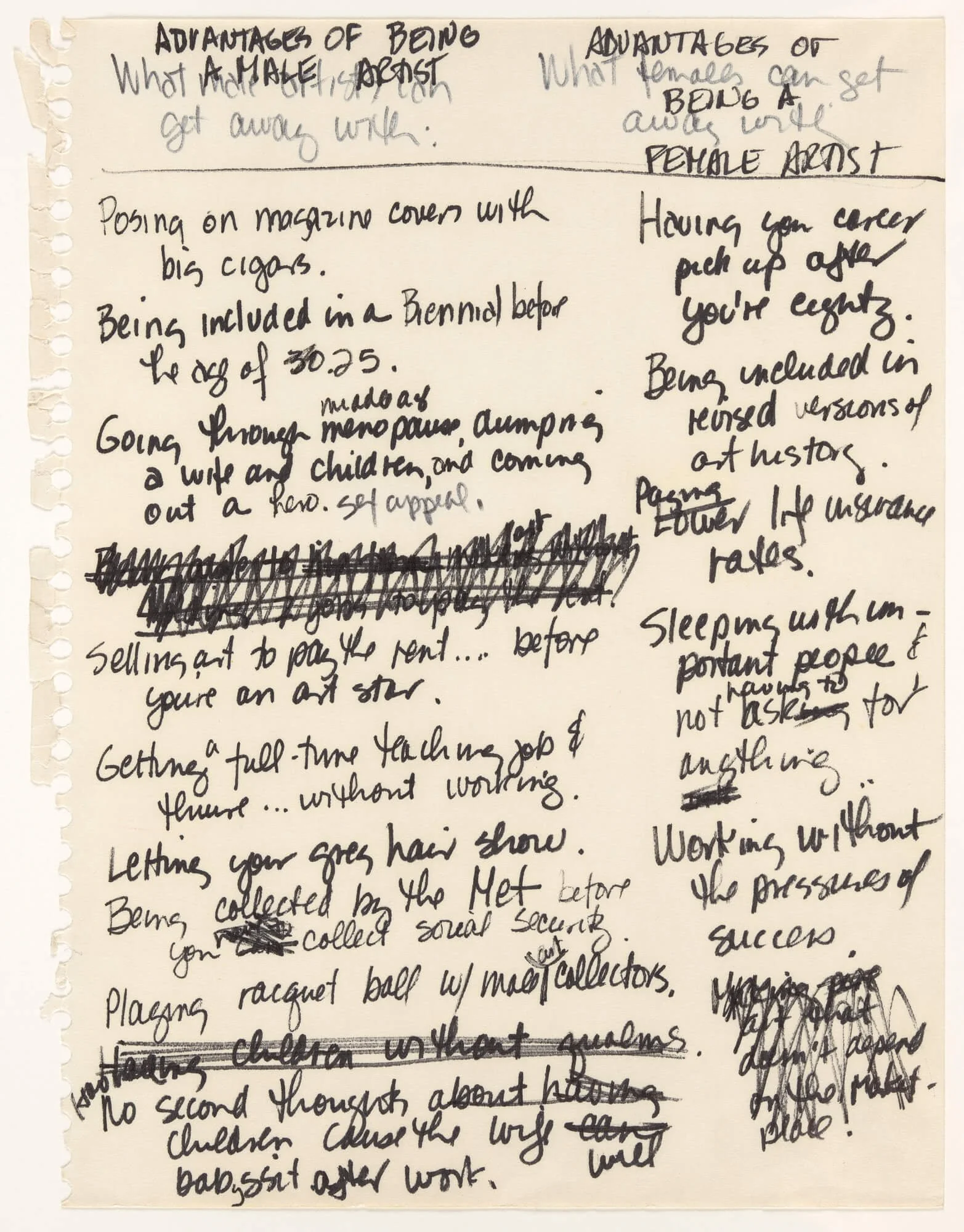
The Getty displays that piece in early developmental stages, showing the collective making handwritten drafts, scribbling out rejected ideas, and laying out the poster, with transfer type in the 1980s, not computers. “We wanted to show the labor,” Gilbert said, “and (reveal) the technical questions that the archives can show us.”
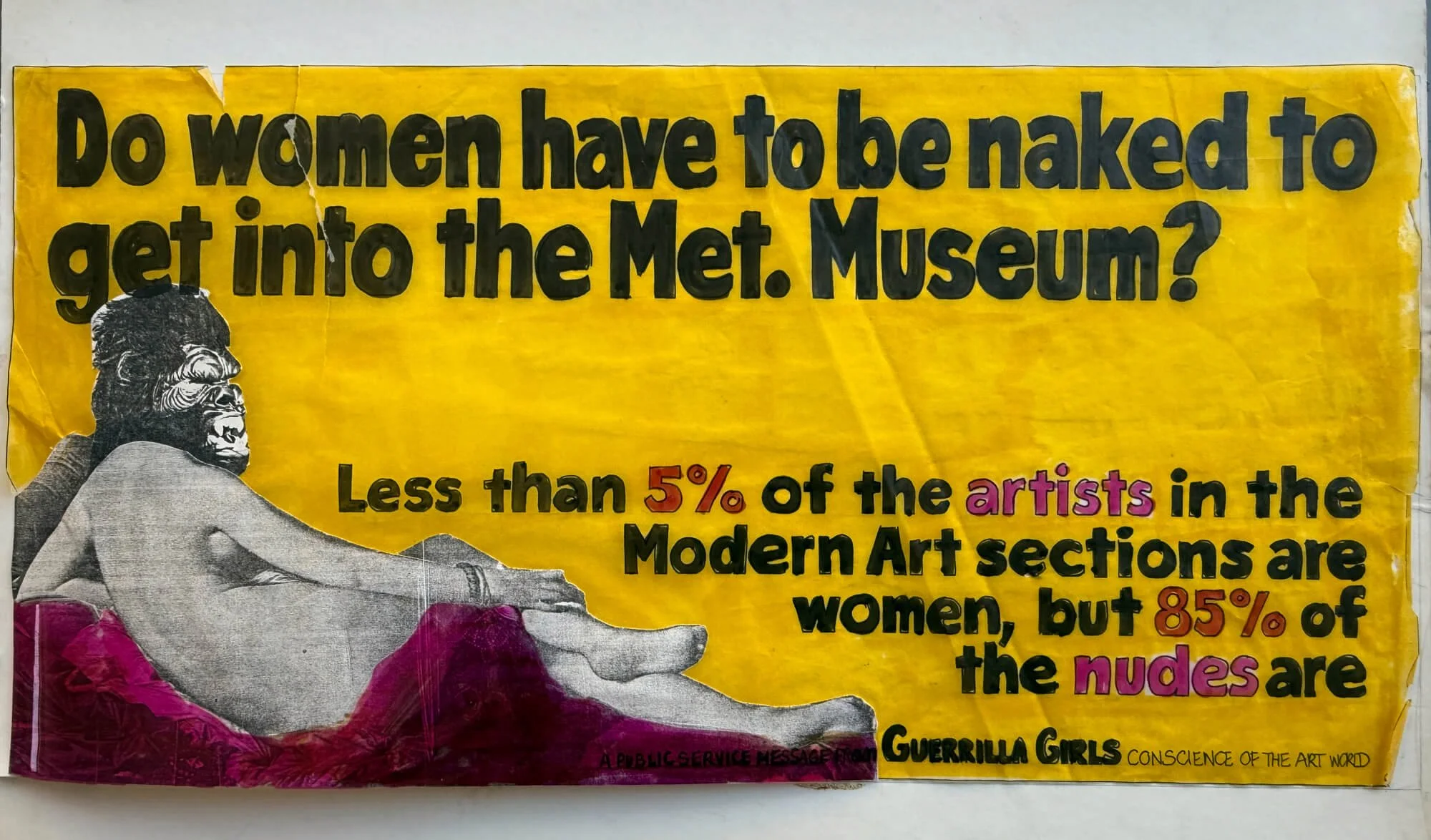
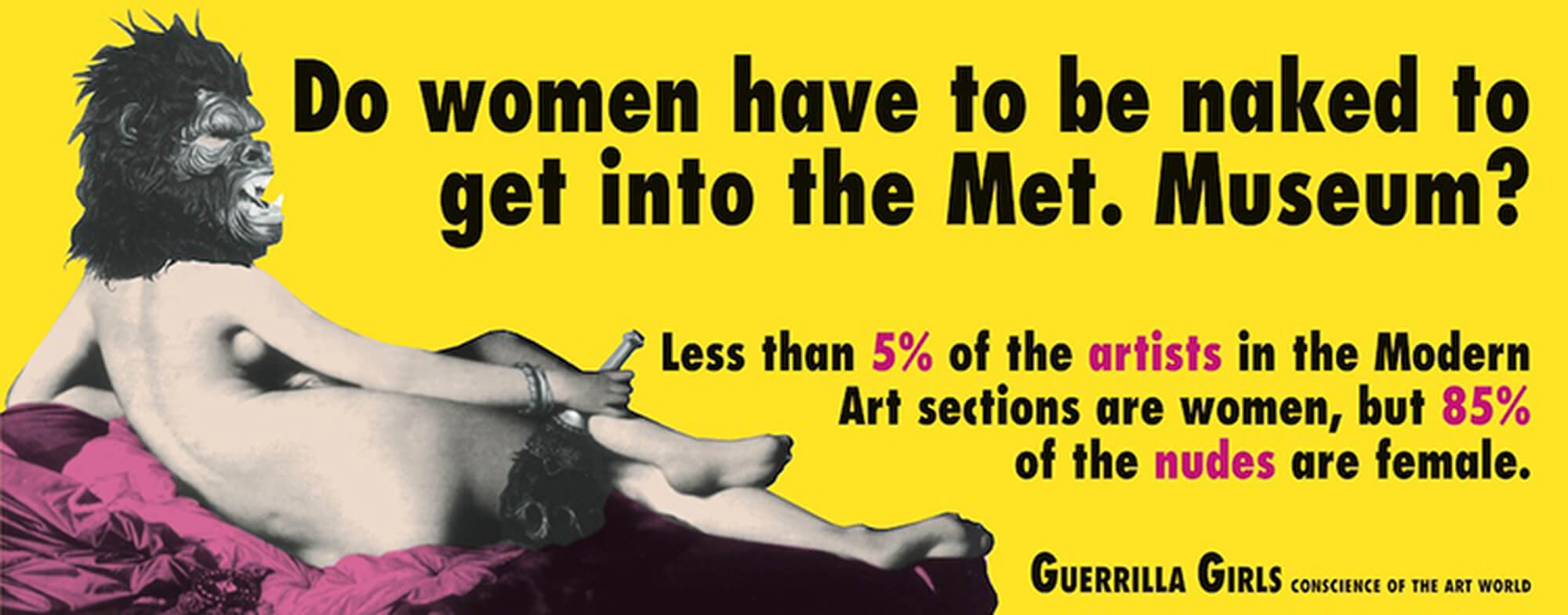
Likewise, for perhaps the collective’s most famous poster, a naked odalisque in a gorilla mask with the question: “Does a woman have to be naked to get into the Met. Museum?” The 1989 poster carried hard facts: women were less than 5 percent of the artists in the museum’s modern sections, but 85 percent of the nudes.
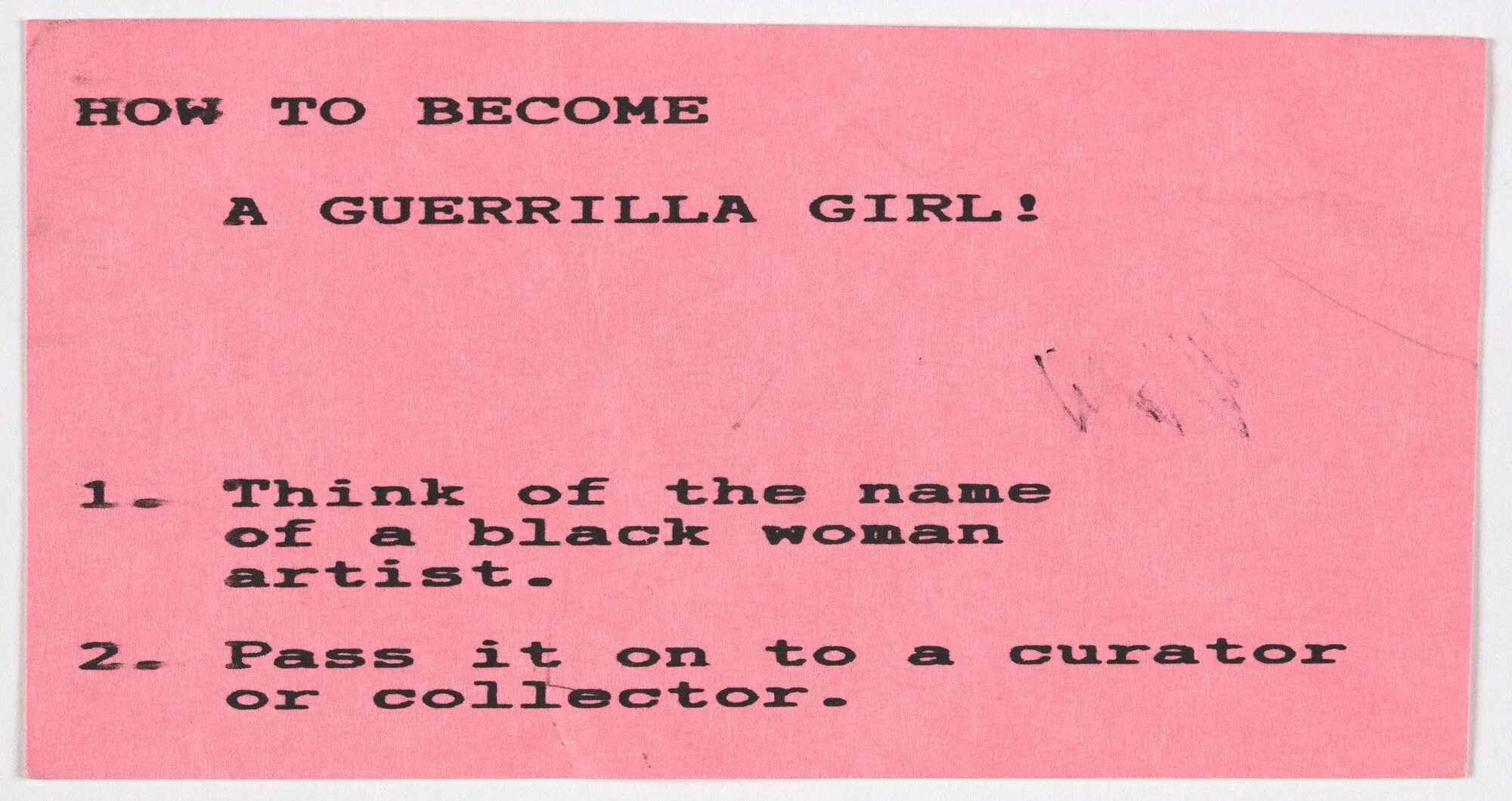
After constant queries on how people could join the movement, the Guerrilla Girls created this card.
There are multiple lessons here. One is about the power of advertising, savvy graphic work accompanied by data. “People don’t believe you unless you show them the numbers,” said the Guerrilla Girl Kathe Köllwitz in an exhibit video. For anonymity, the collective members adopted the names of underrepresented women artists and hid their own identities behind the masks.
The numbers were important. When challenged on their assertions of inequality, they had a ready answer: “All you have to do is count.” The show lays out the methodology.
Their effectiveness was not just getting museums to reach out to artists who were women or otherwise underrepresented. It was educating the arts viewer. After the Getty, on a visit to the Los Angeles County Museum of Art, I found myself noticing all the nudes in a room dedicated to German Expressionism, while only one of the artists ( the actual Kathe Köllwitz) was female.
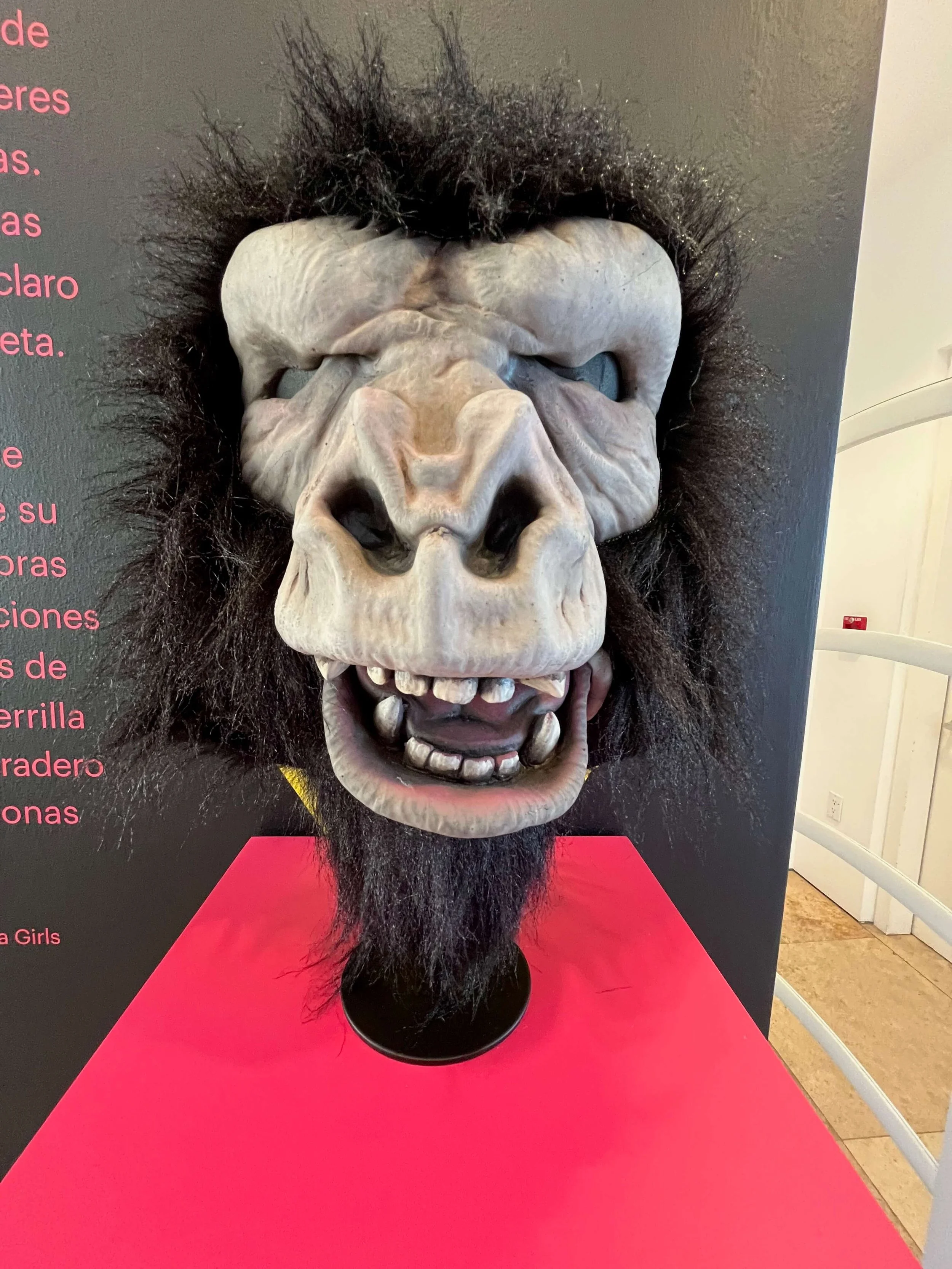
A gorilla mask greets exhibit visitors.
“I think that’s what the Guerrilla Girls project does,” Juarez said. “It works. It trained your eye a certain way, and then you recognized it. That kind of answers the prompt of the show: How to Be a Guerrilla Girl.”
Another lesson is the difficulty of change. The show displays versions of the odalisque poster from 1989, 2005, and 2012. The numbers have not improved much. A subsequent survey still showed only 8 percent of artists were women, said Gilbert.
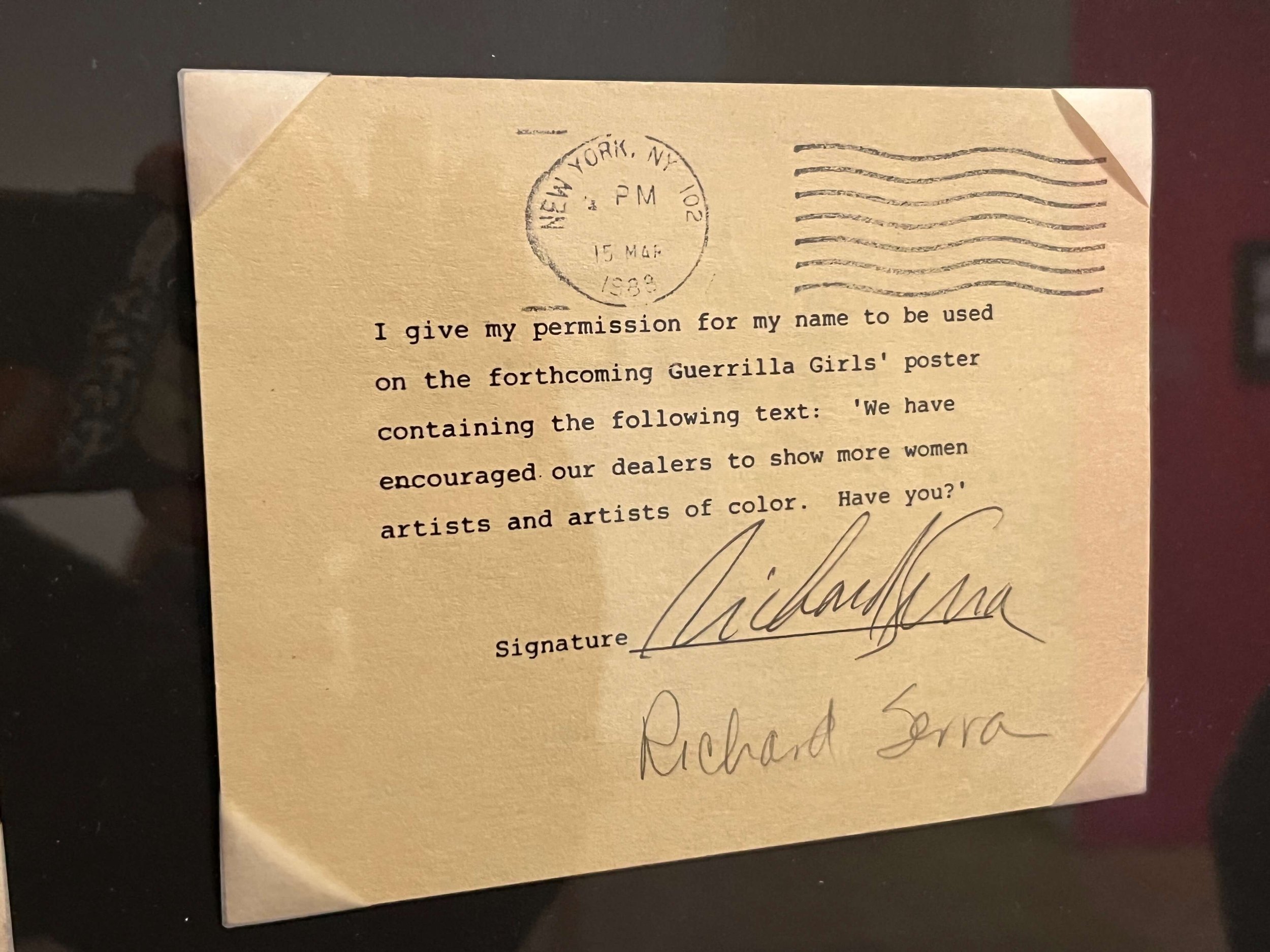
Guerrilla Girls mailed cards to artists asking them to commit support to their principles and work with their galleries to promote equality.
Beyond displaying the collective’s poster campaigns and showing the backstory and work, the show includes video interviews, flyers for appearances, mail campaigns, a journalistic satire, and archival photos of masked members.
The curators had to leave out some items that reflected the group’s depth of commitment to women as artists. To preserve anonymity, the show was unable to include invoices submitted by collective members when they hired child care to perform their Guerrilla duties.
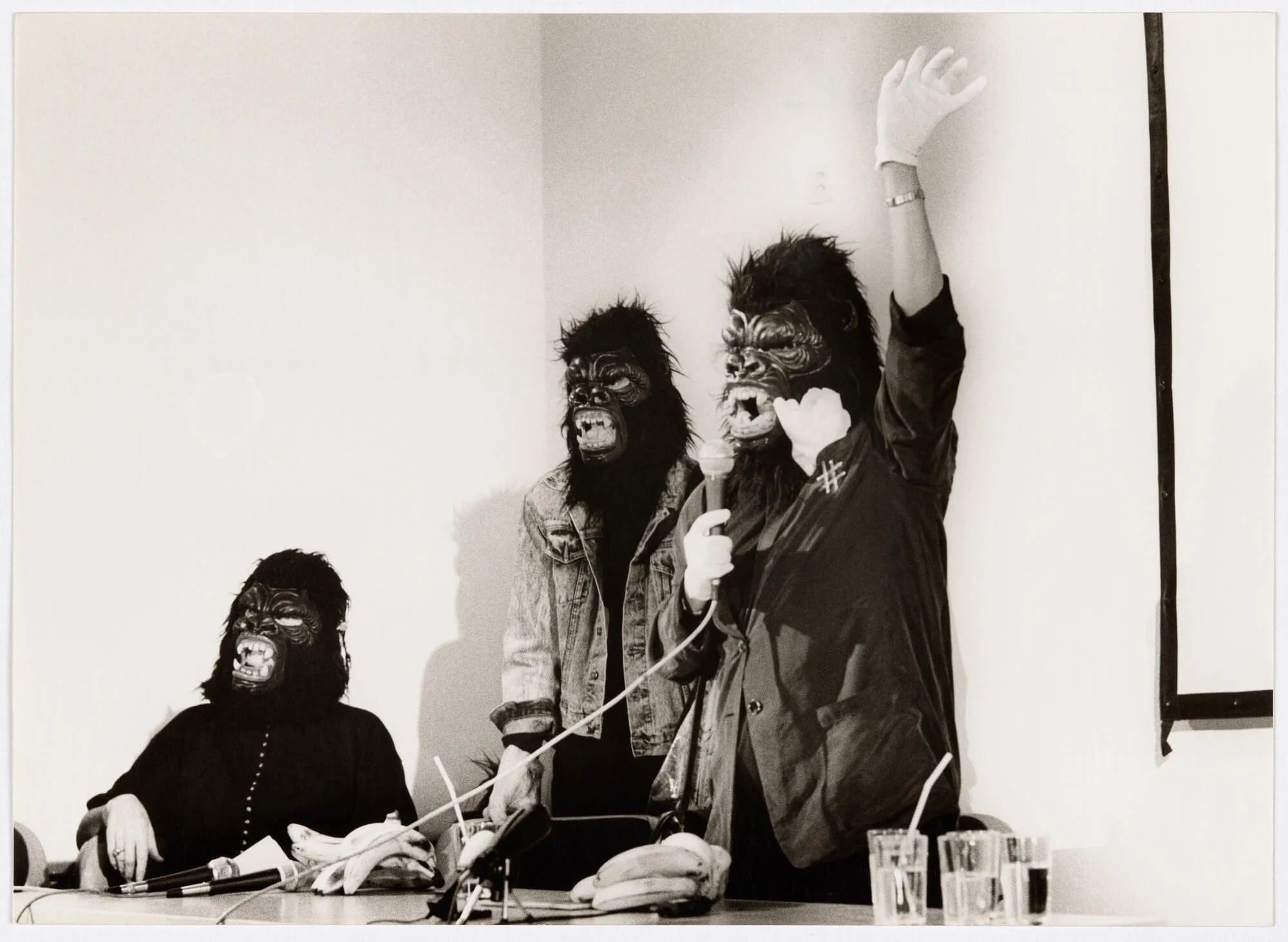
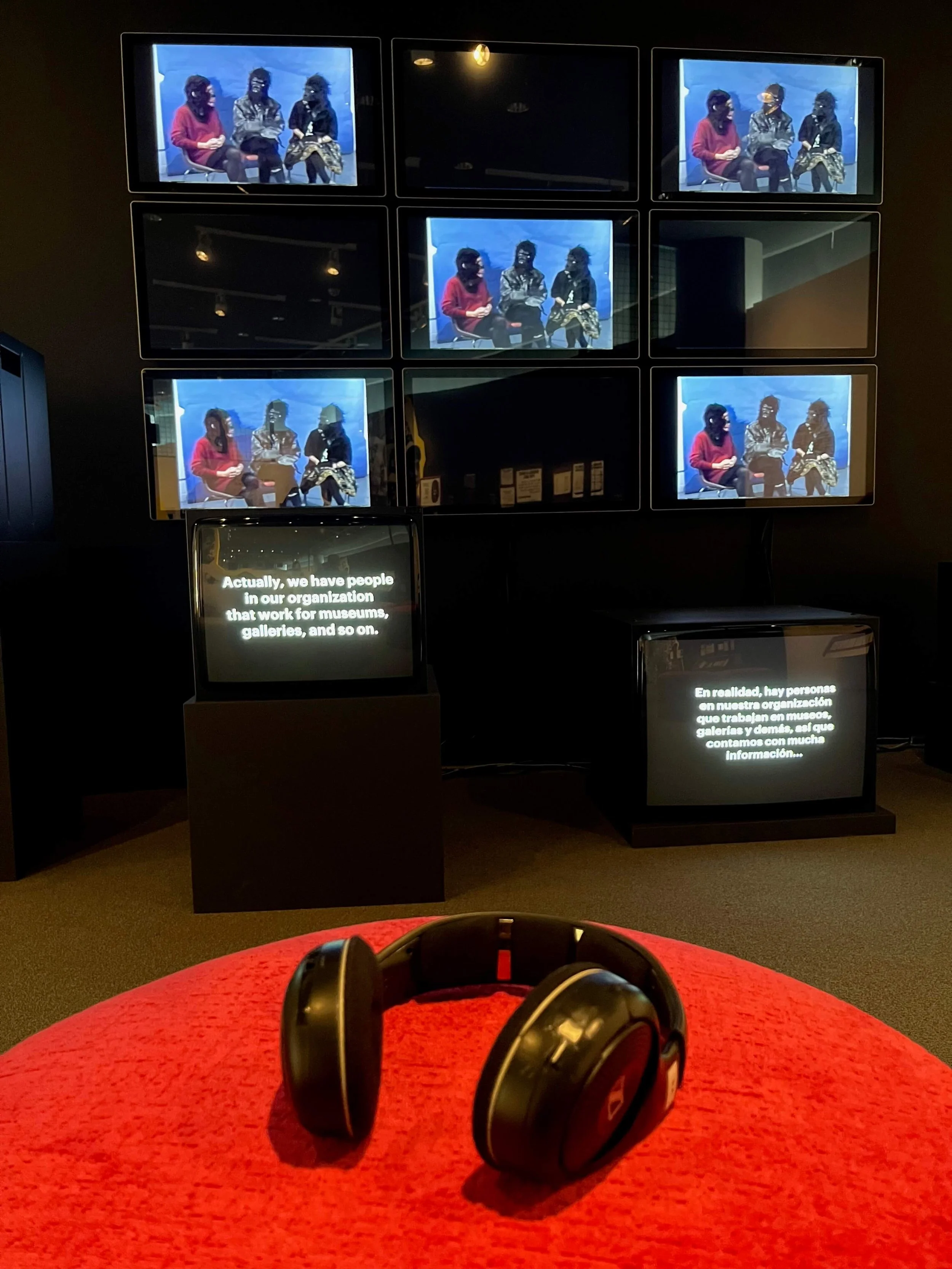
The exhibit does, however, include the item most identified with the group: a mask. Though the collective identified with political guerrillas, one member who went to get masks to preserve anonymity apparently mistook the homonyms, guerrilla and gorilla, and wound up with ape masks.
The GRI’s exhibition effort goes beyond artifact selection and show design. The curatorial team also created research aids for studying the Guerrilla Girls and developed programming to supplement the show.
For Valentine’s Day, they ran a program that allowed visitors to make “Valentines for a Feminist Future.” A March 1 program features Guerrilla Girls in conversation with Geena Davis, actress and founder of an institute on gender in media.
