
Ken Goldberg and Tiffany Shlain, Ancient Wisdom for a Future Ecology: Trees, Time, and Technology, di Rosa San Francisco
Living on the Edge
Grounded and Rooted
By Jan Wurm
The majesty of trees fills the air breathed by Californians who wander beneath giant redwoods; it fills the imaginations of travelers who come to witness their grandeur. To stand in the presence of a great oak or cedar or redwood is to marvel at their age: their endurance, their resilience, their tenacious survival. With yearly growth rings that record their age, that respond to drought, swell with growth in generous rainfall, and steadfastly measure a hardened time, some of these trees have stood, giving oxygen and shelter for thousands of years.
In the current exhibition, Ancient Wisdom for a Future Ecology: Trees, Time, and Technology, the artists Ken Goldberg and Tiffany Shlain present collaborations framed by an introduction of work and interests pursued in their separate art practices. From these parallel investigations in culture and history, commonalities emerge. From Goldberg’s works lining the left side of the gallery to the works of Shlain on the right, the artists call out with singularity of image, dynamic shifts in scale and focus, and the captivating visual of the bright screen and glowing pixels.
The enormous cross sections of trees that fill the largest gallery in the di Rosa San Francisco venue hold a weight and a force that can transform the urban structure and transcend the walls. It is the beauty of the wood, the splits and gnarled edges of bark, the pulsating rings of amber-colored time that expand from an ancient core to inspire a silent awe. But this is not a history of a forest or a tree or a wildfire or an infestation. These salvaged slabs are the material of other histories.
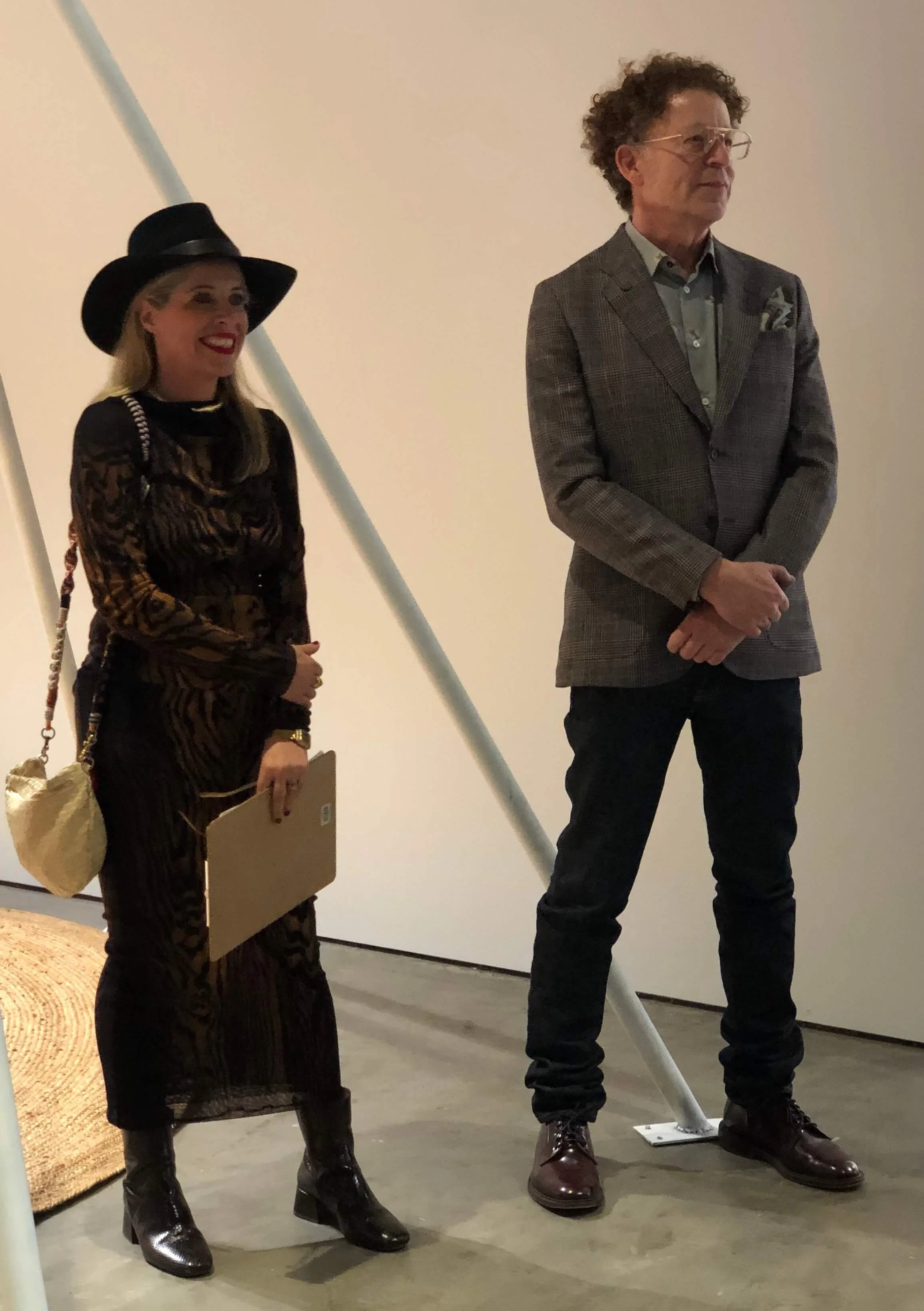
Ken Goldberg and Tiffany Shlain at the di Rosa Art Center
In collaboration, Ken Goldberg and Tiffany Shlain have taken these testaments of life and used them as support for timelines of feminist history, developments in mathematics and physics, Judaic history, and the posing of ever-recurring and persistent philosophical questions bearing down on the very meaning of life.
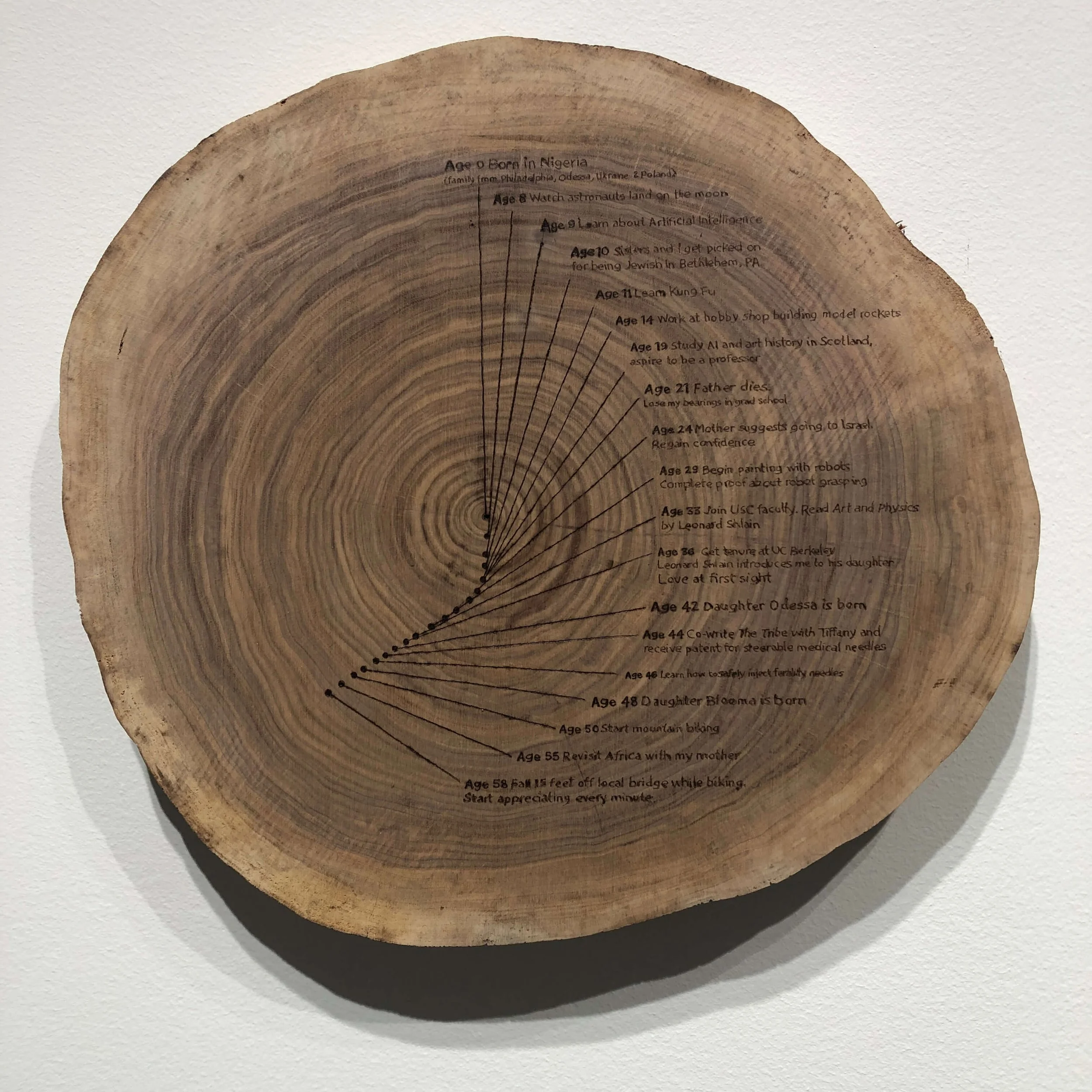
As collaborators, in marriage and in art, Goldberg and Shlain have a give and take, a back and forth as playful to witness as a Spencer Tracy—Katharine Hepburn 1940s film exchange: clever, witty, edgy, yet holding a warm sense of security in research and scholarship. Theirs is a common dedication and compassion. With cross sections of younger trees that have had lives closer to a human span, the artists have each created a self-portrait through incised autobiographical points on their individual timelines. Hanging side by side on the wall it is hard not to expect these pieces to collide, dovetail, merge, like tectonic plates pushing and shifting with subduction or uplift.
Ken Goldberg Self Portrait
Kindred Spirits. Meeting and declaring love at first sight. What, in their early years brought them to this intersection? It is tempting to read into these very bare facts: Parents Divorce, Death of Father, deep imaginings of Odessa – home, family, roots, recovery of what was lost. Akin, reclaimed wood is sliced and sanded, polished to make visible the years past– life rooted and anchored.
With Goldberg, we read the centrality of his work, the deepening development and intellectual hold of the conceptual pushed, the imagined given form. With Shlain we feel the physical body, the struggle and pain through pregnancies, miscarriages, and fertility treatments. And humming through each self-portrait is loss, grumbling is the disorientation of searching, and ticking loudly is the timekeeper— mortality.
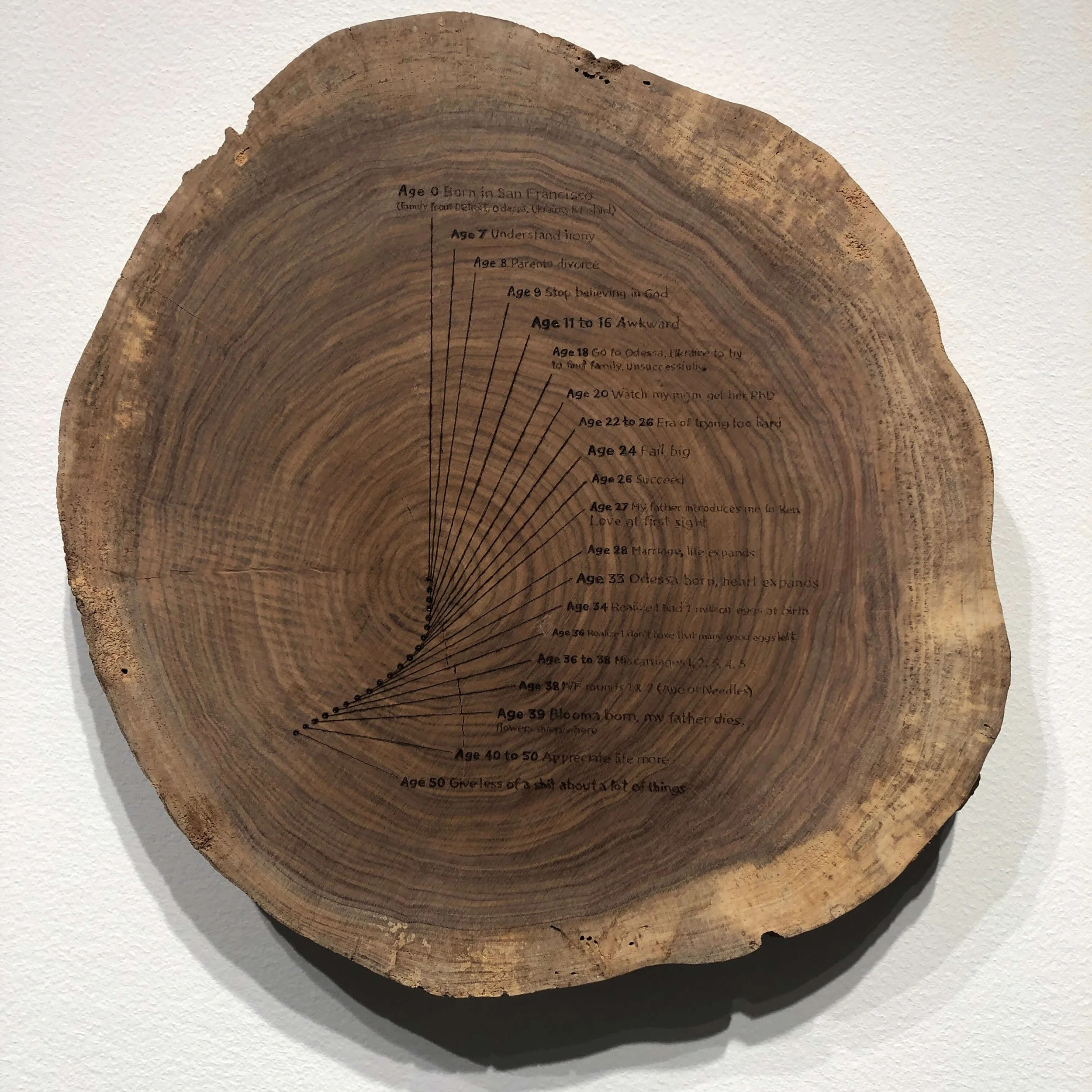
Tiffany Shlain Self Portrait
For some artists, the self-portrait marks a transition: a marriage, a move to a new country, or a state of despair. Rembrandt’s self-portraits followed his aging, Van Gogh his social isolation, Käthe Kollwitz the grief of the deaths of her son and grandson, Frida Kahlo the torment of miscarriage and surgeries; the listings continue to mark impact and hold memory. Ken Goldberg and Tiffany Shlain have created self-portraits that not only are autobiographies, but also personal histories that mirror the very work that connects them, that becomes the work itself.
Dendrofemonology: A Feminist History Tree Ring presents 50,000 years of history through a feminist lens with a selection of 33 milestones from “50,000 BCE Goddesses Worshiped” to “2022 Roe v. Wade is overturned” burned across its rings.
Chilling markers note that after “Literacy develops and seeds of patriarchy spread (3100 BCE),” Mesopotamian law declares “if a woman speaks to a man out of turn, her teeth will be smashed in by a burnt brick (2400 BCE).” It is difficult to watch the very long wait for emancipation and social and political progressions that are then thwarted and unravel.
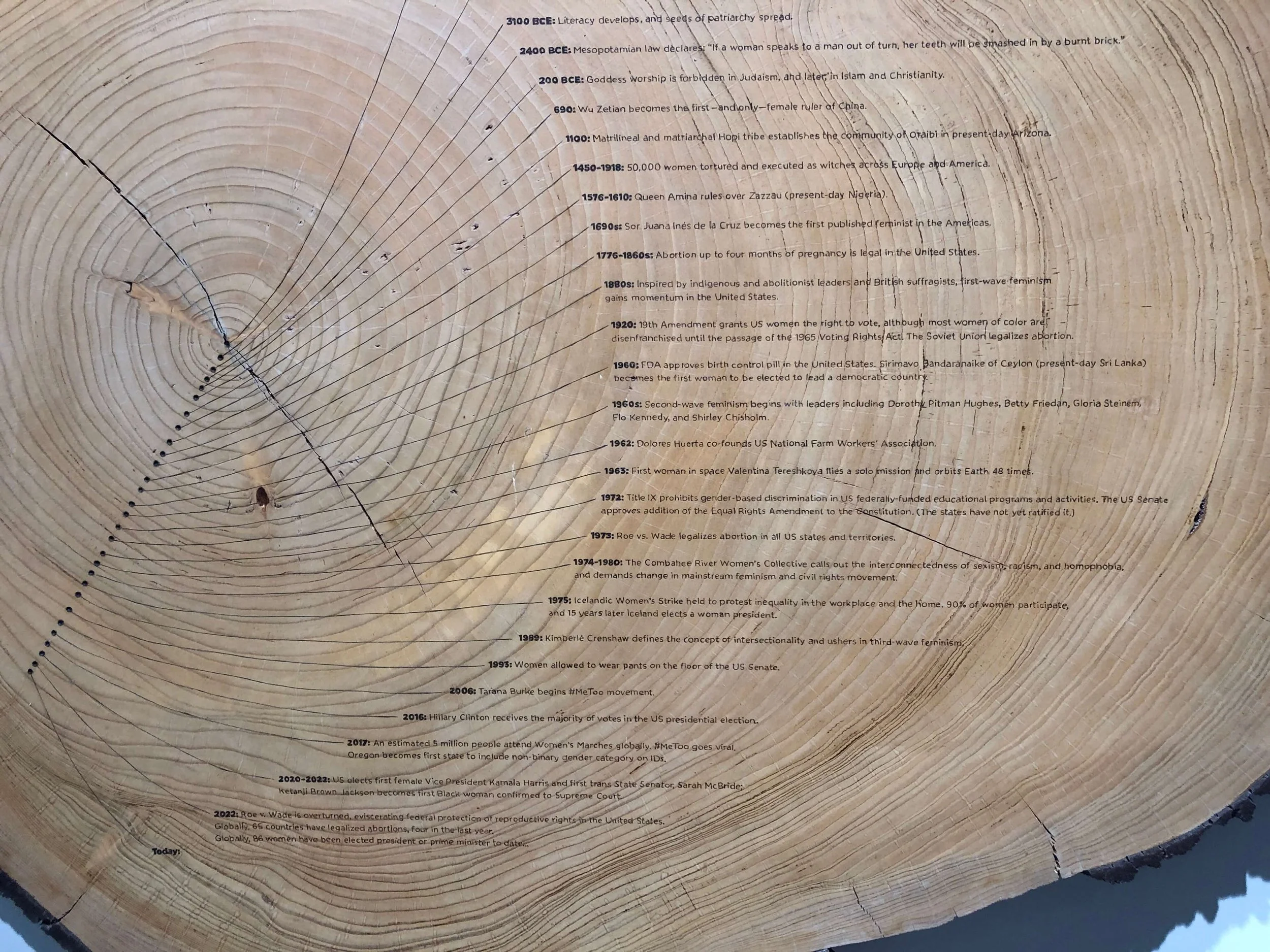
Dendrofemonology: A Feminist History Tree Ring
Dendrofemonology: A Feminist History Tree Ring stands as a movable monument to draw attention, particularly in sharp contrast to the likes of horse-mounted bronze warriors or phallic stone stelae.
In concert with the Dendrofemonology, Shlain’s film, We Are Here, details her process and vision for the work, documents historical points of successful social and political movements, and even performs as a motivational video. The fast editing and pulsing soundtrack of the film push forward at a breathless speed – conveying the urgency of our time.
But in the gallery, it is in the quiet of the tree fragment that the mind can ponder the developments and shifts over expanses of time beyond personal experience. The physical presence – the weight, the testimony of the tree itself, cut down after its long life—still speaks. As witness, it echoes the history burned into its flesh. Ending with the one final word: “Now,” it becomes a question, a task, a responsibility.
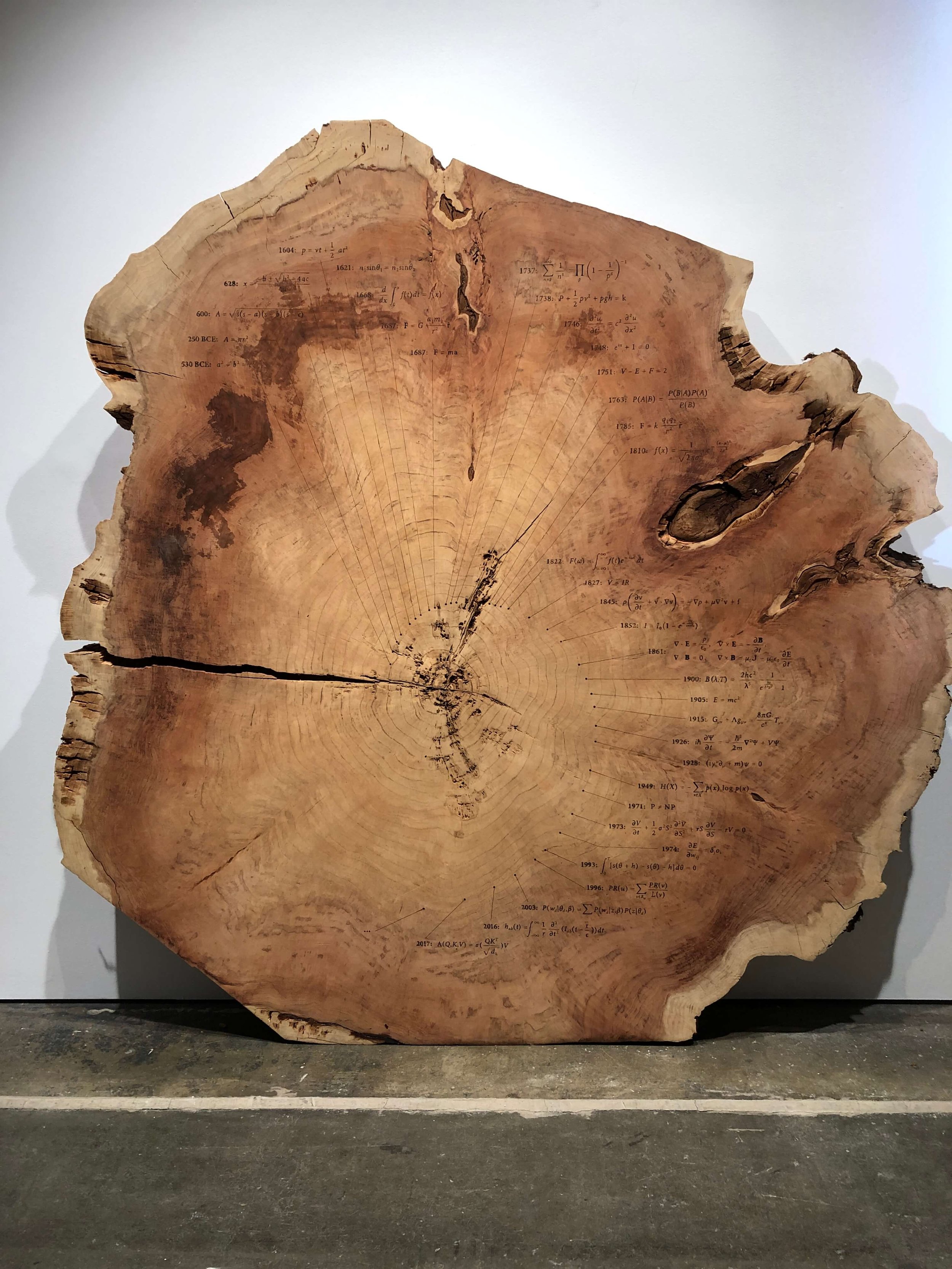
Abstract Expression
In a delightful shift in language, an assembly of numerals and symbols address a different obsession and pursuit. Abstract Expression conveys the roots of scientific mathematical investigation with the Pythagorean theorem marking the timeline’s first inscription of 530 BCE followed 120 years later by the formula for the area of a circle and then swirling with ever greater excitement through mathematics and physics. The beauty and purity even in what may appear most puzzling arises from thought that pushes and bores and twists. The impulse and drive in questioning and discovery are a dizzying trajectory through the realms of the theoretical and open-ended, reaching an undated ellipsis.
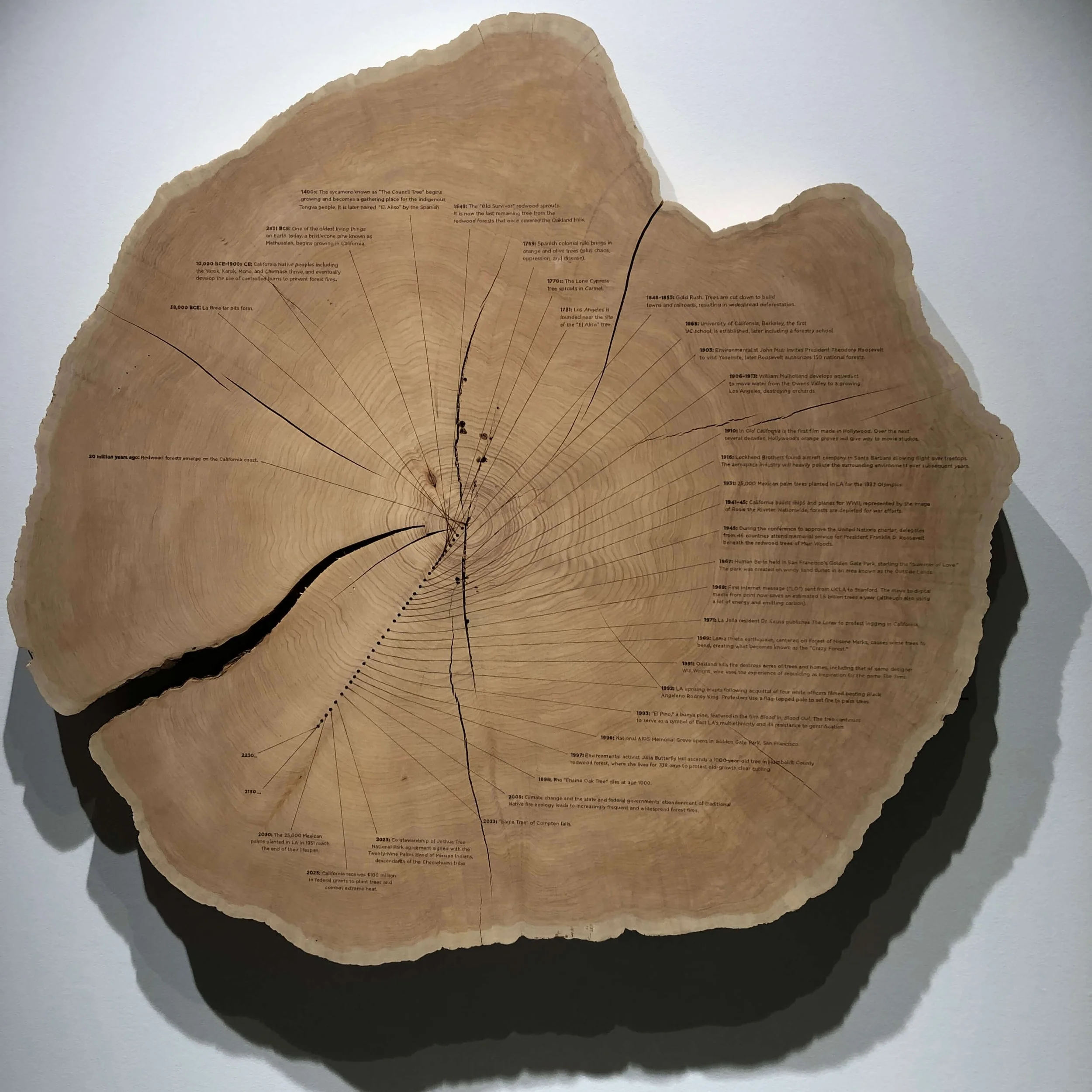
The most integrated of ecology and human impact can be visualized through Living on the Edge in which the artists have mapped out geological and botanical events in California from the beginning of redwood forests (twenty million years ago) and the formation of the La Brea Tar Pits (38,000 BCE) to the Los Angeles planting of 25,000 palm trees imported from Mexico (1931). The consequences of the development and growth of Los Angeles as water diversion, aeronautics, and urban sprawl reconfigure the landscape ring with a hollow echo. It reverberates with a death knell marked for 2030 as thousands of palm trees reach their life expectancy. The ephemeral quality of the modern and the short-sightedness of contemporary planning is placed in perspective – writ on the material evidence of time. How the thousands of years of established forests can be devastated so quickly by overconsumption and social habits becomes a question raised by each ripple of bark, by every ancient deep core.
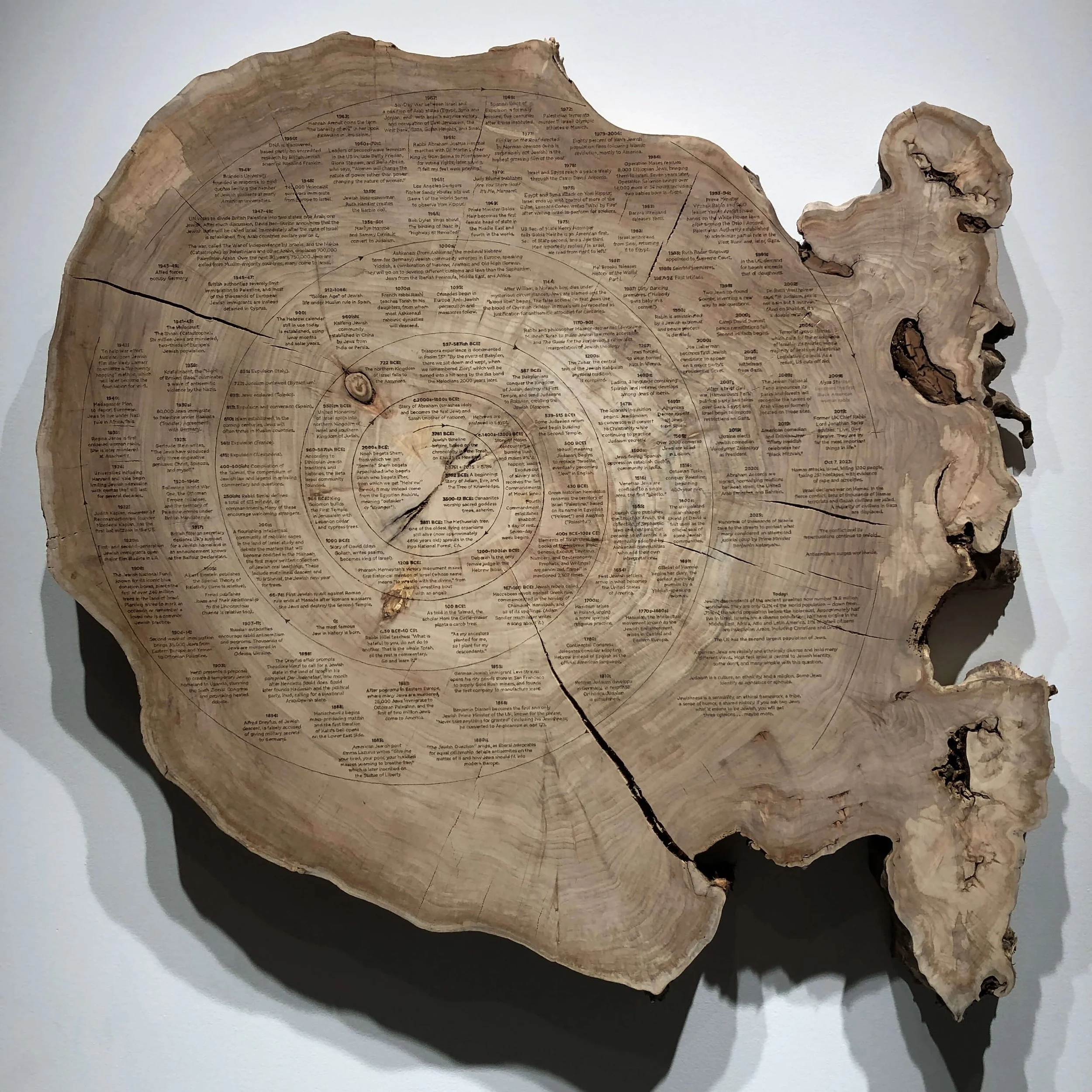
DendroJudaeology: A Timeline of the Jewish People
Perhaps one of the most curious timelines, DendroJudaeology: A Timeline of the Jewish People, places historical and cultural events across an expanse of six thousand years. It is both wrenching and hilarious, with commemoration of wars and the Barbie doll side by side. This timeline also carries the simplest notation: ”0 –the most famous Jew in history is born.” A beautiful ,crazy quilt, this collection of communities and persecutions, of political histories and popular culture, of baseball and Bob Dylan, spirals across continents and across time.
Memory has often relied on photographs, letters, tombstones, and monuments. History has rested on recorded stories and song, accounts written, retained and preserved. Ken Goldberg and Tiffany Shlain have marked histories that still have futures. Unknown, they are still to be written. To lose track of time, place, meaning –is to tread a truly perilous path. These reclaimed woods are evidence of time as well as momento mori for a society rapidly destroying culture, history, and nature. To retain the ellipsis… to write a future, has become an imperative.
