
Wardell McNeal - strange / familiar, Cañada College, Redwood City, CA
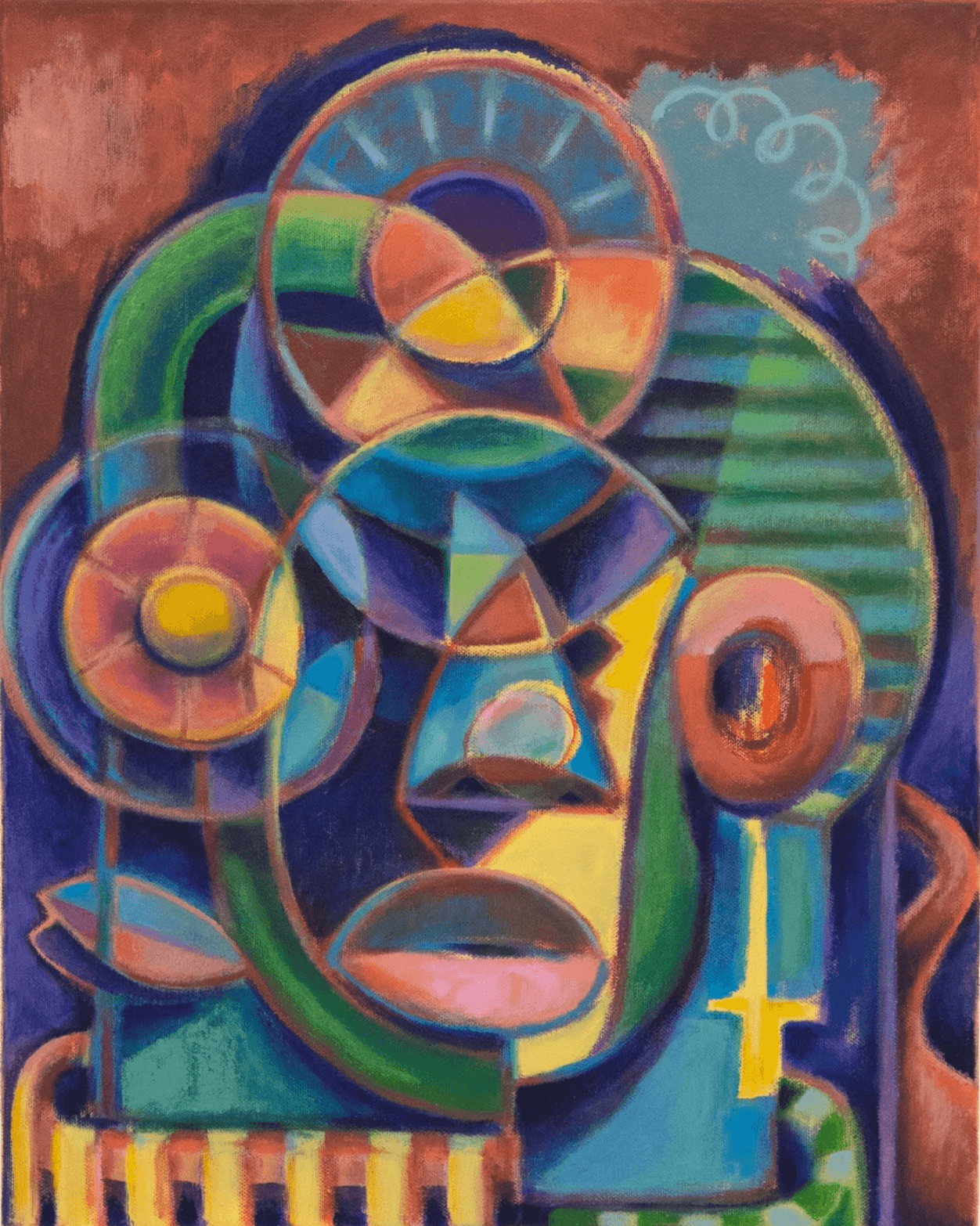
Wardell McNeal, Care is Eternal, acrylic on canvas, 20 x 16 inches, 2026.
Wardell McNeal - strange / familiar at Cañada College, Redwood City, CA is Curated by Emilio Villalba
April 9th - May 14th, 2026
Walking into the gallery, the light hits first. Late afternoon sun cuts across the white walls at an angle, catching the paintings in a way that feels almost accidental. Some colors get sharper, others soften. The walls are stark, but that contrast makes everything land harder. The blues feel deeper, the oranges warmer, and the quieter areas start to glow a bit.
McNeal’s paintings don’t fight the light. They sit in it. Even when the colors are bold, there’s a softness underneath that slows you down. The spacing helps too, nothing is crowded, each piece has room. Together they start to feel connected. You’re not really moving from one painting to the next. It feels more like drifting through them, like something just slightly off from reality.
Wardell McNeal, based in Oakland and represented by pt.2 Gallery, has been steadily developing this visual language over the past few years through a series of solo exhibitions. Shows like A Series of Meditations on the Complexities of Life (2021) and Dreaming with Eyes Wide Open (2022) established his use of stylized figures and shifting, almost unstable spaces. By the time of A Little Room To Bloom in 2023, that language had loosened, opening into more organic forms and less fixed compositions. strange / familiar continues that progression, focusing less on subject and more on perception; how something recognizable can start to slip the longer you look at it. That progression becomes clearer once you return to the room and let the paintings unfold in the light.
In Dream Sequence 2.0, that relationship to light sharpens. Two large, rounded hands frame a small, glowing form at the center, which reads less like an object and more like a source. The palette is saturated with blues, greens, and sharp orange accents, but it doesn’t sit heavily. The paint softens at the edges, especially where the light seems to move outward, diffusing through the composition. Under the gallery’s late afternoon light, those transitions become more noticeable, pulling the work away from something purely graphic and into something more atmospheric. The repeated circular forms across the lower half build a steady rhythm, echoing the central glow without fully resolving it.
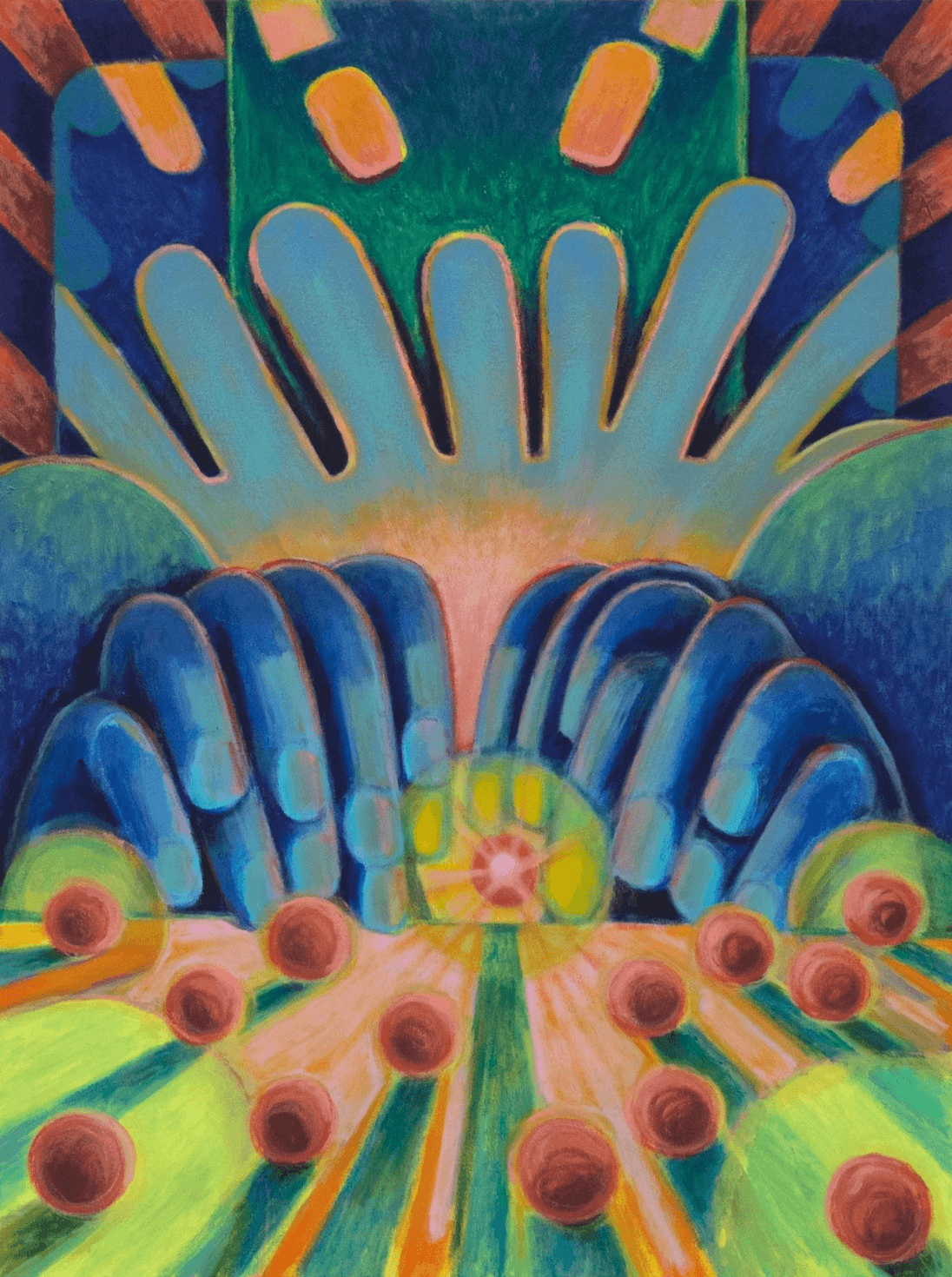
Wardell McNeal, Dream Sequence 2.0, acrylic on canvas, 40 x 30 inches, 2026.
If Dream Sequence 2.0 holds its light at the center, empath / impasse lets it spread. The composition opens up, with light moving across the surface rather than staying contained. A striped hand rests over a coiled form, set against suns, orbs, and geometric shapes that feel both constructed and unstable. The color is more forceful with bright yellows, greens and deep blues, but it never hardens. The brushwork keeps it loose enough for the light to shift as you move.
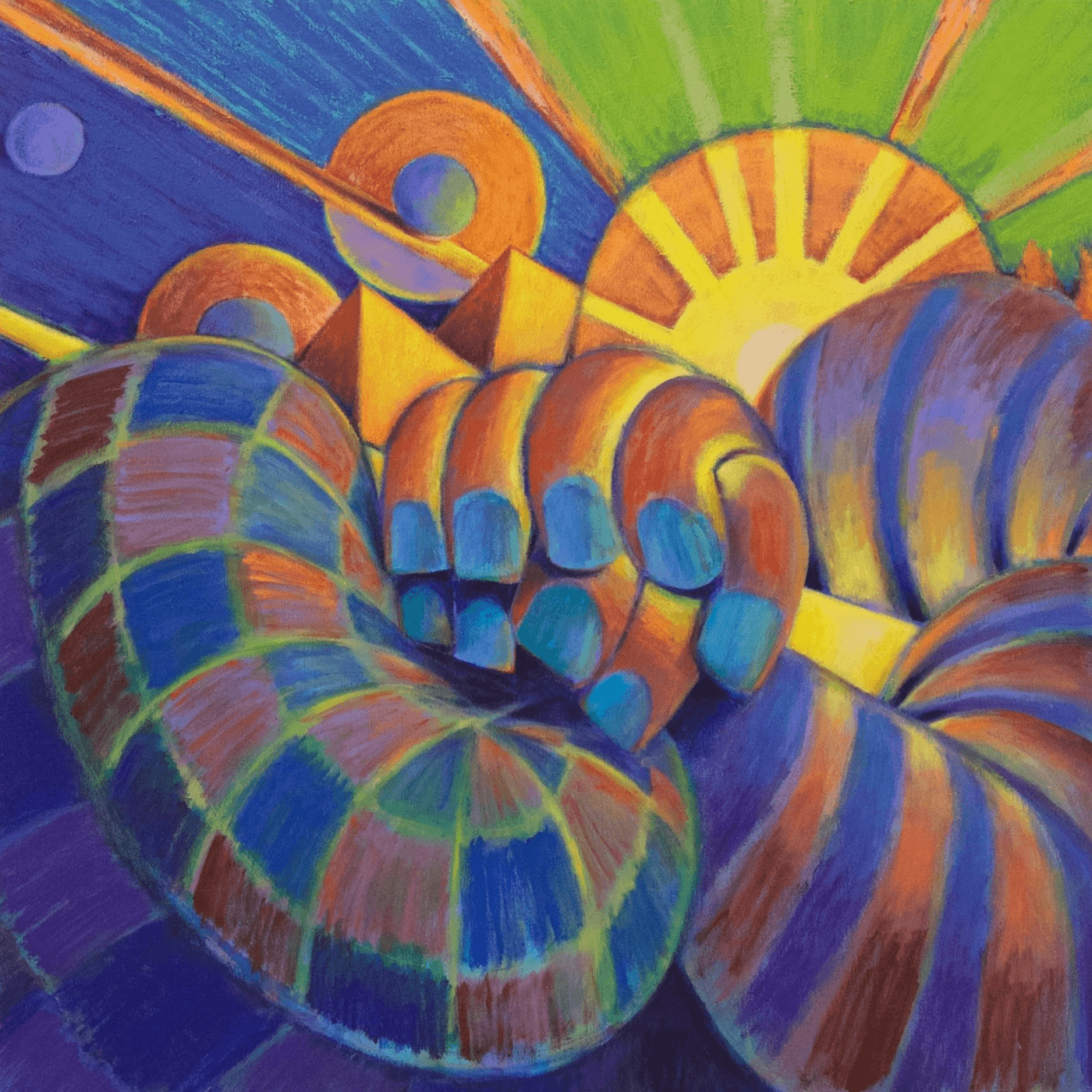
Wardell McNeal, empath / impasse, acrylic on canvas, 36 x 36 inches, 2026.
Together, the two paintings feel like variations on the same problem. One pulls inward, the other opens out. In both, light and color do the work of holding the composition together while also quietly undoing it.
In Specters of Time Well Spent, the figure moves forward but never fully settles. At 48 by 36 inches, it holds a strong presence on the wall, especially against the sharp white of the gallery, but it too doesn’t feel heavy. A face anchors the composition, built out of shifting planes of color, with a plant and a glass pulled into the foreground. The structure is there, you can feel it, but the surface keeps it from locking in. Edges soften, colors drift, and the space folds in on itself.
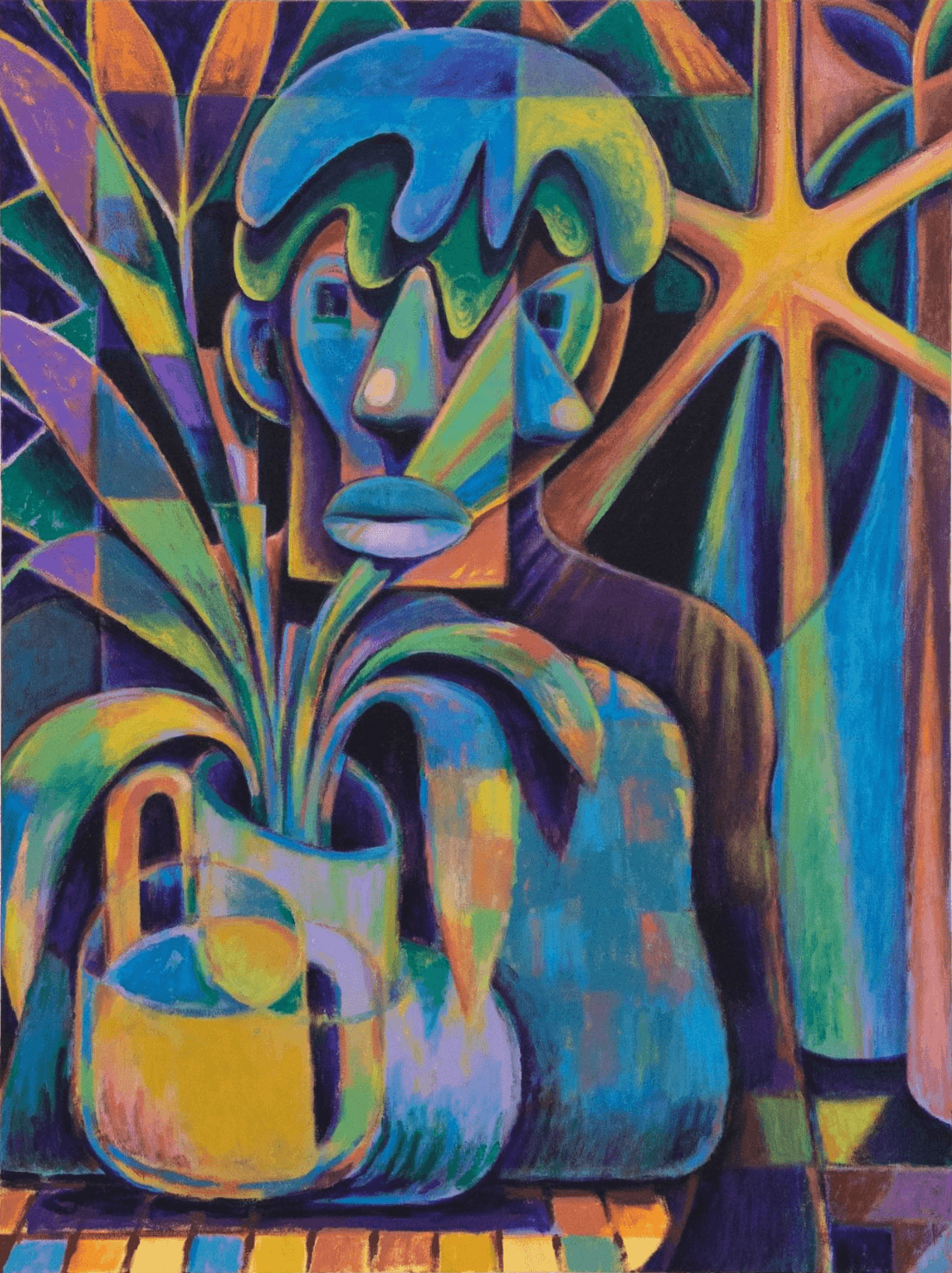
Wardell McNeal, Specters of Time Well Spent, acrylic on canvas, 48 x 36 inches, 2026.
It feels quieter than the other works. Less about movement, more about holding something in place for a moment. Despite its size, it stays relatable, human, and soft. The title fits, it doesn’t read as nostalgia exactly, more like a pause or a moment. The kind of stillness where things feel familiar but slightly out of reach like a found photograph you could swear is someone you know even though you are certain it’s not.
Spiritual Practice pulls things in again, both in scale and feeling. Four figures sit close together, their forms simplified into rounded shapes and repeated circular heads that almost read like halos. They could be friends meeting, or something closer to a quiet form of worship, but the longer you sit with it, it starts to feel more internal than that, like different versions of the self in conversation. Not fixed identities, but shifting states, moving between each other. There’s a sense of looking inward here, of trying to understand something profound. The repetition of forms reinforces that, like thoughts circling, returning, opening slightly each time. It begins to read as a kind of self-examination, where the act of sitting with it gradually widens the space of awareness. The color keeps it alive, moving across the surface so it never settles. It feels less like a scene and more like a ritual or process; something ongoing, shared within the self, and slowly expanding.
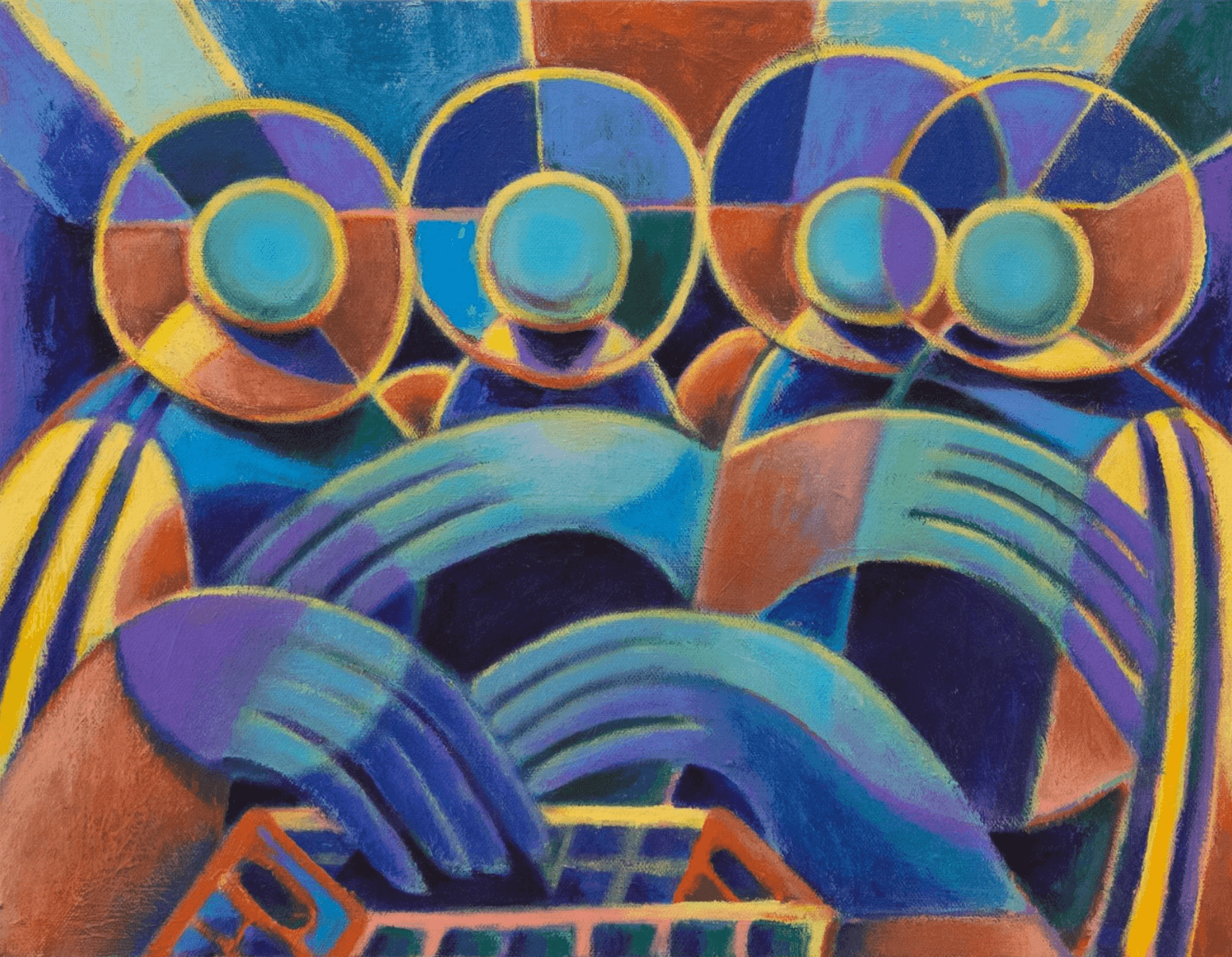
Wardell McNeal, Spiritual Practice, acrylic on canvas, 14 x 18 inches, 2026.
What holds the exhibition together isn’t any single image or motif, but the way McNeal lets things remain slightly unresolved. Across the work, forms shift between figure and object, interior and landscape, never fully settling into one or the other. There’s a looseness to that approach, but also a clear sense of control in how the paintings are composed and spaced. The light in the room amplifies it, but the paintings carry it on their own. You leave with the feeling that nothing has been fully explained but that’s part of the point. The work stays with you because it doesn’t close itself off. Its looseness shifts in a way that feels close to life. Whether over a moment or a decade, things change, people evolve, and that sense of movement is visible throughout the work.
This is the fourth exhibition curated by Emilio Villalba, Assistant Professor of Art at Cañada College, continuing a focused and steadily building program at the school.
