
Entropic Landscapes, TINT Gallery
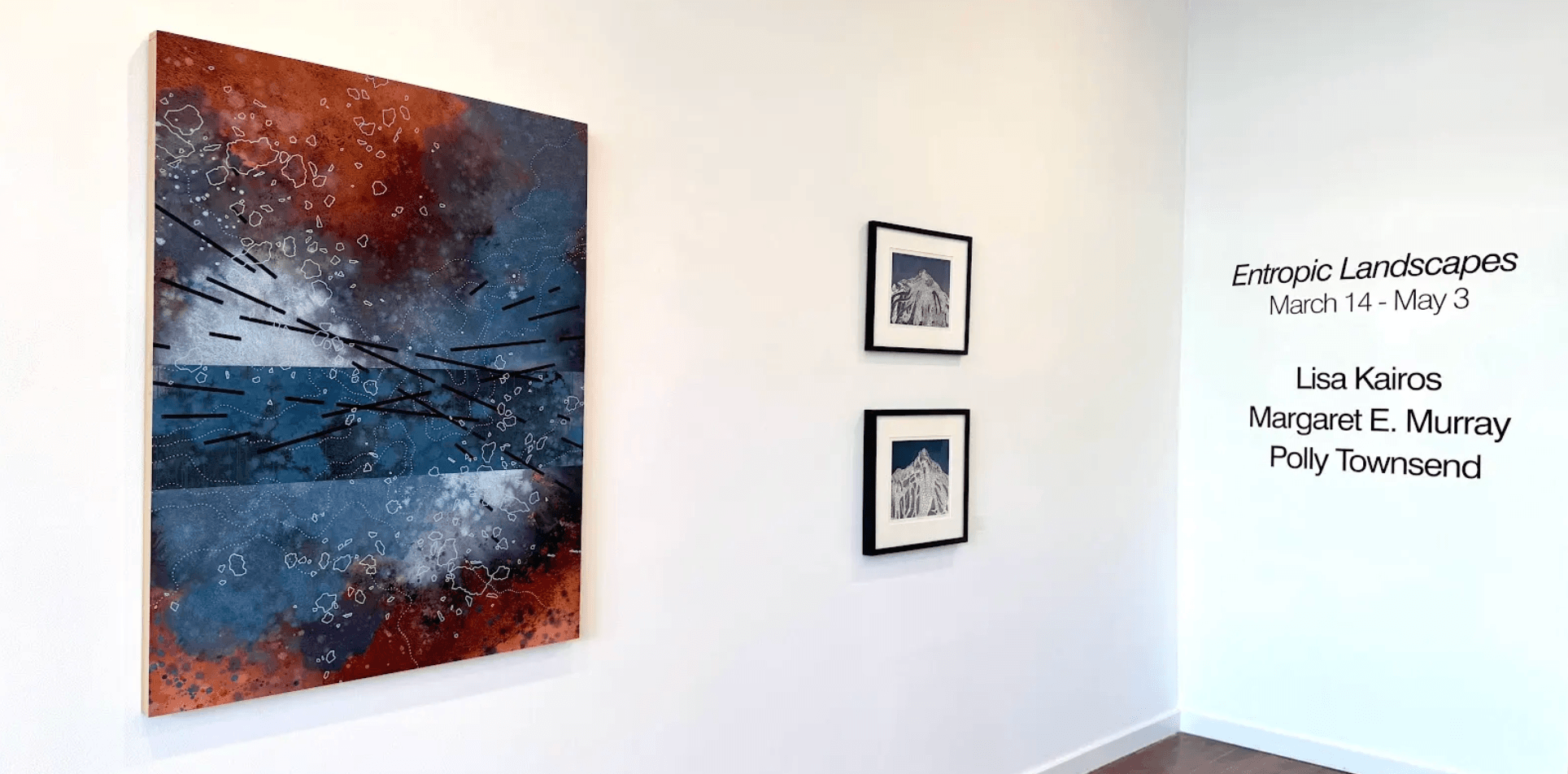
Climate-themed group shows tend to fail in one of two ways. Either the work drifts into abstracted politics that could have been made from a desk, or it leans so hard on its subject that you forget there is an artist in the room. Entropic Landscapes at TINT Gallery avoids both. Michelle Edelman has built a three-artist exhibition around a deceptively simple principle: every piece on these walls was made by someone who went to a place, stayed long enough to be changed by it, and brought a record back.
The artists are Margaret E. Murray, a printmaker who sailed to Svalbard; Polly Townsend, a realist painter who has worked in Antarctica, Death Valley, and the Badlands; and Lisa Kairos, an abstract painter rooted in the Mojave. On paper, those approaches shouldn't work, a realist and an abstract painter with an etcher. In the room, they talk to each other remarkably well. Edelman told me she curates from a running list of artists whose work speaks to her, watching for connections across media. “I loved the idea of having a super realist painter next to an abstract painter, bridged by a printmaker,” she said, “all inspired by places they’d traveled to, where the effects of climate change were evident.” That thoughtfulness is visible in every pairing on the walls.

MARGARET E. MURRAY
Glacial Melt VI, 2025
Aquatint etching
17 × 20 in. framed
Courtesy of the artist and TINT Gallery
Murray’s etchings are ones I kept returning to, ever since I showed her work at Ingleside Gallery in 2021. Her process has remained the same however the imagery and subject matter has evolved. She works with copper plates using a hard-ground technique combined with heated egg whites, a method that causes the plates to crack in unpredictable ways. Those cracks become the work, whose beauty is in the textural fracture lines standing in for the calving ice sheets she witnessed firsthand in the High Arctic. In April 2025, Murray spent two and a half weeks on an Arctic Circle Residency expedition, sailing through the Svalbard archipelago between the northernmost tip of Norway and the North Pole with twenty-eight other artists. When I spoke with her about the show, she described catching the last sunset of the season and watching the light shift entirely to blue. She talks about the stillness of those northern places with a kind of reverence that’s easy to feel in the prints. A piece like Glacial Melt VI holds that register of something solid becoming something liquid, the transformation recorded in the materiality of the process itself. The entropy isn’t written out, it happens in the making.

POLLY TOWNSEND
Spirit Level, 2025
Oil and acrylic on panel
12 × 16 × 3 in.
Courtesy of the artist and TINT Gallery
Townsend’s paintings are the quietest works in the show, and they reward patience. She paints landscapes pared back to their essentials, modest bands of earth and sky, simplified until the eye has nowhere to go but into what’s left. Her palette is restrained; her compositions are stripped to the parts that matter most. Spirit Level offers a sliver of terrain that feels both radiant and tender, like catching a landscape holding its breath. Townsend has spent time in some of the most extraordinary and difficult places on the planet, a residency in Antarctica in 2023, painting trips to Death Valley and the Badlands, high-altitude work in Mongolia and that directness comes through. These aren’t paintings of landscape as a conceptual or distant place. They’re paintings by someone who stood in these places, looked carefully, and found a way to distill what she saw into something essential.
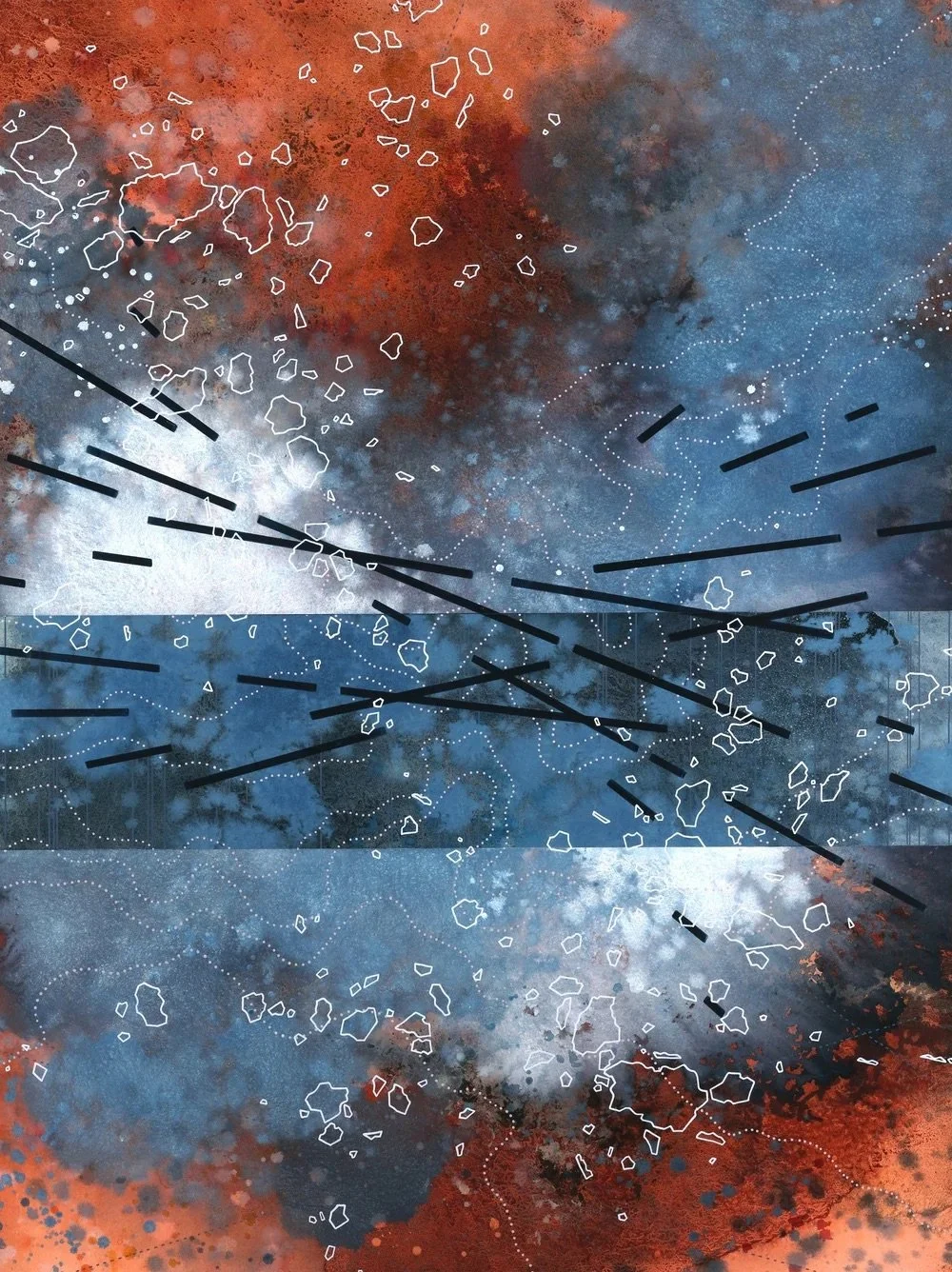
LISA KAIROS
Threshold, 2023
Acrylic on panel
48 × 36 in.
Courtesy of the artist and TINT Gallery
Kairos takes the exhibition into abstraction, and it works because her process is rooted in the same impulse that drives the other two: go to a place, spend time there, translate what being there felt like. She talked about working in the Mojave, building up an ambient awareness of a place over many visits rather than painting any single view of it. Her paintings begin as improvisational ink drawings on paper, then get mounted to panel and finished with acrylic. The results carry the language of maps and topography, shapes that could be a macro view of a coastline or a micro view of cracked desert ground. Diagonals and crisp interruptions in the picture plane suggest shifts in altitude or time. Color, she told me, is emotional: it corresponds to where she was with the painting, not a literal description of terrain. Threshold sits between landscape and memory, and the longer you look, the more those two things blur.
What holds the show together is that all three artists are making records of presence. Murray’s plates crack because the material does what she wants viewers to see what's happening to the ice. Townsend’s paintings distill because the land she paints asks for that kind of attention. Kairos layers and interrupts because that’s what happens when you try to hold a changing place in your head long enough to paint it. The climate change's message lives in the work as a condition, an experience, something each artist absorbed by being in a landscape under pressure, created in the studio and now shared on a wall.
TINT Gallery has been carving out a specific identity on Gough Street since Edelman opened the space in 2021: contemporary women artists, with a particular ear for technical craft and material invention, and a program that bridges international debuts with Bay Area painters and printmakers. Entropic Landscapes is one of the clearest expressions of that ethos I’ve seen from the gallery, tight curation in a large gallery with three confident voices, and enough breathing room. There’s an artist talk on April 26 during Climate Week, and if you can make it, you should; hearing Murray, Townsend, and Kairos describe their processes in the room with the work will sharpen everything. Even on its own, the exhibition asks the same thing of you that the landscapes asked of the artists who made it: slow down, stay long enough to notice, and trust that paying attention is its own form of response
