
The Mirror: A Student Exhibition at Cañada College Art Gallery, Redwood City
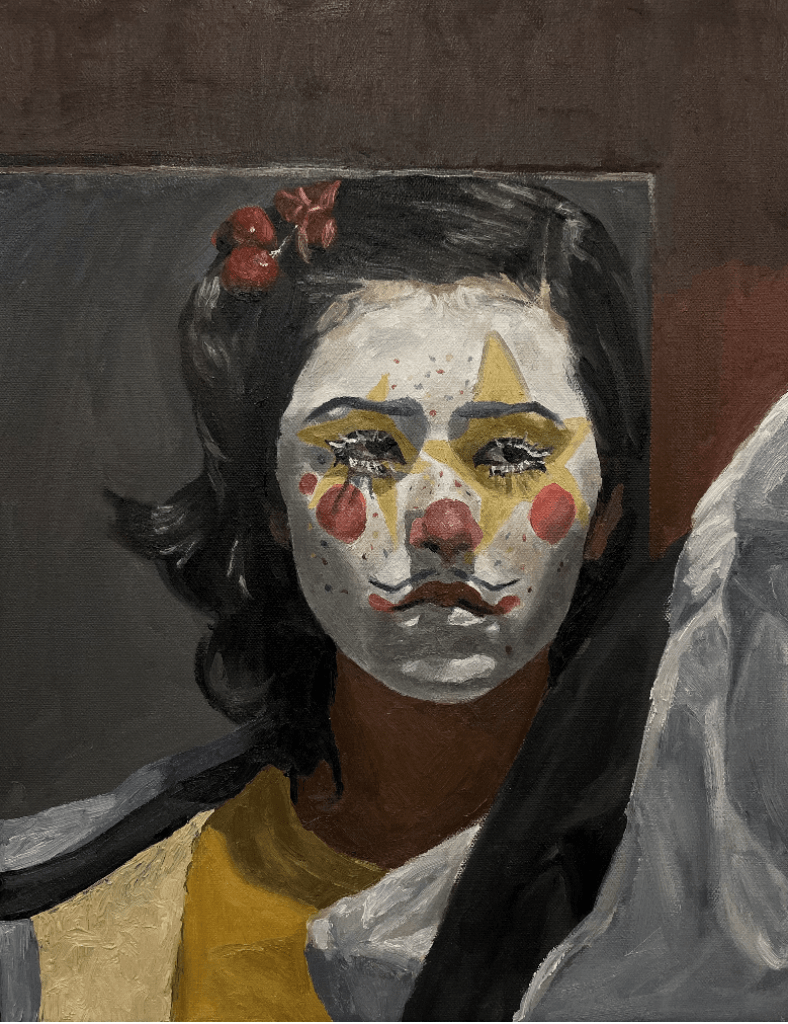
Cece Escobar, Untitled, oil on canvas, 18 x 14 inches (2025).
Cañada College Art Gallery
The Mirror: A Student Exhibition curated by Emilio Villalba
Featuring: Alan Pobanz, Anya Masnik, Ariana Myers, Cece Escobar, Corin Vernon, Dorothea McCowan, Estefani Cisneros Frias, Gail Felchle, John Guinness, Katharine Wolf, Remy Steiner, Rho Bean, Richard Holober, Sally Roth, Shasha Tao, Violaine M’Raihi, & Yichen Wang
September 10 through October 27, 2026
The earliest known use of mirrors in painting can be traced back to the Renaissance, specifically in works like Jan van Eyck's “Arnolfini Portrait” (1434), featuring a married couple standing in front of a convex mirror which reflects the interior portrait scene and makes the painter an eye-witness to the moment. Other well-known paintings utilize an object, which was once called a looking glass, as a compositional device. Diego Velázquez’s “Las Meninas” (1656) places a mirror in the background that reflects King Philip IV and Queen Mariana, who appear to stand where the viewer is located thus making the painting's viewpoint deliberately ambiguous. In Edouard Manet, “A Bar at the Folies-Bergère” (1882) a large mirror behind the barmaid reflects the crowded music hall. The reflection's angle does not seem to match the woman's position, creating a famous visual enigma still being debated as showing us a viewpoint highlighting impossible perspectives or the complexity of viewpoints a mirror can offer us. Pablo Picasso’s “Girl before a Mirror” (1932) has a young woman, presumably Picasso’s mistress Marie-Thérèse Walter, standing before a mirror facing her reflection. The reflected image contains radically different colors and forms, suggesting contrasting emotional states.
A mirror allows light to bounce off it forming an image of whatever is in front of it. Importantly, mirrors operate on the principle of light reflection. A mirror reverses the direction of light at an angle equal to its incidence thus allowing the viewer to observe things behind them or whatever may lie even at an angle depending on the direction the mirror is facing. In some cases the viewer sees their own image, in other cases the angle of reflection shows us things that would otherwise be out of view. Placed into paintings, the use of a mirror can expand the composition and meaning of a painting.
In keeping with this tradition, Emilio Villalba, an Assistant Professor of Studio Arts at Cañada College (in the Humanities & Social Science Department), has curated an exhibition of student works, “The Mirror: A Student Exhibition at Cañada College Art Gallery.” Villalba’s instructional prompt allowed each of the student artists to use a mirror to challenge the viewer's understanding of space and perspective.
Villalba’s exhibition catalyst gave students direction: “Each artist was asked to create an original work in which a mirror appears somewhere in the composition. There were no restrictions on medium, size, or subject matter. The only requirement was that the mirror be present — and more specifically, that it be shown as a physical object: its edges visible, what it rests on, the context around it. Not just a painting of a reflection, but a mirror as a thing that exists in the world of the painting. That distinction — the mirror as object rather than window — is what drives the concept.” Importantly, Villalba emphasizes that “When the mirror is grounded in physical space, it creates a layered, pic-in-pic composition: the viewer moves between the real space of the painting and the reflected world inside the mirror. Not a literal narrative, but a visual road that keeps cycling the eye in and out of the painting.”
All of the students’ original works created interesting possibilities manipulating prospective and compositional arrangement consistent with the tradition of placing mirrors in paintings and the disruptions of visual composition that result.
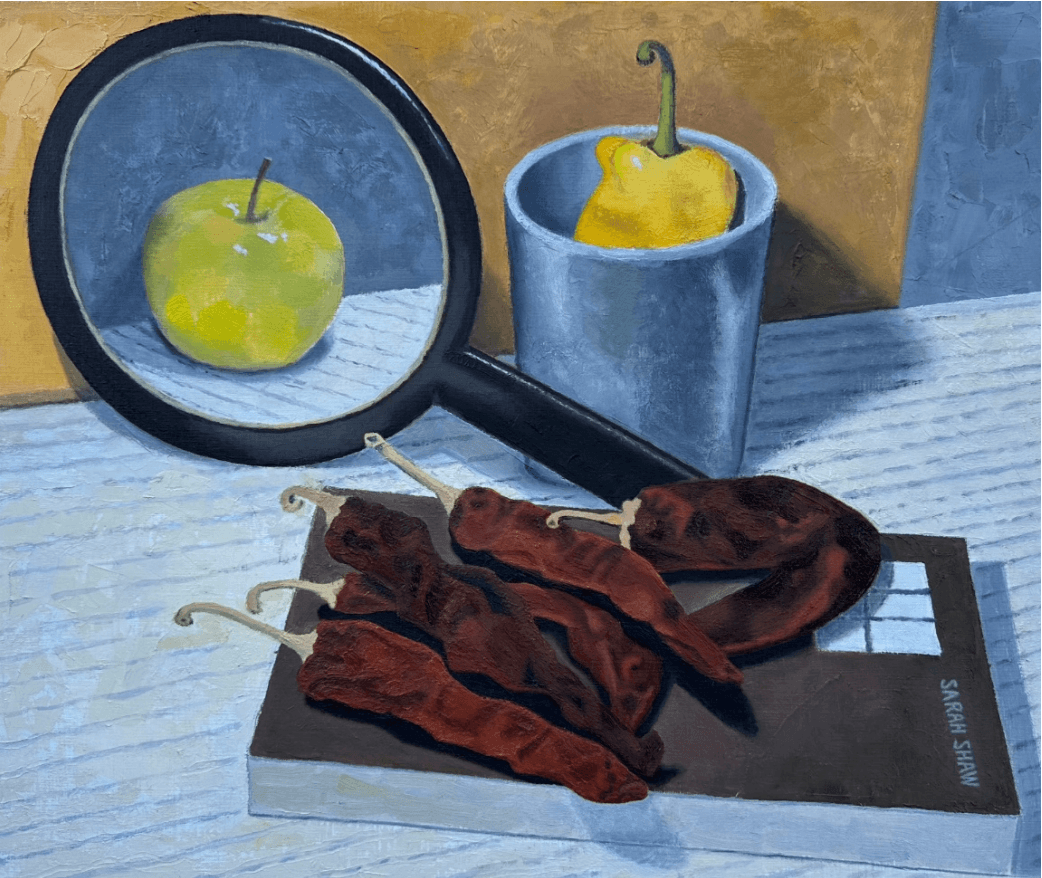
Alan Pobanz, Green Apple, oil on paper, 14 x 17 inches (2026).
Alan Pobanz
Pobanz utilizes the mirror to show a view of a green apple which otherwise isn't in the frame of the still life composition. Making the apple one of the subjects of the painting, an object that otherwise would have been left out of the picture, allows for a juxtaposition between it and the guajillo chile peppers that are posed on top of a book in the foreground. An apple is laden with symbolism related to temptation, knowledge, and sin while the peppers often represent warding off negativity and bad luck. An oil on paper composition, the painter shares in the promotional material for the exhibition, that he primarily used “a single warm lamp, with ambient overhead light from the classroom” for lighting.
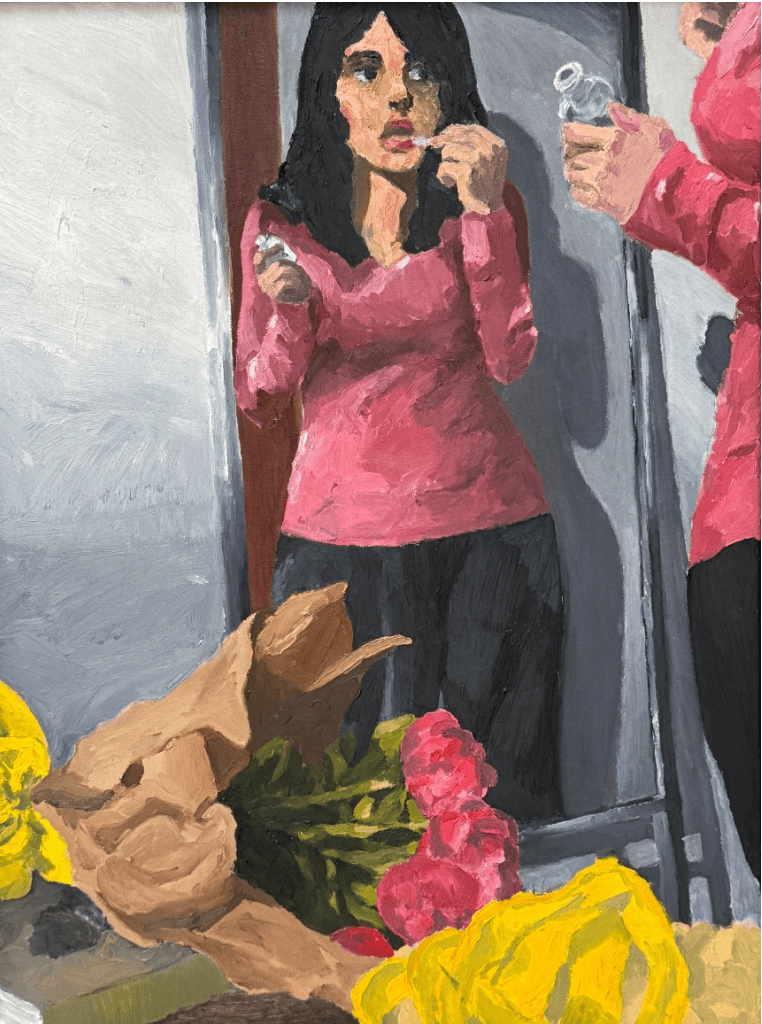
Anya Masnik, Don’t Be So Hard on Your Own Beauty, oil on canvas, 24 x 18 inches (2026).
Anya Masnik
Masnik captures his partner in what is likely a familiar, intimate pose. The paint application to the face is chunky which competes with the figure’s own application of make-up. The subject’s facial expression both captures the focused attention and expectation of an imminent date, as well as the routine process of applying makeup, where you often see the furrowing of a brow and the pursing of lips in concentration. The title of the painting suggests Masnik is trying to assuage any hesitation his partner has about her attractiveness, “Don’t Be So Hard on Your Own Beauty.” The prominent flowers in the foreground suggest that whatever truth the mirror offers us may in fact be irrelevant as the floral offering tells us someone else (here the artist, himself) has already made a romantic gesture meant to make his partner feel chosen and cherished. The partial figure to the right of the composition, the only part of the subject we see in full reflection, is quite convincing and particularly well-executed. Masnik observes that mirrors are the primary tool we use to observe ourselves, and his attention to detail, despite a painting style that has qualities of expressionism, respects the accuracy of a mirror’s reflection.
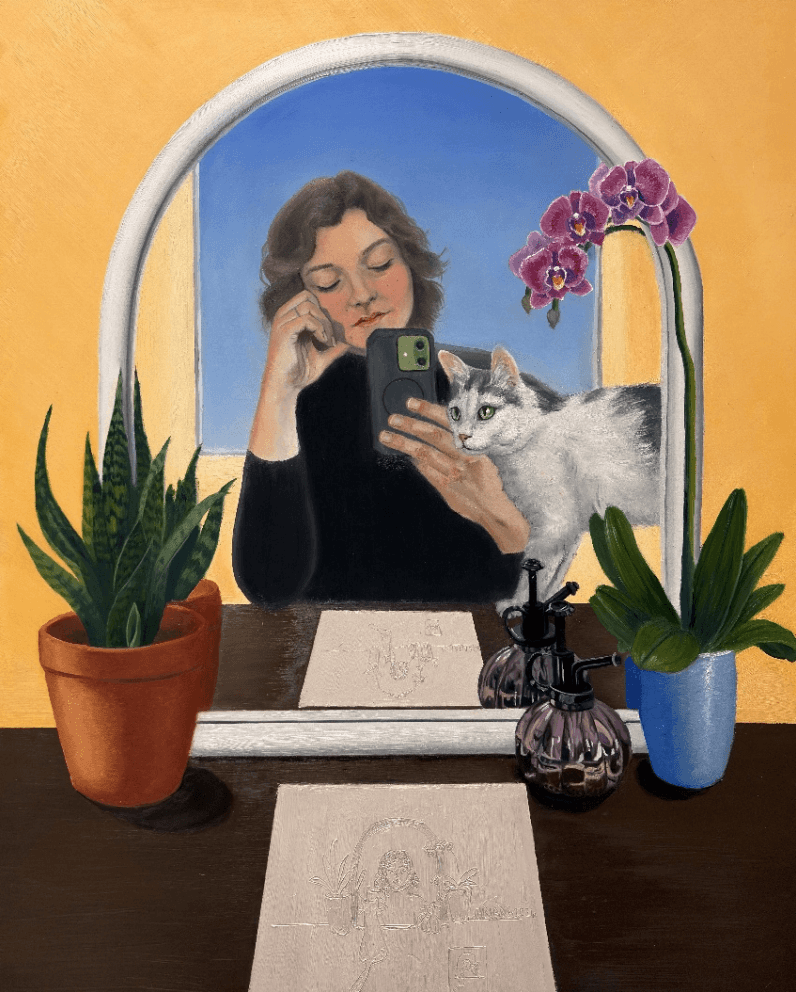
Ariana Myers, Ariana and Athena in the Mirror, oil on wood panel, 30 x 24 inches (2026).
Ariana Myers
Painters often rely on self portraiture when another subject isn't readily available. There is always the self to paint. Here, Myers relies on her cat, Athena, to saunter into the composition creating both a staged self-portrait and one with an expected participant. It lends itself to a familiar moment and one which any viewer who has lived with cats can relate to. With added features such as houseplants bookending the scene, it has the look of a classical setting, yet modern with its color-field, austere surroundings. The reflection visible on the ribbed, purple-glass plant mister is rendered, alongside a broad-leafed plant in a vibrant blue ceramic pot, in a particularly capable manner. One wonderful element is the still unfinished drawing, a study of the painting we are looking at, presented in reflection in the bottom foreground of the composition. Athena isn’t in this version yet, thus heightening the elusive sense of time Myers ultimately captures.
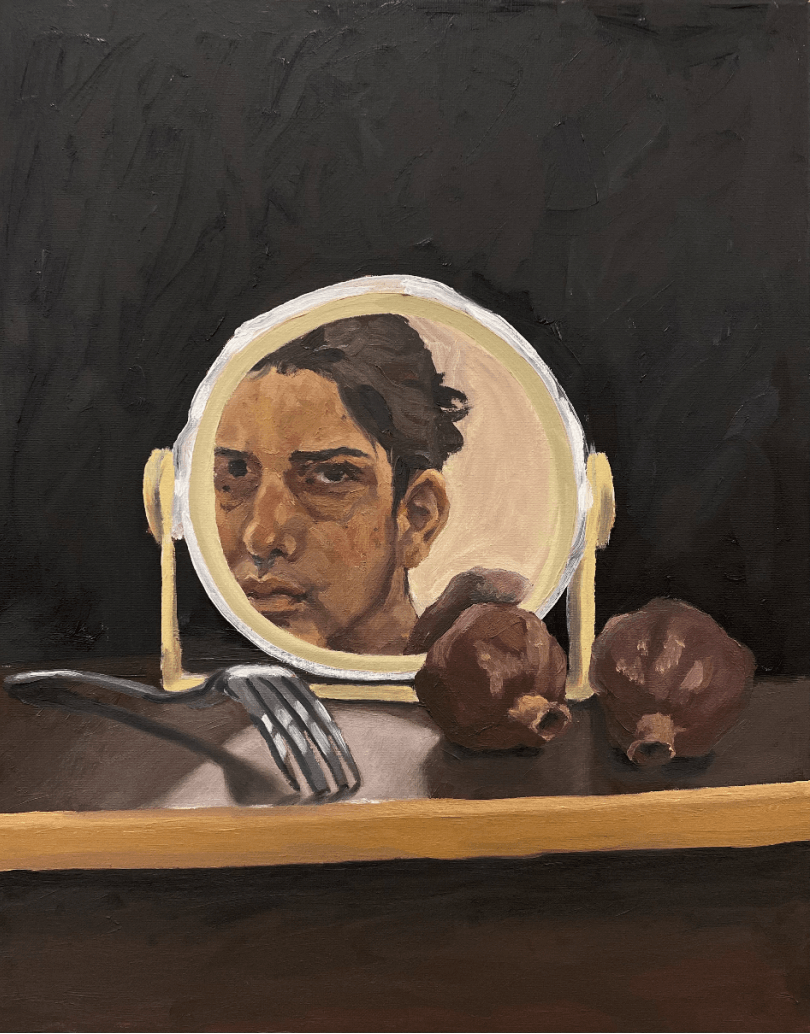
Cece Escobar, Pomegranates, oil on canvas, 20 x 16 inches (2025).
Celeste (Cece) Escobar
Escobar offers two paintings, both quite successful. The untitled clown painting lets the viewer see the artist in a contrived, yet relaxed and candid manner. The accents of paint on the face both covers her face yet reveals the contemplative sense of self. It raises questions of how we often hide behind things, makeup and clothing, yet still retain our inherent presence. In “Pomegranates,” Escobar uses the mirror to render a partial visage with two pomegranates. The additional placement of a fork poses the question of why a spoon wasn't chosen to more easily access the juicy seeds. Escobar’s arrangement of her face partially to the side of the mirror, reminds us how too much symmetry can make a painting look contrived. Here, the skewed countenance is an element that adds realism and suggests tension and movement.
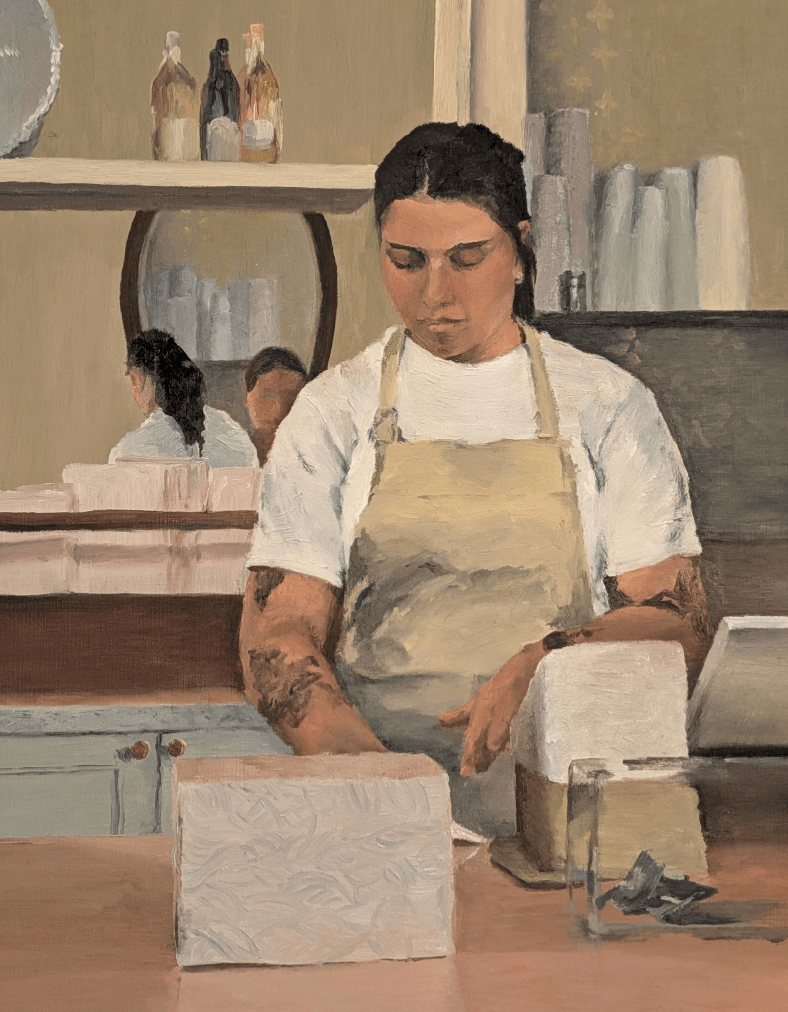
Katharine Wolf, Colette’s, oil on canvas paper, 20 x 16 inches (2026).
Katharine Wolf
The cafe or restaurant scene presents us with a server or cook standing at a counter preparing a take-out order. The subject checks to see if the order is correct as she works the register. There are many little details painted austerely, visible in the composition. From bottles on a back shelf to objects on the counter in the foreground, the Morandi-esque vignettes show off Wolf’s talent for rendering objects with just enough detail; throughout it all, Wolf doesn't lose the power of ambiguity. An oval mirror on the back wall reveals a complicated combination of mirror reflection and the vantage point of the viewer, which also convey a reflective quality. The customer, precisely where the viewer is standing, appears in the oval mirror. Both server and customer look downward emphasizing the drama in the painting are the subtle details, not an overt expression of emotion.
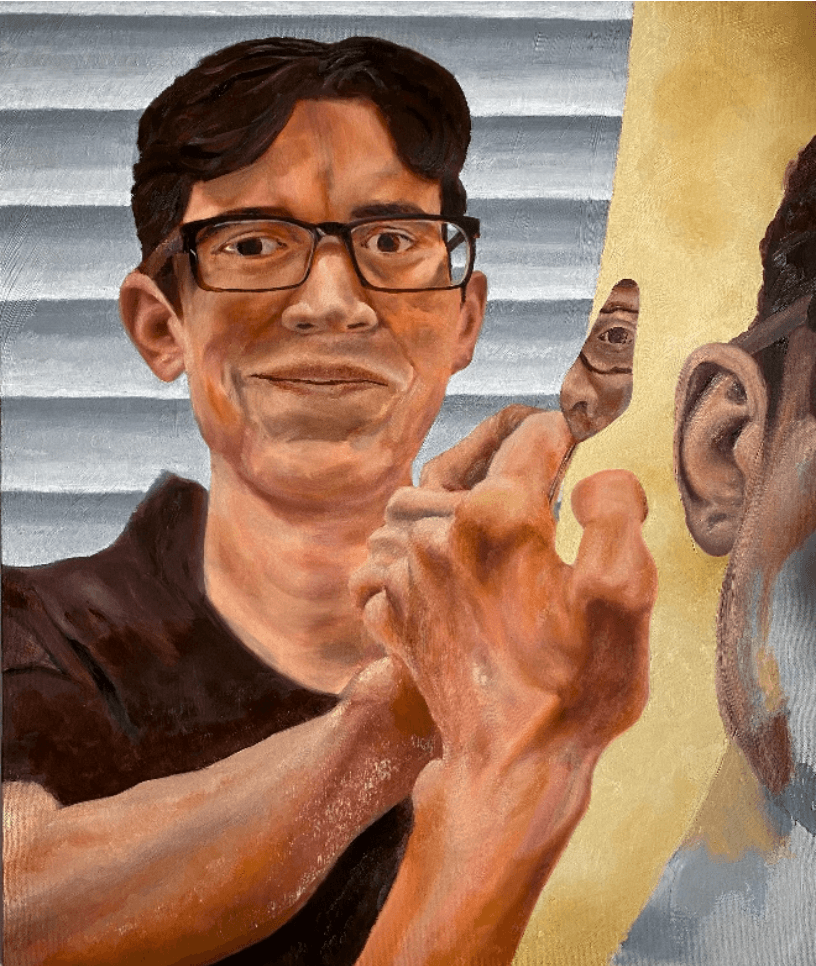
Rho Bean, Mirror, canvas, palette knife, oil on canvas, 24 x 20 inches (2026).
Rho Bean
Bean paints a self-portrait captured in the painter's teardrop-shaped palette knife or trowel. It features a pointed tip and broader midsection lending itself to enough space to capture a nostril and one eye. The composition is purposely unsettling in its orientation. The main figure is presented in reflection. The viewer can see part of the self-portrait being painted to the right of the picture on a yellow canvas; then the self-portrait on the trowel itself; and finally reflected from a mirror with horizontal blinds. Bean shares that “The work was painted from life, using oil on canvas and a limited palette (black, white, red, and yellow ochre).”
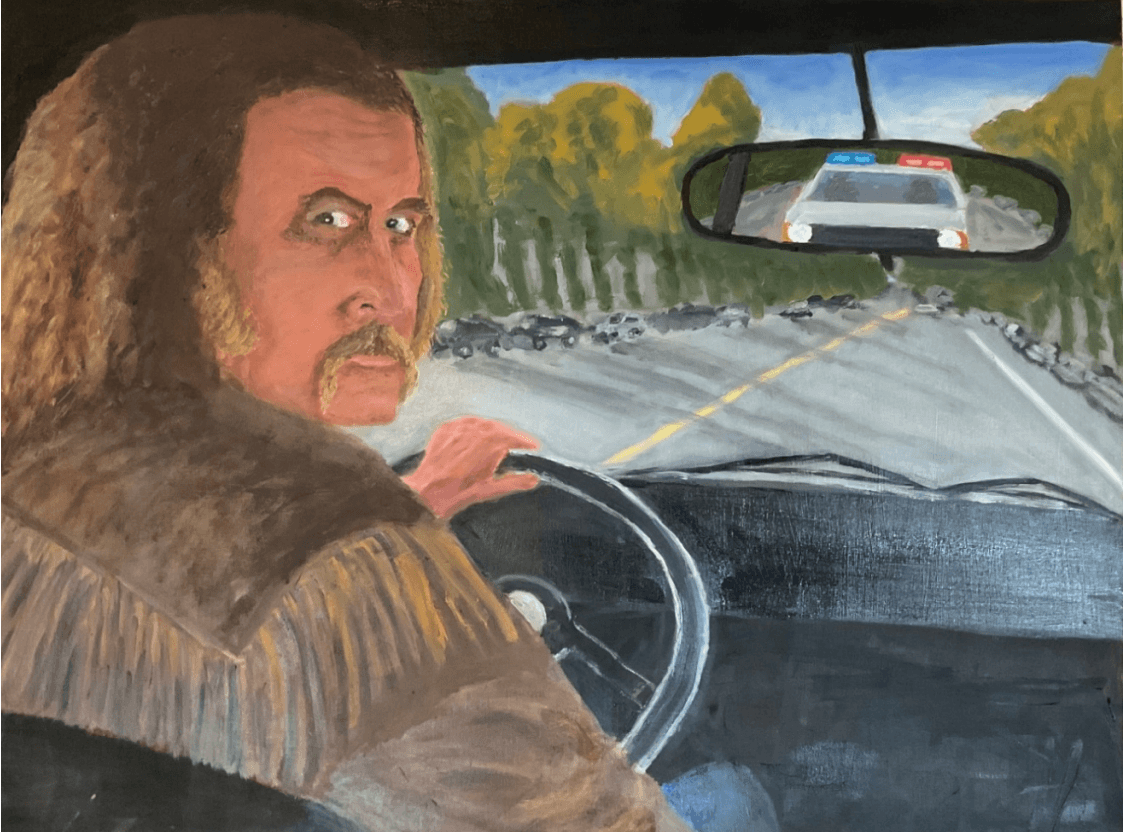
Richard Holober, “Almost Cut My Hair,” oil on wood panel, 18 x 24 inches (2026).
Richard Holober
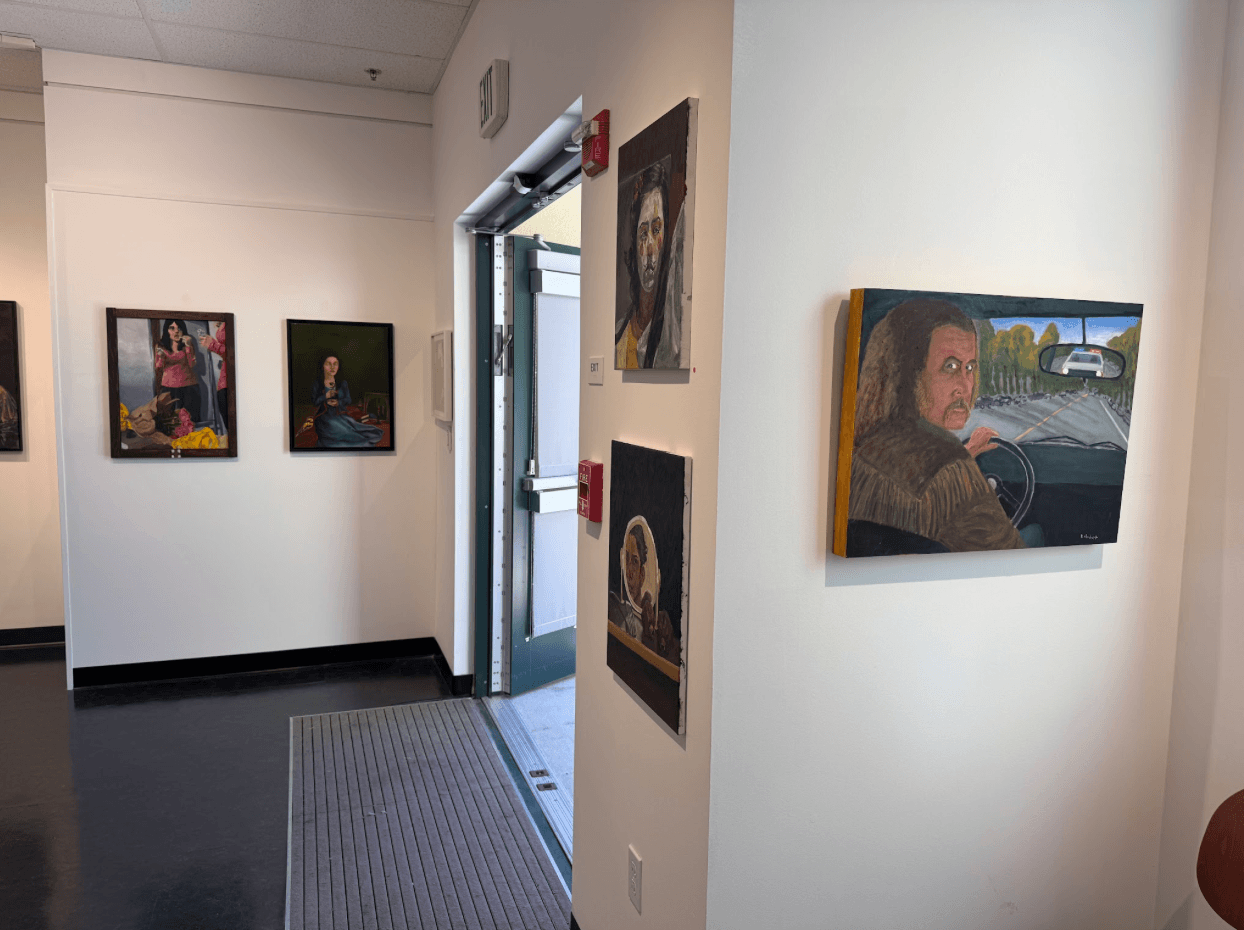
Holober’s oil on panel painting depicts a scene from the Crosby, Stills, Nash, & Young song “Almost Cut My Hair,” a decidedly rebellious song that questions whether the singer should cut his hair and conform to societal norms. Instead, the songwriter David Crosby, dressed in a fringe buckskin jacket with prominent tassels, and sporting his horseshoe mustache, rejects any notion of fitting in. Holober captures a moment that is an articulation of counter-cultural values, yet conveys an almost humorous scene as the viewer can see a police car with its lights flashing in the rearview mirror, seeking to pull him over. There is defiance, on the one hand, and a pondering of whether perhaps a little conformity might have been more practical. The juxtaposition is both cheeky and accurate as the lyrics from the song speak to how the decision to keep his hair long has fueled his paranoia, “like looking in my mirror and seeing a police car.” Villalba’s prompt might have been about self-reflection in a mirror, here seen in the rearview mirror, but Holobern captures the theme of reflection as the subject ponders the ramifications of life choices; a reflection in a metaphoric sense.
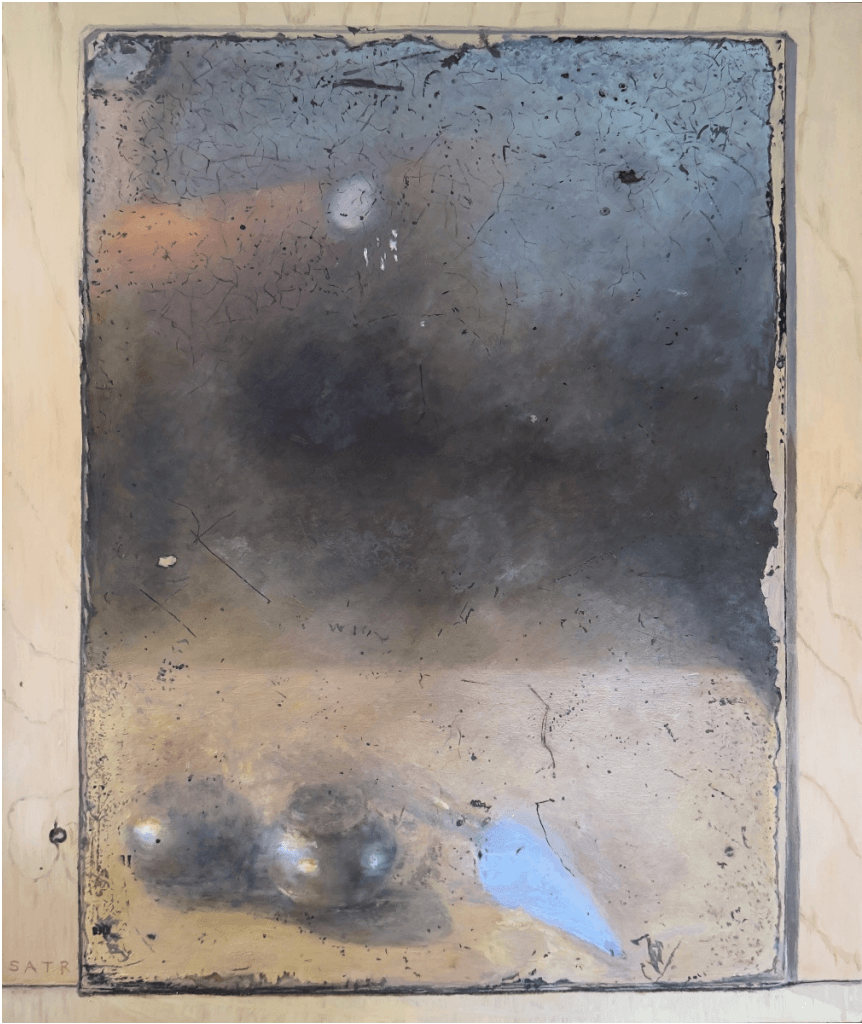
Sally Roth, Palimpsest, oil on plywood, 24 x 20 inches (2026).
Sally Roth
Roth’s oil on oiled-in plywood painting challenges the viewer the most. What exactly are we looking at? It's a century-old vintage mirror with many flaws, rendered realistically with objects in the foreground. The plywood support has been treated with oil to create a stable surface allowing the oil paint to adhere smoothly. Roth shares that she worked as an architect for many years, and this is reflected in the “design and qualities of built environments.” The defects on the coating of the mirror conveys a haunting or ethereal quality that draws the viewer closer to make out various marks and blemishes. In the foreground two small rounded objects, which could be small glazed ceramic vessels, are visible. Roth shares that they are actually known as an artist’s dipper or palette cup. Small, rounded containers with a screw top and a spring clip at the bottom, which can be affixed to the edge of a palette, allowing a painter to keep solvents or mediums nearby to mix with paint. Their nature will likely be mysterious to the viewer who will see generic still-life elements. The wood grain Roth has painted with sharp realism is very successfully rendered. The artist’s four letter initials are visible in the bottom left of the composition.
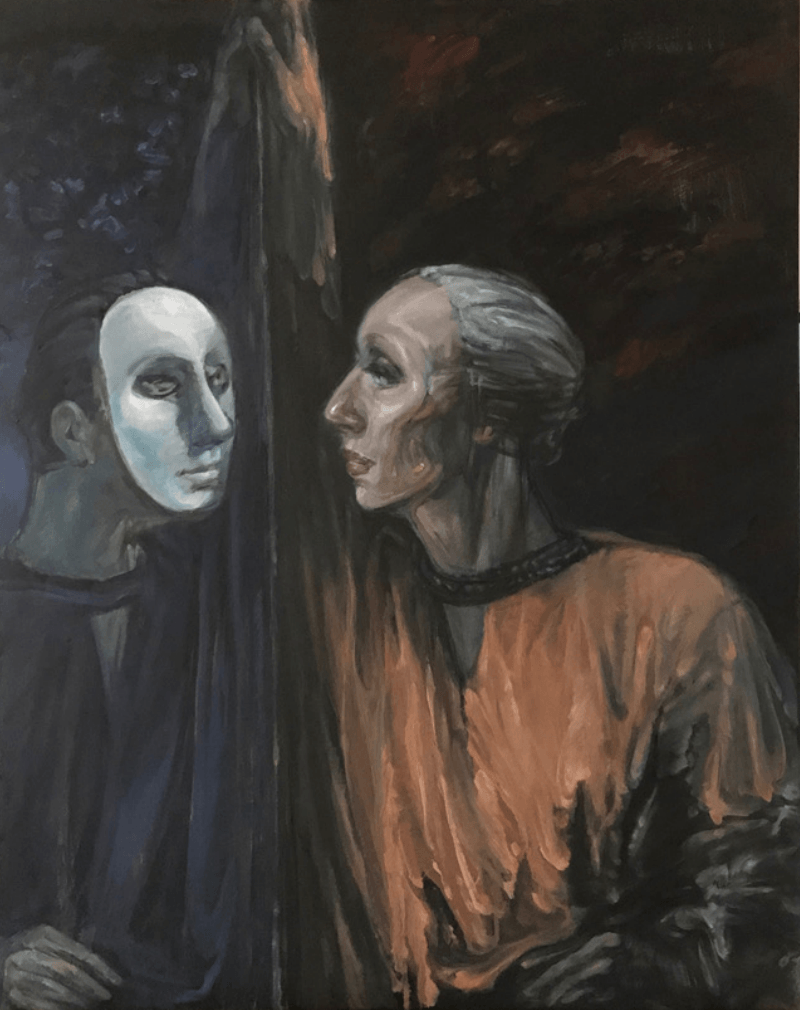
Shasha Tao, Beyond the Glass, oil on canvas, 30 x 24 inches (2026).
Shasha Tao
A number of artists utilized the mirror element to offer the subject’s own countenance looking back at the subject. Shasha Tao has a subject facing a masked-figure in the mirror, where even the color of the clothing does not match. Tao trades accuracy for a psychological message of how the mirror’s reflection is contrived and subject to the way we see ourselves. Tao reflects how "The past (is fixed) watching a synthetic present — or is the synthetic self staring back at a frozen memory?"
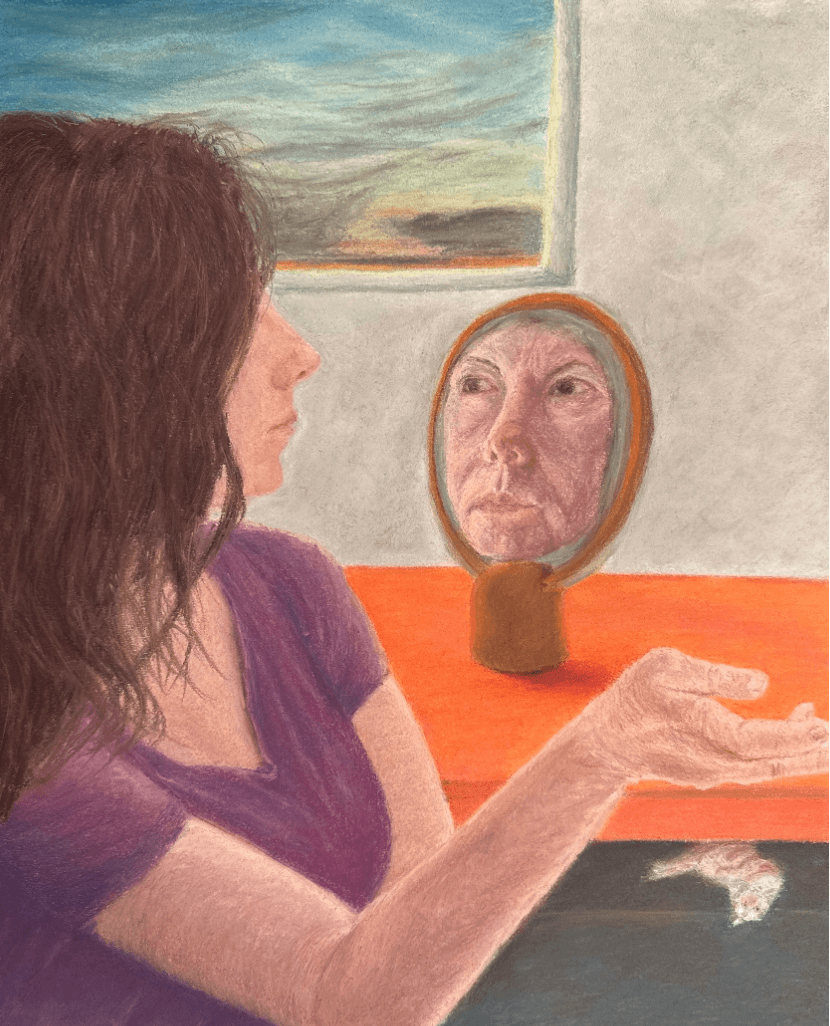
Violaine M’Raihi, Now What?, chalk pastel on paper, 17.5 x 14 inches (2026).
Violaine M'Raihi
M’Raihi emphasizes the temporal element of age thus making the piece about the dialogue between a younger and older self. There is a contemplative narrative at play, as the subject confronts another version of themselves. She poses two different figures looking at one another raising questions about how we see ourselves, versus how we actually are. M’Raihi notes that “the values of the past that led to this moment” is the subject as “one’s reflection, usually a grounding force in the thought process, looks away. One is on their own.” The painting succeeds because the viewer can see they’re encountering a conversation between selves at mid-point, and they are invited to reflect on their own lives. A cat depicted in the bottom right of the composition completes the picture and stands as a witness to everything unfolding.
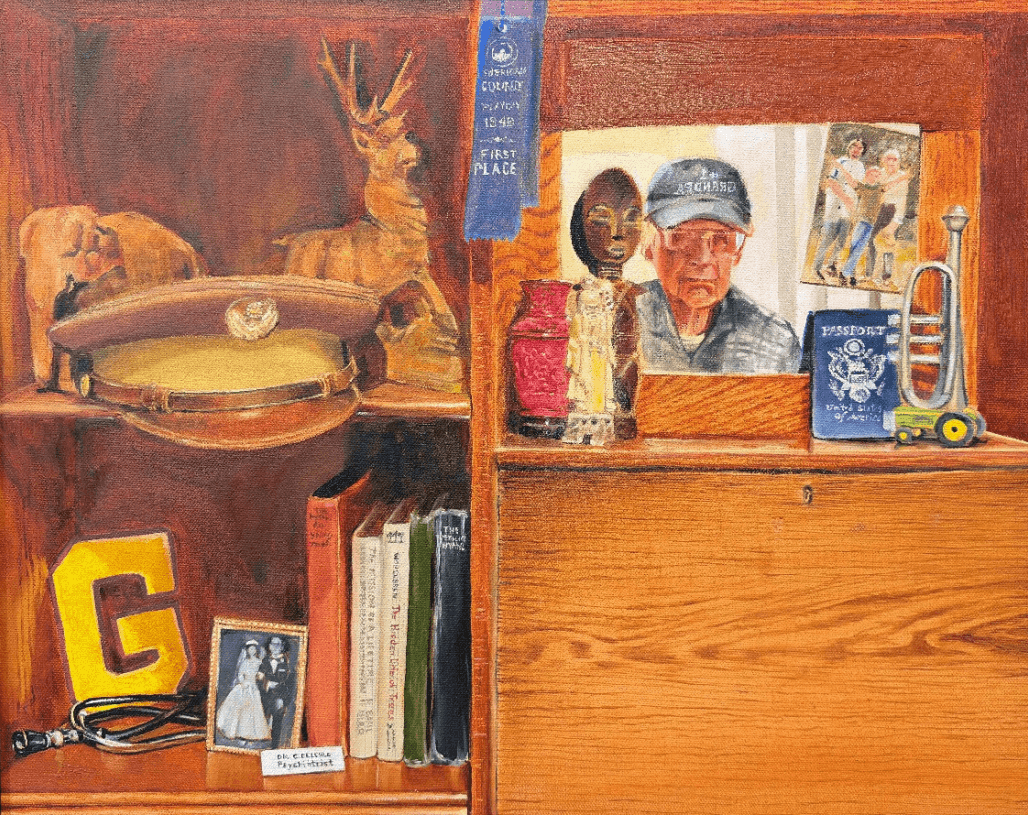
Gail Felchle, Reflections of a Life Well Lived, oil on canvas, 16 x 20 inches (2026).
Gail Felchle
Felchle depicts the essential things that comprise a life. The figure wearing a cap is her 95-year old immigrant father-in-law seen in a mirror on a shelf of a desk he has had since his youth. A military cap, childhood toys, various books including a collection of hymns, first-place athletic ribbon, wedding photograph, a passport, and a small coronet, all unite to tell his story. Coming to the United States, adolescent success, and a career as a psychiatrist are all reflected here. The title emphasizing a “life well lived” embraces the idea of a subject looking at personal objects or talismans, that cause self-reflection and exploration of memory and the past.
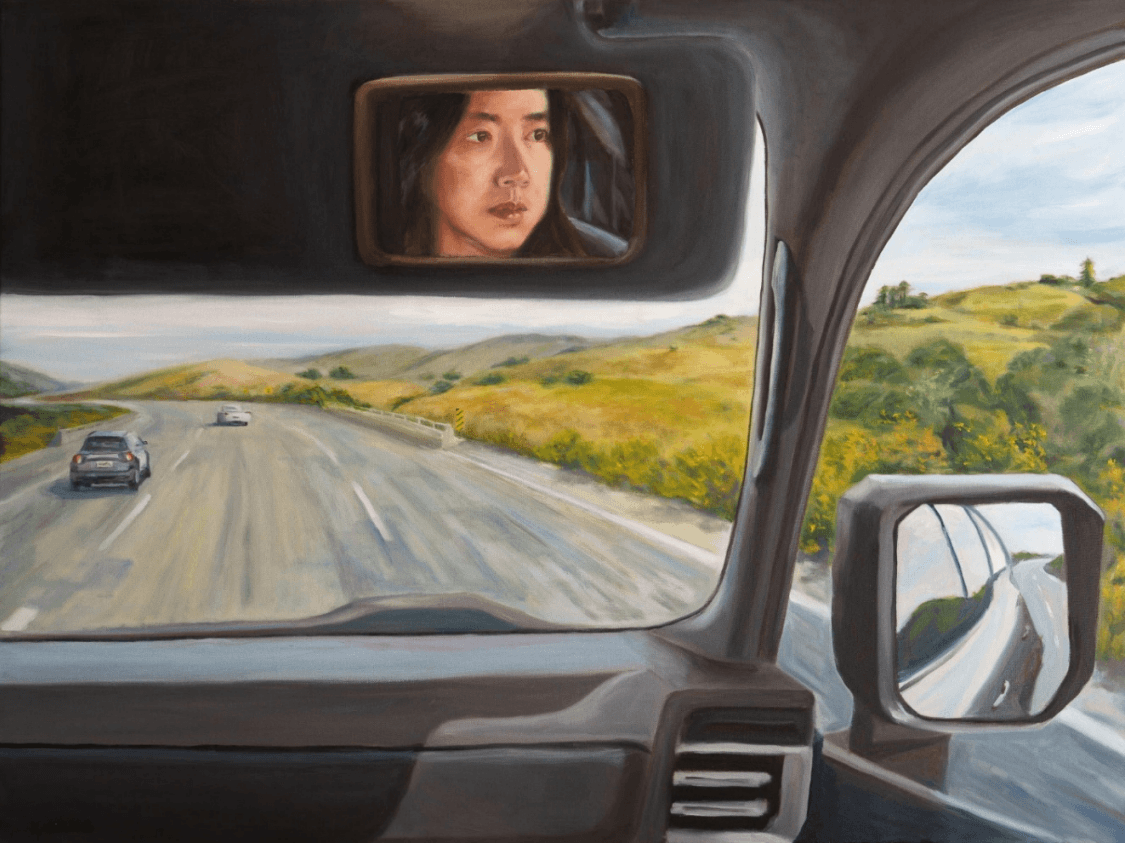
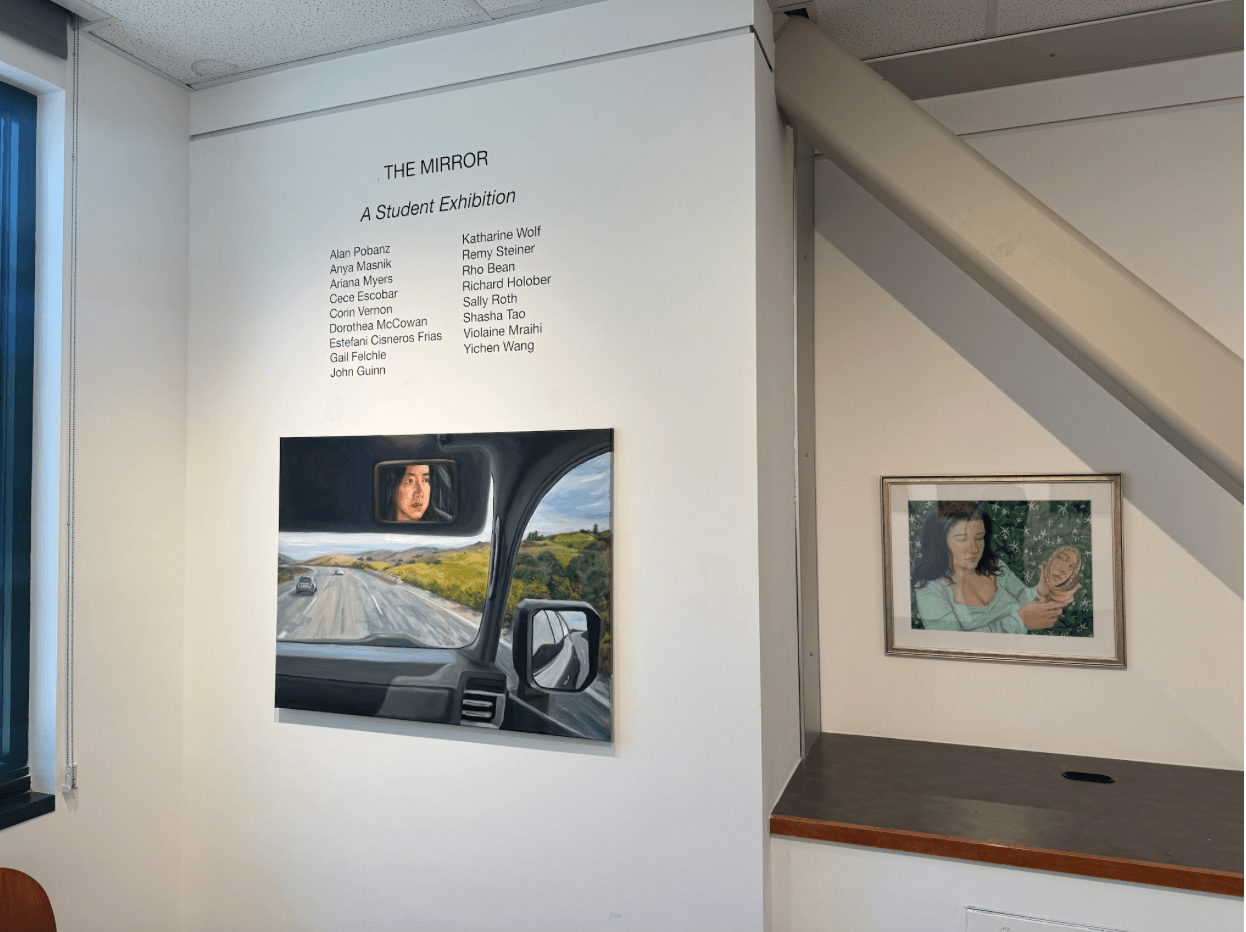
Yichen Wang, On The Road, oil on canvas, 30 x 40 inches (2026)
Other student artists in the exhibit also offer intriguing works based on Villalba’s prompt.
In John Guinn’s “Sylvester Waiting,” dry pastel on paper, 24 x 18 inches (2026), Guinn renders a tilted rectangular mirror depicting his small white dog amidst a living room setting. Fabric folds on the artist’s clothes are accurately rendered showcasing his attention to detail. The angles of the tall mirror frame cause the composition to look narrower at the bottom foreground; a realistic element which helps the viewer to consider the subject’s vantage point from well below that of an adult person, serving to heighten the stature of the subject.
In Remy Steiner’s “Squash & Sweet Potato,” pastel on paper, 14 x 19 inches (2026), Steiner pushes the limits of Villalba’s prompt by incorporating at least four mirrors. She used a long and tapered sweet potato and a striped delicata squash from a farmers market to explore the abundance of reflections.
In Dorothea McCowan’s “A Sense of Clarity,” chalk pastel on paper, 20 x 16 inches (2026), McCowan depicts a silhouette of greenery foliage which when reflected in the small table mirror, reveals a cluster of grape hyacinths with bell-shaped florets. The viewer sees truth in the reflection rather than what can be seen directly toward the more shaded and ambiguous flowers.
In Corin Vernon’s “Perceived Image,” chalk pastel on paper, 16 x 20 inches (2026), a self-portrait holding an ornate oval vintage mirror, which partially reflects her face, is presented. Vernon tells us that she wanted to share her experience with the condition known as dermatillomania, “an uncontrollable urge to pick at the skin.” Vernon presents “the moment before the mind betrays its own skin.” The painting background is detailed with delicate white flowers, simple five-pointed white star-shaped blossoms, set against a dark green leafy background.
In Estefani Cisneros Frias’s “The Cleansing,” oil on canvas, 24 x 18 inches (2026), the subject wears a cerulean blue gown accented with bright crimson ribbons, while holding a young green sapling of some kind. A goldfinch perched to the bottom left side of the canvas watches the main figure in a moment of solitary reverence. Cisneros Frias, who is from Michoacán, Mexico, notes her culture's belief that mirrors are “portals and holders of energy.” Symbolically, the mirror in the right portion of the composition only reflects the image of a single smoldering candle standing before it. Some blue folds from the figure's gown are also visible, but otherwise the composition excludes the figure, flower, bird, or books stacked nearby. The mirror here is pointed more toward the viewer than the objects in the painting causing one to ponder where each of us fit into the settings we inhabit.
In Yichen Wang’s “On The Road,” oil on canvas, 30 x 40 inches (2026), Wang renders a passenger seated in a car. Her expression gives off a sense of anxiety perhaps emblematic of the highway as a metaphor for life. The viewer sees the partial road ahead, with various other cars, through the car’s windshield, and the vacant road behind her from the passenger rear view mirror. A small mirror on the sun visor shows us the passenger.
Of the 17 artists included in the exhibition, five are foreign born (from Mexico, China (2x), Austria, & Ivory Coast) and at least three originally hail from states other than California (Oregon, Indiana, & New York). Not surprisingly this diverse group offers distinct and creative ways to honor Villalba’s original assignment. As a result, Villalba has assembled a worthy exhibition showcasing a theme long utilized by painters over the previous centuries.
Since the fall of 2024, this is the 6th exhibition Villalba has mounted. The preceding shows included a survey of work by Bill Morales, a former professor at Cañada College; paintings and drawings by Bay Area Figurative painters Paul Wonner and William Theophilus Brown; a student exhibition featuring seven women artists; a retrospective by realist painter Guy Diehl; and, contemporary works by Wardell McNeal, an African-American artist based in Oakland.
Future exhibitions are planned which include an exhibition by abstract figurative artist KL Folgner, who currently shows with Pamela Walsh Gallery in Palo Alto.
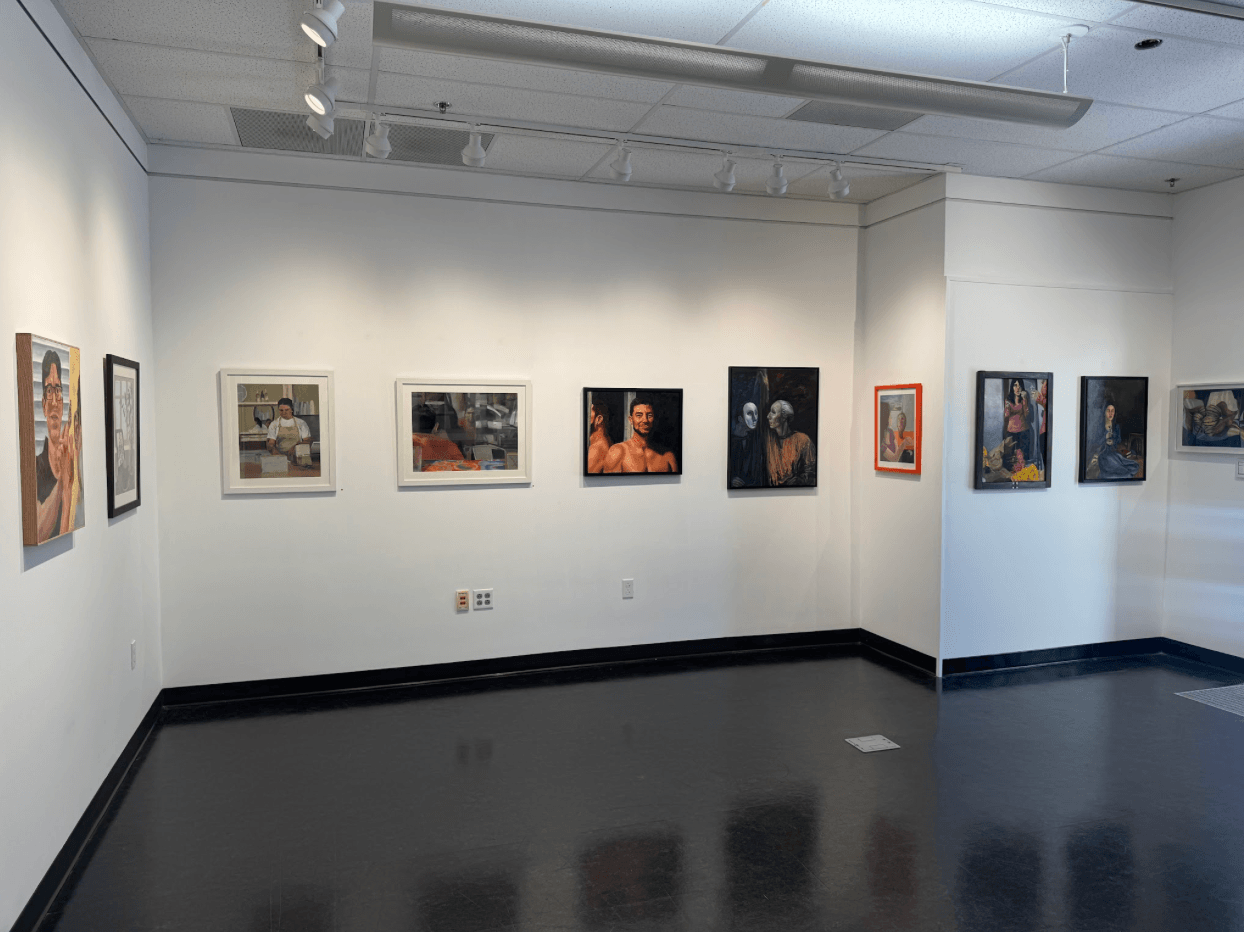
Installation photographs: