

The Deported Artist a.k.a. Javier Salazar Rojas
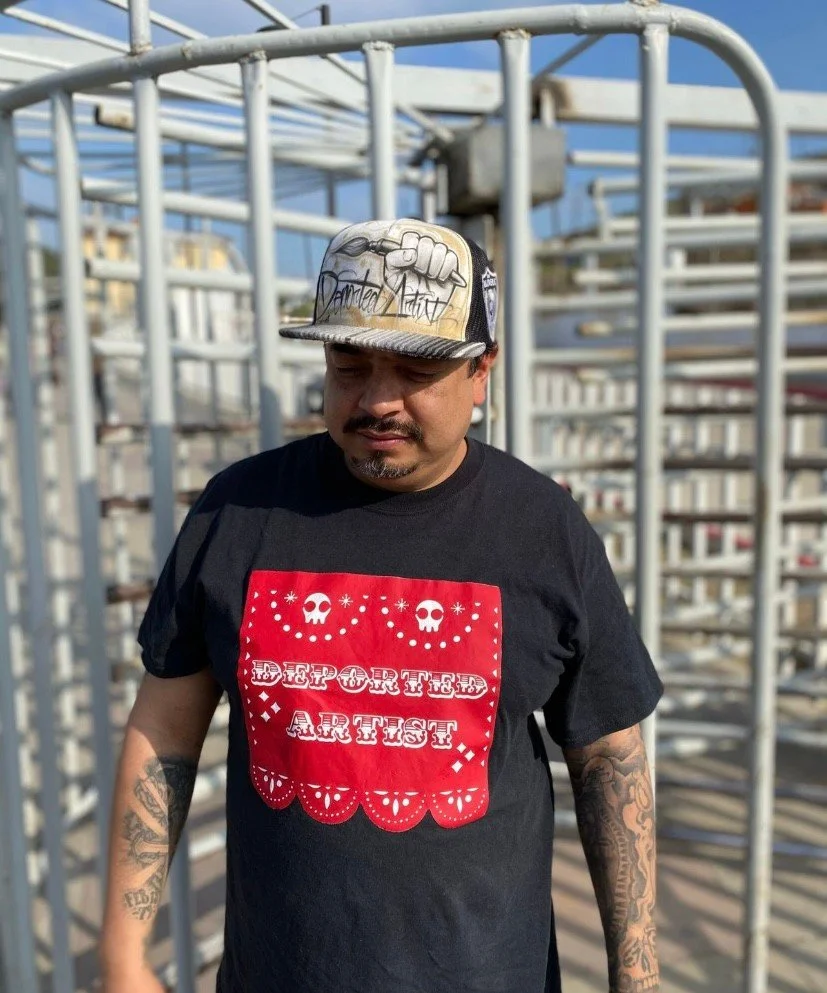
Javier Salazar Rojas, known artistically as DeportedArtist, is a visual artist born in Mexico whose work centers on the lived experiences of migration, displacement, and cultural resistance. Born in Tijuana and raised in East Oakland, Javier’s life has been profoundly shaped by deportation, border violence, and the resilience of the undocumented community.
His work fuses Chicano muralism with the social realism of Diego Rivera, creating powerful visual narratives that denounce the criminalization of migrants, the militarization of the border, and the spiritual ties between Indigenous peoples and the land. Each piece is a declaration of survival, painted with urgency, memory, and love.
Through his art, Javier speaks not only for himself, but for millions whose stories are silenced by fear. His works have been used in direct actions, protests, community events, and exhibitions throughout both the U.S. and Mexico.

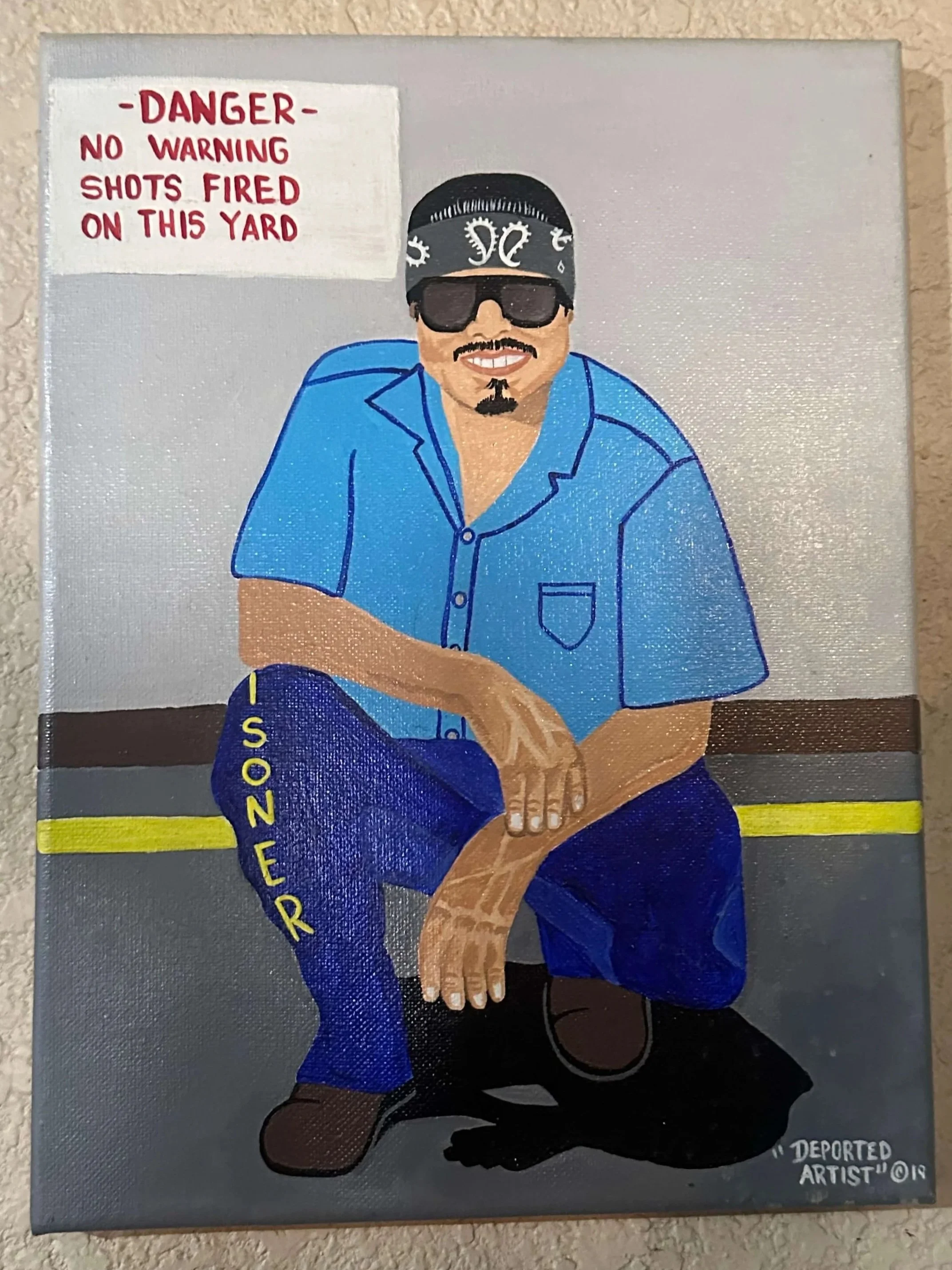
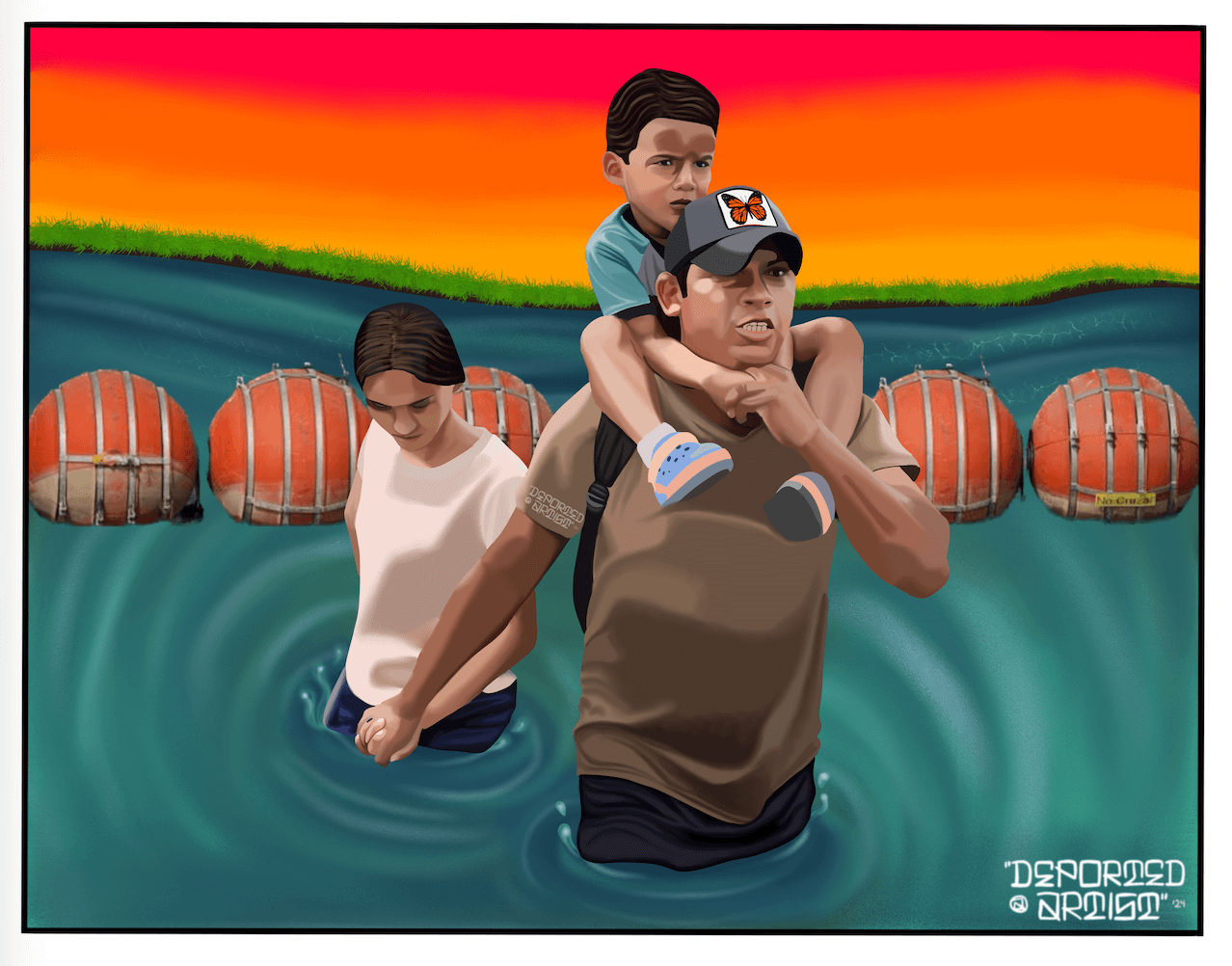
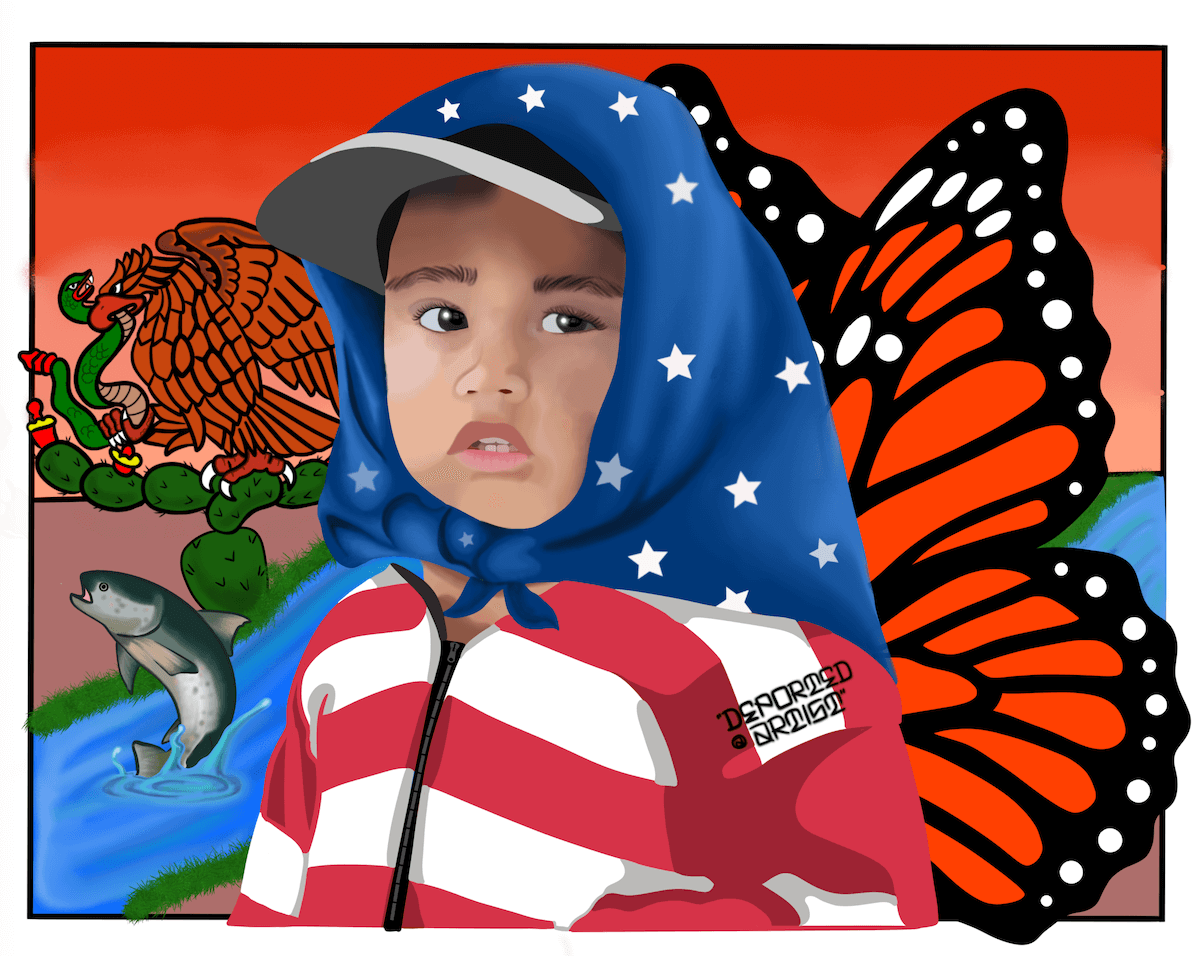
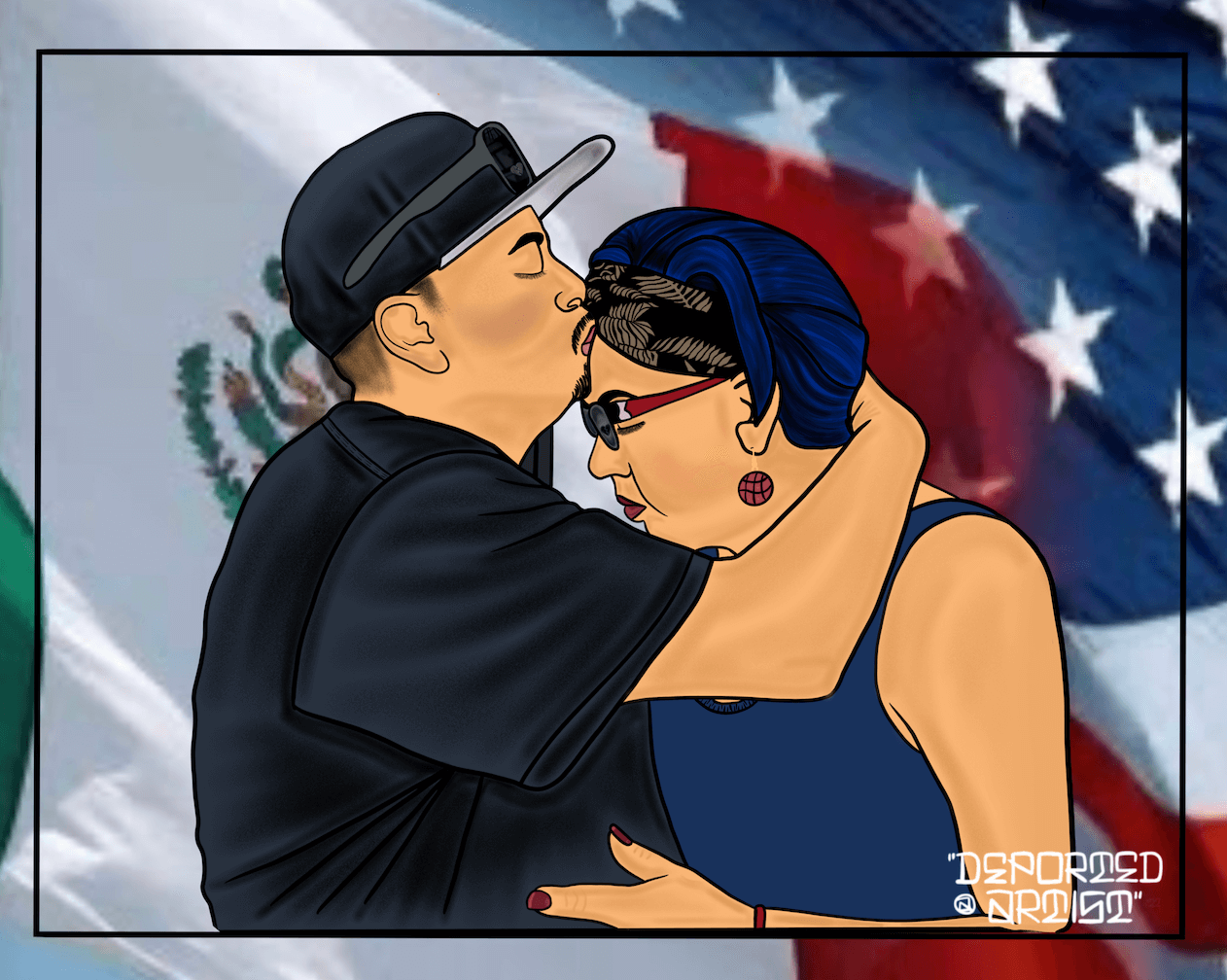
The following are excerpts from the Deported Artist’s interview.
Hugh Leeman: Javier, most of us don't have life-changing moments until well into adulthood. Yet your first life-changing moment came when you were just 11 years old in Mexico at the US border with your family. That experience continues to influence your artwork and activism to this day. What is the long version of what happened on that day?
Deported Artist: So I was born here in Tijuana. I was taken to Oakland, California when I was about three months old. Back then the border wasn't all militarized. Immigration wasn't criminalized the way it is now. So I grew up in the States, in Oakland. When I was 11, my family brought me to a quinceañera here in Tijuana. We were out here for about a week, and then on the way back, I saw everybody packing. I saw my family loading up in the van, and it looked like they were getting ready to leave. I was watching from the window and I was like, "Oh my god, they're forgetting about me."
I ran out there and tried to get in the van, and my mom stopped me. She was like, "Where are you going?" I was like, "Oh, I thought we're going home. I see everybody in the van already." And she's like, "Yeah, we're all going home, but you can't come back home with us." I was like, "What?" I was all confused. I was like, "Well, why not?" And she was like, "Well, you were born here in Tijuana and you don't have any papers, so you can't come back with us."
I was 11 years old. I didn't know at that time that I was born in Mexico. I didn't know that I didn't have any papers. It was the first time that I heard the terms "undocumented," "illegal." I couldn't wrap my head around that. I was like, how can a human being be considered illegal just for not having some papers?
I was confused. I was angry. I was like, why did you bring me knowing that I can't come back home with you guys? And she was like, you know what? It's one of those things in life. If you want to meet the rest of your family, this is one of the sacrifices you're going to have to make because you don't have any papers, and this is the only way you're going to be able to see them and get to know them.
She told me, "Yeah, we're going to go home, but you're going to have to try coming back through the hills tonight and cross the border that way." So that was how I found out that I wasn't born over there and that I didn't have no papers. It was a rude awakening.
I got sent to cross the border that night. I had a second cousin that came with me. He was older. We got a guide. The guide was supposed to help us cross the border safely, and he told us that he had a plan. His plan was that we're going to wait till a certain time till he gave the signal, and once he gave the signal, we were all going to go across the border. Back then it was a fence that they had—a hole cut out in the fence already. He said, "We're all going to just run for it and they're not going to be able to catch us all." That was his big plan.
Sure enough, we waited for a while. He gave the signal, and when he gave the signal, we all started going through the hole. As soon as we started going through the hole, there were a bunch of immigration officers that came out—Border Patrol agents. Back then, they were on horseback, they were on ATVs, and then the helicopter came out. Everybody started running.
I remember the hills were kind of inclined, kind of steep, and I was a little kid. So I ran as fast as I could, but sure enough, I got tired. I got separated from my group, separated from everybody, and I didn't know what to do. I kind of got lost and just hid behind some bushes for a while. It wasn't till like 20, 30 minutes later that the helicopter found me and they radioed for some agents to come and get me.
They took me to the detention center. Back then there was no such thing as unaccompanied minors—there were no terms like that. So they kind of put me in there in the holding cell with everybody, with all the adults. I remember there were about—I want to say 100, maybe 200 people in a small cell, and there were only like two toilets for everybody. They were flooded. There was no toilet paper.
I remember somebody spit on the ground and the Border Patrol agent saw him and was like, "Hey, pick that up." He was like, "Well, give me some tissue paper. There's nothing to clean with. We need some cleaning supplies." And he was like, "No, pick it up with your hand." The guy refused to do it. What they did is they pulled him out of the cell and put him in the cell in front of us. They had a bunch of empty cells, but I guess they did this on purpose. They put him in the cell in front of us and they pretty much beat him up between a bunch of agents while we watched. It was kind of like a message to us saying, "This is what happens if you don't follow the orders that they give you."
I remember I was in the holding cell. Back then they didn't even have the records in the computer. They had an agent inside the cell with us and he was on a typewriter, typing away. I figured he was processing our paperwork. He kept looking at me for some reason. At one point he called me over. I thought it was my turn to get processed. So I went over there and he tried to give me a Hershey bar. He put out a Hershey bar and tried to give it to me.
I was confused at first. I looked at him and I looked at the Hershey bar, and I was like, why does this guy want to give me some chocolate? Then I figured—I was the only kid in the holding cell, so he probably felt bad or something. But I refused the chocolate from him. I was 11 years old, but I understood that even though he wasn't the one that arrested me personally and was going to deport me, he worked for the system that was keeping me from returning home to my family. So I refused it.
After a bunch of hours, they finally let us out. Back then, they would just kick you back out. They wouldn't hold you in detention for a long time. So they kicked us back out, and the next day we tried it again and made it the second time. From there I just grew up in Oakland, and when I was 16, I finally gained my permanent residency.
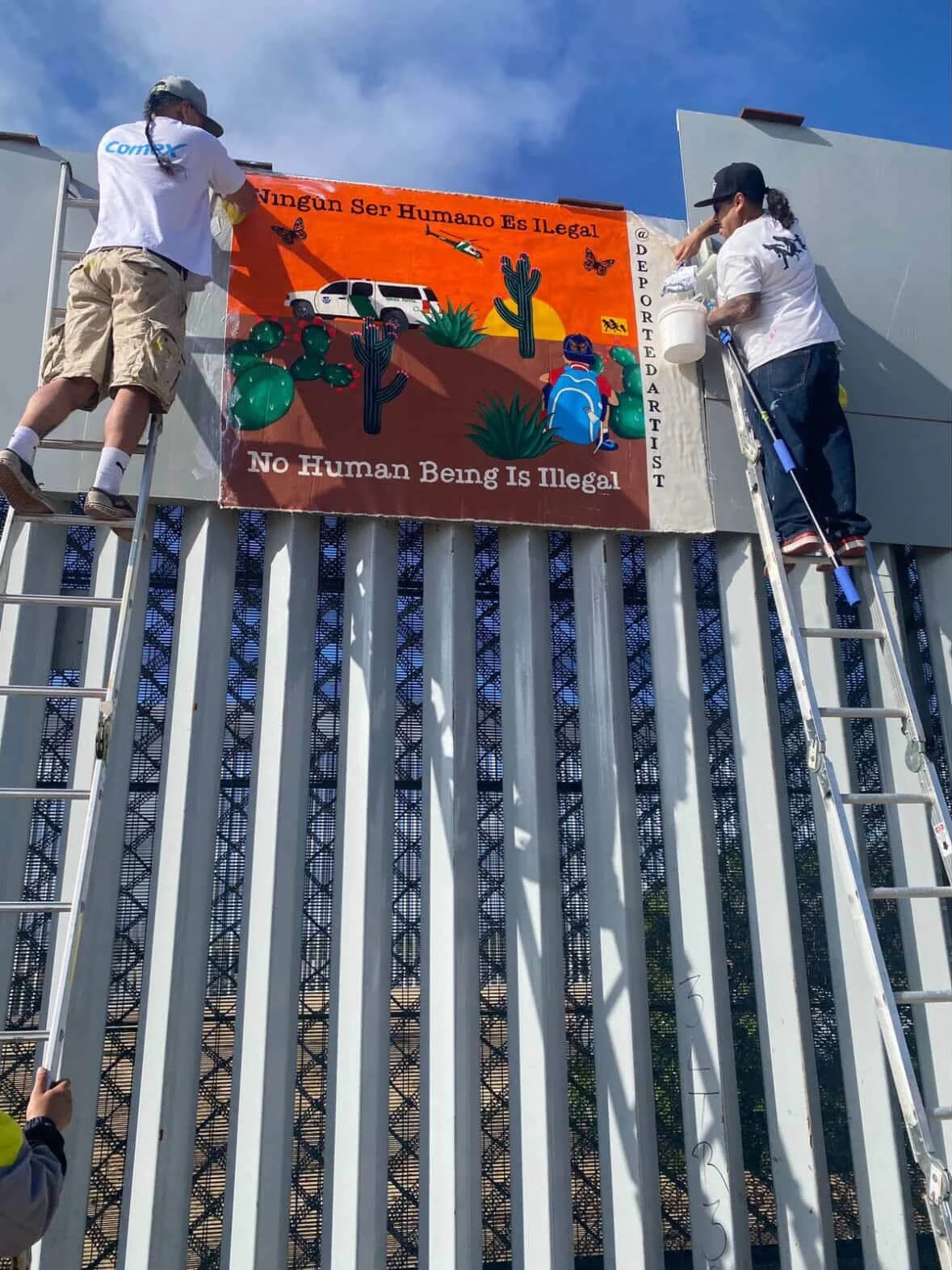
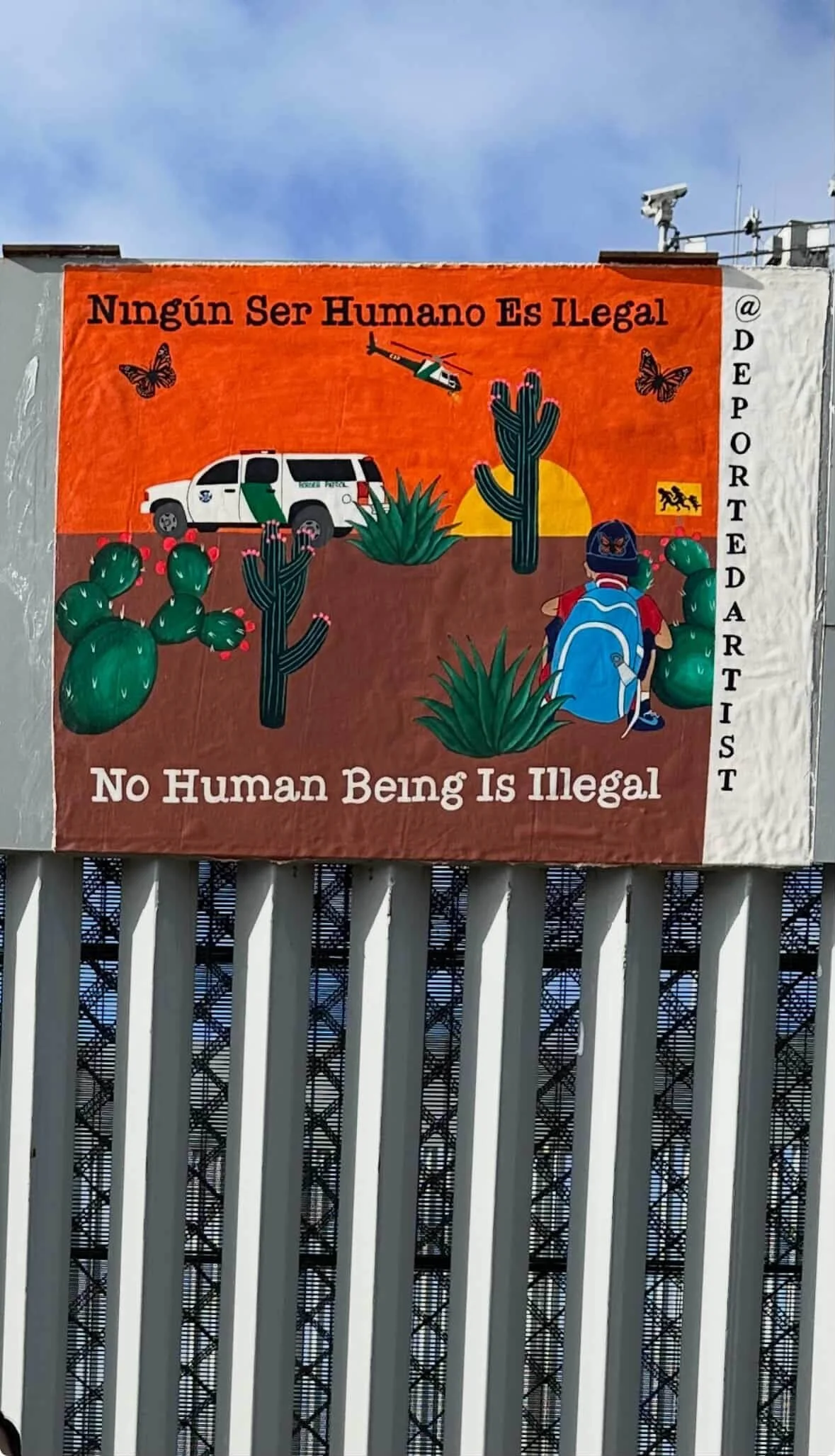
HL: You made a painting of this experience—the experience of crossing the border when you were 11 years old. Then you took another version of that painting that was much larger and you installed it on the border wall. What was that experience like to install this on the border wall of all places and to make that painting?
DA: That painting depicted that story that I just told you. So it's a very special piece to me, and having it on the border wall had big meaning to me because that place right there, Friendship Park, where the border wall is at, gets visited by thousands of tourists from different countries every day.
So it was a chance for people to see the other side of immigration—what we have to go through. When I'm there sometimes and I'm sitting there and people are passing by and they see the work, I could tell that some people can't read the words that say "No human is illegal." They probably can't understand it, but as soon as they see the image, they understand perfectly what it is and what it represents.
I've talked to a lot of people, interacted with a lot of people who are looking at it, and they tell me they've been through similar experiences. So that artwork is not just representative of my story but representative of thousands of people who have gone through the same process.
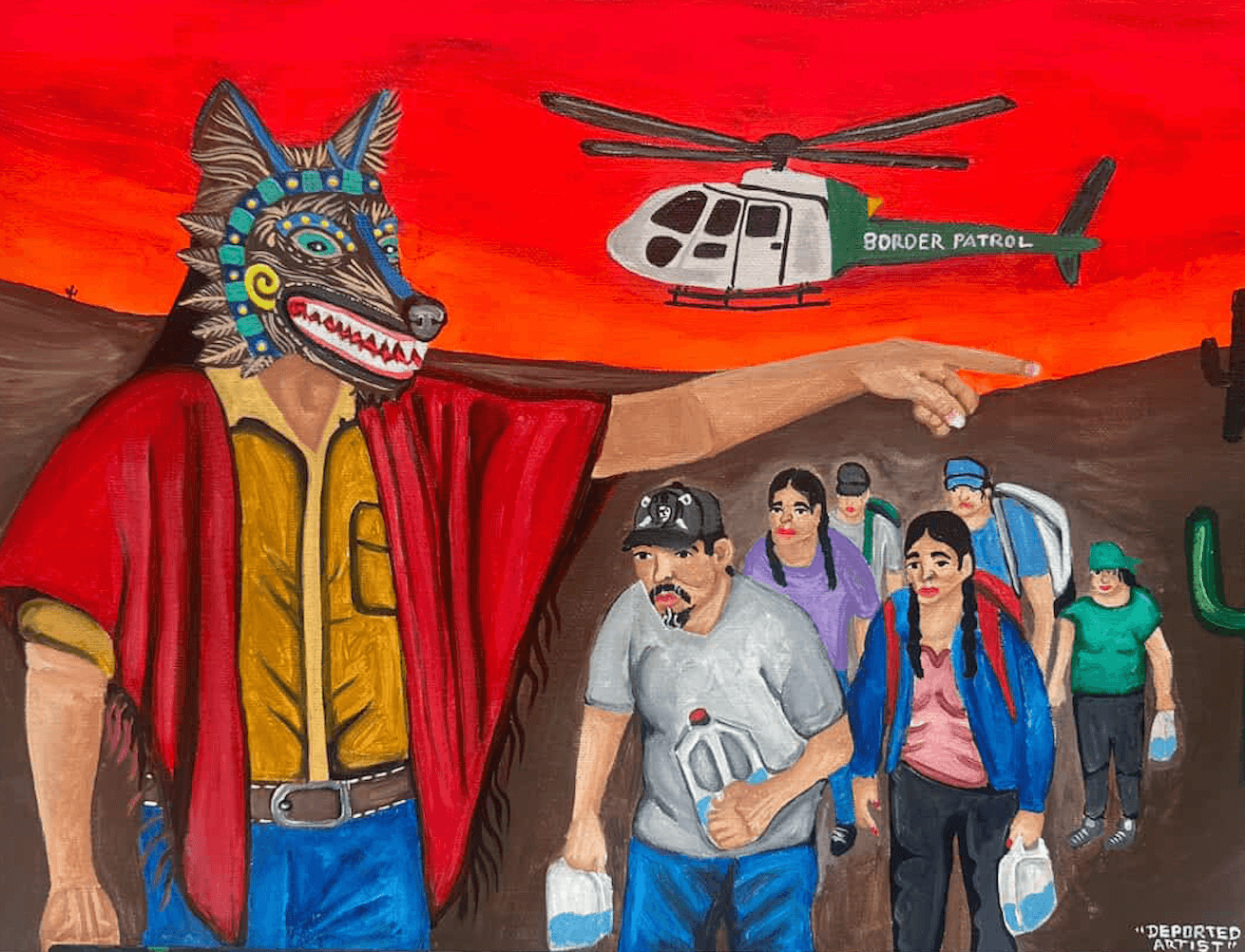
HL: In telling that story, you mentioned that there was someone that was guiding you all to the border wall. I want to connect that to another painting that you made of a coyote and a group of people following him. Of that painting, you wrote, quote, "This one is dedicated to all those that risk it all and never made it to their destination," end quote. Can you tell us what a coyote is and about the people in that artwork that you referred to who never made it to their destination?
DA: A coyote is a guide. It's a guide that you hire to help you navigate the border and get you to your destination. A lot of the times they do help you and they do get you across, but we hear a lot of stories where a lot of people have lost their lives because of the negligence of these coyotes, or because they tricked them, or just because of the conditions they try to smuggle them across. Sometimes they abandon them in the desert. A lot of people set out on this journey, but not everybody makes it.
On the other hand, a coyote could also be a guide, a protector—somebody who helps you get across. So it's kind of like the dualism that coyote has.
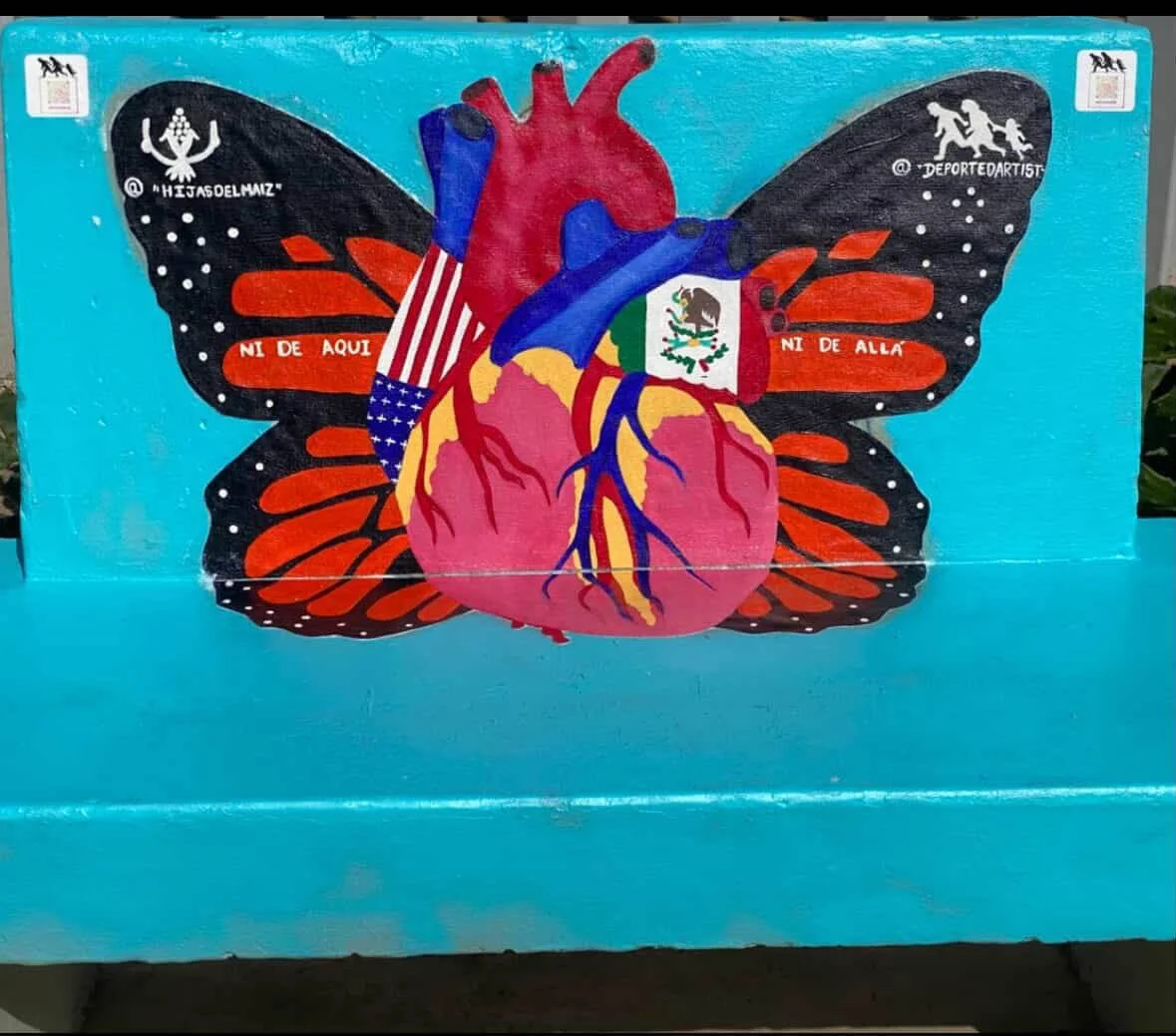
HL: Your artworks and your workshops are largely influenced by a well-known Spanish phrase. The clear translation is "neither from here nor from there." But what does that phrase mean to you emotionally?
DA: When I was raised in Oakland, I remember growing up—I used to speak Spanish first at the house with my family, and then when I would go outside, I would speak English with my friends and at school. So knowing both languages, I liked music in both Spanish and English. When my friends figured that out, they kind of teased me about it and they would call me names or make fun of me saying—because I listened to Mexican music. They teased me sometimes because I had an accent.
Then once I got deported back to Mexico, sometimes people would say, "He's not a real Mexican," or they would just treat me or look at me differently because I was raised on the other side. So sometimes I feel like—even though I'm from both places—I don't fit in sometimes in either of those places. But yet I still belong to both.
If I had a choice, if they told me right now, "Would you like to live in the States or would you like to live in Mexico for the rest of your life?" I would be like, "I would like the choice to move back and forth because my home is neither here nor there." It's everywhere. It's tied to this land as a whole, not just to a certain place.
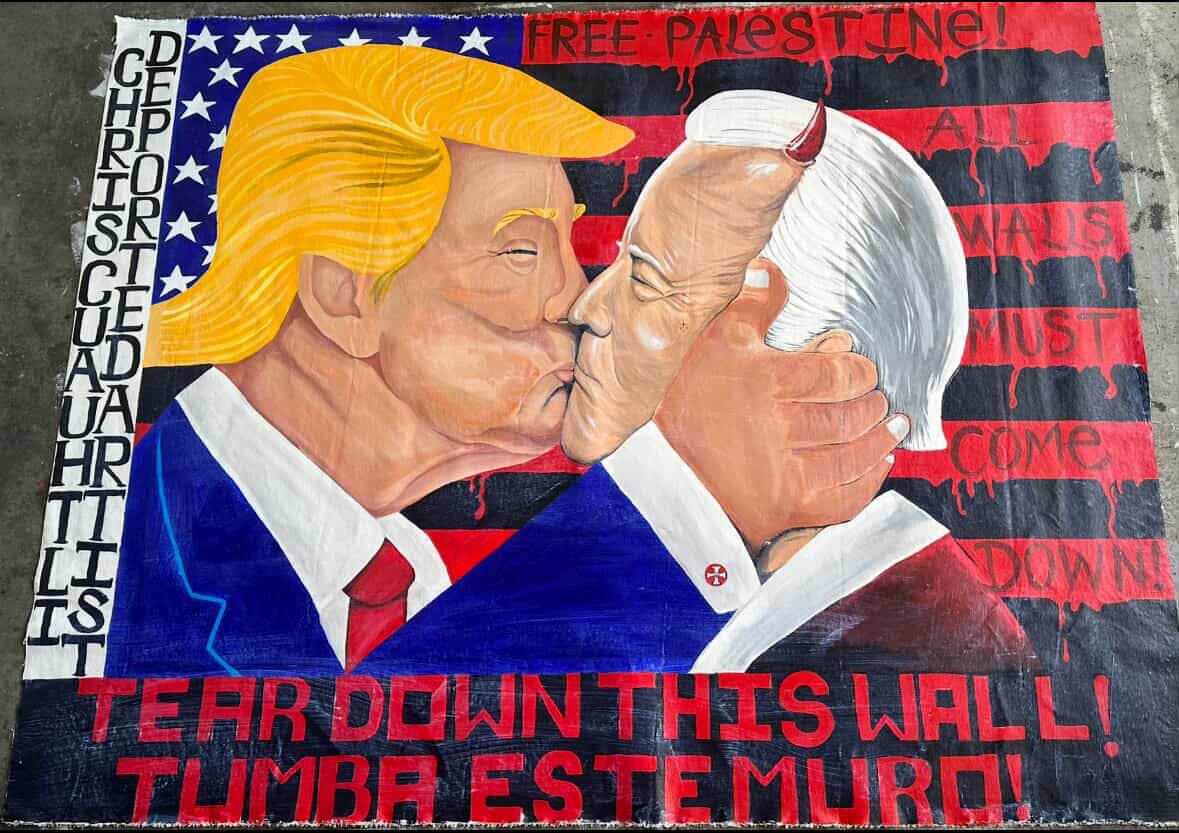
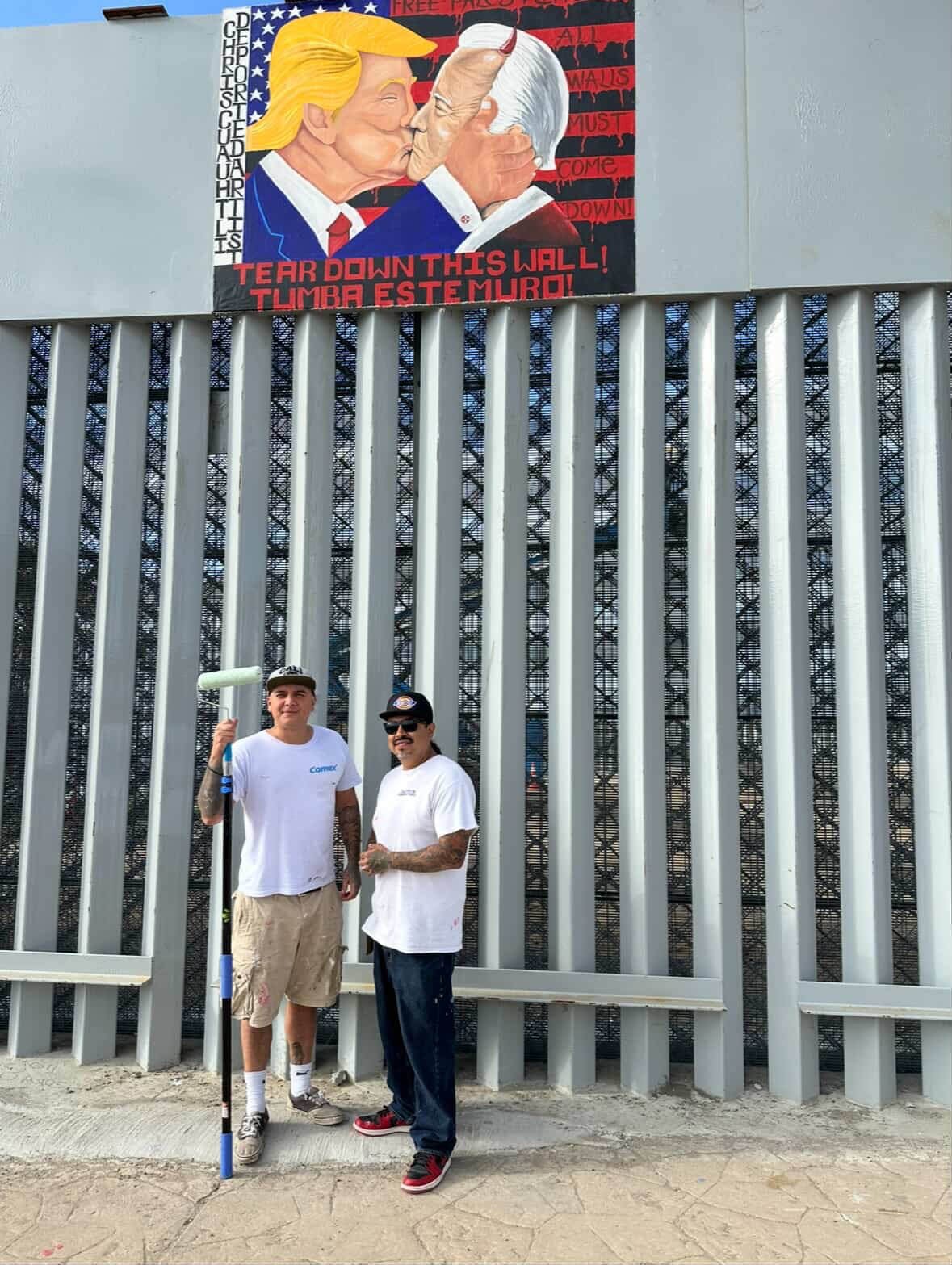
HL: Going back to the border wall, there's a particularly large artwork that you did and you installed it on the US-Mexico border. In the painting, Joe Biden wears horns and he's kissing Donald Trump. What inspired this painting and the putting of it on the border wall?
DA: I painted it with my friend Chrisley, and it was during the time of the elections in the States. I remember everybody was talking about it. Everybody was like, "Are you going to vote for Biden? Are you going to vote for Trump?" The immigrant community—everybody was leaning mostly towards Biden because Biden was promising immigration reform. On the other hand, you had Trump who was outspoken with racist and anti-immigrant rhetoric.
Everybody had their hopes on Biden, but in the end, every time somebody's coming into the presidency, they use immigration as a political pawn. They use this as a political pawn to get what they need, and then once they get into the presidency, they just pretty much forget or abandon all their promises to us.
The Biden and Trump kissing is kind of like a reminder that the left and the right are just different wings of the same bird in the end.
HL: There's some really powerful symbolism in some of your artworks that relate to precolonial cultures of Mexico. There's one particular painting where there is a mother carrying a baby and the baby is wearing a hummingbird costume. Can you talk about the story of these people and that symbolism?
DA: It's a mother and she has a baby on her back. She's crossing the border and then you see footprints in the ground. This image has deep symbolism. In Aztec prehispanic codices, it's called the Codex Boturini because that's where they have it—I think it's in Vienna, France—I mean Italy. So they have it there, and it's pretty much our history of how we migrated from Aztlán, which used to be somewhere in the northwestern United States, to what is now modern Mexico. It was the story of how we migrated.
I reimagined that same scene from that codex and just put a modern twist to it. It's just a reminder that we've been migrating on this land for thousands of years. Long before any man-made border, our ancestors—we used to migrate. Some of us were hunter-gatherers, so we migrated to follow the herds, migrated for better climate, migrated so as not to exhaust the resources. There were a lot of reasons to migrate. Migration is natural. Even the animals in nature migrate. It's only in modern days that humans have criminalized migration once they put all these man-made borders.
HL: I want to talk a little bit later about your workshops, which is very impressive. As a lead-in to giving context to those workshops as well as further contextualizing your artwork—previously we spoke of the transformational event in your life at 11 years old, yet you undergo another transformation. In preparing for our interview, you wrote to me of your incarceration and making art and running art workshops for deported individuals since your incarceration ended. Who was the person before you were incarcerated in comparison to the person who you are now?
DA: I would say night and day. Before I was incarcerated, I didn't have a sense of giving back. Everything was—I was more egocentric. I would say everything revolved around myself. Once I got deported and I went through incarceration and then deportation, I saw what not only I went through, but what a bunch of other people went through. That pretty much inspired me to give back and to use my artwork as a form of activism and as a way to help others heal and use it as a way to help others. I used something that was negative in my life—a negative experience—and turned it into something positive and as a way to give back to others.
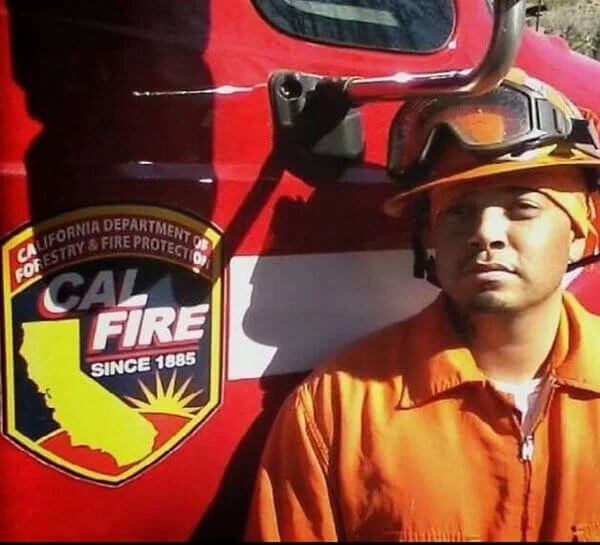
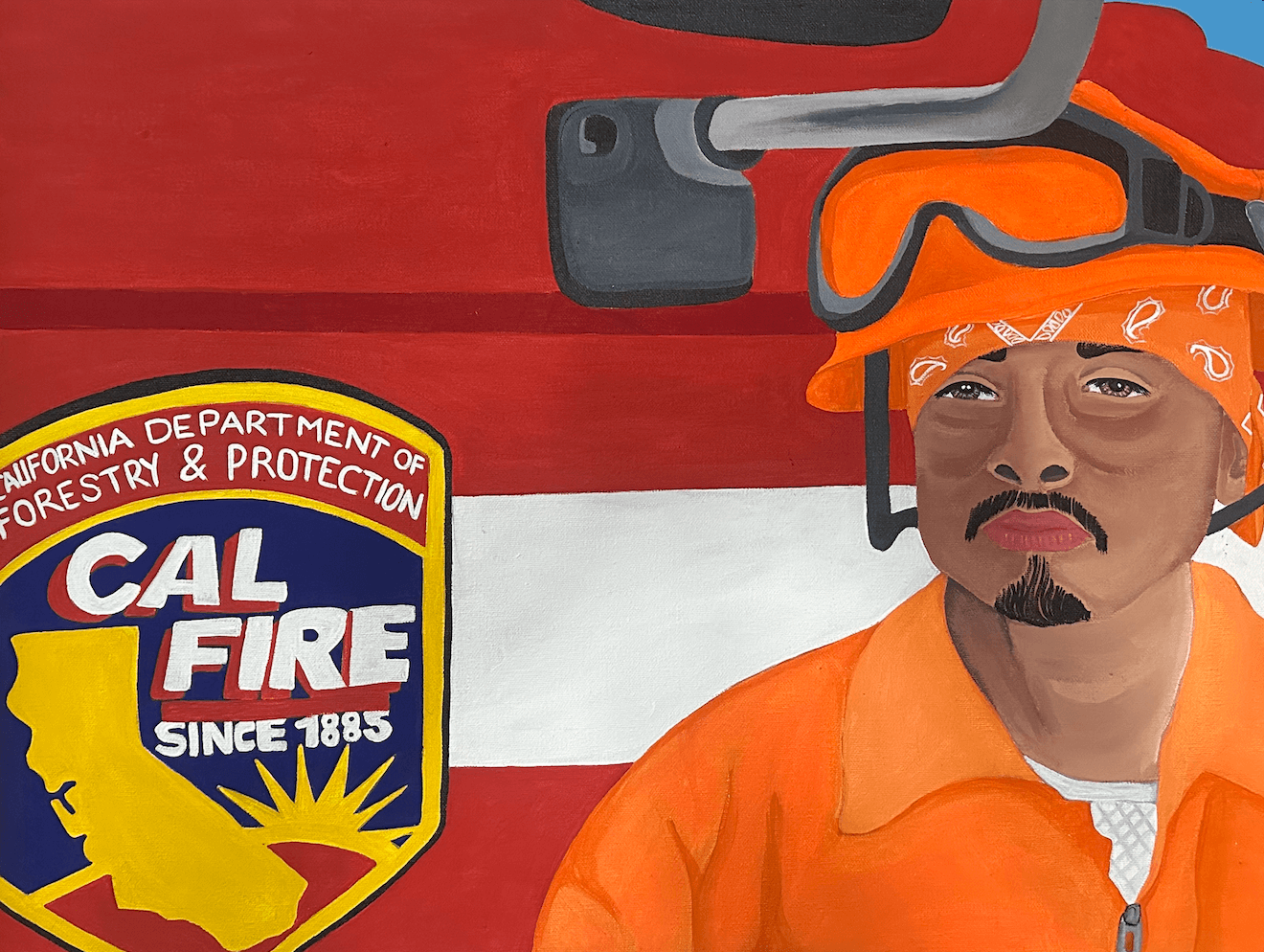
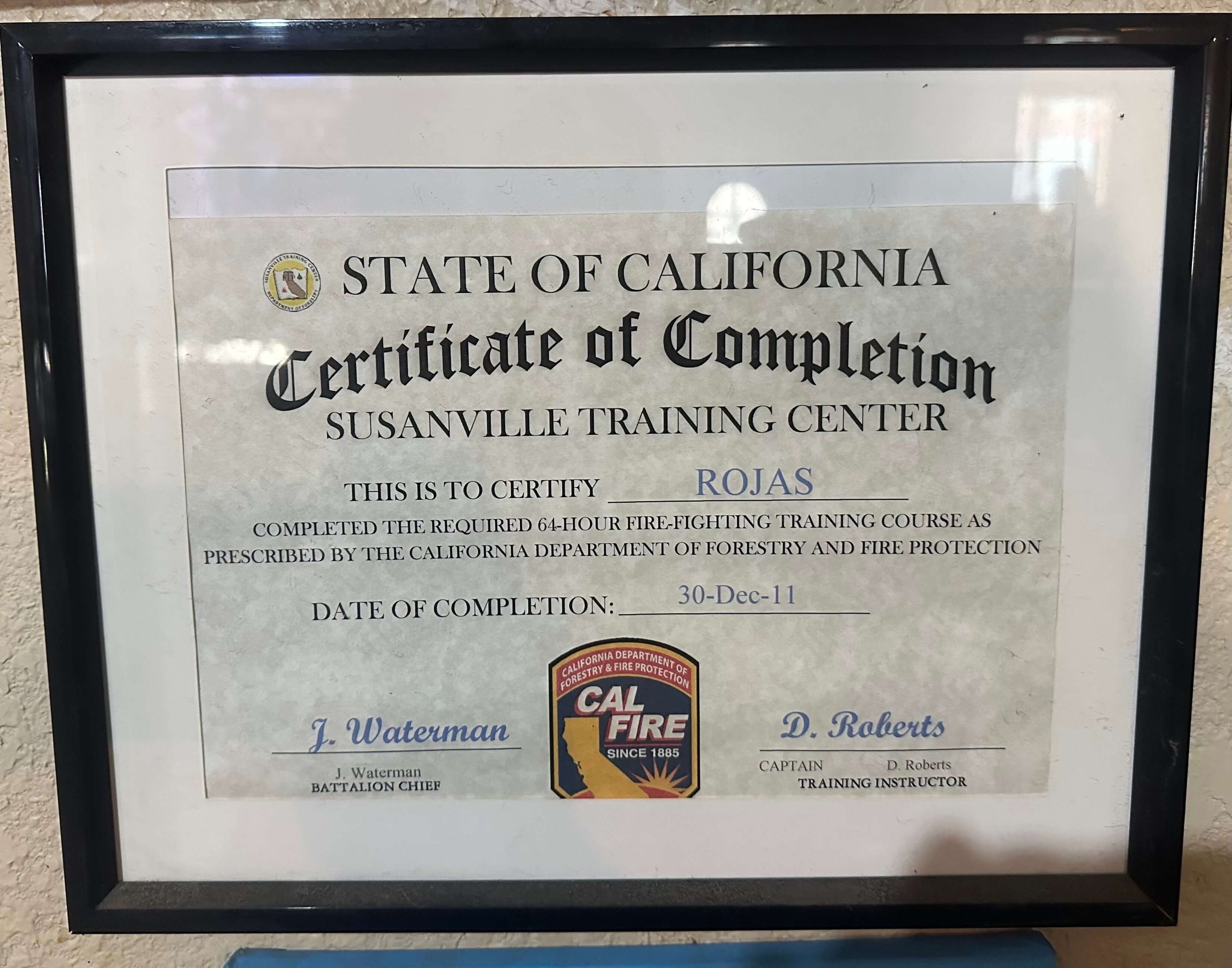
HL: Thank you for sharing that. It's impressive, your transformation, and I want to connect on that a little bit later here. Additionally, in preparation for our interview, you wrote to me about serving the final three years of your sentence in prison as a wildlands firefighter. This sounds incredibly intense, and I've seen your artwork around that as well. What were the wildlands firefighting experiences like during those final years of your incarceration?
DA: I want to say it was bittersweet. On one hand, we were getting paid a dollar an hour, and it was under intense conditions. When we were fighting fires—when we were not fighting fires—we were rehabilitating roads, schools, public parks, forests. We were getting paid 30 cents a day. So on one hand, it felt kind of like slave labor. It was something we were forced to do. It was not an option that they gave us.
On the other hand, it was very fulfilling. It was the most fulfilling part of my whole incarceration. Why? Because when I was out there fighting fires, I didn't feel like an inmate anymore. When we would pull up to a town that was getting threatened by getting consumed by a wildland fire, the people would receive us with signs and they would be cheering. They didn't look at us like inmates. They were happy that we were there. So it was deeply fulfilling. I was out in nature instead of in a prison cell. So I loved it because I got to save a lot of forest land and homes and communities.
HL: That's impressive. It's really interesting to hear you refer to this idea of the bittersweetness of it—that in one hand there's a sense of slave labor to it, on another that it's very fulfilling. And then earlier in our conversation, you referred to a sense of duality in some of your experiences and some of your paintings, and also of course the idea of "neither here nor there." Through your art and activism, you've created a platform for visibility and changing narratives. If you could have it be however you like, what would you want to change the narrative to?
DA: I would like to change the narrative around immigration. Once the borders were put up, immigration took on a lot of faces. On one hand, it helped save a nation during World War II, it helped feed the country. Immigration—immigrant labor—helped feed the country. Right now, the United States depends on immigrant labor, whether they like to accept it or not.
So I would like the whole narrative changed around immigration. People think that we're coming to steal their jobs, that we're coming and that most of us are criminals and things like that. I just want to change that whole narrative because in reality, nobody wants to leave their home.
When I go out to the immigration shelters and I speak to everybody and I get to hear their experiences—people who are from Venezuela, people from Colombia, people from El Salvador or just other parts of Mexico who are fleeing violence—I get to talk to them. Something they all have in common is that nobody left because they wanted to. They were forced to leave. Who in their right mind wants to leave their home? People who were forced to leave are looking for a better way of life, better opportunities for their children, just like everybody else. You can't say those opportunities belong to a certain group of people but not to everybody else.
When I grew up in the public school system in the United States, I grew up with this concept of the United States and how they had this moral authority over the world, and they were the bastion of freedom. Now that I see everything that's going on, how it's turned on the immigrant community, how racist it's become—I don't recognize it anymore. It's not the America that I grew up believing in as a kid.
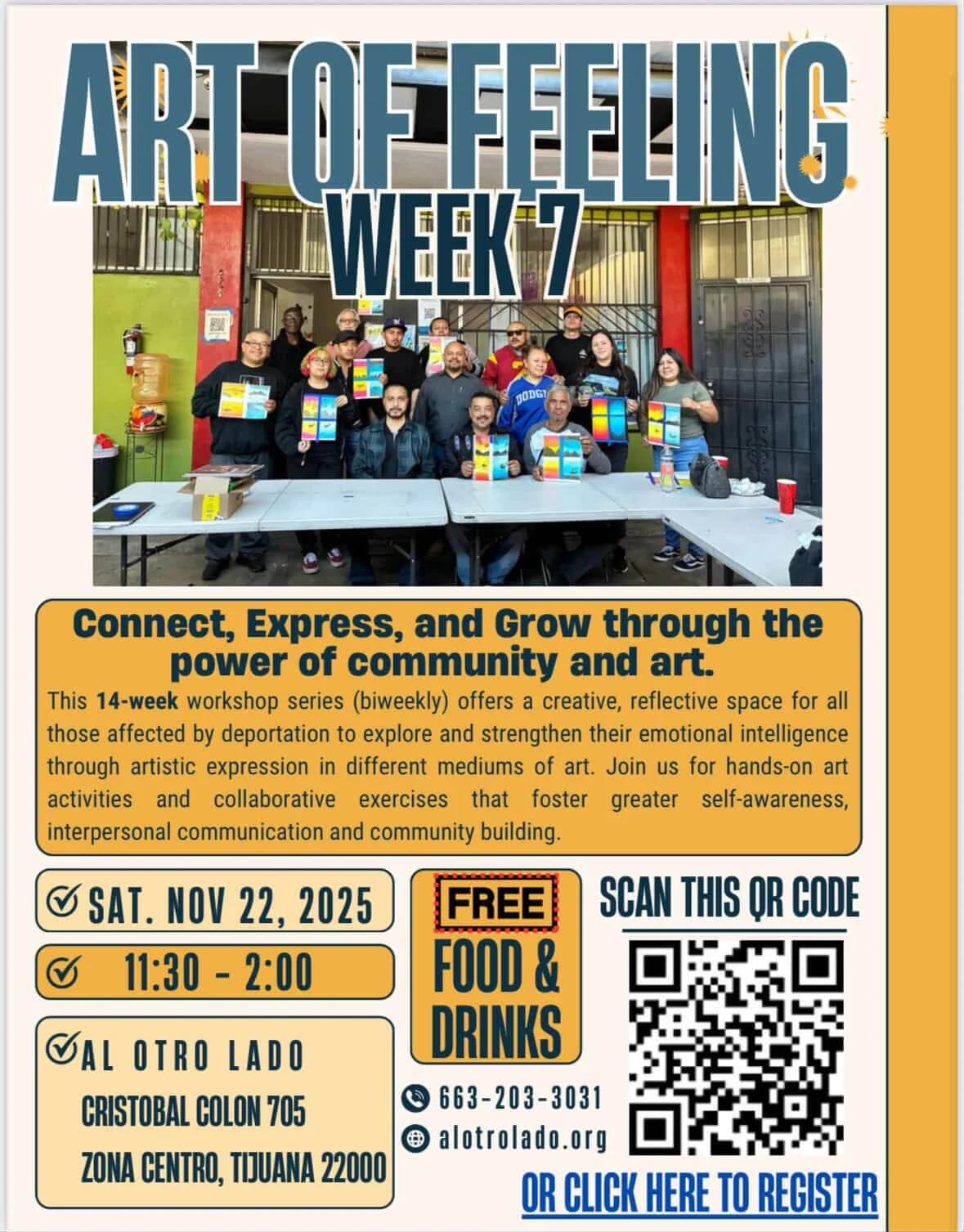
HL: I want to come back to the workshops. This is something that's very inspiring that you are a part of and that you've created. You run these several-month-long workshops that are art-based workshops for people that have been deported, to offer participants a creative reflective space to explore their emotional intelligence through artistic expression, then engaging in guided discussions and collaborative exercises. What are some of the workshop discussions like between participants, and how would you describe the collaborative exercises that you lead?
DA: These classes are offered to deported people. Most of the time, the people who come are just recently deported, so they're barely getting accustomed to life out here and trying to navigate the system. When they first get there, we introduce ourselves and we talk a little bit about ourselves and what we're going through. Then we offer a little bit of mental health, emotional intelligence—like a sort of workshop. After that, we go to our activity. We show them how to channel their emotions through art as a way to reduce their anxiety, their depression.
For the most part, these classes are very positive. People love the class. They have a good time. They tell us if it wasn't for the classes, they'd be at home self-isolating or just dealing with things on their own. This is the only opportunity that they really have to go out and interact with other people who are going through similar things.
But sometimes it can get intense during the first part when people open up. Sometimes as soon as you give the word to somebody to introduce themselves, they just let it all out. We know that they were just waiting for an opportunity to let it out somewhere. If they didn't have that, who knows what would happen to them?
I see a lot of people who were deported and don't have these opportunities, and they end up on the streets. Sometimes using drugs—they get lost in drugs. In some instances, some people commit suicide because they can't get used to life out here when all they know is a life in the States.
HL: Was that difficult for you? The transition? Getting used to life there in Tijuana?
DA: Yes, it was very difficult for me at first. I grew up my whole life in the States. I visited Mexico as a kid, but to live out here is a different thing. All my family's in the States now—even my grandparents, everybody's in the States. So when they deported me out here, I pretty much came out here to be alone.
My wife and kids—they have jobs in the States, so they travel back and forth to come visit me. But yeah, it's very depressing and it gave me a lot of anxiety at first.
I remember during one of those visits, me and my wife were laying in bed, we were watching TV, and Bob Ross came on TV. I remember watching him paint, and I told my wife, "You know what? He's always very happy. He seems very happy, very positive every time he's painting. Maybe if I start painting, maybe I'd be a little bit more happy." And the next visit, my wife brought me my first paint set.
So I started painting—more than anything to deal with my emotions. I had a lot of time on my hands and I was alone. So I started painting, and it really helped me a lot to get through those hard days.
Once my wife started seeing my artwork, she was like, "Why don't you try selling it?" I was like, "Who is going to want to buy my paintings?" But sure enough, she took some of my paintings to the Bay Area. She went to the pop-ups over there, and I remember my first painting sold for $50. At the time, I was working at a call center and I was earning about $120, $150 a week for six days of work. So $50—I was like, man, that's pretty good. I'm going to start painting more.
At some point, my artwork became kind of financially motivated, I would say. But after a while, after being out here in Tijuana, I saw how us deportados, the deported community—we had nothing coming. We were out of sight, out of mind. We kept our heads down and we lived in the shadows. Why? Because we become targets for extortion by the cops. They figure we have family who have money in the States, and they try to extort us for any little thing. People hear our accents and they try to charge us more at the market—just little things like that.
So being deported was something that we kind of hid and we didn't talk about. But after seeing all this and living this whole experience transitioning, I finally said, "You know what? If we never speak up for ourselves and we don't speak up, we're never going to have nothing coming." So that's when I started signing my artwork as "Deported Artist," and that's when my art took a turn to artivism. I started painting about immigration and everything that I went through, and my art became more political than anything.
HL: It's incredible. It's beautiful, the way that your story and your experiences are going through this alchemical transformation and making it a part of your creativity. Then you're sharing that back with the community through these workshops. Of everything that you've just shared, what is it that comes to mind that you feel like—earlier you said something very powerful about people coming to these workshops sometimes the very first time and then they get the chance to speak and it just kind of opens the gates and they really needed that. What's a similar moment for you? What is something that you want people to know about your experience or about the immigration experience or the deported experience in general?
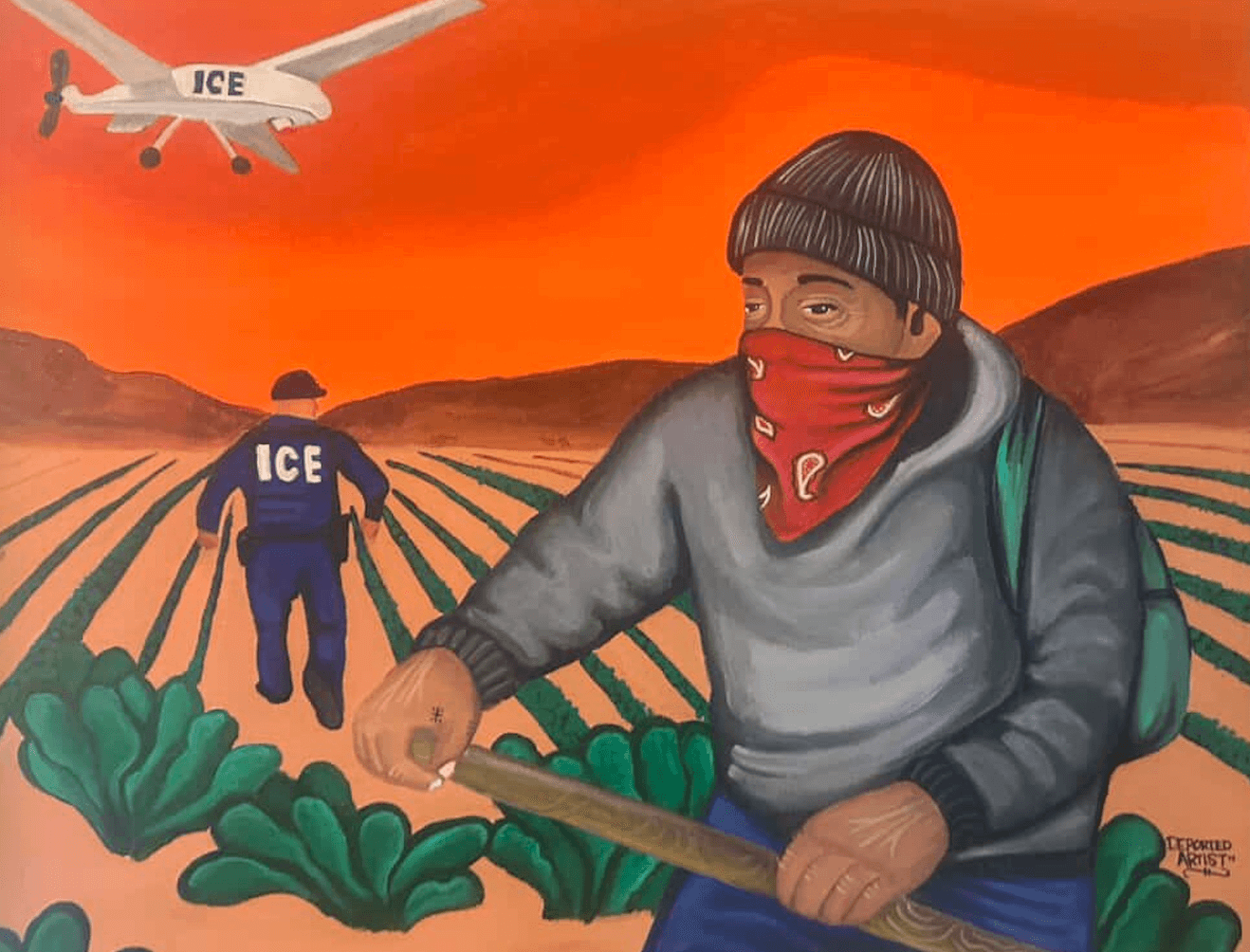
DA: A lot of people, they just hear about deportations on the news. You hear about deportations. You hear about ICE deporting people. But what happens to people after they get deported? You never really hear about that. What happens to us once we're out here and we're stuck out here and we have to make a new life for ourselves out here?
I would just like people to see the flip side of that. Like immigration reform—when we hear about immigration reform, immigration reform is just for the people in the States. Once you get deported, we don't count under that reform anymore. So we're kind of forgotten about. I just would like to give us that visibility, give us that voice out here.
HL: It's incredible—the visibility from the installations on the border wall, from your artwork, through the stories you share, of course the activism. Let me see if we can pull things full circle here with one final question on this very idea. The workshops you mentioned—this sounds like a very cathartic, therapeutic experience in many ways, people tapping into their creativity and even just community, connecting with other people that have a shared experience. What have the outcomes from the workshops been like for some of the participants and for you emotionally?
DA: The outcomes have been very positive. Sometimes people come and they're having a very hard time navigating the system, getting a job for the first time in Mexico. So we connect them with resources, and they get jobs. They get on their feet. So for the most part, it's positive and happy stories.
But sometimes when we go in there and we hear what everybody's going through and how they're living and how they're having a really hard time, and we're trying to make it a positive experience for them—I almost feel like a sponge sometimes. What I mean by that is I'm absorbing—it's almost like I'm absorbing all the bad so that it's positive for them. Then at the end of the day, I come home and it's hard for me to disconnect from that because I totally relate to everything that they're going through—the struggles. It's just something that I can't just forget about.
So yes, it's positive. I enjoy—it's very fulfilling for me to help others. I love helping others who have gone through what I've been through. I love sharing my experiences with them and showing them how they could benefit from my experiences. But yes, sometimes it's a little bit overwhelming sometimes. Like, who gives mental health to the people who are giving mental health?
HL: You bring up an incredible point. It's such a challenging time—not just mental health in general and the challenges that society is facing, but also with immigration, deportation. I think you make an incredible point around the idea that oftentimes it's a statistic. It's like, okay, X number of people have been deported, and that's the end of the story. It's like, well, these are human beings. What is their story? Who are they? What is happening to them afterwards? And you are an incredible example of that—not just of what is happening to that person, what is going on, but so too an incredible example of what can be done for others. You're living proof of that. So you're doing it. It's beautiful.
Deported Artist: Thank you. Appreciate it.
