
Seongmin Yoo, Spirit Made Visible, Dougherty Station Community Arts Center

Seongmin Yoo, Celestial Tides, oil, ink, rice paper on panel, 50 × 50 inches, 2025.
Spirit Made Visible
Solo Exhibition of Sculptures and Paintings by Seongmin Yoo
January 6 - February 1, 2026, Dougherty Station Community Arts Center
Featuring a Live Performance 3:30pm February 1, 2026
Seongmin Yoo is a Korean-born artist based in Northern California whose practice has quietly expanded over the past several years across painting, sculpture, installation, and performance. Having received her MFA from UC Davis, her work has been exhibited in institutional and gallery contexts, including presentations at the John Natsoulas Gallery in Davis, the Corey Helford Gallery in Los Angeles and the Holter Museum of Art in Montana. Yoo has steadily developed a visual language that resists easy categorization. Rather than anchoring her work in autobiography or overt narrative, Yoo builds worlds that are almost speculative, hybrid, and insistently physical, and that reflect the experience of living between varied communities and states of belonging.
Her current exhibition, Spirit Made Visible, on view at the Dougherty Station Community Arts Center through February 1, 2026, brings together painting, sculpture, and a live performance in a way that feels less like a presentation of discrete objects and more like an environment slowly revealing itself. What makes this exhibition notable is not its scale or ambition (though it has both) but its attention to how viewers move, pause, and orient themselves in relation to the work. The show unfolds spatially and emotionally, encouraging a kind of quiet attentiveness rather than spectacle, and it rewards time spent with it.

Seongmin Yoo, Stirring for Stars, oil, ink, ricepaper on panel, 24 x 24 inches, 2024
While Yoo’s earlier exhibitions often emphasized migration and displacement through imagined landscapes and alien forms, Spirit Made Visible marks a shift toward integration rather than fragmentation. Here, the mediums no longer feel like parallel threads but like parts of a single organism. Sculpture echoes painting, painting anticipates movement, and performance can activate what is otherwise dormant. There is a sense that Yoo is no longer describing transformation from the outside but allowing it to occur in real time; tangibly, spatially, and bodily.
Technically, Yoo’s paintings remain anchored in oil and ink layered with rice paper, a combination that introduces fragility and permeability into otherwise saturated, luminous surfaces. Works such as Big Moon (2025) and Spectrum of Soul (2024) operate less as images than as fields; dense with color, drifting forms, and gravitational pull. The rice paper interrupts the authority of the painted surface, creating seams and hesitations that feel intentional, as if the work itself is negotiating its own presence. These are paintings that seem to breathe rather than assert.
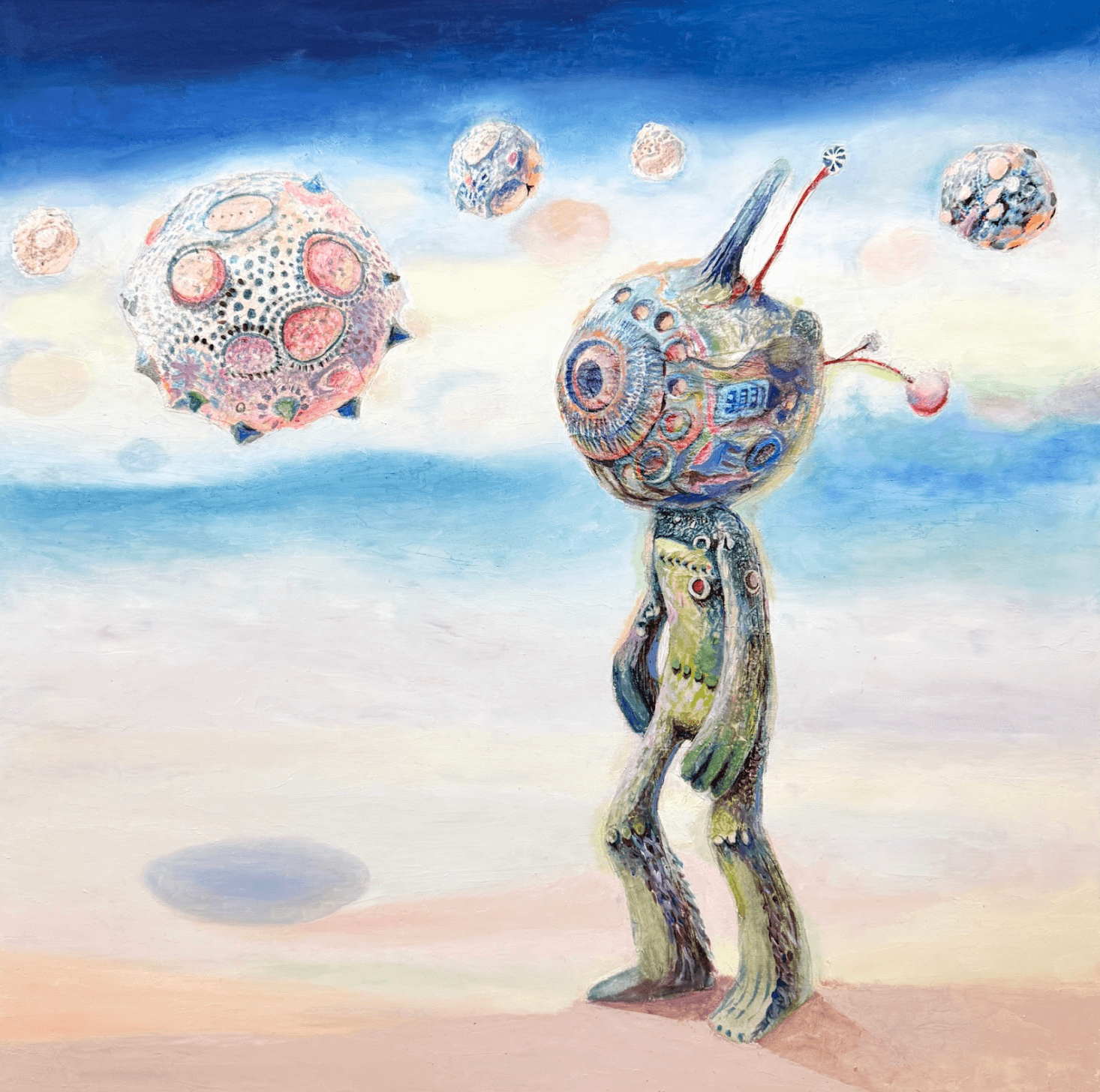
Seongmin Yoo, Big Moon, oil, ink, ricepaper on panel, 18 x 18 inches, 2025.
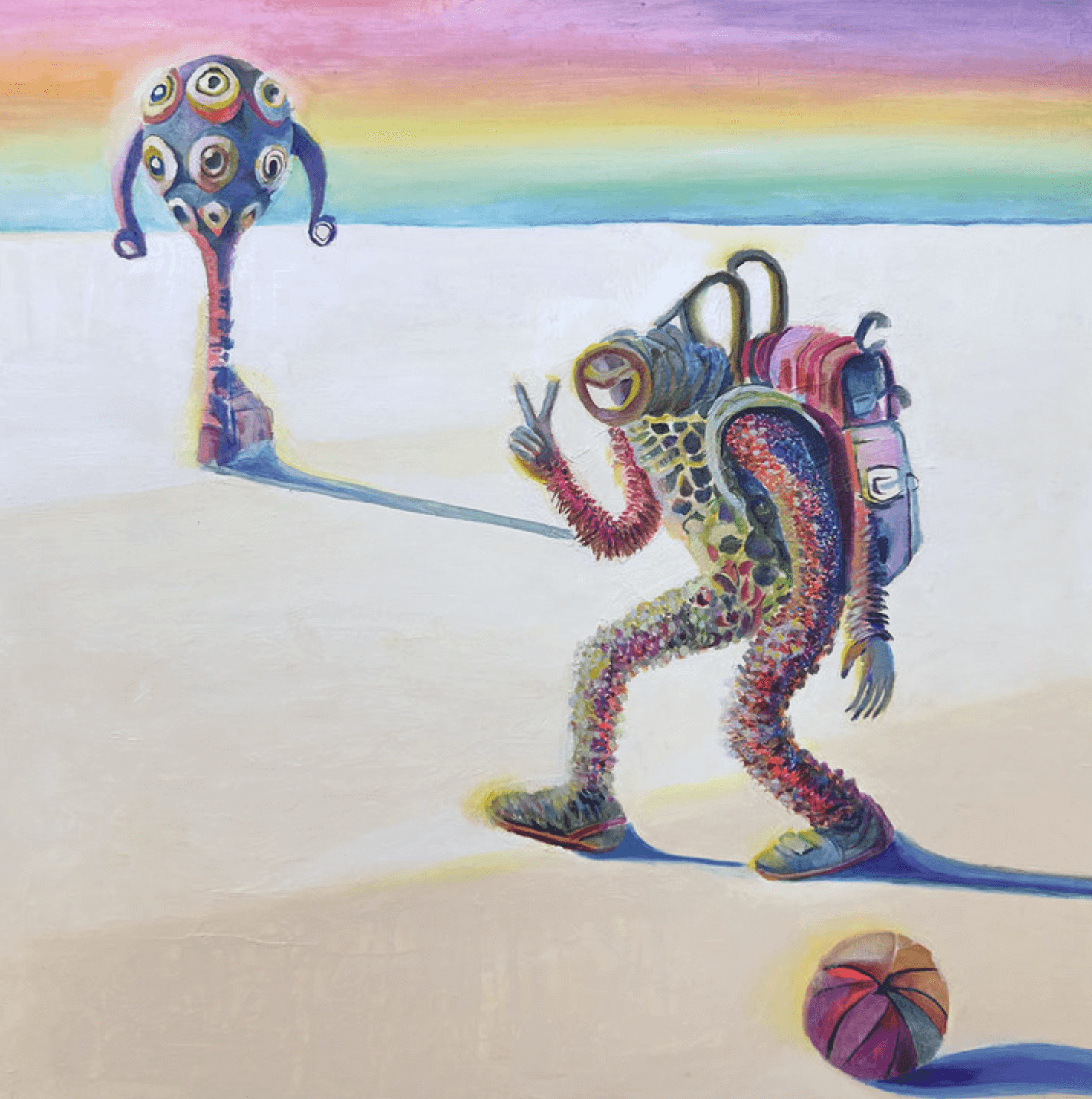
Seongmin Yoo, Spectrum of Soul, oil, ink, ricepaper on panel, 24 x 24 inches, 2024.
The sculptural work deepens this sense of negotiation. The central sculptural installation, Spirit Made Visible (2025), feels neither fully grounded nor entirely weightless. Its organic contours suggest growth, erosion, and accumulation all at once, while its surface, which is rich in color and texture, mirrors the atmospheric qualities of the paintings nearby. Rather than functioning as an object to be circled and observed, the sculpture behaves more like a presence, subtly reorganizing the room around it. It asks the viewer to consider where edges begin and end, and whether those distinctions matter at all.

Seongmin Yoo, Spirit Made Visible, mosaic, 70 x 23 x 20 inches, 2025.
Philosophically, Yoo’s work pushes back against the familiar doomsday tone that so often shows up in speculative and eco-futuristic art. Pieces like Celestial City (2024) and Offset Magnetic System (2024) imagine frameworks that are complex but not hostile, unfamiliar but not threatening, as if one was to see an apparition of a beloved relative who had passed on. There is a quiet optimism embedded in the work, not the optimism of solutions or answers, but of coexistence. Human, non-human, and imagined forms are not competing for dominance here; they are adapting to one another.

Seongmin Yoo, Celestial City, oil, ink, ricepaper on canvas , 48 x 53 inches, 2024.
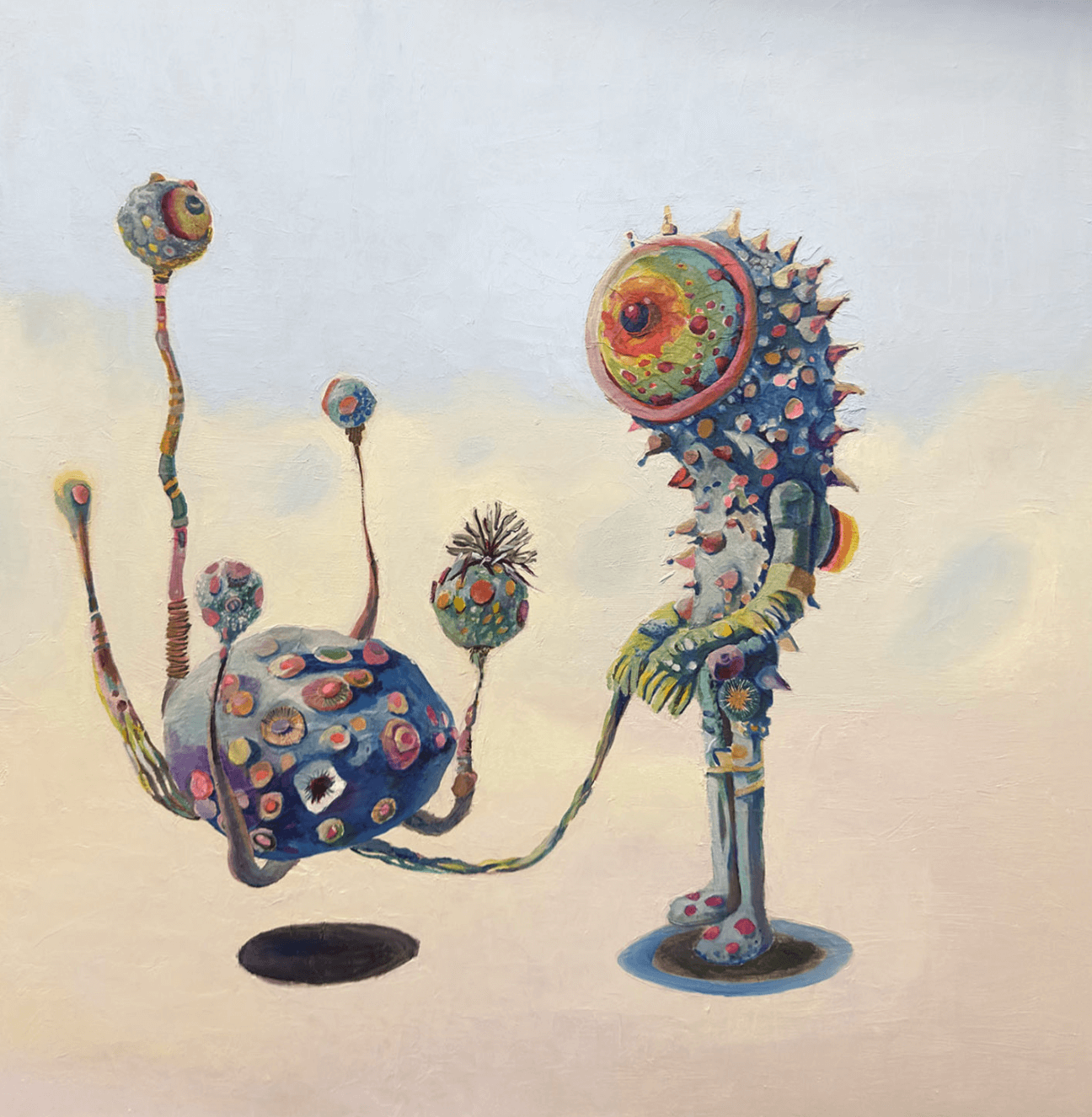
Seongmin Yoo, Offset Magnetic System, oil, ink, ricepaper on panel, 24 x 24 inches, 2024.
The planned live performance introduces another layer of possibility to the exhibition, one that has yet to unfold. Developed in relation to the sculptural installation, the performance suggests that movement and the human body will temporarily reconfigure the space, shifting how the work is perceived rather than explaining it. If the paintings and sculptures establish an environment shaped by adaptation and negotiation, the performance has the potential to test those ideas in real time, allowing meaning to emerge through proximity, motion, and duration. Rather than offering resolution, it promises to keep the exhibition in a state of becoming.
The exhibition as a whole reads as a meditation on permeability, of borders, bodies, materials, and identities. It is a show that trusts its audience to bring their own physical and emotional awareness into the space, and it does not rush them toward interpretation. That restraint feels increasingly rare these days.
In the context of the current Bay Area art landscape (where speed, visibility, and market logic often dominate), Yoo’s exhibition offers a different model. It insists on slowness, attention, and embodied presence at a moment when political, environmental, and social systems feel increasingly abstract, dishonest and unmanageable. Spirit Made Visible remains on view through February 1, 2026, and its timing feels precise: a reminder that meaningful change, like meaningful art, often begins not with declaration but with careful observation and shared space.
