
Run Fast, Bite Hard, Catharine Clark Gallery
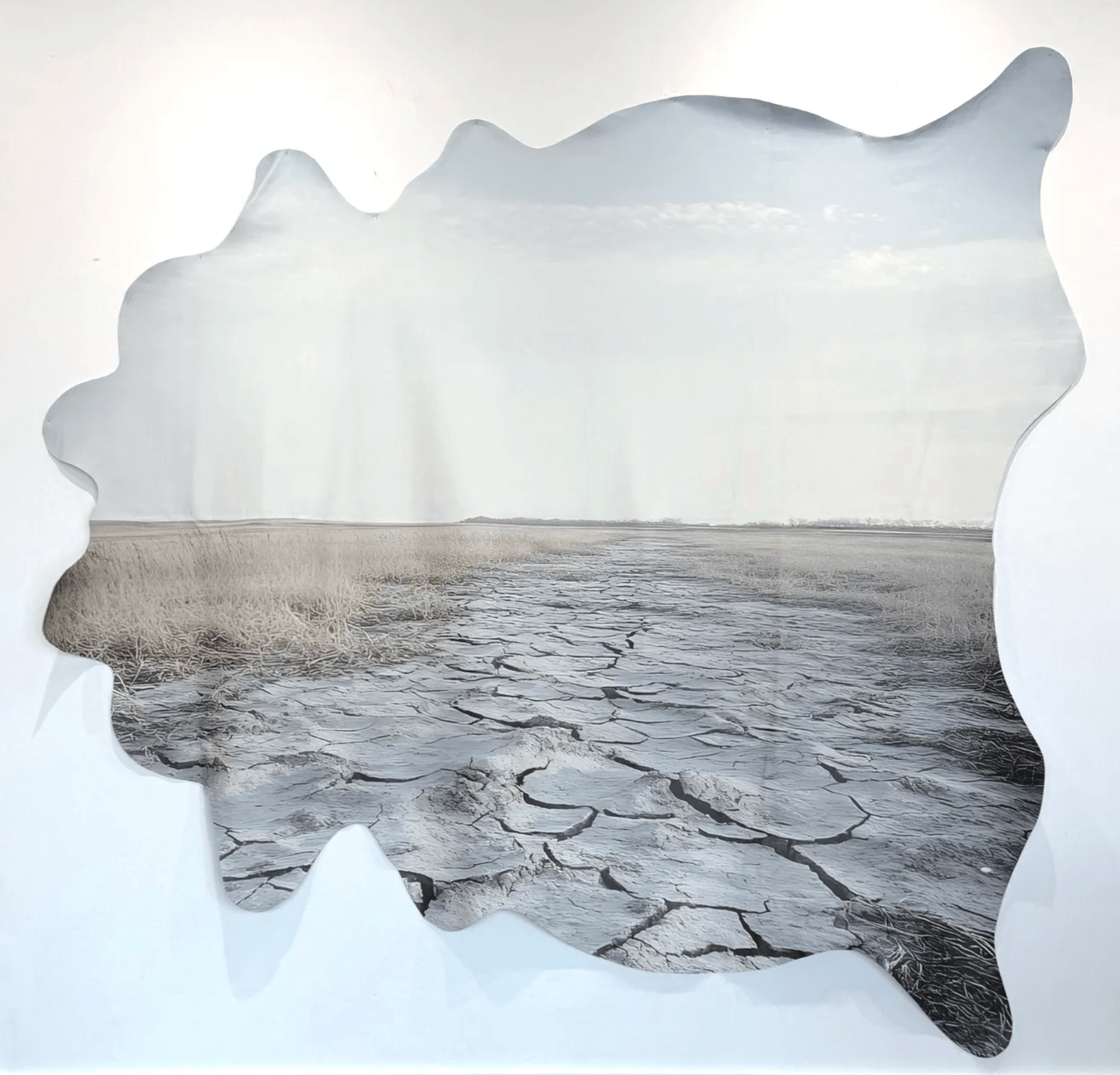
Deborah Oropallo. Rangeland. 2026. Pigment print on cowhide. Printed at Magnolia Editions, Oakland, CA. 82x82 inches.
Run Fast, Bite Hard curated by Anton Stuebner at Catharine Clark Gallery, San Francisco, Mar 14—May 30, 2026
Donna Haraway is known for thinking through compact figures: cyborg for composite identity, then companion animal for “co-habitation, co-evolution, and embodied cross-species sociality.” In “Run Fast, Bite Hard,” the exhibition on view at Catharine Clark Gallery through the end of May, with a title drawn directly from Haraway’s The Companion Species Manifesto, artworks in different media gather to illustrate what happens when such concepts move from language into visual form. At a moment when the nonhuman is often imagined through AI, automation, and synthetic intelligence, the show redirects attention toward older entanglements: dogs, deer, cattle, prey, skins, domestication, and loss.
The route through the exhibition is roughly circular, beginning and ending at the vestibule of Catharine Clark Gallery’s clean-lined, modern show space. One of the first works to address the exhibition’s premise is Laurel Roth Hope’s Man’s Best Friend: French Bull Dog II (2026), a walnut wood carving of a dog skull whose gaping eye sockets and nasal cavity appear unmistakably human. At once a fantastical extrapolation and playful speculation on a possible outcome of human-dog coevolution, it offers a bold imagination of the depth our inter-species involvement could take.
Further in, the bright colors of Marie Watt’s rainbow block-letter works catch the eye. Her two pieces turn address itself into image: illuminated letters cast spilling primary colors, while the meanings of the words, invoking pun and associative thinking, probe interspecies relations. Salutation (2025) looks simpler: the text DEERDEER is rendered in red and blue, the emotional exclamation maintained by pronunciation but unsettled by the replacement of “DEAR.” The text here becomes an address to a different species: an invitation to come closer, a yelp of excitement, or another possibility altogether. In any case, the text presupposes proximity between deer and the caller of “Dear, dear,” the address itself establishing deer and human as companions, at least at the moment of calling.
This direct address can also be found in Jen Bervin’s Sloth (2021). At first glance, it is simply a rectangular piece of white fabric hung on the wall; but the work’s meaning changes once you notice the stitched lettering “sloth.” The silver-colored needlework itself is abstract, so it takes a moment to recognize the word, a delay that feels apt given the animal’s defining slowness. But recognition only prompts further questions: why sloth? Nothing else in the work indicates any association with the hairy, algae-inhabited tropical animal. Is this a blanket made for a dog named “Sloth”? This would be a reasonable explanation, but it also reduces a richer meaning to the mundane. The exhibition is strongest in moments like this, when interpretation emerges slowly rather than being delivered all at once.
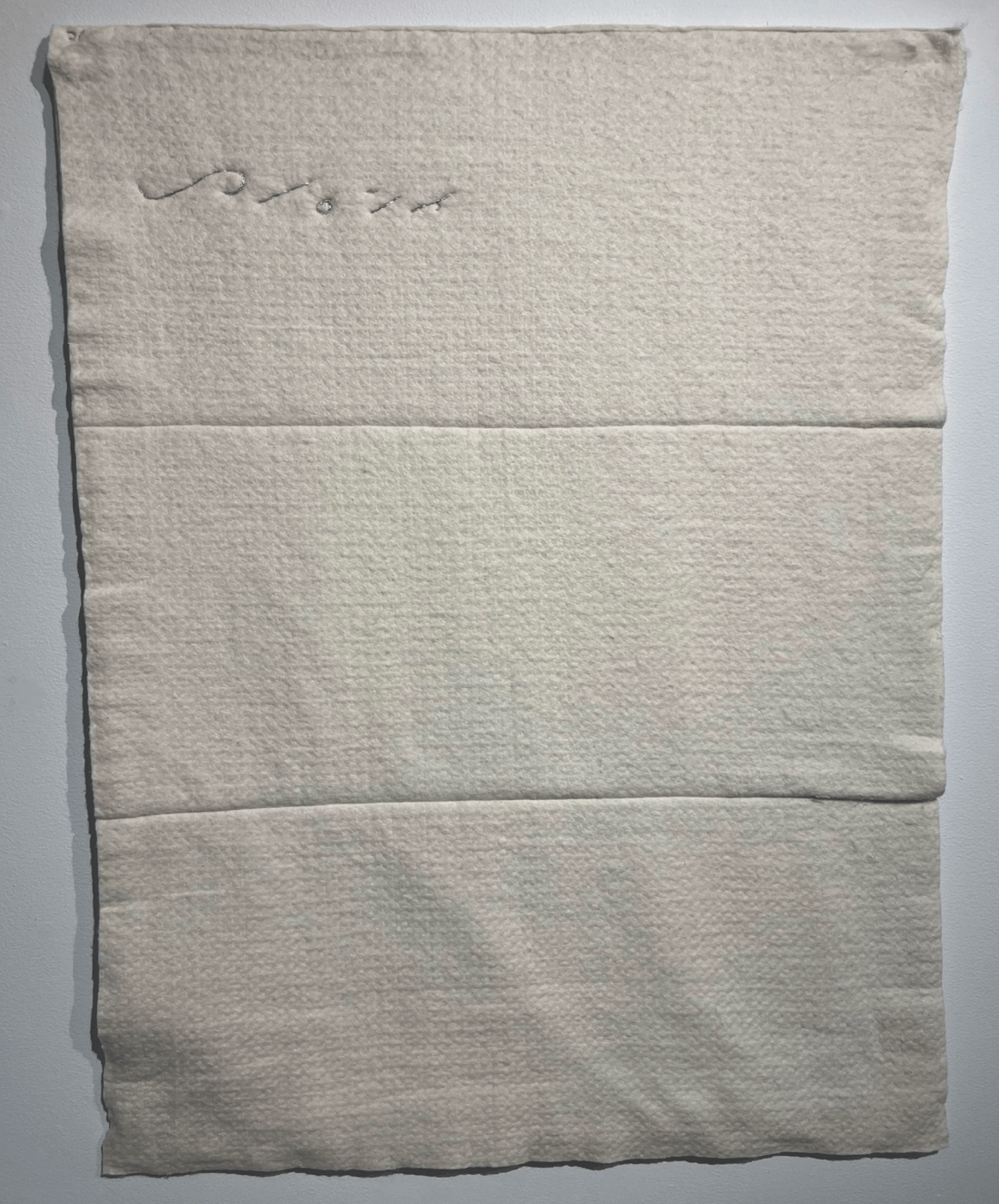
Jen Bervin, Close Reding 76 “Sloth.” 2021. Cotton batting, muslin, mull, silver thread, 48x30 inches
Another work built on delayed recognition waits on the other side of the exhibition space: Deborah Oropallo’s Rangeland (2025), a photographic image of cracked land. Here, it takes a moment to recognize that the shape of the photo is cowhide, then another, if you walk up close, to see that the image itself was printed on cowhide. The work then resolves: a ranchland deprived of moisture amidst climate crisis, where the only cattle present are dead and survive only as cowhide. The relationship between our companions is marked by absence, a memory evaporated through the cracks of the dried land.
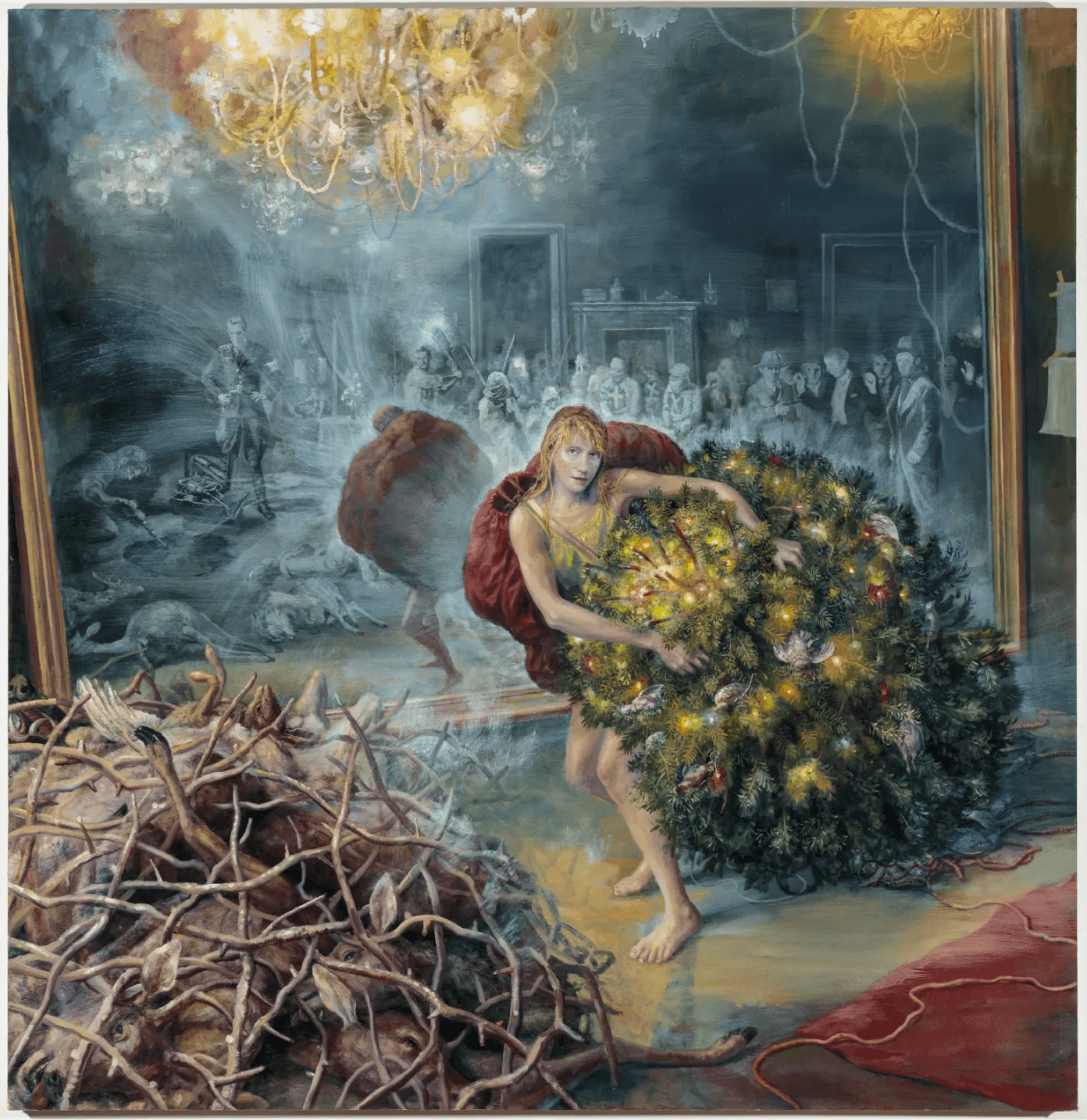
Julie Heffernan. Self-Portrait as Gatherer (Mirror World), 2017. Oil on canvas, 68x66 inches.
Juxtaposed with this lack is the overflowing maximalism one finds in Julie Heffernan’s Self-Portrait as Gatherer (Mirror World) (2017). In it, the barefoot, sack-loaded artist is pulling an ornamented Christmas tree through an ornate interior space not unlike Versailles’ Hall of Mirrors. Hunted deer are piled into a small mound on her left, while a scene of political oppression—one that could evoke Nazi soldiers ordering captured Jews to dig their own tombs—is reflected, desaturated, in the mirror behind her. This assemblage of dissonance pushes into absurdism and invokes thoughts not only of companion animals but of human brutality: companion animals are relationships not between singular entities, but cyborgs.
More companion animals and cyborgs appear in the show: mice, lizards, seals, and more abstract fusions of recognizable species. Because there are no wall labels, it takes longer to arrive at interpretations of what one sees. This can feel like a constraint, a disorientation, since companion animals’ complex histories need more clues for unpacking; but it can also feel like a liberation, as if, standing before the work long enough, the stories of coevolution at our core might begin to emerge. The absence of labels is part of the show’s risk. Sometimes it leaves the works too open, turning complicated histories into loose metaphor. Taken as a whole, the exhibition is strongest when the works it gathers make Haraway’s ideas visually convincing.
