

Roland Petersen at 100 - A Life in Painting, Studio Shop Gallery
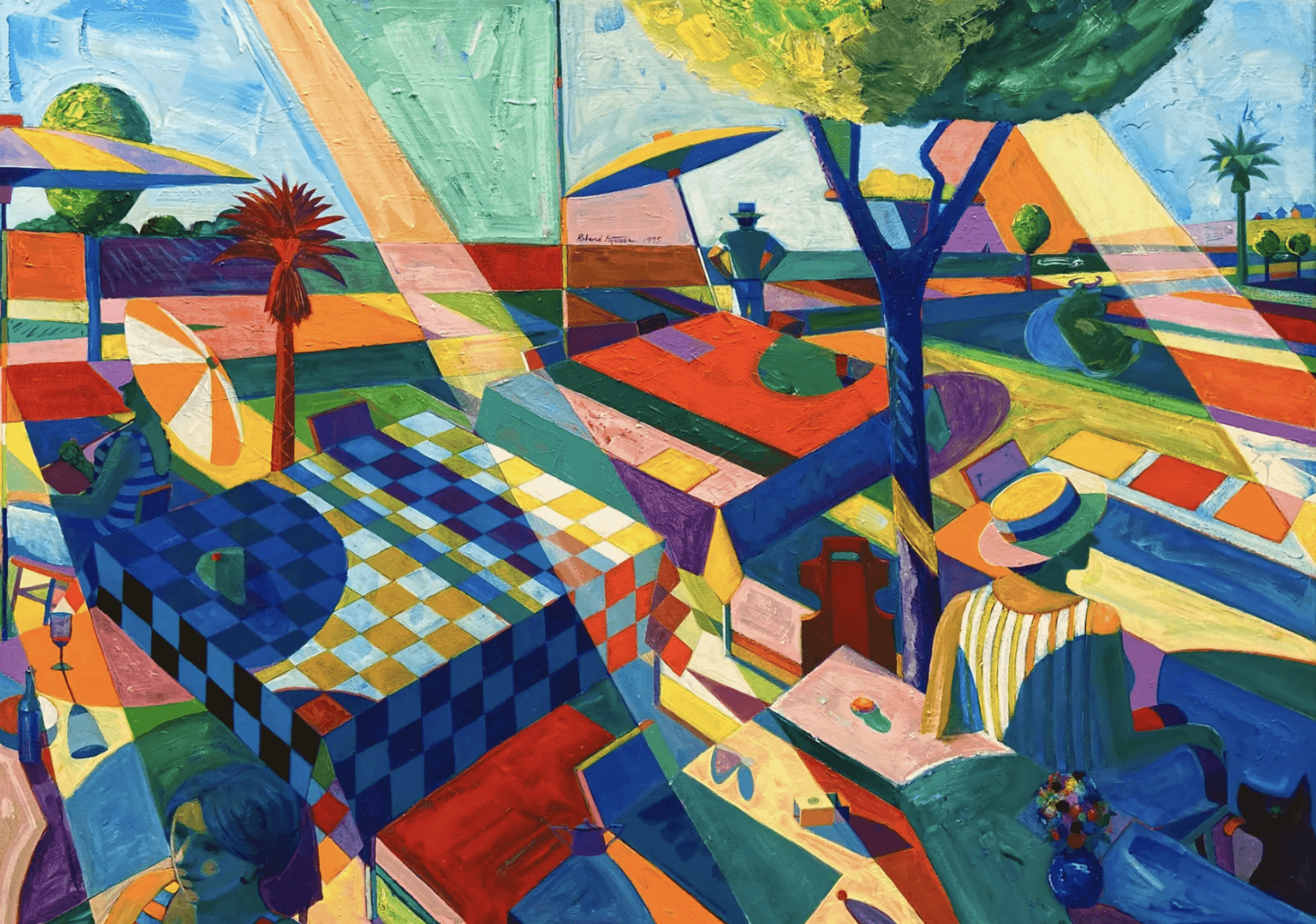
Roland Petersen, Picnic With Red Palm Tree, acrylic on canvas, 53 x 73 inches, 1995.
Roland Petersen at 100 - A Life in Painting
Studio Shop Gallery - Burlingame, California
May 8 - 30, 2026
There are few privileges greater than reaching one hundred years of age, and fewer still than arriving there with one’s creative faculties not diminished but actively engaged with pertinent aesthetic questions related to form and color. To stand before Roland Petersen’s paintings at Studio Shop Gallery during the celebration of his centennial is therefore to encounter more than a retrospective. It is to share, however briefly, in the rare continuity of a life still in dialogue with art. One leaves not only aware of Petersen’s longevity, but quietly grateful to witness a body of work that remains unfinished in spirit and alive in its sustained art making.
The exhibition itself avoids the sentimentality that often shadows centennial celebrations. Petersen’s paintings do not lean on age for significance or ask to be viewed as the final chapter of a long career. Figures gather beneath umbrellas, stretch across landscapes and move through spaces shaped as much by composition preferences as by a suggested narrative. Pattern, shifting light and fractured planes give even the most relaxed scenes a quiet energy that spill into the ambiance of the gallery. What stays with you is the sense of someone deeply engaged in looking, experimenting and finding joy in the act of painting.
While Petersen’s paintings are often situated within the Bay Area Figurative tradition, this exhibition suggests a practice never entirely confined by the designation. The influence of Hans Hofmann, with whom he served as a studio assistant in the early part of his career, remains visible in the push and pull of color, shifting planes and carefully negotiated space, yet Petersen employs these formal concerns toward distinctly personal ends. His compositions hold abstraction and figuration in productive tension, allowing landscape, still life and human presence to intermingle without settling fully into any single mode. What emerges across the galleries is not an artist departing from Bay Area Figuration so much as one deepening its possibilities, extending its vocabulary through decades of sustained experimentation and an unwavering commitment to the pleasures and complexities of looking. Many of the later picnic paintings are rendered with harder edges and tighter realism, suggesting that Petersen has slowly moved to more recognizable iconography, just as Paul Wonner and William Theophilus Brown did later in their careers. Yet, Petersen continues to explore the checkerboard and geometric patterns which these outdoor compositions offer.
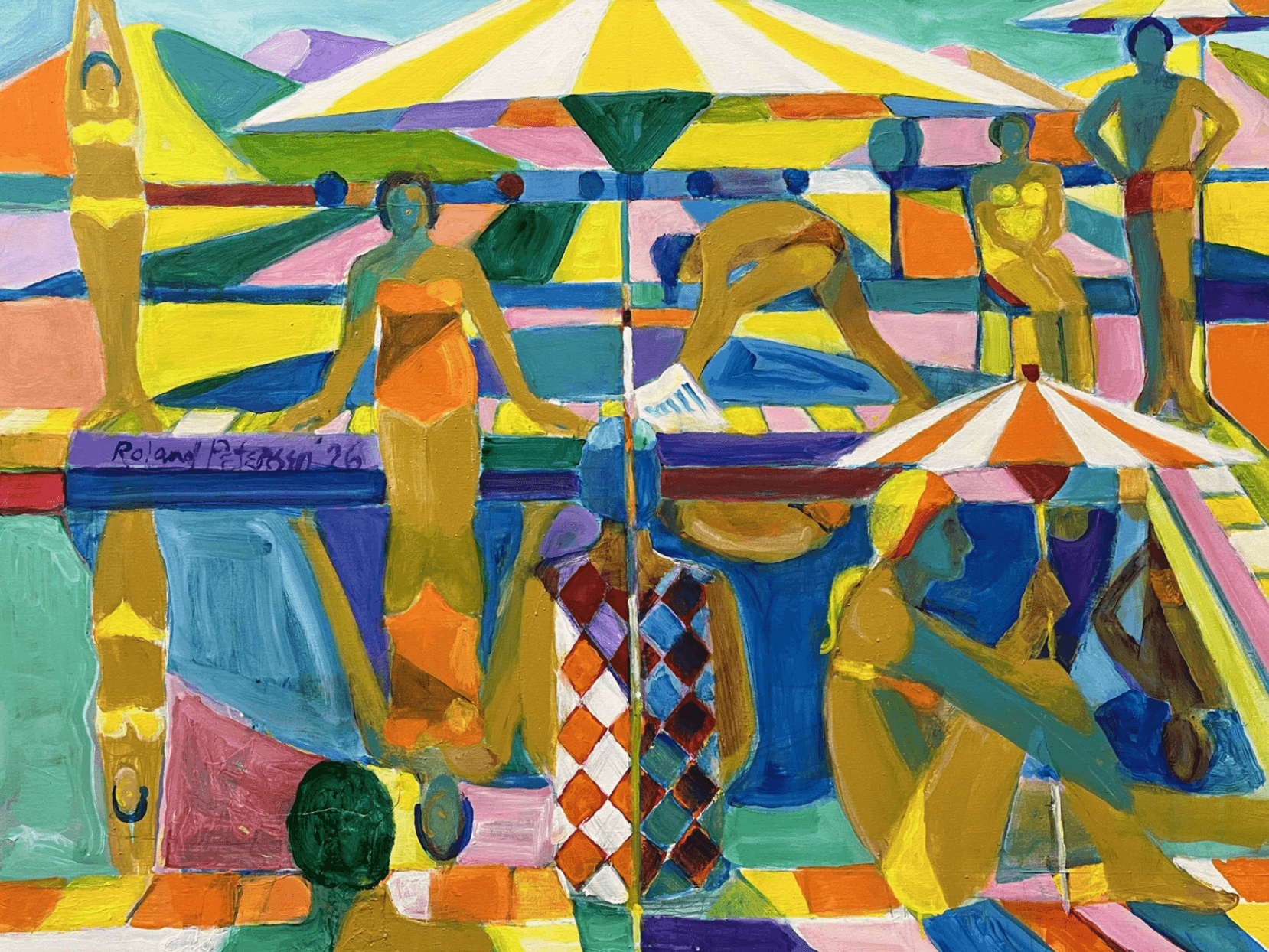
Roland Petersen, Sun Bathers, acrylic on canvas, 36 x 48 inches, 2026.
The exhibition's breadth also makes visible how Petersen’s relationship to painting has evolved over time. In Chair and Man (1958), made during a period when Bay Area Figuration was reshaping the possibilities of postwar painting, the figure feels caught between observation and abstraction. The work carries the qualities of that era; the searching and testing of how human presence might fit into increasingly expressive spaces. Petersen’s newest painting, Sun Bathers (2026), manifests from a very different place. The work is less concerned with negotiation and more confident in itself. The atmosphere feels open and the arrangement at ease, as though decades of painting have already answered weighing questions while making room for new ones to emerge. If Chair and Man is a reflection of an artist working through the tensions of a particular moment in history, Sun Bathers suggests something quieter and perhaps harder won; a painter fluently at leisure within his own language.
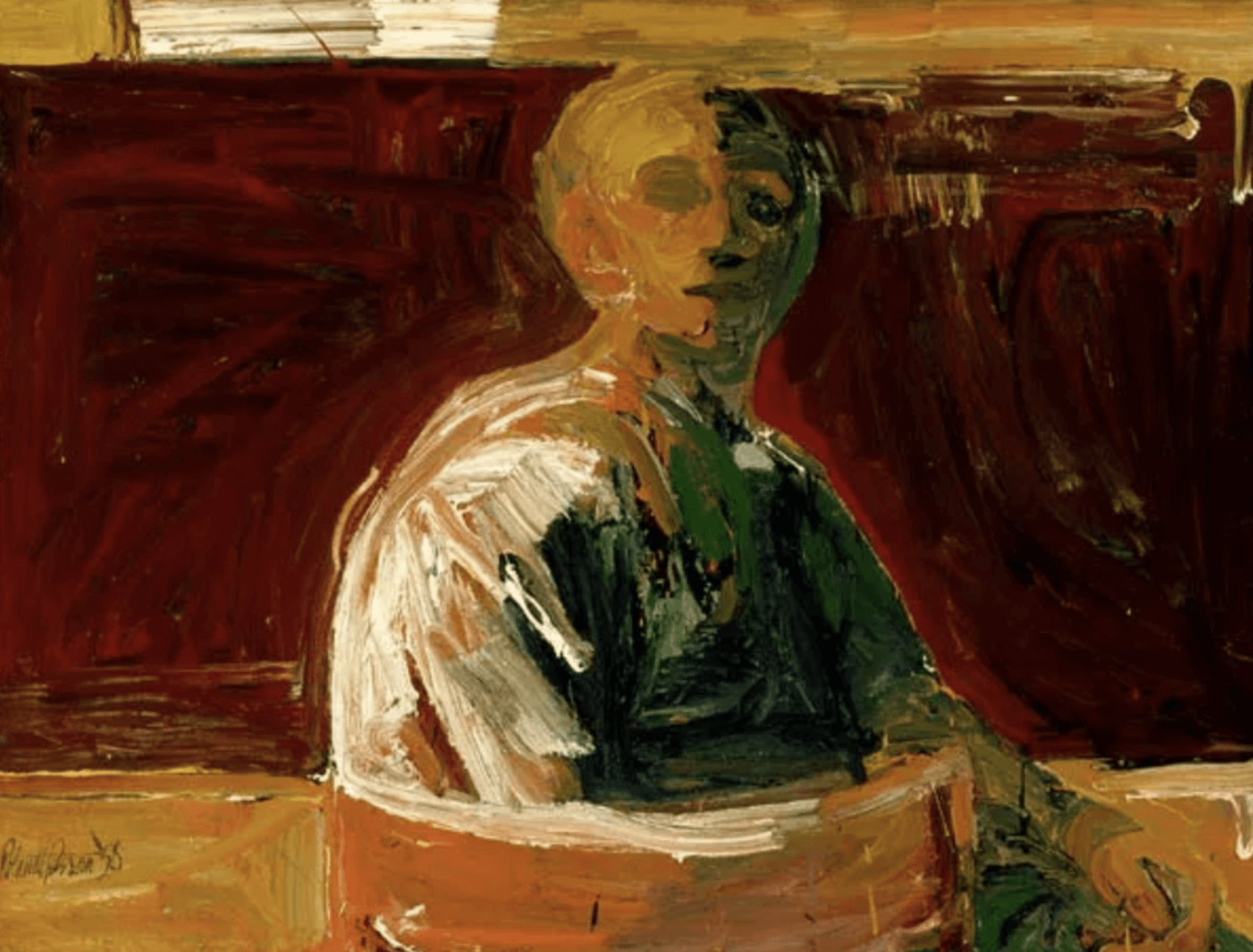
Roland Petersen, Chair and Man, oil on canvas, 29 x 38 inches, 1958.
Petersen’s picnic paintings perhaps best reveal the particular world he has spent decades building. In Farm Picnic (1968) and July Luncheon (1967), people gather across carefully arranged spaces where leisure, landscape and structure exist in quiet balance. Umbrellas, tables, horizon lines and patches of color guide the eye across the surface, building movement through the paintings without ever forcing it. Lines stretch and intersect, sometimes dividing space and sometimes gently holding it together, allowing the image to feel both composed and alive. The choice of subject is likely about how it renders the opportunity to make each of his paintings a combination of still life, landscape, and portrait. All three elements are present in each of these compositions which he then combines with abstract and color field areas with recognizable subjects. The scenes never become overly ordered or sentimental. There is pleasure here, certainly, but also a gentle distance, as though Petersen is less interested in documenting a social occasion than in observing the rhythms and relationships that unfold within it.
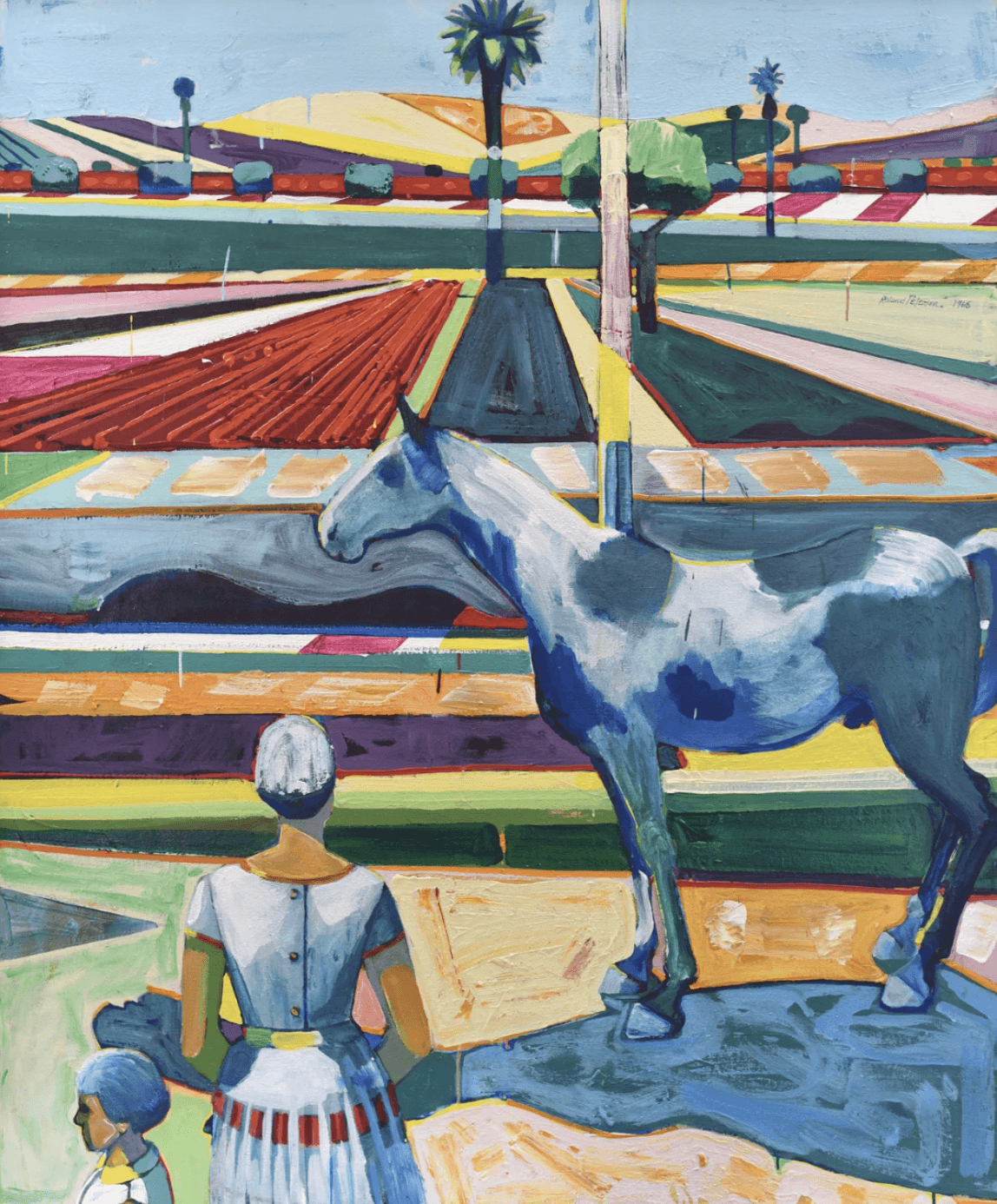
Roland Petersen, Farm Picnic, acrylic on canvas, 72 x 60 inches, 1968.
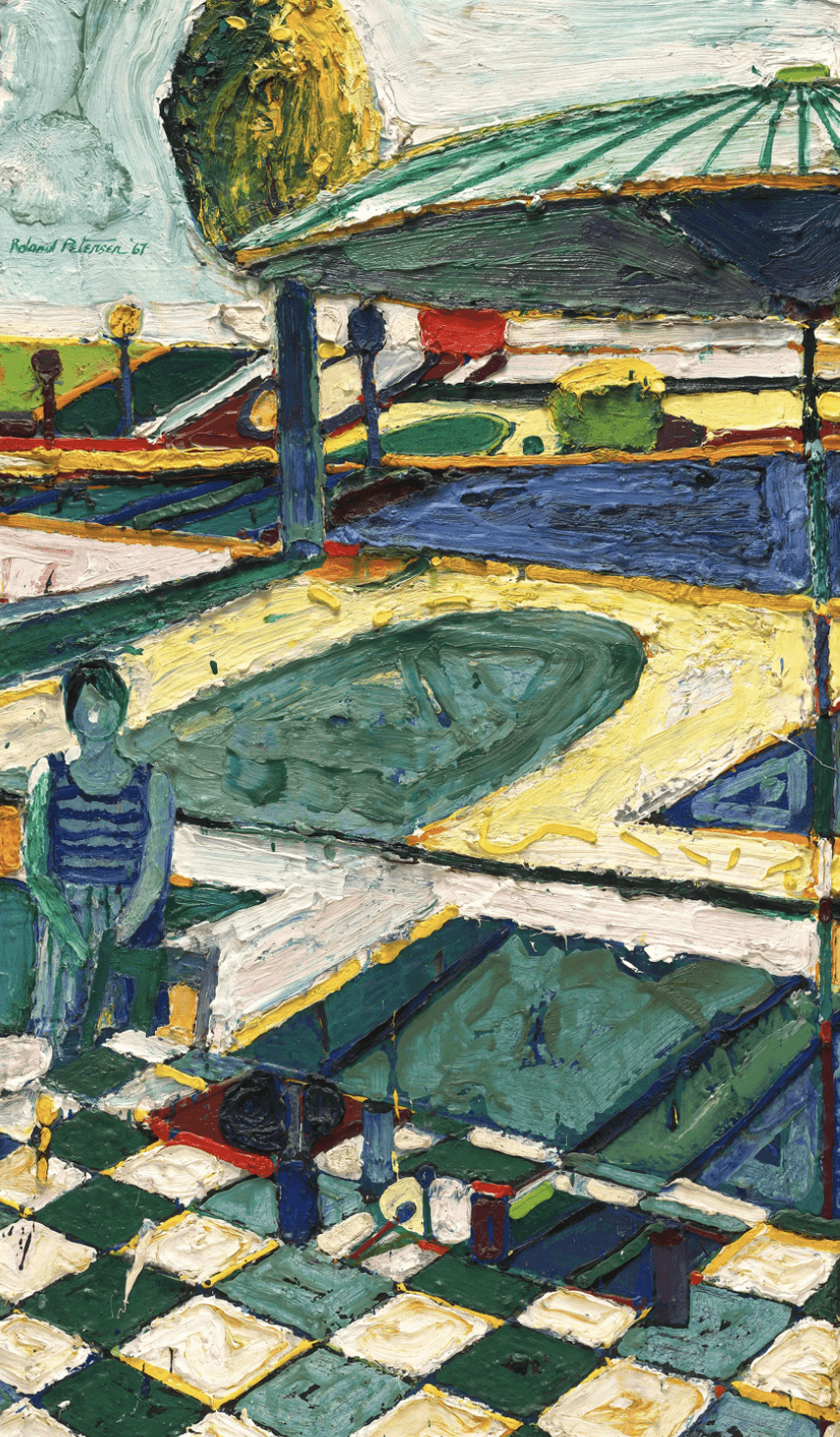
Roland Petersen, July Luncheon, oil on canvas, 48 1/4 x 28 1/4 inches, 1967.
That sensibility carries forward into Picnic in Paradise, where the atmosphere shifts but the underlying curiosity remains. The later work feels lighter and more spacious, perhaps more dreamlike, yet it still holds onto Petersen’s fascination with gathering, arrangement and the subtle ways people occupy a shared space. Across these paintings, one begins to understand that Petersen’s picnics are never simply about recreation. They are carefully built worlds where line, color and companionship unfold together at their own pace. The composition itself challenges meaning for a viewer. Figures are interspersed in the composition, except for a cluster of three persons seated at a table in the lower left of the painting, mostly standing alone and usually wearing a wide brim hat. They don’t exactly appear lonely, and yet they are solitary within a multi-person placement throughout the picture plane. In many respects it captures the very individual lives we lead even when among other people we commune with. Sunlight and a candy-cane assortment of colors make the painting pop with a brightness that keeps it from being melancholy.
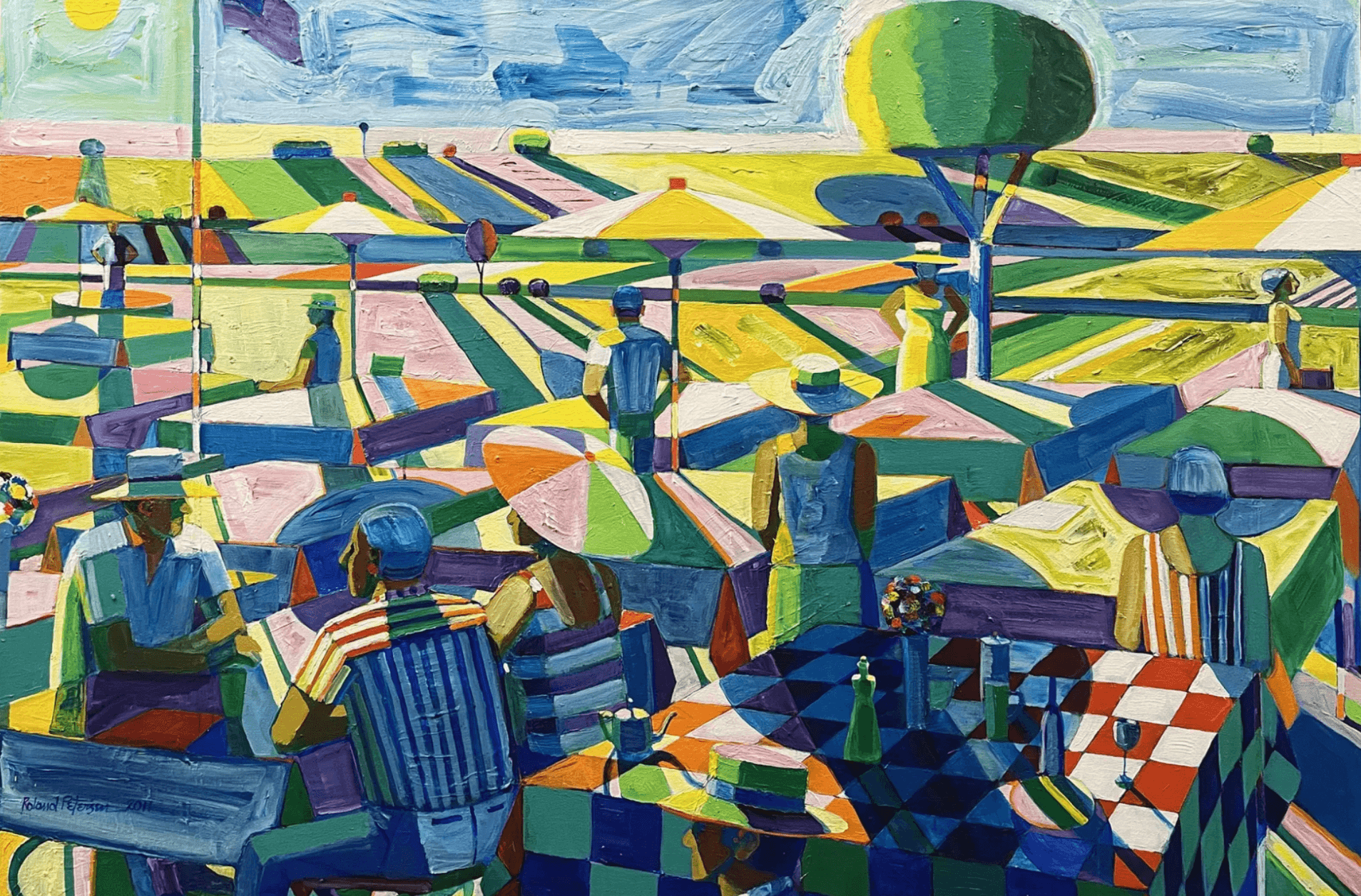
Roland Petersen, Picnic in Paradise, acrylic on canvas, 53 1/2 x 80 inches, 2011.
Petersen joins a rare company of artists who remained actively engaged with painting at or beyond one hundred years of age, among them Wayne Thiebaud, Lawrence Ferlinghetti, and Carmen Herrera. In Thiebaud’s case, the parallel feels especially close, not only in longevity but in their shared relationship to California and the Bay Area’s artistic landscape. Yet these comparisons ultimately feel secondary when moving through Petersen’s exhibition. In a rapidly shifting art world, there is something quietly powerful about witnessing an artist’s continued service to their practice and commitment to self-expression, not as performance or preservation, but as necessity. Petersen once remarked, “When I paint, I’m in heaven.” The statement lingers throughout the exhibition. Whatever legacy these works continue to build seems almost incidental to the act itself. The paintings do not feel made for posterity or even for our approval, but from a more private and enduring impulse: gratitude for the ability to create at all, and the simple need to keep discovering what painting might still reveal.
* all photos courtesy of Studio Shop Gallery
