
Rebels with La Causa, Royal Chicano Air Force Art and Activism 1970 – 1990, The Crocker Art Museum, Sacramento
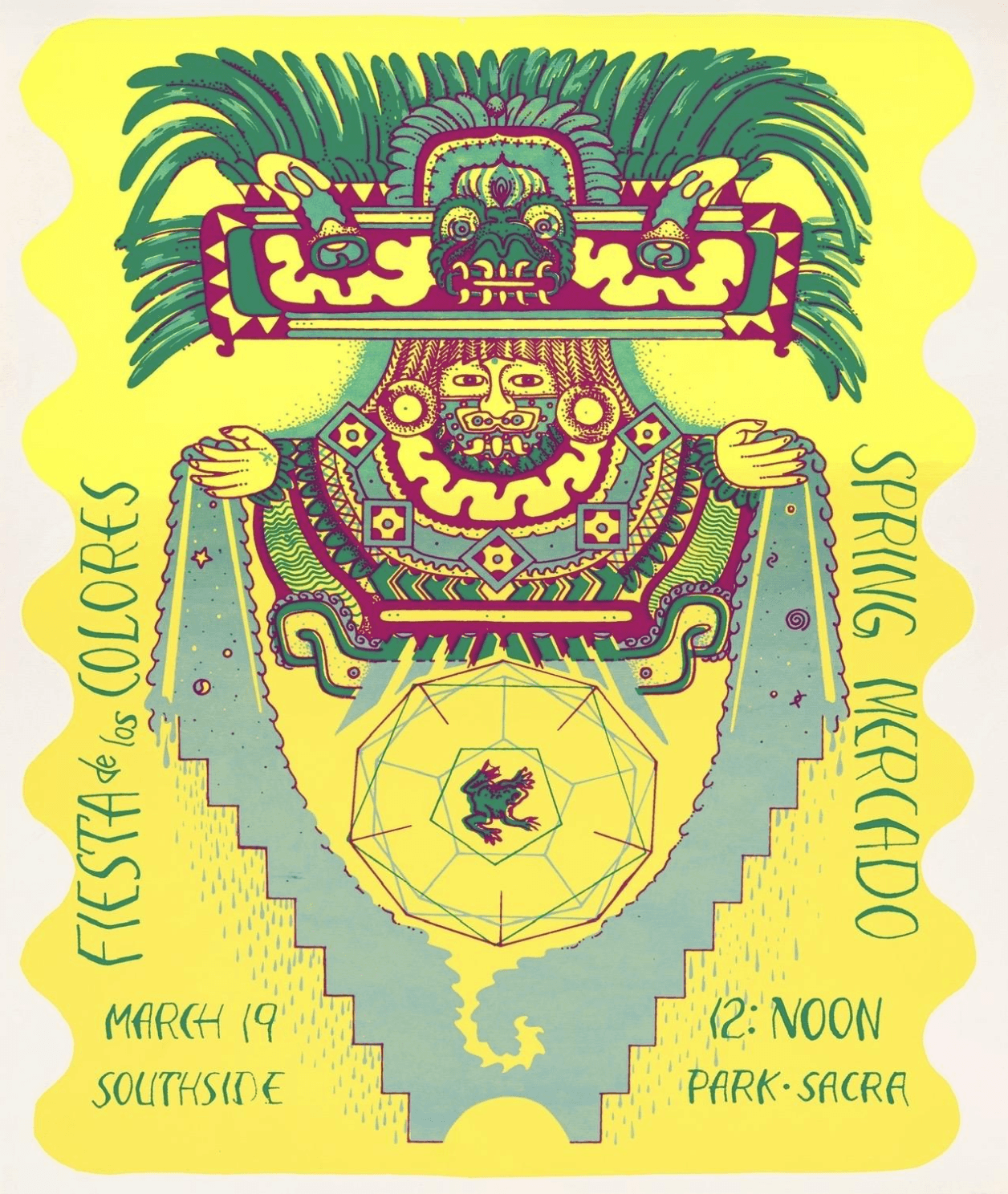
Stan Padilla, Fiesta de los Colores / Festival of Colors, Screenprint, 22.5 x 17.5 inches, 1978.
The Crocker Art Museum’s exhibition, Rebels with La Causa, presents 95 screenprinted posters made by over 20 different artists (alongside photographs, ephemera, and video materials) from a two decade period featuring work by the graphic design and mural collective, the Royal Chicano Air Force (RCAF). Founded to support, among other activities, the United Farm Workers boycotts seeking better pay and working conditions in the heavily agricultural Central Valley of California, the group is usually credited as being started in 1970 by Jose Montoya and Esteban Villa, two professors at California State University, Sacramento. It was a loose-knit organization rooted in a community that boasts many other Chicano/a artists as part of its origin story including: Ricardo Favela, Armando Cid, Juanishi Orosco, Rodolfo "Rudy" Cuellar, Louie “the Foot" Gonzalez, Juan Carrillo, Joe Serna, Jr., Stan Padilla, Irma Lerma Barbosa, Juan Cervantes, and Max Garcia. The Crocker Art Museum is the natural venue to present the first major museum exhibition of the screenprint collective spawned in its own backyard.
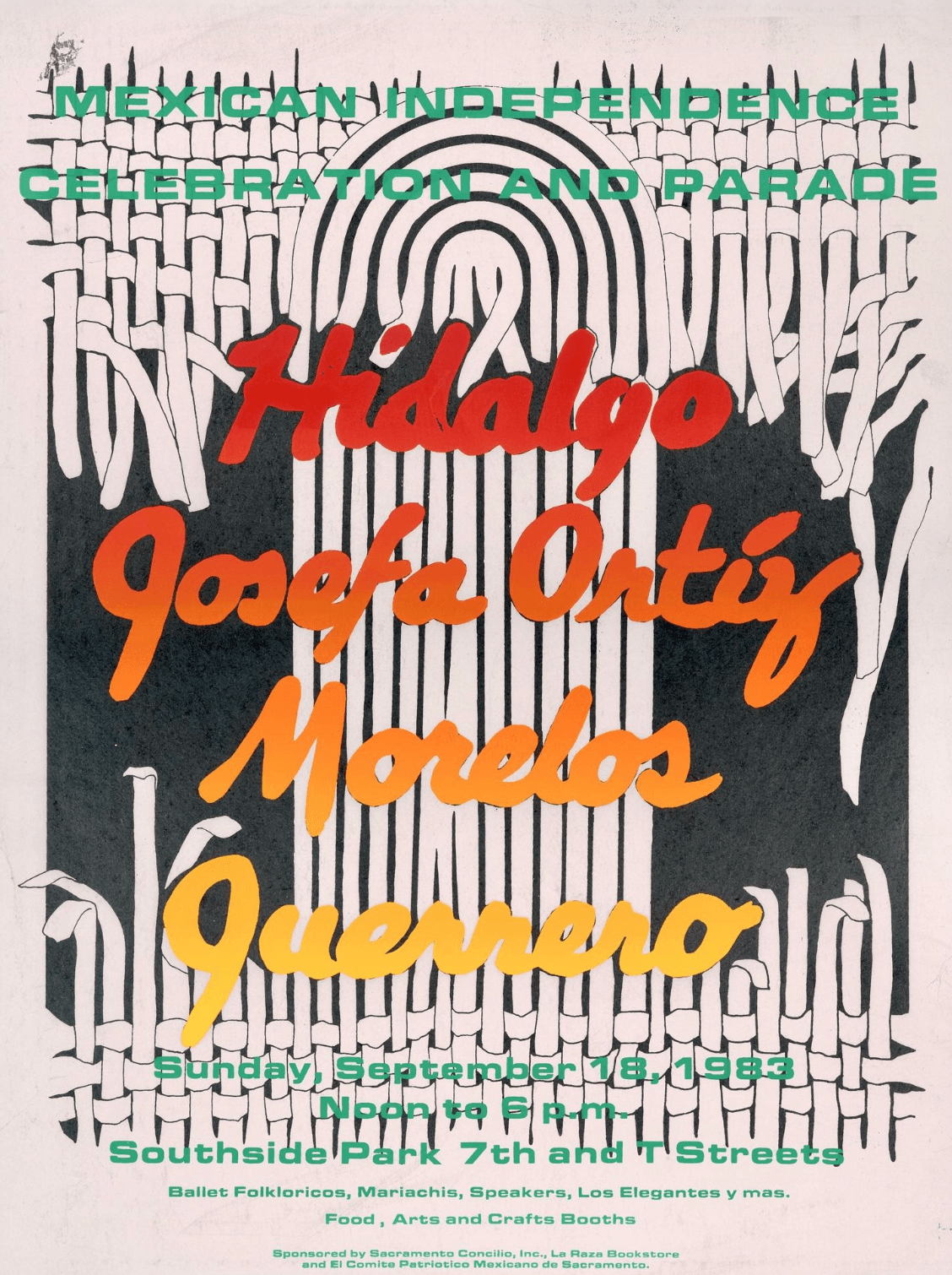
Lorraine Garcia–Nakata, Mexican Independence Celebration and Parade, Screenprint, 28 x 22 inches, 1983.
The Rebel Chicano Art Front, as it was originally known, was founded to foster the arts in the Chicano/Latino community, to educate young people in its history and culture, and promote political awareness. In 1972, the RCAF founded the Centro de Artistas Chicanos (Center for Chicano Artists) which operated as a non-profit hub to facilitate grants and support community-based art programs. Over the years, the RCAF is recognized as one of the most significant hegemonic cultural endeavors in support of a political cause. However, it is important we remember that the RCAF was influenced and inspired by antecedent organizations that both predated and worked alongside what became a varied effort in furtherance of the Chicano civil rights movement of the 1960s and following decades.
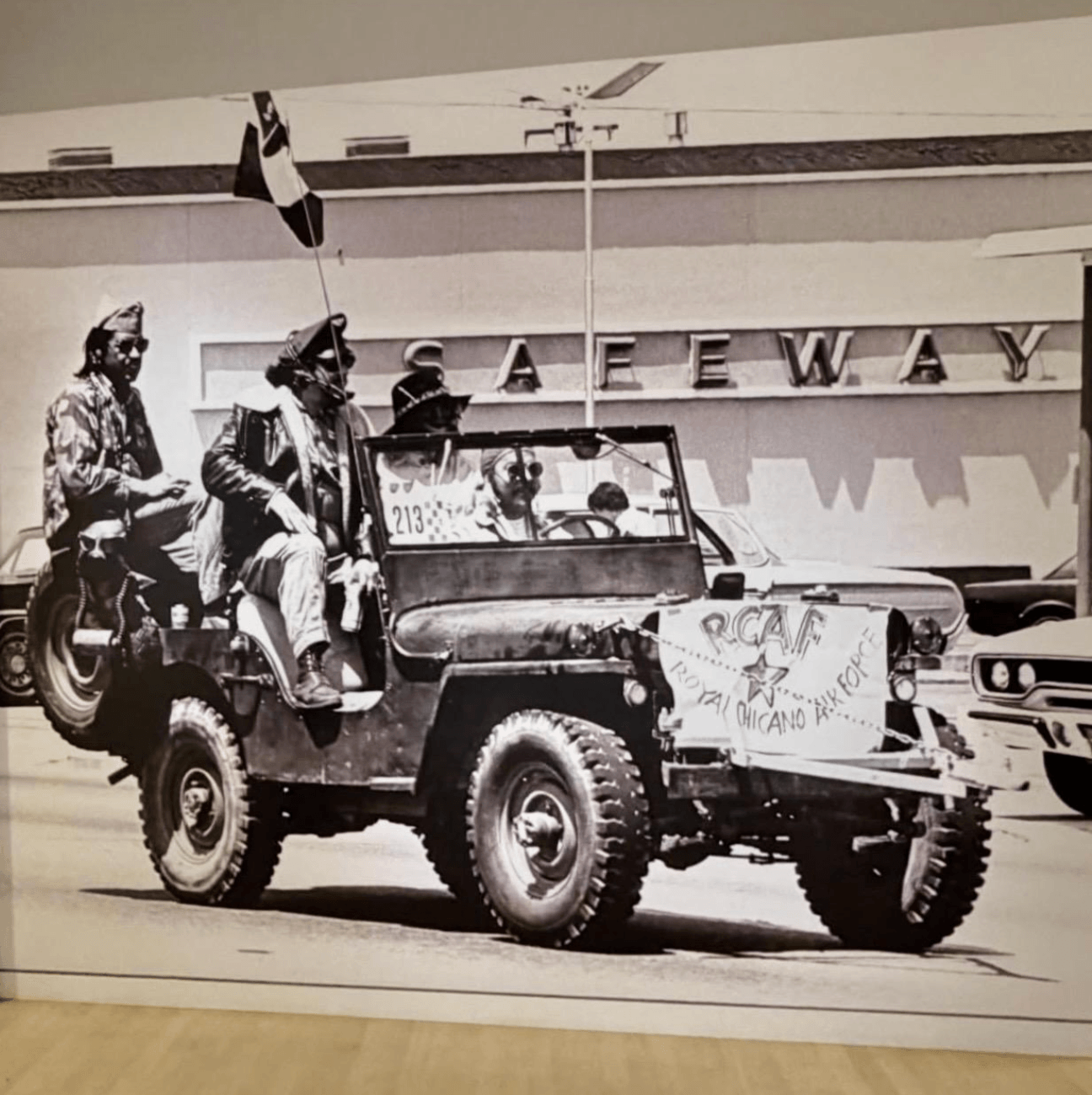
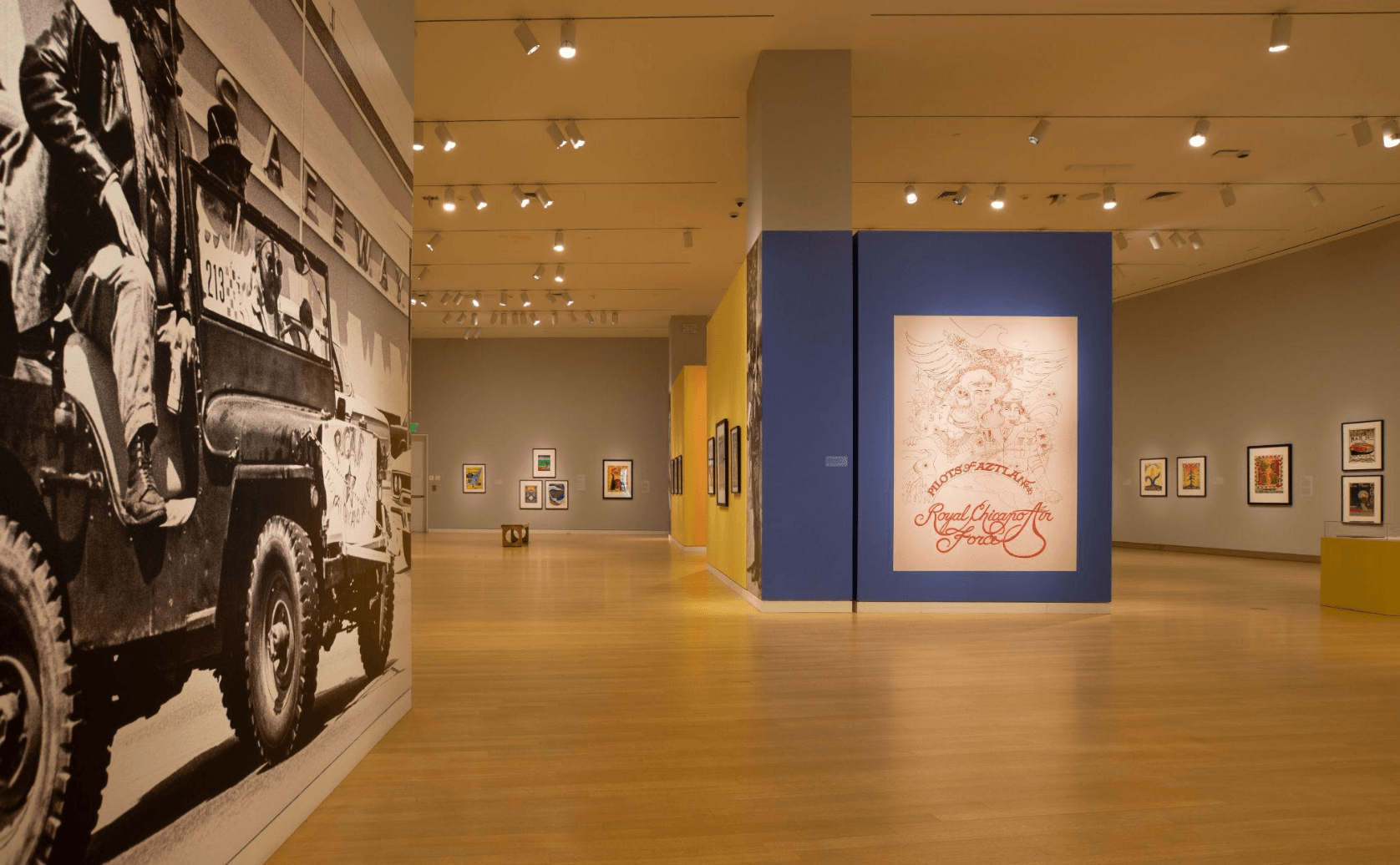
Crocker Art Museum installation photograph featuring an image of the arrival of RCAF members to a boycott action at a Safeway grocery store. Photograph by Harold Nihei.
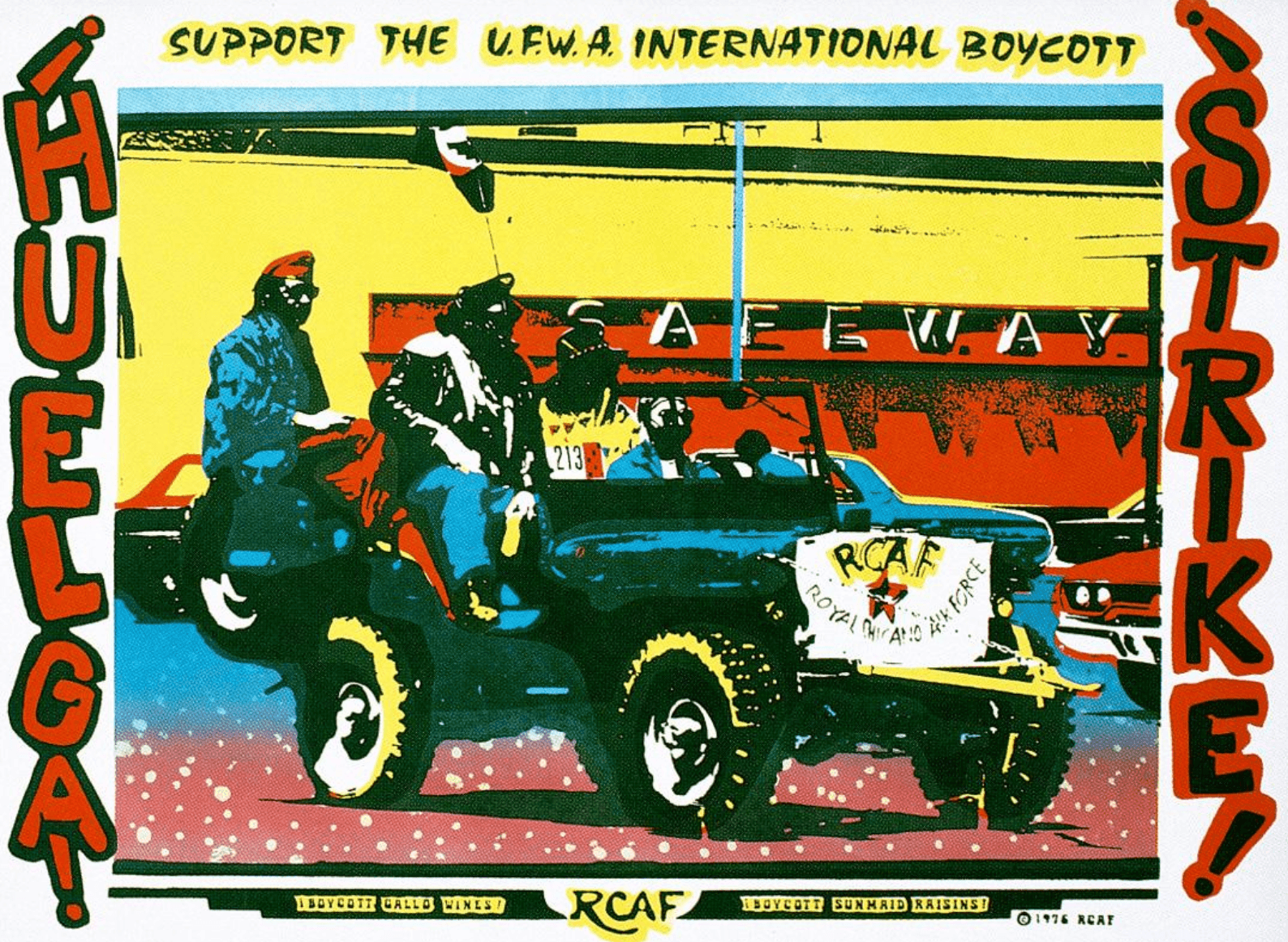
Ricardo Favela, ¡Huelga! ¡Strike!, Screenprint, 19 x 25 inches, 1976. Based on a photograph by Harold Nihei.
El Teatro Campesino (The Farm Workers Theater) was founded in 1965 during the Delano grape strike by Luis Valdes and Agustin Lira who brought their troupe into the fields and to picket lines on flatbed trucks. They used theater as an organizing tool performing short, often improvised plays, to empower and entertain workers. Performances often mocked bosses and used humor to tell stories of injustice.
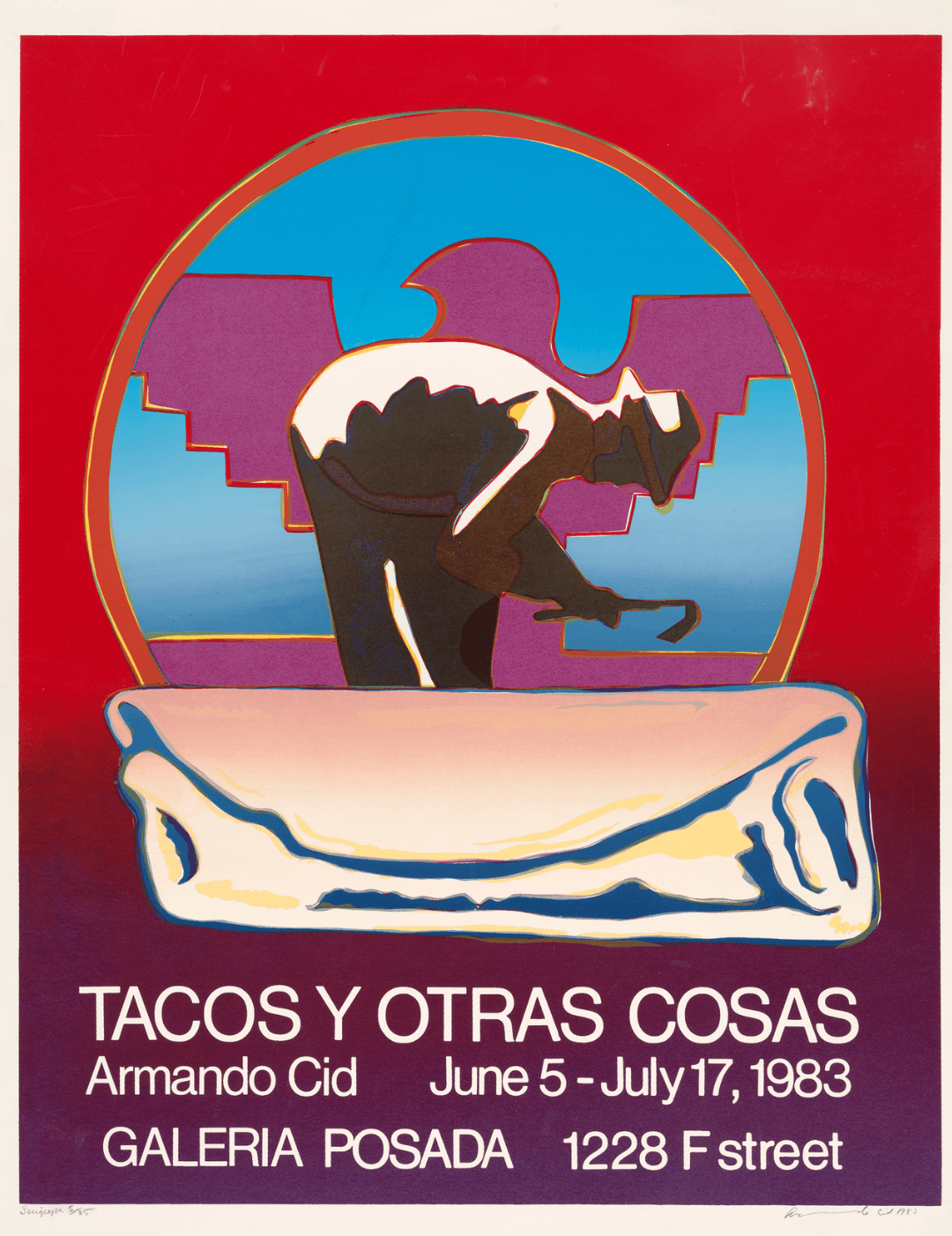
Armando Cid, Tacos Y Otras Cosas / Tacos and Other Things, Screenprint, 23 x 17.5 inches, 1983.
Another forerunner to the RCAF was The Mexican American Liberation Art Front (MALAF) which was one of the first Chicano art collectives, founded in the Fruitvale District of Oakland by Malaquias Montoya (RCAF co-founder Jose Montoya's brother), Manuel Hernandez, Esteban Villa (RCAF co-founder), and Rene Yañez. The stated goal of the collective was “organizing Chicano artists who are interested in integrating art into the Chicano social revolution sweeping the country." It brought together a group of artists engaged in political and cultural work based in the San Francisco Bay Area.
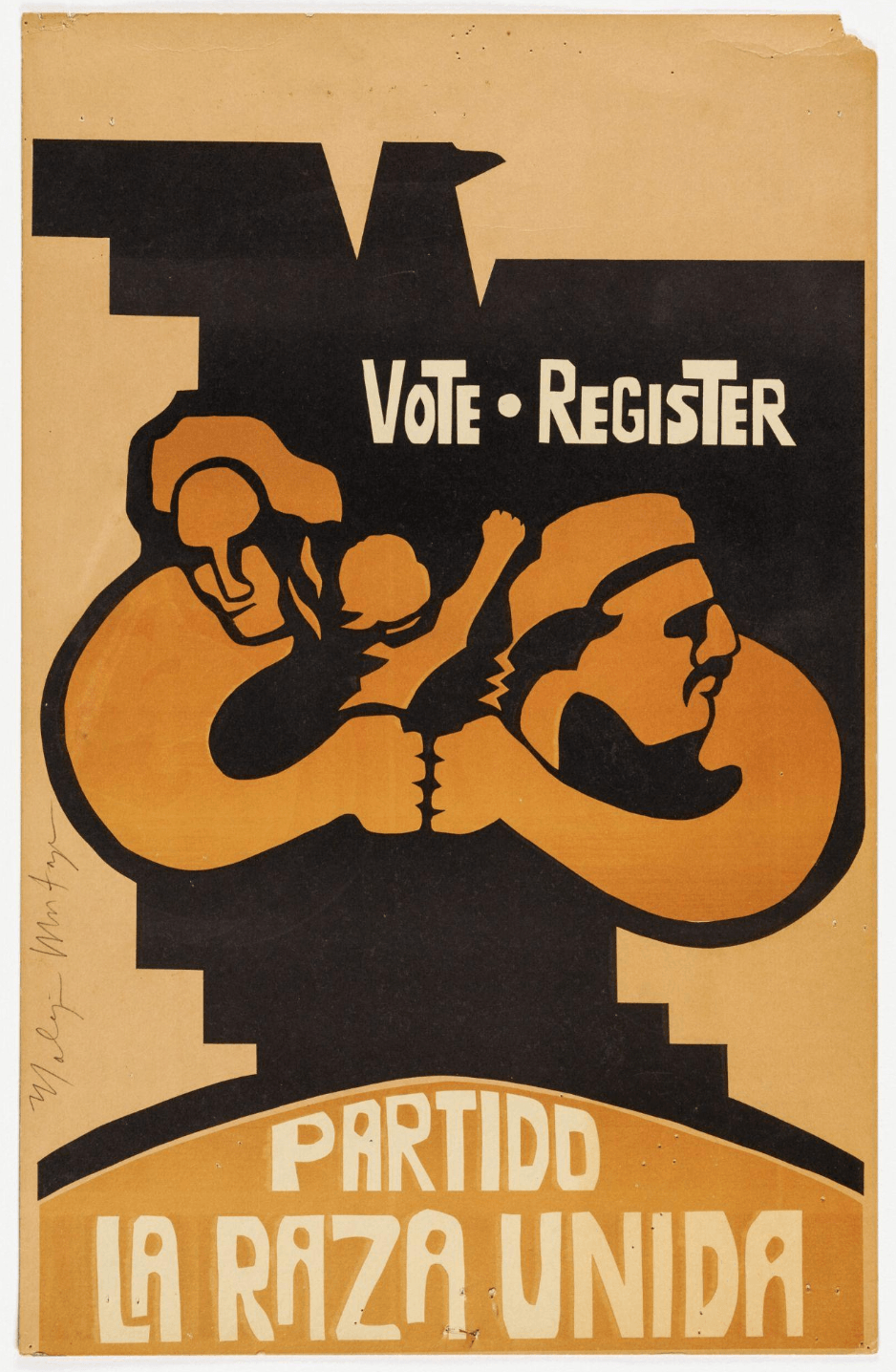
Mexican American Liberation Art Front (MALAF) poster by Malaquias Montoya, Vote Register, Screenprint, 54 x 34.3 cm, c. 1971. The poster promoted the Texas-based La Raza Unida, a Chicano-led political party. Collection of the Smithsonian American Art Museum, Washington, D.C.
These efforts were part of the burgeoning national Chicano Movement which signaled the changing dynamics of race relations in the United States. The RCAF’s posters played an important part in telling the story of the labor struggle by elevating the various events they publicized into something worthy of documentation, all the while making the promotional posters educational. Part information conveyance and part historical record, the RCAF captured the plight of poor laborers while offering a distinct kind of solace; the workers knew they were not alone in their struggle for better working conditions.
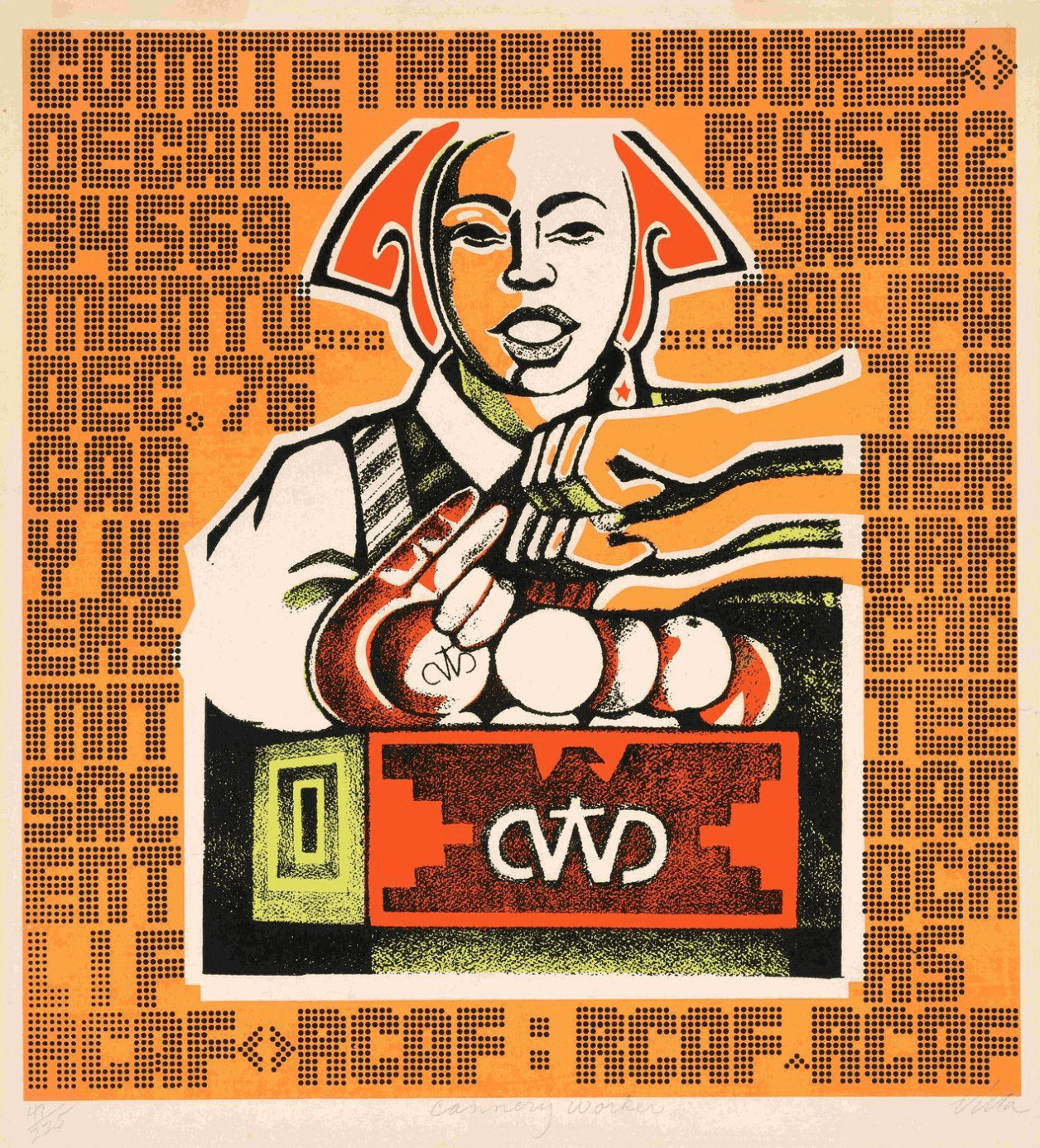
Esteban Villa, Comite Trabajadores de Canerias / Cannery Workers Committee, Screenprint, 16.5 x 15 inches, 1976.
Many of the members of the RCAF had themselves come from farm worker families. RCAF co-founder Jose Montoya had picked grapes as a boy with his family in Delano and Fowler, for instance. The group’s authenticity and social justice commitment was not separate from their art activities and thus were always seen as integrated in the movement, not adjacent to it. Montoya would later say his early artistic efforts included drawing on the paper used to dry grapes into raisins. Notably, it was common for RCAF artists to join picket lines with workers who were unaccustomed to having allies.
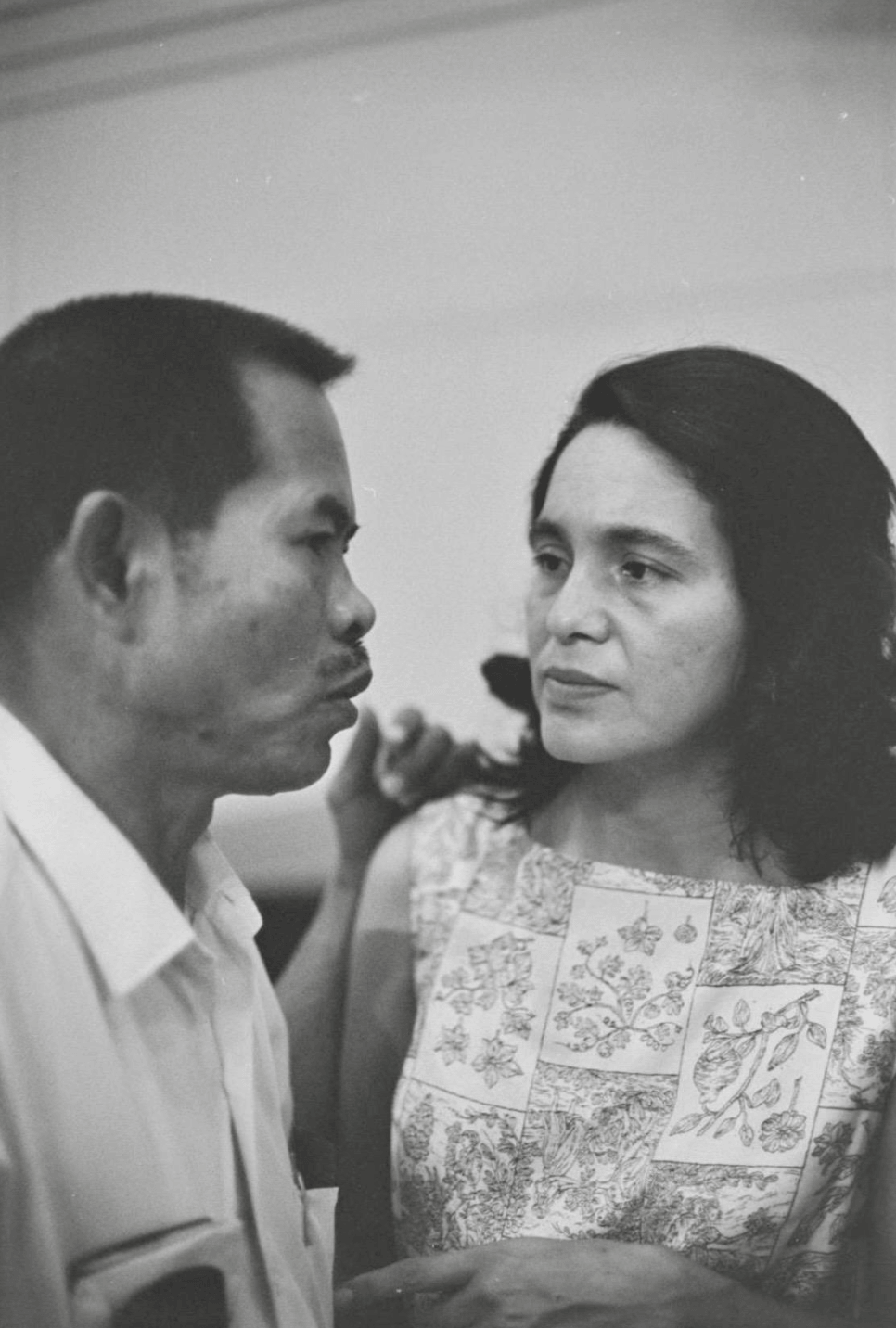
Co-founders of the UFW Larry Itliong and Dolores Huerta. Photo by Ted Streshinsky. After the Agricultural Workers Organizing Committee and National Farm Workers Association merged in 1966 to form the United Farm Workers, Itliong served as its assistant director and Huerta served as its vice president and lead negotiator.
Any discussion of the history of the United Farm Workers must acknowledge the significant contributions made by Filipino-American agricultural workers. In fact, the Delano boycott which launched in 1965 was preceded by a Filipino-led farm worker strike in Coachella Valley earlier that year. In Delano, over 1,000 Filipino workers led by Larry Itliong, walked off the job to protest working conditions, $1.20 per-hour wages, and the absence of any health insurance or pensions. Mexican-American farm workers voted nine days later to join their boycott; one which would last for years and be immortalized as a UFW launched-effort because of the merger of the Filipino and Mexican worker unions (AWOC and NFWA), which formed the United Farm Workers of America (UFW) the following year.
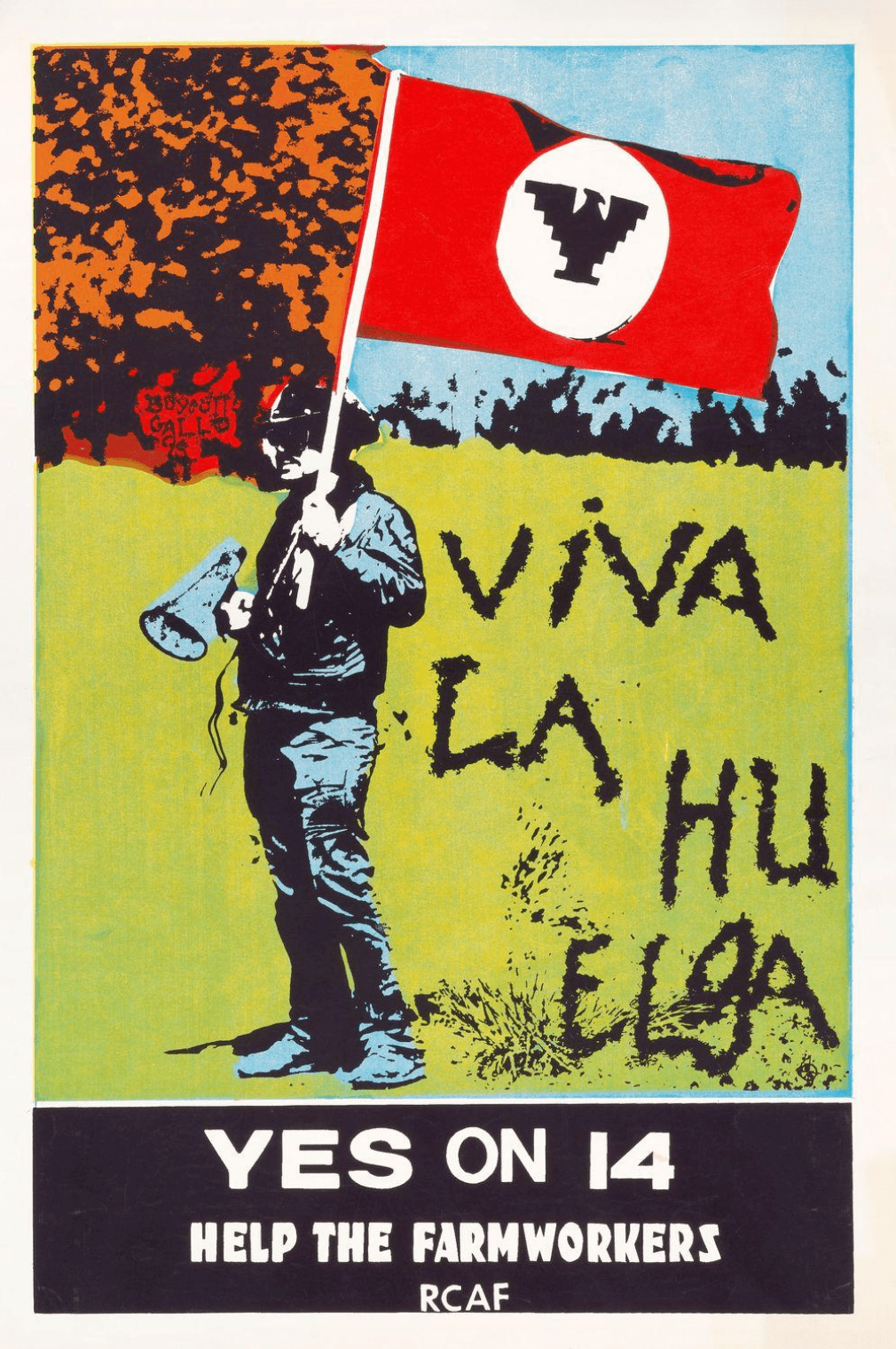
Louie “The Foot” Gonzalez, Viva la Huelga / Long Live the Strike!, 1976. Screenprint, 25.5 x 16.5 inches, 1976. Based on a photograph by Hector Gonzalez.
RCAF posters often directly addressed politics. One such poster, in support of the 1976 California ballot initiative campaign, “Yes on 14,” which aimed to protect funding for the Agricultural Labor Relations Act of 1975 would have, among other things, ensured secret-ballot union elections for farm workers and protected collective bargaining rights. Although the United Farm Workers collected over 700,000 signatures to place it on the ballot, the measure was defeated by a heavily funded effort by agricultural growers, reminding us today that the effort to obtain workers rights was full of setbacks.
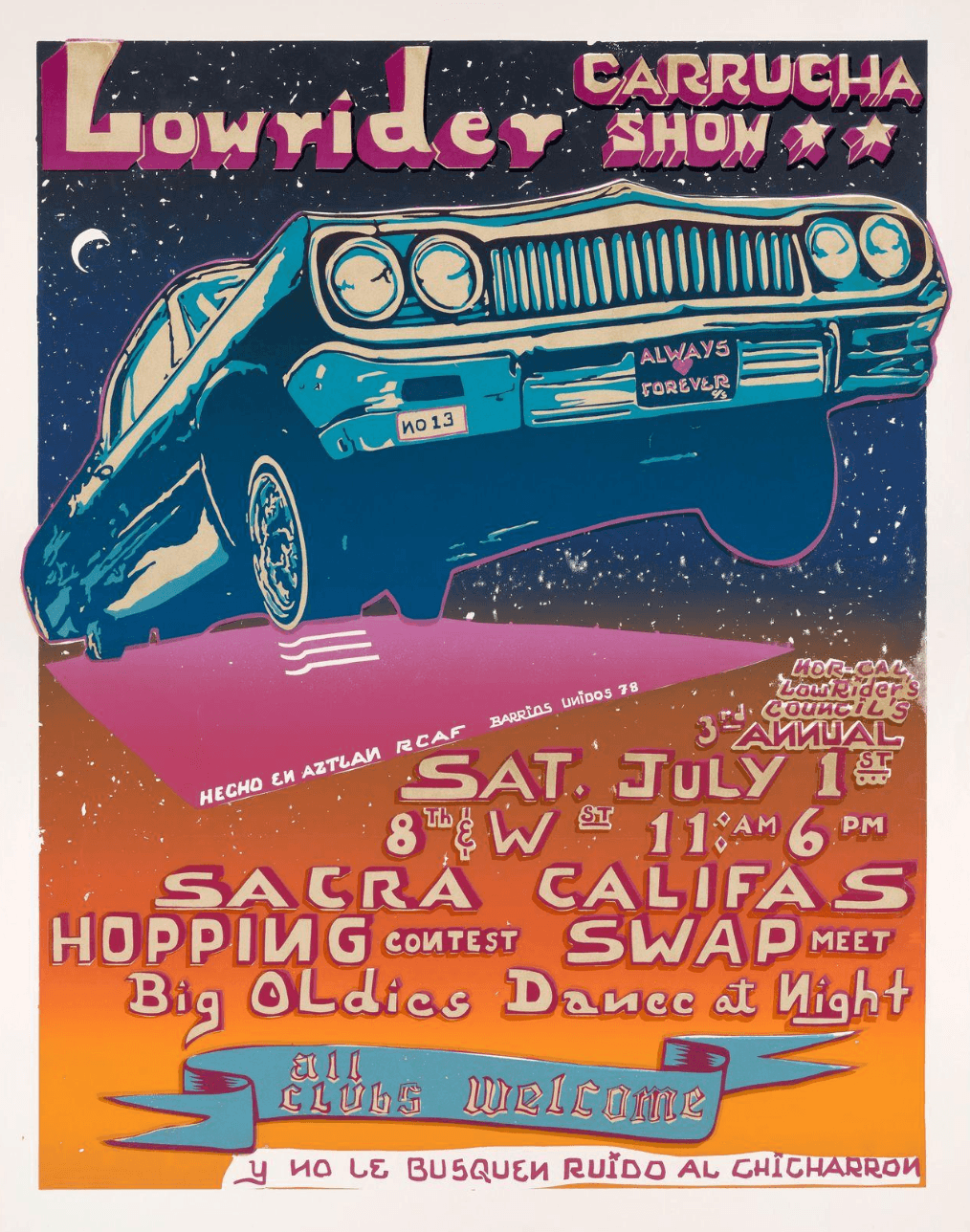
Rodolfo “Rudy” Cuellar, Lowrider Carrucha Show, Screenprint, 29 x 23 inches, 1978.
The story of how the RCAF got its name demonstrates how the group harnessed humor while engaging in serious political work. The RCAF members did not typically sign their artwork individually, preferring to use the group's acronym as a demonstration of their collective solidarity. Because their abbreviation was often confused with the internationally renown Royal Canadian Air Force (RCAF), which had fought alongside Allied Forces during WWII (notably flying over 3,000 sorties during the Normandy invasion of 1944), members of the Chicano RCAF were often asked if the two were connected (usually by someone who hadn’t paused to consider the absurdity of what they were asking). Someone in the artist group once replied that they were the Royal Chicano Air Force and that they flew adobe planes, made of earth.
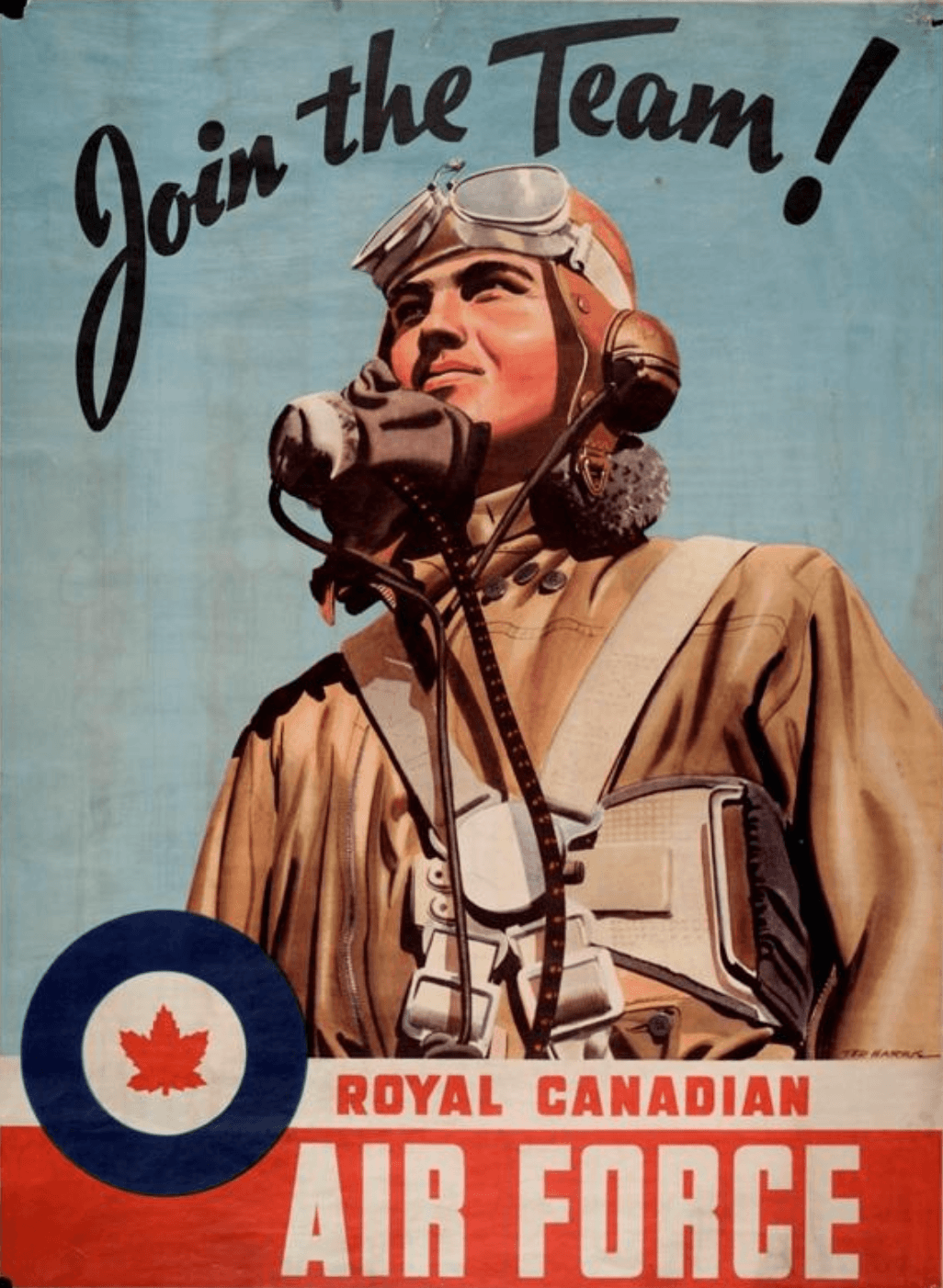
Royal Canadian Air Force recruiting poster c. 1939-45.
The Chicano activists fully embraced the playfulness of this proclamation. They thereafter adopted a mock-military persona wearing airforce attire such as peaked caps, aviator goggles, bomber hats, surplus flight suits, and leather jackets. They often were deployed to various strike actions riding in an army jeep. Just like that, the Rebel Chicano Art Front became the Royal Chicano Air Force.
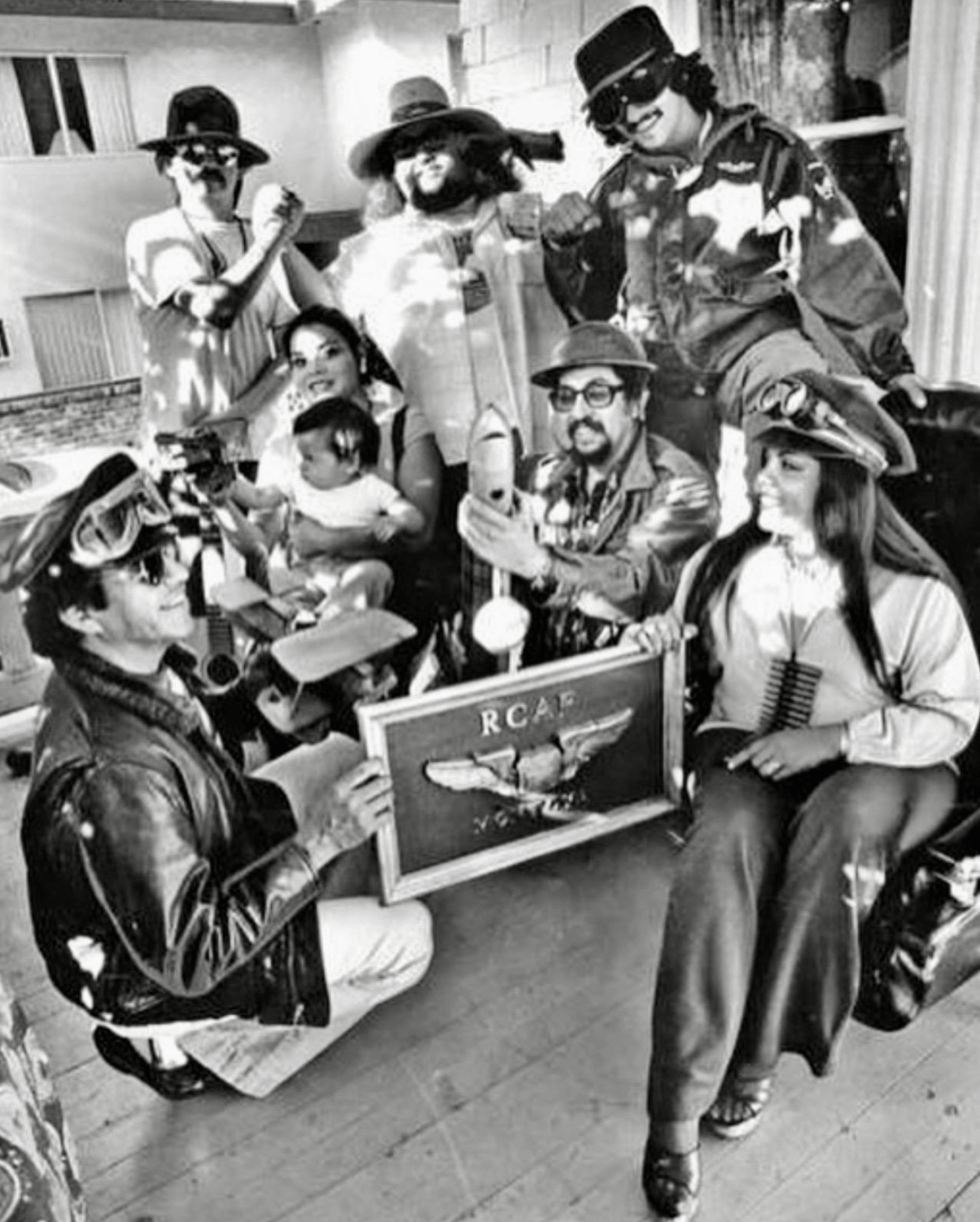
“Generals” from left: Esteban Villa, Elias Alias, Lola Polendo (holding child), Ricardo Favela, Jose Montoya, Malaquias Montoya, and Juanita Ontiveros. Los Angeles Times photograph by Fitzgerald Whitney, published July 22, 1979.
RCAF co-founder Jose Montoya said, “Our sense of humor, which we call our locura, our insanity, was precisely what allowed us to accomplish the things that we accomplished. Uniforms, and flying helmets, bandoleers, leather jackets, jeeps. The regalia that was provided for us became a natural thing for us to use in our locura." For Chicanos, locura cannot be translated simply as craziness or madness. It is a concept that envelopes a Dada outrageousness which includes absurdity, flamboyance, defiance, and resilience, all mixed together. Often stated by members of the group as la locura lo cura meaning "the madness will heal it" or "craziness is its own cure," the phrase is a play on the Spanish word "cura" which means to heal. The concept became a motto of the group.
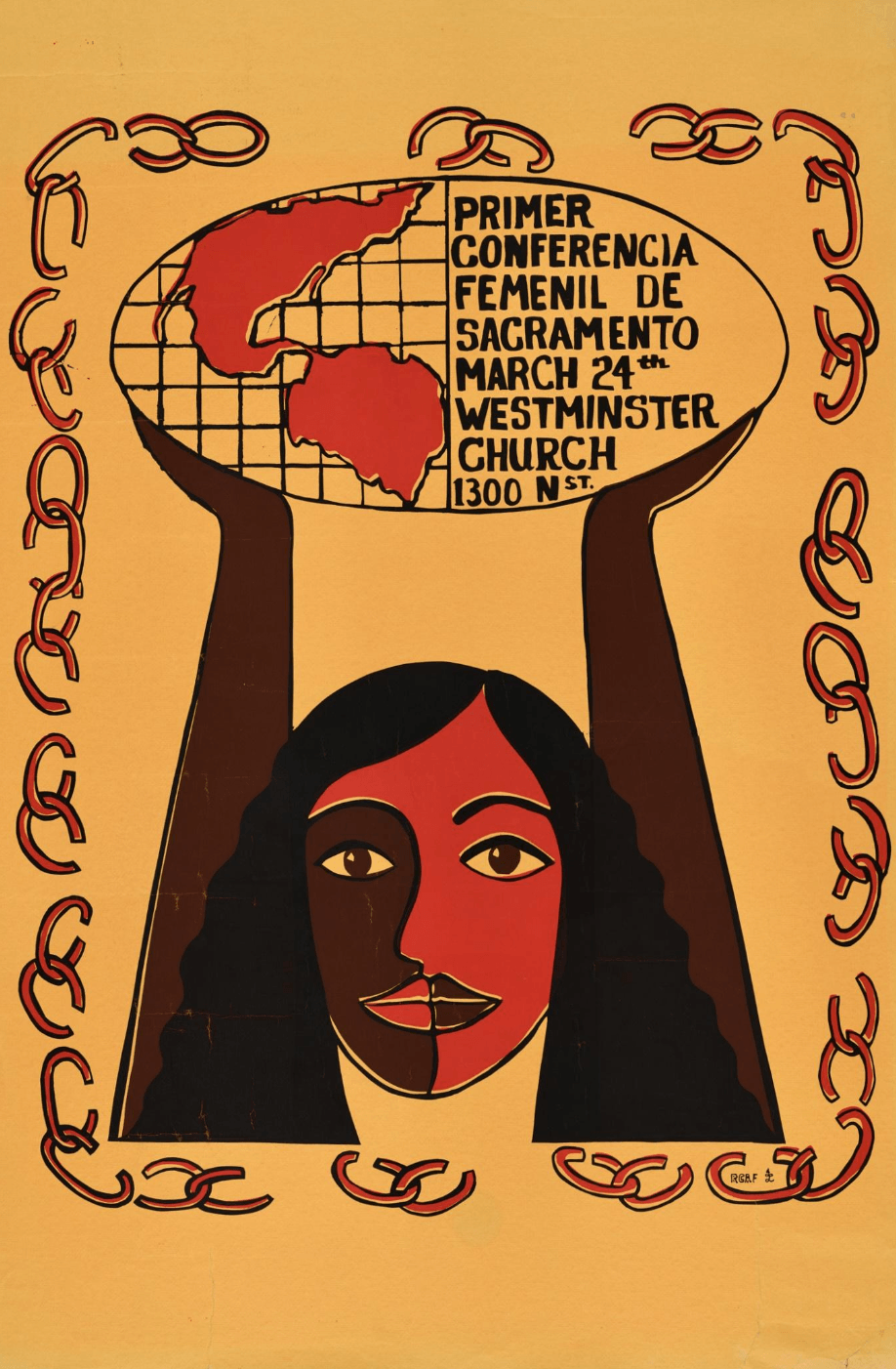
Irma Lerma Barbosa, Primer Conferencia Femenil de Sacramento / First Sacramento Women’s Conference, Screenprint, 35 x 23 inches, 1973.
The re-branded Chicano RCAF also captured the military essence of political work, which at its core is a battle for the hearts and minds of the people. Importantly, many of the Chicano RCAF members had served in the U. S. military including Jose Montoya who served in the U.S. Navy and Esteban Villa who served in the U.S. Army, both during the Korean conflict. Armando Cid, Hector Gonzalez, and Juanishi Orosco served in the U.S. Army during the Vietnam War. This sacrifice further highlighted the un-American nature of the conditions the RCAF was fighting to improve at home. While they made sacrifices for our country abroad their families faced unfair wages and inhumane working conditions in the agricultural fields of California.
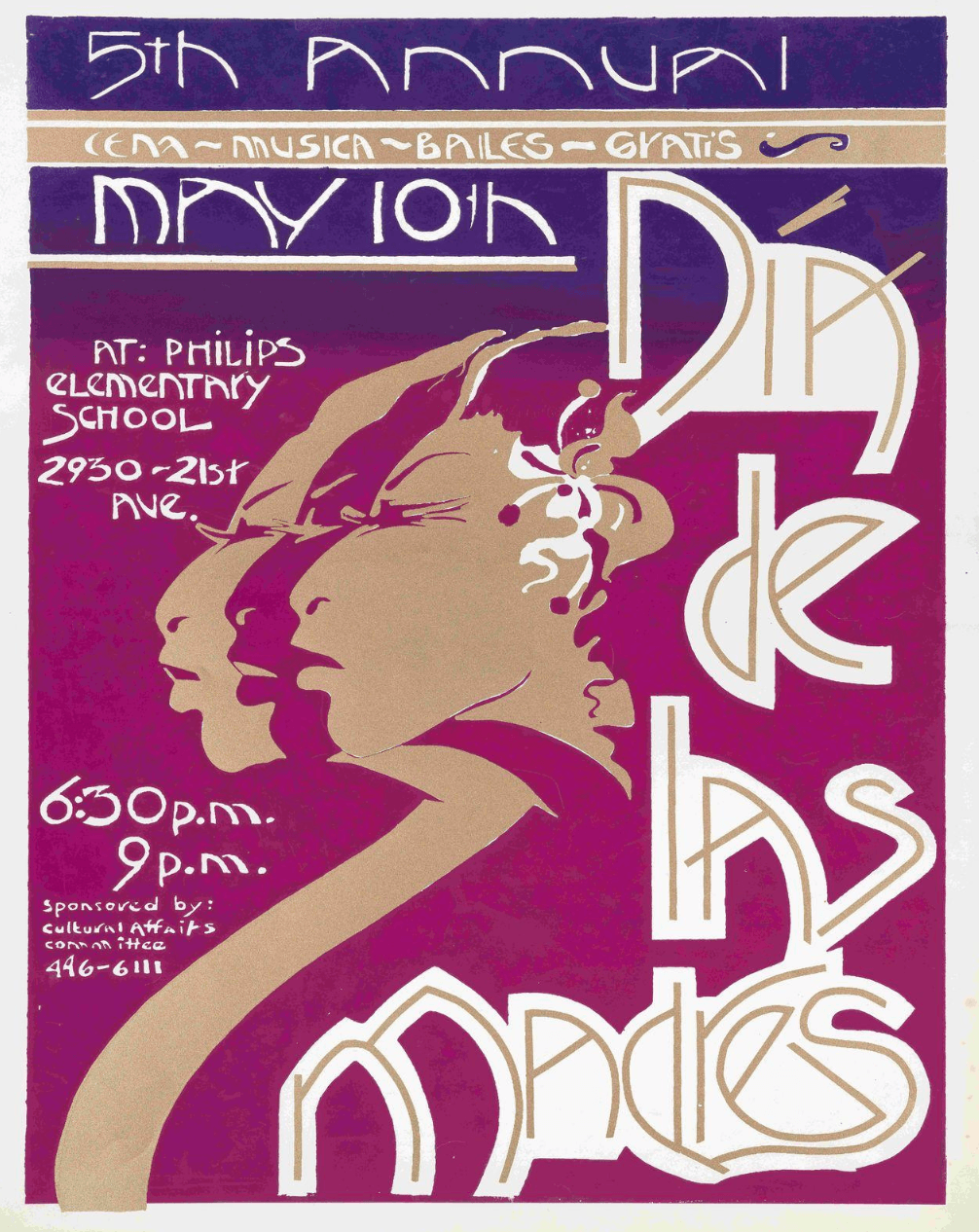
Eva Garcia, 5th Annual Dia de las Madres / Mother’s Day, Screenprint, 23 x 18 inches, 1979.
Political art often gets relegated to uninspiring social realism. It’s not that it doesn’t require skill to execute, but because it is in service to politics, it often results in the art being mechanistic somehow. It gets reduced to propaganda with a direct message to impart. But agitprop can serve both sides, and if authentic, can unshackle the bland expectations often associated with it. When art is made by un-alienated and fully-committed artists who are embedded in a movement, whose values they are seeking to disseminate, what they make resonates differently within the community. They breathe air into and enliven their common struggle with love and excitement creating something that encapsulates genuine inspiration. The RCAF posters exude a sense of warmth and vibrancy of life that set them apart from the conventional political posters of other eras. In his 1937 essay “The Affirmative Character of Culture” Herbert Marcuse argued that art embodies the potential for liberation and the formation of radical subjectivity. Values can be constructed that pose a challenge to the social order and can be circulated aesthetically. He thus assigned an emancipatory function to art. This is exemplified in what the RCAF did as they facilitated and helped create a space for thinking about what change could look like. They embraced community so that, despite occasional political defeats the workers felt they collectively belonged to something bigger than just themselves. They each could imagine the victory that awaited them.
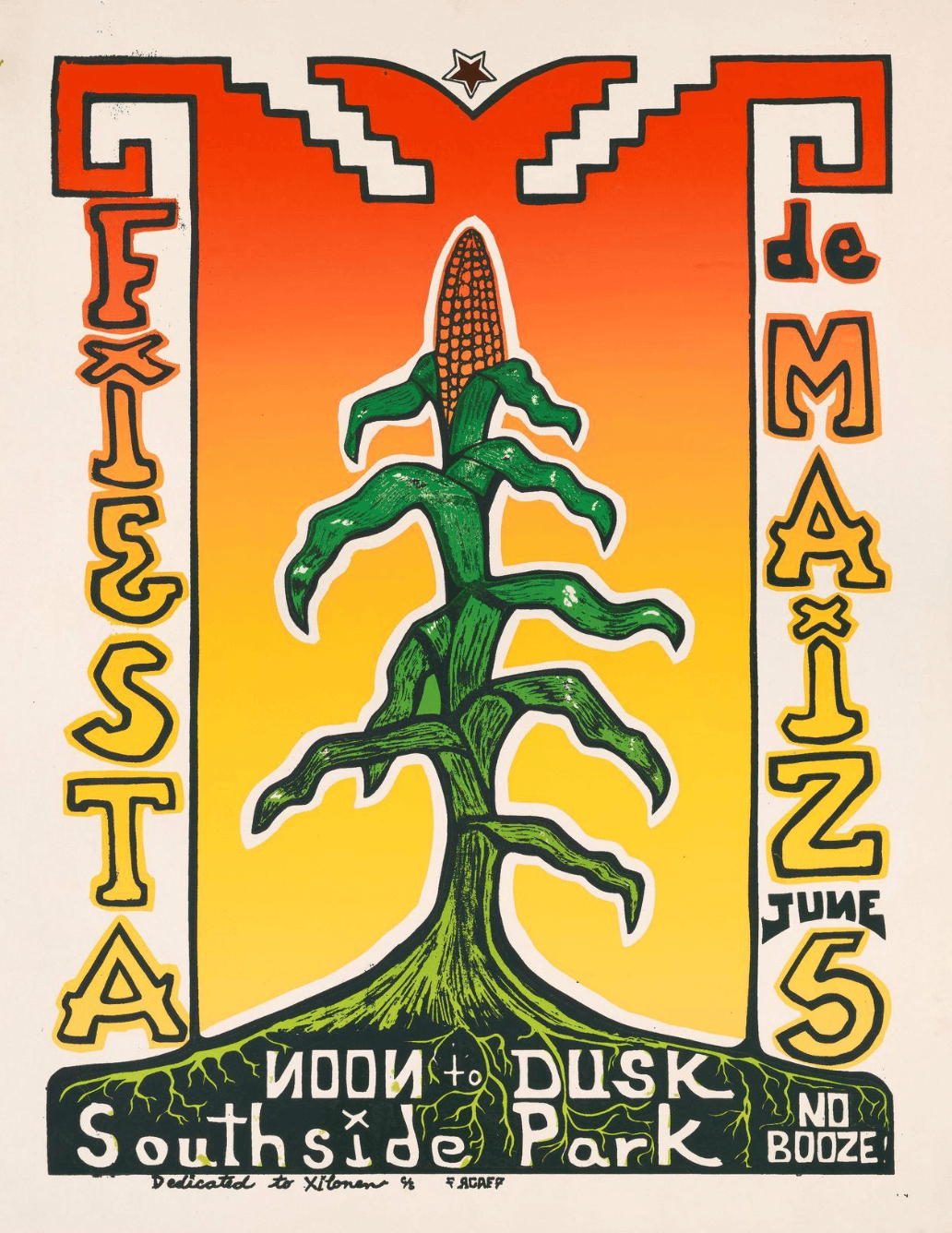
Rodolfo “Rudy” Cuellar, Fiesta de Maiz / Corn Festival, Screenprint, 22.5 x 17.5 inches, 1977.
Not surprisingly, there is no official record of the Royal Canadian Air Force ever acknowledging the Royal Chicano Air Force adoption of their acronym and air force persona. Had they taken notice, it’s likely the Canadian RCAF (known for their camaraderie and jovial nature even in the face of wartime adversity), would have accepted the obvious satirical humor for what it was. Moreover, it would have been easy to dismiss any chance the duplicative acronyms caused confusion since each group was active outside the realm of the other.
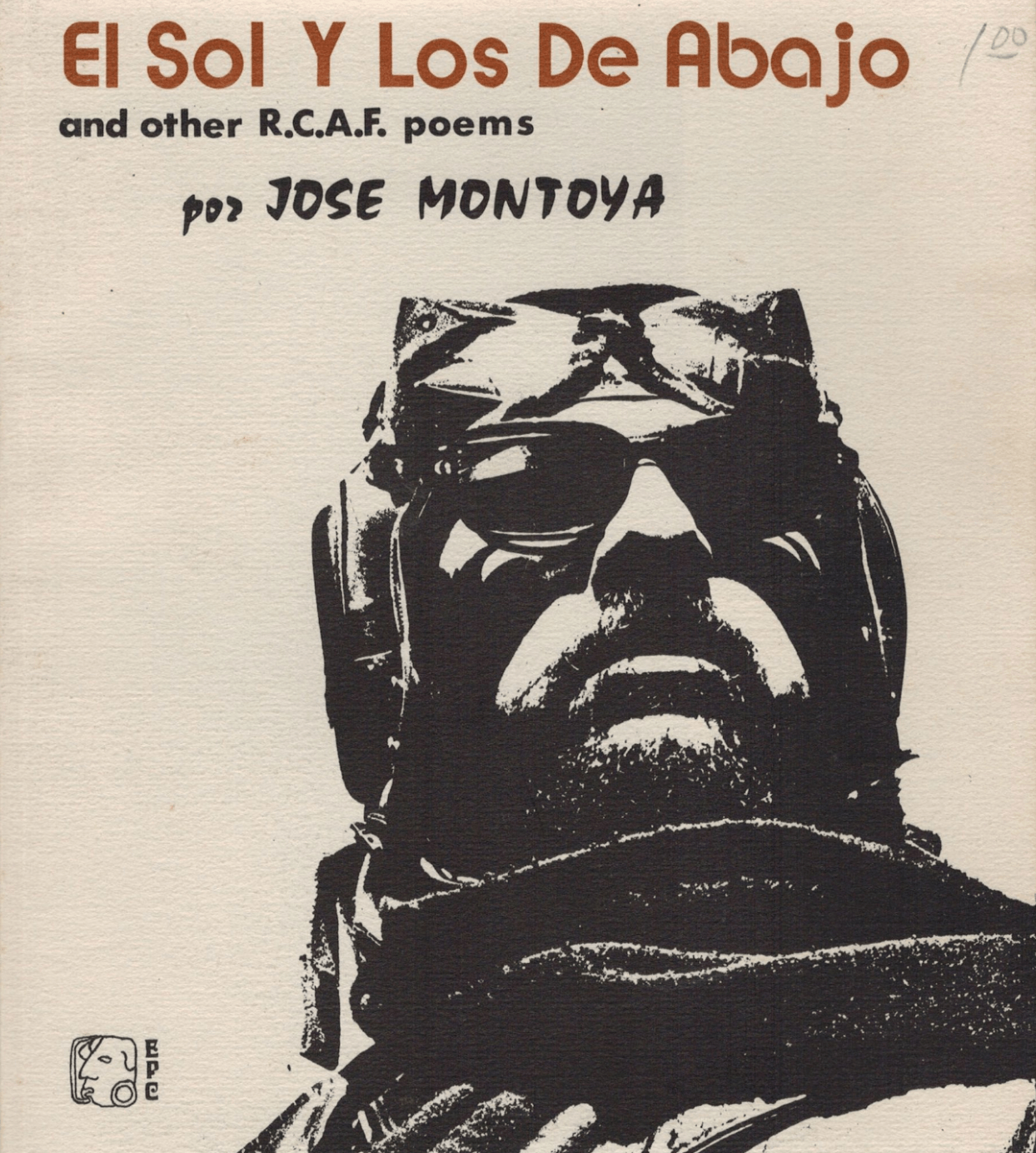
El Sol Y Los De Abajo and other R.C.A.F. poems [The Sun and The Underdogs and other R.C.A.F poems] by Jose Montoya (San Francisco: Ediciones Poco-Che, 1972). This is a reversible publication, known as a flip book or “tête-bêche, which includes Oracion A La Mano Poderosa [Prayer to The Powerful Hand] by Alejandro Murguía. A first book for both authors, Montoya would be named poet laureate of Sacramento in 2002 (30 years after the publication of this book) and Murgia would be named poet laureate of San Francisco in 2012 (40 years after the publication of this book).
What historians of the Chicano RCAF have not previously noted is that at the time of the Chicano collective’s founding in 1970, the Canadian military had actually officially dropped the name "Royal Canadian Air Force" in favor of "Canadian Forces Air Command" (AIRCOM). This was done as part of a 1968 unification whereby the Canadian government combined its three separate military services (the Royal Canadian Navy, the Canadian Army, and the Royal Canadian Air Force) into a single organization called the Canadian Armed Forces. So in actuality, by the time the Canadian air force restored their old name (for largely nostalgic reasons in 2011), the Chicano RCAF had used the acronym for several decades, exclusively.
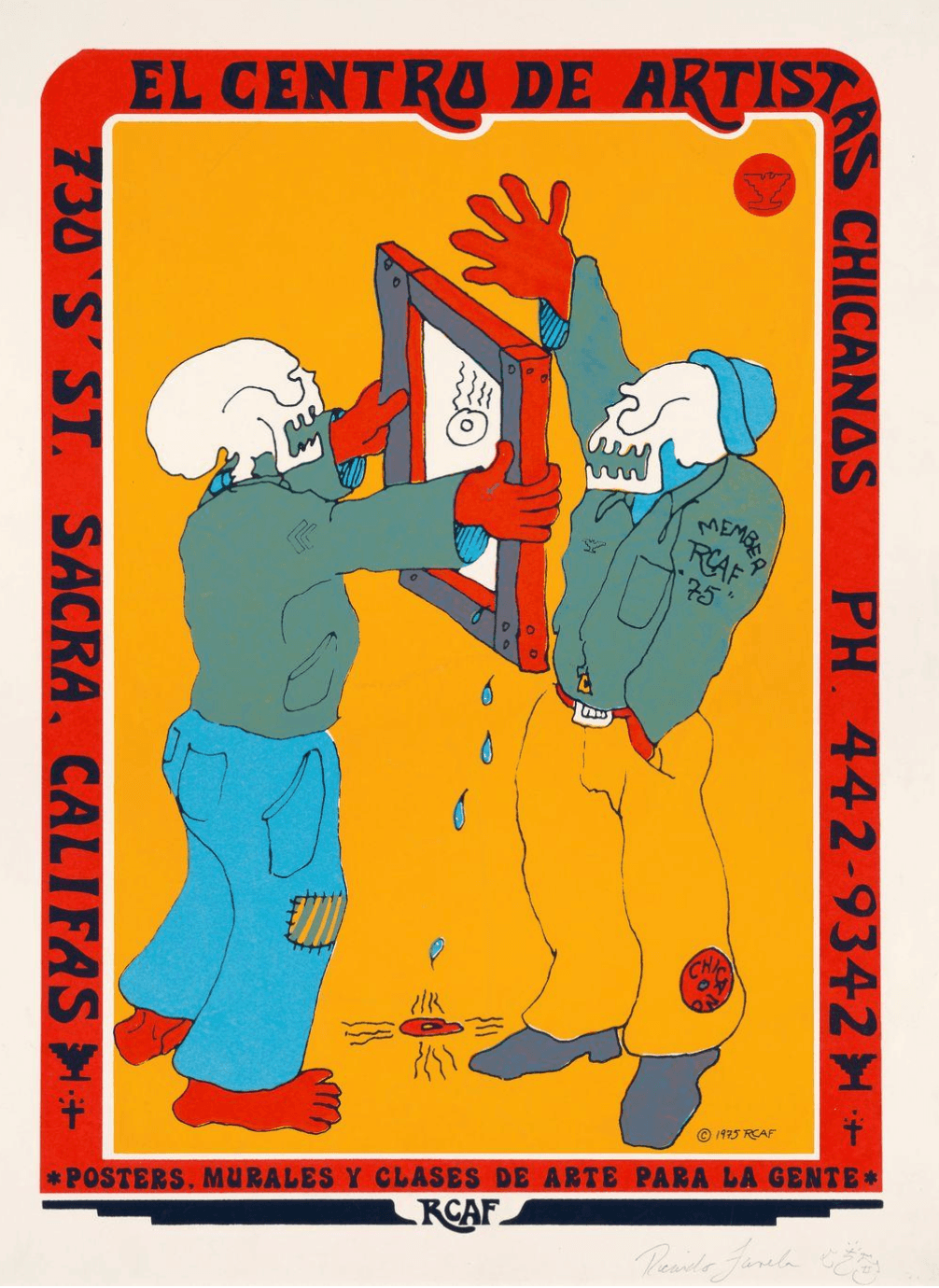
Ricardo Favela, El Centro de Artistas Chicanos / The Center for Chicano Artists, Screenprint, 22.25 x 16 inches, 1975.
Ricardo Favela’s screenprint El Centro de Artistas Chicanos (1975) references La Calavera Catrina and other skeletal images from zinc etchings by Mexican lithographer Jose Guadalupe Posada (1852-1913), which have become ubiquitous in Day of the Dead (Dia de los Muertos) celebrations. Favela depicts a Chicano artist holding up a mesh screen from the silkscreening process to another who expresses obvious enthusiasm. Both are wearing army shirts, one emblazoned with RCAF ‘75 on their sleeve. Favela’s poster was made to promote public art classes “para la gente” (for the people) and includes United Farm Workers (UFW) logos. The use of skeletons for the characters conveys the Chicano-focused arts program and incorporates Day of the Dead homages to departed ancestors, who nonetheless remain present in our lives.
In addition to giving the actual location in Sacramento where the art activities will take place on “S” street, it references “Sacra, Califas.” Sacra is short for Sacramento. Califas is Chicano slang for California, but it also references mythical indigenous roots before Spanish colonial times. The name for the state of California comes from an early 16th century Spanish chivalric romance novel The Adventures of Esplandian by Garci Rodriguez de Montalvo which tells the story of a crusade by Christian knights. Today the novel is mostly remembered for introducing the mythical island of California, populated by dark-skinned warrior women led by Queen Calafia whose name is linked to the Arabic words for caliph (khalifa) and successor (khalf). Although Calafia is defeated in the novel, partly because her army of 500 (half-lion and half-eagle) griffins fail to devour the Christian men as they were trained, she survives by converting to Christianity and fleeing her home.
The Chicano use of Califas goes beyond the literal plot of the 1510 novel and represents a reclamation of identity aligning them with an independent, powerful, and indigenous people who ruled themselves before the arrival of colonial interlopers. The use of the name Califas is a symbol of resistance.
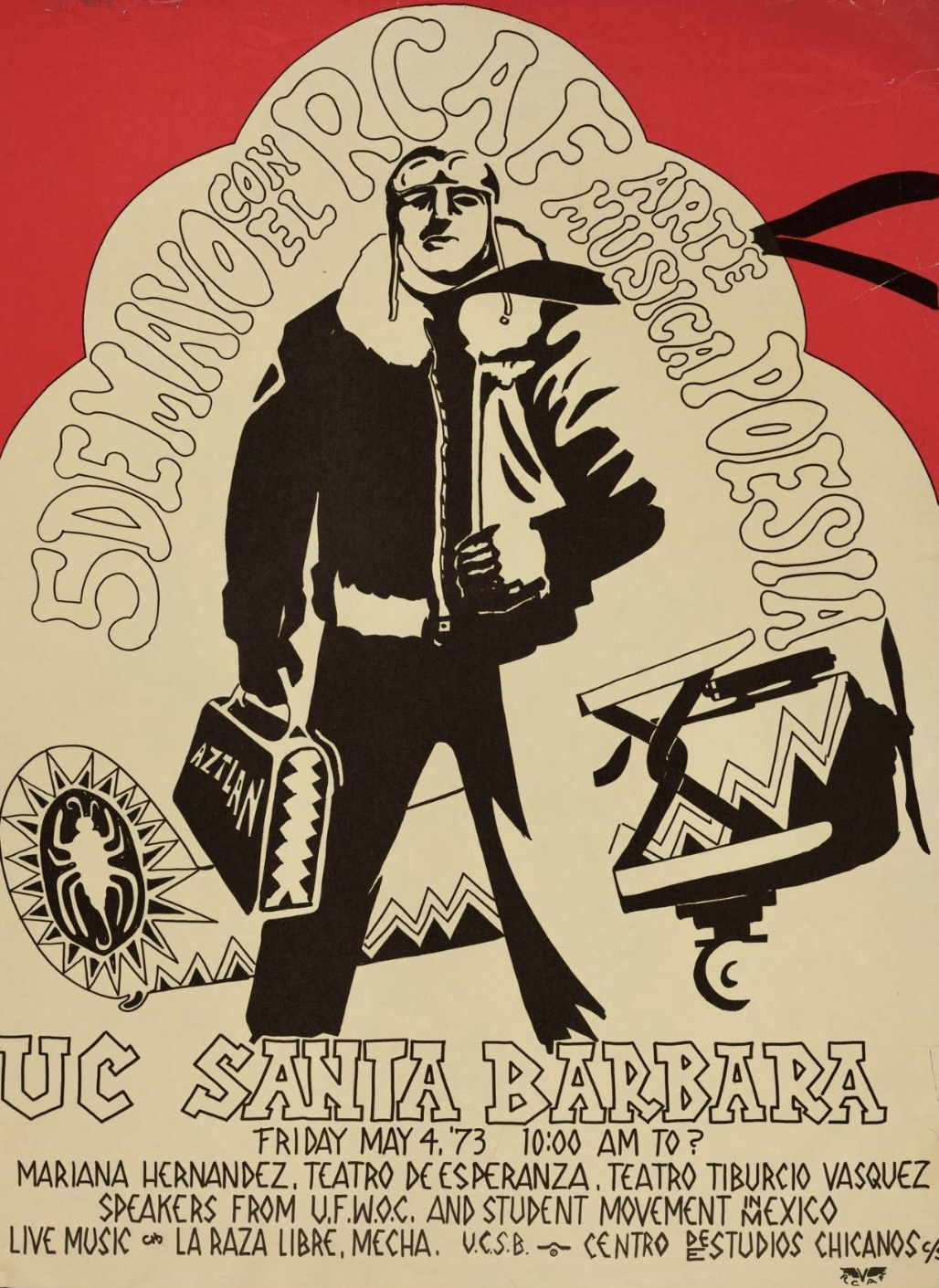
Esteban Villa, 5 de Mayo con el RCAF / May 5th with the RCAF, Screenprint, 28.5 x 21 inches, 1973.
In an RCAF poster promoting a Cinco de Mayo event, including art, music, and poetry, at Centro de Estudios Chicanos/Center for Chicano Studies, U.C. Santa Barbara (UCSB), two very specific iconographic signifiers are used. The scorpion painted on the empennage acts as a dual symbol of protection and danger—a cautionary warning that anyone venturing too close risks being stung. Additionally, the word “Aztlan” emblazoned on an attaché case carried by the RCAF pilot makes a point about ancestry. Aztlan is the ancestral homeland of the Nahuatl-speaking Mexica people, known as the Aztecs, who migrated to the Valley of Mexico in the early 14th century. Its location is the subject of debate, some placing it in northwestern Mexico and others in the American southwest. What is agreed upon is that it represents cultural pride and an origin story that unites Chicanos in asserting that they are not foreigners in the United States but indigenous peoples.
This idea was first articulated in two 1969 manifestos El Plan Espiritual de Aztlan (written collectively by delegates to the First National Chicano Liberation Youth Conference), including in its poetic preamble written by the poet known as Alurista (Alberto Baltazar Urista Heredia); and in El Plan de Santa Barbara (a blueprint drafted by the Chicano Coordinating Council on Higher Education). Since that time, many Chicanos have reimagined Aztlan, not as a specific geographic location, but as a shared spiritual homeland carried within them.
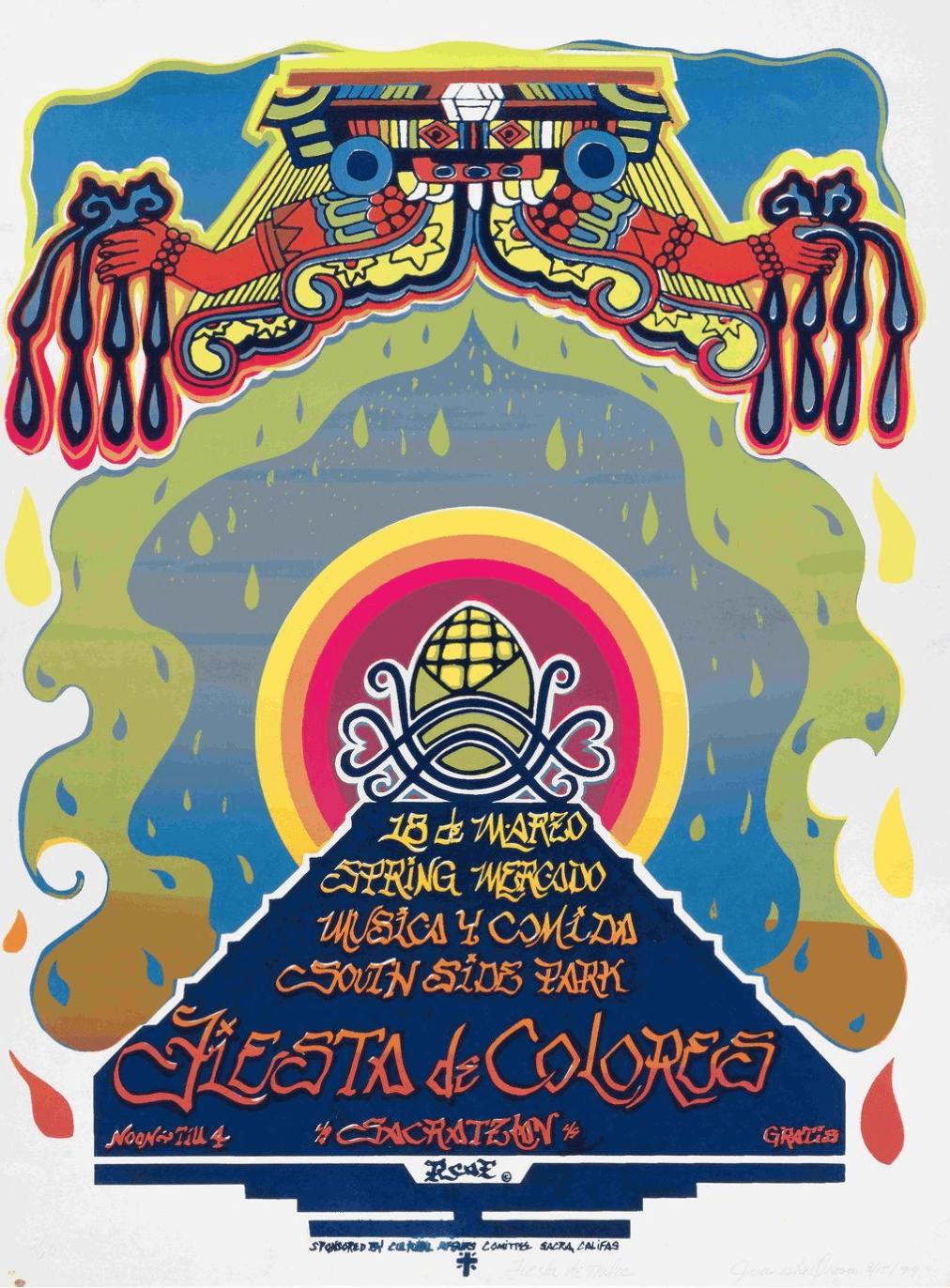
Juanishi Orosco, Fiesta de Colores / Festival of Colors, Screenprint, 23 x 17.5 inches, 1979.
The title of the exhibition is very intentional. Rebels with “The” Cause is distinct from Rebels with “A” Cause, the former suggesting a shared collective reason to be standing shoulder to shoulder. "La Causa" (the cause) is a significant term within the Chicano Movement, symbolizing the ongoing struggle for justice and equality among Mexican Americans. It embodies the collective efforts to address systemic issues of discrimination affecting their communities.
The RCAF famously adopted a wide range of non-art related programs which included efforts to address food insecurity, provide mental health services, literacy initiatives, and the promotion of cultural pride through the organization of various festivals/fiestas (celebrating the corn harvest, honoring Tlaloc the Rain God, and remembering ancestors through Day of the Dead festivities). They viewed their community engagement in the widest manner possible. This non-art activity was so pervasive that David Rasul, a long time member of the RCAF's Cultural Affairs Committee (whose collection of over 50 posters and other ephemera from the group is now in the permanent collection of the Harvard Library), has referenced being part of the RCAF's Tortuga Squadron [tortoise squadron] made up of the non-flying members.
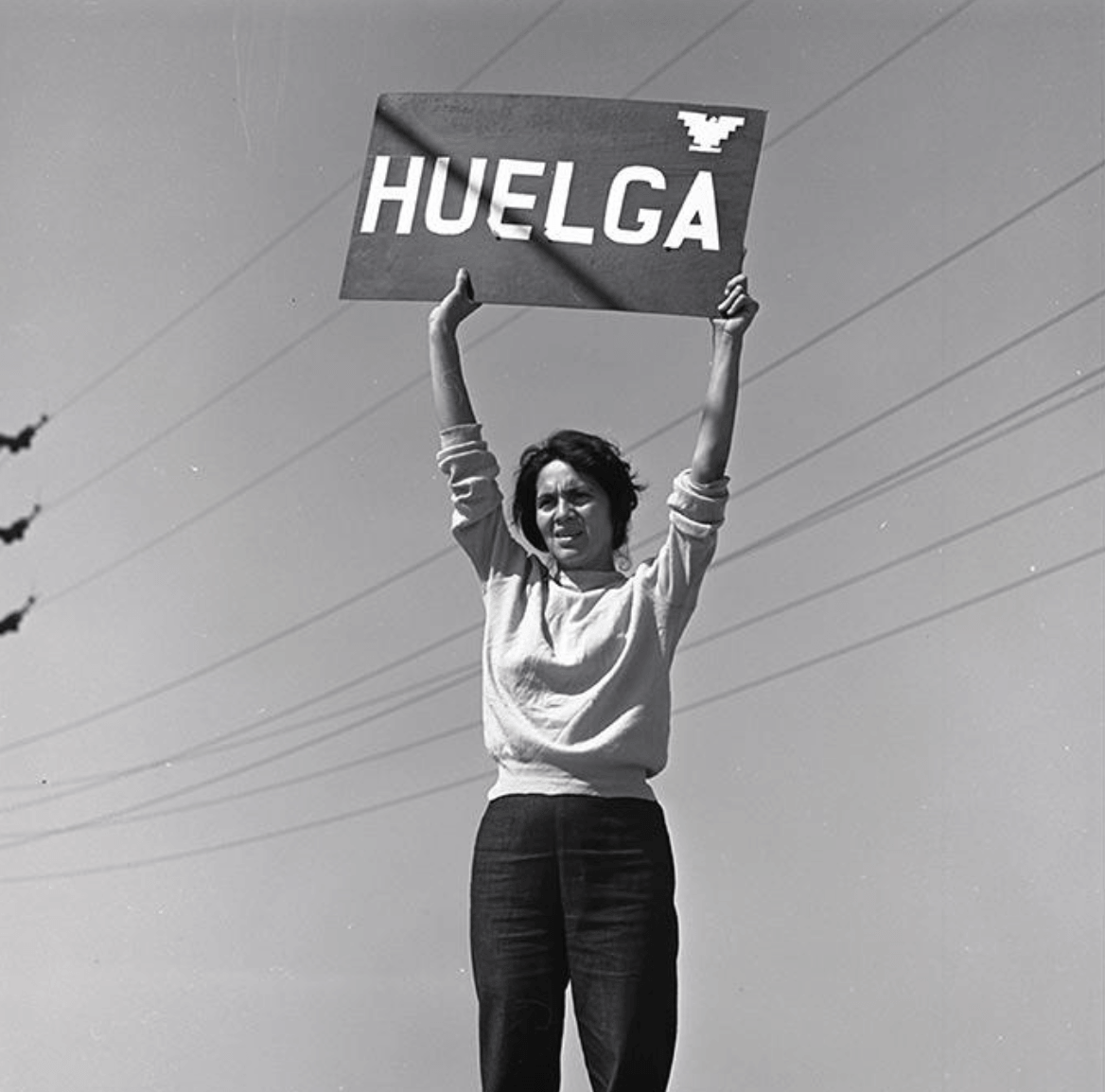
Dolores Huerta, Huelga / Strike, Delano, California, September 24, 1965. Photograph by Harvey Richards.
At a time Cesar Chavez's legacy is rightfully undermined by revelations he groomed and sexually assaulted minors the RCAF reminds us that no one person was responsible for the success of the Chicano civil rights effort. The farm workers movement was a multi-person struggle to obtain justice, and artists and other creatives were integral to the accomplishments attained. Dolores Huerta once said “The Royal Chicano Air Force had an incredible vision about what they wanted society to look like. They did what they started out to do, and I just wish that model existed in every city. I think our whole country would be a lot different if we had a RCAF in every community.”
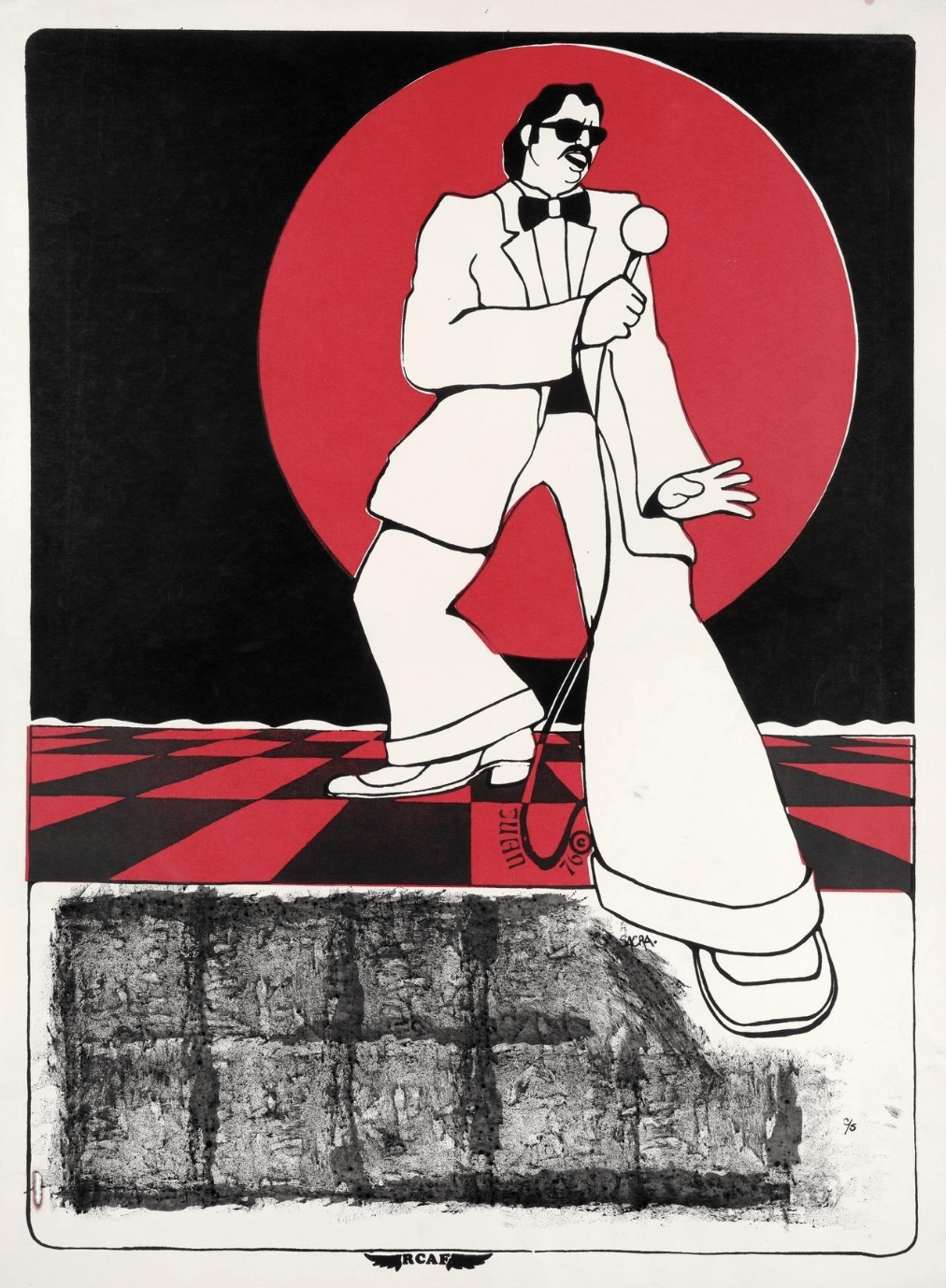
Juan Cervantes, The Singer, Screenprint, 25 x 19 inches, 1976.
At funerals or political gatherings, within Mexican-American or Latinx cultures, "presente" is used as a collective call-and-response roll-call, meaning "present" or "here", to assert that the deceased person lives on among those assembled. It affirms solidarity, continuation of the struggle, and that the person’s spirit remains accounted for in the community. Many of the founders of the Royal Chicano Air Force have died since their halcyon days and cannot enjoy the near-canonization their work has since achieved, including as a result of the current Crocker Art Museum exhibition. The pride they inspire within the Chicano community today and their participation in consequential historical events will not soon be forgotten. For a new generation of artists and activists the members of the RCAF will always be, ¡Presente!
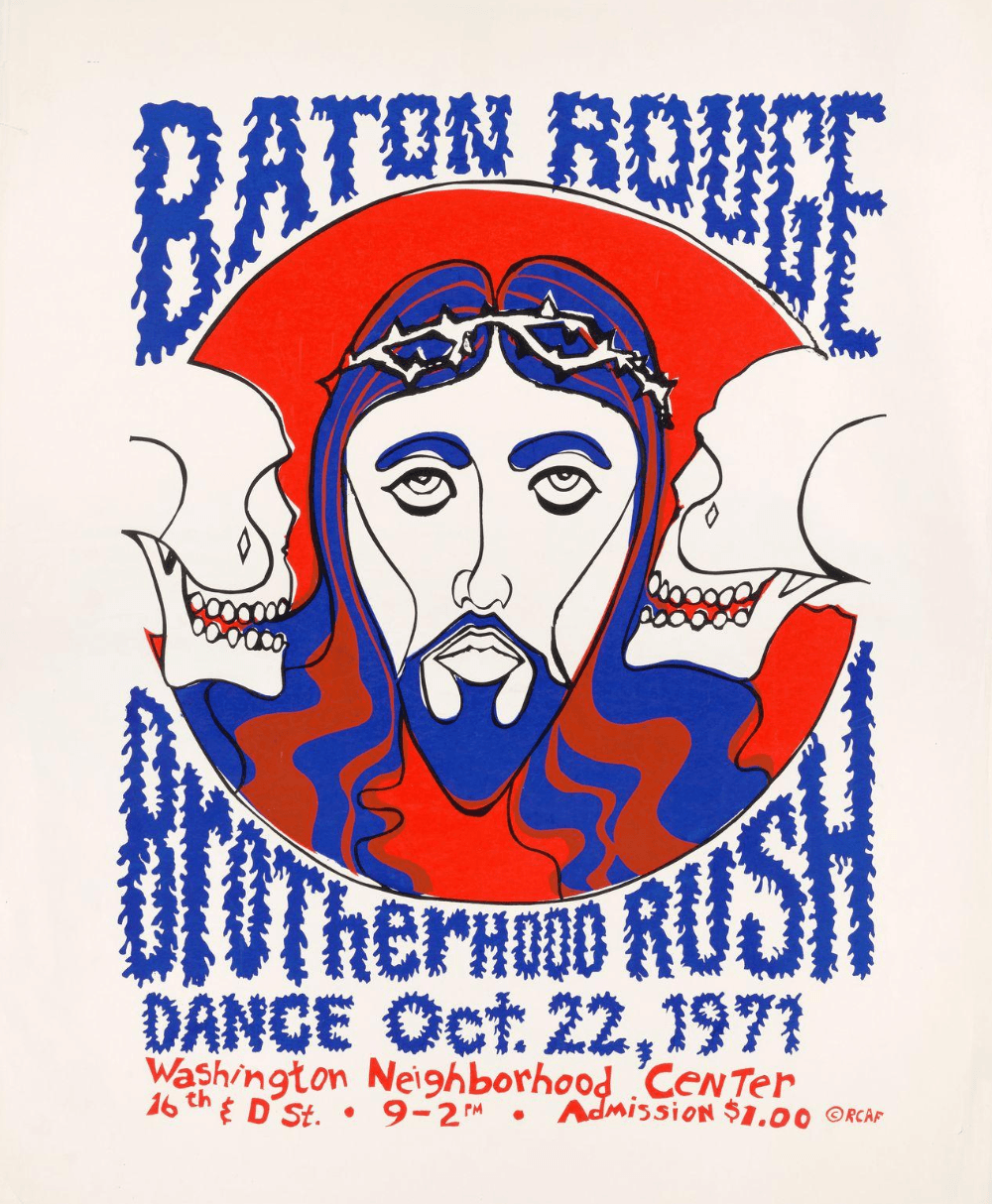
Max Garcia, Baton Rouge, Screenprint, 27 x 22.25 inches, 1971.
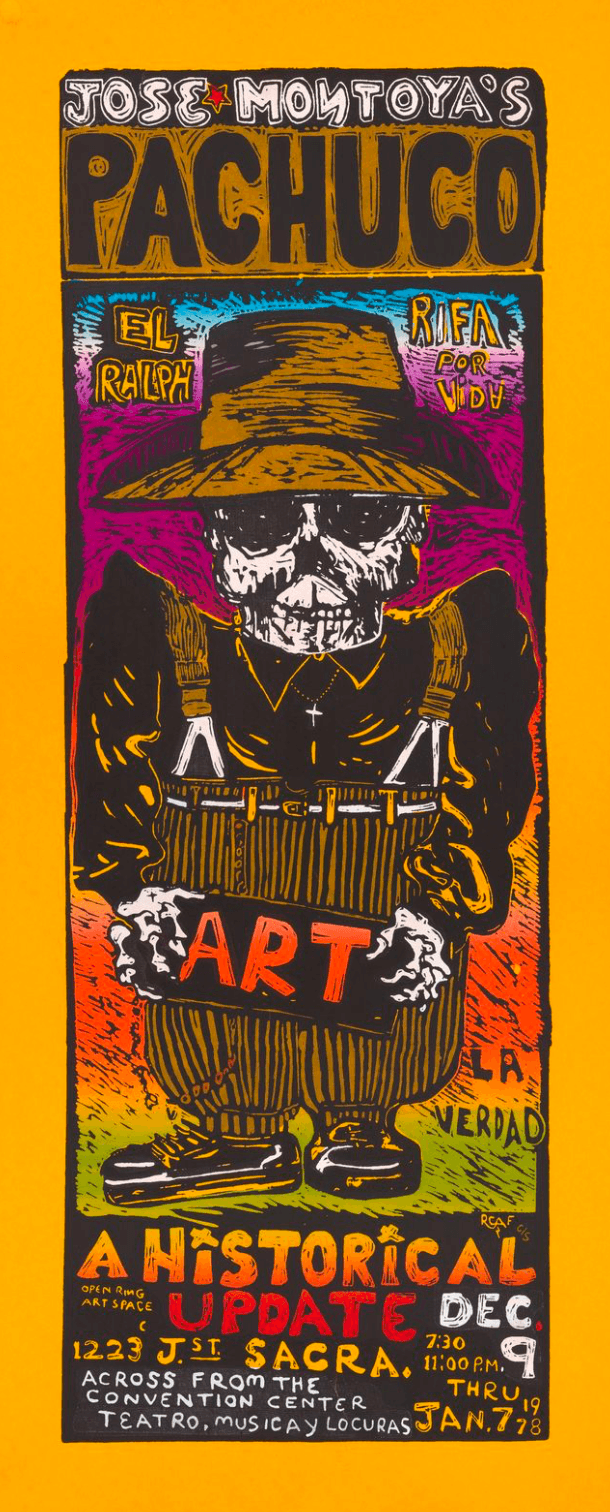
Rodolfo “Rudy” Cuellar, Louie “The Foot” Gonzalez, & Jose Montoya, “Jose Montoya’s Pachuco Art, A Historical Update,” Screenprint, 31 x 13 inches, 1977.
ABOUT THE EXHIBITION:
This important exhibition is guest-curated by Terezita Romo (affiliate faculty in Chicana/o Studies at University of California, Davis) and managed by art historian Mariah Briel (former Crocker Curatorial Projects Manager and current adjunct faculty at Woodland Community College).
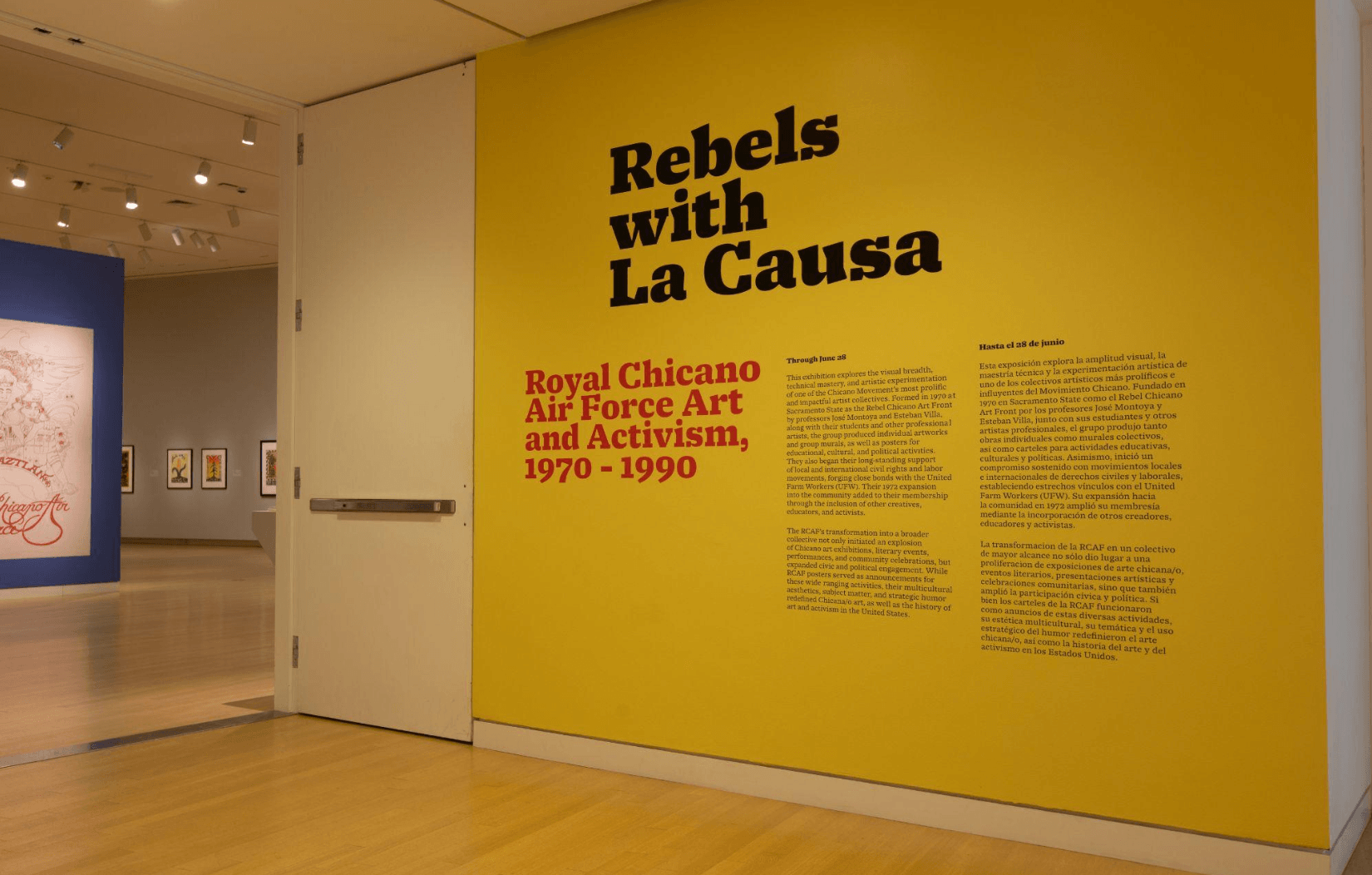
Exhibition artwork is sourced from a variety of lenders including RCAF artists and families, other private collections, and university library archives. The exhibition is accompanied by a 240-page book catalogue into the RCAFs history, Rebels with La Causa: Royal Chicano Air Force Art and Activism, 1970–1990 (New York: Scala, 2026) with essays by Tere Romo, Taiana Reinoza, Jesus Barraza, Ella Maria Diaz, and Lorena Marquez.
The exhibition recreates an RCAF screenprint studio in the museum offering visitors an immersive experience into their often versatile and mobile, art-making practice.
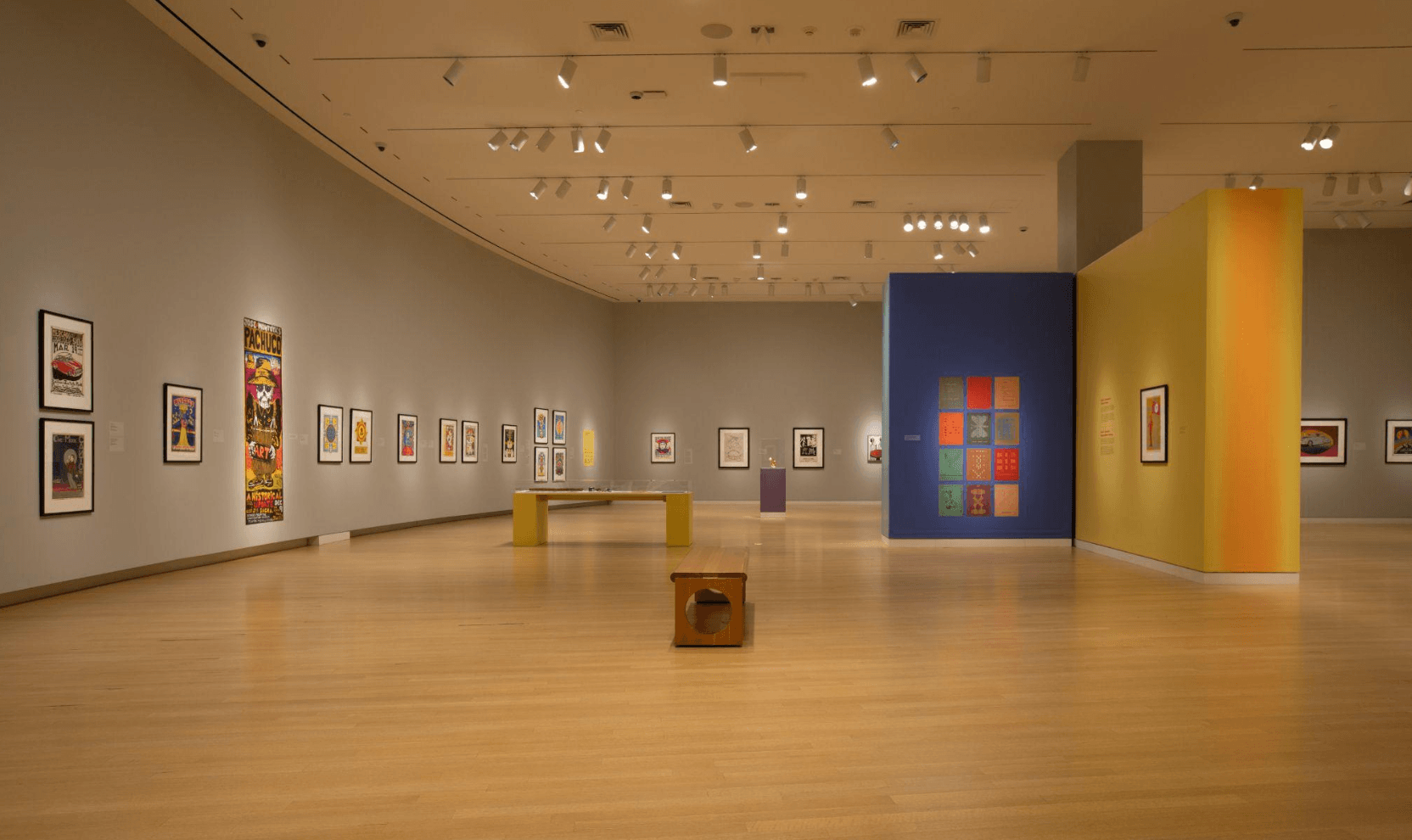
Coinciding with the Crocker Art Museum exhibition, La Raza Galeria Posada is hosting InFormation, a regional celebration of the RCAF, running from January – June 2026. Fifteen art and literary organizations, including other museums, galleries, libraries, and cultural centers in Sacramento, Roseville, Davis, and Woodland will present RCAF related exhibitions (including artist panels, workshops, poetry readings, and film screenings).
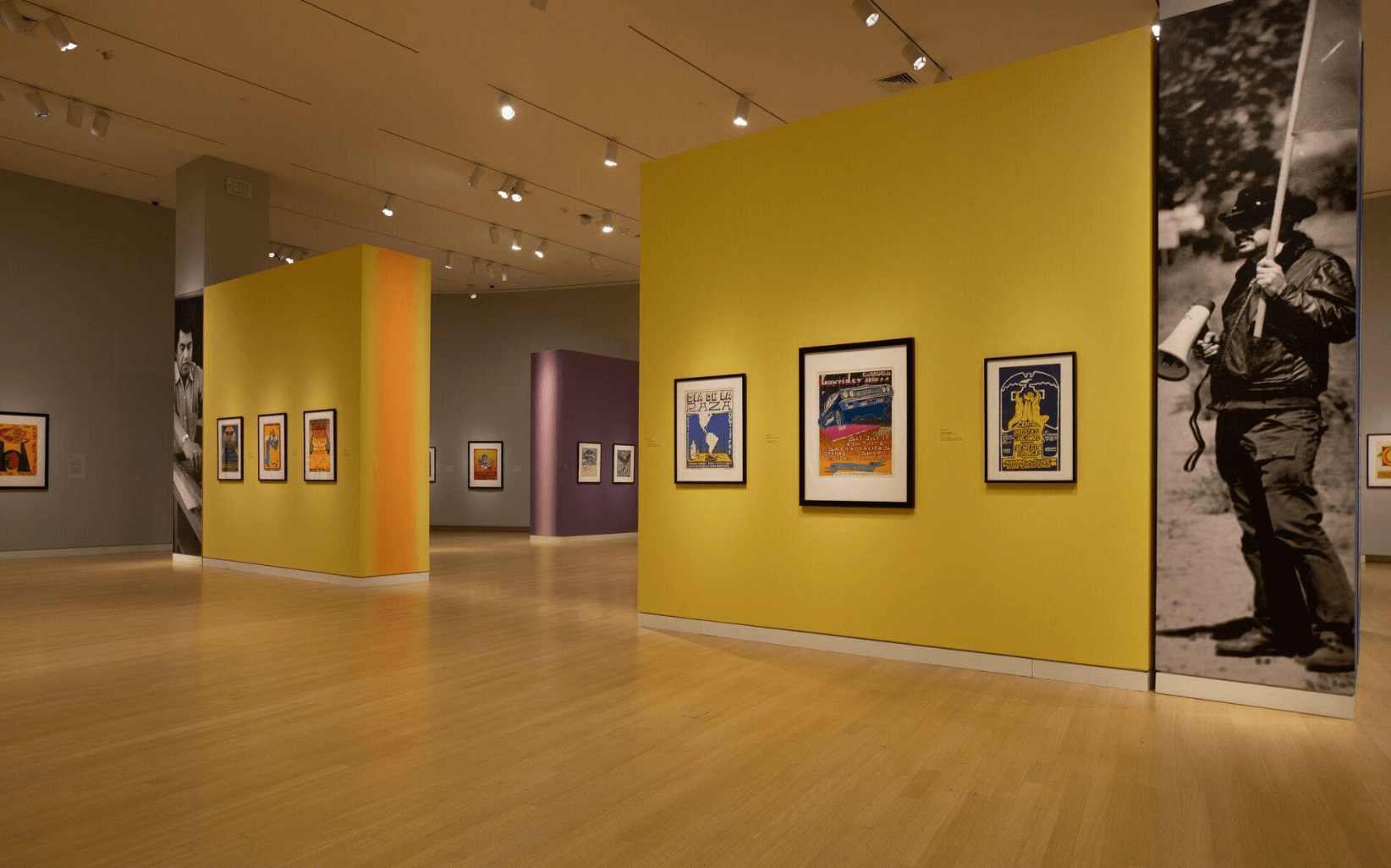
RCAF printmakers who contributed to the Crocker Art Museum exhibition include: Juan Carrillo, Juan Cervantes, Armando Cid, Rudy Cuellar, Jose Felix, Ricardo Favela, Eva Garcia, Kathryn Garcia, Max Garcia, Lorraine Garcia-Nakata, Bill Gee Gonzalez, Luis Gonzalez, Hector Gonzalez, Evelyn Jenkins-Cronn, Irma Lerma Barbosa, Jose Montoya, Juanishi Orosco, Stan Padilla, Celia Herrera Rodriguez, Raul Suarez, and Esteban Villa.
The exhibition runs through June 28, 2026.
Installation photographs (courtesy of the Crocker Art Museum).
