
Ara Hao, Close Desire, SWIM Gallery
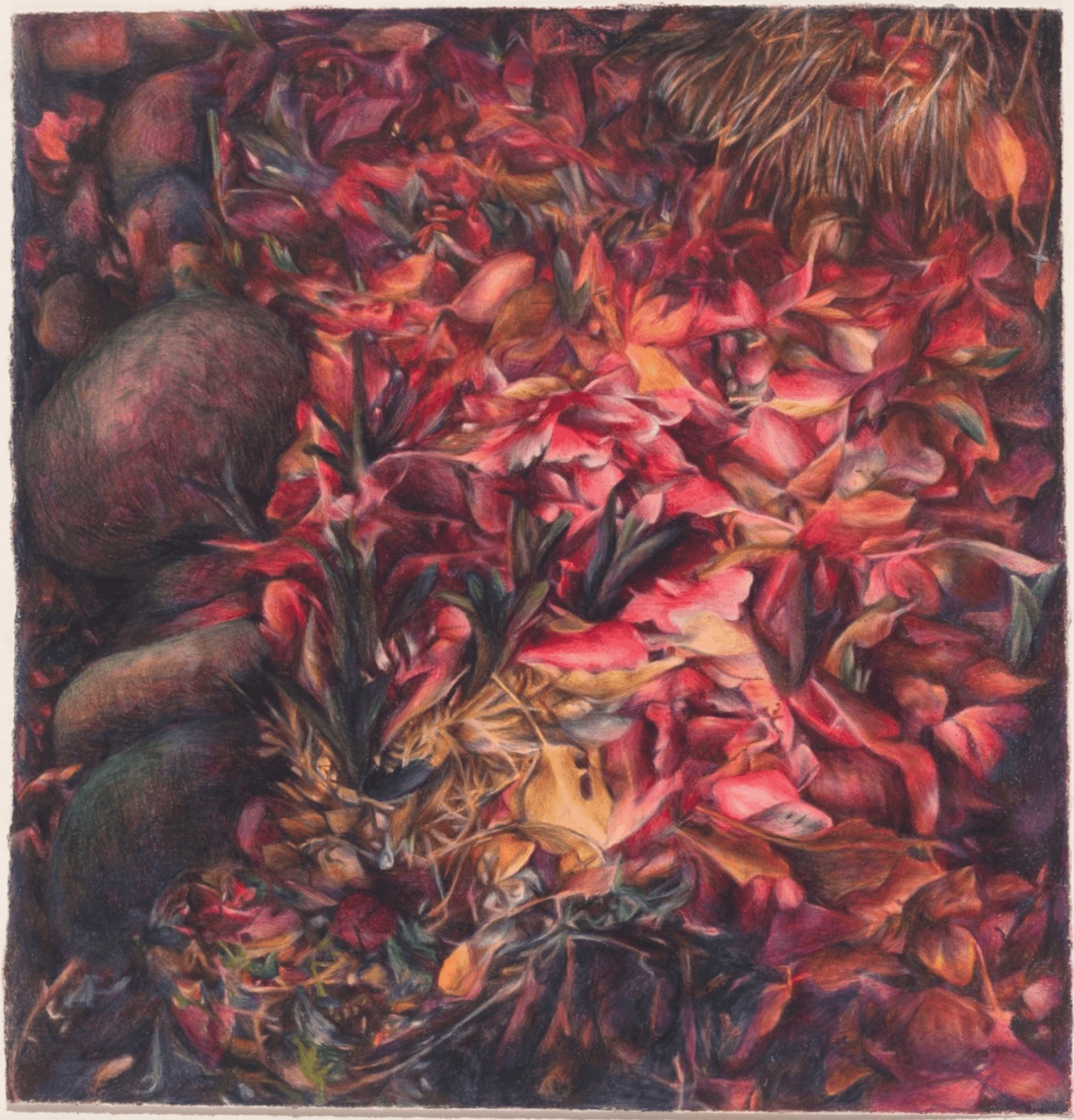
Red Leaves (2024). Colored pencil and varnish on paper. 13.5 x 14.25 in.
Plants, unlike animals, continue to add new organs (roots, stems, leaves, flowers, seeds) throughout their lives. Although they lack a final, fixed form, plants do not come in infinite shapes; instead, their morphology is circumscribed by a stereotyped growth pattern in which a small set of defined modules are added in sequence. An identical process facilitates the creation of giant redwoods, ornamental roses, crops like corn and wheat, and the scrubby weeds that grow out of cracks in the sidewalk.
The works in Ara Hao’s show “Close Desire,” on view at SWIM Gallery through May 2nd, depict a variety of plant forms, dead and alive. Each artwork (one large oil painting and eight smaller works on paper) has been made using a three-step process: first, photographic inspiration is gathered, second, the photographs are manipulated using AI, and third, the AI-spawned photographs are painted or drawn by Hao.
AI’s role in this process is unusual. Today, common applications of AI—for instance, customer service chatbots or automated writing tools—use its imitative ability to replace human labor. In Hao’s process, AI does not substitute for the artist’s work. Instead, it facilitates the arrangement of pre-determined elements, much as the chance operations used by John Cage and other Fluxus artists structured their work. But AI is more complex than a roll of the dice: it has been trained on data (for instance, information from nature, or from other artists); we might expect that, compared to chance procedures, it plays a stronger role in forming the finished work.
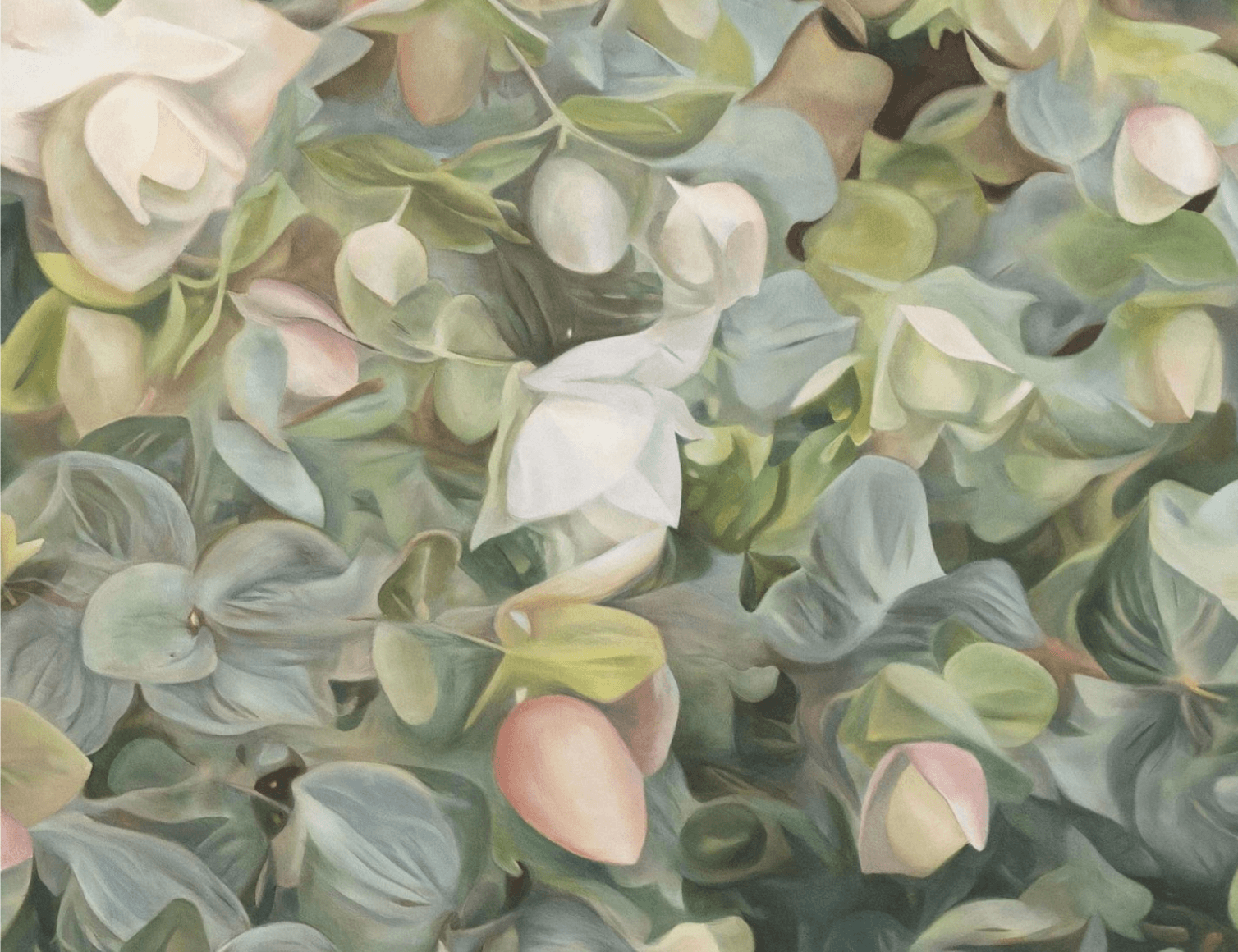
Detail of Passages (2024-2026). Oil on canvas. 113 x 60 in.
A walk through of the show reveals that although the works depict natural elements, the components have been arranged in a way that is a little off—not quite natural. The works seem to have been composed by piecing together modules, although no seams are visible. The different works also appear to be instances of a single archetype. Both the segmental composition and single-pattern aspects of the works remind me of plants.
The layered, modular nature of the works could also be described as collage-like. As with many collage-based forms (think of Cubist works), the pieces lack ground. They’re all figure, no empty space. But the lack of seams means that the works do not declare themselves as collages—so the missing space reads as surprising, even uncanny.
Also strange is the works’ resistance to pictorial harmony. The compositions range from slightly awkward to kind of ugly. Many look like wallpaper, although without the repetition. The works also contain partial leaf, flower or architectural forms. These object fragments may originate in an AI model’s interpretation of a partially obscured feature as an alternate whole.
The fakeness of these works’ compositions and shapes contrasts with the extreme realness of their details. Many petals and leaves are shown with the exaggeratedly pointy tips that, in nature, derive from the tips’ early growth cessation. The distinct character of the edges of the leaves and petals, also a consequence of developmental patterns, is rendered clearly, especially in the painting. The leaves’ vein networks are pictured in a biologically correct way in nearly all cases (Untitled/Brown (2026) includes a Frankenstein exception). The seemingly infinite and messy ways in which leaves’ basic form can be interrupted, especially in death, are catalogued.
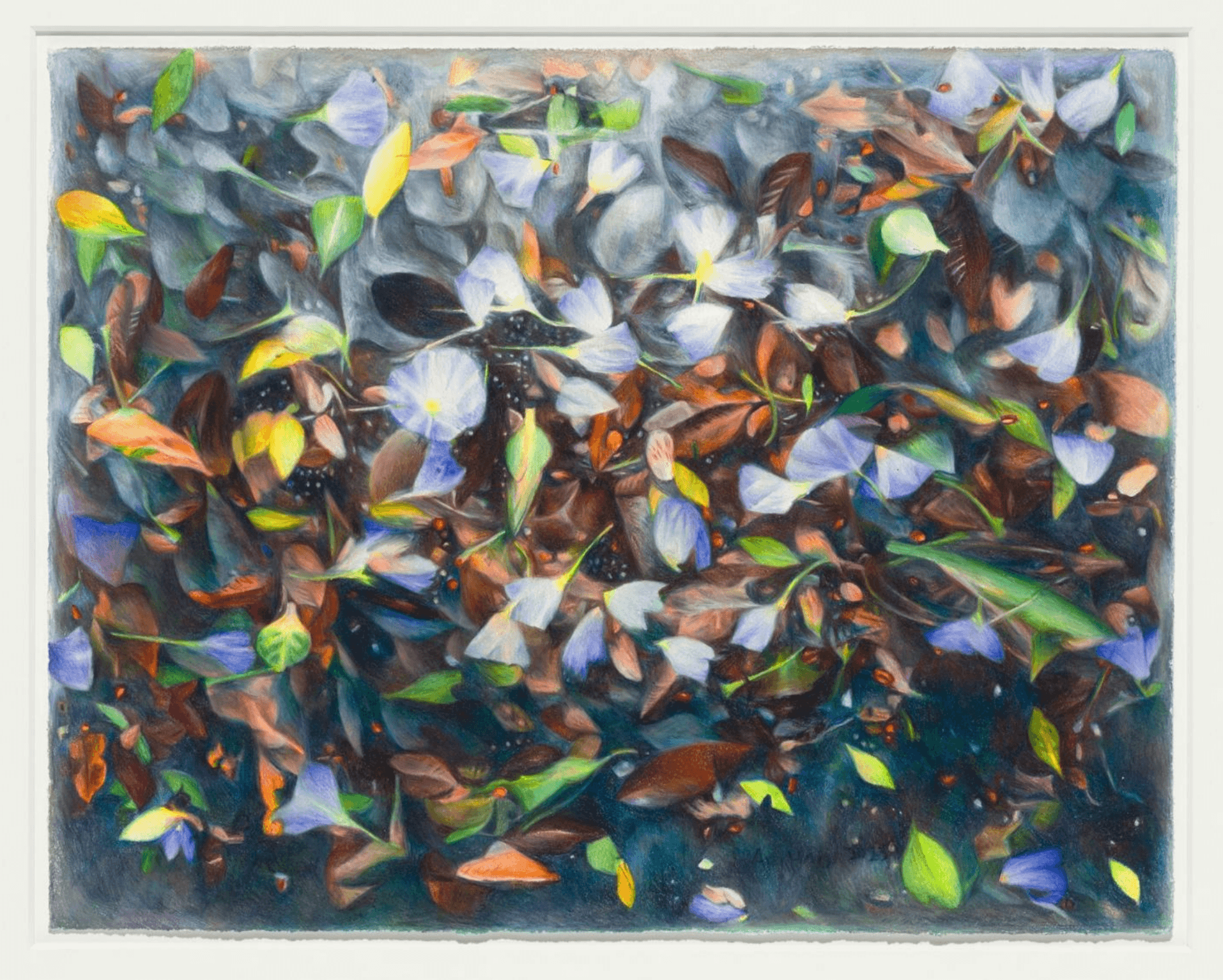
In Blue (2025). Colored pencil and varnish on paper. 14 x 11 in.
These tiny biological details appear, time and time again, as the result of an enormous amount of human effort. In the pastels, pencil strokes are visible at close range but are backgrounded by the intensity and variety of color and the lighting effects the patterns of color application create. In the painting, evidence of human brush strokes is scant; instead, a creamy surface pierced by rich color stands out. Close up, the edges of the plant organs are immaterial, merging into the canvas as if the two grew together. The work has too much detail, variety, and care to have been produced by a machine—but might have been produced by an angel.
Many of the pieces appear to contain studies of natural phenomena. For instance, Red Leaves (2024) examines the ways in which buried bulbs’ leaves erupt through dead matter. Splintering and reassembly of form run rampant in these works—but there is also compounding. In San Francisco (2026), leaves whose leaflets fan out from a central point burst into the picture plane like the fireworks whose shape they share. The drawing In Blue (2025) includes petals scattered among leaves in a way that suggests that AI may understand the fundamental homology of leaves and petals, as described by Johann Wolfgang von Goethe in his Metamorphosis of Plants.
The works’ fracturing, layering, and mashup-ing is a way of treasuring nature, of holding it up to the light, then examining it from every angle. The process used to create the works also acts as a transformation engine. The input is our world; the output, a new universe, sprung from ours but novel, with its own rules and modes of existence.
