
By Robert Brokl
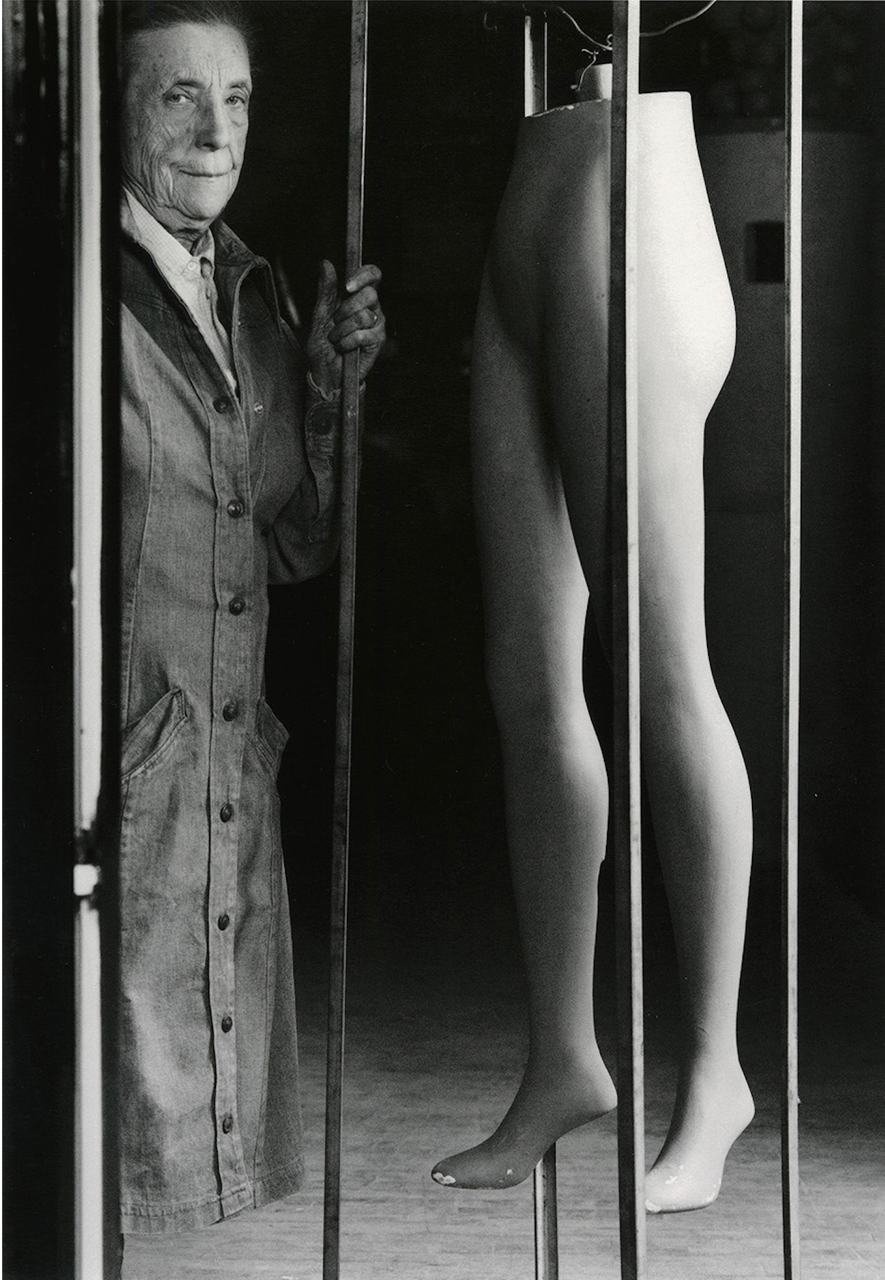
Nancy Lee Katz (1947-2018), Louise Bourgeois, 1986. Gelatin silver print. Gift of Michael S. Sachs, Magnes Collection of Jewish Art and Life, UC Berkeley, 2024.
The art world moves in a pack, like the culture in general. Case in point: for years, Ruth Asawa was a revered Bay Area artist, respected for her woven hanging mental sculptures, a folk hero for her collaborative public art projects and support for art programs in primary and secondary schools, with a rich personal and social life. But late in her life and now after her death in 2013, her star has risen so far, so fast that her sprawling SFMOMA retrospective traveled to NYMoMa, their largest show by a woman artist ever. Crowds and critics joined the pack. How refreshing then to happen upon an exhibit by an artist that almost no one knows about and where the work hasn’t been analyzed to death, so no hype to cut through. Simply black and white photographs installed in a meditative space with dark blue walls and a minimal of explanatory signage, and no music or videos. Viewers are left alone with the work, and those who take their time may feel like an explorer in an intriguing new world.
Such is Nancy Lee Katz: A Private Pantheon, at the Magnes Collection of Jewish Art and Life (formerly the Judah L. Magnes Museum) in Downtown Berkeley. Part 1, with 67 photographs, runs through Dec. 17, Part 2 opens Jan 19, 2027, and runs through May 13, 2027. Lauren Graves, Associate Curator at the Boston Atheneum, is the Guest Curator, with Magnes Coordinating Curators Alissa Schapiro and Hannah Weisman. Admission is a suggested $10 donation.
Nancy Lee Katz (1947-2018) was a New York City photographer, born to a Jewish family in Los Angeles, who created portraits of creative individuals she admired—painters, sculptors, architects, musicians, playwrights and “intelligentsia” that included members of the United States Supreme Court. She and her life partner, Michael S. Sachs (now her executor) attended concerts, went to movies and museums, like many New Yorkers, and was exposed to the work of giants in their fields. And some of her subjects she passed in the streets. But that’s where the narrative about her project to photograph her favorites gets more complicated, and puzzling. She did 192 shoots of different individuals over several years, but not until just before her death, at the prompting of Sachs, did she agree to allow the work to be shown. She selected 128 pieces that comprise the “Pantheon,” as Sachs dubbed it. Her surviving, younger sister, Virginia Katz, a noted film editor in Los Angeles, assisted. The Magnes exhibits are the result of the gift of prints by Sachs to the Magnes, one of several museums around the world to benefit. Her work is made available for exhibitions, but are not for sale. The 11”X14” prints (she wanted a format she could carry around) are produced by her longtime printer/collaborator, Brian Young. Sachs, Young, Virginia Katz and Graves participated in an illuminating Magnes symposium, available on YouTube, and their comments inform this review.
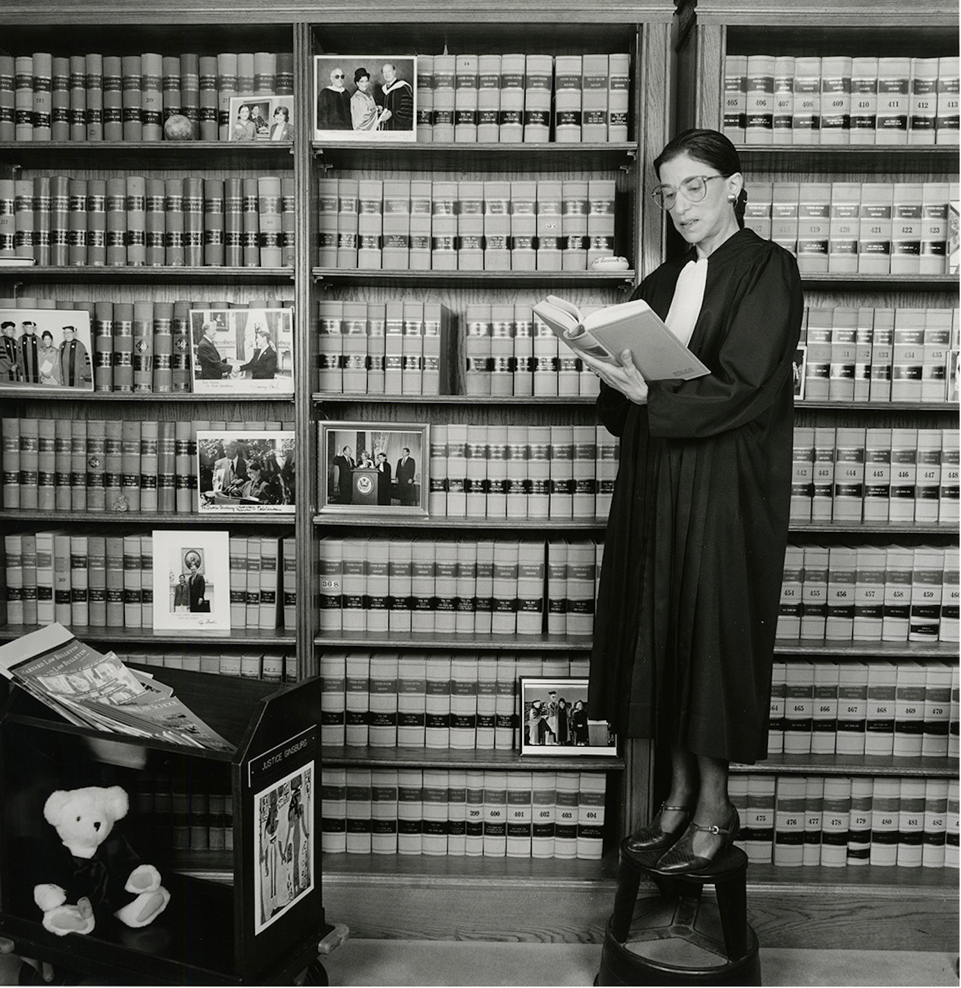
Nancy Lee Katz (1947-2018), Justice Ruth Bader Ginsburg, 1994. Gelatin silver print. Gift of Michael S. Sachs, Magnes Collection of Jewish Art and Life, UC Berkeley, 2024.
Katz used a “cold call” approach to each of her potential subjects—simple handwritten notes, asking for an hour of their time for her to take the photographs, and promising them they would get a “good print” afterward. She said she was planning to compile of book of photographs, which never came to pass. Sachs explained her manner of approach: “Socially adept, she talked with everyone. Remarkably, when she spoke to you, there was no ego showing; it was all about you; perhaps that is what made it possible for her subjects to open to her in the course of a one hour session. In her work, there were three elements: the subject, the photographic image, and the photographer. No one else was permitted to participate; the closest I got was the garage at the Supreme Court. Similarly, she did not show her pictures to others or even mention them, wanting not to be consumed by chit-chat about the cultural icons she documented.” Katz never networked with her subjects to gain access to other potential subjects, nor did she continue with any contact after the shoot, other than providing the print. She chose images from her contact sheets for Young to print, soliciting his opinion about her selection. The rare book dealer, Hans Kraus, said she had a “laser eye.” The subject got one print, to use as they saw fit (Richard Serra put his on the cover of a book of his work), and one to herself, with three extra. These were stored in boxes in her bedroom. She never told even Sachs who the subjects were, with rare exceptions like the outing they took together to Philadelphia for her to photograph the cellist Mstislav Rostropovich, where he observed her in action, hovering and shooting as Rostopovich conducted a master class.
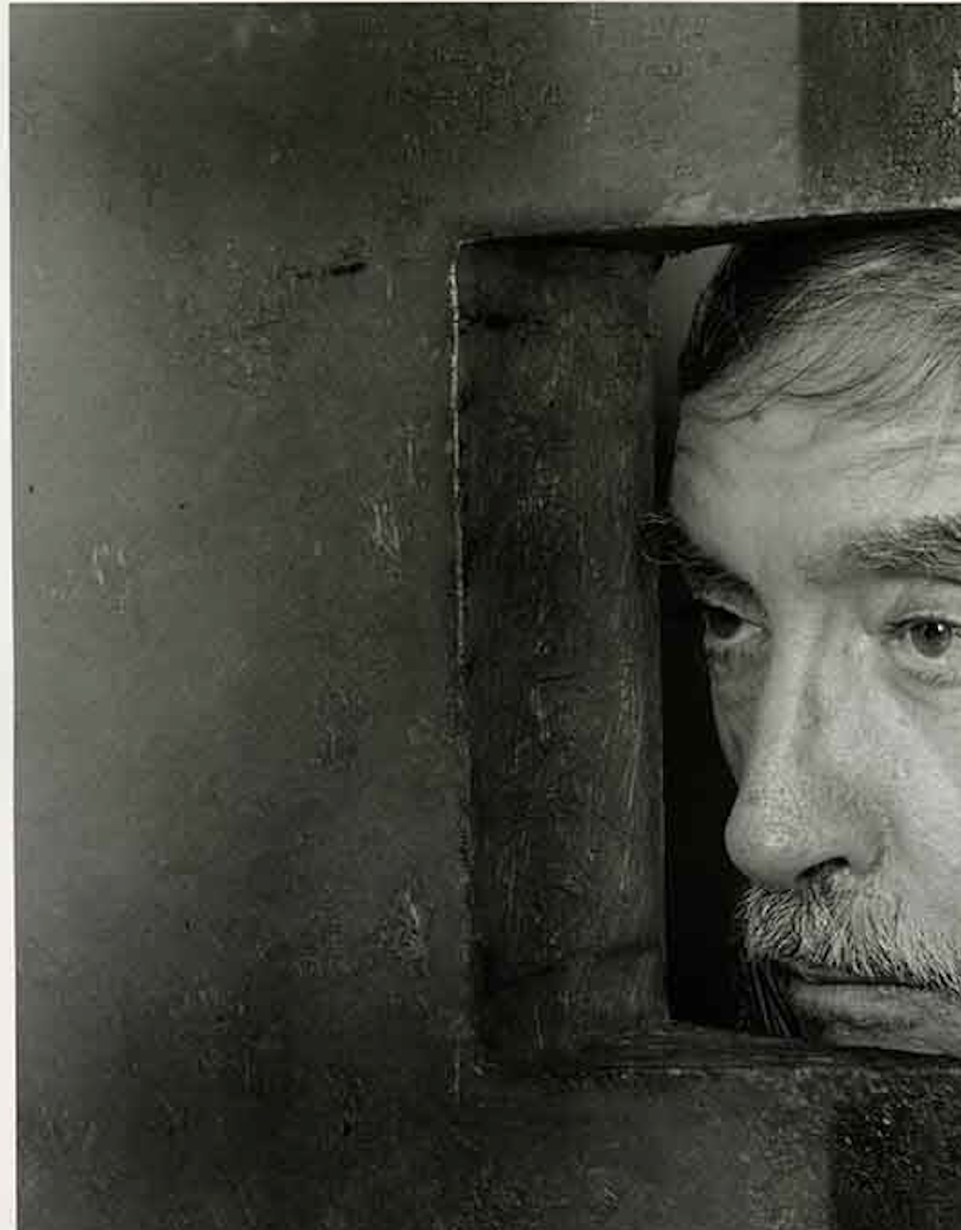
Nancy Lee Katz (1947-2018), Edward Albee, 2000. Gelatin silver print. Gift of Michael S. Sachs, Magnes Collection of Jewish Art and Life, UC Berkeley, 2024.
It’s not clear whether she intended to create a book or compilation of work, but she didn’t try to show or sell them. Her reticence extended even to her closest friend who came to her apartment every Sunday for tea, but was never told some of the photographs on the walls were by Katz. Sachs, who told that anecdote, is a print dealer, handling the estate of M.C. Escher and assembling a collection of 19th century photographs for the Israel Museum. Katz was involved in the selection of prints for their acquisition and had a reputation as a “deal killer” among sellers, so she was aware of the business side to her profession.
Her project ended in 2010, with her onset of cancer, and in #13 The Classic Spring 2025 Sachs explains what changed: “Shortly before she died, and with the awareness of her pending demise, I proposed that her work be exposed to the light of day, and asked for her thoughts about the photographs. She went through the boxes that were piled high in her bedroom, selected the best images from each of the 192 shoots, and rated them good, maybe, or forget it. After she passed away, I assembled what I took the liberty of terming her “Pantheon,” which consists of all of her first choices, almost all of her maybes, and one of the rejects, the depressed ninety-five year old Ilse Bing: 133 portraits of 128 subjects in all.” Bing ended up in Katz’s reject pile, Sachs suggests, because Katz didn’t like depression. He was surprised her image and Gordon Park (Part 2) are the two images more requested for reproduction and exhibits.
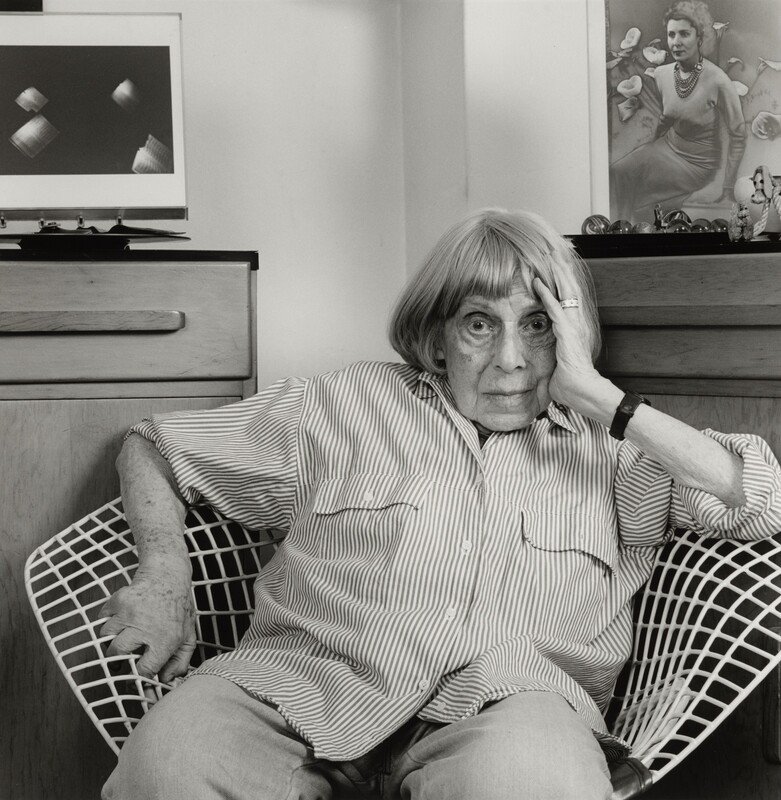
Nancy Lee Katz (1947-2018), Ilse Bing, 1993. Gelatin silver print. Gift of Michael S. Sachs, Magnes Collection of Jewish Art and Life, UC Berkeley, 2024.
As portraits of well-known people, she differs from other more famous modern practitioners of the genre, coincidentally New Yorkers also. Richard Avedon could be cruel and vindictive, exposing the vulnerabilities of figures like Oscar Levant and Marilyn Monroe. Peter Hujar probed for the truth under the surface, seeking intimacy. Annie Liebovitz is mass culture commercial, albeit with memorable images of Whoopie Goldberg in a tub of milk and Brad Pitt reclining in sausage-casing pants. Diane Arbus occupies her own lane, with her signature gimlet-eyed, melancholic vision.
Virginia Katz underscores the narrative quality of the imagery—the artist in the setting of their studio or workplace, placing them in the context of their work. Unlike the aforementioned, she is not trying to strip away layers, but in the course of the shoot, occasionally masks slip and the images get added depth, beyond the obvious skill and technical accomplishment. Virginia Katz noted her sister’s zeal for getting the perfect composition, once even risking death barely getting out of the way of a group of stampeding horses. Malcolm Daniel, Curator at the Houston Museum of Fine Arts, underscores the interest of Katz in her subjects’ work: “Whereas Nadar’s best portraits often relied on a collaboration born of long-standing friendship, Katz knows her subjects in a different way, not personally, but rather from deep familiarity and appreciation of their accomplishment.”
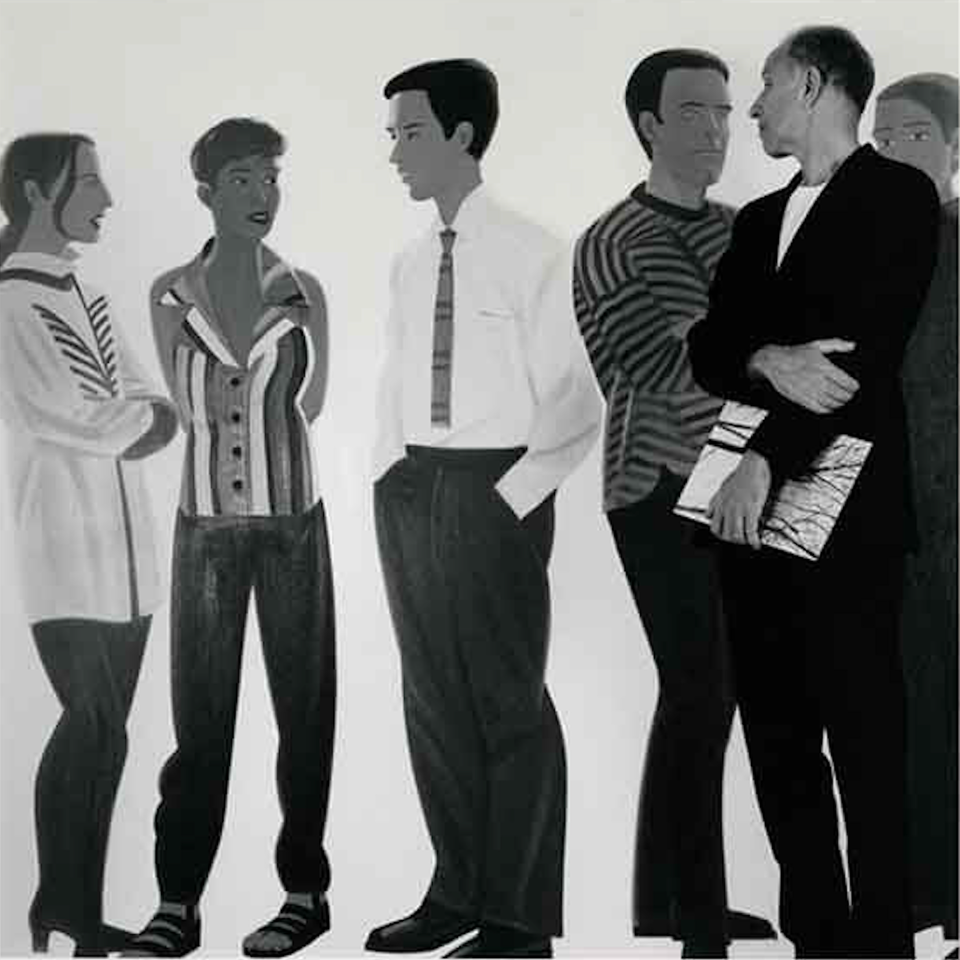
Nancy Lee Katz (1947-2018), Alex Katz, 1993. Gelatin silver print. Gift of Michael S. Sachs, Magnes Collection of Jewish Art and Life, UC Berkeley, 2024.
Alex Katz almost slips into the painting of his “downtown” fashionable, youthful subjects—he’s similarly attired and stylishly slender at 66. Pamela Roskin, writing in the Aug. 15, 2016 Fashion Style Journal quotes Katz: “Because you live in a city where there is so much elegance and beauty and that’s like one of the things I’m involved with,” and continues: “In the 1960s, Irving Sadler, the art historian, saw the emergence of Alex Katz and his ‘world of a ‘modern dandy.’ Katz’s dandy is not one specific Beau Brummel but rather the semi-private world of the New York’s avant-garde.”
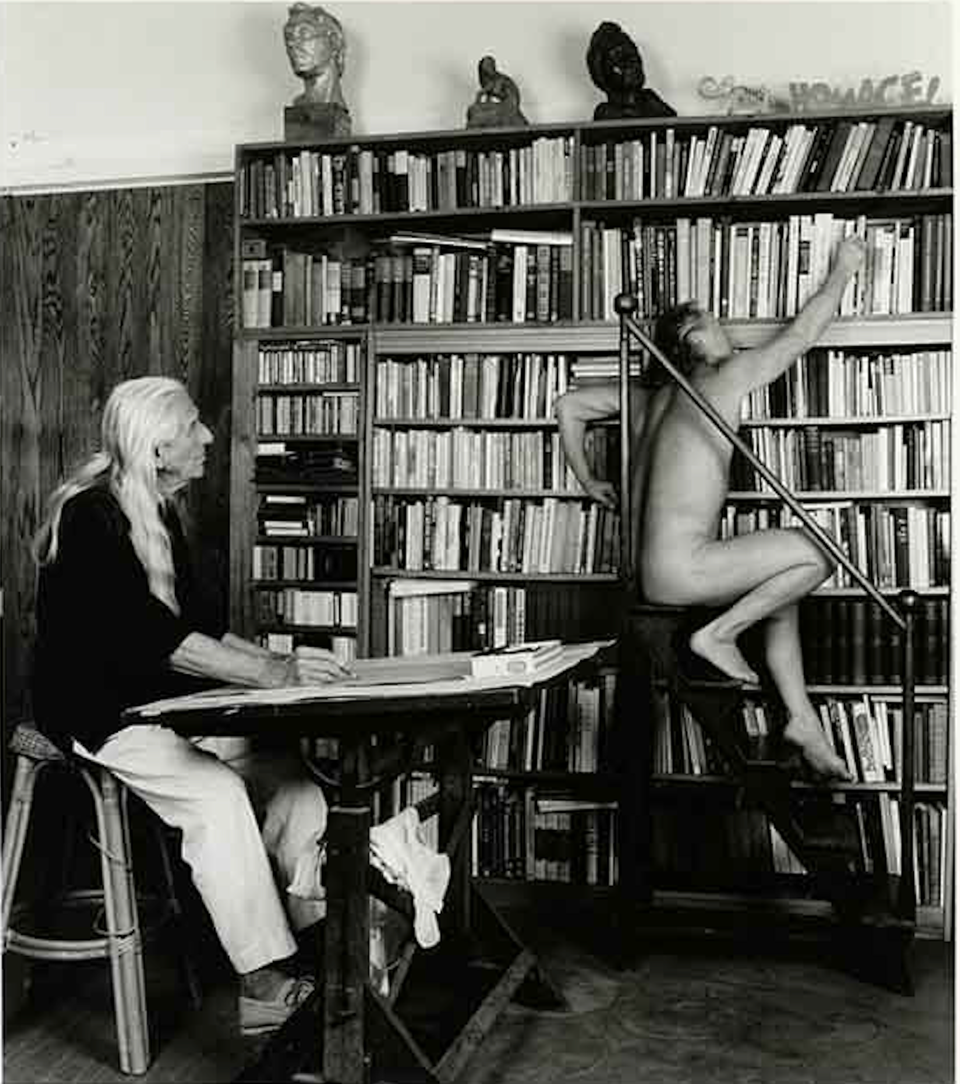
Nancy Lee Katz (1947-2018), Paul Cadmus, 1996. Gelatin silver print. Gift of Michael S. Sachs, Magnes Collection of Jewish Art and Life, UC Berkeley, 2024.
Paul Cadmus is shown clothed and at work, drawing a nude male figure who sits on a bookshelf ladder. Unless I’m mistaken, all of the other subjects in Part 1 are alone. Katz didn’t title her work, so this may be simply an artist-with-model set-up; Jon Anderson, Cadmus’s boyfriend and model in his later years may be the nude, who could also just be an apparition. Edward Albee peers out of what could be a cell or bunker, although he seems more prankish than frightened. Perhaps after lobbing another devastating critique of modern bourgeois marriage, like Who’s Afraid of Virginia Woolf? and Sylvia, or Who’s the Goat?. Bourgeois seems bemused and hinting at secrets, perfectly in character. The half-mannequin contrasts with Bourgeois, whose legs are not apparent beneath her studio smock. The mannequin evokes Bourgeois’s famous installation Cell XXV (The View of the Jealous Wife) of two mannequins wearing her own clothes, one an evening dress and another more matronly one, with two balls suspended underneath. This tableau is interpreted as representing her mother, father, and his mistress who was also her nanny.
Bing isn’t the only subject to appear unhappy or out of sorts. Robert Rauschenberg appears to be sinking out of the frame, his imagery on the wall behind blurry, too. And Marisol is sheltering in shadow and holding a saw, her carved figure and watchful dog as guardians.
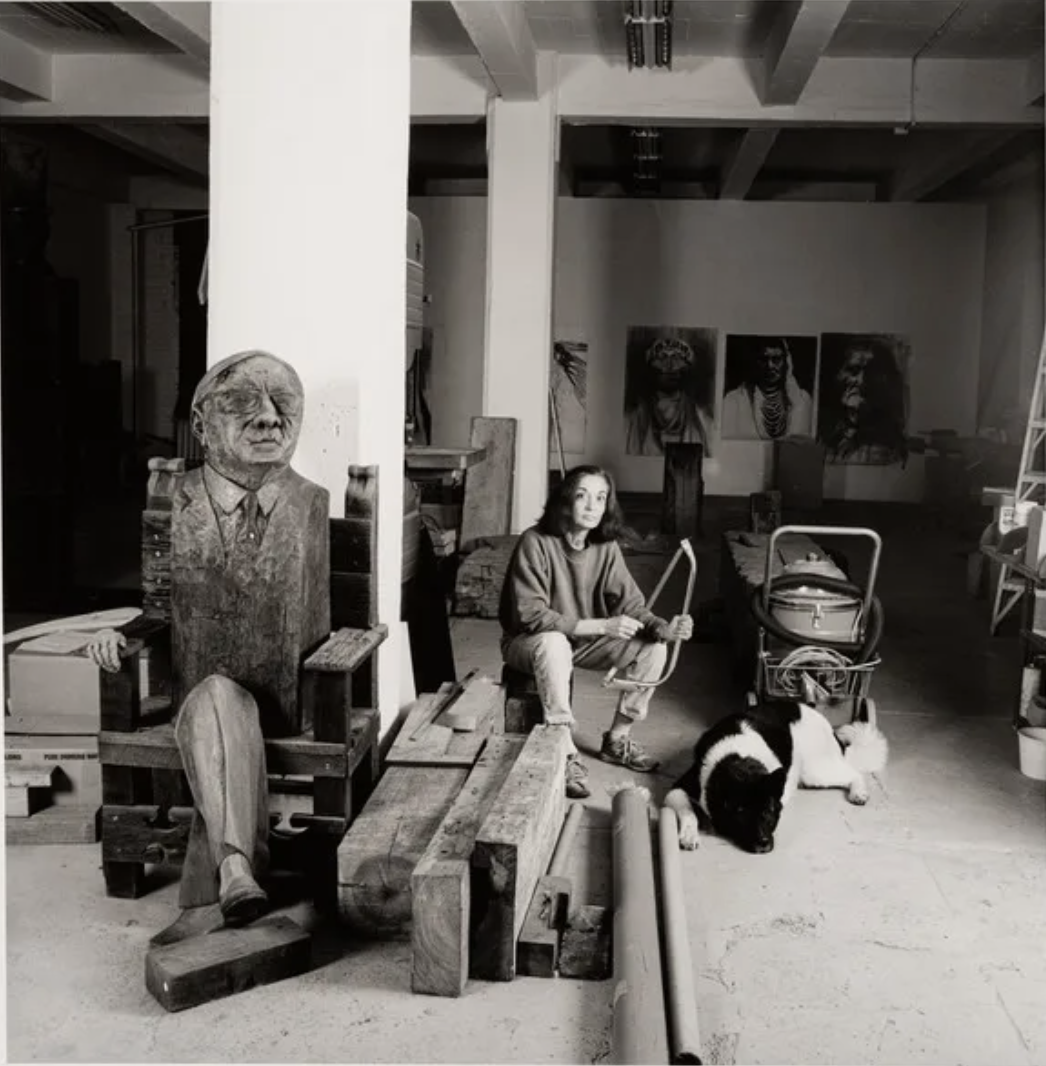
Nancy Lee Katz (1947-2018), Marisol, 1993. Gelatin silver print. Gift of Michael S. Sachs, Magnes Collection of Jewish Art and Life, UC Berkeley, 2024.
At 88, Sachs says he’s “running out of time” to sort through the estimated 100,000 Katz negatives remaining to be processed. These would appear to be a break from the Pantheon portraits making her famous, images she took of their trips to far-flung, off the beaten track destinations and cultures. Hopefully Sachs has plans to pass the torch.