
Muzae Sesay, Domestic Demo, pt. 2 Gallery
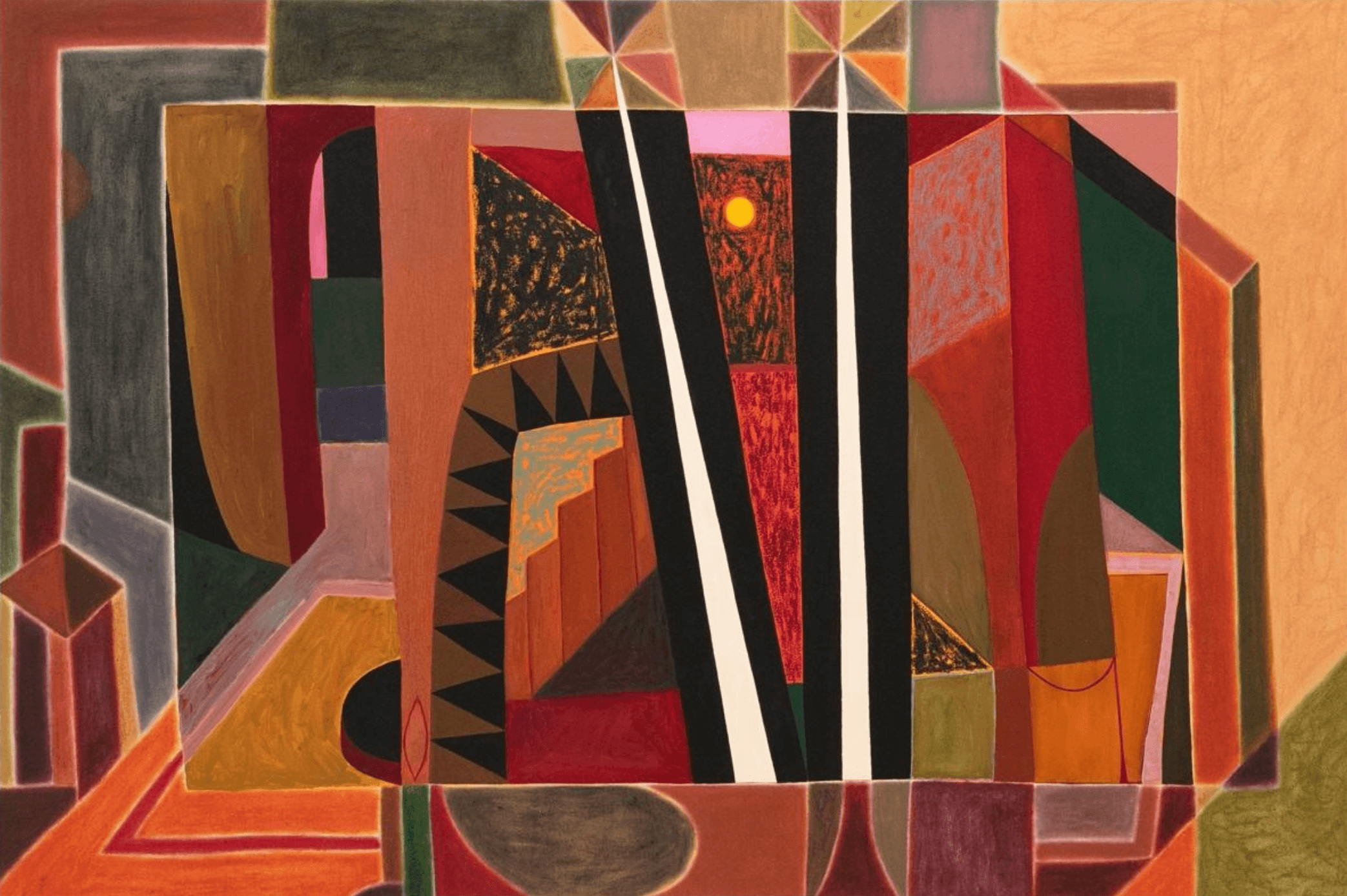
Muzae Sesay, As We Are Stepping Through the Gates, Oil and Oil pastel on canvas,
48 x 72 inches, 2025
By S Anne Steinberg
The front room of pt. 2’s southernmost set of spaces includes a rectangular expanse of white wall that sticks out an inch or two, resembling an untouched or very simply painted canvas. On my first visit to the gallery, several years ago, I briefly entertained the possibility that the outcropping was a part of the exhibition. In subsequent visits, I watched as each hanging gracefully skirted the rectangle, accepting but failing to engage the eccentricity. “Domestic Demo,” a group show curated by Muzae Sesay and including two rooms of Sesay’s own paintings, is the first exhibition I remember making use of the feature. The panel houses a map of the show, drawn directly on the wall, in pencil.
The seemingly ad hoc map is emblematic of the unpretentious nature of the show and its sensitivity to its space. On paper, the exhibition’s structure--Sesay, plus artists who have influenced him—brings a museum retrospective to mind. In person, the show eschews the reverential vibe of a retrospective; it’s an organizer, plus his community. One might say that the two Sesay rooms form the center of a flower, the remaining rooms its petals. There’s no unengaged inch of space, and, like the exhibition map, labels for each room are penciled directly on the wall.

Muzae Sesay, Cheers to Nothing Really, Oil, oil pastel, and vinyl emulsion on canvas. 24 x 24 inches, 2025
Sesay presents paintings, almost all made in 2025, falling into two groups. In Room II, the works examine destruction, including that of the Palisades fires in January of this year. In Room IV, the paintings investigate social and romantic themes. The two rooms share Sesay’s color palette of the last several years: orange, dark green, and pinkish purple. In both rooms, we see an obsession with the transmutation of form—and a lack of interest in paint, beyond its utility.
Sharing elements doesn’t mean that the two sets of paintings are not distinctive. In Room II, orange, black, and dark purple dominate; in Room IV, a pale pink floats in. The outlining of shapes in lighter colors is seen much more frequently in Room II. Although the works in Room II do not abandon ambiguity, each painting self-assembles into a clear, legible statement.
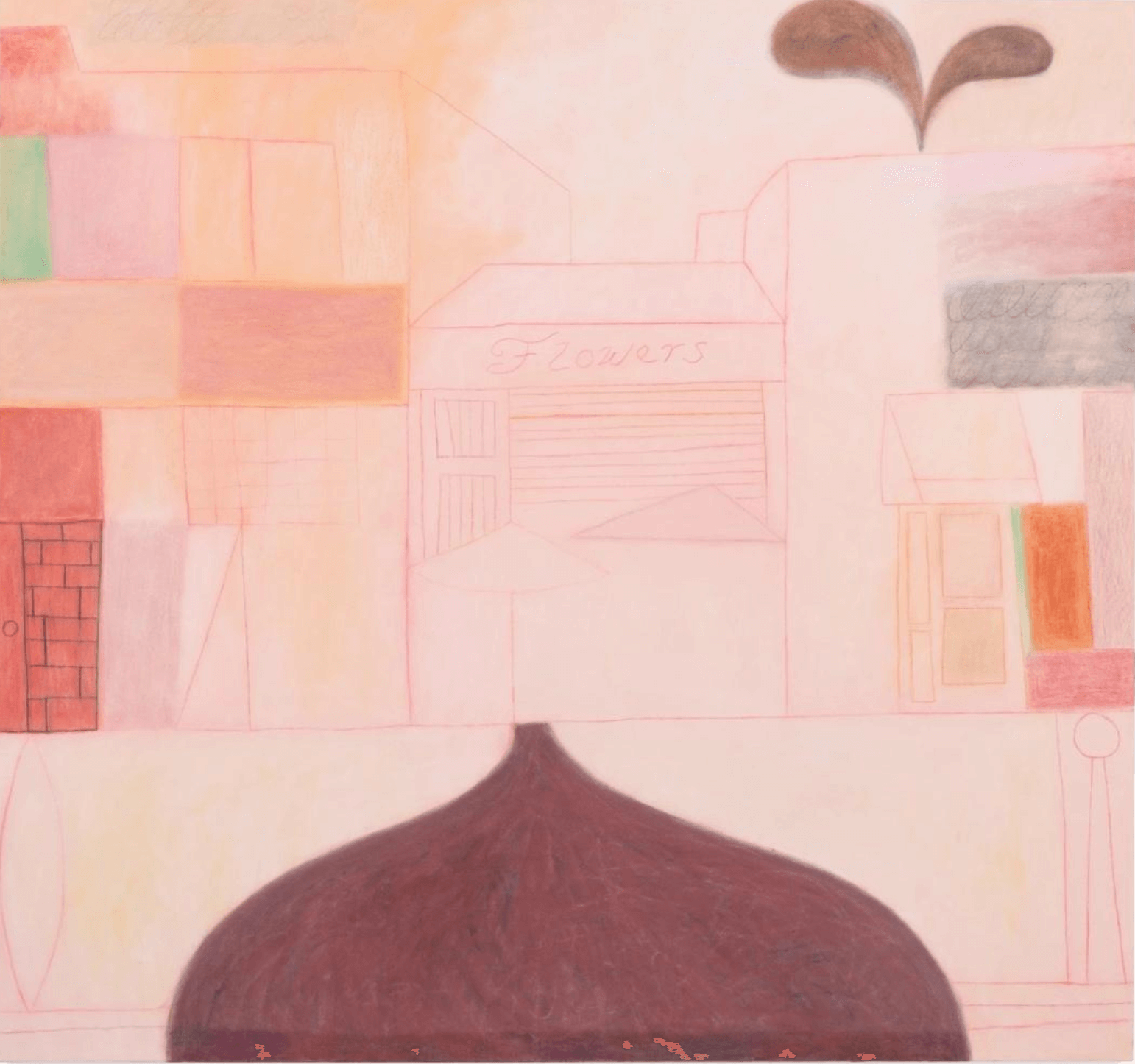
Muzae Sesay, Flower Water, Oil pastel and oil pencil on canvas. 59.35 x 63 inches, 2025
In Room IV, the inventive exuberance of the paintings mirrors the feeling of being in love. It might take a while to figure out what is going on. Room IV also includes a painting, “Flower Water,” in which neighboring shapes do not house highly contrasting colors, as well as a work from 2023, “Untitled,” that uses a color scheme entirely different from the other paintings.
Room I, the exhibition’s internal group show, consists of paintings that rhyme with Sesay’s in their fascination with the shapes of domesticity. In Ashley Wentling’s “Vanessa’s house (2025),” slices of pie morph to skinny triangles, plates become white halos, and, in their abundance, the combinations face us, flattened outwards. In “Untitled (2025),” Arrington West blurs a bedroom into a small universe, glowing in pink and celadon.

Ashley Wentling, Vanessa’s house, Acrylic on canvas, 31 x 25 inches, 2025
Room III, an alcove, shows Billie Ocean’s video “Protonema.” The piece begins with silly and affecting home footage of a first birthday, perhaps that of Billie herself. In the rest of the movie, a grown-up child with a soothing voice shows us what she has seen.
It’s arresting imagery, including otherworldly elements such as a rabbit somehow passing through a solid door. Still, everything is grounded in the quotidian; there are no monuments or wonders of the world. Three cycles of a core image sequence are included, possibly to induce a relaxed, hypnotic state. That kind of transport may be more likely if one is not sober.
The fifth room, titled “Demo Room: An Unclean Wash,” is the most fun. There’s shadow play, crazy chair-shaped things (by Cheflee and Elliot Surber), a collage wall that evokes Henri Matisse’s place in his cut-out era, but in black and white, and a movie that, at one point, sounds like it is taking off. “This is cool,” said a kid who wandered in from the street. Lighting is provided by multiple floor lamps, giving everything a warm glow.
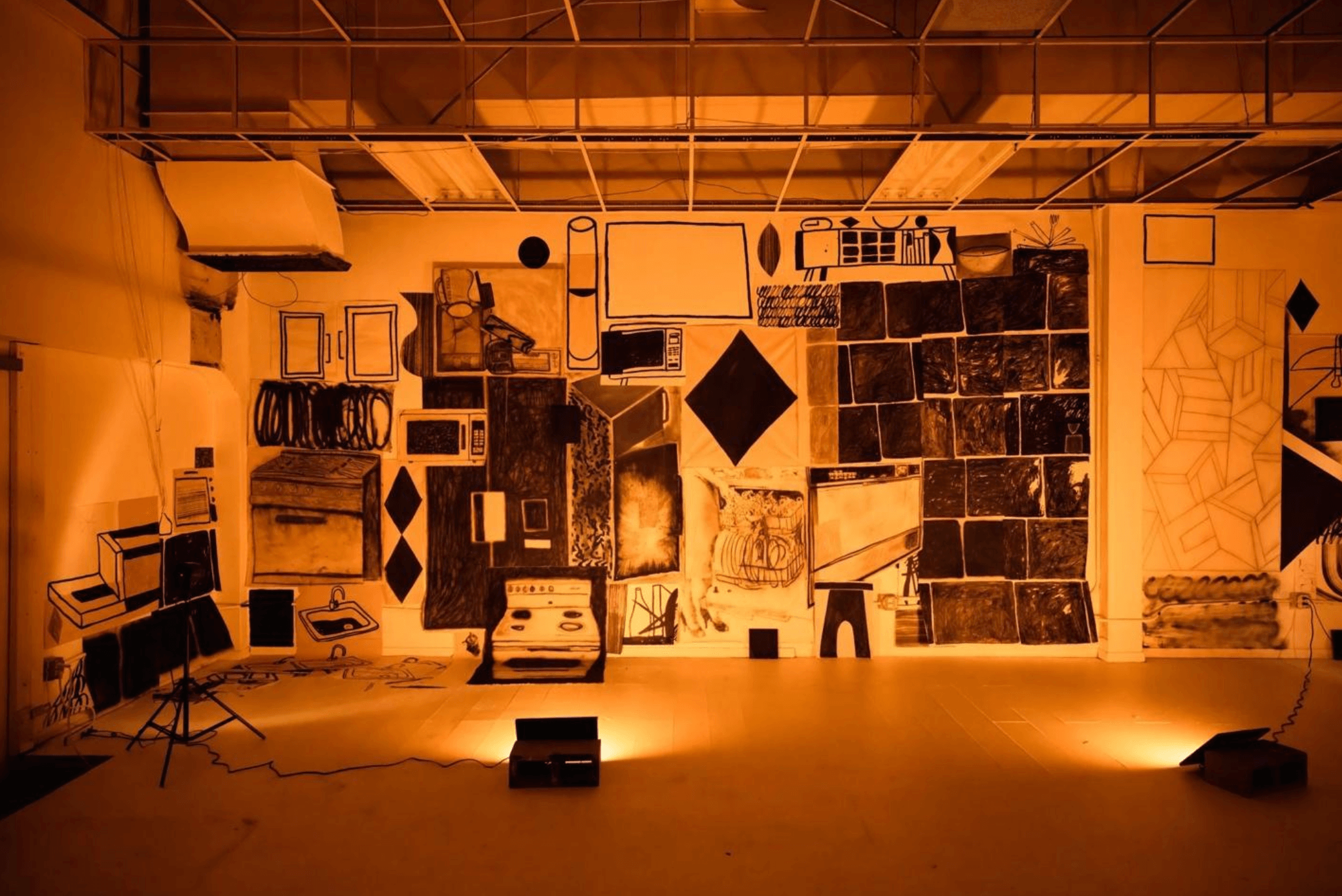
Partial view of Demo Room: An Unclean Wash, Cheflee and Muzae Sesay
The 16mm film, by Cheflee and Kate Dollenmayer, is worth watching. Called “Chasing Rest,” it follows a worker, home from the factory, who sees the chair he attempts to sit in repeatedly disappear. The short, fragmentary film effectively evokes the disorienting state at the crossroads of dream, nightmare, and wakefulness.
The show’s title fails to catch its mood. Sure, “Domestic” is apropos. But “Demo” adds little. The show’s text tells us that “demo” refers to both demonstration and demolition. But neither noun is a good fit: demonstrations are banal instructional vehicles; demolitions, simple removal.
The show is too subtle and too rich to be well-described by either of these words. A better title would gesture towards the show’s modesty and its simultaneously serious and fearless approach to art making.
The exhibition text posits the show as the close of a chapter in Sesay’s work that began with a pt. 2 show exploring domestic themes in 2018. On Sesay’s website, one can find examples of the artist’s work since 2015. There’s a clear progression, and it’s easy to see “Domestic Demo” as the culmination of an investigation. Where does he go from here? I plan to keep watching.
