
Mark Engel, Shifting Terrain, Triton Museum of Art
By Hugh Leeman
In 1965, renowned American author Alvin Toffler published the essay "The Future as a Way of Life" in Horizon: A Magazine of the Arts, in which he posited that technologies would change faster than humans could adapt, producing emotional overwhelm. Five years later, Toffler expanded the essay's ideas into the book Future Shock, in which he wrote, "Culture shock is relatively mild in comparison with a much more serious malady that might be called 'future shock'. Future shock is the dizzying disorientation brought on by the premature arrival of the future."
In the coming years, the first email would be sent, the Apple II would make its way into homes across the U.S., floppy disks would dramatically expand information storage, and early Ethernet proposals would emerge. Despite these advances in the 1970s, the pace of development offered humans ample time to evolve with their technologies.
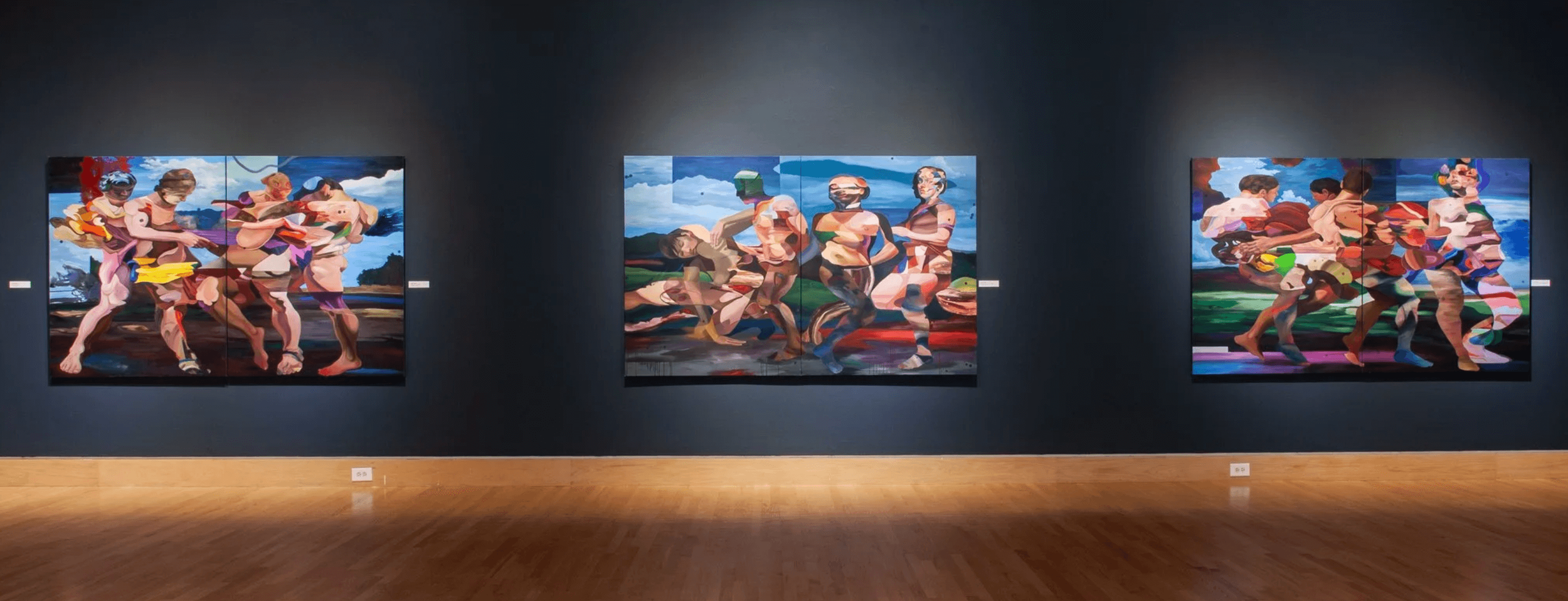
Amid today's premature arrival of the future, Mark Engel paints a contemporary vision that visualizes Toffler's prescient prediction. In doing so, Engel captures the culture shock of an exponentially accelerating world. His exhibition, Shifting Terrain, aptly on view in Silicon Valley at the Triton Art Museum, uses the ancient medium of paint to lend static permanence to the pixel-shifting technological intensity the digital terrain imbues on its inhabitants.
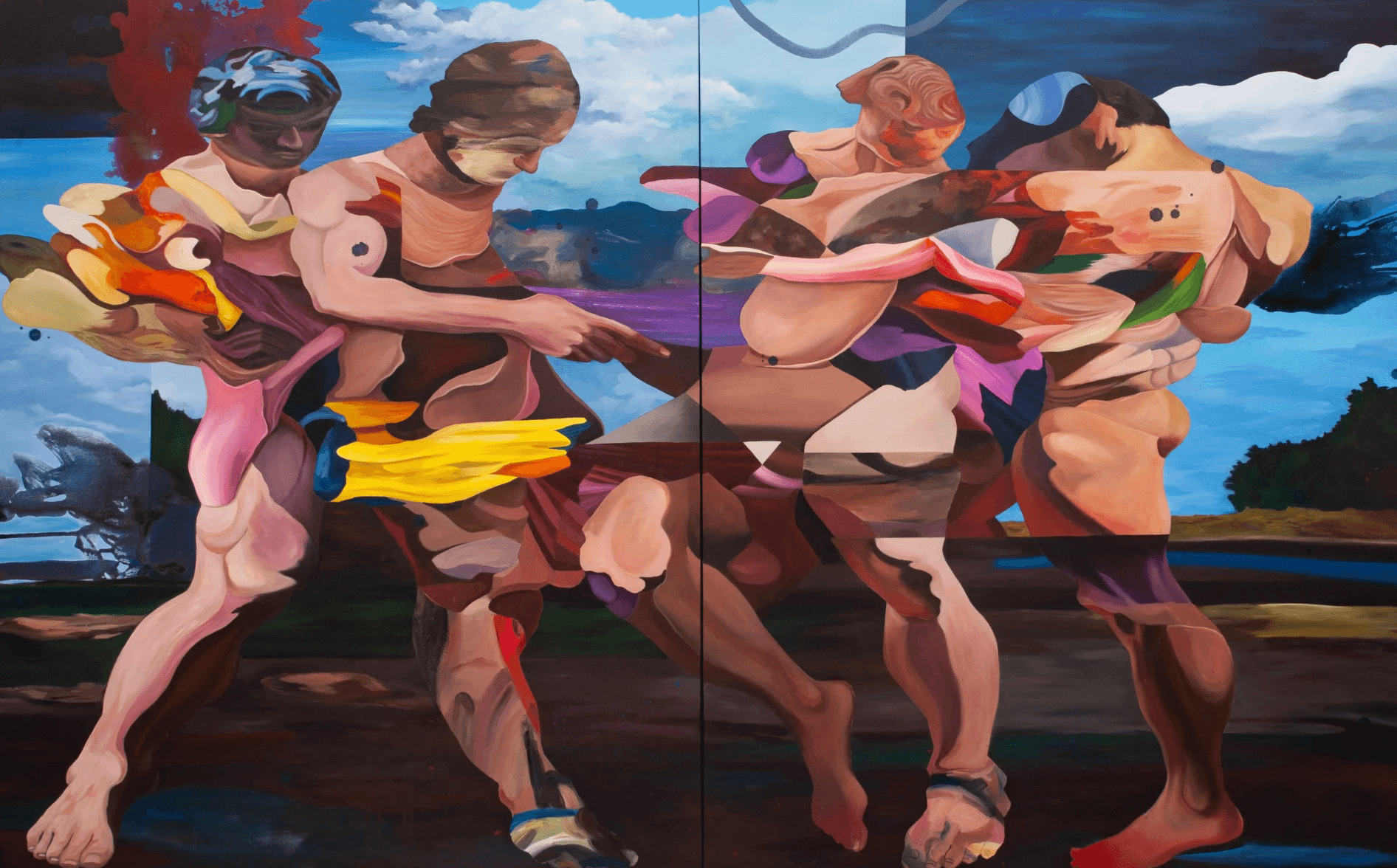
Shifting Terrain // acrylic and spray paint on canvas, 60" x 96", 2025
Engel's figures recall art history's figura serpentinata, seen in the ancient Laocoön sculpture and 16th-century mannerist painters twisting forms that dramatically stretch and writhe to convey the intensity of their time. In the former, the gods punish a father and his sons with a strangling snake for warning that the Trojan horse at the gates could not be trusted. In the latter, painters broke with the classical tradition of proportion, exaggerating human form to heighten the drama of social instability. In Engel's works, Laocoön's ancient serpent could well be the technology gods tightening their grip on humanity, as the Trojan horse, once made of wood, has since become an invisible algorithm that previously promised social connection, yet after being brought inside the gates, has, as Yuval Harari posed, unleashed its merciless army on society.
Engel's chimeric forms vacillate between realism, abstraction, and painterly passages silhouetted to read as an arm or leg. Burnt sienna flesh tones abruptly end alongside highly saturated yellows, blues, and streaks of hot pink; a glitch-in-the-matrix appears to have made a myth out of what it means to be human. Amid a civilization seemingly intent on entertaining itself into oblivion, Engel does as great artists of the past have done, show society the invisible world in which it floats. The omnipresence of today's digital ether transforms distant, organic-toned traditional landscapes with clashing neon paint whose splatters deliberately destabilize our gaze. In a conversation with the artist, he tells me, "We have so much information that we're hit with rapidly; it affects how we connect with others. It affects how we connect with ourselves."
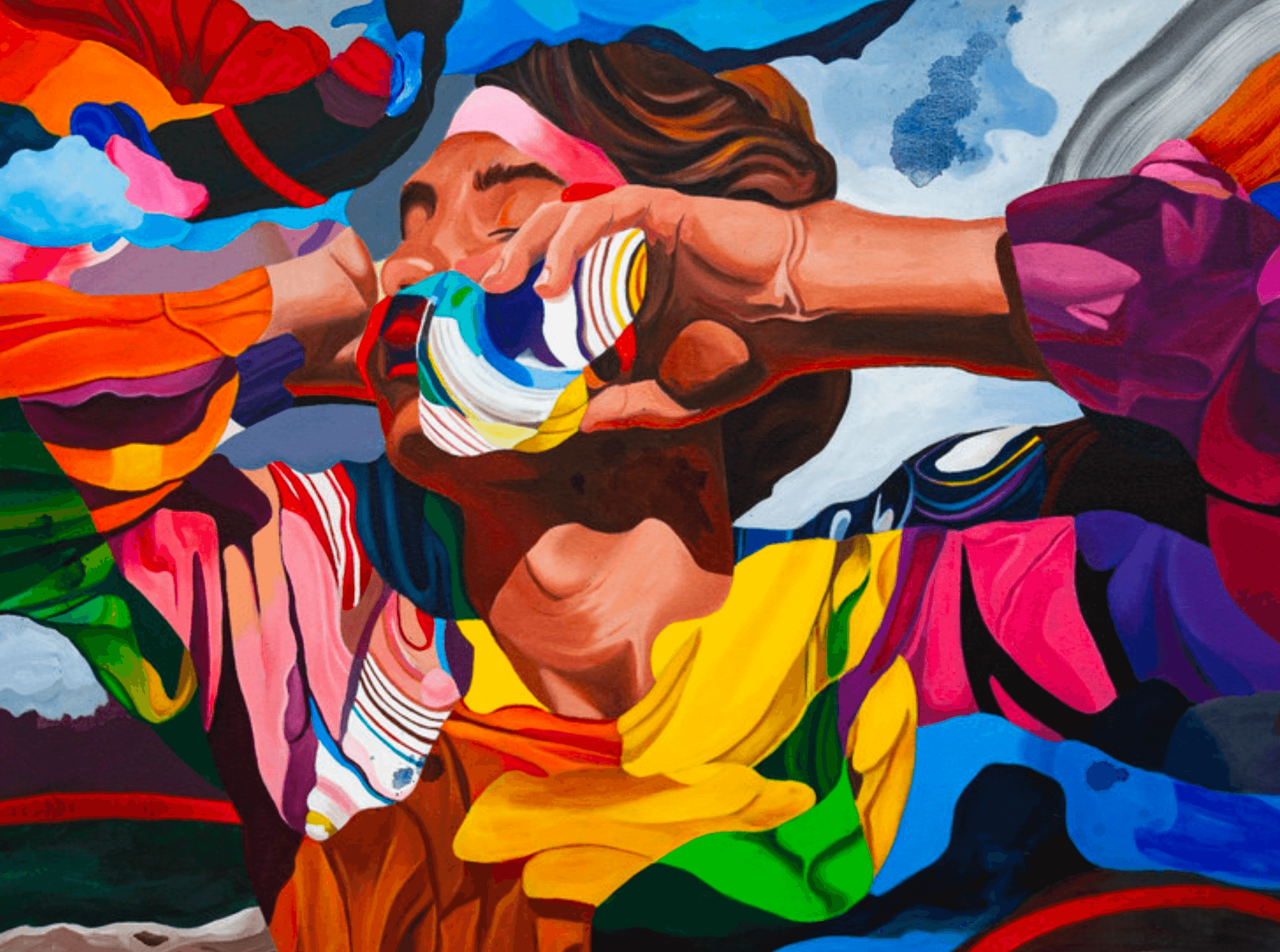
Echo Chamber, acrylic on canvas, 30” x 40”, 2024
Shifting Terrain comprises multi-paneled canvases with interacting figures, singular figures, and cut-out freestanding paintings. At times, the titles are as powerful as the colors. In Echo Chamber, a single figure stands enraptured by the technicolor dream coat of colors that she wears or has become. Each colorful form never takes full shape, implying divided attention. Inside a cupped hand held beside her ear, concentric circles evoke a visual echo. The sum of the divided elements reverberates as if an echo chamber, a digital space where information reinforces pre-existing beliefs as though they were facts. Engel says, "The solitary figure paintings draw influence from the Bay Area Figurative painters such as Nathan Oliveira, Elmer Bischoff, Joan Brown, who merge figuration and abstraction to express a deep sense of existential isolation. In my work, however…they are captured amid transformation where body and environment are porous and blended into one another."
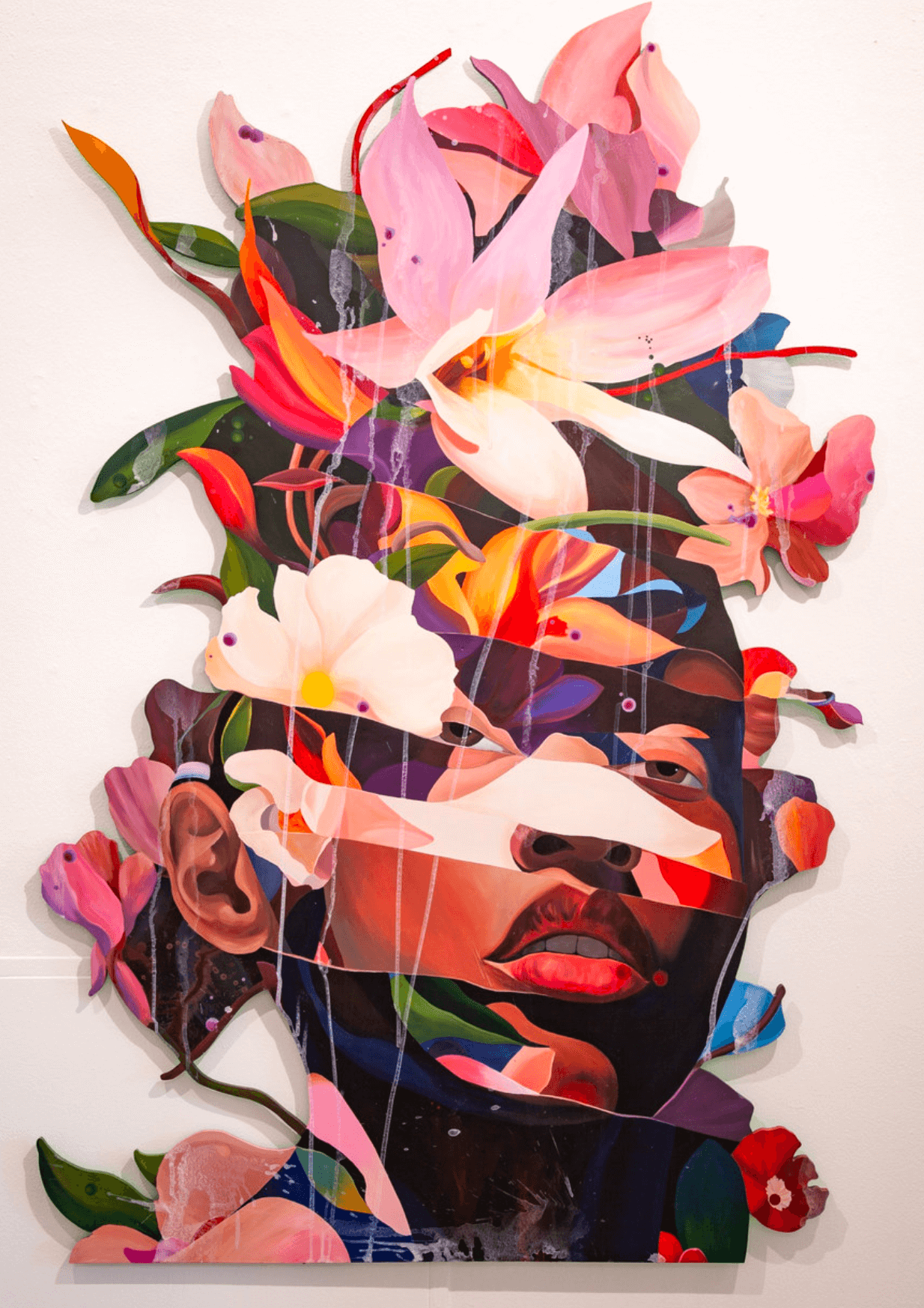
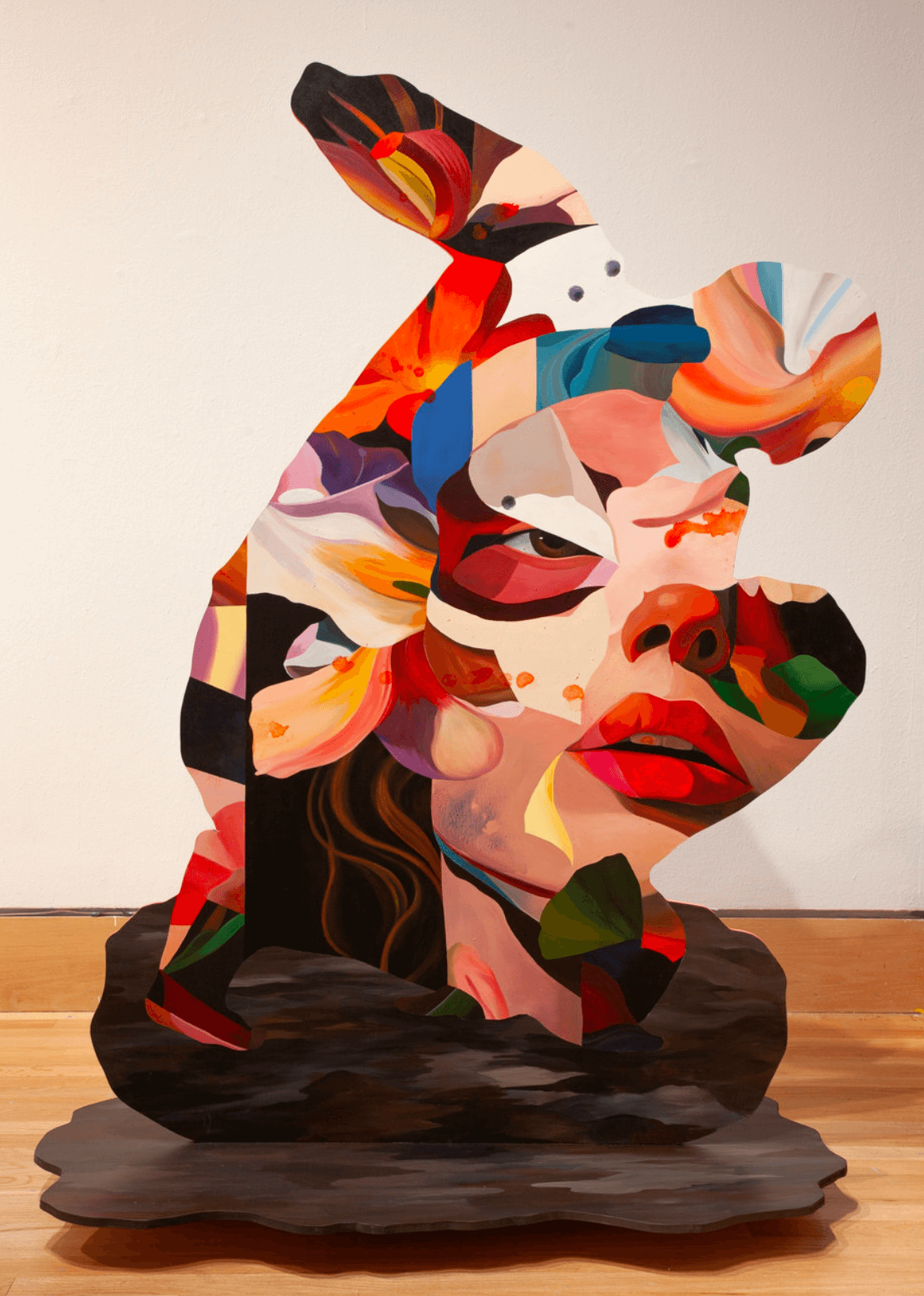
(L) Strata // acrylic on birch. ≈ 72" x 46", 2025, (R) Uprising, acrylic on birch, 60" X 48" × 32", 2025
In Strata, a wall-hanging, cut-out acrylic painting on birch panel, the artist has captured the visual culture of the internet's parallax scrolling, each horizontal band of the face evoking the web design technique where background content moves more slowly than foreground content to create the illusion of depth. A similarly designed, sculptural freestanding version, Uprising uses the parallax effect to seemingly collapse form and attention in on itself. In both Strata and Uprising, the portraits are subsumed in flowers, each bloom never taking full form, and our eyes are always moving on to the next. Uprising's facial features capture a breathy exhale of visual stimulation's pleasure, contrasted by red bags under the eyes and dilated pupils, suggesting that all the internet's visual stimulation comes at a cost.
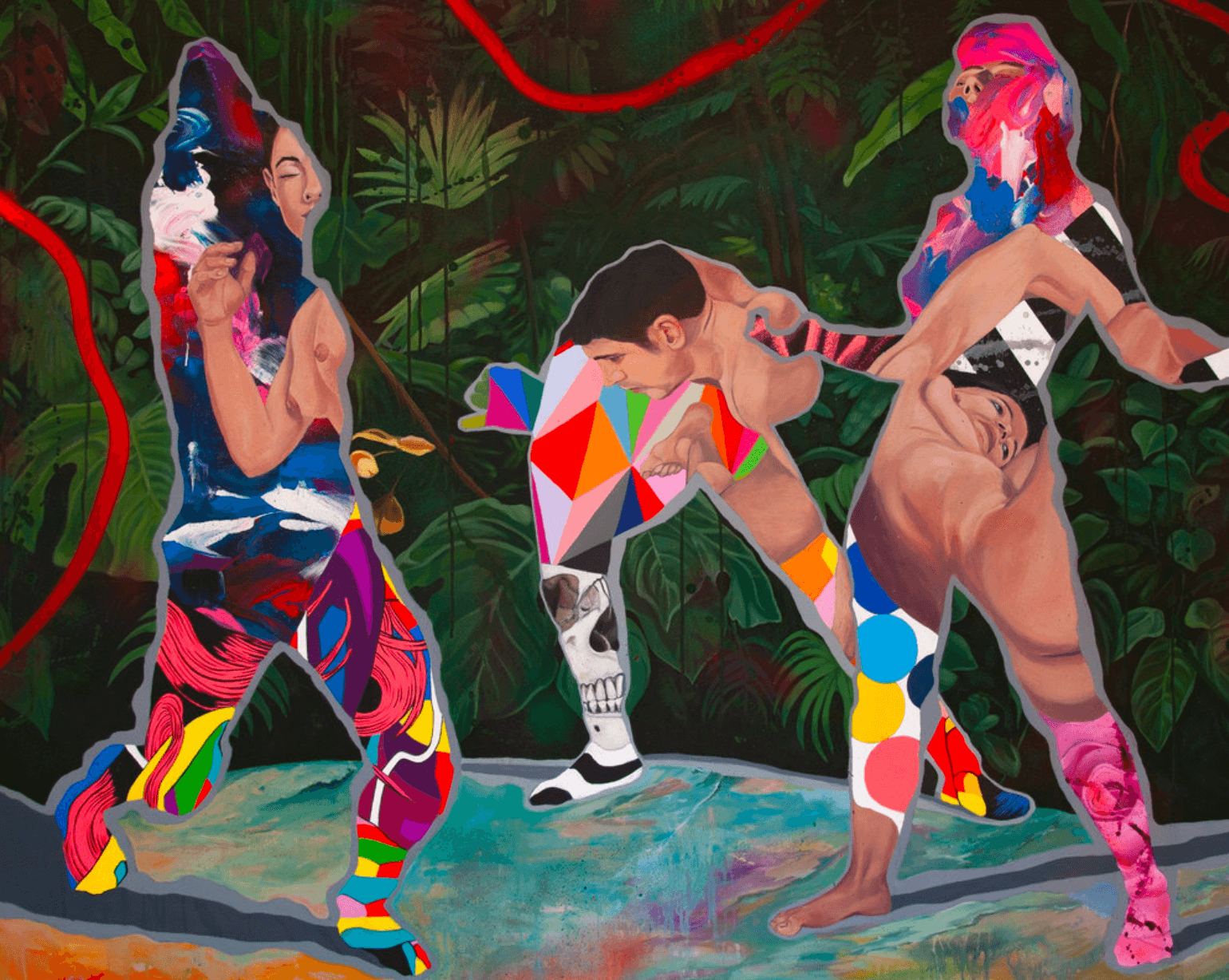
Three Graces// acrylic and spray paint on canvas, 48" x 60", 2024
Engel elevates his ideas with multiple interacting figures evoking compositions made in centuries past to capture the viewer in mythological narratives connecting humans' struggle between desire and disappointment. In Three Graces, a dopamine overload of Damien Hirst-esque dots and interlocking candy-colored patterns pushes flesh-toned figures beyond their bodies. The nude figures search for the silhouette of the self, contrasted by the lush green backdrop of the jungle. Engel's Three Graces joins a long line of artists who have taken on the story of Zeus's daughters, whose ancient names mean radiance, joy, and flowering, crafting a myth for the modern age. Despite all the attractive newness, Engel suggests that what remains the same is our collective destination, as a memento mori peers from within a figure into our world.
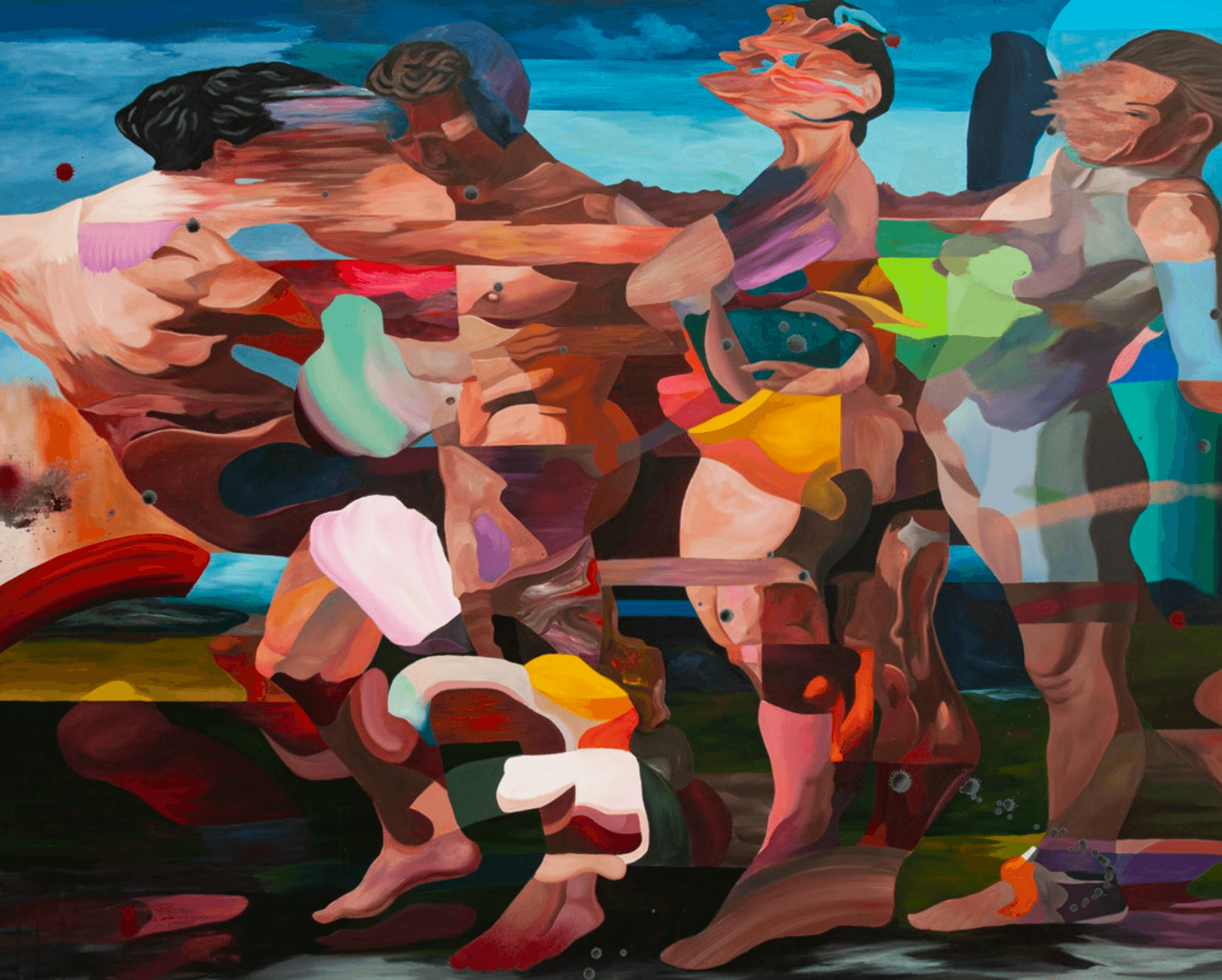
Continuum // acrylic and spray paint on canvas, 48" x 60", 2025
Continuum suggests human histories of gradual change remain consistent over time as exponentially accelerated musculature erupts into the abstracted malleability of Francis Bacon-esque flesh, transforming from one being to the next. The disembodied figures form a cubist, shoulder-to-shoulder pose, recalling ancient friezes that symbolized stories of unity and shared purpose, allowing the visual narrative to unfold.
The path forward in Engel's art is not immediately legible. Yet, similar to Toffler's 1970 book on future shock, the author optimistically put "forward a broad new theory of adaptation." Shifting Terrain is more than a mere critique of our world; the paintings hint at the positive, but where is the path that his figures seem all too distracted to find?
Engel tells me that he finds optimism amidst the incredible challenges, "The light in society today depends on how you view things, the light is the shifting of hope or perspective …really there is no resolution in the work. Everything's kind of in this state of flux."
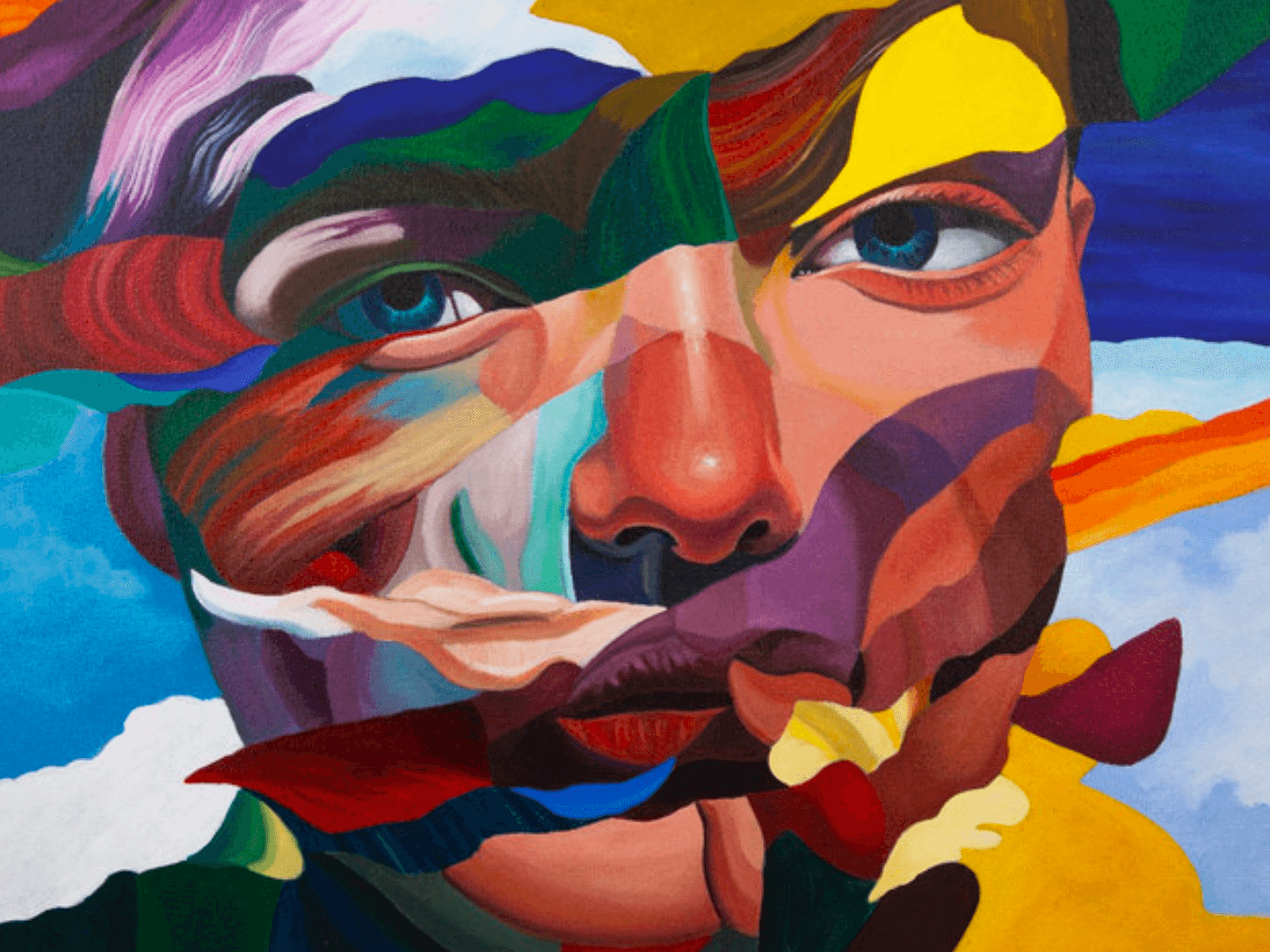
New Skin // acrylic on canvas, 18" x 24", 2025
While an infinite-scroll anxiety and society's shifting terrain palpably permeate Engel's visual glitches, accurately evoking Toffler's future shock throughout our conversation, the artist speaks of society's uncertainty as a moment of opportunity, suggesting it is a catalyst for transformation. Although inspiring, I can't help but consider Toffler's dizzying disorientation brought on by the premature arrival of the future.
The morning following my conversation with Engel, the artist texted me, "I want to add one thing to your question about where I thought we [as a society] were headed, and I should have said, 'closer to the heart,' because I feel that is the whole point of transformation. It could have been an alternate title for the show." Through Engel's alchemical optimism, one can see how Toffler's serious malady of how disorientation becomes a catalyst for transformation. Unlike the world of saturated scrolling images, the most compelling part is not the paint's surface but the world Engel allows us to enter. Depending on the direction we choose to walk through the darkness of the digital jungle and the perspective through which we see Shifting Terrain, beneath the surface, getting "closer to the heart" winds inevitably through the unavoidable algorithmic distractions. Yet Engel and his art remind us that beauty and respite rest in the shared organic tones of human fallibility, the chimeric improvise, and connection with carbon-based life.
