
Mario Laplante
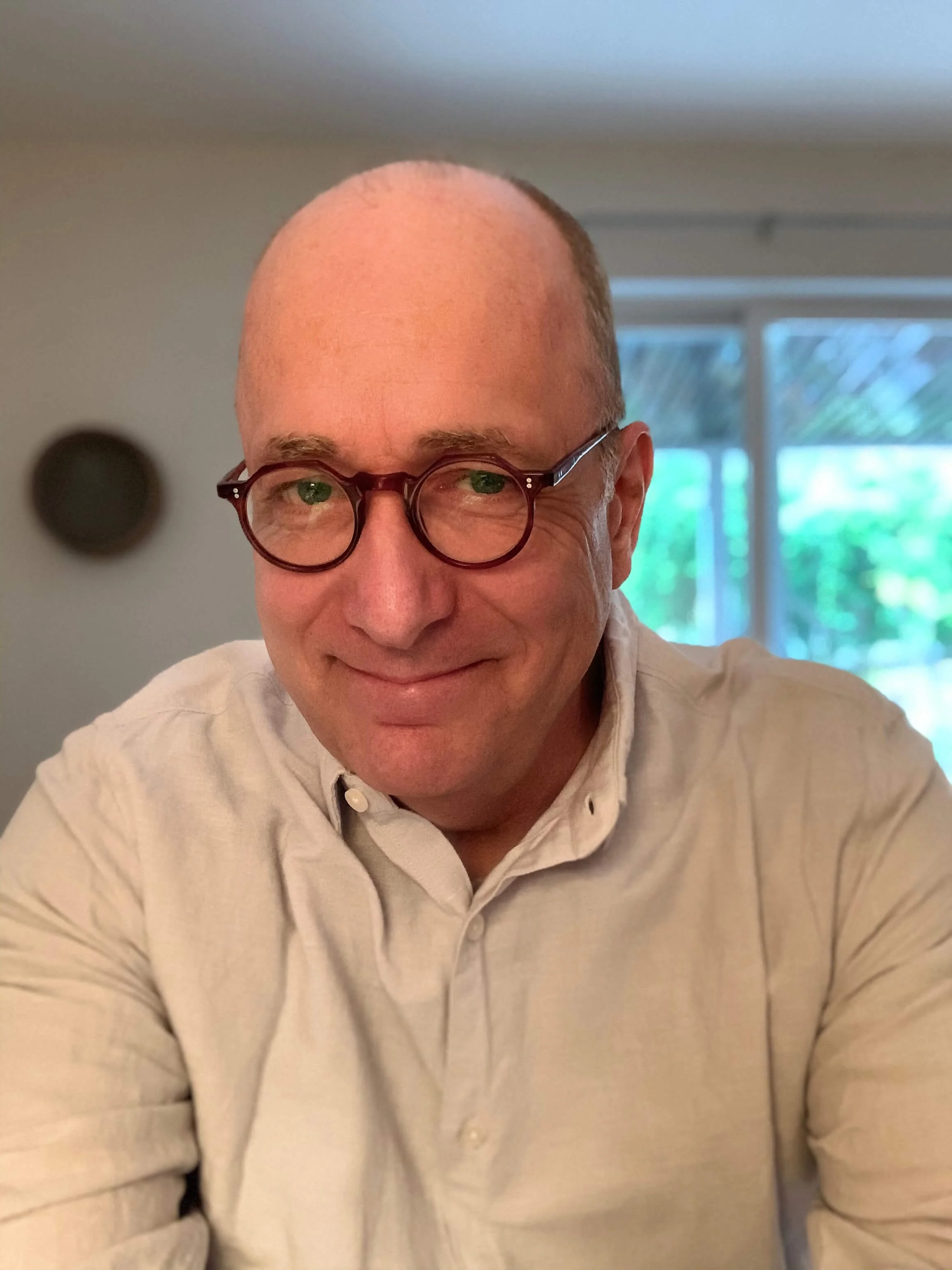
Mario Laplante lives in San Francisco and is a native of Quebec. He exhibits regularly, and his work is represented in several public collections, including The Bibliothèque Nationale du Canada, the Museum of Modern Art in New York, the Tate Gallery, and the Victoria and Albert Museum in London.
He received his MFA from the University of Wisconsin – Madison. These were extremely formative years for him, combining his interests in book and periodical illustration, typography, and type design with the “fine arts” potential of woodcuts, etching, lithography, screen printing, and digital prints.
His teaching is deeply connected to his work as a studio artist, and his interactions with students and the dialogue that develops within the academic environment are integral to his research and projects. His work with students has provided him with problems to solve and questions to answer. Art can raise consciousness and engage critical thinking, and he believes this is now more important than ever.
The following are excerpts from Mario Laplante’s interview, as conducted by Hugh Leeman.
Origins: Art as Social Confrontation
Hugh Leeman: Mario, many artists can trace their beginning creative interest to some form of doodling as a kid, but what you do transcends image-making. It confronts cultural challenges and the dark corners of society. How did your interest in tackling such challenging topics through art begin?
Mario Laplante: I think the year I was born had a lot to do with it — the late sixties, where there was more interest in focusing on people outside the larger group. Being gay, and the formation of different groups that sort of helped the cause. That's something that brought me to what I'm doing today. At the beginning I was more interested in what it means to be gay and its implications in our culture. Becoming more out through graduate school and meeting people from different parts of the US — I moved from Quebec to Madison, Wisconsin — formed my intellectual understanding of how to view myself: as a French-speaking, French-Canadian person, and where I fit in that whole community. That helped a lot in verbalizing and understanding where I stood and where I was going to change as an artist.
The Gay Experience as an Ongoing Spiral
Hugh Leeman: You mentioned the idea of examining the self, understanding your own sexuality, being gay. One of the main concepts you examine, as you write in your artist statement, is "the gay experience." In these examinations through your art, what have you learned that you feel the world has yet to truly see or understand?
Mario Laplante: What have I learned? Well, that it's an ongoing spiral. What I've gone through myself, and try to clarify through the work and through conversing with different generations — I've noticed over time that what I learned back then, which is very important: to stand proud and understand where you are. It sort of shifts to the next generation. I see students today trying to do the same thing when it comes to understanding their place as trans people. It's a total wheel that starts again — this need to stand out and be proud. I see it in our young people right now. So it's the same thing over and over again, but with a different group. Does that make sense?
Gender as a Social Construct: Then and Now
Hugh Leeman: Absolutely. One of the common refrains in academia is that gender is a social construct. How have you seen that idea shift from the time you were a student in art school to now?
Mario Laplante: My peers and people I've joined in academic groups — at SF State and other institutions — have all kind of acclimated and accepted me for what I was doing. From the time I applied for the job, I was always open: I'm a gay man whose work is founded on my understanding of that change, both academically and in terms of my surroundings. As a gay faculty, other students around me are able to verbalize and speak about their identity more clearly. Every semester I teach, groups of students are proud of who they are and able to act and be who they are very clearly, without any thoughts that may go against them. I've been proud to see this grow — especially in an art department, where students feel better about who they are and can express themselves as gay or trans people.
Teaching as Mentorship at SF State
Hugh Leeman: Art at San Francisco State University — your students speak in great platitudes about how you've influenced them as more than an art teacher, but in many ways as a mentor. This is beautiful and it's rare. Where does this care and interest in others' wellbeing come from?
Mario Laplante: It really comes from an early place. The love of art came first, being raised in a household where I had parents incredibly interested in the arts — from opera to ballet and music. That was always present in my formation as a young man. I understood music, I was interested in dance, my views were quite wide. I think that activated a certain complexity, an openness about emotions, and a willingness to be more honest — taking pride in the fact that I'm different and able to express that clearly with other people. In general, my character makes me seem approachable — people call me sweet very quickly. That's always stuck with me. It's part of who I am, and I was always very honest throughout.
The Unembarrassed Anxiety of Our Memories
Hugh Leeman: There's a portion of your artist statement in which you write: "The construct of each project that I'm involved corresponds to a restoration and excavation of the truth and unembarrassed anxiety about our memories." What is the unembarrassed anxiety of your memories?
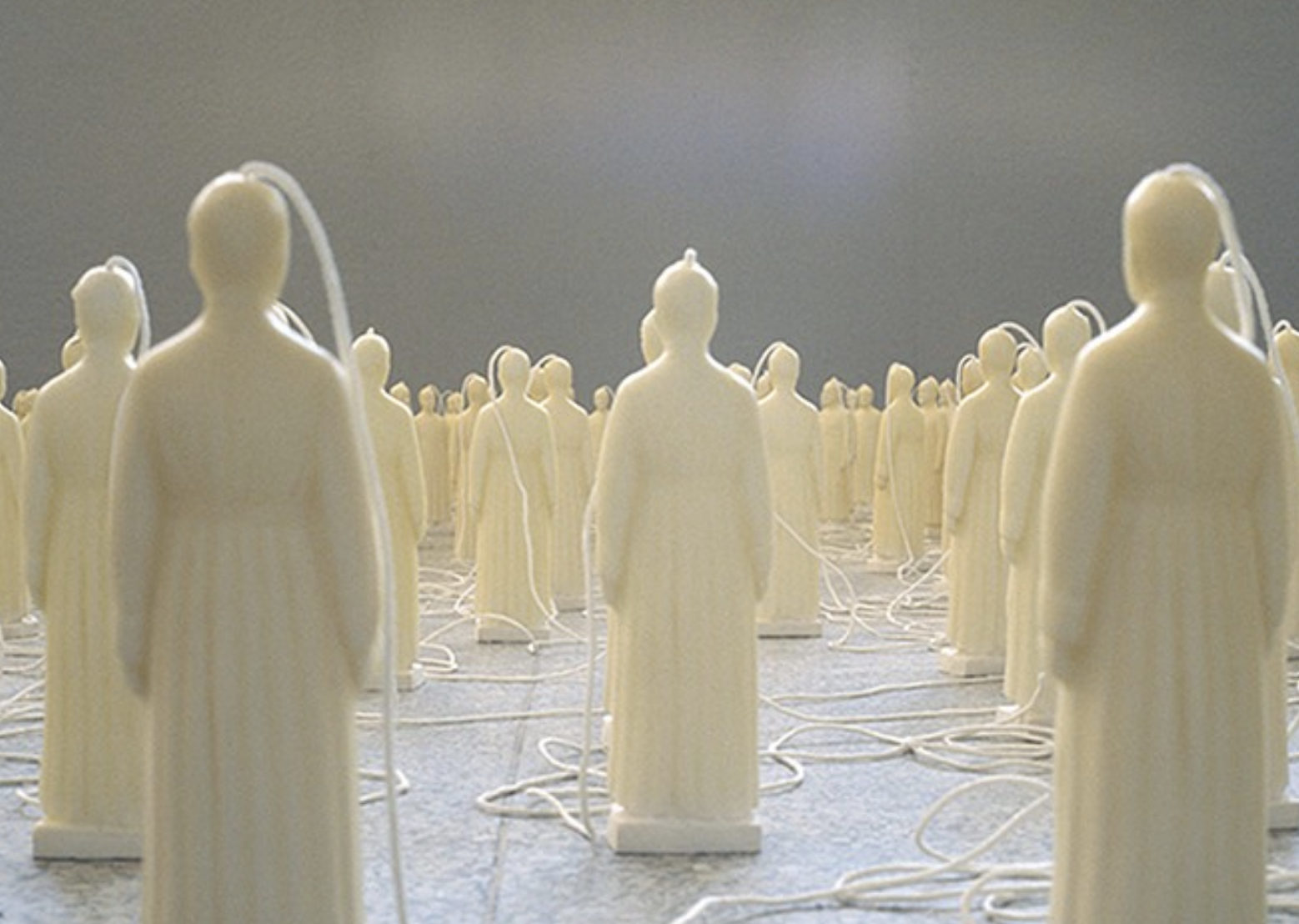
Mario Laplante: I guess I could go back to the gay experience — speaking truly of things that might bring up anxiety. Where do I fit next to yours? Where do I fit next to a woman in their seventies, or somebody in their early teens? And all the anxiety that comes with the capacity to speak of that. Art is the place where one can do that. In all the uncertainty I felt throughout my life, I somehow had the impetus to choose a form that spoke of that anxiety — using different forms to bring up these issues. I remember one year working with ceramics, learning about repeated parts. I created small ceramic figures — three hundred different characters — to respond to an event in Boston where three hundred and fifty cardinals had gathered to deal with the sexual abuse crisis in the Church. As a French Catholic man, I needed to deal with that subject. Creating that piece and having people come around to talk about it was really rewarding — to get it out. To be able to speak openly about the impact of Catholicism, and certainly how the structure of the Pope and priests conducted themselves toward children.
Project Illuminae: Confronting the Catholic Church
Hugh Leeman: That brings us to Illuminae — your project focused on the Catholic Church's covering up of sexual abuse scandals. What I admire is that you use your voice and art to uncover what's typically inconvenient to look at, yet this topic is particularly sensitive as it challenges the foundations of trust, religion, and its so-called holy leaders. Before embarking on this project, what was your inner dialogue? Was there hesitation?
Mario Laplante: Well, as a young person in the sixties, my family attended church — it was part of our upbringing. Then in the mid-sixties, everything stopped. The Quebec government decided to pull the education system entirely out of church hands and the churches emptied almost overnight. One day my parents believed in sin; the next day they did not. That was really a jarring experience — something was not clearly defined for me. I still have faith — it's managed and changed in various ways — but this lack of clarity in my upbringing drove me back to that project. I was trying to clarify, not bring answers, but create a form where a conversation could occur. That's what artists do. They create a moment where people can get together and talk — not fully understanding the full grasp of what might happen, but loving the making, the constructing, the learning about objects and form, and hopefully creating a forum where some can enjoy it. And in that particular context, having an institution willing to finance the project was very meaningful.
Hugh Leeman: In your writing about the Boston clergy abuse scandal, you ask: how can a church that preaches against so many forms of consensual adult sex simultaneously tolerate, ignore, or cover up the sexual abuse of children by its own priests? You call those acts a definition of what evil is. How has grappling with this moral hypocrisy affected your relationship to your own faith, and to the visual tradition — icons, altarpieces, ritual objects?
Mario Laplante: I came across a person who was incredibly impactful for my academic and creative career — Diane Fine, whom I met in graduate school. She's from a Jewish tradition; I'm Catholic. The two of us coming together and collaborating — we've collaborated for thirty years. Hearing her understanding and love of poetry, of text, and sharing her upbringing as a Jewish person was really enlightening. It gave me faith in understanding and taking pride in what my heart really believed: kindness, love, and bringing people close to you. Working with Diane was a key factor in how I was able to acclimate to the contradiction of being Catholic and who I am as a gay man today. Even now, when we work together, it's about our common thread, our disparity, and our love and faithfulness to each other and to our work.
Excavating the Truth: The Bible as Medium
Hugh Leeman: The other portion of that statement speaks of "an excavation of the truth." What is the truth you're excavating, Mario?
Mario Laplante: It's an ongoing process. Most of the recent work I've done is basically looking at Bibles — trying to understand their presence in our world, and dismantling and reconstructing them into symbols that are beyond what the object is, intrinsically always going back to the roots of my upbringing: Catholic church, then gay, trying to implicate some meaning from what that stems. Even today, even though I never fully understood the implication of Catholicism in my work and often put it aside — thinking it wouldn't be read as meaningful for everybody — I still do it. The usage of the Bible today is something that really is important to me in creating another symbol, something much more universal for a larger amount of people.
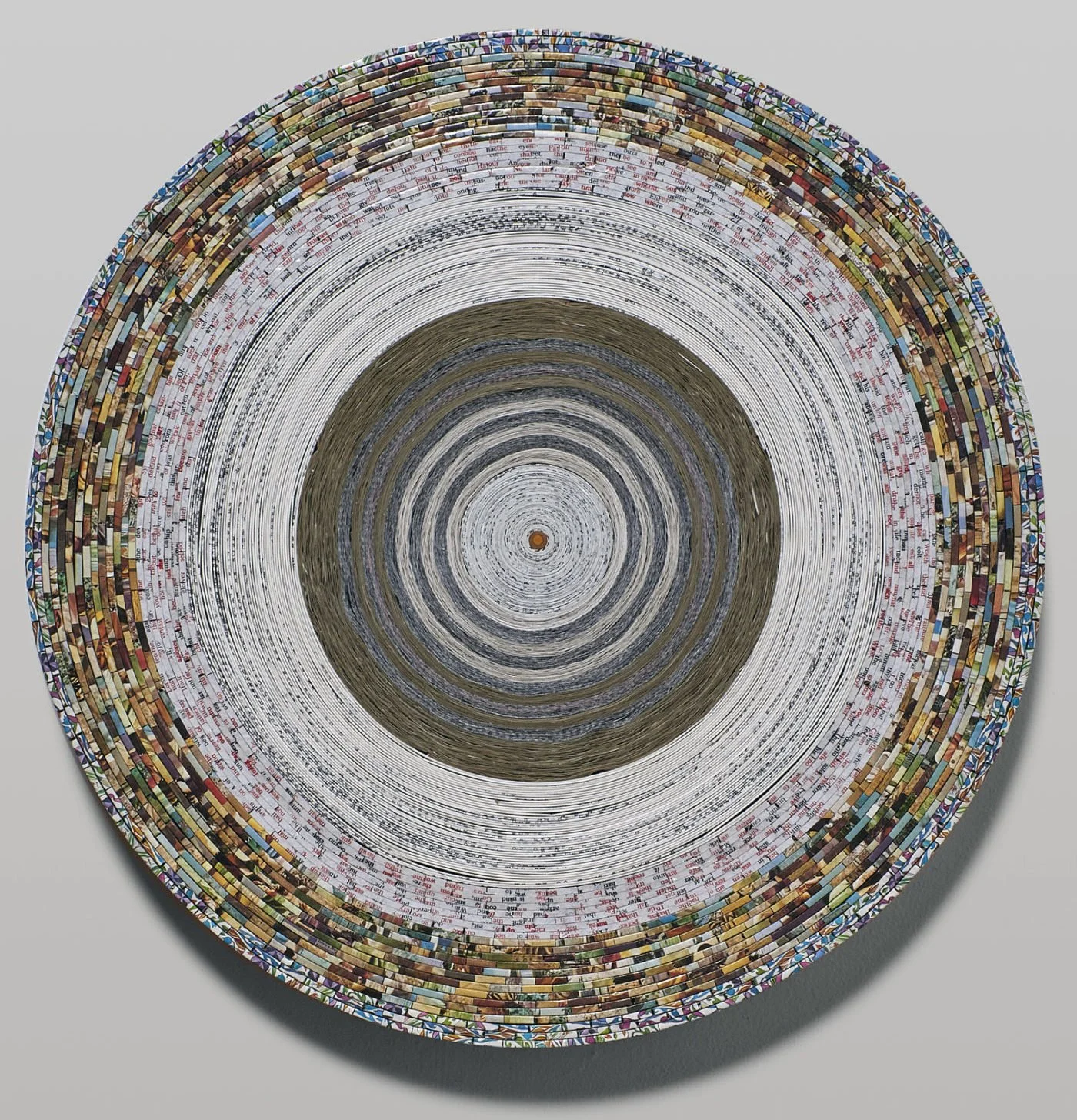
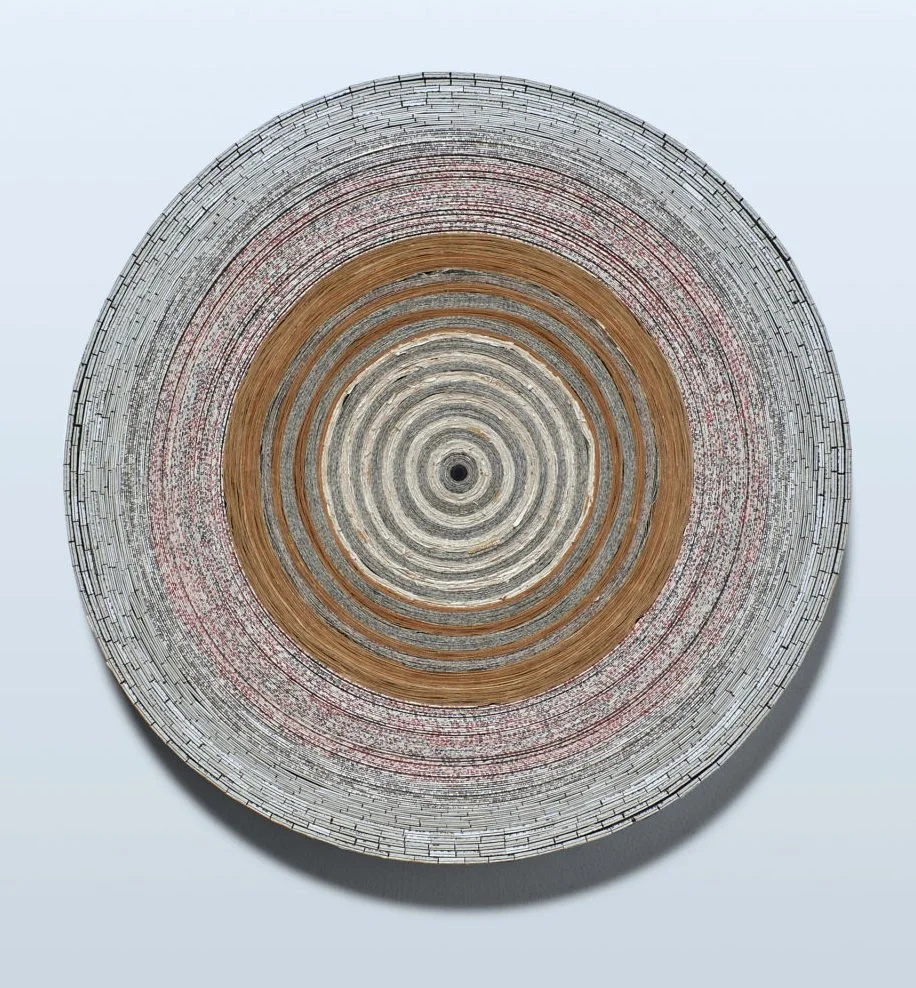
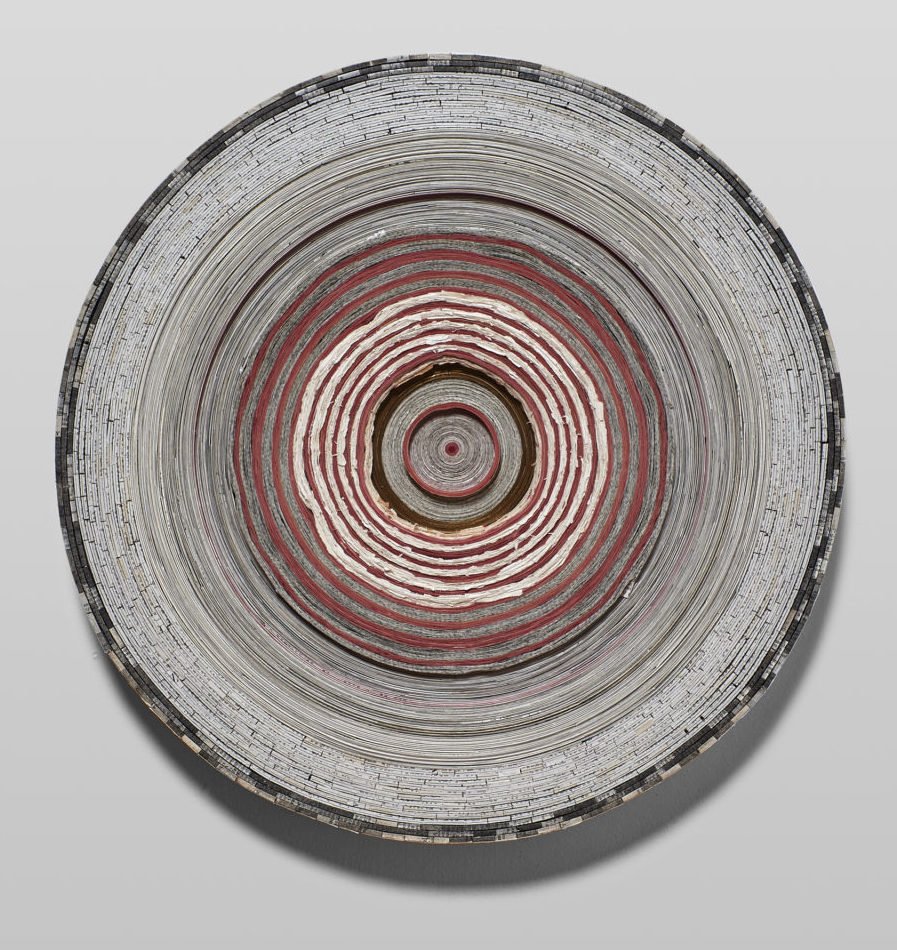
Hugh Leeman: You have a project called First Book Number Thirteen, in which you use paper and covers from the Bible to make large disc-like artworks. By using and reconditioning those materials, you're recontextualizing the Word of God. What is the significance of such a contrast — taking a wall decoration from the word of the Christian God?
Mario Laplante: I was trained as a bookbinder — I'm currently teaching artist books at SF State. So my understanding of the book made me feel like I have the right to look at it, to potentially dismantle it, and to see how it's created. In doing so, I'm reshaping the Bible. I don't seek to destroy or desecrate it — but to maybe elevate the text in a different way of viewing or encountering it. I hold the integrity of each page, every word — no parts are discarded. I hold all the contradiction of the text, every bit of the story. When someone comes to a different representation of a book as a flat disc, they can still read the words, still see the pages, the cover — they know it's an old object. So it brings reverence and certainly respect. It just allows one to reconstruct something old and view it in a way that's implicated in our world today. The most recent one was very emotional for me: I tried to isolate and highlight the word "Gaza" — keeping it visible as much as possible. That felt like, wow. I'm in a position of integrating something that's current politically into an object that has age and time.
Art, Gaza, and Iraq: A Political Conscience
Hugh Leeman: Let's go to the Middle East for a minute. It's not particularly common that Western artists show their work in the Middle East, yet your artwork is in the Iraq National Library in Baghdad. What is the story behind that?
Mario Laplante: It's related to Mutanabbi Street — a street where car bombs were exploded. A group of artists got together and decided to make art specifically about that event. I did a few prints, and they were included in a collection that was donated to that library. I was implicated in a group with a political aspiration of bringing understanding to a horrific event. Politically, I'm aware of what's going on in the Middle East — it's very hard to take on, and scary, because the history is not entirely known by all of us. But I'm taken aback by the increase of anti-Semitism in American culture. That's something that has always been going on, but it's heightened right now, and I find it very disheartening to witness.
Open Studio: Navigating Confrontation
Hugh Leeman: The studio is often a sanctuary for artists. When you do an open studio — with work on such sensitive topics — how do you navigate those conversations when people are confrontational?
Mario Laplante: At the time someone confronted me, he said: "I will never do that. You should not do this. This is sacrilegious." And at the same time, the man who voiced these opinions was with a friend — and that friend happened to be a librarian. She handles books all the time. She said to me: "Mario, it's all right. You're doing good with the book. You're giving it another life." She gave me strength and affirmation. If it hadn't been for her, I would have had a hard time moving forward. Both extremes were presented in half an hour — I felt terrible about the outcome from this man's perspective, then this woman who was a librarian said, "You're giving life to these old books. That's all right."
Hugh Leeman: So if she doesn't give you that social affirmation — where does this go? Do you stop making them?
Mario Laplante: It all depends on what comes from the world. Right now, within Diane Fine's family, her sister's husband has these old Hebrew books that his father read every day. He says, "Mario, can you do something with these books?" I'd never worked with Hebrew study books. I've had them in my studio for a year and I still haven't touched them — it's very difficult to approach them. I have conversations with them periodically, just to make sure I'm starting from a good place. But it's requests like this from the outside world that give me the impetus to continue. It's not just my own desire to work. It's also members of this extended family that I absolutely love who approach me and say, "Mario, do something beautiful with these books that my father loved." I was very touched by that.
Dual Identity: Canada, California, and the In-Between
Hugh Leeman: You've mentioned identity in the context of sexuality, but there's also the identity you confront through being from Canada and immigrating to the United States. In your artwork "The Role," you write: "The role allows me to meditate on the consequences and ramifications of being emotionally attached to two cultures, two countries, and two homes." With the friction between Canada and the USA right now, how do you view these emotional attachments today?
Mario Laplante: Being respectful of both vantage points — I've been in the US longer than I've lived in Canada. I have family ties; I go back twice a year. When I travel, I'm very sensitive to how my Canadian family reads the United States — their willingness to not buy American products, to check the origin of things they purchase. Many Québécois are in that position, and I respect that. But when I travel there, they're now being much more boisterous about their actions and what they're bringing into their lives. My identity is certainly much more American than Canadian now, but there's still a lot of weight on both sides — one is emotional and family, one is friends and work. Here in California, learning more about Cesar Chavez has been another layer. My understanding of the history of this state actually buttresses who I am as a person, both in understanding and pride. Quebec for many years was a minority in a large group of English-speaking people — and that was part of my premise, understanding language and what it means to be French-Canadian in a world of English speakers. Here in California, it's this understanding of all these minorities that come and try to make a living, and the complexity of integrating yourself into a larger group.
Diane Fine: Thirty Years of Collaboration
Hugh Leeman: A few times throughout our conversation, you've mentioned Diane Fine. You have a multi-year-long collaborative series of projects with her. Who is Diane Fine to you, and how did all this begin?
Mario Laplante: I was lucky to be invited to UW Madison for one year as a special student — in the graduate printmaking program, which has a very large department. I happened to meet Diane during that time, her first year in the graduate program. We met and collaborated on a book called List — she was the binder, I did the lithographs, and a third person contributed the text. That was our first collaboration, our first year, and we've collaborated like that every year since for thirty years. Through the collaboration, she ended up relocating to Plattsburgh, New York — an hour south of Montreal, geographically very close to where I'm from. So when I travel to Montreal to see family, I drive to Plattsburgh, work with her, collaborate, and then fly back here. She merged into my family structure. Right now she's building an incredible structure that will be both a studio and a community center where art will be taught. She's got an incredible capacity of largeness and love for her community. Diane is like a gift to me — she's guiding me in all kinds of directions and has formed me as a person, as an artist, in so many different ways. I can't be thankful enough.
Teaching Adults and the Next Chapter
Hugh Leeman: What you're sharing here about this transformation — going from sharing your passion for art with twenty-year-olds getting a degree to doing it for people who just want to learn and share and create — there's something profound about that. Create a landscape sketch for me: you're at this community center, you're teaching a class. What do you want to share with them?
Mario Laplante: Having the title of artist from California always carries some weight — but also returning to the East Coast, returning home, having visited that community for thirty years. Diane has built a large community of friends there. I think she's creating a forum where I can just fold right in. She's set up with letterpress — she's got a number of presses for etching and linoleum. So I'm hoping that together we'll be able to present workshops covering the full spectrum of the book: the writing, the publishing, the binding, the printing. What I could contribute is the imagery part — the printmaking and the visual. Diane is an incredible bookbinder and letterpress artist. Together, those two ideas would allow artists and writers in that area to come into that space and say: I'm ready to self-publish. Guide me through the process.
What Comes Next, Projects and Social Challenges
Hugh Leeman: To bring our conversation full circle — we've talked about your projects from religion to the deconstruction of a holy book, the Catholic Church abuse scandals — challenging things that are so convenient to ignore. What projects and social challenges do you want to confront now and going forward?
Mario Laplante: The transition of no longer being a faculty member at SF State is certainly a big change. Shifting my focus to a different demographic — older adults willing to go back to class. Diane and I have been traveling — Italy, England — finding locations where we sit for a month and work, and out of that comes work we can publish or show in galleries. As for my own studio, if given the forum to formulate a project specific to an idea, I'm willing to do it — through grants or residencies. Cahoots in Petaluma is a place I've always wanted to go. But I must say: what you've created right now — this conversation — I've never had the opportunity to have an arch over the entirety of what I've done with such clarity. It gives me pride in the career I've had. I want to thank you very much for making this possible.
Hugh Leeman: Mario, thank you for sharing so vulnerably and candidly. One of the things I set out to do with these interviews is address the challenge we have as a society — we've become so obsessively curated of our personalities, so filtered in how we present ourselves, and there's a major mental health aspect connected to that. Reading about what you've done, and then talking with you — it's a not a panacea, but it certainly softens that challenge. There's something very candid, very honest and vulnerable in your work and in this conversation. Mario, thank you very much.
Mario Laplante: Thanks for the opportunity. I really, really appreciate this moment that we share. Thank you very much.
