
Devon Pin-Yu Chen, The Dog is Busy Having Hotel Breakfast,
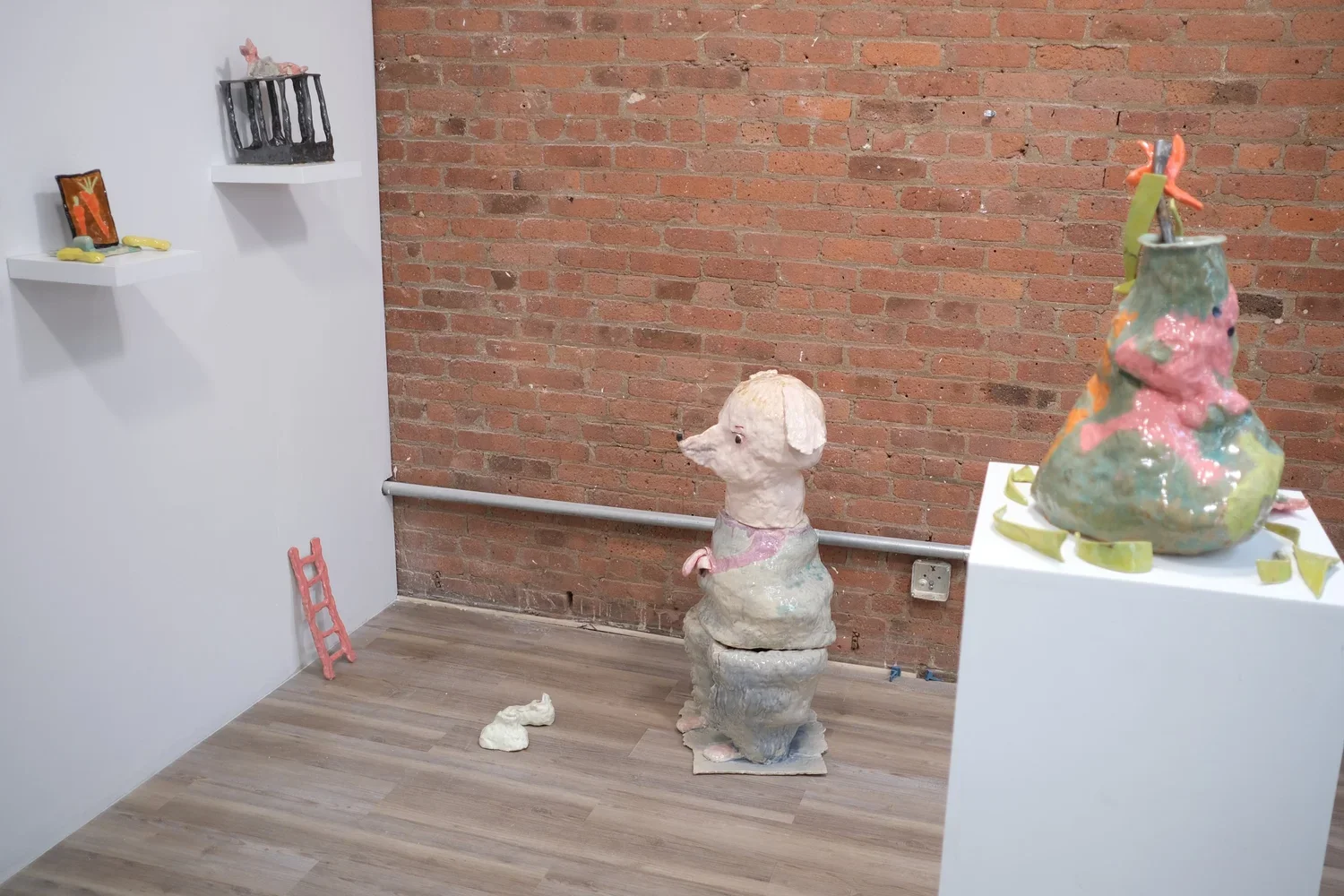
Installation view ofThe Dog is Busy Having Hotel Breakfast
By Wei Huang
“What does it mean?” was among the first questions I asked Devon Pin-Yu Chen after stepping into The Dog is Busy Having Hotel Breakfast, the artist’s latest exhibition for her residency at the pottery studio All’bout Clay, nestled in the bustling Midtown of Manhattan. By that, of course, I was referring to the title. “It means what it means, literally.” She replied, before denying any reference to sayings or proverbs. Along with the somewhat esoteric title at first glance, this short exchange encapsulates Chen’s work: endearing, delightfully earnest, and inviting to dwell on.
I first met Chen at her debut solo show, Happy Islands, at Nguyen Wahed this February, less than a year after she received her MFA from Columbia in 2025. At the show, Chen shared that the feedback she received on her first assignment, for which she made container-like ceramic works, was “you might as well make them at home.” She told me that at Columbia, “functional works” are looked down upon by the faculty. The school does not provide parts [I’m thinking “accessories,” as in attachments that could be added to the works that could be deemed “functional,” such as wheels. In the program, a vase, for example, needs to be made as sculptural and abstract as possible to avoid scrutiny and therefore gain legitimacy. Chen recounted this anecdote with more bewilderment in her tone than resentment, and while much could be written about the hierarchy of the arts and its legitimacy, The Dog is Busy Having Hotel Breakfast does, inadvertently or not, respond to the issue. By hosting the exhibition at a “pottery” studio, Chen came out undeterred and adherent to the pragmatic dimension in her aesthetic pursuit. Stretching Dog Vessel With Human Flowers (2026),an ensemble comprising a vase painted with a pink dog and orange bones, a ceramic flower, ceramic leaves, and scattered star-shaped ornaments, is among the examples in the show that stylize domestic objects without obscuring them.
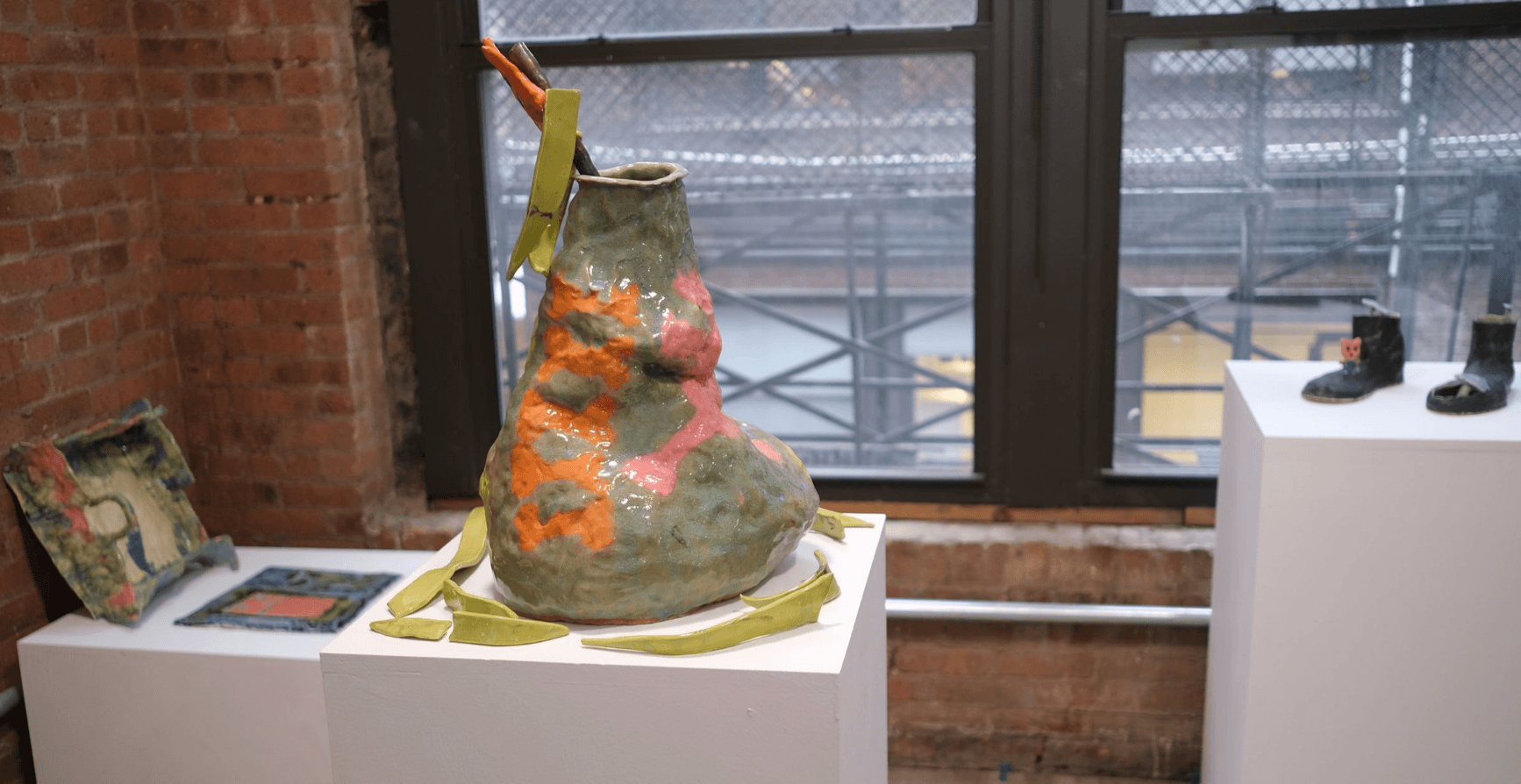
Devon Pin-Yu Chen, Stretching Dog Vessel With Human Flowers, stoneware and glaze, 19 x 11.5 x 15 in., 2026
Chen is conscious of hierarchy and social rules as well as their subtle precarity, articulated through the dog image that transfixes the majority of the 11 ceramic pieces on display. Beneath the title’s quirky façade, the suggestion that a dog is participating in a financially privileged human ritual—hotel breakfast— provokes questions on societal norms to which all citizens are presumed to acquiesce. In some cases, the subtlety cracks, as seen in The Serious Dog (2026), a free-standing statue of an anthropomorphic canine standing at 38 inches tall, frowning at two miniature sculptures aptly titled The Serious Dog’s Shoes (2026) and The Social Ladder (2026). On the other hand, more ruse is deployed to sneak in the message in Would You Share Your Mushroom? Little Dog? (2026). A work in two parts showing a crouching puppy coveting a white mushroom on a saucer, the ceramic sculptures are twofold in the innocuous scenario they enact and the latent question they pose on the ownership and entitlement of resources.
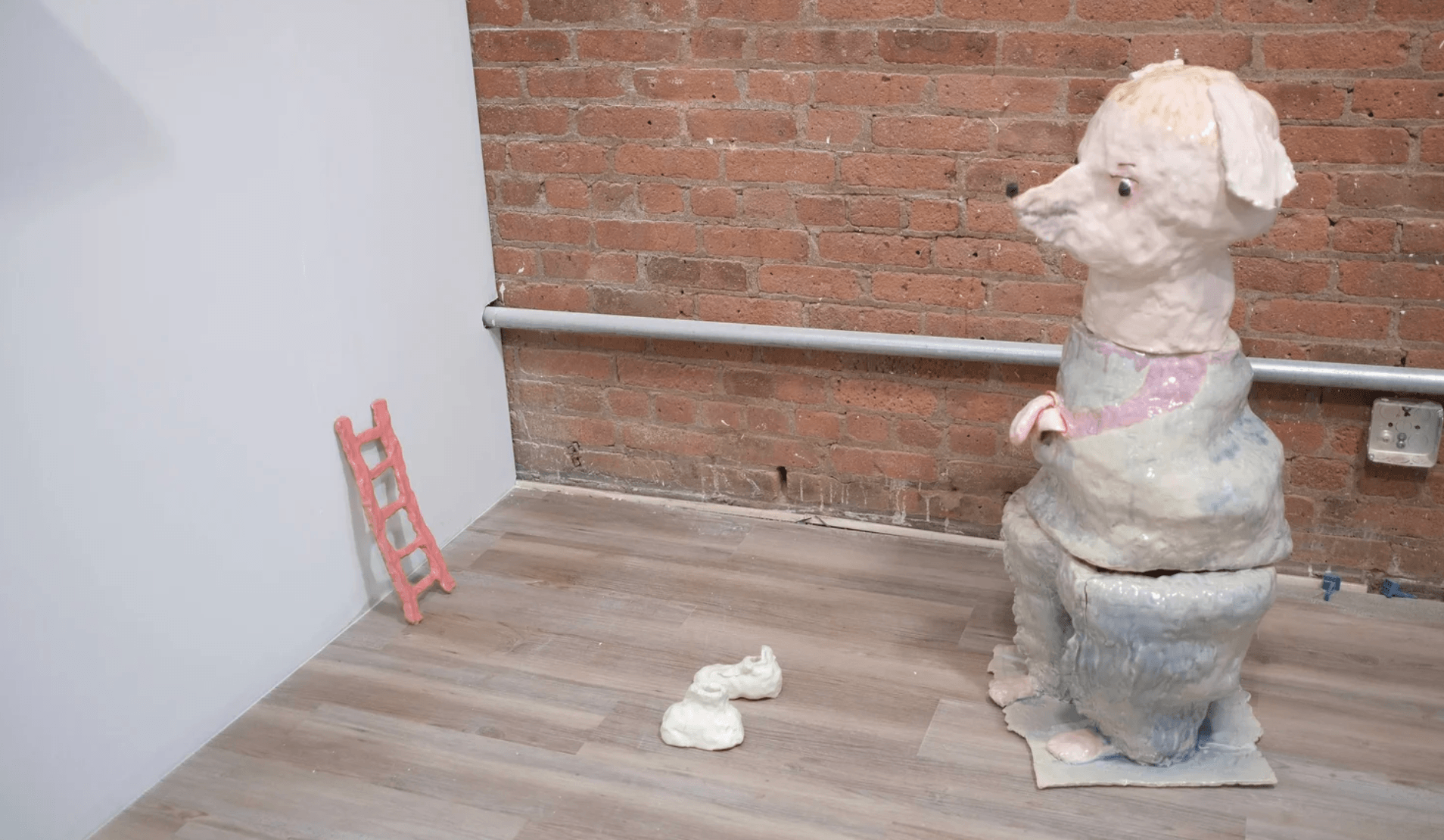
(Left) Devon Pin-Yu Chen, The Social Ladder, stoneware and glaze, 15 x 0.5 x 6 in., 2026; (middle) The Serious Dog’s Shoes, stoneware and glaze, 3 x 6 x 9 in., 2026; (right) The Serious Dog, stoneware and glaze, 38 x 15 x 15 in., 2026
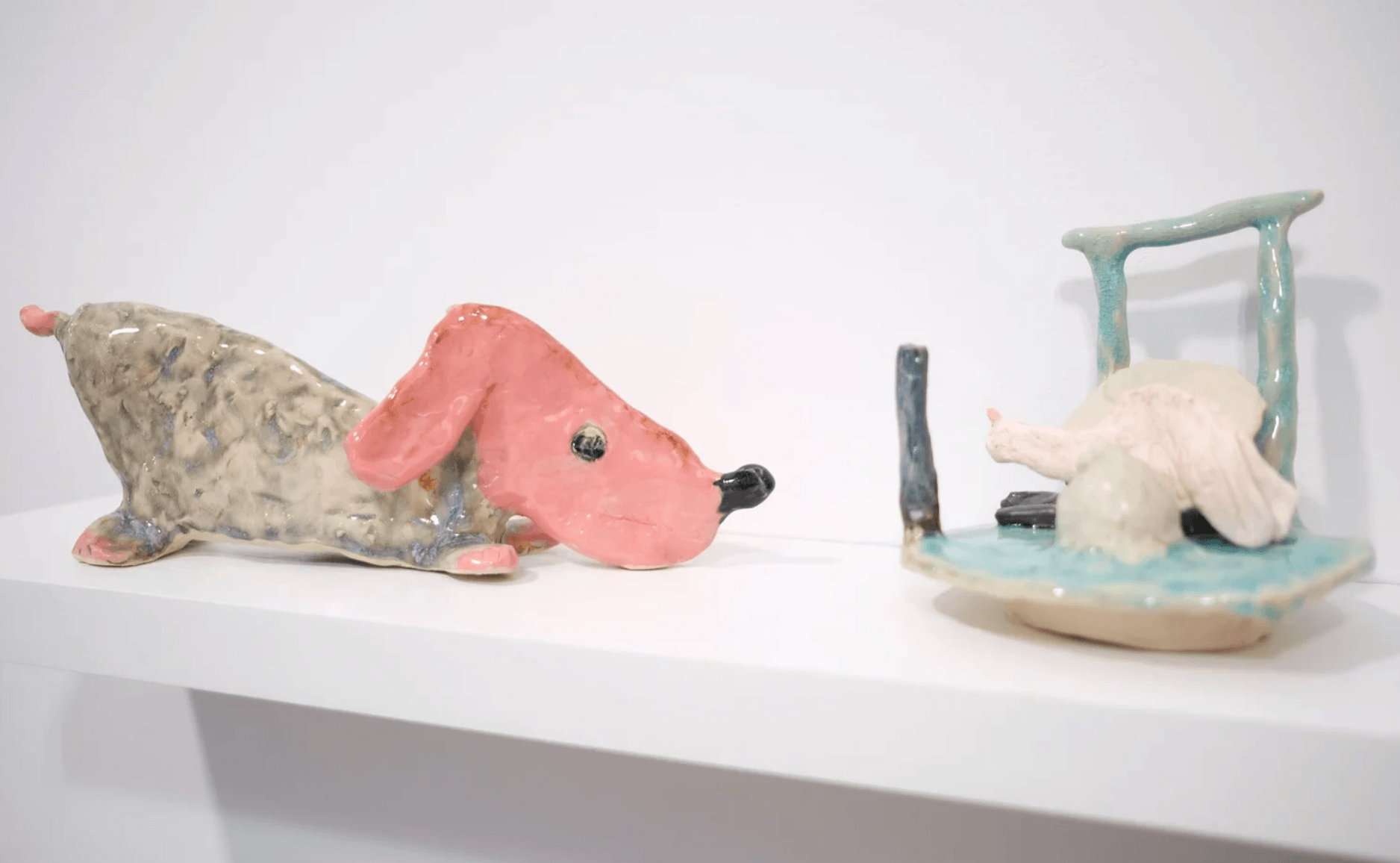
Devon Pin-Yu Chen, Would You Share Your Mushroom? Little Dog?, stoneware and glaze, 4 x 4 x 10 in. (dog) and 5 x 5 x 5 in. (mushroom), 2026
Along with the dog, food is the other headliner of the exhibition to consummate Chen’s allegory of social class and her conceptualization of clay as material. In the curatorial statement, clay is analogized to food, as they are “both extracted from the ground, shaped by hands, and placed on a surface to be desired.” In drawing the comparison, Chen expands what “farm-to-table” means by bringing the vehicle of food into the picture. The analogy between clay and food roots deeper into the life cycle of both: the care, cultivation, and transformation of it all, which explains the handmade quality that characterizes Chen’s works. Palpable is the unsmooth surface with traces of manual manipulation across the exhibited ceramics. Under the glistening glaze, the purposefully textured skins of the sculptures are tactile. Each crinkle and fold maps Chen’s squeezes and pushes, corroborating the wet clay’s precursory materiality harbored in the now hardened ceramic. Focusing on the transformative process of clay and food, Chen likewise looks back to shared memories and lived experience to source her themes. Born and raised in Taiwan, Chen’s works primarily reference the nostalgia she holds for the western Pacific island. Invoking the maritime geography is the featured artwork Coastline (2026), a standing slab hybrid of sculpture and relief on which the bright blue ocean, the saturated orange landscape, and images of wildlife compose the ecosystem of Taiwan.
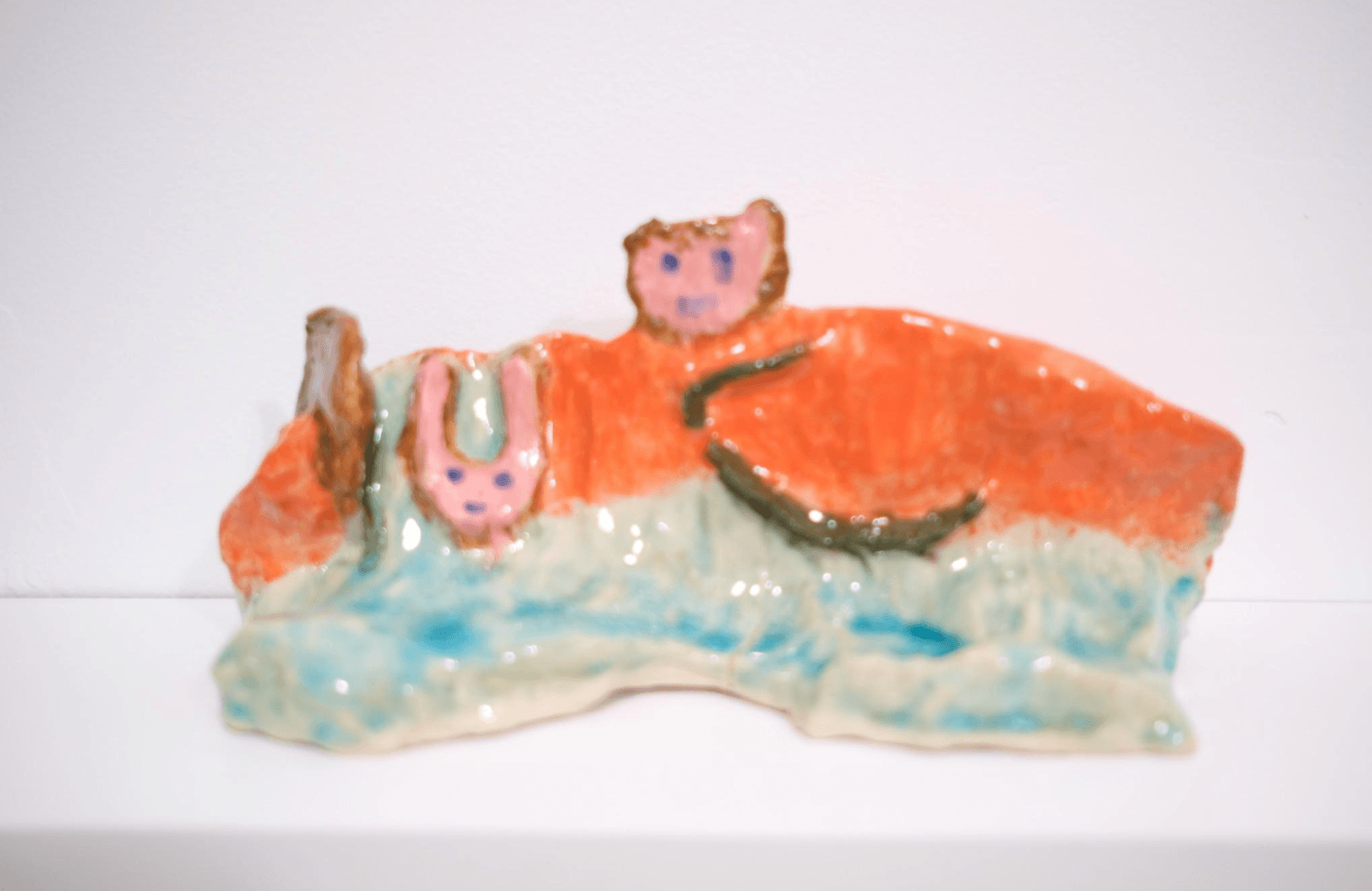
Devon Pin-Yu Chen, Coastline, stoneware and glaze, 5 x 5.5 x 11 in., 2026
More than just indulgent in the nostalgia, Chen infuses her works with a sense of unease brought by her immigration status. In the slab painting Metal Pencil Case (2026), Chen invokes the classic Taiwanese stationery adored by schoolchildren. The peach-colored, animal-themed pencil case is cramped in stark contrast against the indigo backdrop adorned with thick dark green brushstrokes. The strong visual presence makes a subtle gesture toward another piece of memory shared by many: the loud sound the metal case produces when accidentally dropped to the floor. Circling back to the capacity of ceramic works to “contain”, Metal Pencil Case brings uncertainty on the extent of carrying and extending a specific and vivid piece of memory to a new place and making it home.
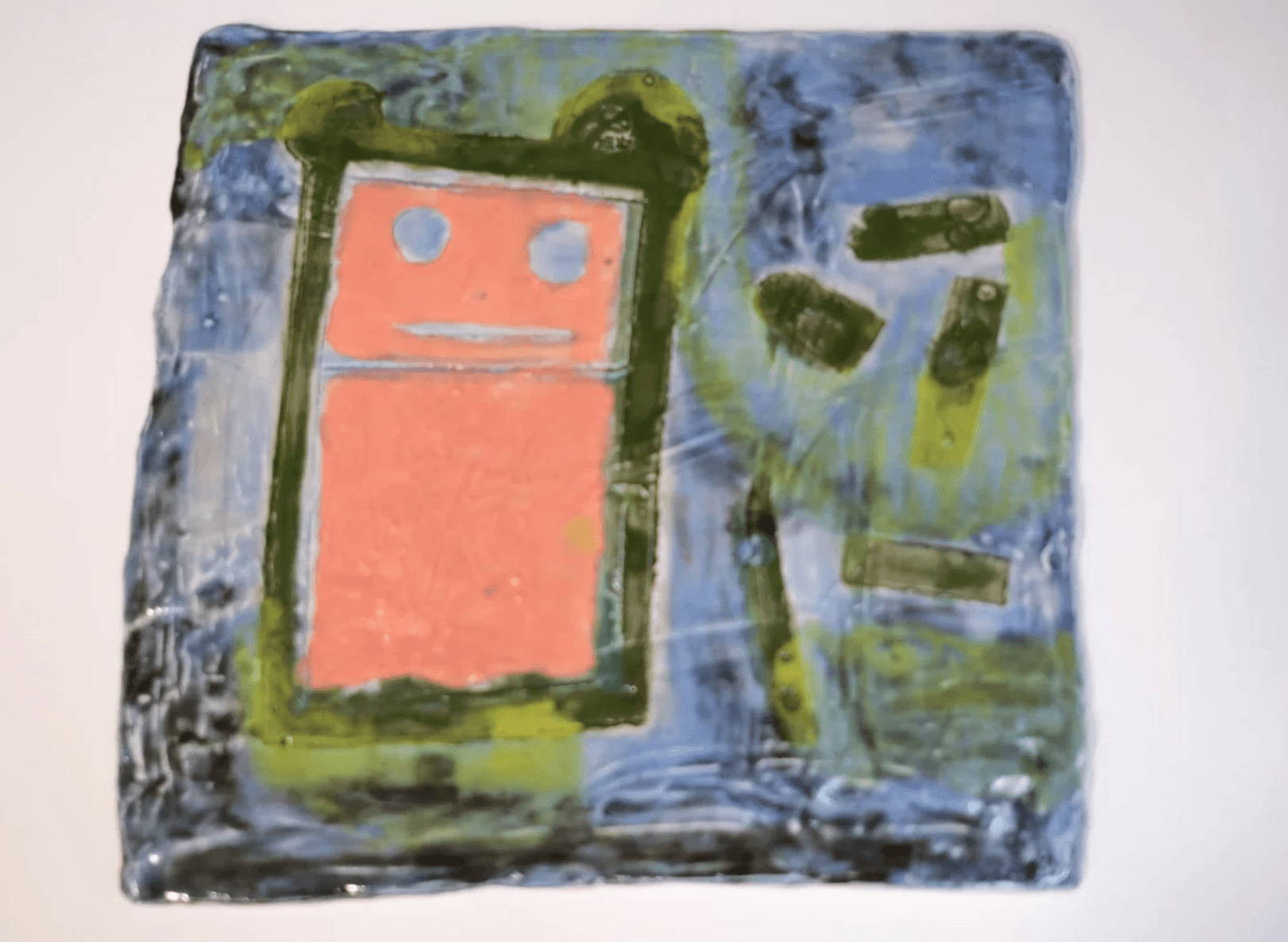
Devon Pin-Yu Chen, Metal Pencil Case, stoneware and glaze, 13 x 0.2 x 14 in., 2026
The most prominent cultural reference in the show would be the “Ghost Month,” part of the Taiwanese folk religion that designates the seventh month of the lunar calendar as a time when spirits from the underworld are allowed to come back and roam among the living to enjoy ritual offerings. Devil Out of The Cage (2026), a peach-colored, foxlike entity lying on a charcoal-colored cage, points to this belief. The reference adds another layer to the allegory, how life and death are in and of themselves a hierarchy predicating the value of beings.
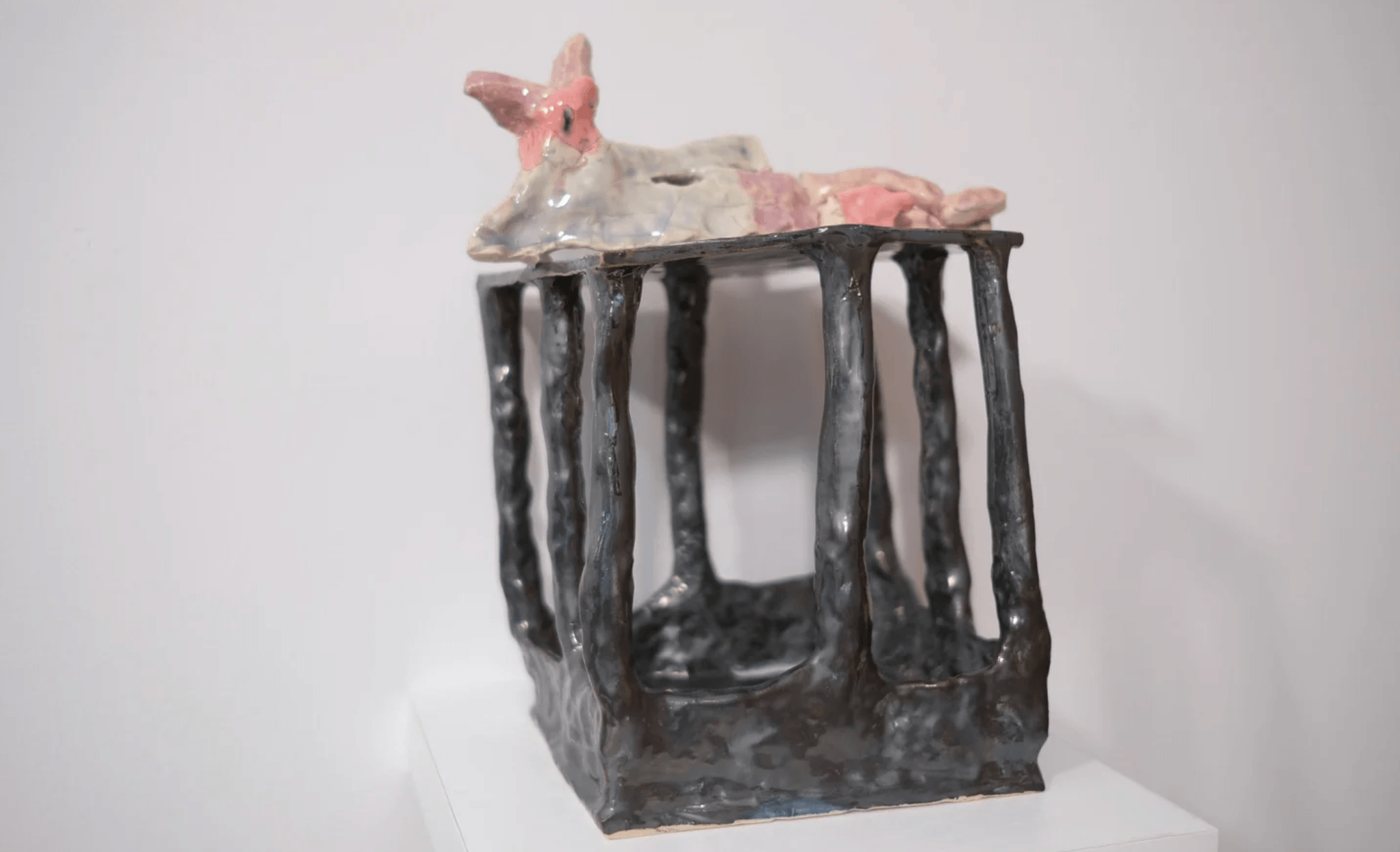
Devon Pin-Yu Chen, Devil Out of The Cage, stoneware and glaze, 12 x 7.5 x 7.5 in., 2026
“Don’t you find it lazy?” Comments Chen on the idle devil on the cage. It came off not so much as an interpretation than a critique, as if she, the artist herself, was not the culprit of its indolence. Chen sees the world through an animistic lens; souls inhabit all things, animated or not, and she has no hold over their individuality (incidentally, she could not decide whether The Serious Dog was a living dog or a spirit when trying to interpret the statue). In a way, it feels egalitarian. In the clearest hierarchy between artists and artworks, Chen forfeits the privilege to dictate what one work could or could not be.
