
Maija Peeples-Bright: Life is Just a Bowl of Terriers, Sonoma Valley Museum of Art, California
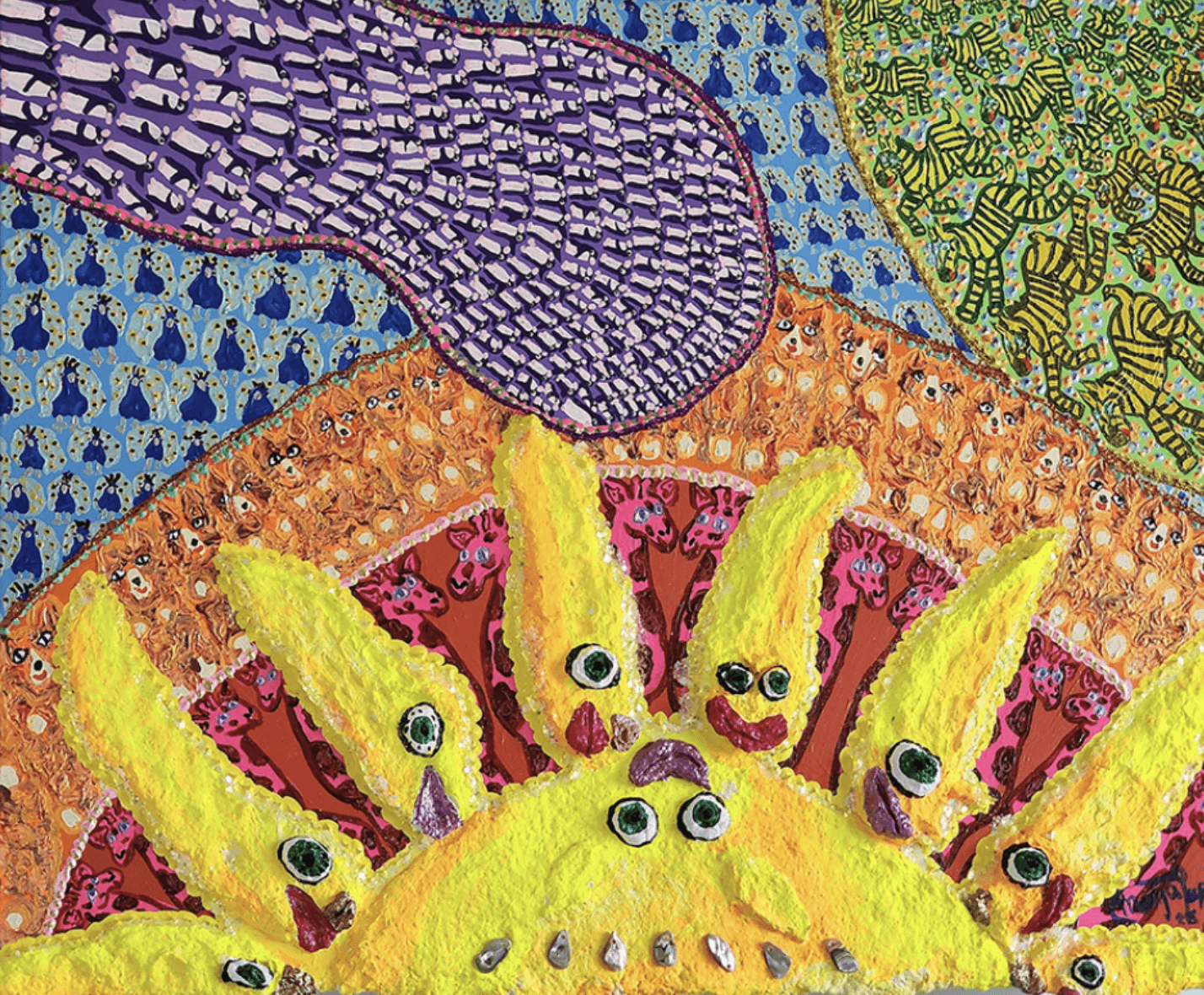
Maija Peeples-Bright, Best Sunburst entHARES the Sky, acrylic on canvas with wood, paper clay, glitter and abalone shell, 2025. Photo courtesy of Muzi Li-Rowe.
January 17–April 26, 2026
There is a kind of unruliness to Maija Peeples-Bright’s work that feels immediate, bold, crowded and a little mischievous, but the longer you stand with it, the more deliberate it becomes. Animals multiply, patterns press up against one another, surfaces thicken and swell with color, and what first reads as exuberant quickly reveals a careful, almost methodical construction. The paintings, sculptures, and textiles don’t simply celebrate whimsy; they insist on it, building entire worlds out of repetition, texture, and a refusal to leave any space unconsidered.
Peeples-Bright came of age within the irreverent orbit of Northern California’s Funk scene, though even there her work feels particularly light on its feet. After arriving in California from Latvia as a child where her family had fled the upheaval of World War II, she eventually found her way to UC Davis, where a painting class with William T. Wiley rerouted her from mathematics toward art. That shift seems fitting; her work carries a kind of internal logic, but one that favors play over order. While she is often folded into the Funk narrative alongside artists like Wiley, Roy De Forest, and David Gilhooly, Peeples-Bright resisted the neatness of that designation. With David Zack, she was central to what became known as Nut Art; a looser, more unruly framework that made space for the absurd, the decorative, and the deeply personal without needing to justify itself. The Rainbow House, which the two established in San Francisco’s Alamo Square Historic District, became a gathering point for that spirit: part studio, part social experiment, and wholly committed to a way of working that refused to behave.
The Sonoma Valley Museum of Art exhibition gathers these threads into something vivid and immediate, less a retrospective than a fully inhabited world. Paintings, ceramics, and textiles move easily between one another, each carrying the same visual language while testing how far it can stretch. Surfaces are dense but never heavy; color is saturated without collapsing into noise. What emerges is a kind of continuity, not just across mediums, but across time, where earlier impulses and later works feel in conversation rather than in sequence. The installation reinforces this, allowing objects to echo one another across the space: a painted leopard slipping into a textile form, a ceramic figure holding the same offbeat posture as one rendered in oil. Rather than isolating disciplines, the exhibition leans into their overlap, making clear that Peeples-Bright’s practice was never about medium so much as it was about building and sustaining a particular kind of visual ecosystem.
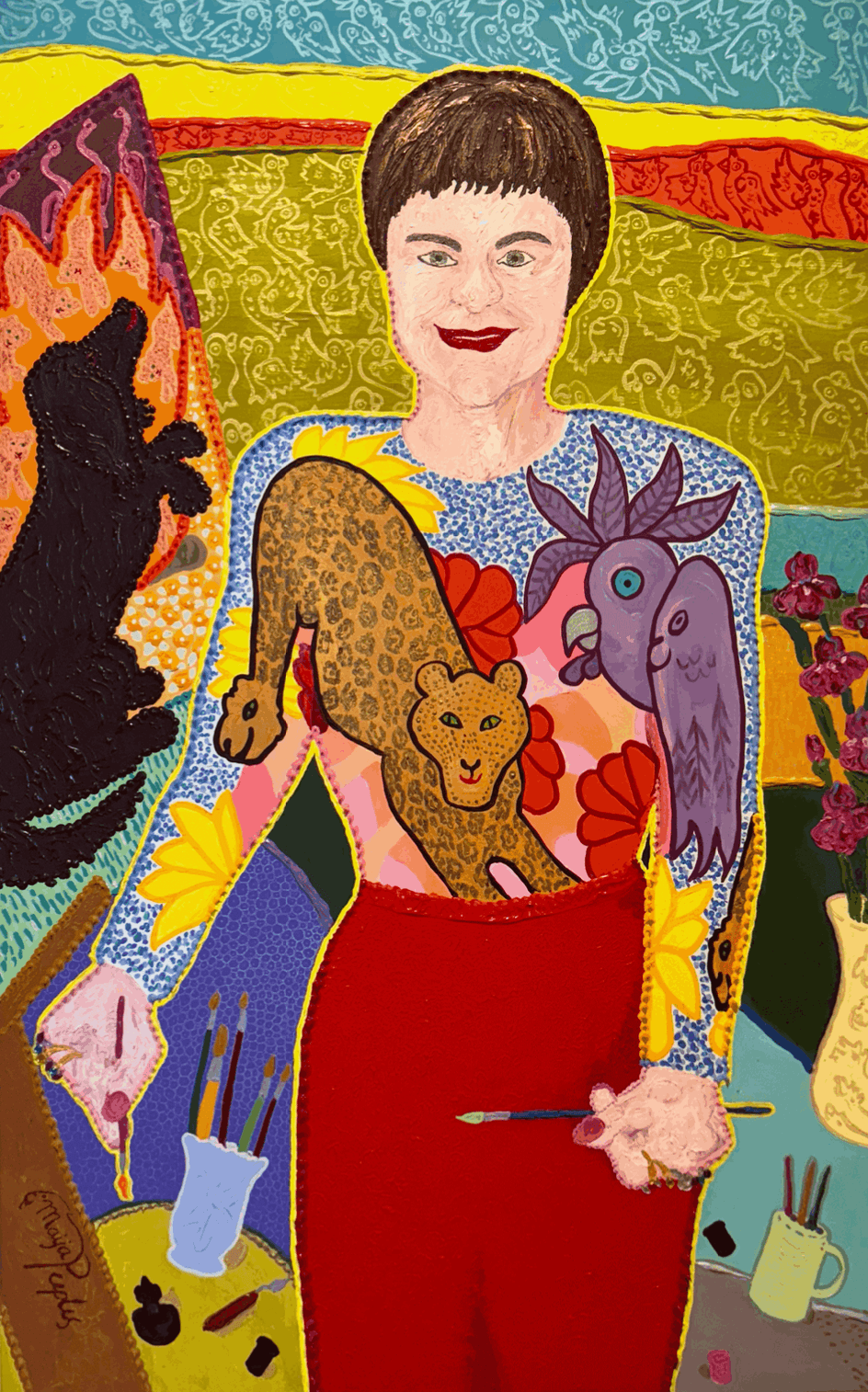
Maija Peeples-Bright, Oh Maija, Oh Maija, acrylic on canvas, 1996.
At the center of that ecosystem are her “beasties”, her animals that are less observed than invented, multiplying across canvases in looping patterns and rhythmic clusters. They grin, stretch, and stare back, at once comic and slightly uncanny, their repetition creating a pulse that runs through the work. What initially feels spontaneous begins to reveal a quiet discipline: patterns are carefully structured, color relationships are tightly managed, and even the most playful compositions are held together by a strong sense of balance. This tension carries across materials. In the paintings, thick passages of oil push forms forward, while in ceramics the same sensibility becomes fully dimensional, lumpy, irregular, and unapologetically tactile. The textiles extend this further, translating her visual language into something worn or held, collapsing any boundary between image and object. Whether deliberate or instinctive, the result is the same: a practice that appears to follow its own logic, one where humor and rigor are not opposites but working as a team.
In Sun of Beast over Clowder Clouds and Alligator Sea, everything is turned up, the color, texture, repetition but somehow it still holds together. The surface is thick and built up, almost sculptural, with glitter and raised forms pushing the image outward. Bands of animals move across the canvas: elongated yellow figures above, clusters of smaller leopards and tigers in the middle, and a dense, swirling field of alligators below. It’s busy, funny, and a little overwhelming at first, but the longer you look, the more controlled it feels. The repetition isn’t random, and the color never slips. It’s playful, but it’s also precise. One feels transported into otherworldliness, not as a spectator but as a participant.
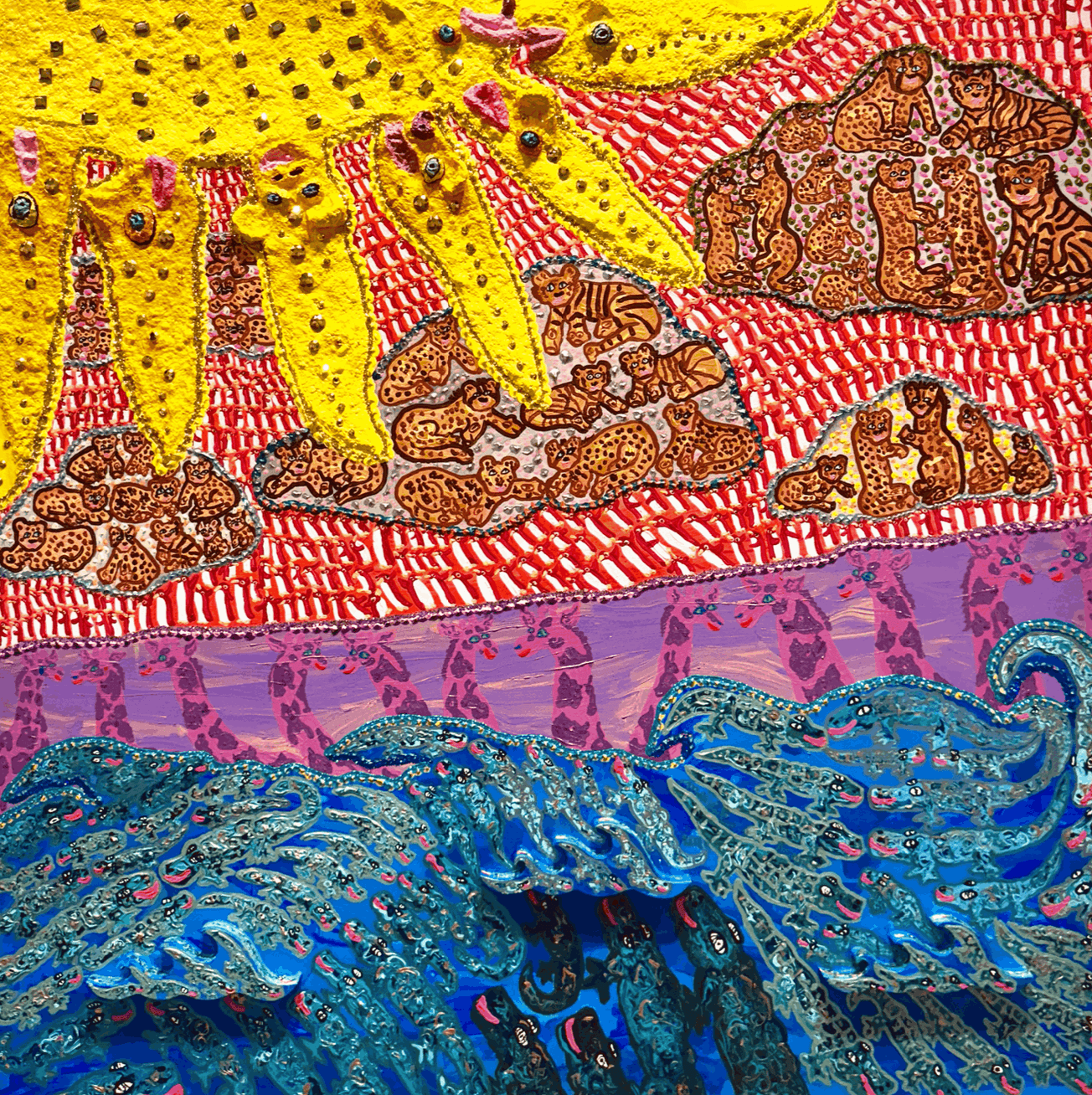
Maija Peeples-Bright, Sun of Beast over Clowder Clouds and Alligator Sea, acrylic on canvas with wood, paper clay, glitter and spangles, 2025.
Lotus of Love Says Hare to Love moves differently. Instead of stacking the image, it spreads out. A red hare stands upright at the edge, facing a loose gathering of animals and forms that feel more like a scene than a pattern. The surface is still thick, still worked, but the composition breathes more. The humor is quieter here, it's less about repetition and more about how these figures seem to acknowledge each other. At points, the painting even slips past its own edges, with forms pushing beyond the canvas so that the animals themselves start to act as the border. It’s a small shift, but it matters; it suggests that these worlds aren’t meant to stay contained. Seen together with the 2025 painting, it becomes clear that Peeples-Bright wasn’t just filling space with energy. She knew when to pack it in and when to let it open up, and both feel just as intentional.
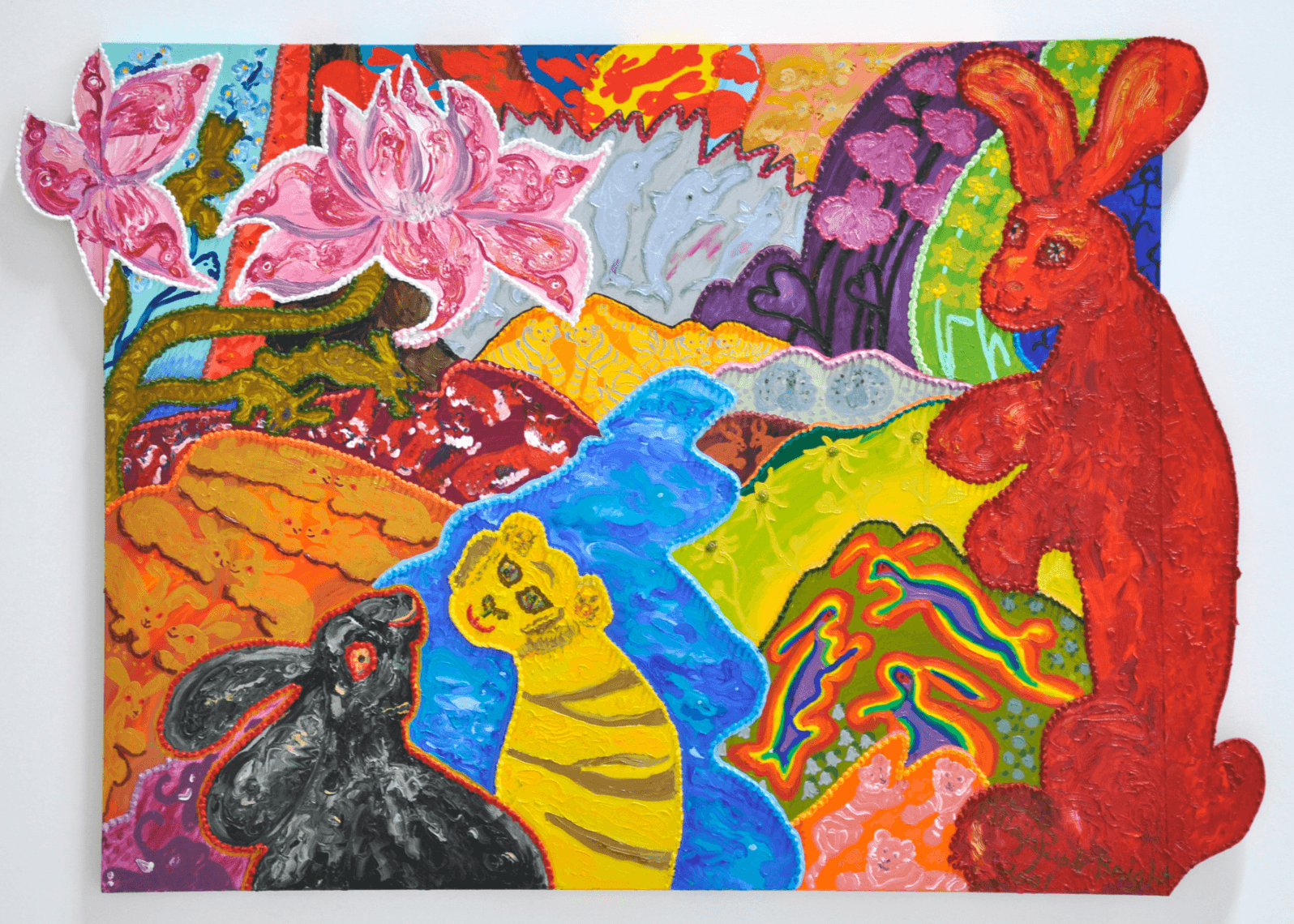
Maija Peeples-Bright, Lotus of Love Says Hare to Love, acrylic and wood on canvas, 2001.
The shift into sculpture feels less like a departure and more like the paintings stepping off the wall. In Flamingo Flames, the “beasties” fully break free from the surface. A cluster of flamingo-like forms twists upward, their long necks looping and leaning into one another as if they’re mid-conversation or caught in some shared joke. The glaze is thick and glossy, colors bleeding into each other, reds, pinks, oranges, so the whole piece feels alive and slightly unstable in the best way. It’s messy, tactile, and joyful, but not careless. The way the forms stack and balance shows a clear sense of structure underneath all that movement. Even here, where things feel most improvised, nothing actually falls apart.
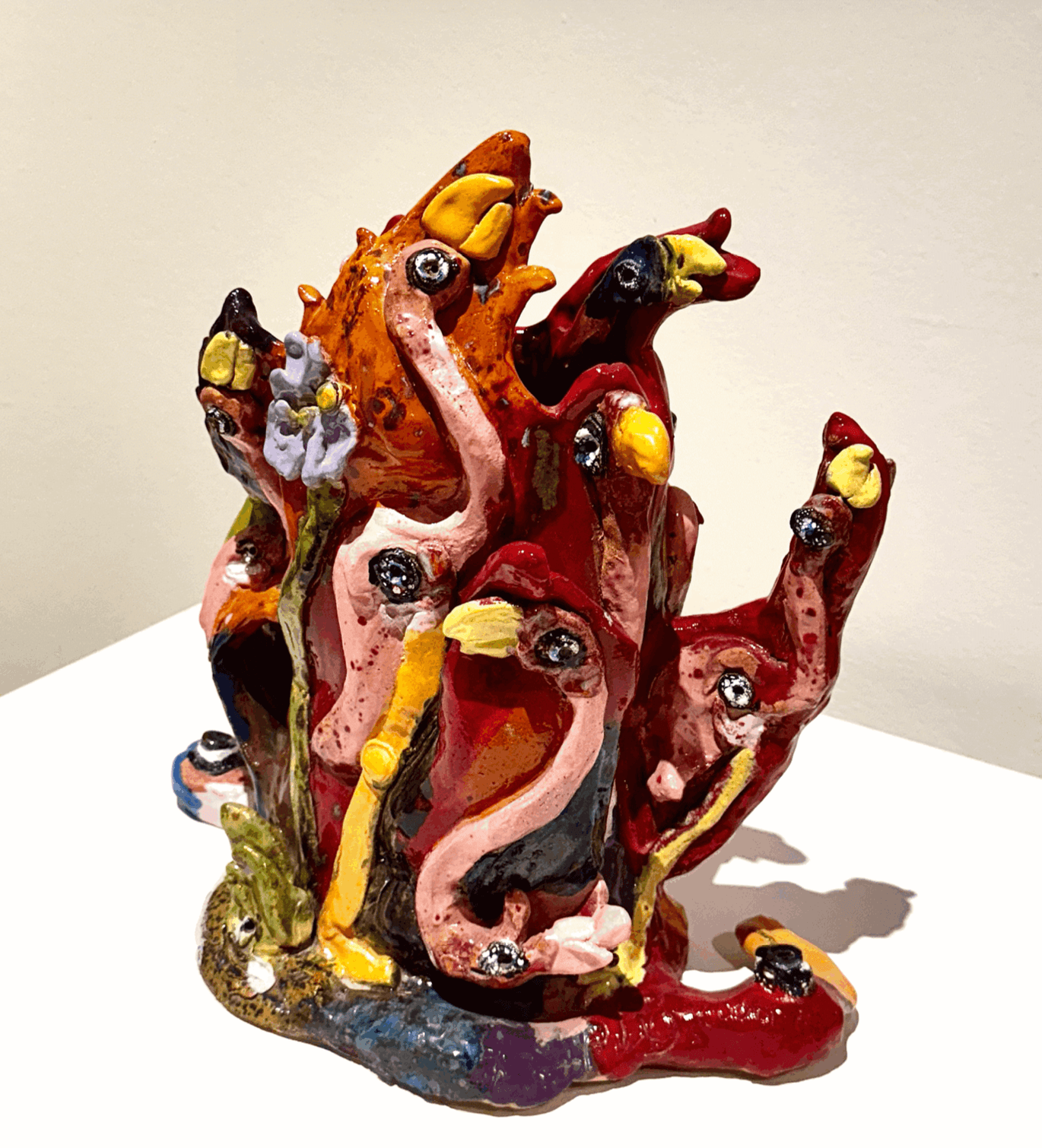
Maija Peeples-Bright, Flaminga Flames, glazed ceramic, 1999.
IRIS You SplenDOED Love takes a different approach. Instead of clustering, it builds upward. A central figure holds a kind of canopy, part flower, part wing, part drawing made solid, hovering above a base crowded with smaller animal forms. The piece feels more staged, almost like a totem, with each section doing something slightly different. Painted lines sit on top of the form rather than dissolving into it, bringing drawing back into the object. It’s still playful, still full of odd pairings and small surprises, but there’s a bit more separation between parts. Together, the two sculptures show how easily Peeples-Bright moves between chaos and structure, sometimes letting forms pile up and tangle, other times slowing things down and giving each element its own space.
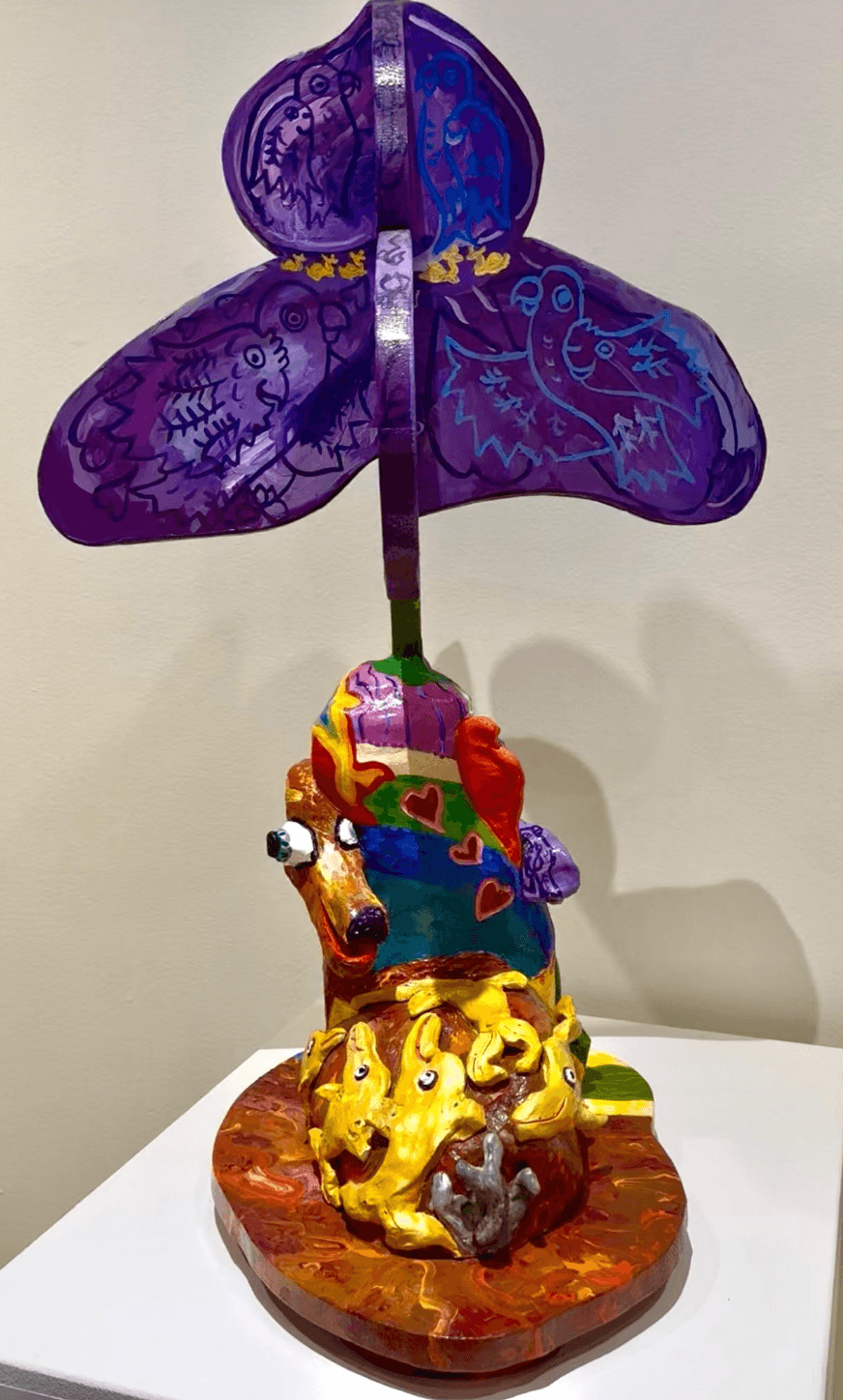
Maija Peeples-Bright, IRIS You SplenDOED Love, acrylic on wood and unfired clay, 2001.
That same instinct to blur categories carries into Tiger Chair and Snail Dress (two-piece), where Peeples-Bright moves fully into lived space. The chair feels less like furniture and more like a painting that decided it wanted a body, its surfaces wrapped in her familiar creatures and patterns, a yellow tiger peering out as if it has quietly claimed the object for itself. It still holds its structure, it still functions, but it refuses to stay neutral. The dress does something similar in a softer register, built from crocheted forms that spiral, cluster, and collide, like her painted worlds translated into fiber. It sits somewhere between garment and environment, something to be worn but also something that holds its own presence without a body inside it. In both, there is a sense that her visual language does not belong to any one medium. It simply moves where it wants, landing on canvas, clay, or cloth with the same clarity and ease.
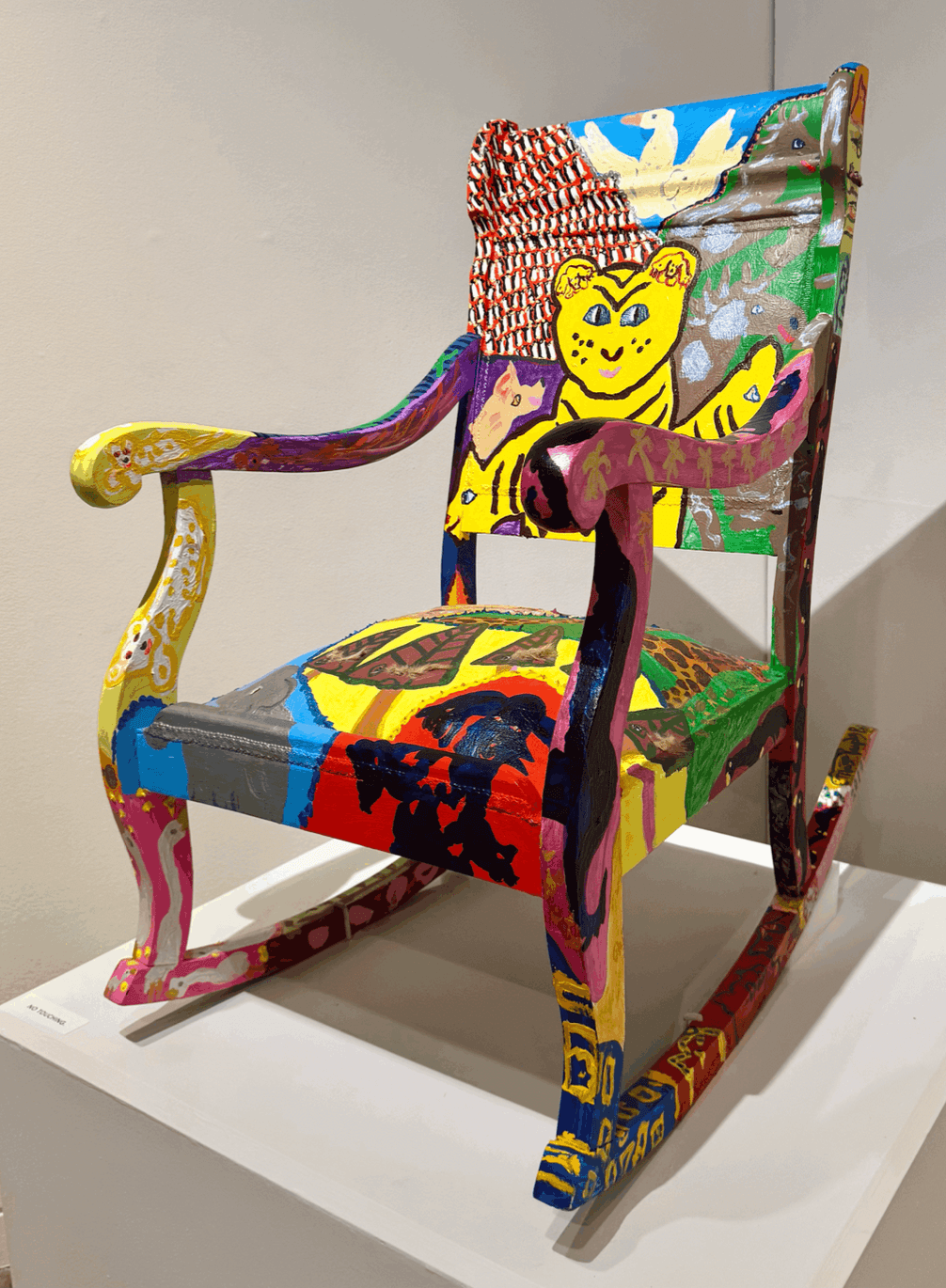
Maija Peeples-Bright, Tiger Chair, acrylic on rocking chair, 2019.
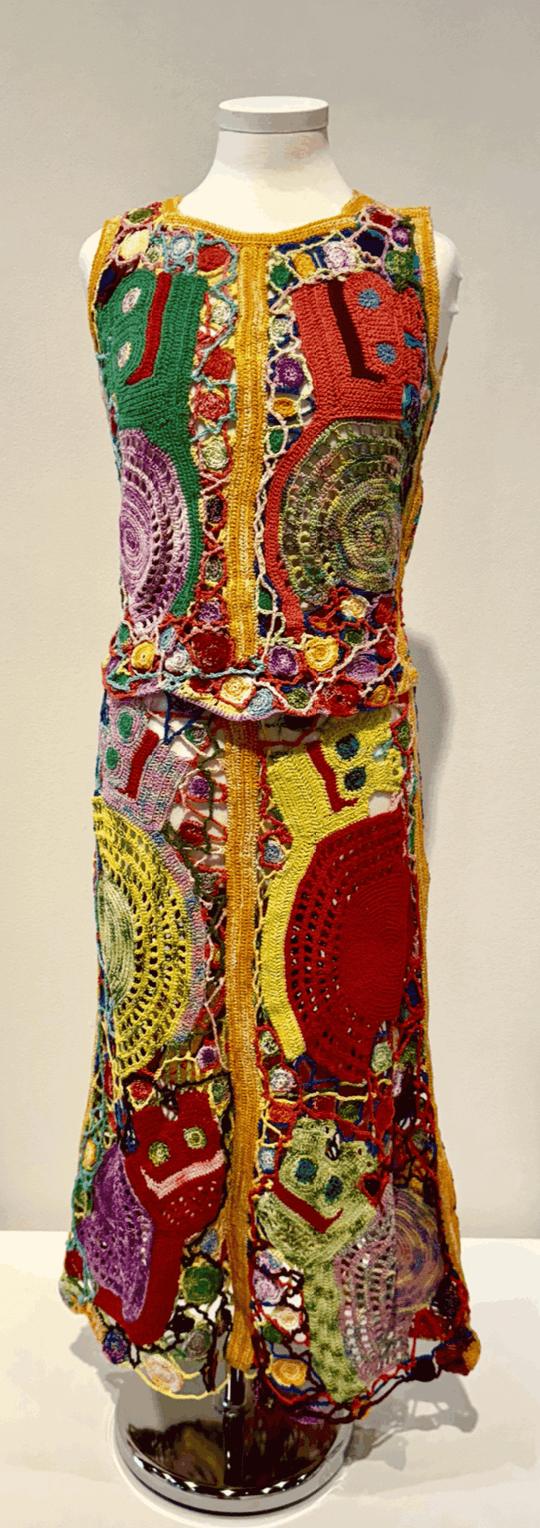
Maija Peeples-Bright, Snail Dress (two-piece), crochet yarn, circa. 1978-79.
There is a generosity to this exhibition that is hard to ignore. The works discussed here feel like only a small portion of what is on view, more like a first bite than the full meal, enough to give you the flavor but not the whole experience. Moving through the galleries at the Sonoma Valley Museum of Art, it becomes clear how expansive Peeples-Bright’s practice really is, not just across mediums, but across decades of sustained curiosity and invention. What stands out is not only the consistency of her voice, but how much room she allows it to shift and stretch without losing itself. The show does not try to resolve her work into something neat or singular. Instead, it lets the abundance speak for itself, and in doing so, it leaves a lasting impression that feels both full and open-ended.
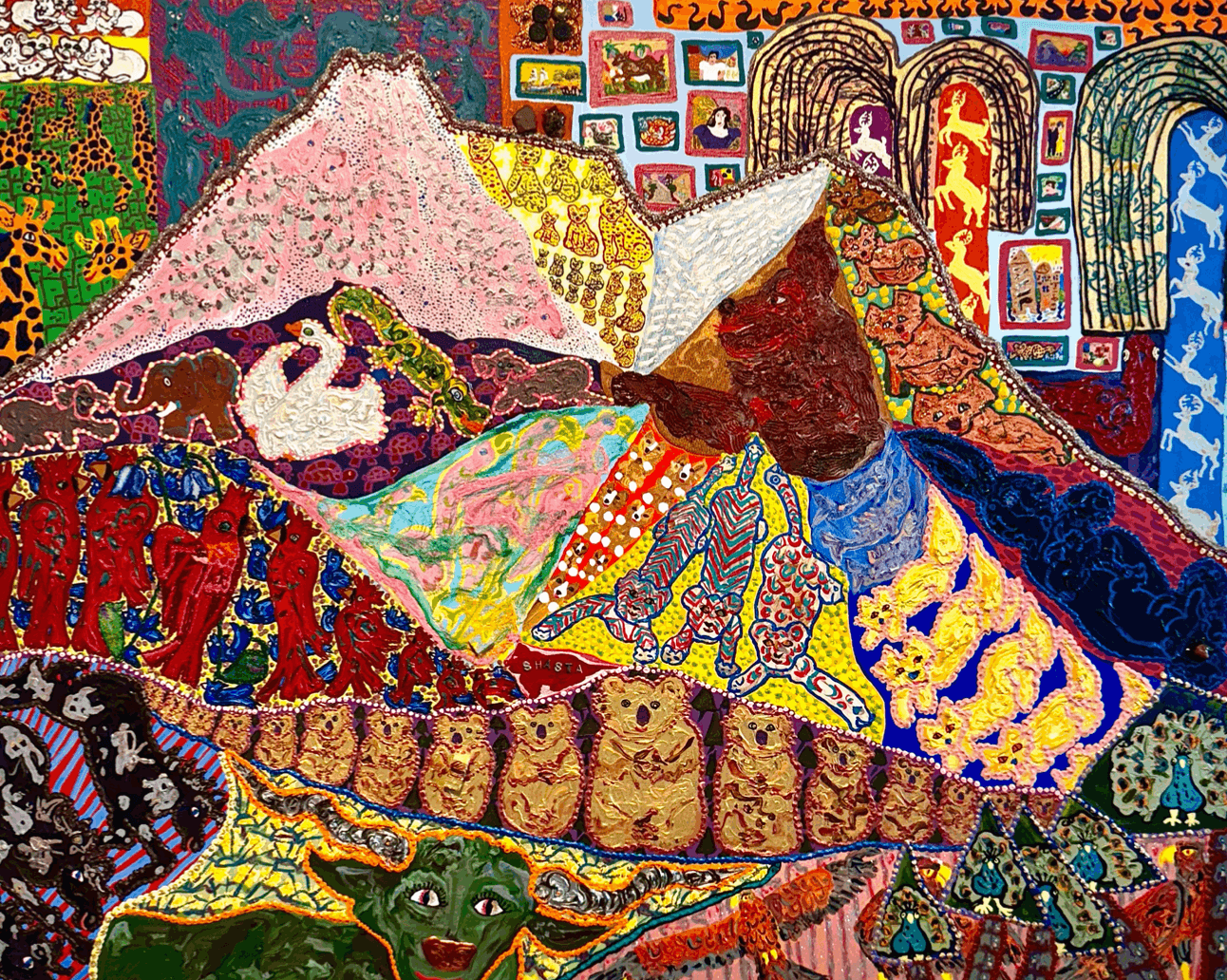
Maija Peeples-Bright, Stell Hare Shasta, acrylic, glitter, yarn, cotton thread, fabric, embroidery, metal buttons, and stones on canvas, 2016.
What lingers is not any single image or object, but the way Peeples-Bright allows joy, humor, and discipline to coexist without hierarchy. There is a lightness to the work, but it is not casual. It is built, considered, and sustained over time. You begin to sense that what might first read as instinct is actually something closer to trust, a deep familiarity with her own visual language that lets her move freely without losing structure. The exhibition holds that balance carefully. It gives space to the play without flattening the rigor behind it, and in doing so, it offers a fuller understanding of an artist who has spent decades following her own logic, regardless of where it fits within or outside of established movements.
To see this many works gathered together feels rare, and quietly significant. It is not overwhelming, but it is generous, and it stays with you in a way that is both immediate and lasting. The exhibition runs until April 26, 2026.
