
Lee Materazzi, PLAYMATE, Eleanor Harwood Gallery
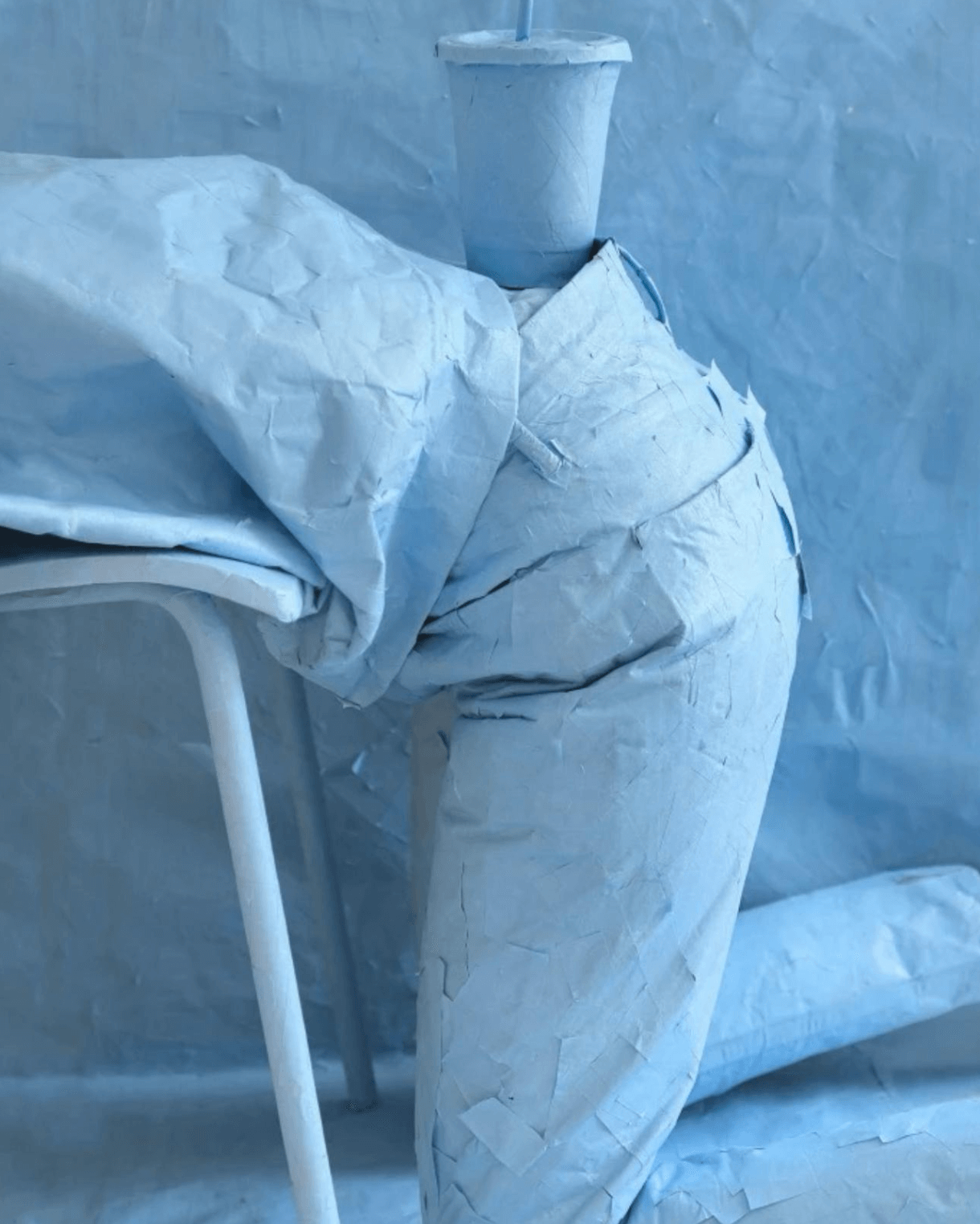
Lee Materazzi, Baby Blue, archival inkjet print with diabond mount in polished aluminum frame and UV plexi, 22 5/8 x 33 in, edition of 2 plus 1 artist's proof (#1/2)
January 10 - February 28 2026
At Eleanor Harwood Gallery, Lee Materazzi’s PLAYMATE presents a group of photographs rooted in physical constructions assembled from familiar, everyday materials such as paper, clothing, tape, and household objects, arranged around the artist’s own body and surroundings. The resulting images move fluidly between sculpture and photography, often collapsing distinctions between figure and ground so that bodies, objects, and environments appear fused into a single surface. A San Francisco-based artist whose work has long explored the camera as a sculptural tool, Materazzi expands that approach here through an installation that pairs photographic prints with physical elements in the space.
While Materazzi has consistently worked with staged environments and her own body as material, PLAYMATE feels more formally resolved than some of her earlier exhibitions, with a noticeable shift toward tighter compositions and a stronger emphasis on objects themselves as compositional anchors. In several works, the human figure recedes or disappears entirely, replaced by arrangements of chairs, cords, clothing, and bundled forms that carry the same visual intensity without relying on performative presence. This subtle recalibration gives the exhibition a different kind of coherence, suggesting an evolving interest not just in transformation through surface, but in how objects alone can hold tension, weight, and ambiguity within the photographic frame.
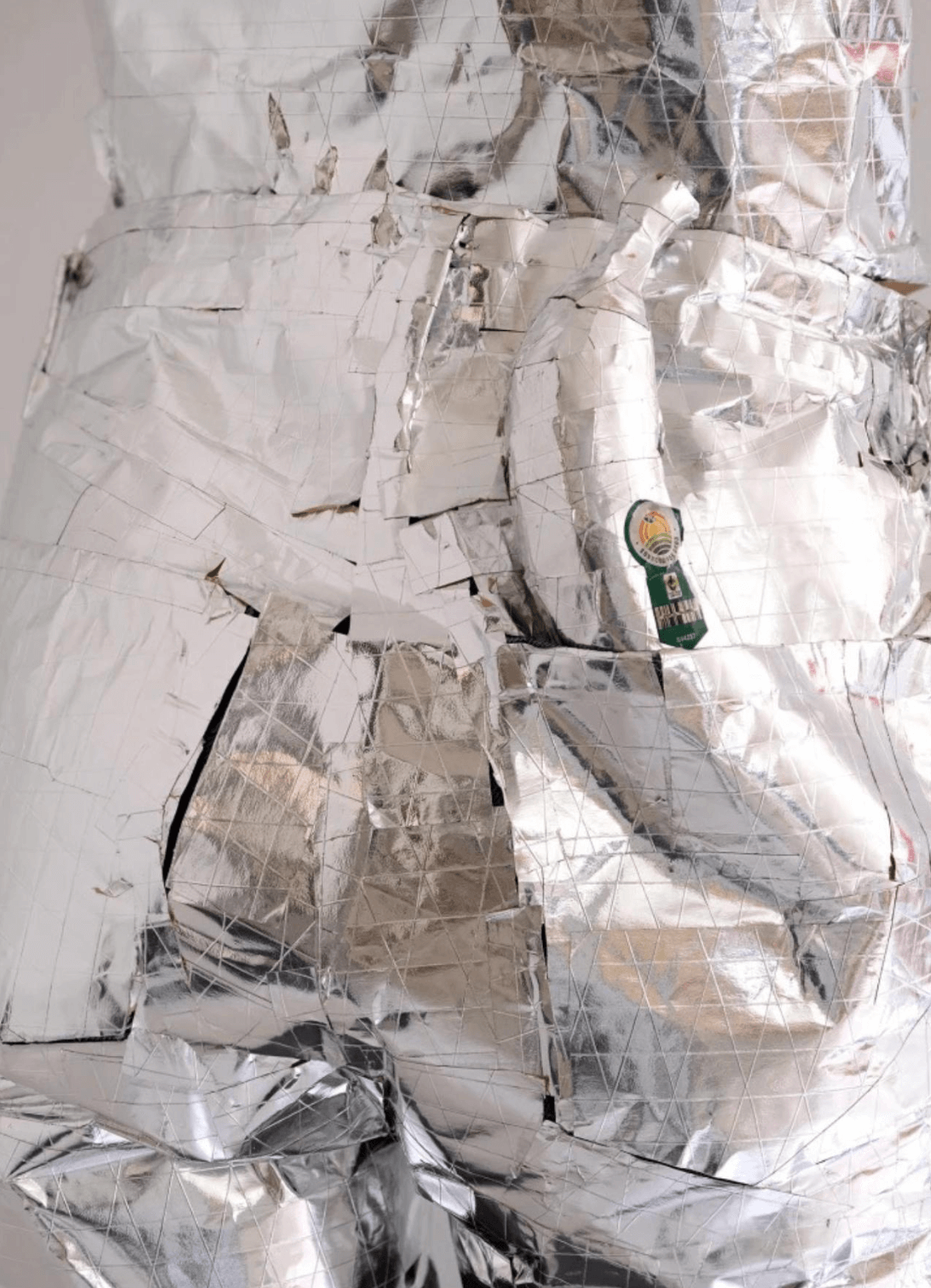
Lee Materazzi, The Last Piece of Fruit, archival inkjet print with diabond mount in polished aluminum frame and UV plexi, 24 x 33 in, edition of 2 plus 1 artist's proof (#1/2)
This shift also seems connected to a broader change in focus. As artists move through different stages of life, the boundaries between studio practice and everyday experience often become less distinct, and in PLAYMATE there is a noticeable turn toward materials and forms that feel closer to lived space. Objects such as chairs, clothing, cords and miscellaneous bundles are handled with a kind of attentiveness that suggests time spent observing rather than staging. Without foregrounding biography, the work carries the sense of an artist whose perception is evolving, shaped by maturity, physical experience, and the demands of daily life, where the body is no longer positioned as the central subject but exists alongside objects within the same visual field. The resulting images feel quieter and more grounded, less concerned with performance than with the subtle tension that emerges when familiar materials are pushed just beyond recognition.
One of the most compelling works in the exhibition, Tangle, centers on a folding chair wrapped in green marble-patterned paper, interrupted by the sharp intrusion of a neon-orange extension cord that spills onto the floor in a loose coil. The composition is fairly simple at first glance, but there’s a push and pull happening between control and messiness that gives it a lot of energy. The chair is carefully wrapped, almost trying to become one continuous surface, while the extension cord refuses to cooperate, spilling outward in this bright, tangled line that disrupts the order. Without a body present, the object itself takes on a kind of presence, sitting somewhere between recognizable furniture and something more abstract. The photograph doesn’t try to resolve that tension, and that’s part of what makes it interesting; you keep shifting between seeing what it is and seeing how it works visually, realizing that not much is needed to create intensity when the materials and colors are handled thoughtfully.
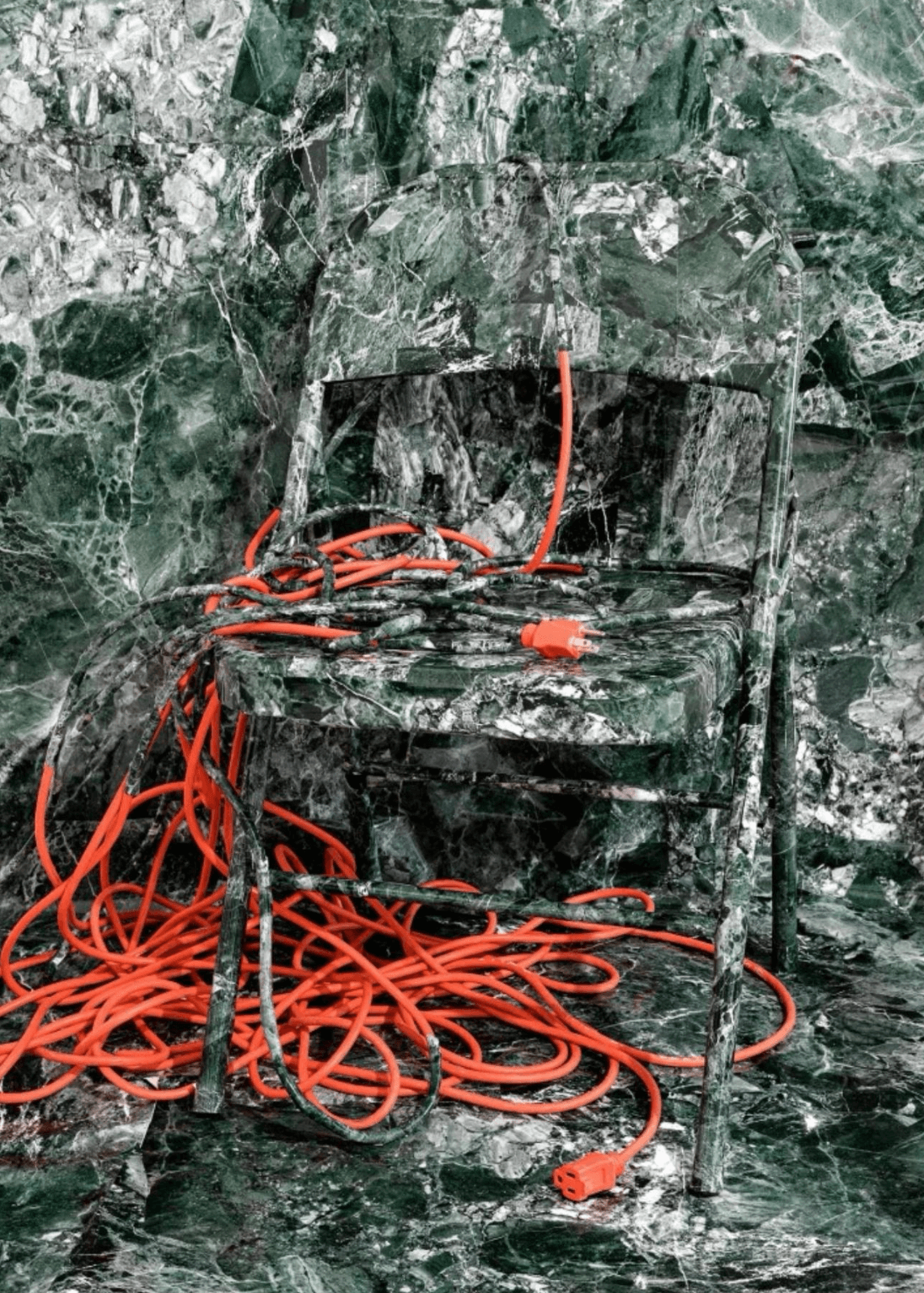
Lee Materazzi, Tangle, archival inkjet print with diabond mount in polished, aluminum frame and UV plexi, 23 1/2 x 33 in, edition of 2 plus 1 artists proof (#1/2)
If Tangle demonstrates how objects alone can hold tension, Incomplete returns to the body, though in a way that feels deliberately restrained. The figure appears partially obscured beneath layered material, bent into an awkward posture that emphasizes knees and joints rather than identity or gesture. Unlike earlier works where the body carries a stronger sense of performative staging, here it feels more like another form within the composition, it seems structural rather than expressive. The covering does not fully conceal or fully reveal, leaving the figure suspended between presence and absence. That ambiguity introduces a quieter tension, one that feels tied to vulnerability more than drama. The body never quite holds its own space, it seems to dissolve into the materials around it, as though identity is being formed by environment rather than contained within the person. You move between recognizing a human presence and just seeing surface and shape, and that instability becomes what stays with you.
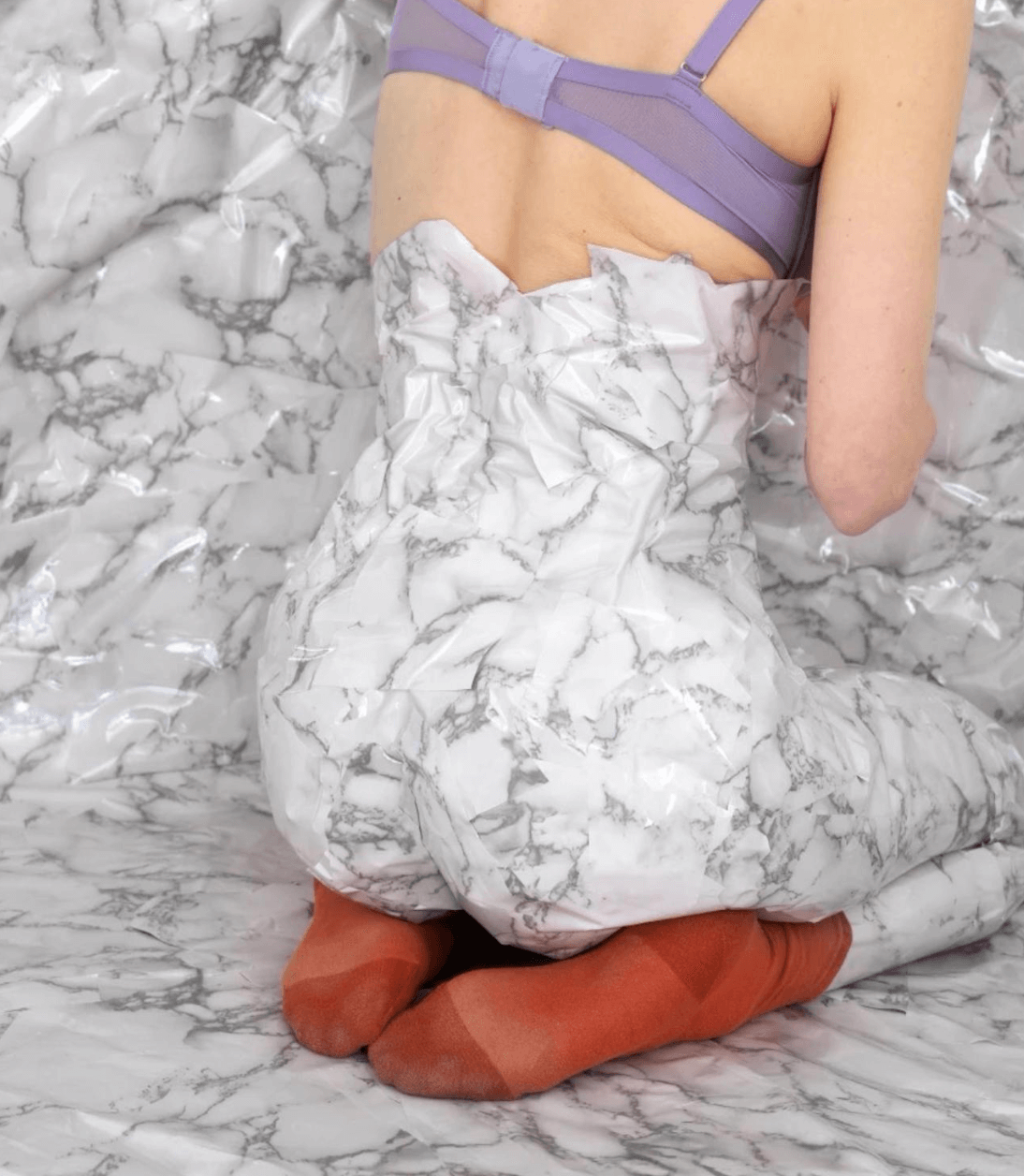
Lee Materazzi, Incomplete, archival inkjet print with diabond mount in polished aluminum frame and UV plexi, 25 1/4 x 29 in, edition of 2 plus 1 artist's proof (#1/2)
There are also moments in the exhibition where the materials like clothing and bundled fabrics begin to suggest a proximity to daily life, hinting at experiences beyond the studio without explicitly narrating them. Rather than functioning as autobiographical markers, these elements feel absorbed into the same formal language that governs the rest of the work, suggesting that personal circumstances are influencing perception and material choices without becoming the subject of the images themselves.
That sense of lived proximity becomes more emotionally visible in The Fit, where piles of socks are gathered into a dense, almost bodily form that hovers between abstraction and recognition. The softness of the material and the way it compresses together carries an unexpected tenderness, recalling the physical closeness of shared domestic moments. Bodies pressed together under blankets, the casual entanglement of limbs, the small, quiet rituals that accumulate into family life all allude to this concept. At the same time, the work resists sentimentality by holding its structure tightly, allowing the arrangement to function as color and form as much as recognizable objects. What emerges is something quietly vulnerable: an ordinary accumulation transformed into a concentrated image of intimacy, where familiarity becomes the source of both visual cohesion and emotional resonance.
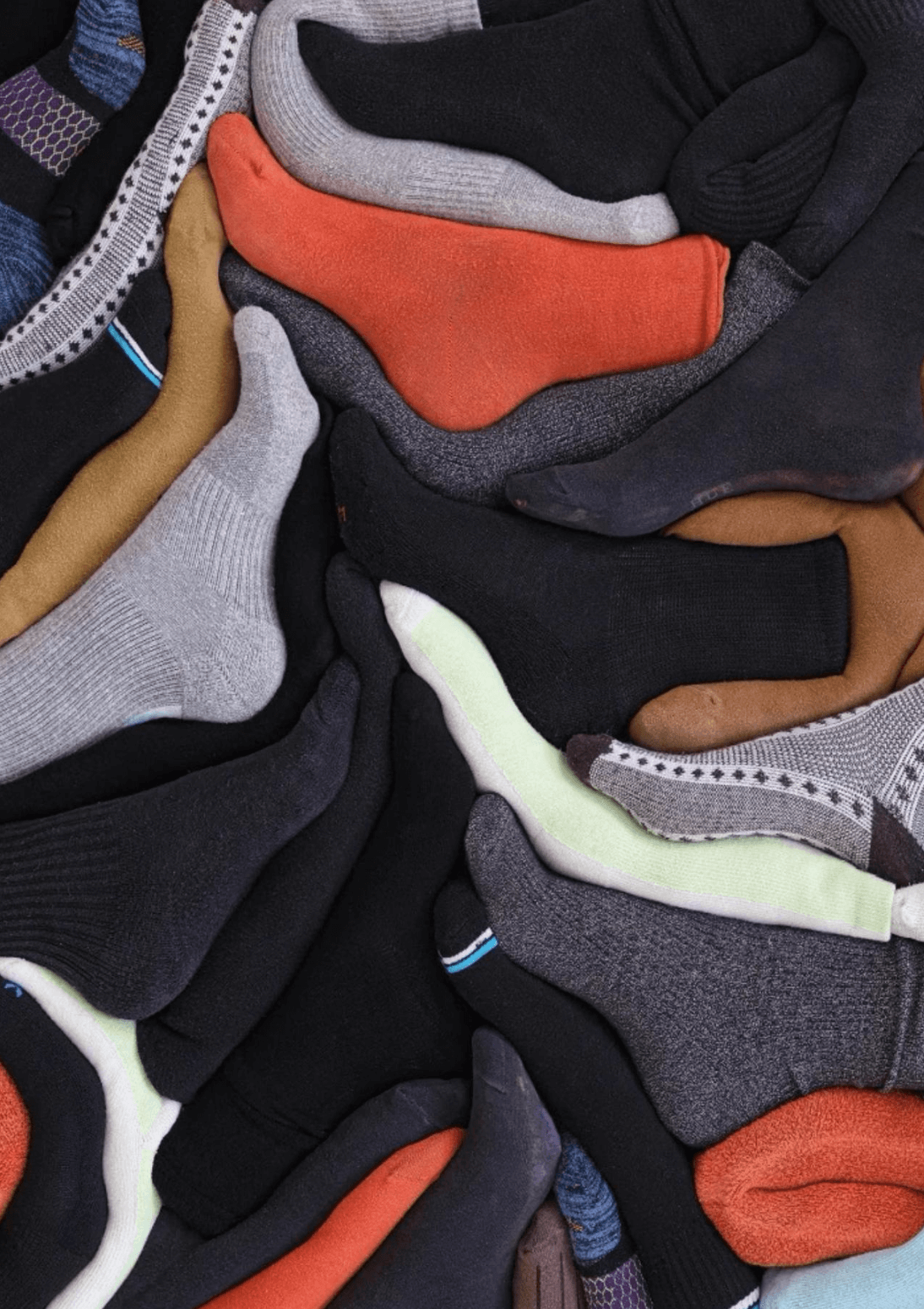
Lee Materazzi, The Fit, archival inkjet print with diabond mount in polished aluminum frame and UV plexi, 23 1/4 x 33 in, edition of 2 plus 1 artist's proof (#1/2)
The physical installation works in conversation with the photographs in a way that feels natural rather than forced, almost like stepping behind the scenes of how the images came into being. Seeing the objects (chairs, cords, cast forms) existing in the same space makes it clearer that these photographs are rooted in touch and handling, in things being moved around, covered, rearranged. It reinforces the sense that the work is about proximity and interaction as much as composition, extending the themes of merging bodies, objects, and environments into something you can physically move around and experience with your own body.
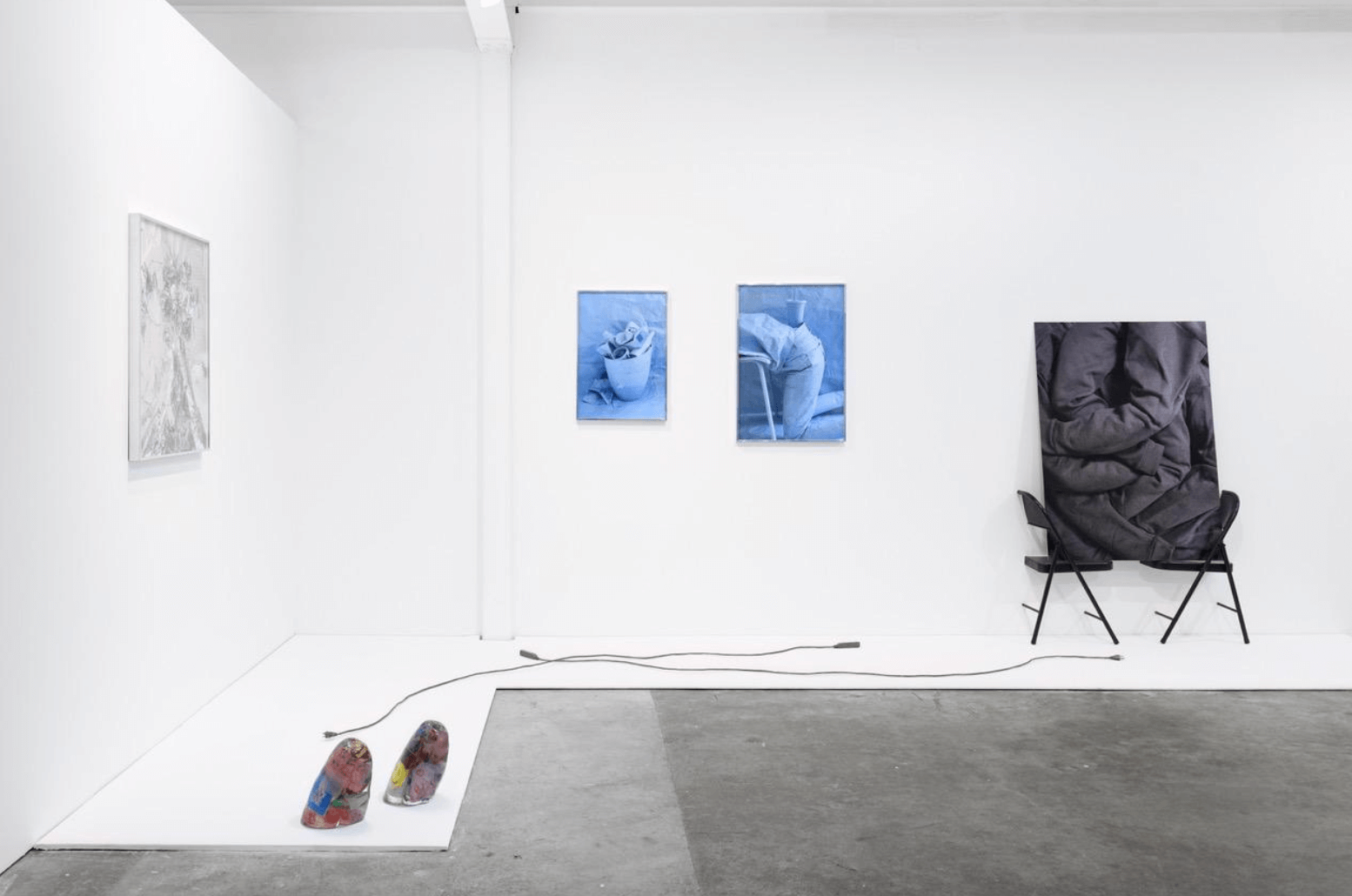
Lee Materazzi, installation at Eleanor Harwood Gallery, courtesy of Eleanor Harwood Gallery.
At the same time, being in the presence of these objects shifts the experience in a way the photographs alone can’t. There’s a difference between seeing a chair flattened into an image and standing near it, noticing its weight, its awkwardness, the way a cord pulls your attention across the floor. That physical encounter introduces a new layer, one that’s less about perception and more about awareness, reminding you that these transformations aren’t just visual tricks but actual negotiations with material, gravity, and space. It opens the work outward, making you more conscious of your own movement and relationship to what you’re looking at.
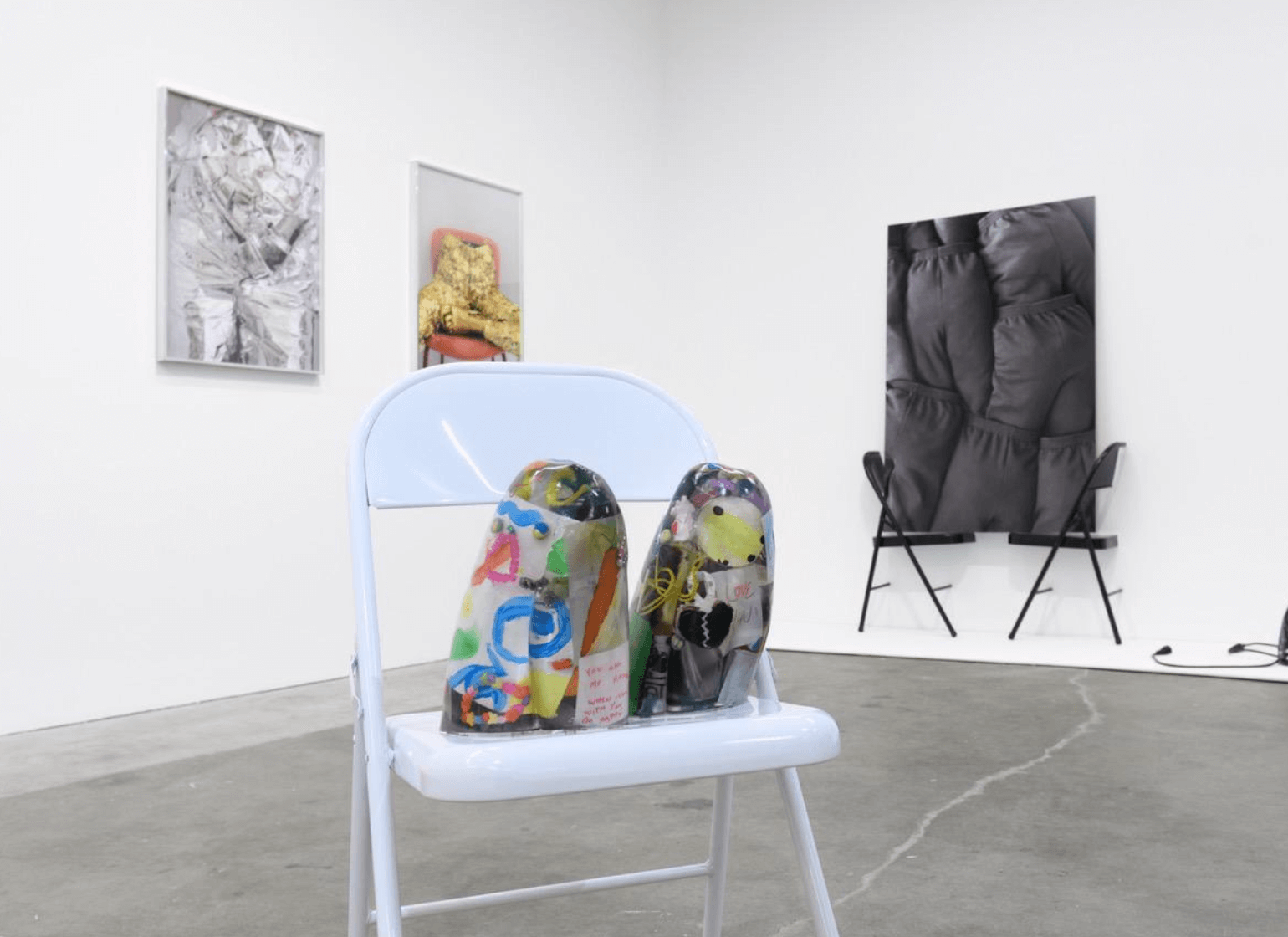
Lee Materazzi, installation at Eleanor Harwood Gallery, courtesy of Eleanor Harwood Gallery.
What makes PLAYMATE particularly compelling is the way it balances familiarity with transformation. The materials are ordinary, even mundane, yet the attention given to them, how they’re handled, arranged, and re-seen, creates moments that feel both intimate and quietly surprising. There’s a sense of an artist allowing the work to shift alongside her own experience, moving toward something less performative and more attentive, where objects and bodies share the same visual importance and emotional weight. That evolution feels refreshing, not because it abandons earlier concerns, but because it deepens them, opening space for a more grounded and resonant kind of engagement. The exhibition remains on view at Eleanor Harwood Gallery through February 28.
