

Katherine Sherwood (b. 1952, New Orleans) is an American painter and disability-rights advocate whose work reimagines art history through feminism, neuroscience, and disability. A graduate of UC Davis and the San Francisco Art Institute, she taught at the University of California, Berkeley, for more than three decades, establishing the course Art, Medicine and Disability. Following a cerebral hemorrhage in 1996, Sherwood relearned to paint with her left hand, developing a fluid approach that has become central to her practice. Her acclaimed series, including The Healers of the Yelling Clinic, Venuses, and Brain Flowers, examine representation, the body, and cultural ideals of beauty. Sherwood has exhibited internationally and received an NEA Artist Fellowship (1989), Pollock-Krasner Grant (1998), Guggenheim Fellowship (2005), and Joan Mitchell Foundation Grant (2006). She also co-founded the Yelling Clinic. Her work is held by the San Francisco Museum of Modern Art, Ford Foundation, and National Academy of Sciences.
Katherine Sherwood interview by Hugh Leeman
Catholic School and the Saints
Hugh Leeman: Katherine, you grew up in New Orleans during the '50s and '60s, a period when expectations surrounding gender, religion, and social identity were very different from what we see today. What memories from your childhood best illustrate those expectations, and how did you begin to question them?
Katherine Sherwood: I moved from New Orleans to California when I was in seventh grade. My dad died when I was nine, and that was a very impactful event. When we moved to California, my new stepfather had promised his deceased wife that he would educate my stepsister in Catholic school. So we all went to Catholic school — the three of us in our family went and joined her.
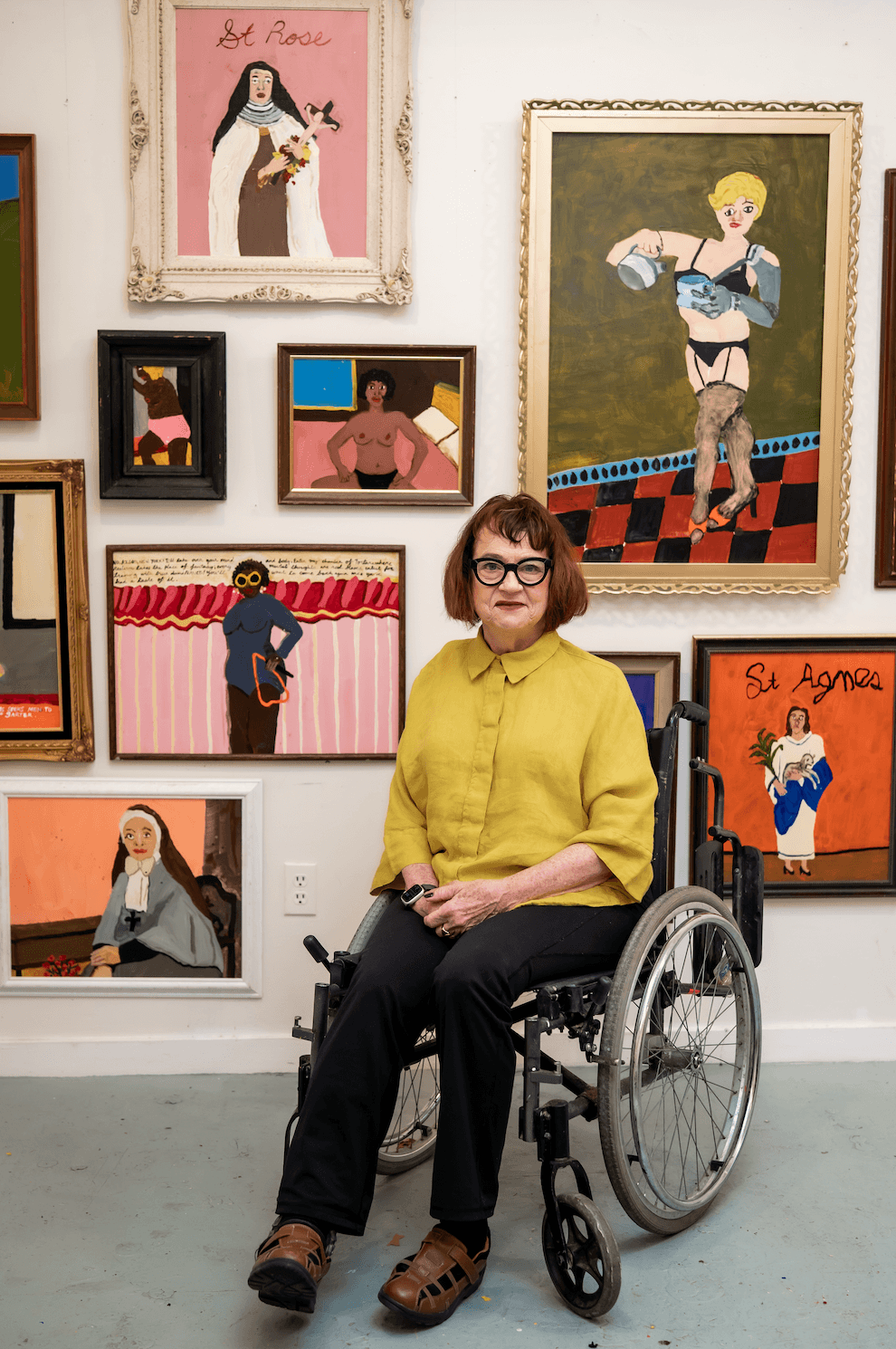
It was seeing Catholicism anew that really intrigued me — not anew, exactly, but as a religion that was new to me. I became so involved with the idea of the saints at that time. When I did the Pandemic Madonnas, which we can talk about later, I was thinking, where did these come from? And then my studio manager, Farley, reminded me that I had done that kind of work early on, when I went to the Art Institute.
A Superior Somebody
Hugh Leeman: Thank you for sharing that. What sticks out to me is that idea of renewing your perspective on Catholicism, and that you got really interested in the saints. Over the years of my life, one of my great interests has been people's faith, whatever their religion or belief system. And it seems a common theme for people who have engaged with a faith is a dynamic, nebulous, if not constantly changing, relationship with God. What has that relationship been like for you — from the time you were nine years old and your father died, until today?
Katherine Sherwood: Well, I went to college and was a religious studies and art major, so I really started comparing religions and trying to figure out which one was right for me. I settled on Buddhism and meditation — and even the Buddha says it's not a religion, that it's more a psychology. That's been a steady force in my life for the last thirty years.
I do believe there's a "superior somebody." That's what the Hopi say for their Supreme Being — superior somebody — and I really like the sound of that.
Hugh Leeman: Oh, so do I. A superior somebody. There seems to be this deep need many of us share, wanting to be a part of something greater, wanting to believe in something greater.
"I Would Cry If I Got Any Bad Reviews"
Hugh Leeman: You mentioned approaching all of this through a lens of learning, and you chose Buddhism, which you speak of as a philosophy or a psychology. You originally studied art history at UC Davis, but instead of pursuing formal training as a painter, you took a different path. What was happening in your life when you first began making paintings?
Katherine Sherwood: It really happened when I was taking a studio class for my undergraduate major. I had to take two studio classes, and I had the great fortune of having the great painter Mike Henderson, who is a Black painter. He said to me, "Why don't you pursue art?" And I just looked at him and said, "Oh my god, I would cry if I got any bad reviews." I think of that so much, because I've gotten so many bad reviews, and I'm just fine.
Hugh Leeman: That's really interesting, because the perception of a lack of social validation can become such an impediment. All the beauty you've since discovered might never have happened because of that fear — of a lack of validation, or of being degraded through someone else's eyes, some critic's eyes.
Katherine Sherwood: I think I was buoyed because I had so many friends who were art students. I moved with a bunch of artists to San Francisco and got a loft there, and having them as examples was really good for quelling my fears. And within five years of getting out of college and moving to San Francisco, I was getting some really resoundingly bad reviews. I just started to laugh at it, because — what else are you going to do?
The Ugliest Paintings
Hugh Leeman: Resoundingly bad reviews, or resoundingly good ones — it's such a fascinating element, and something I wanted to touch on with you today, because you have such a unique connection with art. There's the process of making art, being alone with whatever's happening, which has gone on for twenty-plus thousand years, since the caves. And then there's the relatively new, modern phenomenon of manufacturing value around it. Part of that is what's often referred to as intersubjective reality: you get a quote-unquote expert to convince other people what is good and what is bad, and if you can convince enough people, that becomes the reality. Going back to religion, this is what pastors and priests have done for thousands of years — there's a man who can walk on water and heal the blind, so who are you to doubt it? When you faced those resoundingly bad reviews — the fear you'd had, now manifest — how did you feel?
Katherine Sherwood: I felt relieved that I wasn't destroyed by them. I remember distinctly one reviewer said, "These are the ugliest paintings I've ever reviewed." But hopefully my sense of humor helped a lot. And I just realized it was sort of funny.
Hugh Leeman: The humor that you found in it — what was that humor? Because that's kind of a magic art in and of itself.
Katherine Sherwood: Oh, I'm not an expert at always bringing humor to the situation, so I'll not answer that.
The Trouble with the Overcoming Narrative
Hugh Leeman: You and I had a previous conversation in which you mentioned the risk and the damage of the overcoming narrative. You're very well known for that narrative: something bad happens, you overcome it, and look at you now, this hero. That's obviously an oversimplification of a life and a career. In our conversation, in a way that was very bold and candid, you said that this oversimplified narrative has a real negative impact, and that it poses a risk not just to the person who's the subject, but to people who will often never be seen or heard. Where does this narrative begin for you, and what are the risks it poses?
Katherine Sherwood: Well, it all started with the Wall Street Journal. It wasn't a review, it was something else — I was pictured above the fold, and it took the writer forever to write it, because I was an evergreen piece, meaning I could fit in anywhere. And I actually think he did a good job. But then there was all the fanfare — I was in the Whitney Biennial that year. And I wasn't involved with disability studies yet, but I soon became involved. I became aware of how it affects disabled people to raise up this one person and say, see how good she's doing. When I became painfully aware of it, I thought, okay, I'm going to try to get to the next level in people's criticism, in telling my story.
Hugh Leeman: When you think of that, are you putting yourself in the other person's shoes — someone who isn't Katherine Sherwood, who wasn't above the fold — hearing that narrative and being told, "Well, John or Sally, why can't you do what Katherine did?"
Katherine Sherwood: Yes. That's exactly what I feared. And now, with a disability studies background, I can see it's just a classic case of how the media deals with disability: you're very special. And you're right — all the other people are hidden by that kind of narrative.
Who Needs a Hero?
Hugh Leeman: What do you make of the narrative itself? If you set yourself aside, and all the other people who may feel its risk and damage, it almost seems to be commenting on something within society — this desperate need to construct the heroic. It's used in sports all the time, at the shallower end of the spectrum: he was just a poor kid from Akron, but my God, look what he did. Why do we need that as a society? And who is it, actually, that needs it?
Katherine Sherwood: That's a really good question. I don't know. I don't know if it's in the writer's mind at all, or if they just accept this kind of format, this way of seeing things. I don't know who's behind it, or what's behind it.
Disabled people are hidden in different ways in different cultures around the world. There are different cultural things. And disability arts has certainly grown so much since I had my stroke.
Art, Medicine, and the Medical Model
Katherine Sherwood: I became a sort of art historian of disability arts, in that I taught a class called Art, Medicine, and Disability. It was an unusual thing for me to combine medicine and disability in the title, because disability activists had for so long tried to get away from what we call the medical model. But I talked to a bunch of disabled people, and they gave me the okay. They felt it was time to introduce that.
And now I've read so many articles about sick people — how they're treated, what they have to do — and they are very active in the disability arts community. I wanted to also talk about people who had a cancer diagnosis and other things besides disability.
A Marketing Term
Hugh Leeman: I appreciate you mentioning that. In our previous conversation, you also mentioned something that's maybe a cousin to the overcoming narrative: the use of phrases like "disability art," almost as a marketing term. What do you make of that, and how do you react when you hear it applied, whether to yourself or someone else?
Katherine Sherwood: If I step aside, I'm very aware that it's a marketing term. I don't think that was its origin, but maybe it is now. I don't know what I think of it, to be honest with you. I don't have a good answer for that.
Hugh Leeman: It seems there's been a bit of a pivot — not that one has gone away — from "this is disability art," or "this person has an overcoming narrative," to using gender and ethnicity as a mechanism for marketing. So many times.
King Solomon's Seals
Katherine Sherwood: Yes, I see that. I'm an observer of all this, because at first, the work I did right after my stroke, when I was just getting used to painting with my left hand, was very inward-looking. It was referred to as abstract, but it was based on King Solomon's seals.
King Solomon was a crip. He was a disabled man, and he achieved such great things for his culture, and he had riches. He used these seals to try to materialize his wishes, so to speak. I used the white magic seals, and I took all the ones that had to do with healing. I worked in that manner for probably ten years after my stroke.
Then I turned around and started looking at disabled people in society — how they have been wiped out — and bringing them back in by using art historical tropes. That's how I began my Venuses of the Yelling Clinic: nudes based on paintings by male painters, which had my brain scans as their facial features, and then a little symbol of disability, like a blind cane, or a brace, or an amputation. That was significantly different from the attitude I had when I was doing the abstract work. So I changed a lot in what I was looking at.
Hugh Leeman: There are a few things you said that I'd like to hear more about. To go in reverse chronology — the white magic seals?
Katherine Sherwood: The seals are attributed to King Solomon. I really liked them because they were very non-symmetrical, and very surprising. I bought a book of magic seals — a pamphlet, really — and found them in it, and I just became fascinated. Then I discovered that King Solomon was disabled, and I just went from there.
The Yelling Clinic
Hugh Leeman: You mentioned the Yelling Clinic. Tell me more about this.
Katherine Sherwood: The Yelling Clinic is a disability art collective. We were very concerned with the disabling effects of war. For instance, in 2013 we went to Vietnam to meet with victims of Agent Orange. Agent Orange has now affected three or four generations since the war. That was really interesting — we got to look at some of their art and talk with them. Nothing really significant came out of it; we had a show of work related to it.
We haven't been that active lately, but we also made a film after we went to the Create exhibition at the Berkeley Art Museum in 2012. That exhibition featured three progressive studios: Creativity Explored, NIAD, and Creative Growth. And we were horrified, because there were so many inaccuracies from the director and the curator. For instance, we'd ask, "Do you talk to the artists about their work?" And the response was, "Well, they don't talk." And there was an artist whose work had hypodermic needles and other medical equipment in it, and they'd say, "Oh, that has nothing to do with his disability" — when, to us, it was totally grounded in his disability.
At the same time, I started imagining a Yelling Clinic. That's why I started doing the nudes — so they could hang up in the Yelling Clinic.
Intervening in the Museum
Hugh Leeman: Those conversations you had — what came of them?
Katherine Sherwood: Well, the video came of them. And it has actually been brought forward by many people as the first museum intervention by disabled folks.
I kept writing back and forth with the director. But ever since the stroke, I write very, very, very slowly. It would be the type of thing where I'd spend a week composing a letter, and then get a letter back from him right away. I didn't want that to be repeated, so that's why I thought of making the film. And they paid for it, at whatever cost, and it was actually shown in the art museum. Small things, small steps, but good ones.
Hugh Leeman: Who is "they," when you say they paid for it?
Katherine Sherwood: The museum.
What Are You Searching For?
Hugh Leeman: A lot of times, we as artists — or even just as humans — are searching for something, and often it falls into the category of resources: social validation, of which Instagram culture is a great example, or financial remuneration, which the arts are infamous for being horrible at, though art schools have historically been very good at selling people the idea that they'll be the next massive success. What you're doing is very different. You're going to Vietnam, looking into these dark corners of the universe, and not just touching on them for some sort of social flag-waving, but actually putting yourself into it, amid your own challenges. What are you searching for, Katherine?
Katherine Sherwood: I guess I felt the need for the articulation of these disabled values so much that I thought, well, I have to do it, or my friends who are disabled have to do it. We just can't stand aside and let this kind of erasure happen in the museum.
When Life Caught Up to the Art
Hugh Leeman: You were already making paintings about the brain, about chance and the fragility of human existence, before the cerebral hemorrhage in 1997. How has that extraordinary convergence between your art and your life shaped your understanding of coincidence, or fate, or intuition?
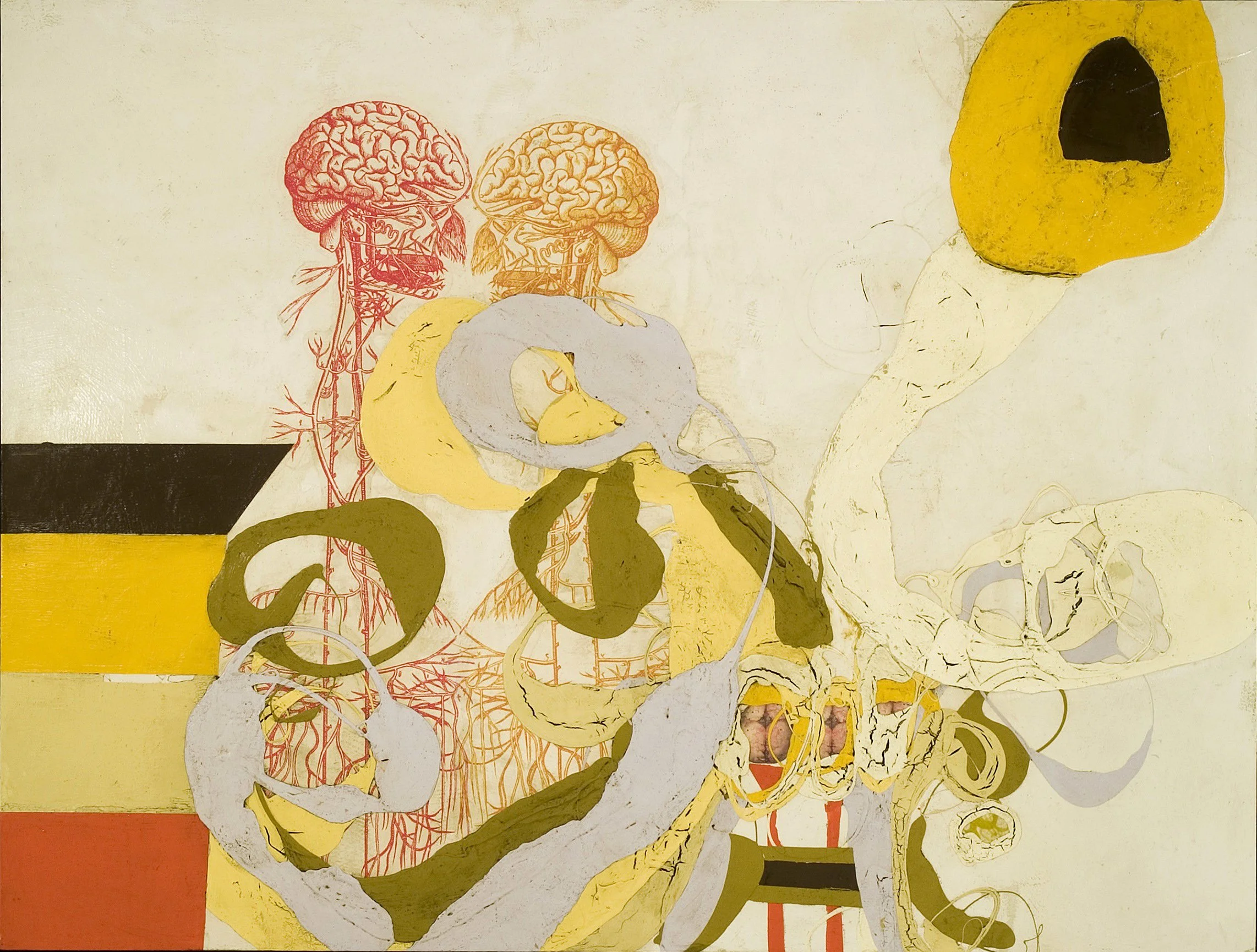
Katherine Sherwood: Well, I like to say it took a while for my life to catch up to my art. I started using brain imagery as early as '91, and I didn't have my cerebral hemorrhage until '97. I do believe there is a spiritual connection with chance.
Joan Brown's Request
Katherine Sherwood: Another thing happened to me. Do you know the painter Joan Brown?
Hugh Leeman: Sure.
Katherine Sherwood: She was my mentor at UC Berkeley. We were at a party at Paule Anglim's house for Epiphany, and she said to me, "Katherine, will you take care of all my disabled students when I'm gone?" And "gone" meant she was going to India. She was setting up a monumental sculpture there, and the roof fell in and killed her and her assistants.
That's a case where I thought — well, it was way before I had my stroke. But I took it seriously: okay, I will be the one to mind your disabled students. Joan also led by good example. She was very involved with Creative Growth, and very involved in bringing art to the prison system. So that little thing she mentioned to me was everything.
Hugh Leeman: Joan Brown clearly had quite an impact on you.
Katherine Sherwood: Yes. And she was a very spiritual person, and that also had its impact on me.
Hugh Leeman: Are you a spiritual person?
Katherine Sherwood: Yes, I would say so.
Hugh Leeman: And that manifests through your practice of Buddhism.
Katherine Sherwood: Yes. And hopefully it manifests through everything I do — my painting as well.
The Empty Well
Hugh Leeman: You've discussed experiencing extended periods of creative block, where after years of prolific painting there's this empty-well effect. How has that affected your sense of self, your identity outside the studio? When someone builds their identity around being an architect, or working for the garbage company, or whatever it may be, and suddenly that's gone — how has that affected you?
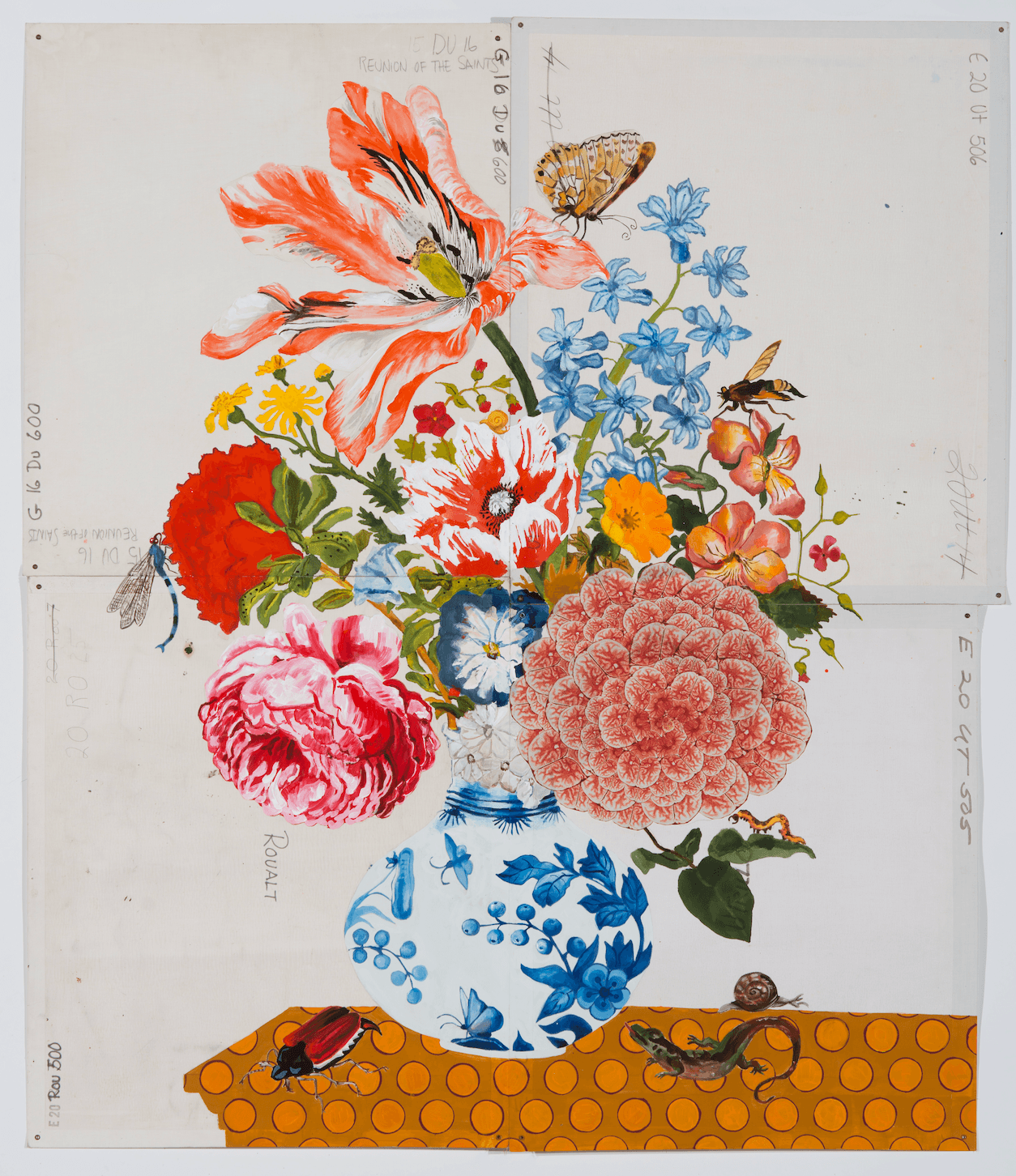
Katherine Sherwood: I've been rather lucky, in that my artist's blocks really haven't lasted more than six months. I don't know how I'd respond if one went on for years. I was just trying to get out of one when I had an early-morning reverie: I saw these brain figures with really long skirts. And I thought, this is the stupidest idea ever — but because I was really searching for ideas, I welcomed it.
Hugh Leeman: During those blocks of up to six months, when there seems to be a nothingness in the creative sense, what did you discover about yourself?
Katherine Sherwood: If I had one tomorrow, it would be much different than when I had them before. A lot of it was that I was teaching full-time, so it made me not as anxious about not making art. I'm really a dedicated painter, and it takes a lot for me to separate myself from it. But those periods gave me that separation, and gave me the impetus to expand and change my art.
Retiring Into the Studio
Hugh Leeman: You just mentioned something really important to your life and your journey — what you've given and how you've served others: teaching. And it seems to go far beyond teaching the visual grammar of art. For more than three decades you taught at UC Berkeley, and retirement gave you more uninterrupted time in the studio. How has this later chapter changed your understanding of ambition and success — and of the ego, which is usually the food for ambition and validation?
Katherine Sherwood: I retired early. My family really asked me to, and I'm so glad I did, because it was the first time in my life I felt I could dedicate every fiber of my being to my painting. And I was really surprised when the paintings were accepted and shown. I question myself, and I think it's good to question yourself. I think every artist should have artist's blocks, too. I think it's a natural part of the process.
Art, Medicine, Disability — and Death
Hugh Leeman: You've described teaching Art, Medicine, and Disability as one of the greatest joys of your career. What happened in that classroom that made it so meaningful?
Katherine Sherwood: First, I'll tell you I also taught a class called Art and Meditation. I looked at art that had been made under a spiritual or religious impulse, and we all meditated before class began. Those two classes were definitely the high point of my teaching career.
In Art, Medicine, and Disability, the transformation of the students was really accelerated, to me. I think that came from being exposed to so much art about or including disability. I also say the class really should have been called Art, Medicine, Disability, and Death, but I didn't want to put that in an advertisement for a class of twenty-year-olds.
Another thing I think was very successful: students from my class interned, as part of their grade, at Creative Growth, at NIAD, and at Creativity Explored. What I always said to them was, you are going to learn more about disability by going to one of those places than you will ever learn in a classroom.
What the Students Taught
Hugh Leeman: There's a cliché among teachers that "my students taught me more than I ever could have taught them." But to play to that — what did your students teach you about disability, perhaps beyond your own experience?
Katherine Sherwood: I met so many disabled artists who were students in my class, graduate students and on through. So I really got a sense of the concurrent domain of art and disability at that time. I would never have said I learned so much from my students — but I did learn from my students, I guess.
That class was very different from a painting class, or any kind of art practice class. It was more like an art history class, but it was a hybrid: they made art, they did internships, and they attended the class.
The Pandemic Madonnas
Hugh Leeman: I want to go back to what you were talking about earlier — your father dying when you were nine, your new understanding of the Catholic faith, your interest in the saints. In your more recent Pandemic Madonnas, you revisit Renaissance religious imagery and introduce disability, medical imagery, prosthetics, and even protective masks. What questions about suffering, protection, and the sacred are you exploring?
Katherine Sherwood: I really looked at thirteenth- and fourteenth-century Madonnas from Italy. I bring that up because I get completely bored once the Renaissance stuff starts. I'm much more interested in the non-formalistic way of working.
Hugh Leeman: That non-formalistic way of working seems to have become a bit of a way of life for you. You told your students that if they really wanted to learn, they had to go out into the world and do these things. When they came back from those places, what kind of stories did they share with you?
Katherine Sherwood: A lot of my students eventually became employees of Creative Growth, especially. Because there was always an art component that made it so special, they'd tell me about that. And I also have students who are disabled and have had resplendent careers in art-making. In fact, those are the people I really learned from in my class.
Redesigning the Curriculum
Hugh Leeman: Much of your teaching has challenged established art historical narratives, particularly the exclusion of disabled artists. If you were redesigning a university art history curriculum today, how would you change the way students encounter disability, illness, and the body?
Katherine Sherwood: There are introductory classes offered in disability studies — one is Women and Disability, another is just an introduction to the field. Ideally, those students would then be ready to encounter me and art, and how that filters into it.
"I Hate the Word Outsider"
Hugh Leeman: In preparation for this conversation, I was listening to a talk you gave, and a phrase stuck out to me because it echoed something you'd said to me personally. You said, "I hate the word outsider." You said it while discussing Yayoi Kusama and the relationship between psychiatric institutions and achieving artistic recognition in the mainstream marketplace. What troubles you most about the designation of outsider art?
Katherine Sherwood: Because I think it is, more than anything, a commercial term: this art will be cheaper for you to buy.
Now the historian in me comes out. Hans Prinzhorn was the first person to go to psychiatric institutions in Germany and Austria and start collecting work. He was a psychiatrist and an art historian, which is a funny combination. His book, Artistry of the Mentally Ill, was under every artist's bed in Paris, for instance, because they got so much influence from it but didn't want to show it to everybody. And I think that's what Art Brut did, what Dubuffet did — just ape the style of the outsider artist. So the commercial aspect of it, the historical aspect of it — it doesn't make sense to me at all.
In another situation, I went to the San Francisco Museum of Modern Art around 2015 and encountered a Judith Scott sculpture. Judith Scott is the most well-known artist in this area; she died quite a few years ago. She had Down syndrome and was deaf. And at SFMOMA they had one of her beautiful pieces right next to a really well-known artist. You didn't have to stop and say, oh, this is an outsider artist, or this is a disabled artist. She was just an artist. And that's what, in a perfect world, I would like.
Contribution Beyond the Object
Hugh Leeman: Katherine, thank you for sharing so candidly. In a lecture, you said that if you're an artist, even if you aren't making art, you can make valuable contributions to the world — suggesting that being an artist isn't necessarily defined by producing objects. What other forms of contribution have become important to you, in your own practice or in others'?
Katherine Sherwood: When I was at the San Francisco Art Institute, I was constantly around performance artists and installation artists. I really studied conceptual art and saw my place in it. That's what I was thinking about when I said that — because they don't produce objects. Or rather, they produce things that aren't bought and sold. I can't even imagine twentieth-century art without the development of conceptual art.
Hugh Leeman: To close: how might we rethink the value of an artist whose greatest influence occurs outside the studio?
Katherine Sherwood: You know, I let other people make those kinds of decisions.
Hugh Leeman: Katherine Sherwood, thank you so much for your time, and thank you for sharing.
Katherine Sherwood: Thank you, Hugh. Very, very interesting questions.
