

Jonathan Runcio, Shadow Work, Et al. Gallery
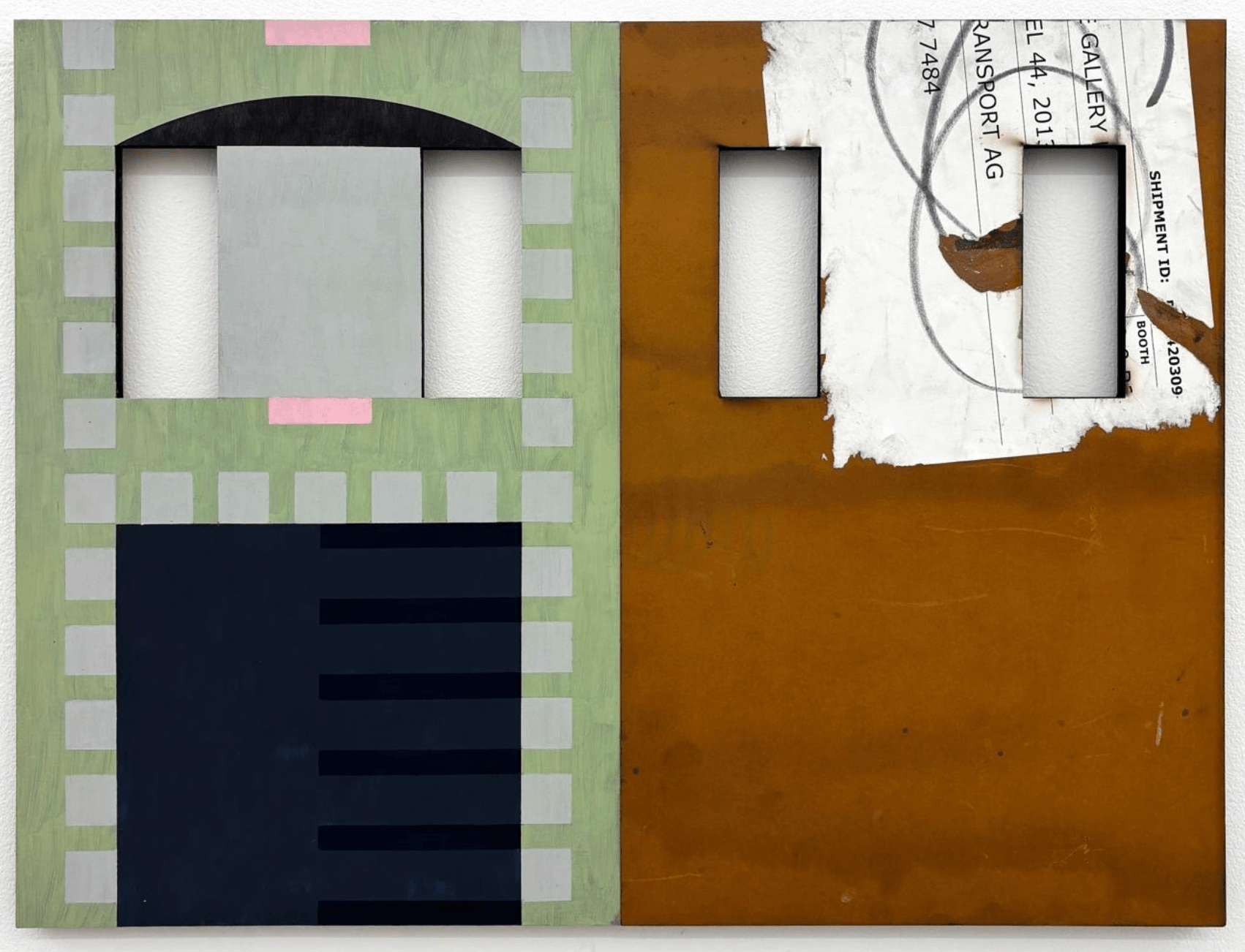
Congo/Ognoc. Oil paint, rabbit skin glue, plywood, hardware. 18 x 24 inches. 2026.
There I was, walking around Et al.’s backmost room, clocking the twin-y, pre/post structure of Jonathan Runcio’s seven works on view through April 18, when a guy with a white beard, slightly stooped, walked in and propelled himself around, looking at each work intently but without lingering.
“Too bad these works have this messy, extraneous junk on them,” he says (approximately), “they’d be good otherwise.”
“I think it’s before and after,” I say.
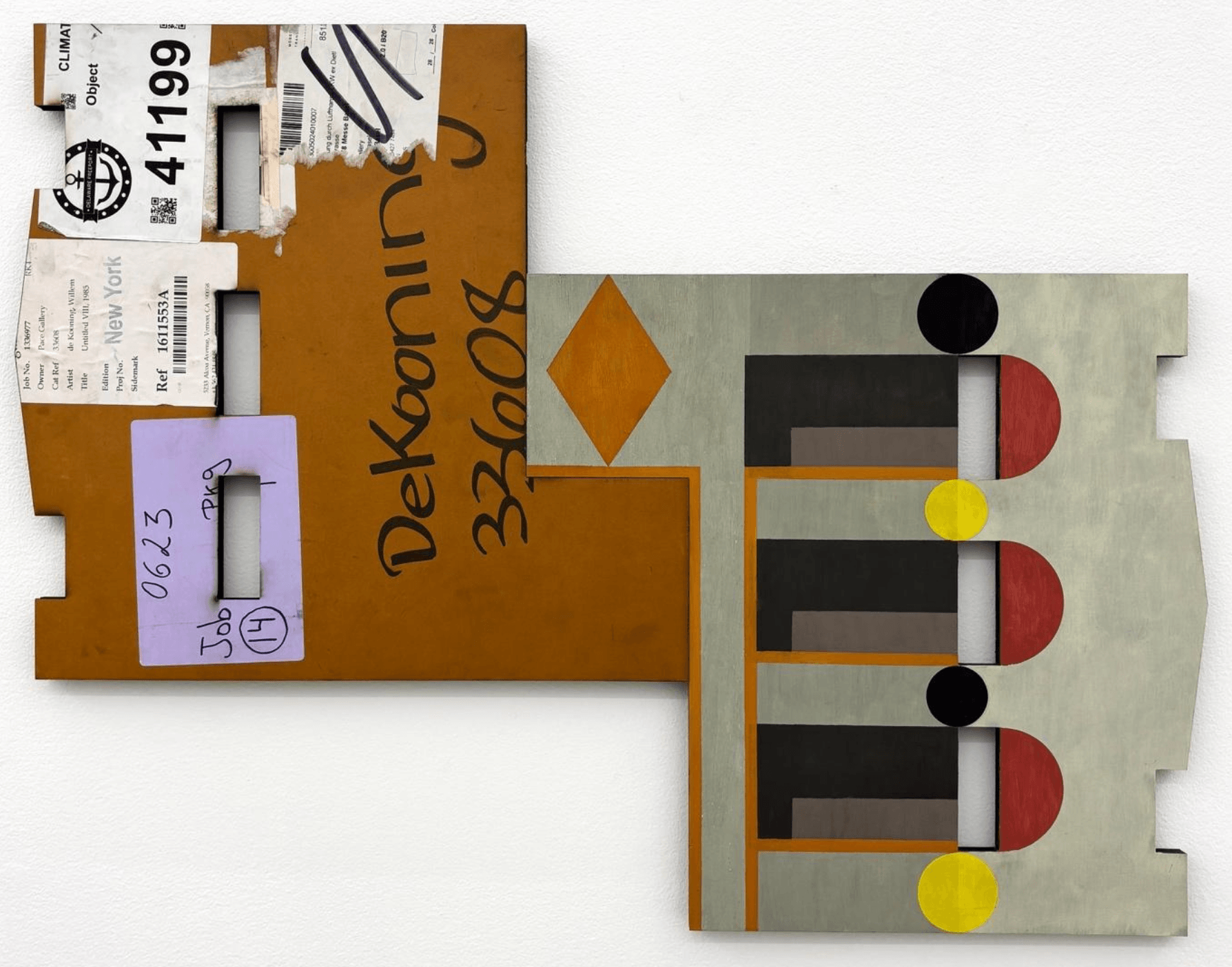
Tega/Aget. Oil paint, rabbit skin glue, plywood, hardware. 22 x 29 inches. 2026.
It’s shadow work. I re-read the gallery text. The words suggest that the shadow is the messy, raw side. Reality must be the pretty, painted side, then, if we’re going with a Plato’s cave reference. Surely, though, realness resides on the raw side? I’m not sure that this is working.
It’s not the verso, the text also says. It’s not a medieval manuscript, held open for your pleasure, folio verso (left page) and folio recto (right page) on display. But it could be two sides of a medieval painting on wood, verso (back) and recto (front) smooshed together. Maybe.
No doubt, it’s a story. deKooning’s Untitled VIII (1985) has flown to Basel and to the Pace Gallery, according to the labels on Runcio’s Tega/Aget, in a wooden crate. Your cat (if you have one) makes use of your empty, cardboard boxes. Runcio (one-upping him) creates art from galleries’ discarded, wooden cases. He, the artist, cuts out in duplicate. Then the original gets paint. The cc, nothing.
It’s a process (I’m not being glib). Maybe you’ve seen tree rings, sediment layers in the Grand Canyon, or Alysa Liu’s hair? You record a process, something taking place, and voilà, a product is created.
I re-re-read the text. It’s paintings, inner child attached. Runcio’s oeuvre includes many pieces in the mode of the pretty side of these works. It seems the artist noticed something lurking in the works he usually creates: what once was, a shadow, an inner child. So he made it concrete. Appended.
“Yeah, but who’d want to live with that,” the guy says.
“I would. And anyway, Et al. is a non-profit,” I say (in theory), as he walks out, vowing to take it up with the front desk.
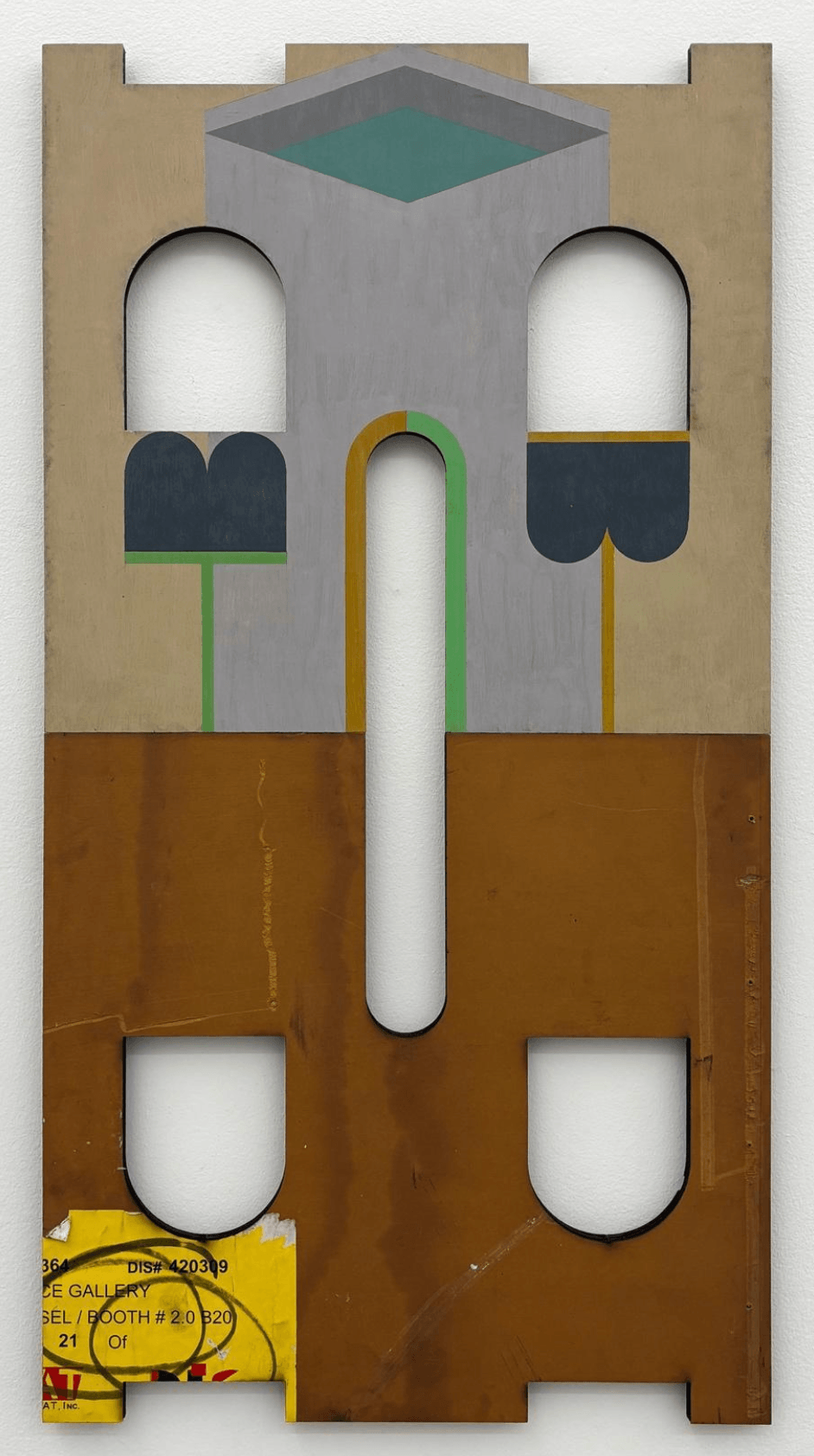
Ceres/Serec. Oil paint, rabbit skin glue, plywood, hardware. 34 x 18 inches. 2026.
Was this guy joking?
More importantly, did he notice that the paintings are on wood, a painting surface used through medieval and Renaissance times but infrequently today? Probably he didn’t read that the materials include rabbit skin glue, an old-school wood preparation. He did not have time, I’m guessing, to observe how shiny and round and smooth the edges of the panels are. Nor, I think, did he notice the way in which the paint had been applied: quite thinly, contra medieval or Renaissance-style panel painting.
Did he see how, on the painted half, the panel cut-outs become part of the composition (for instance appearing as rectangular, arched or elbow-shaped windows), then, on the raw half, switch sides, turning a blind eye to partially removed labels and delivery-assisting scribbles? Did he observe that the panels’ overall shapes, created when they were cut out from the original sheets, evoke architectural forms such as the crenelations of castles or the false fronts ofVictorian row houses?
I’m sure he noticed how pleasing the colors and color combinations are. The bright, clear pink and pale green of Congo/Ognoc, for instance. He also, I’m certain, noted the precision detailing aspect of the paintings. I’m thinking of Ceres/Serec, in which an arch’s outline jumps colors mid-arch, or Congo/Ognoc, which includes 29 identical gray squares (I counted).
I’m less confident the man observed the way in which the works’ architectural motifs can clearly evoke real world structures (for Tega/Aget, a classical arcade or the Metropolitan Opera House), and other times, float freely, shapes only (under the arched cutouts resembling windows in Ceres/Serec are painted double arches, one set curved edge up, the other set curved edge down, that lack a real world counterpart). I also wonder if our visitor noticed how the painted works, usually flat and symmetrical, occasionally cheat, dropping in perspective (as in Tega/Aget) or asymmetry (those under-window arches).
I’d like to think that the interloper was kidding, that it was all a pose. I don’t want to believe that the direct-light world—no shadows, no history, no blur—he professed to want could be desired, seriously. Am I promoting hegemony here though? Finagling another kind of shadow ban? I’ll leave the serious option open. And add the possibility that he changes his mind.
