
Will Riding In
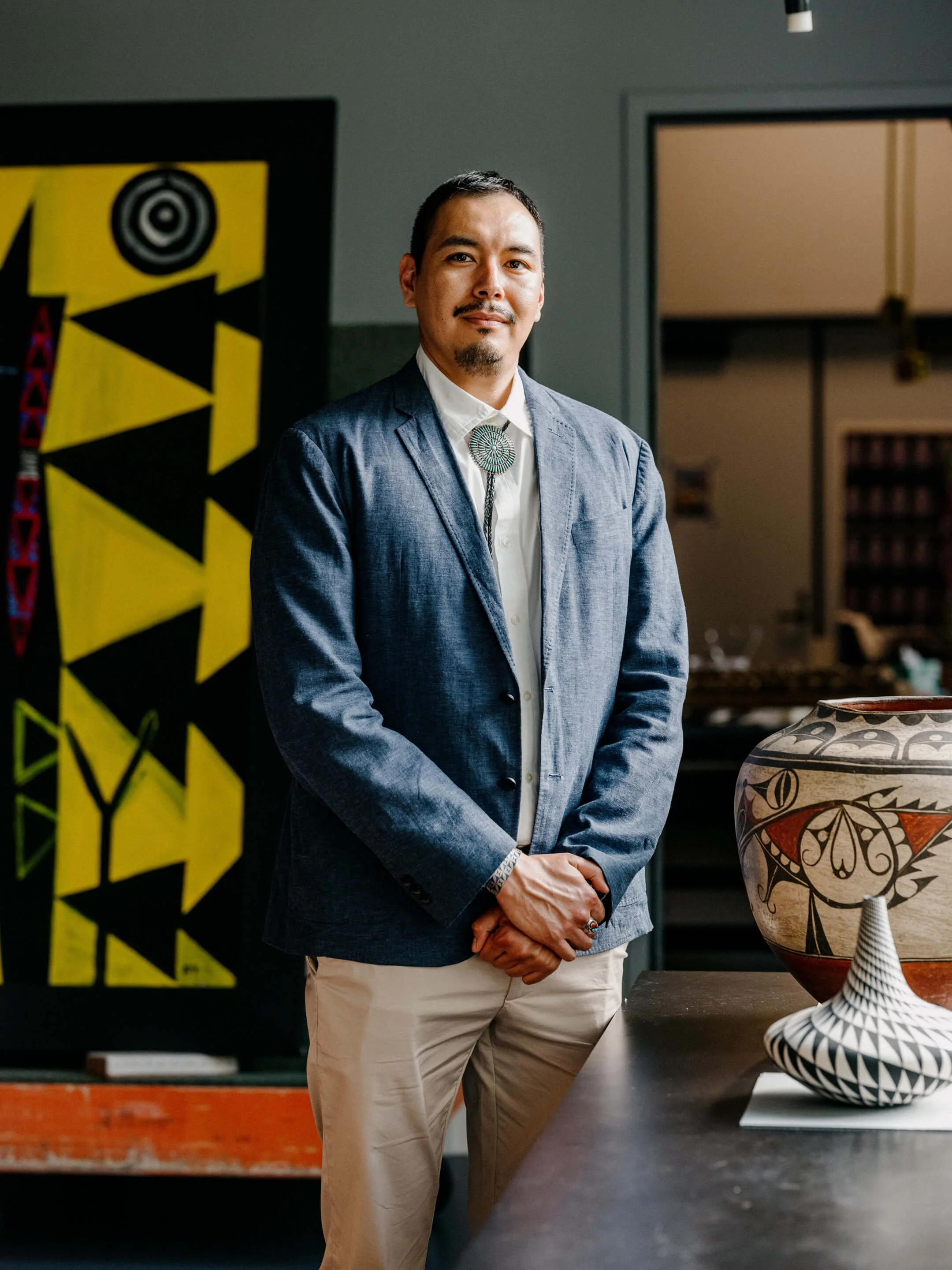
Will Riding In is a distinguished curator, art historian, and potter who dedicated his career to amplifying Indigenous voices and safeguarding Native North American material culture. Currently serving as the Curator of Collections and Engagement at the Wheelwright Museum of the American Indian, Riding In excels at building vital collaborative partnerships with tribal communities to ensure museum collections are ethically vetted, accurately documented, and properly represented.
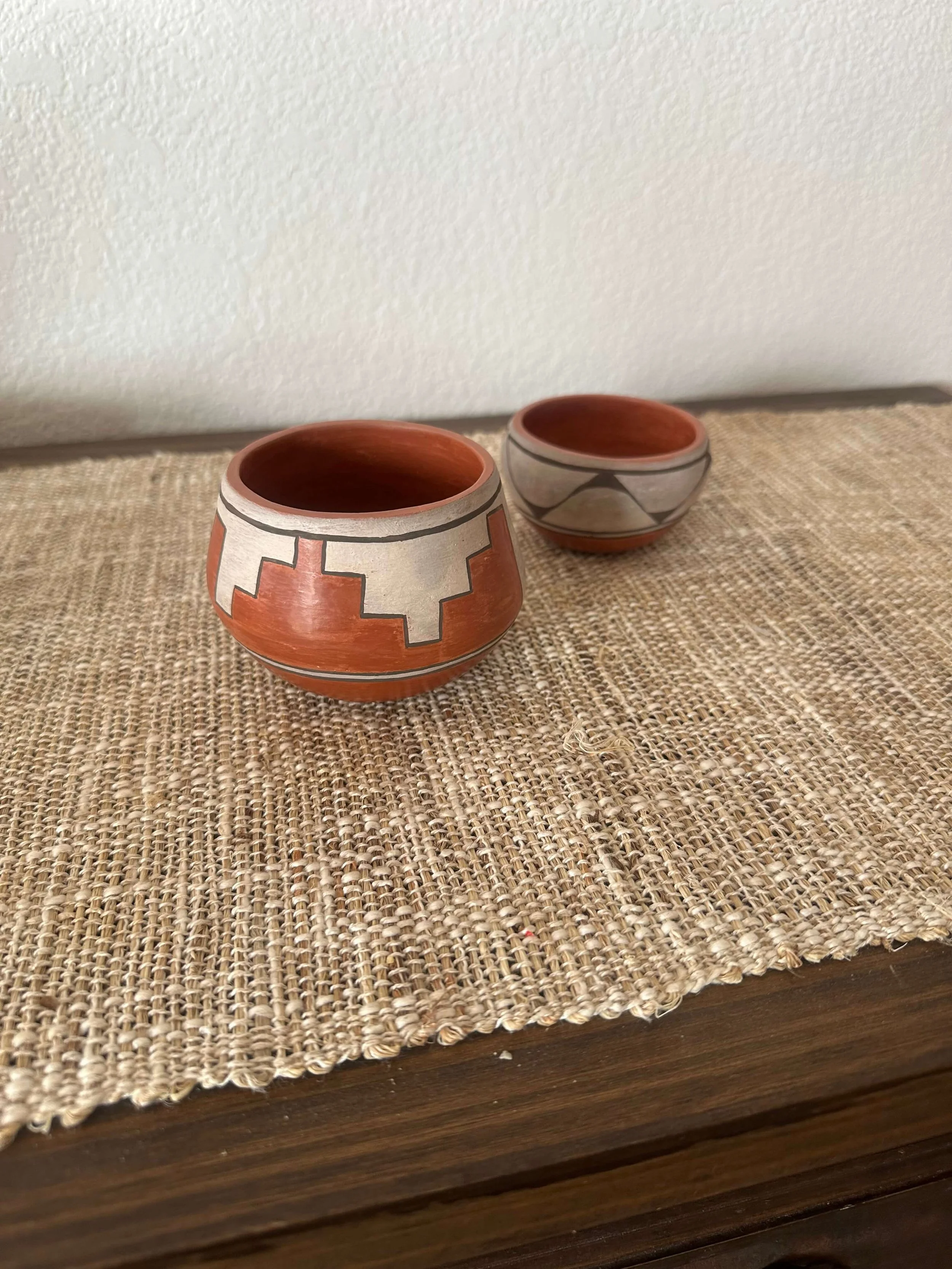
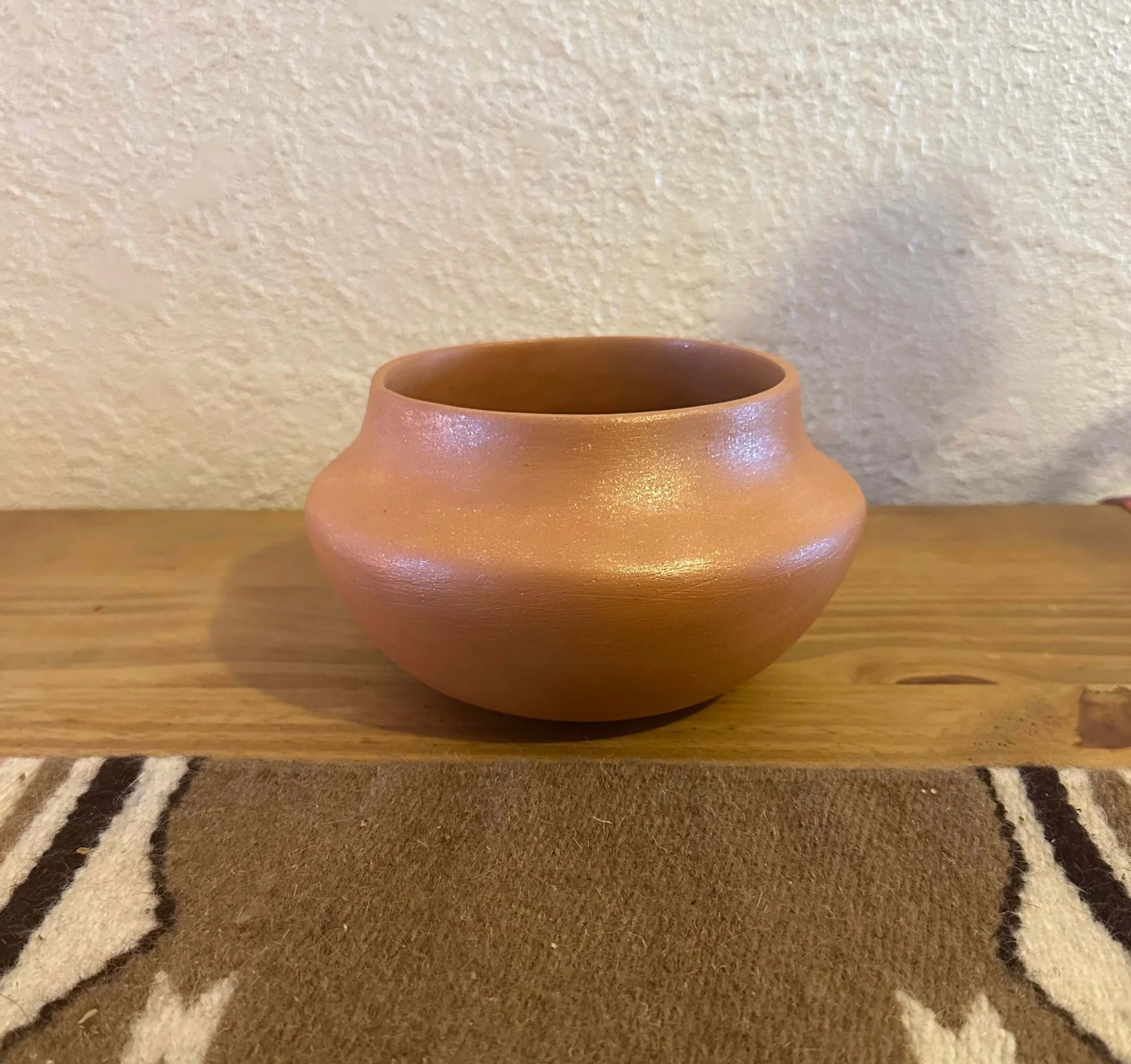
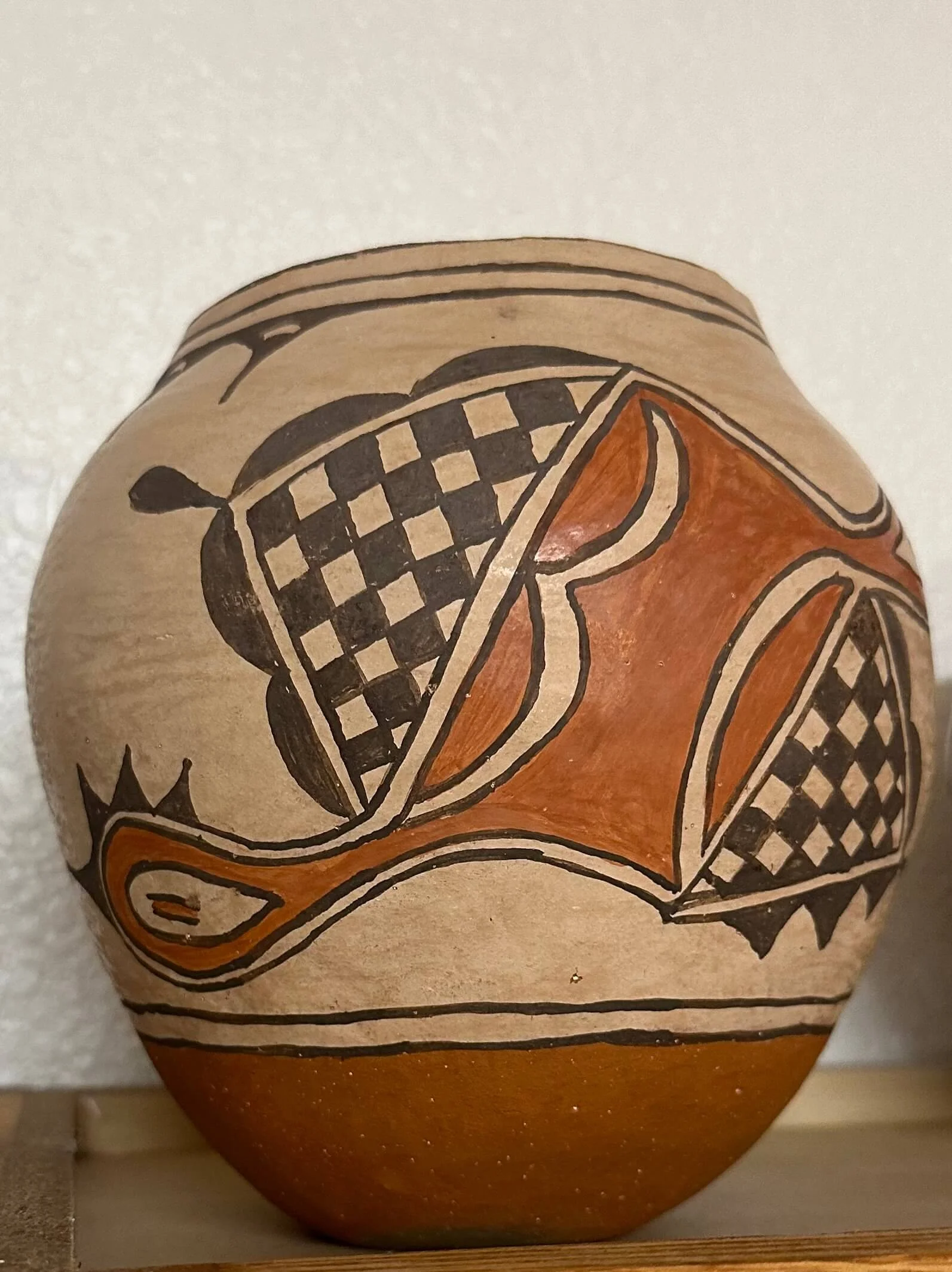
His impactful museum practice includes co-curating and reinstalling the prestigious Indigenous American Art galleries at San Francisco's de Young Museum. Rooted in a deep, multigenerational artistic legacy, Riding In is an active Pueblo potter. He creates traditional hand-built pottery utilizing natural micaceous clay harvested directly from the earth and fired using outdoor wood and manure techniques.
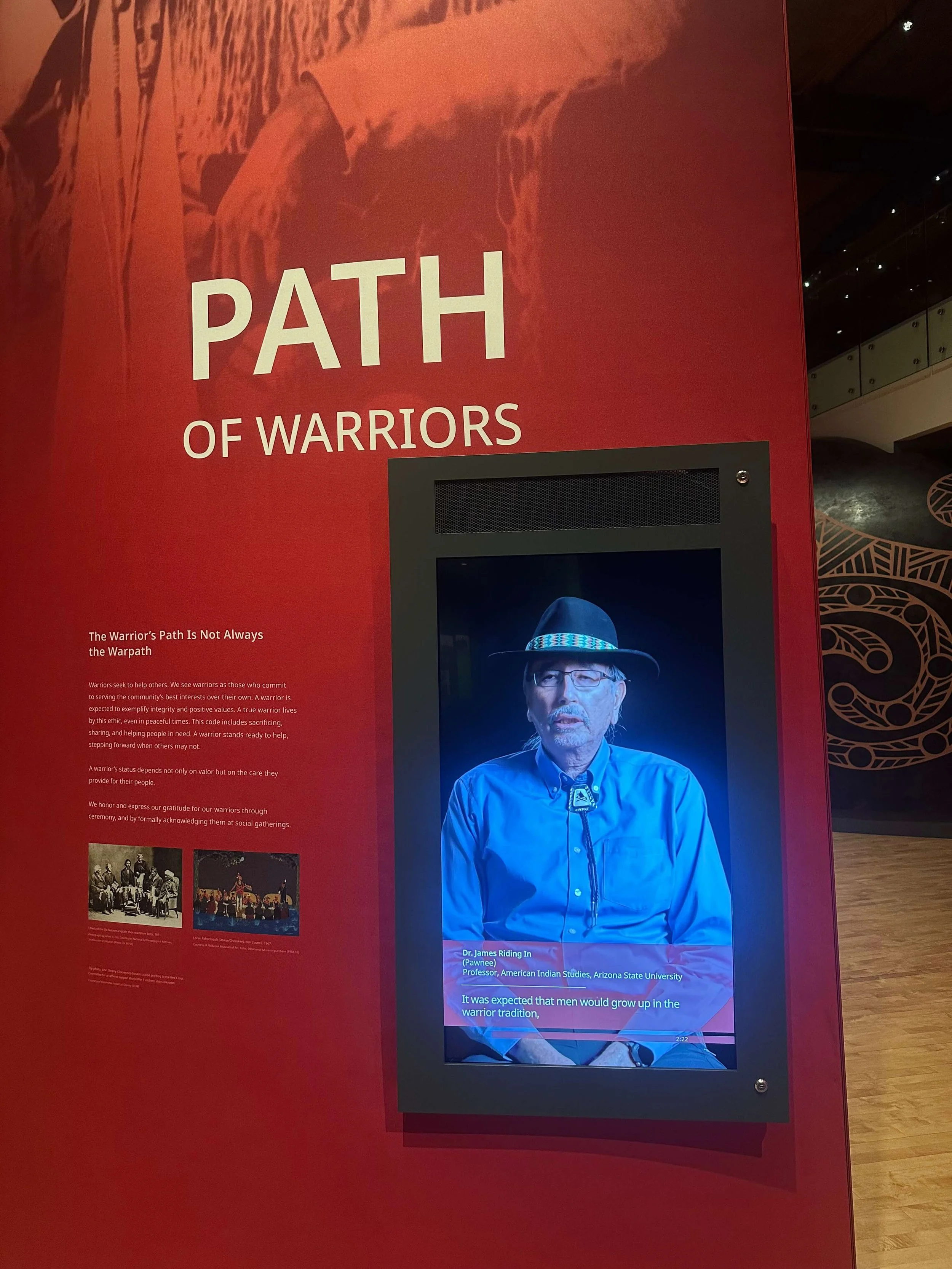
Riding In's professional philosophy is heavily influenced by his family. His maternal aunt, Eudora Montoya, famously led a 1970s revival of traditional pottery techniques at Santa Ana Pueblo. Furthermore, his father, a foundational Pawnee scholar, established the American Indian Studies program at Arizona State University. This powerful lineage inspires Riding In to transform institutional practices, reverse historical colonial injustices, and passionately advocate for the proper indigenization of museum spaces.
The following are excerpts from Will Riding In’s interview as conducted by Hugh Leeman
A Grandmother, a Revival, and a Living Legacy
Hugh Leeman: Will, your grandmother is the subject of a documentary in which, nearly half a century ago, she leads a revival of traditional Pueblo pottery techniques for Pueblo women. Can you give us some context on the cultural significance of that revival, what she meant to you and your family?
Will Riding In: Eudora Montoya was my mother's aunt — in a Native way, she's like my grandmother. She taught a revival pottery class to a group of women in Santa Ana Pueblo in the seventies. She taught them where to get the clay, how to process it, how to process their own materials, and how to do the outdoor firing. Growing up, my mom had several of her pots around the house — small ones and larger ones. And now I see her pots all over Santa Fe, at galleries and auctions. Even though she's no longer with us, her legacy still lives on through her pottery that collectors are still seeking out.
Hugh Leeman: You mentioned the outdoor kiln and collecting clay in nature. We often think of pottery studios as having electric kilns and commercially prepared clay. Can you talk a bit more about the traditional approach?
Will Riding In: I’m a potter myself. I was taken under the wing of Clarence Cruz from Ohkay Owingeh Pueblo in northern New Mexico. I was a grad student at UNM, and I saw there was a course offering for Pueblo Pottery. Already having worked with clay growing up, I thought, why not? Learn from a different mentor.
It was through his class that I learned where to get different clays I wasn't used to — specifically micaceous clay, where there is naturally occurring mica in the clay body. Those are really ideal for utilitarian wares because of the mica, it acts as a heat conductor. He showed me where to get the clay, how to harvest it, and how to process it. That learning experience was really critical for my artistic career — having a new mentor and learning to process different types of materials completely ignited my interest in pottery again. When I was rolling my coils and hand-building, it just came like second nature.
I just before and during Covid, but after Covid passed — around 2021 or 2022 — I had all these finished pots from the clay we had harvested. He was doing a firing at the Poeh cultural center in Pojoaque, NM. , so I brought several of my pots, and we fired outdoors together. For Pueblo pottery, the traditional way is firing outdoors with wood and or manure. The manure ignites fast and reaches a high temperature. That's how many Pueblo potters have traditionally fired their pottery.
Hugh Leeman: Your grandmother made a living at Native art markets, including the Santa Fe Indian Market. Can you give some context on the cultural and artistic significance of those markets?
Will Riding In: The Santa Fe Indian Market (Southwestern Association for Indian Arts) has been around for over one hundred years. It's a way for artisans to sell their artwork. It's branched out to include more contemporary arts as well. When it first started, artists were selling traditional art — jewelry, leatherwork, paintings, and pottery. From what I hear from my aunts, people would be lined up outside my grandmother's booth when the show started, waiting to buy her pots. She had quite a following of collectors.
A Ball of Clay and a Life Set in Motion
Hugh Leeman: Besides your grandmother, your aunt plays an instrumental role in inspiring you at a young age. You told me in a previous conversation that she gave you a ball of clay when you were young, and in no small part, set a lifetime of dedication to the arts in motion. Who was your aunt to you?
Will Riding In: My aunt's name is Laura Peña, and she was one of the potters in our family. She gave me a ball of clay when I was somewhere between eight and ten years old, and that was really a life-changing event. As a child, I was always drawn to mud, to the earth. When it would rain, I'd go outside and make little bowls with the mud. When my aunt gave me that ball of clay, she showed me the basics — how to do coils, how to do pinch pots. She shared where to get the clay and what we put into the clay to make it stronger. She was referring to the temper, which helps strengthen the clay body for firing.
After she gave me clay, I was making pinch pots, little figurines, rolling coils on my own. And when I was done, I would just crush it and start over again, reusing the same clay. With clay, it never really dries out permanently. When it would lose its moisture, I'd just add water, let it sit for a few days, andcontinue to make..
Having her pottery and my grandmother's pottery in the house, I thought to myself: One day I want to do something like that.
Moving from the Reservation to the City — and a Father Who Built Something Historic
Hugh Leeman: You have this multigenerational influence — your grandmother, your aunt, these women around the house literally putting clay in your hands. On the other side, your father becomes a major source of inspiration. Your older siblings grew up on the reservation, and you were the first not to. You move with your dad to the city, and he goes on to found the American Indian Studies program at Arizona State University in the nineties. What was that process like for you?
Will Riding In: We moved around a lot because my dad was in school — our family went from New Mexico to California and then to Arizona. When we got to Arizona in the nineties, he had accepted a faculty position in the Justice Studies department, and that's where he began his career at ASU. After a few years, he was able to recruit other individuals — Manny Pinofrom Acoma Pueblo, Myla Carpio (Jicarilla Apache/Laguna Pueblo), and a few others — and he established the groundwork for developing that program. They were really some of the leaders in American Indian Studies at that time, with strong academic figures like my dad, Cal Seciwa from Zuni Pueblo, Carol Lujan (Diné), and Elizabeth Cook-Lynn (Crow Creek Sioux) from South Dakota, an author and well-known scholar. ASU in those early years of AIS produced this strong foundational cohort of Indigenous scholars who went on to inspire probably thousands of students — Native and non-Native alike.
Hugh Leeman: I can hear the emotion in your voice around that. What did you learn from your father?
Will Riding In: My dad recently passed in November of last year. I've been thinking about him a lot. What he inspired me to do — he's been a huge advocate for me to continue museum work. Growing up, my dad was a historian who worked closely with our tribe, the Pawnee Nation of Oklahoma. He was going to museums constantly, doing consultations with the tribe. Sometimes I got to go on his travels with him. I grew up around museums, seeing beautiful artwork, but also seeing the historic materials. encouraged me to be an advocate for Native peoples — to, as he would say, keep fighting the good fight. Which I interpret as fighting for what you believe in.
As Native peoples, we've endured a lot — systemic racism, colonization. Being in museum spaces is an opportunity to reverse some of those injustices and to Indigenize spaces. My role as a curator now is to work closely with artists and Indigenous communities, because there is a long history of museums not consulting with tribes or disseminating knowledge that was never meant for public consumption. I see my role as working closely with tribes to avoid those unethical situations.
My dad saw the dark side of museums in the nineties and even before. I read something of his recently where he described going to an institution and seeing a display of Native American human remains. That was a pivotal moment in his life — he knew he wanted to fight to get those kinds of exhibitions off public view. He was an advocate for Indigenous peoples all over, pushing for collaboration and consultation with tribes so that those types of materials wouldn't be on public display.
But I also saw museums shift. Even in grad school, I could see them trying to be more inclusive of Indigenous voices. Museums can be a place for Native peoples — a source of inspiration for creativity, a resource for communities. My role as a curator is to bridge those communities with museums and collections, and show that museums can be a resource.
NAGPRA and the Fight for Indigenous Remains
Hugh Leeman: Your father was an advocate for NAGPRA and the repatriation of Indigenous remains from museums. Can you share some context on what NAGPRA is and the history of Indigenous remains and their repatriation?
Will Riding In: NAGPRA is the Native American Graves Protection and Repatriation Act, passed in 1990. It was passed because tribes were dealing with museums displaying burial items, human remains, and items of cultural patrimony— really, without consultation, without even notifying communities about what was on view. In the early years of museums, collections came from archaeologists, self-proclaimed archaeologists, anthropologists going into Indigenous communities, and either taking items outright, doing excavations without the knowledge of communities, or coercing people into selling items. A lot of those items ended up in museums, which would then put them on display without notifying the source communities.
Tribes and Native activists were deeply upset by that. Many of these things were already buried in the ground — people dig them up and put them on view.. It's a desecration of sacred sites and burial sites. Those are the human rights issues that people like my dad were trying to address.
Dropping Out, a Hidden Storage Room, and a Career is Born
Hugh Leeman: You initially dropped out of school altogether. You end up working an entry-level job at the Heard Museum, where you meet Marcus, an Indigenous curator and Comanche man, who reveals a hidden aspect of the museum — the storage that guests never see. This changes your perspective on art, museums, and life. Tell me about Marcus and what he introduced you to.
Will Riding In: I started working at the Heard Museum in 2015. I had dropped out of my master's program in public health and went back to Phoenix, where I took this job in admissions. I met Marcus while working at the front desk. One day, he asked if I wanted to go see the collections, and I said sure — I had never seen them before.
We went, and I got to see pottery from my mom's side — from Santa Ana Pueblo. I was amazed by the collection they had, not only from Santa Ana but from many communities in the Southwest. Their contemporary Pueblo pottery collection was so extensive. That sparked my interest immediately.
Then Marcus was working on an exhibition, and sometimes during my lunch I'd go see what was happening behind the scenes. I watched him take a room with four white walls and transform it into something with a completely different ambiance. He was able to create a mood through the objects, through the art, in the exhibition space — with lighting, colors, text panels, and with exhibition text. Watching that exhibition come together showed me how one person can take art and create a whole new emotional world around it. That's when I really understood how powerful art is. Each piece has its own story, and when you put them together in an exhibition, it tells a much larger story than any single label could. The two are deeply complementary.
That experience made me want to get into curatorial work. I worked at the Heard for a year, then came back to New Mexico. I applied to UNM and got into the museum studies program. I did my practicum at the Museum of Indian Arts and Culture in Santa Fe, helped with the deinstallation of their permanent exhibition, received a fellowship at UNM's Maxwell Museum working with the ethnographic collection, and eventually went back to the Heard one summer to work with Marcus again — traveling pretty much all over the Southwest with him, running programs to create art workshops for tribal communities. The workshops were traditional art forms specific to those communities.
Museums as Places of Gathering
Hugh Leeman: From a curatorial perspective, you've noted that museums need to see themselves as places of gathering, and that there's an opportunity to do better than they have historically. What does that higher aspiration look like?
Will Riding In: Museums are shifting toward being less solely collections-focused and more of a place that can hold conversation. You're seeing a lot of museums get really creative with public programming, which is a way to draw new audiences to the institution. And you're seeing a lot more community-based exhibitions where curators are working with Indigenous communities and putting the Indigenous collaborators' voices at the forefront.
That's a total shift from older museology practices, where the curator's voice — and specifically, often a non-Native curator's voice — dominated. Now you see exhibitions like Grounded in Clay, which has been on a national tour and is now at the Indian Pueblo Cultural Center in Albuquerque. That exhibition had over sixty Pueblo collaborators who were able to tell their own story about the pieces of pottery they selected for the show and what that meant to them. You're getting a whole new perspective on the art — not just the historical context, but what this art means to the community today.
Cultural Preservation at the Confluence of Artistic Evolution
Hugh Leeman: As an artist, you were part of reviving traditional Santa Ana pottery techniques that nearly vanished in the middle of the twentieth century. What is the tension between cultural preservation and cultural evolution?
Will Riding In: There are potters who are still continuing the traditional art form — maintaining those traditions within their community. And then there are some potters who are using traditional methods but doing very innovative work, showing what pottery can be. Virgil Ortiz from Cochiti Pueblo is a great example — his form and the storylines behind his work are really innovative. JeffSuina, also from Cochiti, similarly. And Kathleen Wall from Jemez Pueblo is doing incredible sculptures using traditional clays. So it's slightly different from what people might assume comes from the community, but they're still using traditional methods. Evolving from the foundation rather than departing from it.
Carved Stories: The Wheelwright, Honyouti, and Boarding School History
Hugh Leeman: You've called the Mavasta Honyouti show at the Wheelwright Museum — Carved Stories, done in collaboration with the Honyouti family — a milestone in your career. The show touches on dark corners of America's past, specifically the boarding school era. Can you talk about this show, what it touches on, and how it connects storytelling and art?
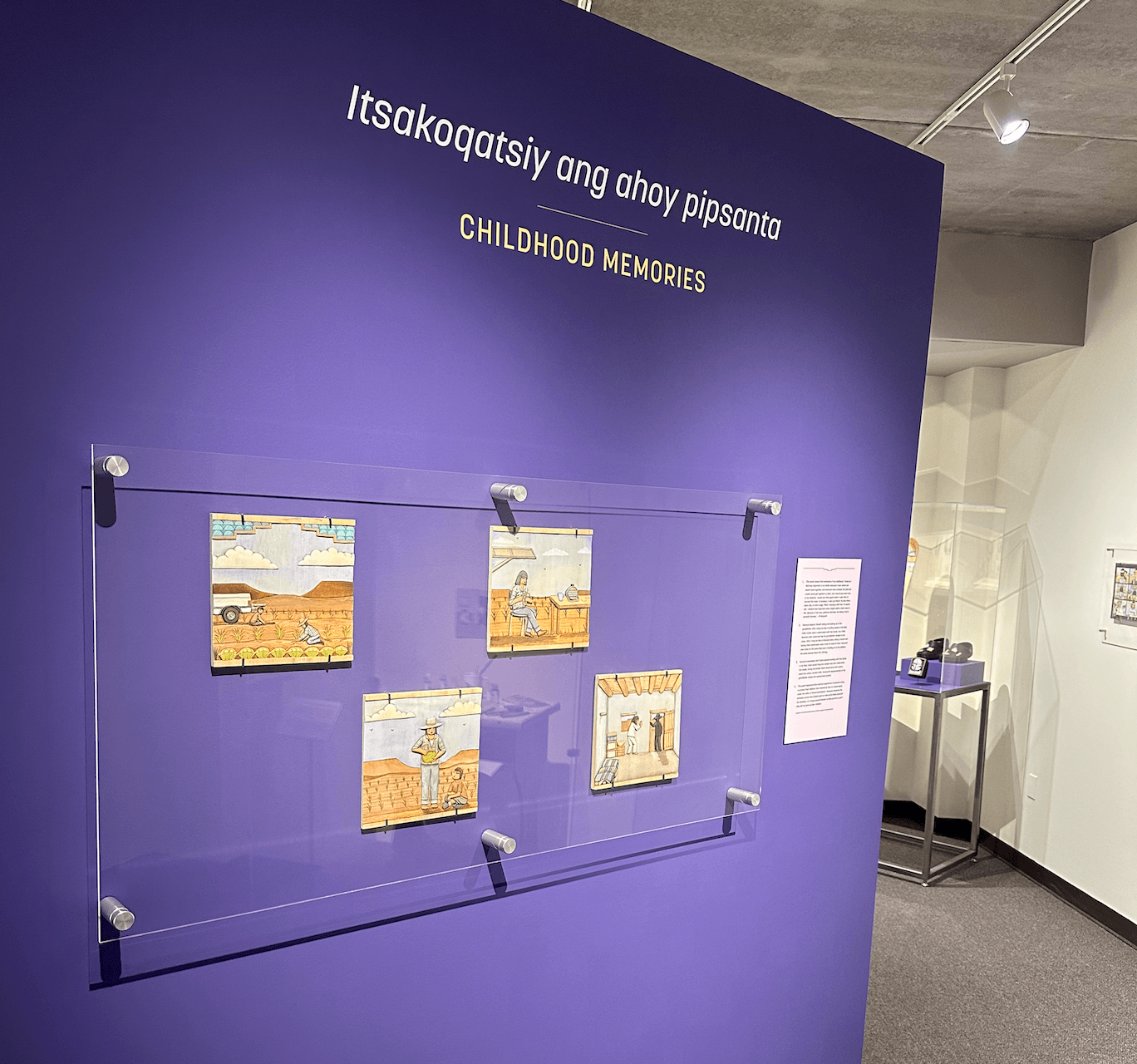
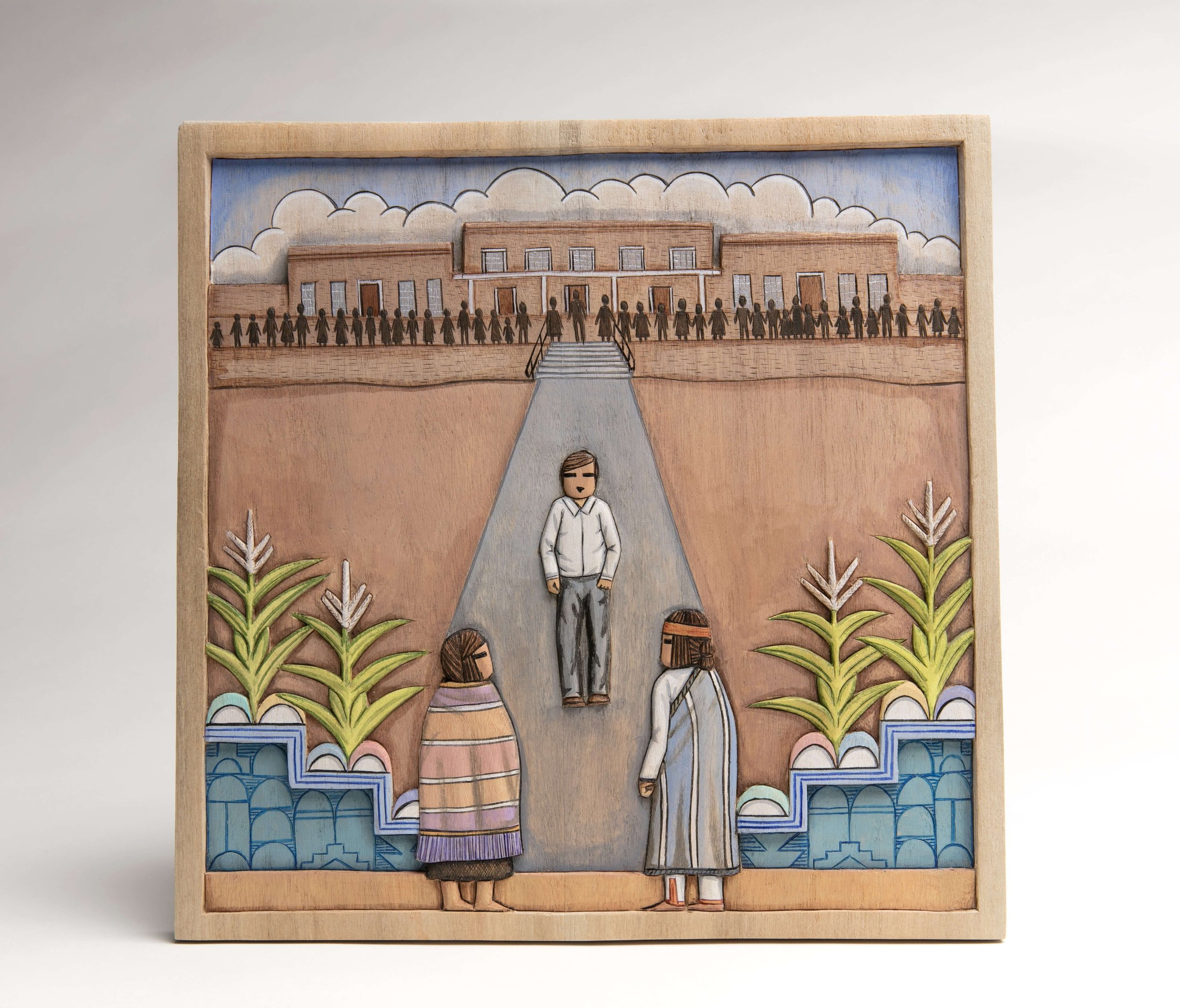
Will Riding In: I curated Carved Stories at the Wheelwright in 2024. When I started at the Wheelwright, the director had already told me the museum had purchased the Coming Home series of master carvings — sixteen low-relief plaque carvings in cottonwood, which is a traditional medium for Hopi people. The story recounts his grandfather's boarding school experience, visually telling the account of a child being forcibly taken from his home and sent to an off-reservation boarding school.
The plaques show him being removed from his family, put on a wagon for several days, and arriving at the boarding school frightened and scared. You can see all of that human emotion in the carvings. The story addresses the US government's assimilation policies — boarding schools designed to take children from their homes, displace them from their culture, and assimilate them into mainstream society. These kids were forced to get Euro-American hairstyles. Their hair was cut. They were issued new clothing. Mavasta’s grandfather, Clyde, for instance, was issued government clothing upon his arrival at boarding school — you can see that in one of the plaques. In the next scene, he was given his English name by someone who pointed at a name on a chalkboard, which was Clyde. At that time, Hopi was his primary language. English was the foreign language.
The story follows his grandfather from being taken from home to being released from boarding school around thirteen or fourteen years old. But the story ends with hope — the final plaque shows his grandfather in his fields, happy, with corn stalks behind him. Even after everything he faced, he went on to live a full life as a traditional Hopi person.
The exhibition was closely connected to the children's book Mavasta wrote and illustrated, called Coming Home: A Hopi Resistance Story. He used the carvings as illustrations. What I did in the exhibition was add historical context that a children's book didn’t go into.
This was a deeply collaborative process. I worked closely with him, his younger brother Kevin, and their father Ron — all carvers. We commissioned a few additional pieces from the family for the show. I worked with the graphic designer, Kevin Coochwytewa, who is Hopi and Isleta Pueblo, who brought the exhibition together visually. My dad contributed some of the editorial work. And we worked with a filmmaker from Acoma Pueblo, John Sims.
As an ethical researcher and curator, since I was addressing Hopi history, I reached out to the Hopi Cultural Preservation Office, informed them about the exhibition, sent them the exhibition text, and received their blessing. They also allowed me to use a historic photograph that Mavasta recreated in one of the plaques — showing a group of Hopi men who had been sent to Alcatraz Island because they refused to send their children to boarding school. I was given permission to include that photograph in the exhibition.
A Father's Blessing
Hugh Leeman: The show inspired Hopi classes to travel four-plus hours to see it. And your father — a towering figure in your life — came to see the exhibition. As you stood there in the museum and watched him move through everything you had collaboratively brought to life, what were you feeling?
Will Riding In: When my dad came for the opening, he went through the exhibition and read every object label and text panel. Then he came out, took a deep breath, and told me, "This is probably the best exhibition I've ever seen. The content is all there. Good job. And I'm not just saying this because you're my son."
He said it was the best exhibition he'd ever seen because of the process — working with the family, working with the community, bringing in an Indigenous filmmaker and a graphic designer. To hear those words from him was the highlight of my life. He had been involved with museums for so many years, often critiquing them. He knew the museum setting deeply. And hearing that from him was such an honor.
That was the moment I thought: this is my process, and I need to continue it. If it's not me who does this work, who else is going to do it? I feel an obligation to continue — to produce Indigenous-led exhibitions, to create culturally appropriate content. Past museum practices have sometimes revealed knowledge that was not appropriate for public consumption. As an Indigenous curator, I won't do that. I consult with the communities I'm working with to ensure the information is appropriate.
Mavasta brought his students from Hopi, which is four and a half, five hours away to see their his work in the exhibit. — Watching their faces light up, seeing how proud those kids were of him — those are the moments that remind me that exhibitions have the ability to really change people's lives.
Hugh Leeman: Shortly after the exhibition, your father became sick. You went to see him at the hospital, and you shared a story with me previously that I'd love to hear again. What did he leave behind with you?
Will Riding In: My dad was in Vietnam and was exposed to Agent Orange. He was diagnosed with a rare form of bone marrow cancer and had been in and out of chemo and radiation. In November of last year, he passed.
In those last days, I was telling him about the work I was doing — that I was fighting hard to continue in his footsteps, producing culturally appropriate exhibitions, doing collaborative work the way he had done it. And I told him I had started to do NAGPRA work too. He smiled at me and gave a fist bump and said, "Good job. Keep fighting the good fight."
That was something he would say to students, to others in the field of American Indian Studies, and the museum world. There's more work to be done. Continue it. I just told him I was following in his footsteps and that I was trying to be like him.
What Will Riding In Hopes You Take With You
Hugh Leeman: For someone who may know nothing about Indigenous arts or the Wheelwright Museum, where you're the curator, what do you hope to leave with them?
Will Riding In: I hope that when people come into my exhibitions, they understand that as a Native curator — as a Pueblo person, as an artist — I'm presenting the exhibition through my lens, and I'm providing a perspective that might be different from other exhibitions they've seen. I work closely with the artists, and sometimes their families, and the content they're receiving is from a Native perspective, culturally appropriate, and genuinely reflects those communities.
I want people to really learn something about Native peoples when they leave. I feel that exhibitions have the opportunity to provide that educational component. In Santa Fe, with its high rate of domestic and international tourism, even if one thing is learned — one new understanding of what Native art is and what it can be — more than likely that person is going to tell their friends about it. As long as they leave with one thing, that's great with me.
Hugh Leeman: Will Riding In — keep fighting the good fight. I admire what you're doing. Thank you so much.
Will Riding In: Thank you.
