

Jeff Dikio, This Must Be the Place, Transmission Gallery
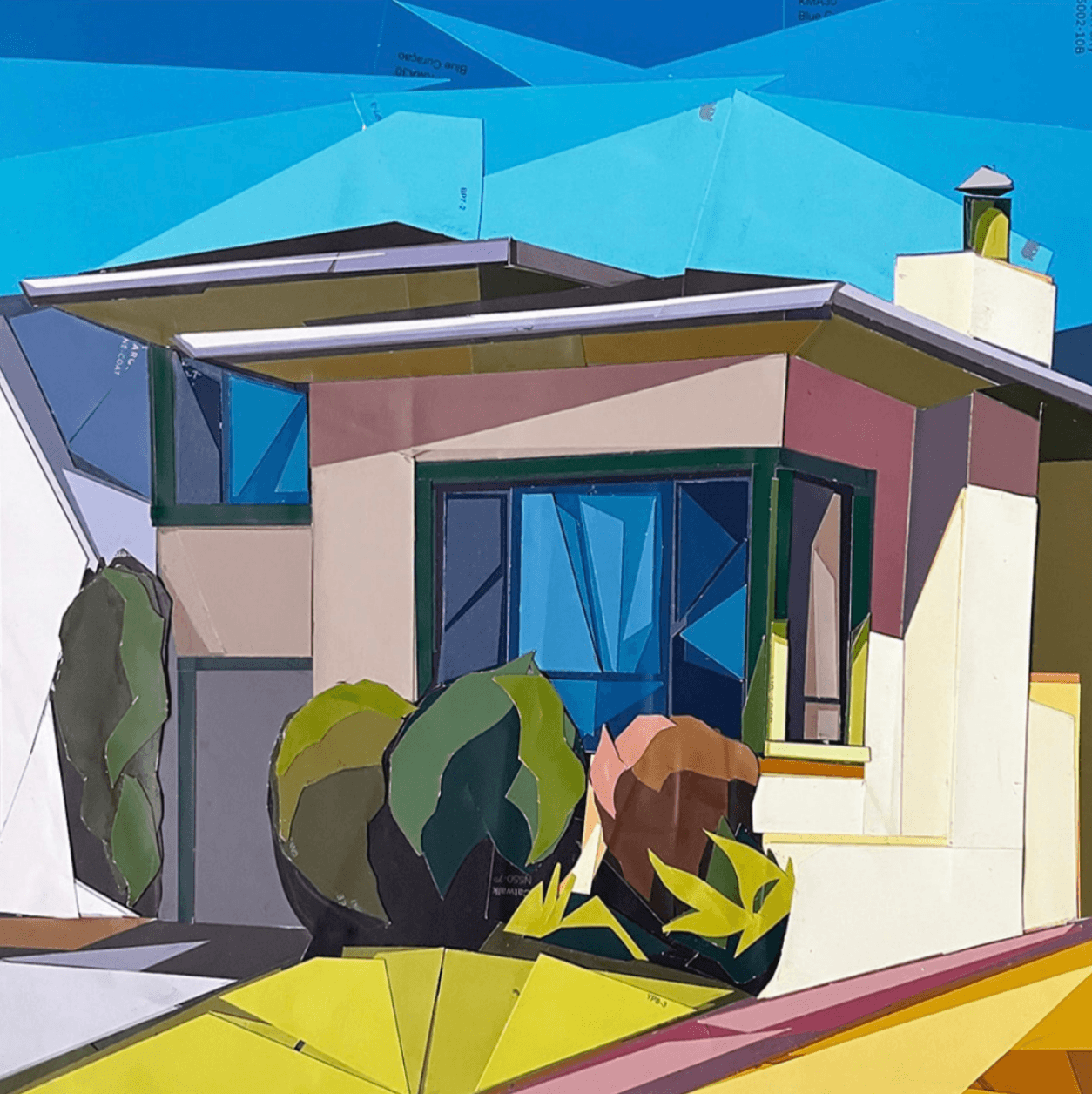
Jeff Dikio, Daly City Doelger (Beige and Green), paint chip collage,12 x 12 inches, 2026.
By Doug Welch
This Must Be the Place, an exhibition of Jeff Dikio’s collage work on display at the Transmission Gallery, in Oakland, offers a beautiful array of works created from repurposed paint chips; the kind of small rectangular swatches that get distributed free at hardware stores to help homeowners choose a wall color. The exhibition showcases Didio’s skill at creating vibrant, colorful images that represent well-known places in the Bay Area. Small boats in Golden Gate Park’s Stowe Lake, a life guard station on Stinson Beach in Marin, a Victorian home in San Francisco’s Mission neighborhood, and Doelger homes common in the Sunset District and in Daly City – all connect the viewer to places and memories from the Bay Area, past and present.
Filipino-born Dikio, who earned a BA in Fine Arts from the University of California, Santa Cruz in 1997, has maintained a practice that moves across figurative, landscape, and mixed-media work. This exhibition explores how he treats painting as a negotiation between looking and feeling, prioritizing expressive response over literal transcription. Central to his method is a commitment to ongoing revision — forms and atmosphere accumulate through repeated application and reworking. Many of the works seem as if he’s tackling the same subject, yet upon close examination, the subtle differences and challenges that presents are apparent.
Anyone familiar with the Sunset neighborhood in San Francisco or the Westlake neighborhood in Daly City will immediately find the homes recognizable. Probably less known is their origin. Starting in the 1920s, a San Francisco developer, named Henry Doelger, began building affordable wood framed stucco homes in the Outer Sunset neighborhood. They were multilevel with living areas built over a garage. Over the years, his styles shifted but his homes remained practical and well built – as evidenced by their continued ubiquitousness close to 100 years later. His initial home design had a Spanish facade and as aesthetics changed, he changed with them. His homes had names such as “Mediterranean Revival”, “Styleocrat” and “Nantucket,” the details of which are known to Dikio, as all make it into his titles.
These collages have an angular, geometric appearance which seems like a natural consequence of the source material Dikio works with. While the paint chips are often cut to fit the particular needs of the piece, the sharp and distinct lines remain. This sharpness is in part a result of the uniform color of each swatch Dikio uses. Unlike paints where colors can be blended, deepened or lightened allowing the color to slowly and subtly change, when Dikio switches colors, a clear differentiation between the swatches reveals itself.
One of the challenges Dikio sets for himself is the rendering of shadow, and it is where his mastery of the collage medium, and his understanding of form and composition, becomes most apparent. Shadow in a collage made from pre-colored material cannot be mixed or changed the way paint can. Instead, Dikio must find or select chips whose existing colors approximate the color change that a shadow necessitates, then cut and place each one with enough precision that the viewer sees shadow rather than simply seeing a different shade or hue.
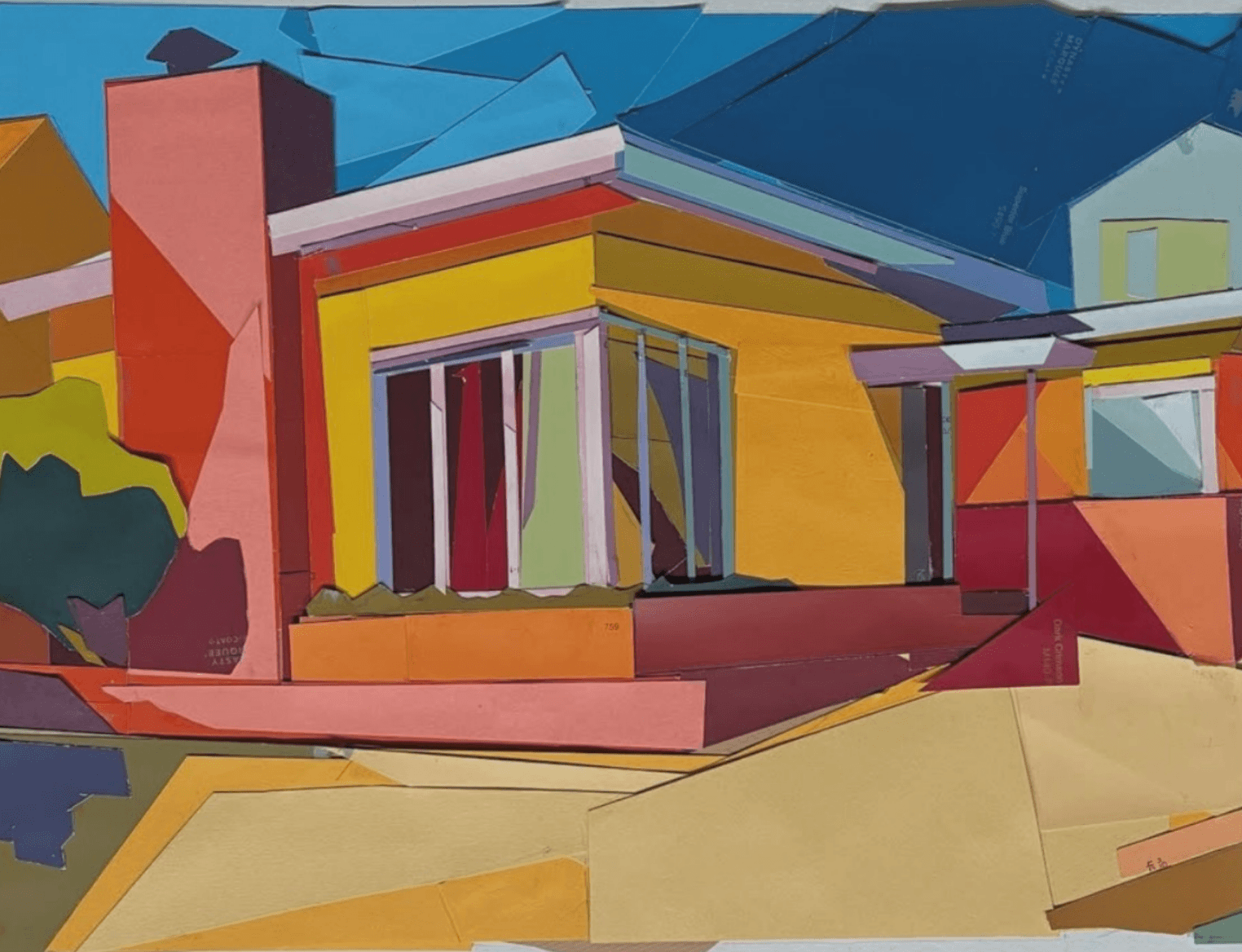
Jeff Dikio, Daly City Doelger (yellow and orange), paint chip collage, 11 x 14 inches (2025).
In Daly City Doelger (yellow and orange), the deep reds and maroons that fall beneath the roofline and along the chimney look convincing, with the tones shifting just enough to create this illusion of a penumbra. The ability to create this shadow, also adds dimensions to the home. It’s easy to forget that the chimney and the overhanging roof are in reality, one dimensional. That this is achieved without being able to blend pigment materials, through selection and placement of paint chip fragments alone, shows unquestionable talent.
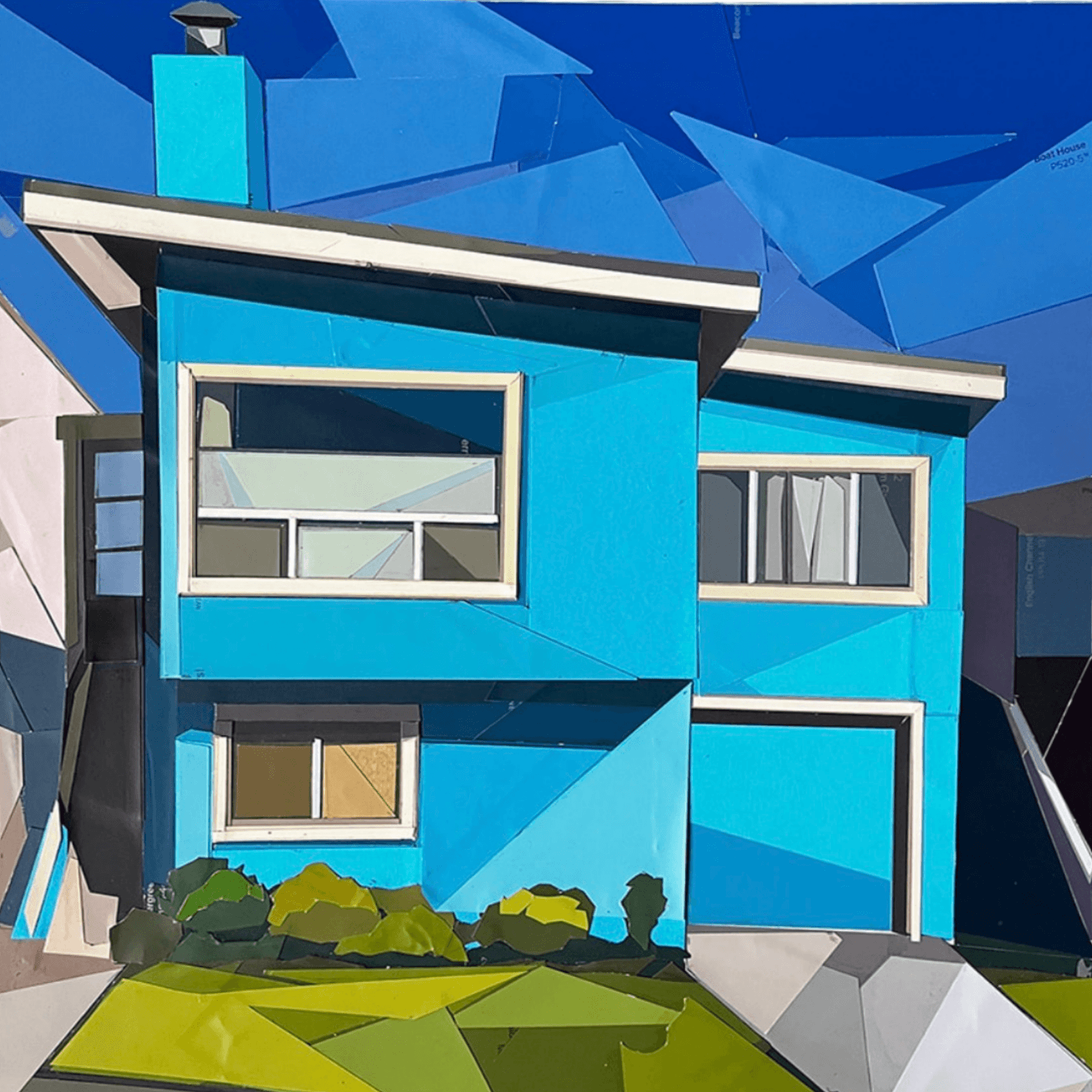
Jeff Dikio, Daly City Doelger (Blue 2), paint chip collage, 12 x 12 inches, 2026.
Daly City Doelger (Blue 2), depicts a split level Doelger home common in the Westlake neighborhood in Daly City. The striking bright blue of the home contrasts with the deep hues of the sky. Off white, light and dark grey swatches combine into a driveway. Green bushes press up against the front of the house with a lawn moving into the foreground. Through slightly different hues, Didio creates the illusion of shade and shadows. Darker blue visible immediately beneath the second-floor overhang and on part of the garage door create a late afternoon feel. Angled and overlapping grey swatches are transformed into a window shade through Didio’s precision.
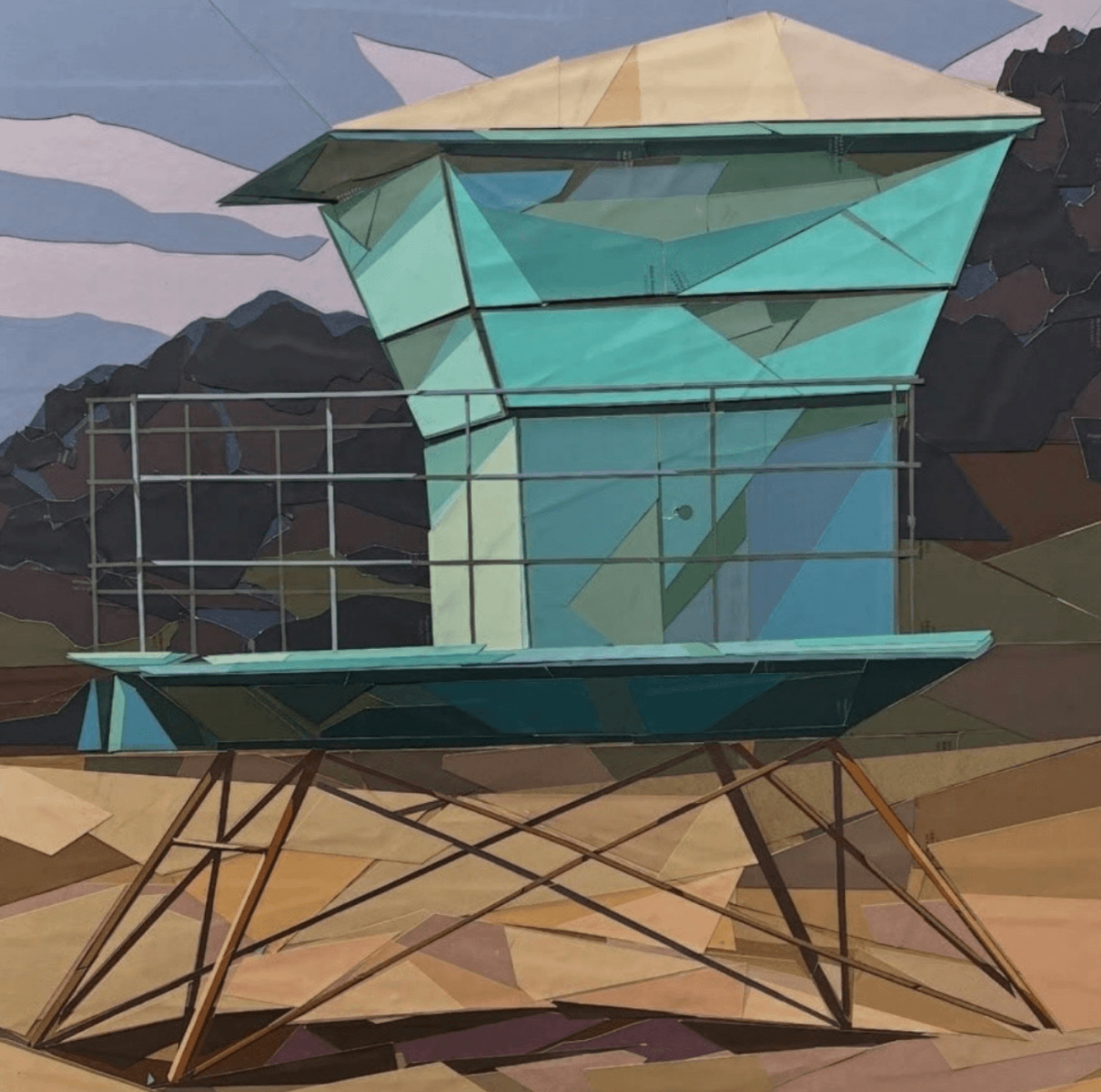
Jeff Dikio, Stinson Beach Sentinel #3, paint chip collage, 24 x 24 inches, 2025.
Stinson Beach Sentinel #3, on a cradled panel shows another object recognizable to Bay Area natives. This lifeguard station offers a multilevel structure, sharp lines and soft pastel colors. He creates a fence around the first level of the structure by using silver or grey swatches that have been cut into very thin, long pieces. Didio effortlessly creates a blue sky with light clouds – the kind that moves quickly over the sky – sometimes blocking out most of the sun, but never for long. This piece demonstrates that Didio’s showcase technique extends well beyond just making living structures. His ability to render landscape elements is manifest. Below the lifeguard station is subtle shaded sand. Around the station, where the sand is not blocked by the structure, we observe the same sand but areas remain unadulterated. In the background are the mountains and foliage one sees from that beach, with ever so carefully placed color augmentations to reflect what the human eye typically sees.
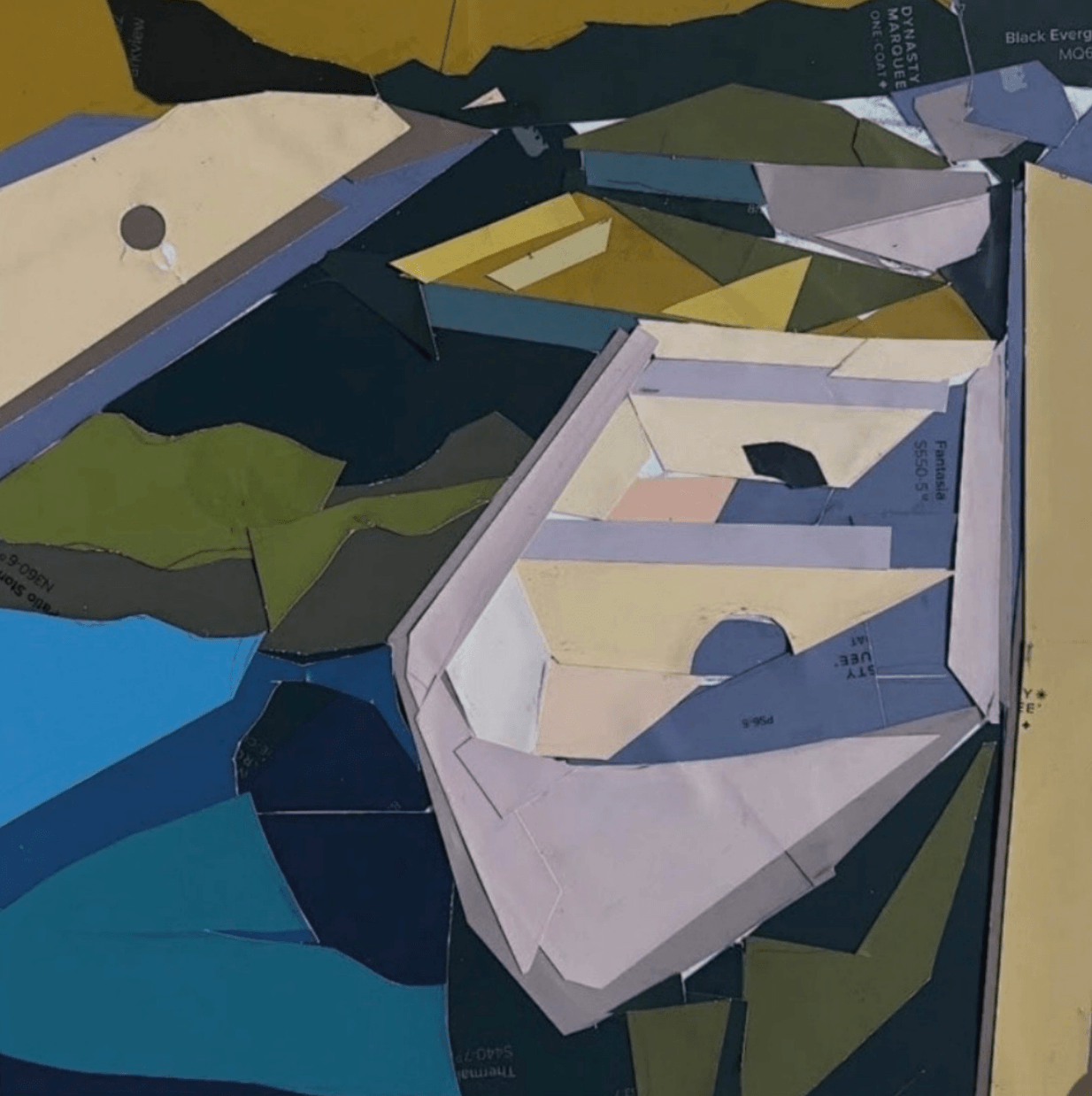
Jeff Dikio, Stowe Lake #2, paint chip collage, 12 x 12 inches, 2026.
Stowe Lake #2, shows a small boat floating on the surface of the body of water in Golden Gate Park’s Stowe Lake. Dikio’s mastery of color and hue gives the surface of the lake varying characteristics. By using aqua, light blue and darker blues, the lake looks deep and pristine. Close to the boat near what is likely the edge of the lake, Dikio uses green and grey. By doing so, he conjures the part of a lake or pond that is more stagnant allowing algae and bacteria to accumulate. Behind the first boat sits a smaller boat and beyond that, Dikio allows the collage to become more abstract – identifying exactly what is represented becomes more challenging - possibly a smaller boat, a dock, or more of the lake. Dikio’s use of ambiguity here adds an element of non-objective abstraction that elevates the experience for the viewer, who naturally looks between recognizable and unknown areas.
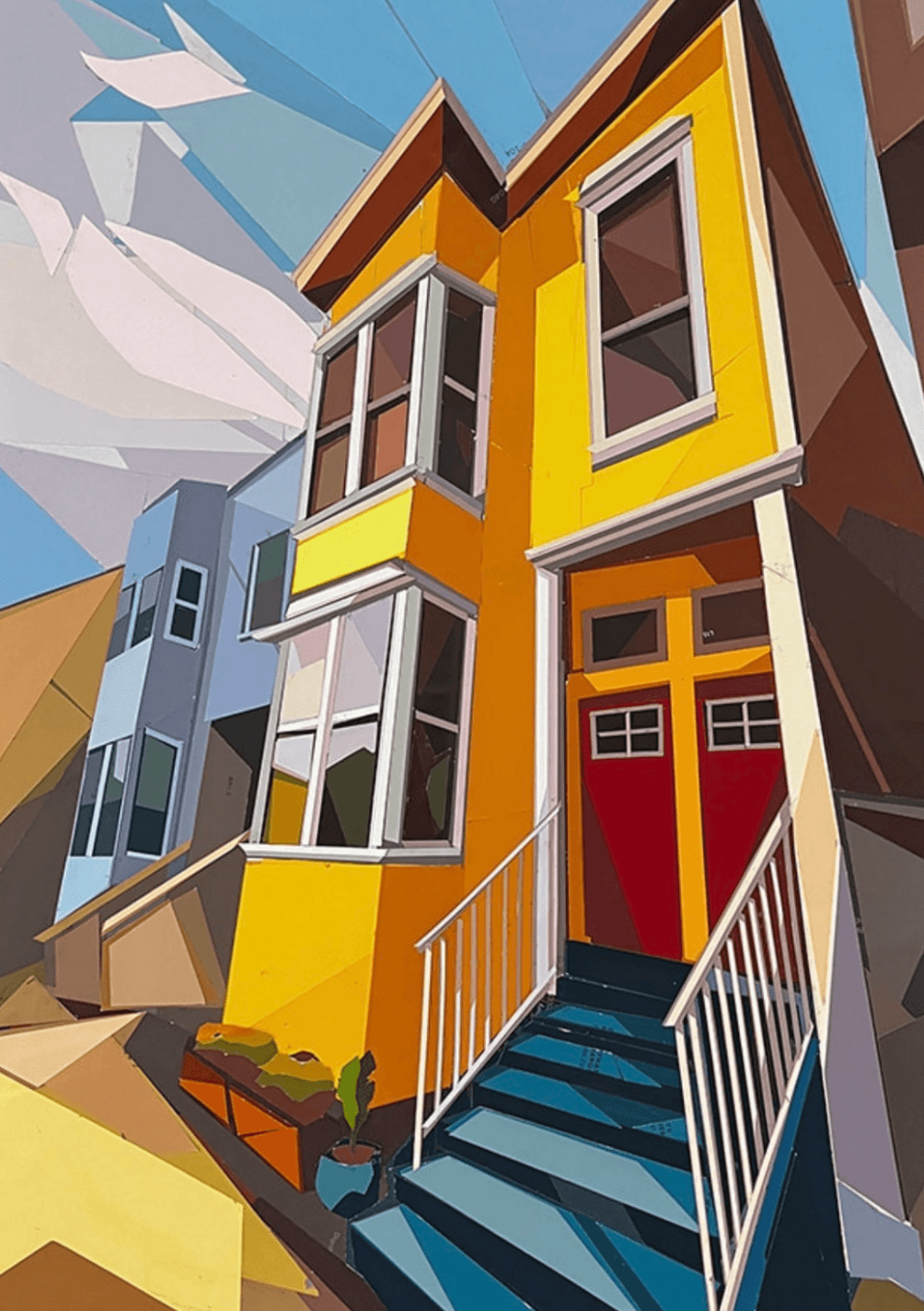
Jeff Dikio, Mission Victorian (yellow), paint chip collage, 16 x 20 inches, 2026.
This exhibition feels like an homage to parts of the Bay Area that do not automatically scream out for recognition – but that nevertheless are easily identifiable by those who love this place. Dikio’s skillful recreation through his collage of distinct homes and neighborhoods, a small part of an iconic park, and a small but beautiful beach, all feels nostalgic and is impressive to see. He reminds the viewer of the beauty that surrounds us, even in often overlooked places, and he celebrates what close observation can convey to us.
The exhibition is open through June 13.
