

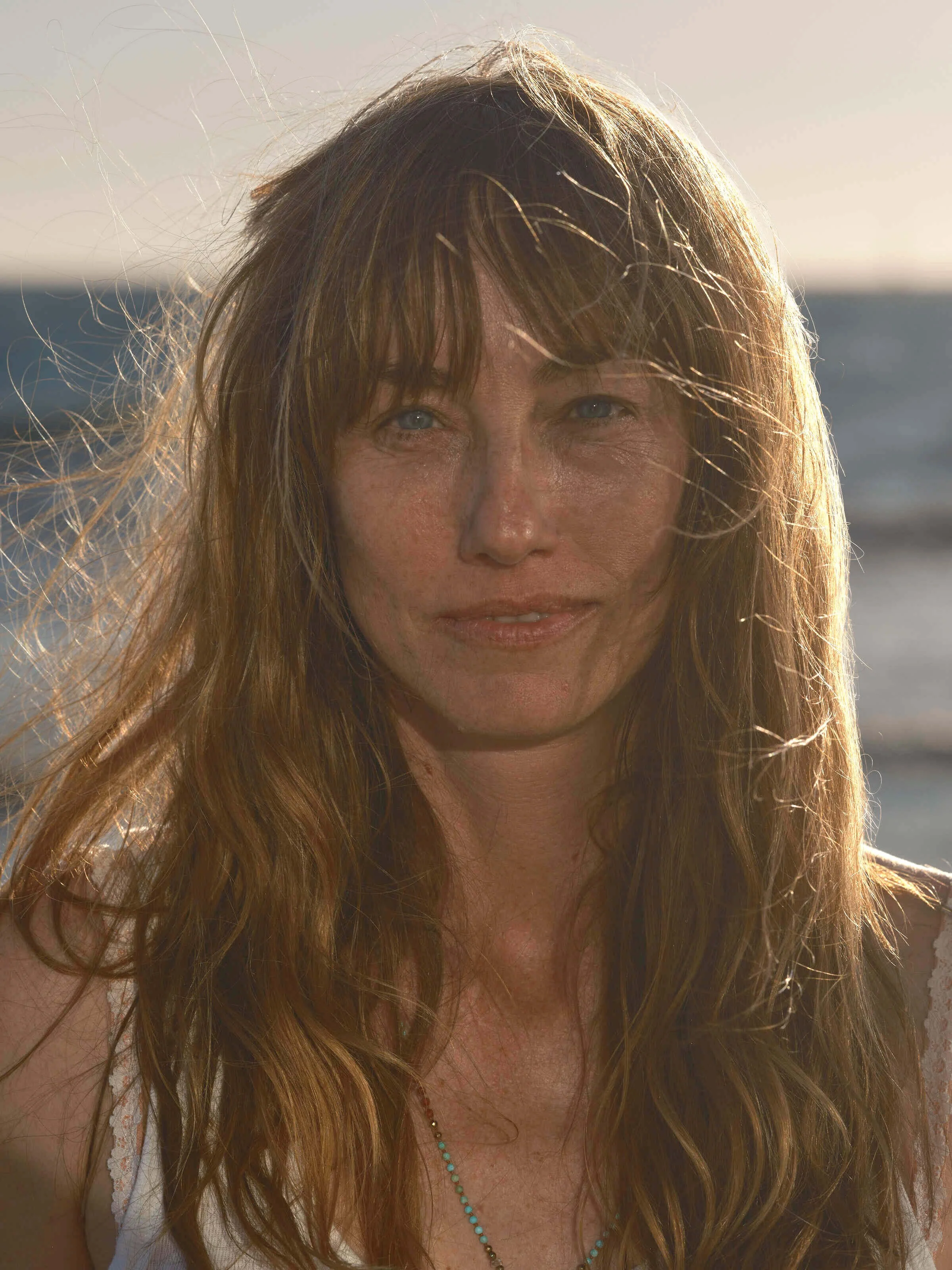
Born in Boston, Johanna St. Clair is a San Francisco-based painter whose work explores the natural world through expressive brushwork and intuitive observation. Working primarily in oil and ink, she captures the movement and energy of organic forms, often painting directly from nature.
Thanks for agreeing to this interview. We’re delighted to learn more about your practice. Can you start by describing your work and specifically what you’re working on now? Do you have a preferred medium? Subject matter?
I like to paint and draw plants. Sometimes that brings me to landscape, sometimes to still life. Lately I’ve been thinking about interiors and other people-plant interfaces. But fundamentally, the plants are a vehicle to make work that is about the physicality of things (including paint), and how we perceive and process visual information.
Where can people see your work? Are you in any exhibitions right now or have anything scheduled? Do you welcome studio visits?
My next project is a group show called Memory Palace at Chandler Gallery in March 2027. It’s a group of artists working in diverse mediums that has been meeting regularly as a book club focused (loosely) on art. Yes, I welcome studio visits!
Can you share how you became an artist? Did you have an epiphany that compelled you in this direction? Did you have formal training? Did you grow up in a family that valued art and left the door open for you to become an artist?
My mother is a talented artist who took me to museums and filled my childhood home with art. She shows her paintings and drawings in her community in Down East Maine, where she also started a gallery and music venue. I remember her teaching me how to render tree bark as a little kid, and I also remember my father teaching me the fundamentals of perspective. I got involved in the art scene in San Francisco when I arrived here as a young person and got a job at the bagel shop across the street from the Adobe Book Store.
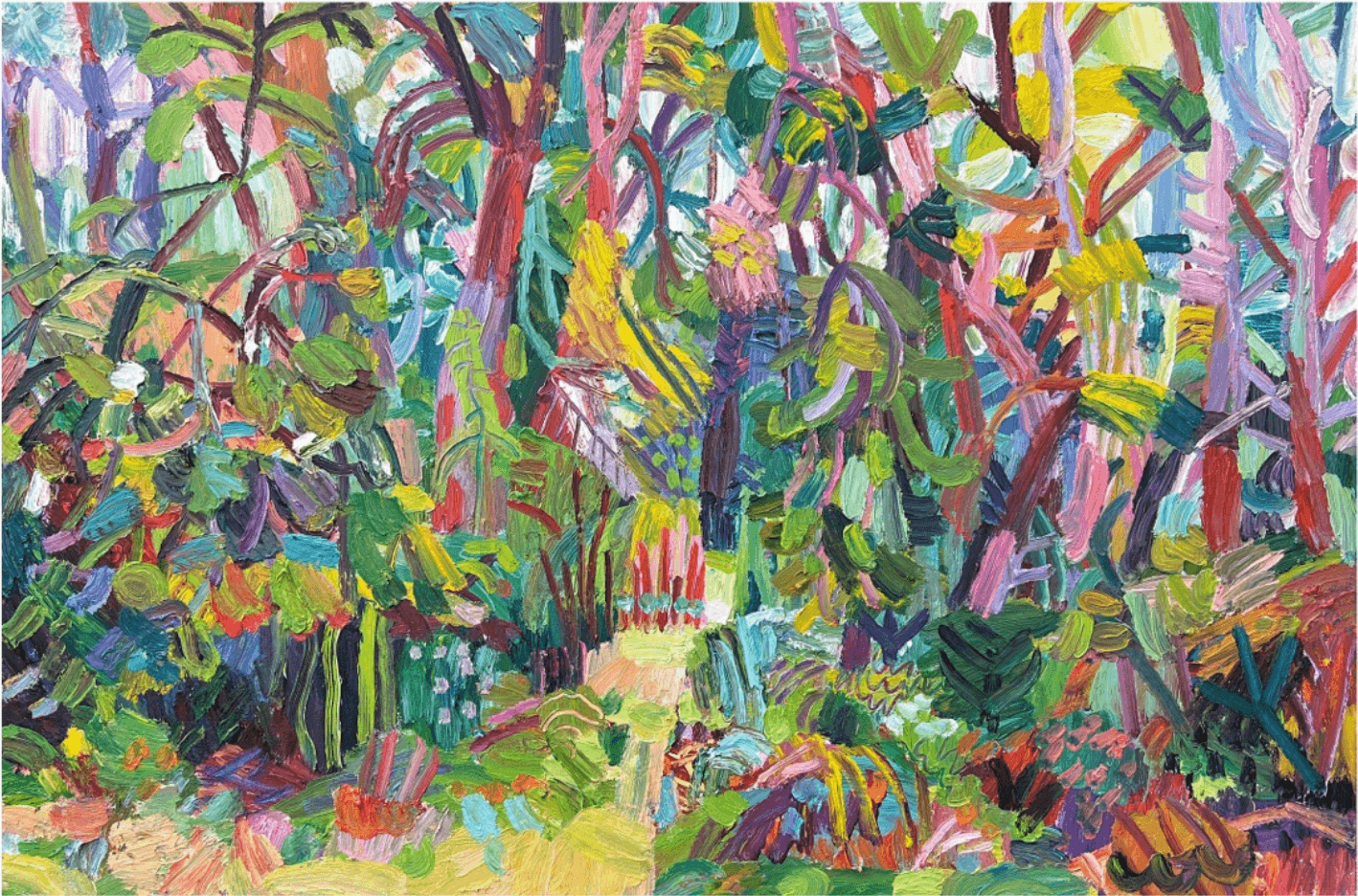
Johanna St. Clair, Picnic Grounds, 2024, oil on canvas, 24 x 36 inches.
What is the most challenging thing about being an artist in San Francisco? There’s a lot being said now about the changing landscape of the art scene here. On the one hand there is criticism that City Hall isn’t doing enough to support the arts and some are pointing to the changing landscape of the gallery scene. That perhaps the old model of a brick and mortar gallery that represents artists, with exclusivity agreements, is dying off. Any thoughts?
It’s been a bummer to lose so many galleries and institutions over the last few years due to the high cost of living. Lowering the cost of living is going to require more building, and City Hall certainly has a role to play there. But the cost of living is complex, and San Francisco is not going to ever return to the lower cost and looser vibe of the 90s, or the 1940s through 1960s when SFAI was in its heyday. What really makes an art scene is gatherings — openings, drawing groups, book clubs. Our remaining art institutions are precious because they create space and opportunities for gatherings. So I think we should focus on parties! More parties! And City Hall should have a thumb on the scale to encourage rehearsal spaces, studio spaces, and temporary use of vacant spaces. I hear rehearsal space is a real issue right now.
Have you ever put on exhibitions yourself as a curator or organizer? If you were to put on an exhibition in the future, do you have any curatorial ideas you’d like to share? Is there a show you’d really like to see put on?
I’ve been thinking about an idea for a group show based around the Bay Area artist Mark Adams, ideally including his work, the work of one or two of his contemporaries, and some current Bay Area artists whose work follows some of his threads. That’s about as far as the idea has gotten. I should work on it.
Do you think art should make political or social commentary? Does your art do that? Is there a role for the artist to play in challenging political climates?
I think that the most effective political and social conditions-oriented artworks are embedded with the complexity and contradictions of the human experience. Without that, social-commentary art functions more as in-group signaling than as a vehicle for changing minds. Can art change the world? Propagandists have thought so throughout modern history. My own art isn’t political.
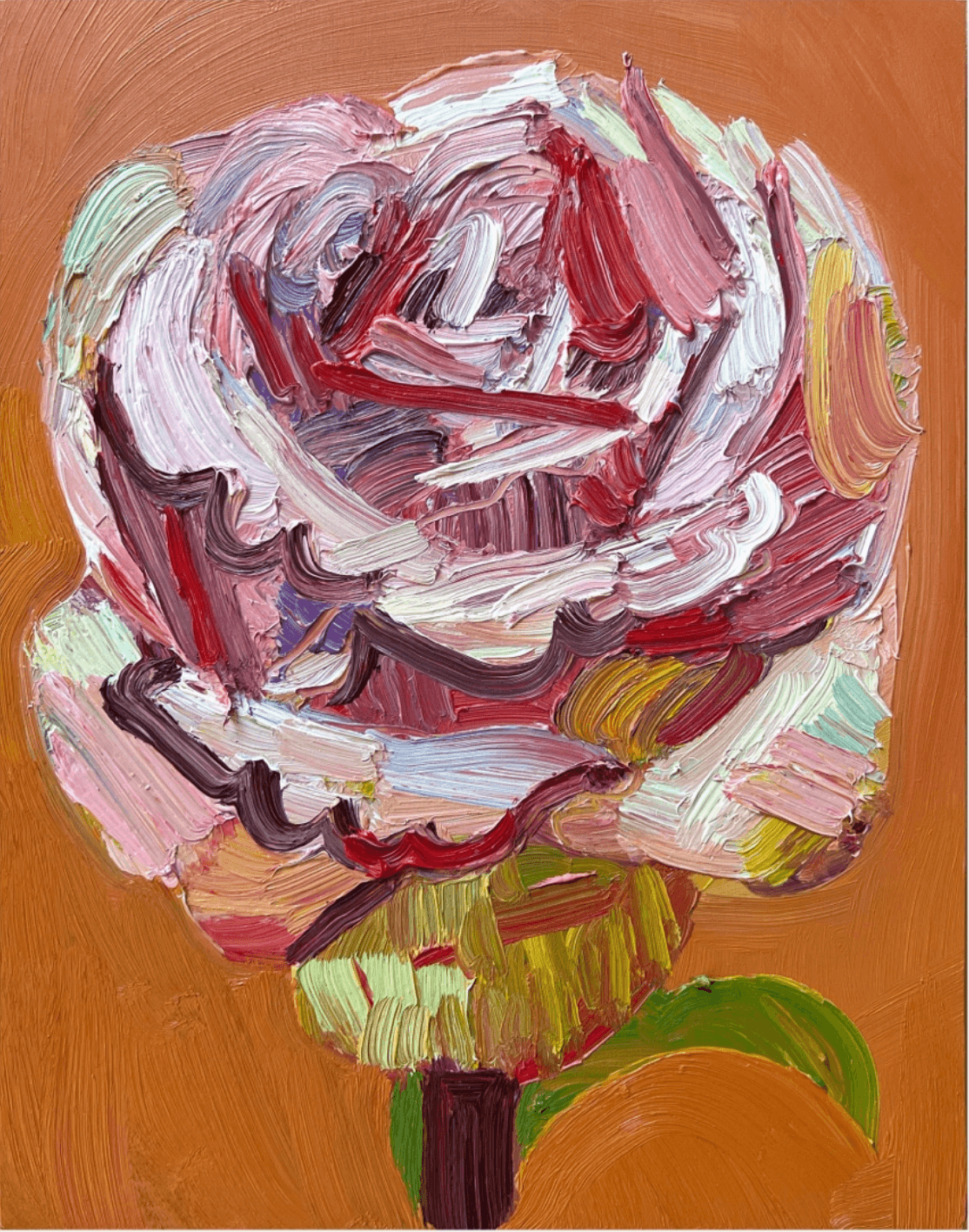
Johanna St. Clair, Quicksand, 2026, oil on panel, 14 x 11 inches.
Do you believe art reflects an artist’s diversity such as gender identity, sexual orientation, ethnicity, or race? Are these (or any other diversity consideration) present in the art you make? Why or why not?
The shift toward diversity in the art world over the last 15 years was overdue and very exciting. But it’s interesting that, at the same time that doors finally opened for people with diverse backgrounds around gender, ethnicity, etc., the art world has drifted toward a monoculture of near-identical CVs. Shared training pushes people toward shared ideas. The institutions that are currently giving so much thought to diversity should make sure that they are looking outside of the cadre of recent MFA graduates. The truth is that it’s very difficult not to repeat oneself and be overly influenced by peers, so there are fundamental human currents that work against true diversity.
What do you think artists should be talking about right now?
Lately I’ve been thinking about the quality of nostalgia, how it is so moving in visual art. Nostalgia is memory embedded with a sense of loss, of time slipping by, of mortality. And I’m always very interested in slippery, shifting qualities of shape and line. Sometimes I’m amazed by how funny drawing is — humor is the other side of slipperiness, the way lines and marks can have double meanings. Drawing is fundamentally funny and always the foundation. I highly recommend drawing.
Outside of artmaking, are there any cultural projects you’re interested in or currently engaged with? Any art-adjacent hobbies you enjoy?
In my day job, I’m a clothing designer. My husband John and I run Mollusk Surf Shop together. I design swimwear, T-shirts, and jackets, make graphics for the clothes, and design fabrics. Unlike my studio practice, my design work is highly collaborative. I work closely with the factories on fit, and with our surf team, our employees, and especially John. It’s an amazing job, incredibly challenging, and I’m always learning. Right now it’s time to design the Fall 2027 sweaters, and I’m surrounded by beautiful yarn cards.
My studio practice and clothing design work feel very separate, but lately I’ve been considering what would happen in the studio if I approached painting as a design challenge, just as a different framework.
Are there any contemporary artists you draw inspiration from? Can you name the artists and say how or why they inspire you? Same thing for historical artists. Are there any who speak to you despite their living in a different era?
For historical artists, I’m obsessed with David Milne, the Canadian (dry) watercolorist who documented WWI and then painted trees and lakes with so much strange rhythm and interesting mark-making. I really love the way Edouard Vuillard and Pierre Bonnard created shifting worlds made up of the everyday, but imbued with magic.
For contemporaries, I love Mamma Andersson’s use of found material to create nostalgia (and her deft handling of paint and her natural, often funny drawing), the way Tauba Auerbach builds perception puzzles, and the way Emilio Villalba has made a Bay Area painting tradition (think Joan Brown) new again by building on it.
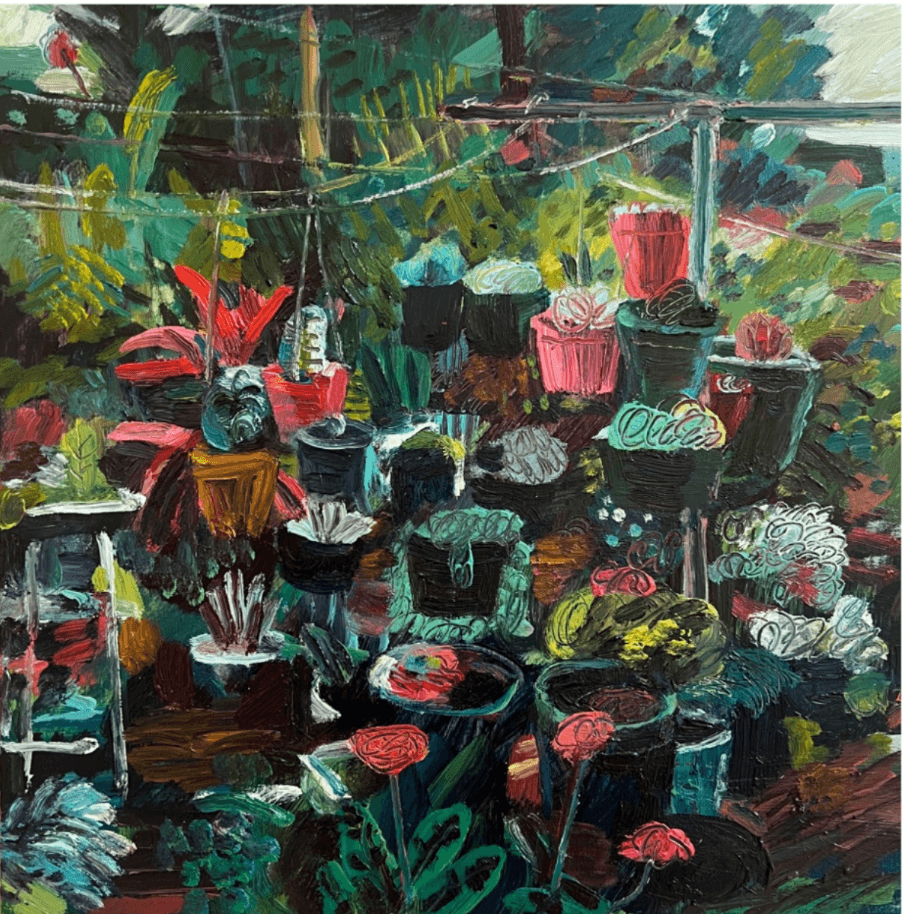
Johanna St. Clair, Plants for Sale, 2026, oil on panel, 12 x 12 inches.
Do you have a favorite public art piece? What is it and why?
I grew up in Cambridge, Massachusetts, and I love Susumu Shingu’s piece Gift of the Wind in Porter Square — it’s a 46’ tall kinetic sculpture from 1985. I also love Glove Cycle by Mags Harries, its cast-bronze mittens and gloves strewn down the long escalator to the red line, also in Porter Square, Cambridge. Lately I’ve been thinking about how much emotional meaning a discarded glove has (I noticed it in my garden), and then I realized that Mags’ gloves are wired deep in my brain.
Can you say something about the art you live with? Whether you bought, found, were gifted, or traded for the piece, what artworks do you live with? How has the experience of having these pieces influenced your own art making?
The art in my home is all by friends, and I love it because I love them, but also because they are brilliant artists. Highlights include a hanging woven sculpture by Michelle Yi-Martin, which I traded a painting for, and watercolors and drawings by Kyle Field that we traded for roommate rent. But I was shaped as an artist more by the art in my childhood home than by the art in my adult home.
Artists are increasingly expected to have an online presence and, in some cases, become their own publicist. How do you feel about social media? Has it helped your career, or does it sometimes feel like another job entirely? Any social media rules or tricks you abide by?
I loved Instagram in the early days as a platform for artists to share work with each other. Current Instagram still has that, but it’s mixed in with so many random reels and ads. I miss the old version. I always admire artists who aren’t on it, but that’s pretty uncommon. I have no tricks. I find it a struggle to post at all, let alone make viral, engaging content that will move the needle. But I still value it despite its flaws.
It’s difficult to talk about being an artist without talking about money. What does making a sustainable life as an artist look like to you? Do you think the art world is honest enough about the financial realities of being an artist?
Almost every artist that I know has a day job. I’m not sure I have a problem with that because making art feels like a privilege, not a right. The problem with the Bay Area is that day jobs have gotten more demanding as the cost of living has skyrocketed.
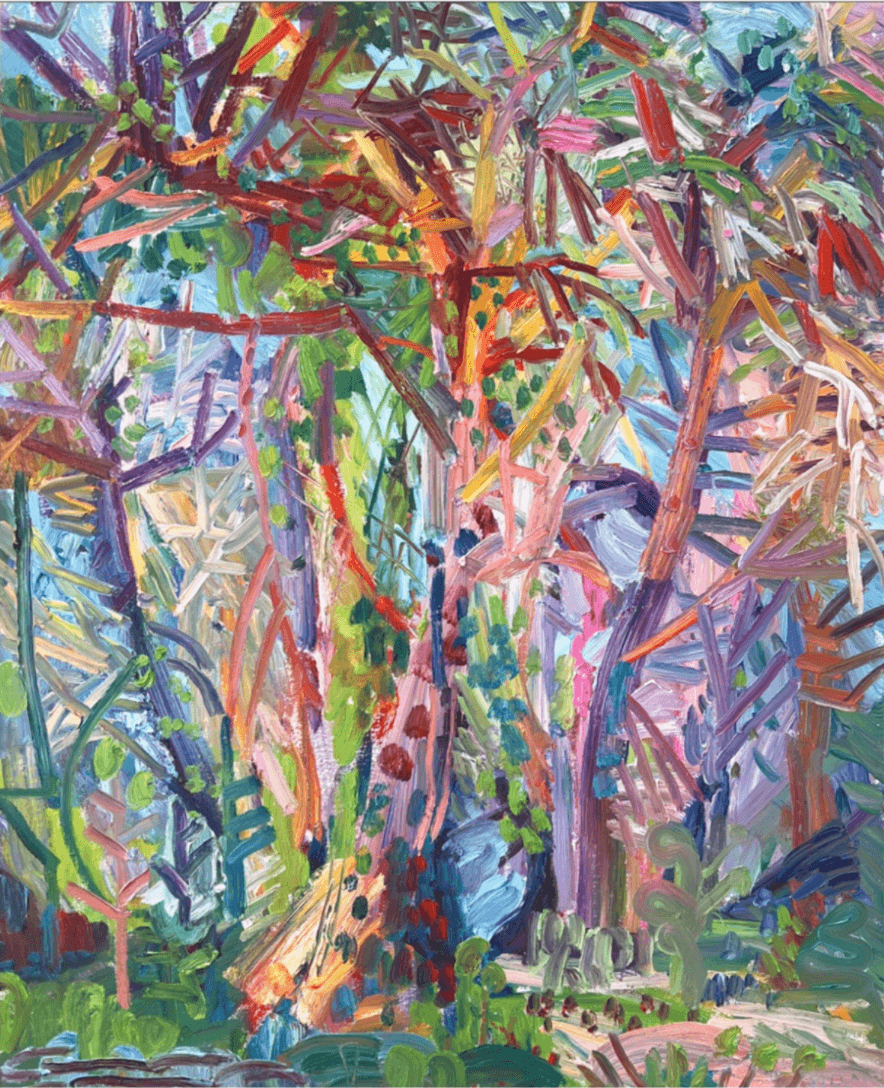
Johanna St. Clair, Nest, 2024, oil on canvas, 30 x 24 inches.
What are you unwilling to compromise on in your work, even if doing so might make the work easier to sell?
I have several times totally changed my work — switched mediums, made big changes to the subject matter. Those big shifts can cause issues, but if I’ve been struggling toward something, when I start to figure it out, the work can begin to feel rote. I need to be pushing myself past my comfort zone to stay engaged.
Whose opinion of your work matters most to you?
My amazing 21-year-old daughter Nina. She’s the smartest, most interesting person I know. And she really feels art; she brings to art viewing both her great intellect and her big heart. She’s far too nice to me, so she says that she loves everything I do. But when I surmise that she actually means it, nothing could be better.
If you suddenly had unlimited money, space, and time to make one work or project, what would you make?
My big constraint is time. If I had hours of daily studio time, I would use it to wander through ideas aimlessly. I’m not sure where that would take me. With more time, I could travel further from where I am now, into the unknown.
I worked for many years without a studio, and I hardly missed it — I worked outdoors (based out of my car), and at my kitchen table. The only difficulty was showing my work to collectors and other artists. Now I have a lovely studio in my backyard, which is an amazing place for studio visits, and I love working in it. But I think my no-studio work is just as good. Outdoors is a great place to work, because it’s challenging. It gives the work a sense of urgency. It would be very tricky to have no studio and also have no car.
If a fancy collector wanted to take you out to dinner anywhere, where would it be? Do you have a suggestion for a great inexpensive meal in San Francisco for the proverbial “starving artist”?
There are not a lot of inexpensive meals left in San Francisco! You can put together a somewhat affordable and truly delicious family meal by ordering à la carte from Sol Food in Marin (and their hot sauce is my favorite pantry staple). RT Rotisserie has chicken soup that’s a great value. Or the tortilla soup at Underdogs Too down the street from me in the Outer Sunset. Also in the Outer Sunset — Mallards $13 double smash-burgers are not cheap for a smash burger in the wider world, but for current San Francisco, they’re a good value, and really delicious. Fancy meal? Maybe Cotogna, but I find the prices for fine dining stressful no matter who is picking up the tab!