
Founded in 2016, Asian American art and fashion collective CFGNY operated on the aesthetic axis of “vaguely Asian”: a visual identity in response to the influx of goods manufactured in Asia, usually with low costs, to the Western market, probing the ambiguity of what constitutes aesthetically Asian as cultures and economic means clash. Imparting the concept to their artworks and design collections, they usually turn out maximalist, rife with popular elements, and more often than not down-to-earth.
If CFGNY speaks to the gradual transformation of visual identity along the expansion of diaspora, artist Hsing Hwang’s first solo show in New York Island Pulp feels “vaguely Taiwanese.” Taking place at Gallery 456, the multimedia artworks are defined by a bright palette predominantly in saturated red hue. Fairy-like figures, some children, some women, are essential to her canvas, carrying and fantastically inhabiting a diverse range of fruits: custard apples, apples, bananas, starfruits, etc. As one dwells on the theme, the contour of Taiwan—an island famous for her fruit—emerges from the conceptual cornerstone, yet nothing reads explicitly Taiwanese. It might be hard for the audience to deduce Hwang’s nationality, or any sort of identitarian portrayal for that matter, solely from a formal standpoint.
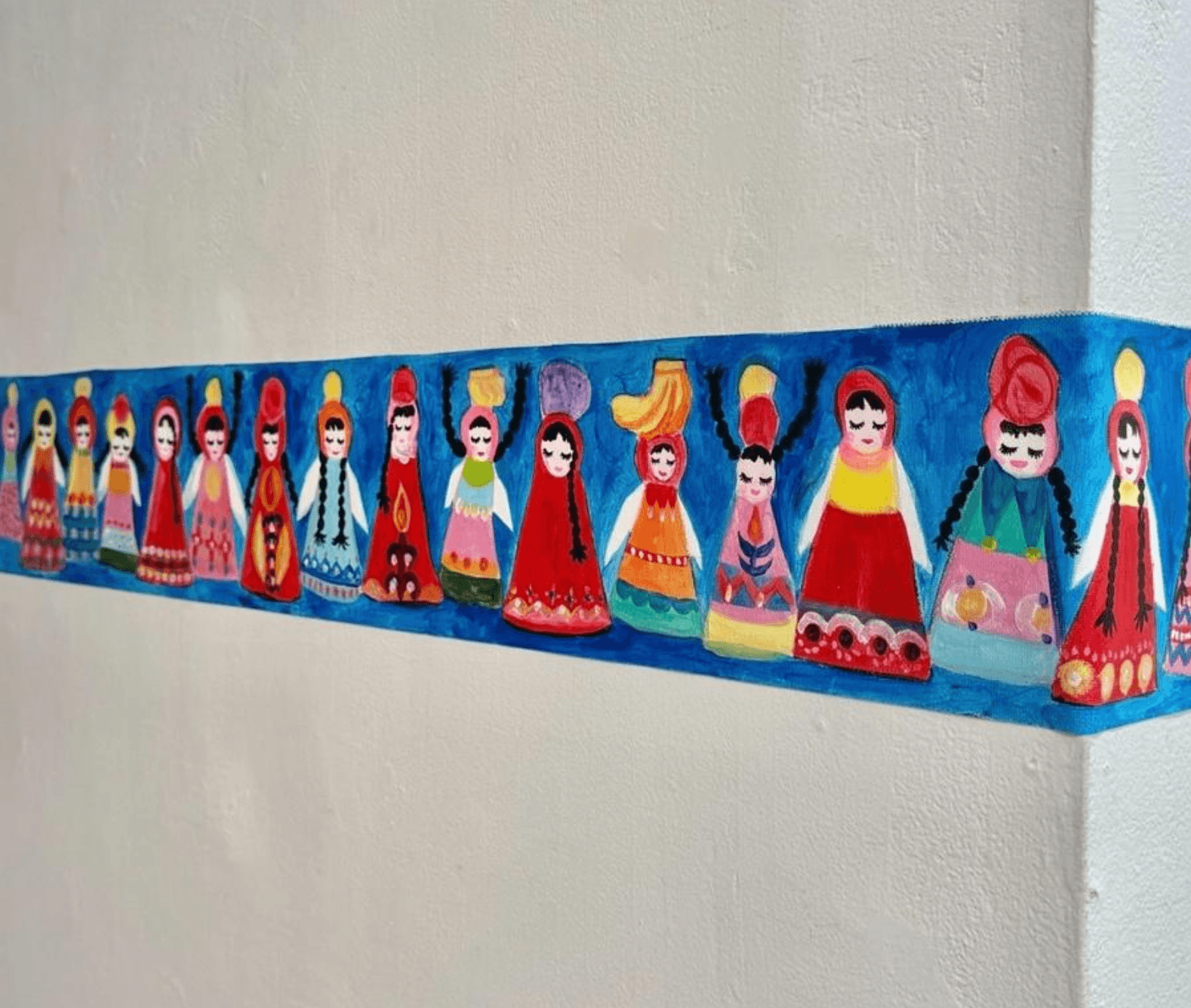
Hsin Hwang, Walking Together into the Distance, 2026. Acrylic and crayon on canvas.
The portrayal of the fairy girl figures so prevalent in her work best illustrates such vagueness. In Walking Together into the Distance (2026), 21 fairy girls, some of them winged, sport long braids, hoods, and bandanas adorned with dots and varied geometric patterns. Those who are familiar with Taiwanese indigenous cultures and folk traditions might find familiarity in these patterns, along with Hwang’s multimedia works that incorporate human-shaped wooden panels and textiles. Hwang, however, did not draw the designs from one specific source. Rather, they are synthesized from the customs and cultures she had seen growing up. Instead of definitive iconographies of Taiwan as a political entity, Hwang’s artistic language comes from her lived experience. The result is distilled into pictures of “vague Taiwaneseness,” an ineffable visual tacit among those who shared the same identity.
Hwang created more than 30 artworks for this exhibition from the outset of her liaison with New York-based Taiwanese curator Man-Ling Cheng in March. Being her first New York exhibition, Hwang’s primary concern is nonetheless the scale—so she can pack the works in her suitcases and take them across half the globe herself, as she did eventually. On the creative dimension, she tells me, there is not much difference from before. Indeed, works featured in Island Pulp are a clear and coherent continuation of her previous output in their lively evocation of warmth and sense of care.
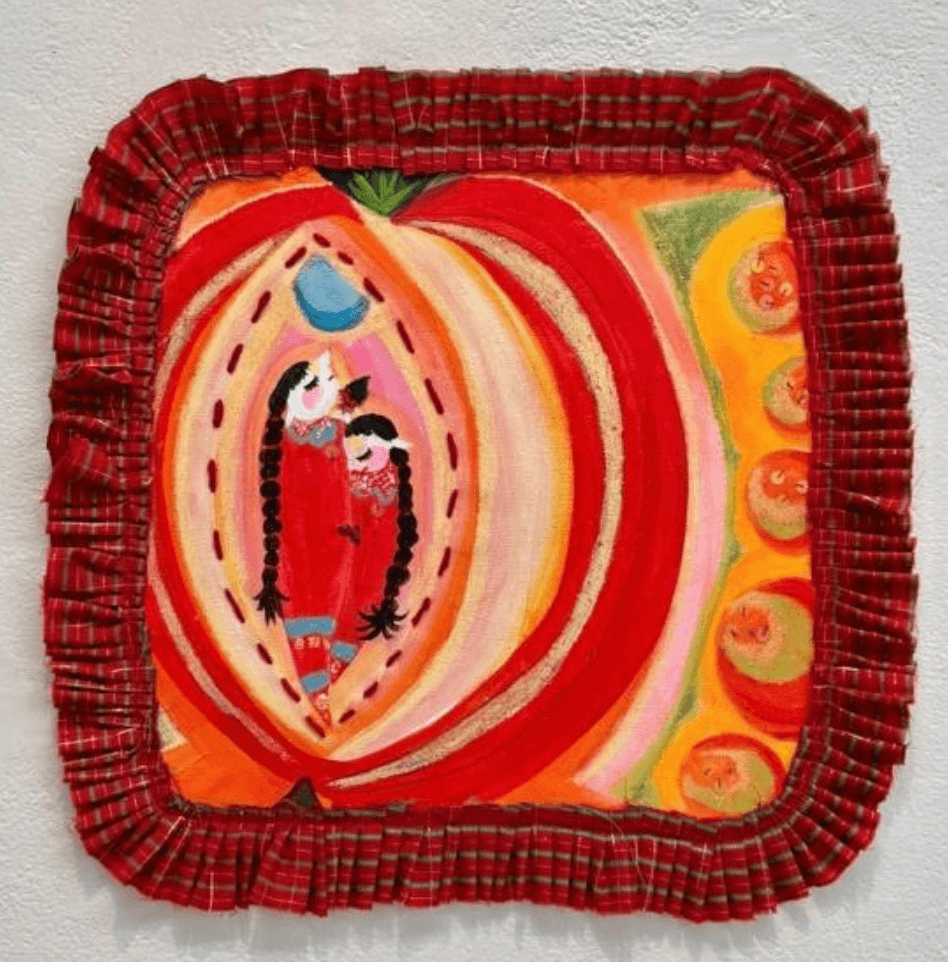
Hsin Hwang, Girl and Pulp House, 2026. Acrylic and crayon on canvas and sequins.
Still, Island Pulp is no mere pastiche of the past. The exhibition marks the first time Hwang works around the motif of fruit. Behind this choice is a synergy between the collective pride in one of Taiwan’s most important agricultural exports and Hwang’s memories. She draws this theme from her experience studying at the Royal College of Art, London, a time away from home when the once ordinary Taiwanese fruits became a luxury. To Hwang, fruit is as much home as it is an anchor that fashions her identity. The Taiwaneseness in her works is vague because the identity harbored in her works are filtered through Hwang’s personality, which explains the multifaceted fruit imagery that transcends national pride. Accompanying the real fruits carried by the fairy girls in Walking Together into the Distance are fantastical ones functioning as a locus of belonging. In Girl and Pulp House (2026), two similar fairy girls are ensconced inside an apple, peacefully bathed in glowing red. To title the exhibition with “pulp” instead of “fruit” points to Hwang’s care for interiority that ultimately leads to the security provided by domesticity.
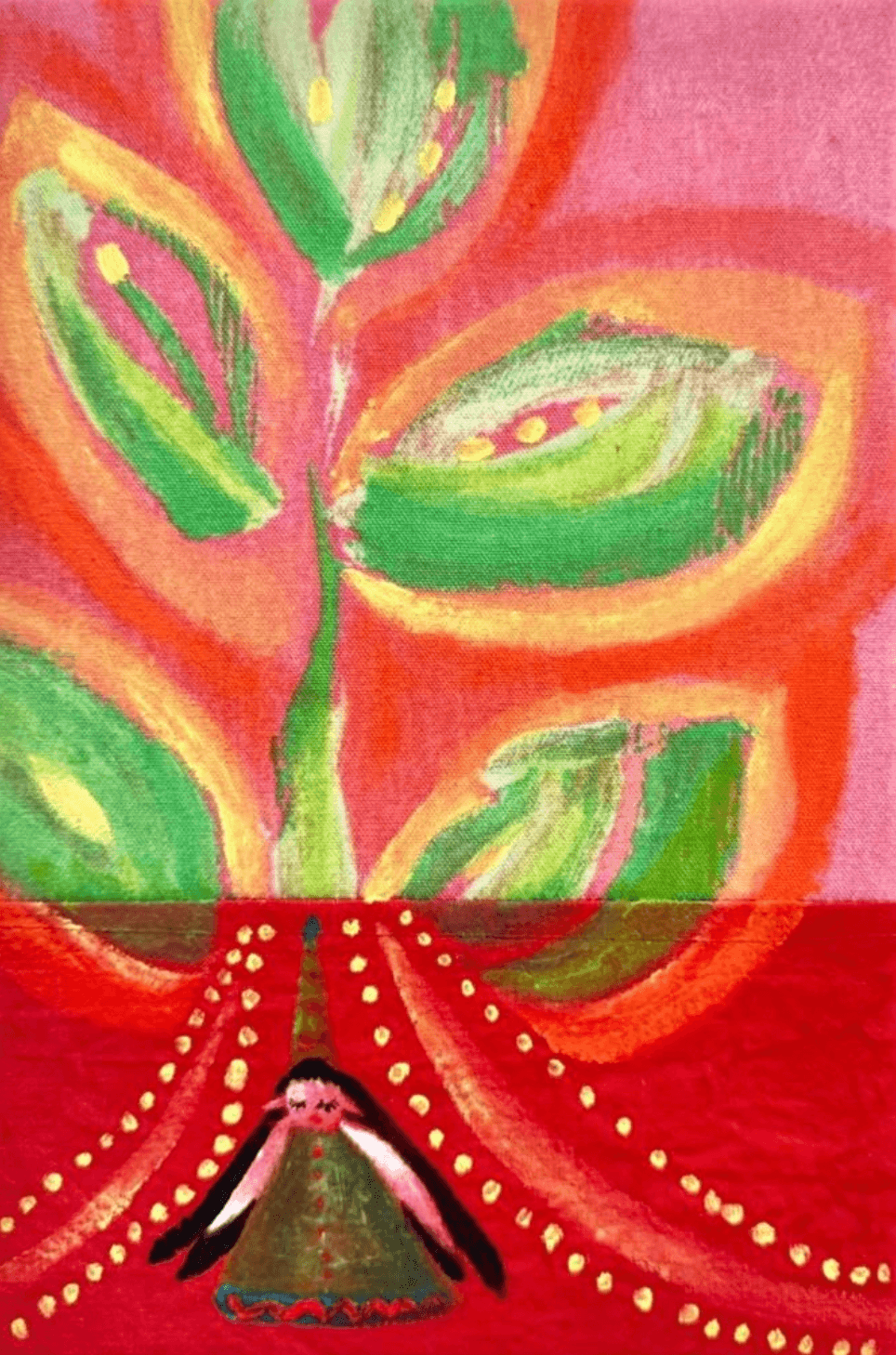
Hsin Hwang, Little Tree of Life, 2026. Acrylic on canvas and fabric.
Fruit as an anchor to Hwang’s identity in her own migrational journey likewise inspires the curatorial direction of the show. While originally a concern of portability, the consistently small scale of the artworks inadvertently becomes a strength that curator Man-Ling Cheng plays into. Mounted on eye level surrounding the gallery space, the constellation resembles a frieze running along the gallery walls. Without any specific works standing out immediately, this configuration on the other hand bears the capacity perfect for storytelling, which is precisely the effect that Cheng strives for. The exhibition begins with works in which the fairy girls are symbiotic with the ecosystem. Much like the fairy girls-bearing apple in Girl and Pulp House, works at the beginning of the show illustrate an analogy between cultivation and botanical growth. In Little Tree of Life (2026), stem and leaves grow out of the root that is the fairy girl, composing an animistic doubling of formation between vegetation and humans.
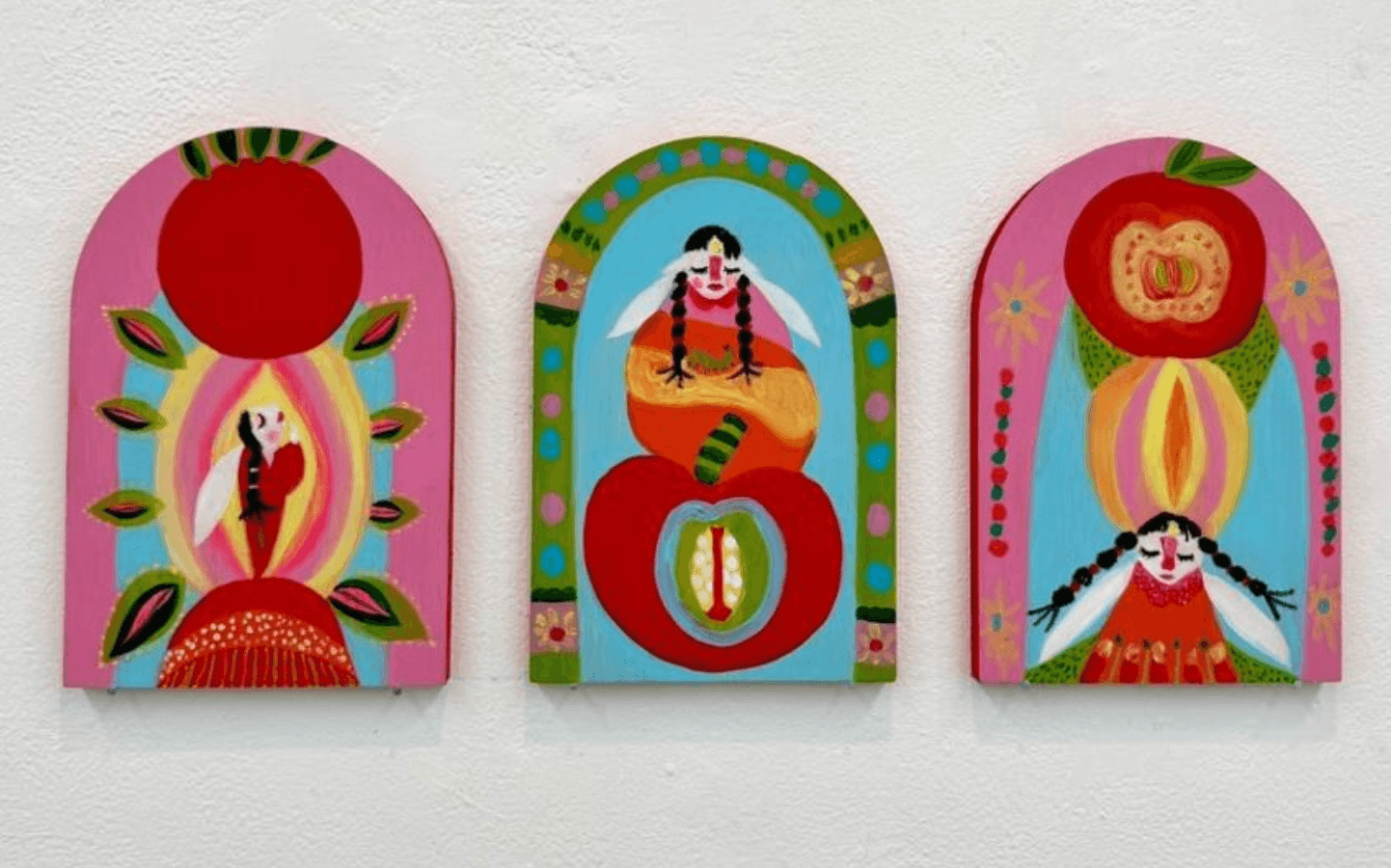
Hsin Hwang, Journey of Light, 2026. Acrylic and crayon on wood.
Works of the fairy girls embarking on a journey come next. Fruits are harvested, carried by the fairy girls on their heads embarking on a journey. Exhibited alongside are figures painted on human-shaped wooden cutouts, fleshed out into individuals with mobility. The journey ends at the horizontally expansive Walking Together into the Distance, which is installed at the corner, bent along the angle. The arrangement allows the exhibition to segue into its last chapter inside an alcove, dedicated to a series of paintings shaped in arches. Works in section present the fairy girls back into the fruits, but unlike those at the beginning, the figures and the fruits fuse together in harmony. Hwang chooses the arch shape to facilitate a metaphor of the door, a gateway to another world. Resonating this notion is the triptych Journey of Light (2026), in which the fairy girl is tethered with an apple, floating freely in what feels like nirvana.
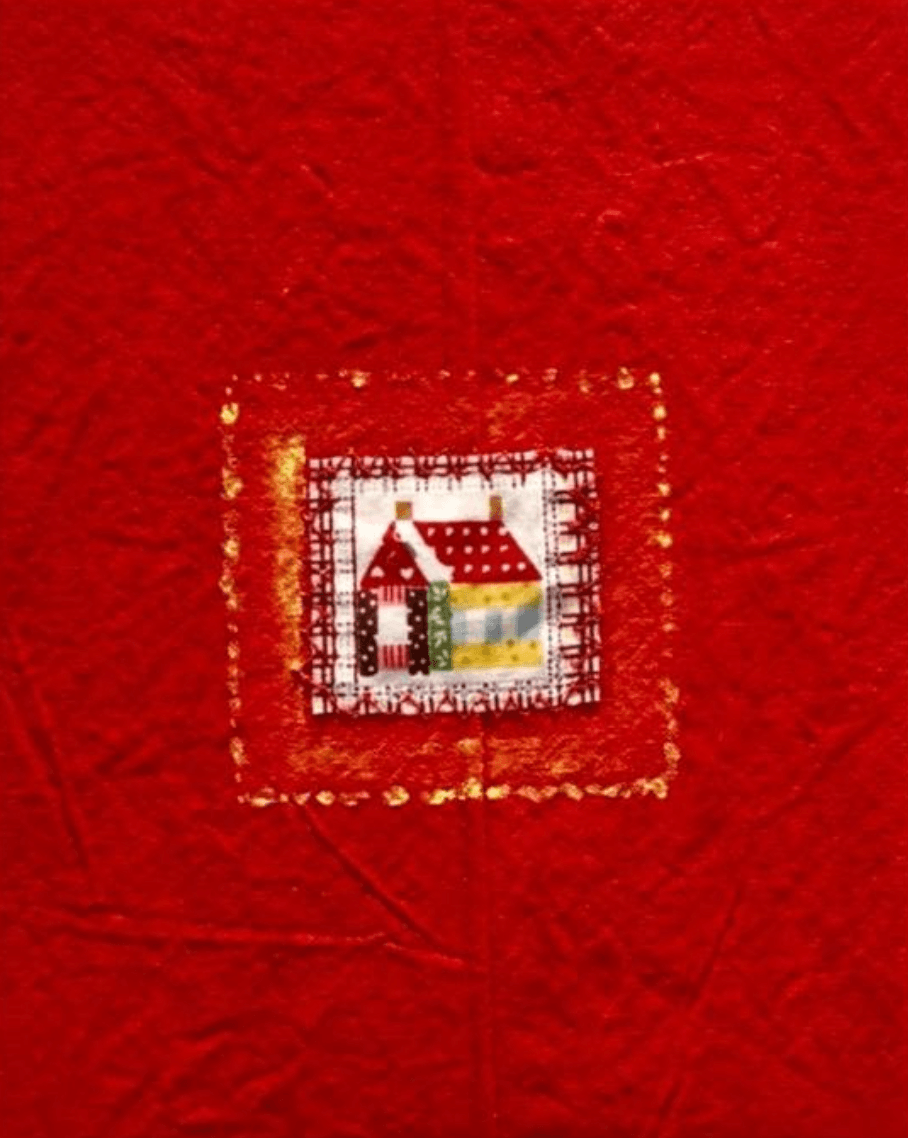
Hsin Hwang, Going Home, 2026. Acrylic and crayon on wood.
An Easter egg is hidden behind the wall dedicated to Hwang’s watercolor studies, between Walking Together into the Distance and Magical Girl's Fruit Journey (2026). Magical Girl's Fruit Journey, a small, ruffle-framed painting of four fairy girls with fruits on their heads going on an excursion to their left. Following the girls and detouring to the backside of the wall will unfold a miniature, Going Home (2026). A simplistic work of textile, sewn in the middle of the bright red background is a small, stamp-like fabric of a drawing of a house. The house in no doubt is home, where all journeys start and finish.
