

Elmer Bischoff, Nelson Duni
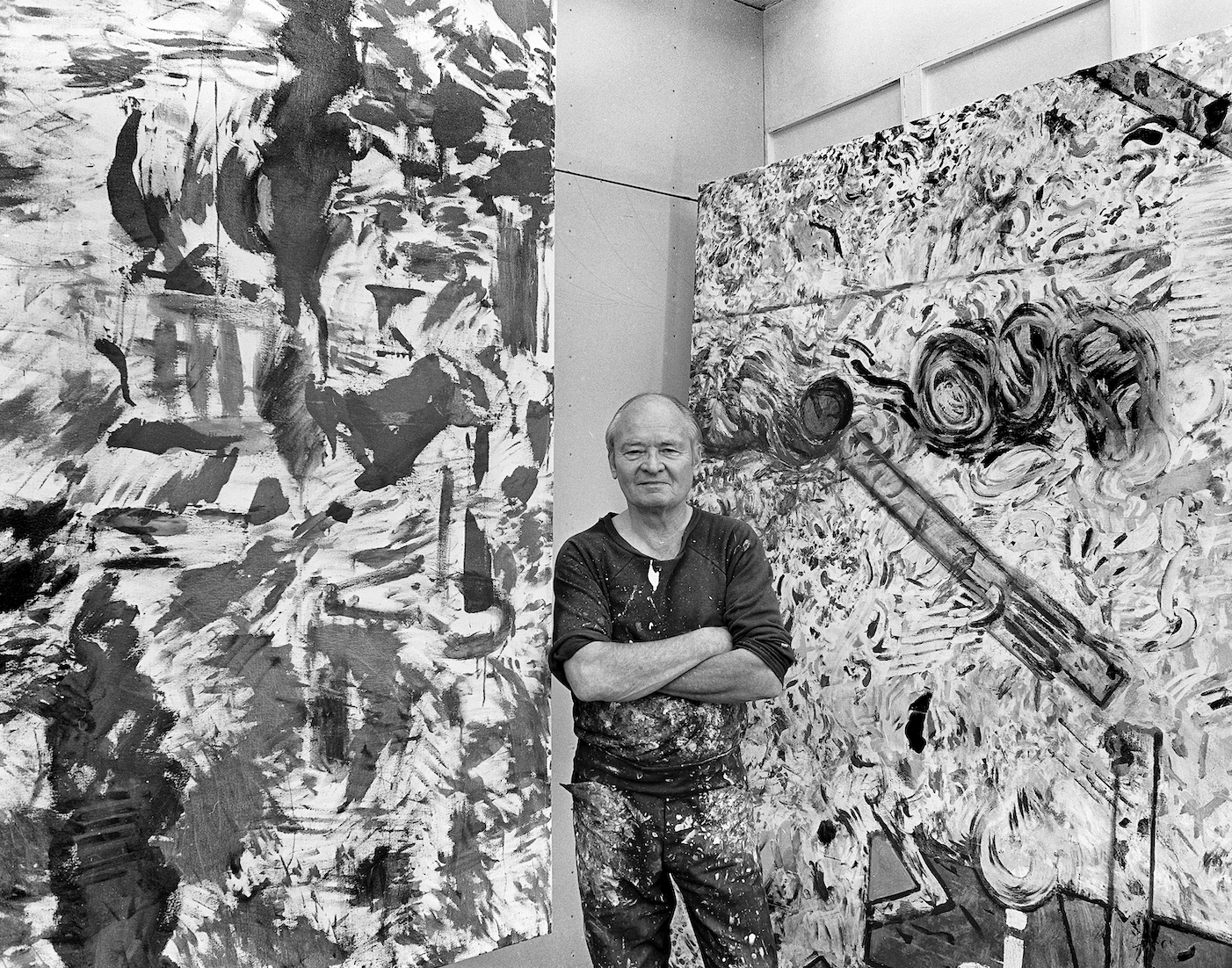
Elmer Bischoff in his studio
This review is part of our “Artist on Artist” series.
Kevin T. Leong is a working artist living in San Francisco.
Some time ago, after an inspiring visit to the Oakland Museum of California (OMCA), I felt compelled to reach out to them with a request. It had been over 20 years since their last exhibit dedicated to the American painter Elmer Bischoff, and I felt, given the magnitude and importance of this painter’s impact, it was time for another retrospective. Selfish, but I knew there were more Bischoffs, and the world had to see them.
The OMCA politely responded to my fan letter. While there were no plans to hold an exhibit, a promise was made to pass on my suggestion to the curatorial staff. I moved on, fingers crossed.
I share this story to illustrate just how excited I was when I learned about the opening of Elmer Bischoff at Nelson Duni. The exhibit showcases an impressive cross-section of Bischoff’s work, dating from the 1940s to the 1980s.
Nelson Duni, located in San Francisco’s Mission District, is a pleasantly raw and well-lit space. The sophisticated atmosphere is an ideal setting for highlighting Bischoff’s career. Approaching the gallery from the alley-like Bartlett Street, I'm greeted by a rush of cadmium sunshine beaming from No. 78 (1984), a towering canvas hung on the wall behind the large, clean front windows. A vinyl reproduction of Bischoff’s signature meets me at the curb. Wonderful.

Objects Above and Below the Horizon, 1947. Oil on canvas, 28 x 22 in, © Bischoff Family Art Trust. Photo courtesy of George Adams Gallery.
Entering the gallery doors, I'm immediately met with a sense of how finite time is. I begin my viewing chronologically, coming to an oil titled Objects Above and Below the Horizon (1947). The composition is split along the waistline and feels like you’re standing on the edge of a cliff. The application is carefully loose. Drawn to the upper half, I look out as a blue day cuts and blends through hovering forms. They dance and hide and push against the picture plane. Below lies a foggy labyrinth of earthen tones that recede up and out into space. It’s hard not to see a body of water as my eye is guided back up to the ‘horizon’, twisting back to life.
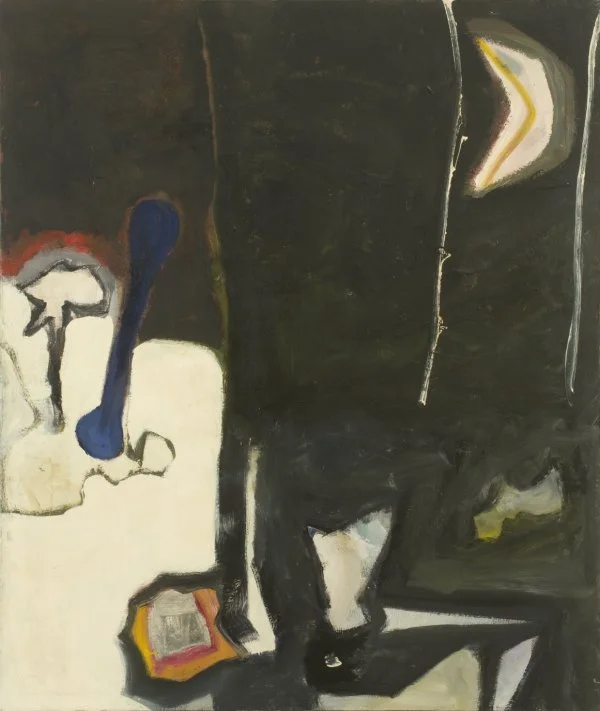
Elmer Bischoff, Untitled, 1950, oil on canvas, 66×56 inches
As I move on, night falls. Viewing Untitled (1950) I find Bischoff painting by moonlight. At a distance the brushwork feels confidently impulsive with broad, immediate strokes. The dominant color is a deep textural black. It cuts through and shatters the buttery white mass at lower left, leaving behind a distant red light that emphasizes forms which are both here and there. I keep going back to the upper right corner where a floating crescent shape appears to illuminate the twig-like scars framing it. Details come to life as I get closer. The reaching black form is built of sweeps and scrubs from a brush loaded with nocturnal grasses and incandescents. I peer out from the interior and see traces of daylight beyond it all.
There are 11 pieces in the show that were made on paper. Across them there’s ink, graphite, charcoal, watercolor and collage. All of these pieces bring focus to the craft and rigor shared by a group of artists fascinated by what the figure could hold. This is particularly evident in the scenes Bischoff depicts of other artists sketching the model.
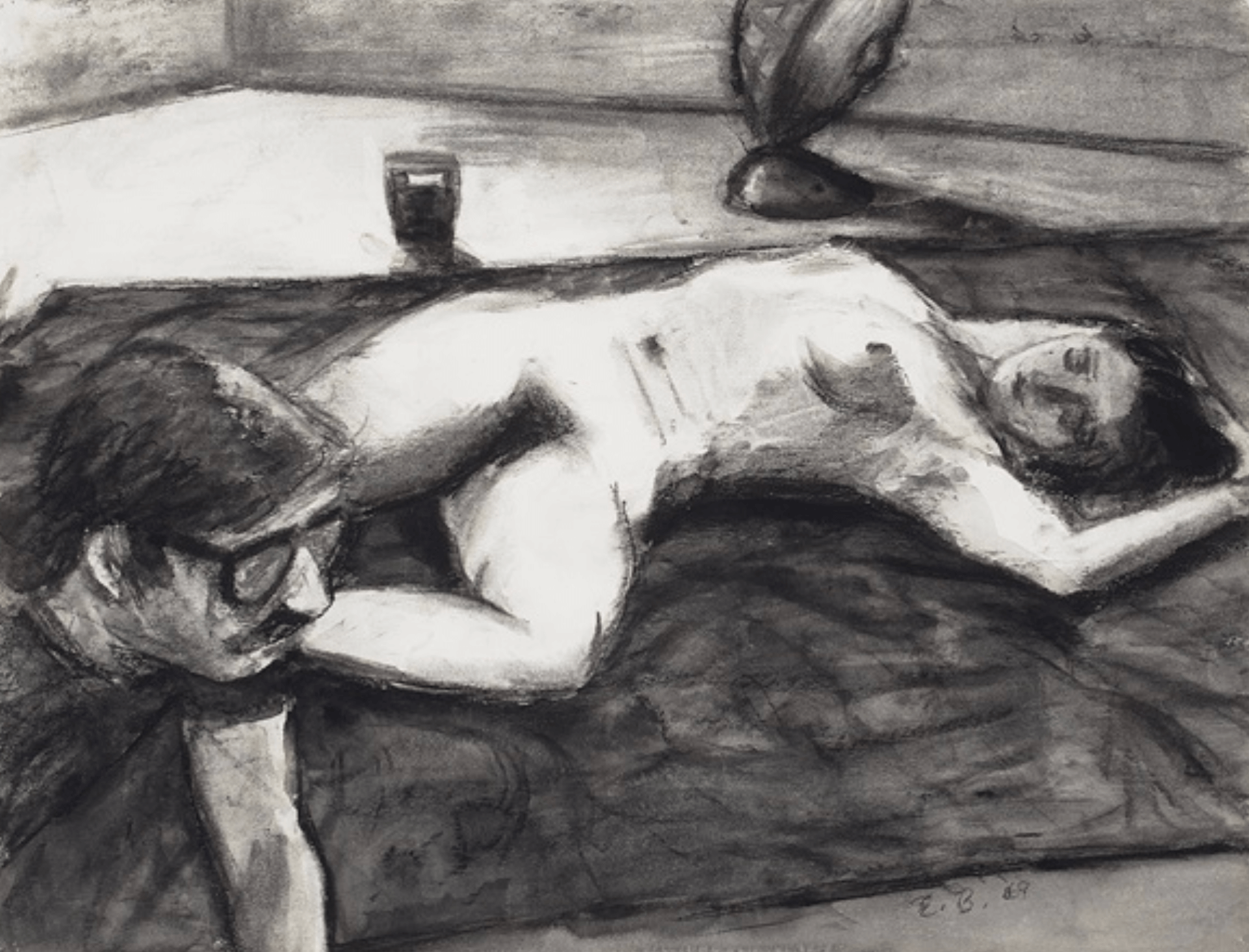
Artist and Model, 1969
charcoal and wash on paper
44.5 x 57.8 cm. (17.5 x 22.8 in.)
He takes this same approach to the scene in the painting Untitled (Artist and Model; Artists with Model) (1969). Three figures occupy the absolute edge of the world, focused on their work. A lone nude appears carved from the featureless room. The application lays bare all of the hours spent sketching, the shifting light, the drinks, the excitement, the fatigue.

Playground, 1954. Oil on canvas, 68 x 55 in, © Bischoff Family Art Trust. Photo courtesy of George Adams Gallery.
Leaving the sketches, I enter a large room with tall, white walls. There are six broadly sized canvases. I find myself immersed in the two earliest pieces in the room, Playground (1954) and Boy Reading (1955). On their own, they each deserve a good study, but together present the viewer with a chance to be both observer and painter.
Playground sets you down in the shade while you enjoy a radiant day in the grass. A carousel of paint comes from the shoulder and charges the viewer. Two children laugh and spin amongst glimmers of lemon-lime grass streamed with fuchsia dahlias. A large figure calmly watches over a small child sitting off of the canvas in the shade. Boy Reading provides a different vantage point. As my eyes adjust to the cooler light the subject comes into view. Arranged in meditative greens he sits, immersed in a book. The brush applies colors gently to compose a scene of fluid shifts that lend a milky shimmer to the surface.
Exiting the exhibit I start my walk home. It’s a dark evening and I immediately feel like I didn’t spend enough time with the work and promise myself I’ll return.
