

Demetri Broxton, Ancestral Echoes, The Museum of African Diaspora
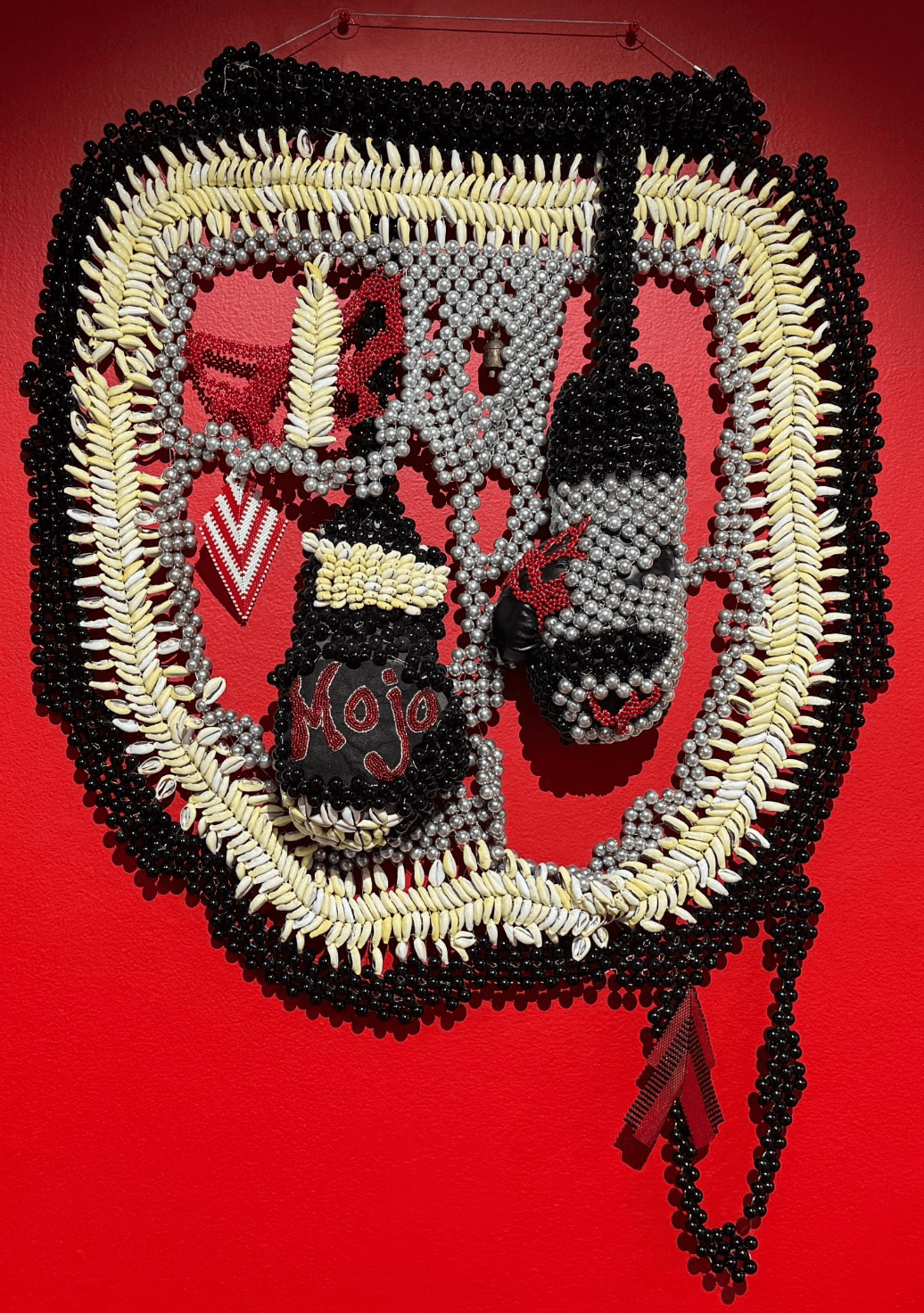
Demetri Broxton, “Mojo Hand”, 2021
Belonging and the reverberations of ancestral labor
Demetri Broxton’s work in Ancestral Echoes at the Museum of African Diaspora is versatile, colorful, inspiring and will “knock you out”, you’ll get that reference if you go and see it. The exhibit is being showcased at MoAD, June 10th - August 16th 2026. His family history is the canvas through which the concepts of safety, opportunity and kinship are explored. His family migrated from the South to California and Broxton describes his family’s migration as having created an “interruption to the transmission of knowledge”.It is that rift that he fills with glass beads, cowry shells, wool, horns, pendants, beads, herbs and cotton to tell stories of sovereign authorship. I was captivated by his work and the boxing motif he uses quite often throughout the showcase. I believe it spiritually signifies the journey of inner resilience and sovereignty.
Broxton leaves love notes in his work, “ancestral echoes” beaded into different art pieces, using both words and imagery. My favorite love notes are on the boxing gloves displayed in the exhibit. In one of the sets of gloves he writes, “I love it when you count me out”. As someone who faces racial discrimination and misogynoir, those words resonated deeply as a mantra that has seen me through hard times. I listened to the ancestral echoes steeped in those words and they left me with delicious morsels of both grace and grit. Through his family’s story of migration, he creates a space where ancestry is an active presence “shaped through care, intention and making”. He imagines that what may have been lost through migration can have a space where it can be reconstructed and consequently carried forward by the descendants who live on through and in time. It was beautiful to witness. But then I stood by the altar on display in the exhibit and that moment left me with a compelling thought.
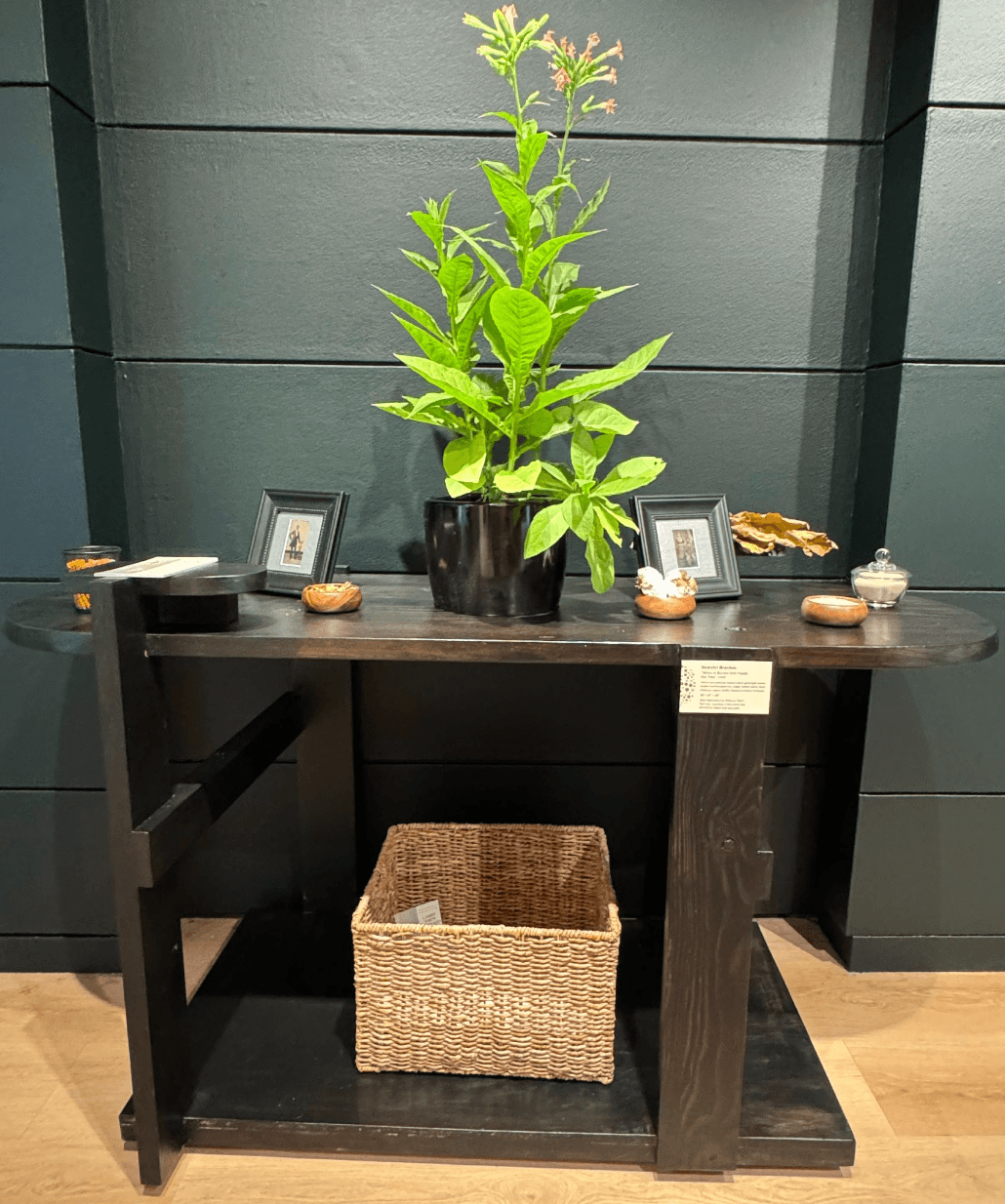
Demetri Broxton, “What is Buried Still Feeds the Tree”, 2026
The altar has pictures of his ancestors, plywood, cotton, tobacco, rice and a few other giftings. Rituals are a crucial part of African diasporic spiritual and cultural practices. They are meant to adorn the individual with protection and fortitude, and so I had to honor that moment. The captivating thought I had was regarding the crops on the altar. “Ancestral echoes” manifest themselves in these four crops: cotton, tobacco, sugar, and rice. The concept of ‘Belonging’ for Black Americans cannot be separated from the labor they provided since they landed in the Americas. The idea of “black labor” and its foundational contradiction within American history was conjured up by this altar. Black people were fundamental to the economic growth of the American South—and ultimately the nation itself—while being systematically denied basic human and political rights. Their labor sustained the country across generations, from enslavement and sharecropping to military service, industrial production, and the service economy. Labor existed outside the framework of freedom, status, belonging, ownership, sovereign authorship, citizenship and inclusion.
There I stood, stuck in that train of thought for a while as I ruminated on how plantation economies built around crops such as cotton, tobacco, sugar, and rice became foundational to U.S. wealth and development.I thought about how Black labor cannot be separated from the landscape of American storytelling. I thought about the hymns and stories slaves had to adorn for protection and resilience. I thought about the myth of America and the understated truth of the thing that haunts it. Black bodies are archives, keepers of stories, of knowledge and are vessels of memory. The thing that haunts these lands is a profound inconsistent thread that has followed the American narrative regarding freedom. What does it mean for a people who labored on a land that stripped them of their identity, of where they belonged whilst simultaneously the very people who depended on their labor denied their humanity? What echoes from the ancestors on the lands they cultivated, labor they gave that transformed that land and yet they had no legal claim to? It is almost magical in some ways, that the hands that altered the ecosystems with their labor - be it songs, dances, manual work, spiritual and agricultural practises they brought with them - that their Beingness transformed geography. Embedded on this land was identity and memory as they created time and space to belong. A clash of the identity that was imposed on them and identity that was their birthright which came with them. And the grief of all that was lost in between.
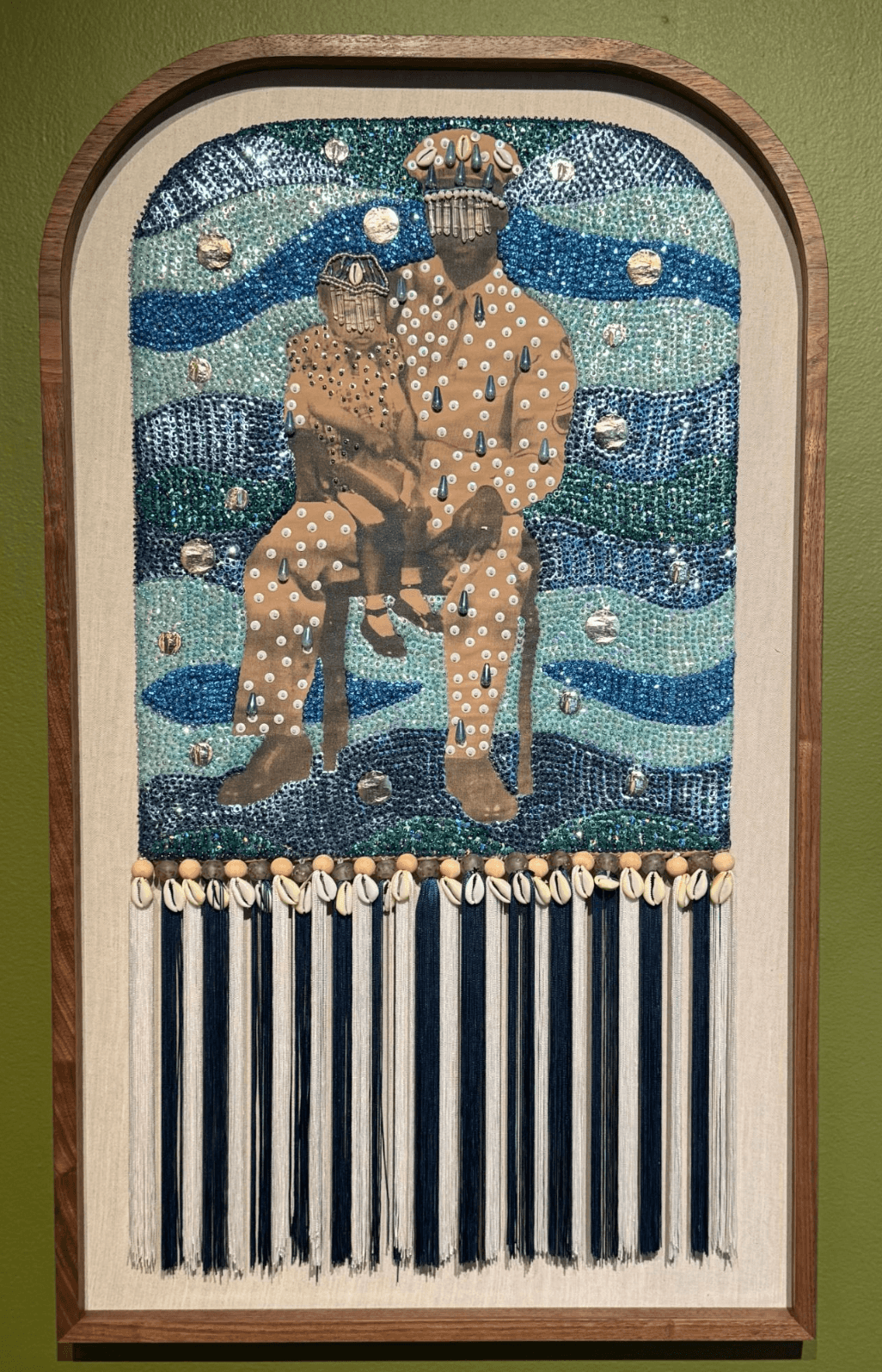
Demetri Broxton, “Just Beyond The Waters”, 2025
There is an art piece of Broxton’s grandfather holding his mother as a little girl titled “Just beyond the Waters”.His grandfather served in the US Army, put his body on the line to protect a country that did not fully recognize his contribution. I believe Broxton exists in the space that mourns what was lost due to his family’s migration, but also due to that lack of recognition of people like his grandfather. But, Broxton refuses to remain stagnant in the rotten ideology that started it all. He deliberately veils or conceals the background on this image because he believes that certain locations or spaces have often restricted viewers to perceiving Black people through a systemic gaze, one that is of a diminutive nature. And so he purposely conceals certain backgrounds so that his family can exist beyond time. I believe in the grand scheme of things, the ancestors cease to be anonymous or reduced to “labor” but they assert themselves as complete human beings who once lived and who live on through their descendants.
A case can be made that ‘Belonging’ still feels like something white supremacy believes it can grant or deny. Yet Broxton’s work emphasizes the need to move beyond any imposed gaze or any static definition of the Self. Echoes from the past are meant to be the fluid aspect of Afro identity. Belonging had to be cultivated for Black Americans because waiting for it to be “given” wasn’t an option. Sovereign authorship, all circumstances considered, left Black people very little else but to establish belonging anywhere they were and everywhere else they migrated to.
What remains beneath the historical narratives society chooses to remember about those crops I mentioned? About the slave laborers with or without names? About the inherited assumptions and imposed identities of those deemed invisible? About the horrors of displacement caused by slavery and colonization? This exhibition rejects the notion that people can only be understood through systemic definitions of their humanity. Memory, or lack thereof, for Black Americans is a site of trauma but it is also a site of reverence. This exhibition offers a pathway, a healing balm that centers knowledge, the body and ritual as sites of belonging. The altar is one of the most powerful elements of the exhibition. It is a communal act of remembrance that moves memory from observation into participation. It is where ancestral echoes are transmitted and transmuted. A living relationship with the past through ritual. The altar in my eyes becomes a metaphor for belonging itself. Belonging is not a fixed concept, it is a site of cultivation through fortitude. It requires tending to, fighting for, singing the songs and hymns that honor it, passing down the knowledge that lives on through “care, intention and making”.
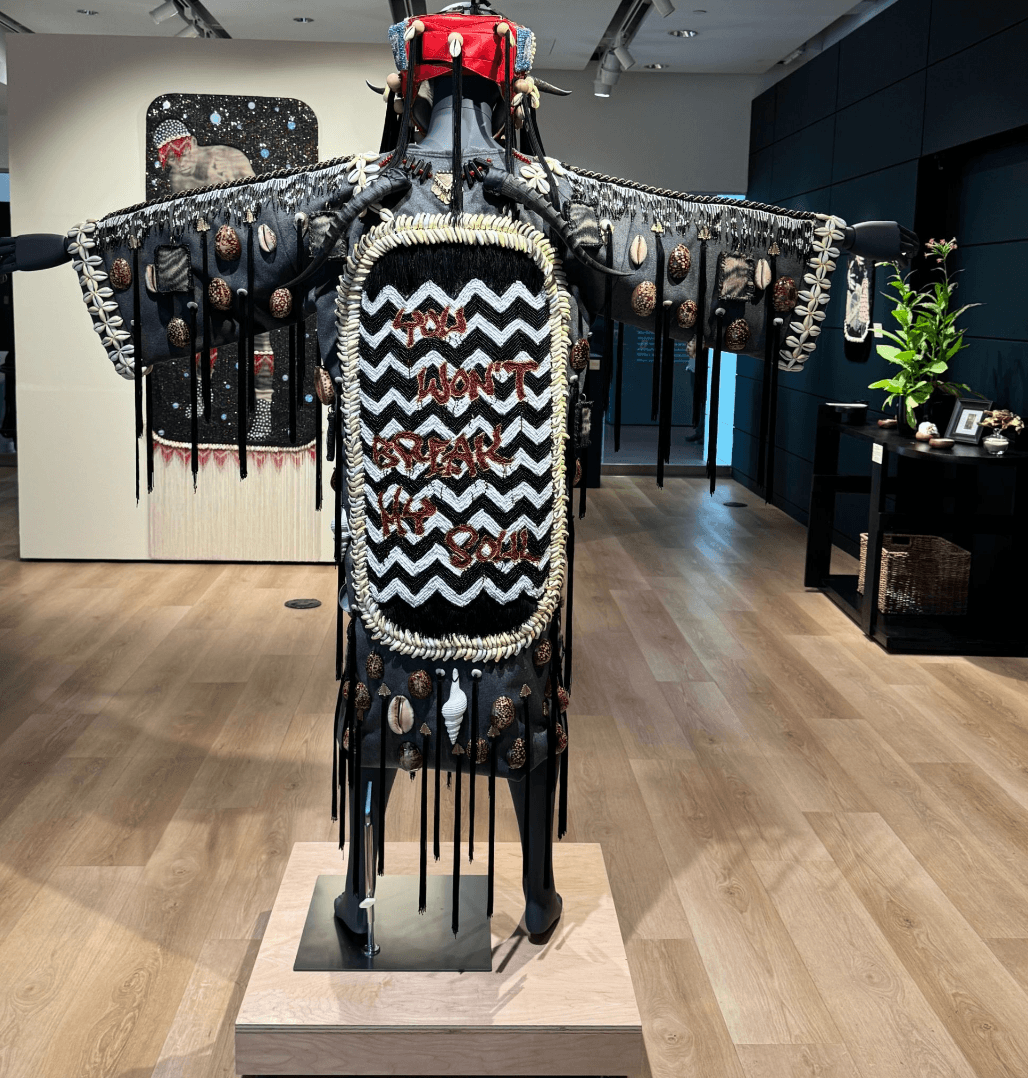
Demetri Broxton, “Cooler Heads Prevail", 2023 & “You Wont Break My Soul”, 2023
I mentioned the boxing motif Broxton used throughout the exhibition. It is imperative I emphasize that ‘Belonging’ for Black people in America has been hard won. It has been a fight to exist as much as it has been a fight to heal. Broxton has a few different boxing gloves throughout the exhibit with “ancestral echoes” written on them. Generations of Black Americans left indelible marks on American history, fighting for the future of their descendants. They live on through their labor, knowledge and fortitude. Their fingerprints are all over the foundation of a nation that struggles, even till today, to acknowledge and recognize them. Broxton asks us as the viewers to remember that even if we may not know all their names, they were active participants in an ongoing story. Their echoes are the winds beneath the sails of Black Americans. And it is from that space that their identity is formed, not from the inert nature of racism.
Leaving the exhibition, I found myself thinking, ‘could belonging be about recognizing and embodying the traces of oneself anywhere an Afro ancestor has laid their head?’ Maybe? I do not know. The exhibit offered no definitive answers either. Instead, I believe it leaves us curious, soothed, open to a powerful truth that I too also harken to. History attempts to reduce people to the labor they provide or the diminutive epithets and archetypes assigned through discrimination. But our humanity outshines all that brand of hatred endeavors to breed. Like the crops I mentioned before, humanity continues to bloom and so do the Afro descendants.
