

Collecting Impressionism, Los Angeles County Museum of Art
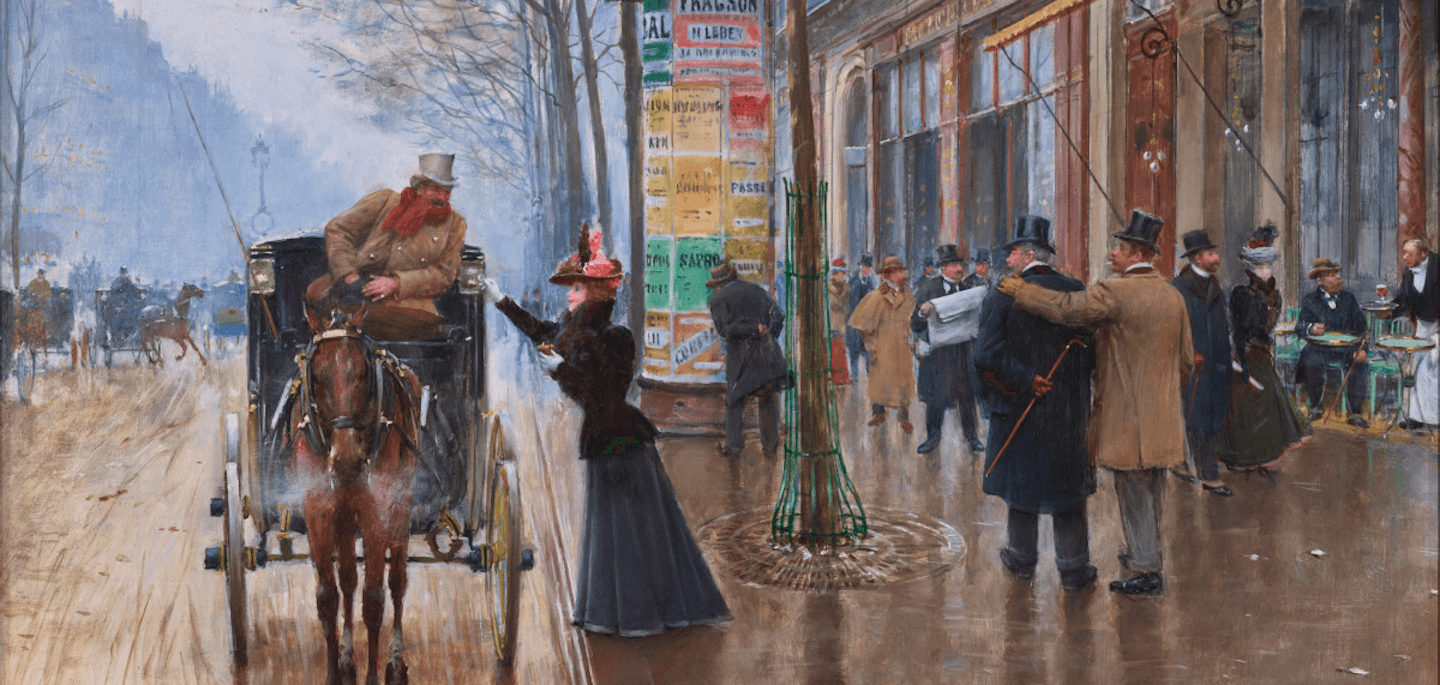
Jean Béraud, A Parisian Street Scene: Boulevard des Capucines, c. late 1897–early 1898
Oil on panel
14 5/8 x 211/2 in.
By Liz Goldner
LACMA, as one of the largest museums in the western United States, with more than 150,000 artworks from ancient times to the present, is exhibiting “Collecting Impressionism.” The show contains 100 paintings, costumes, photographs, and decorative arts from its permanent collection. This remarkable collection has never been on view in its entirety, as many of the artworks were only recently gifted to the museum.
This important exhibition emphasizes the evolution of its ongoing collection of Impressionist art. Wall labels explain: “The exhibition traces early donations of California and American Impressionist pictures, strategic acquisitions in prints, photographs, fashion, and decorative arts, as well as the most recent gifts.”
The work on display here by Jean Béraud, Pierre-Auguste Renoir, William Wendt, F. Childe Hassam, Camille Pissarro, Claude Monet, Vincent van Gogh, and others reflects the turn of the 20th century era, when artists captured contemporary scenes of people and their natural surroundings, as opposed to historical and religious narratives.
The appeal of these paintings derives from the subjects themselves, from illustrations of daily life in harmonious indoor and sunlit outdoor settings, on riverbanks, at the seashore, and of the natural countryside. The works’ allure is also derived from the painting technique of using short brushstrokes, often painted in the outdoors, to capture fleeting moments of life with an emphasis on light.
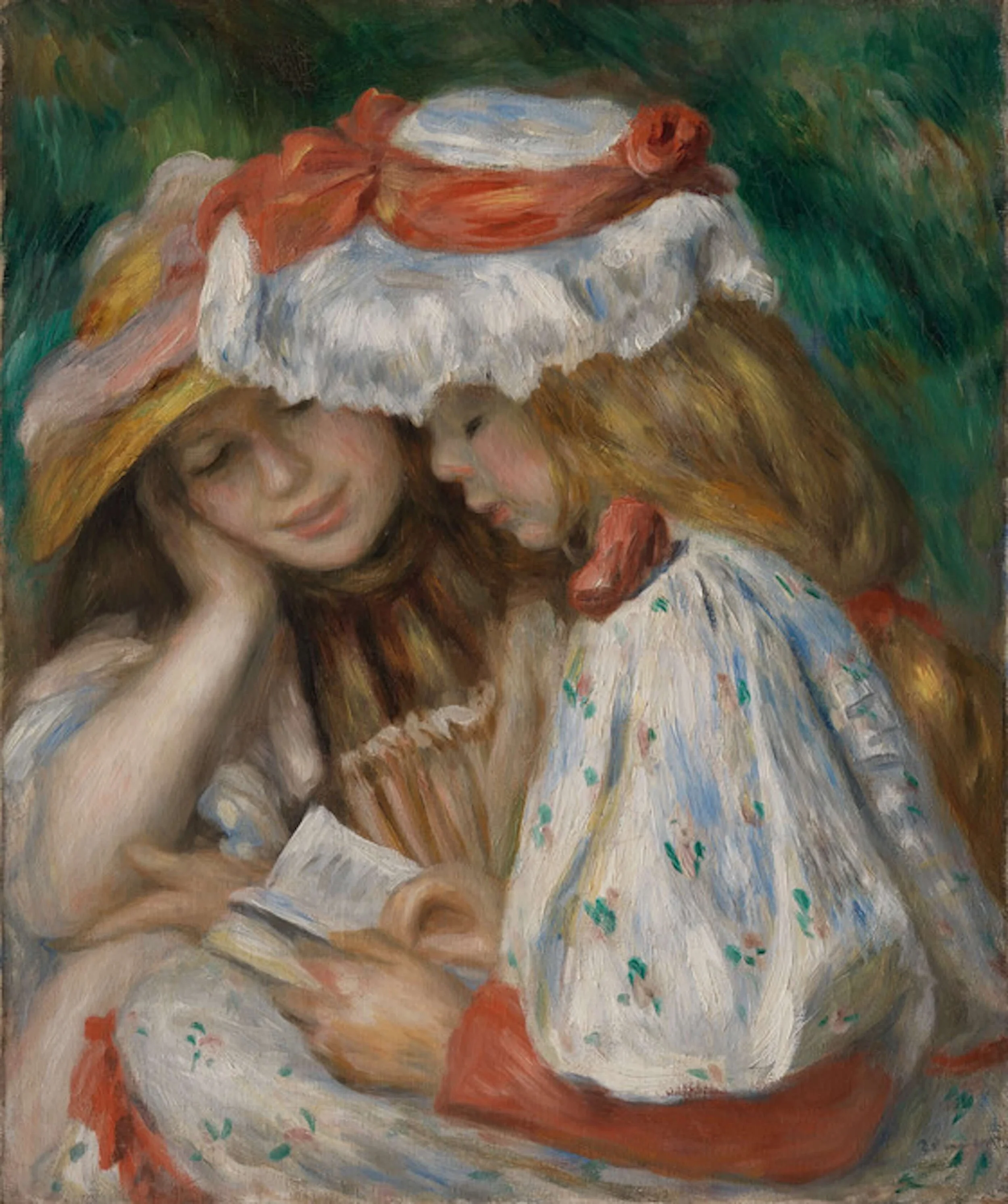
Pierre-Auguste Renoir, Two Girls Reading, c. 1890-1891
Oil on canvas
22 1/4 x 19 in.
A Parisian Street Scene (1897-1898) by Béraud presents a bustling Parisian boulevard with a fashionably dressed woman paying her cab driver. Several other residents, including elegantly dressed men in top hats, socialize along the damp sidewalk. The élan of the painting brings viewers to the spirit of “late nineteenth-century” Paris. Renoir’s Two Girls Reading (1890-91), one of several elegant paintings of females by the artist, provides a lyrical view of two beautiful young girls absorbed in reading together. California Impressionism, also called Plein Air painting, originated in Southern California in the early 20th century. Painters used the light, broad brush strokes and pure, bright colors of their earlier French counterparts, yet concentrated on the magic Southland light to depict bucolic landscapes, while seldom including people.
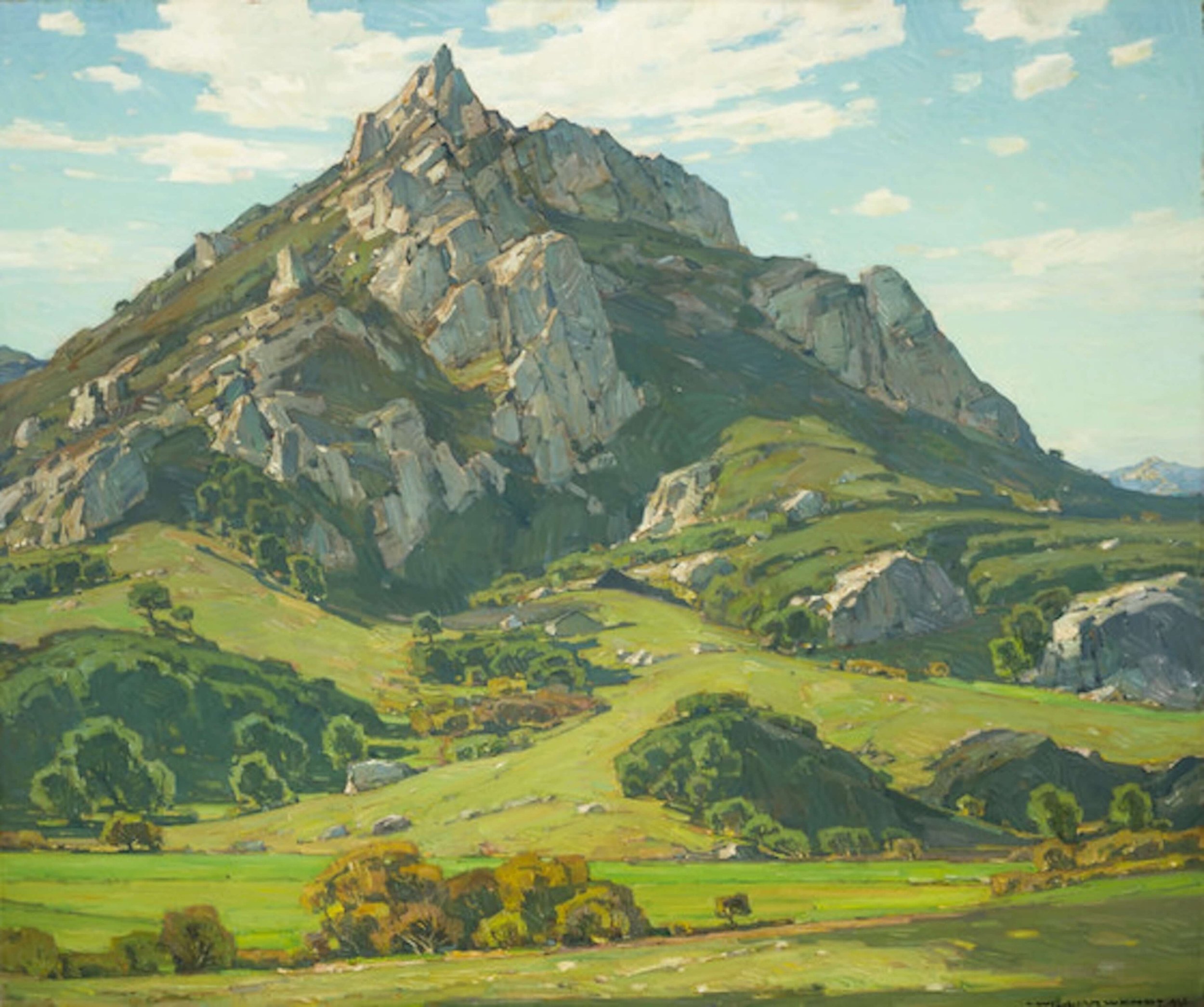
William Wendt, Where Nature’s God Hath Wrought, 1925
Oil on canvas
60 1/16 x 60 1/16 in.
William Wendt, known as the dean of Southern California landscape painters, used the Impressionist technique to create the oil painting, Where Nature God Hath Wrought (1925). It illustrates a mountain in central California lit by vibrant mid-day light. American Impressionism, similar to the California style, was employed by F. Childe Hassam. His Point Lobos, Carmel (1914) illustrates the rocky cliffs and wind-blown cypress trees of the rugged northern California coastline. One of the museum’s earliest gifts was Point Lobos, Carmel. This painting and nine others by the artist were donated to LACMA in 1929 by the pioneering American art collector William Preston Harrison.
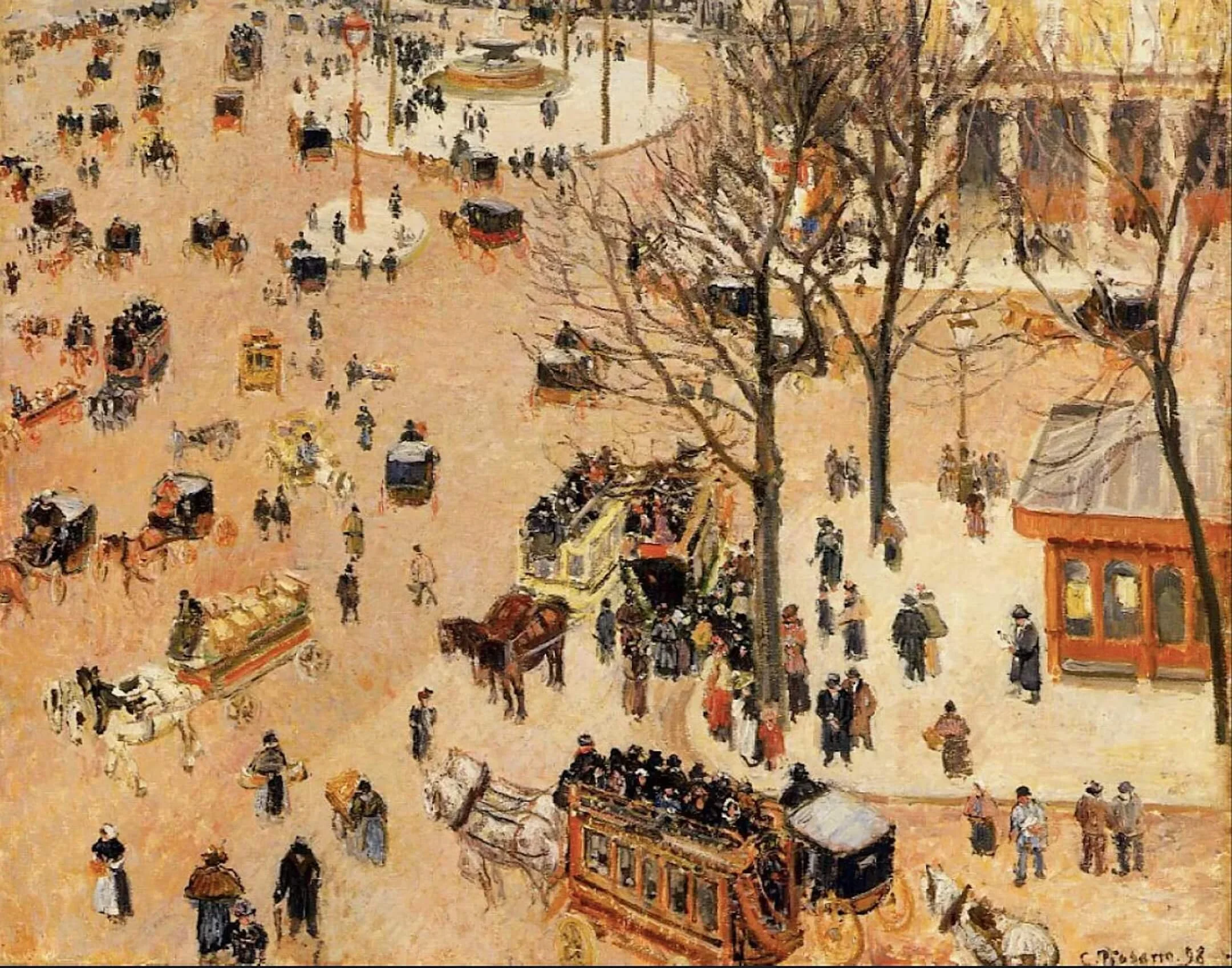
Camille Pissarro, La Place du Théâtre Français, 1898
Oil on canvas
28 1/2 × 36 1/2 in.
Another significant donation was Pissarro’s La Place du Théâtre Français (1898), gifted to LACMA in 1946, along with many other Impressionist and modern artworks, by Hollywood songwriter and film producer George Gard (Buddy) de Sylva and his wife, Marie Wallace. The detailed painting depicts urban life of the Impressionist period with an aerial view of pedestrians and horse-drawn carriages, created with energetic brushstrokes.
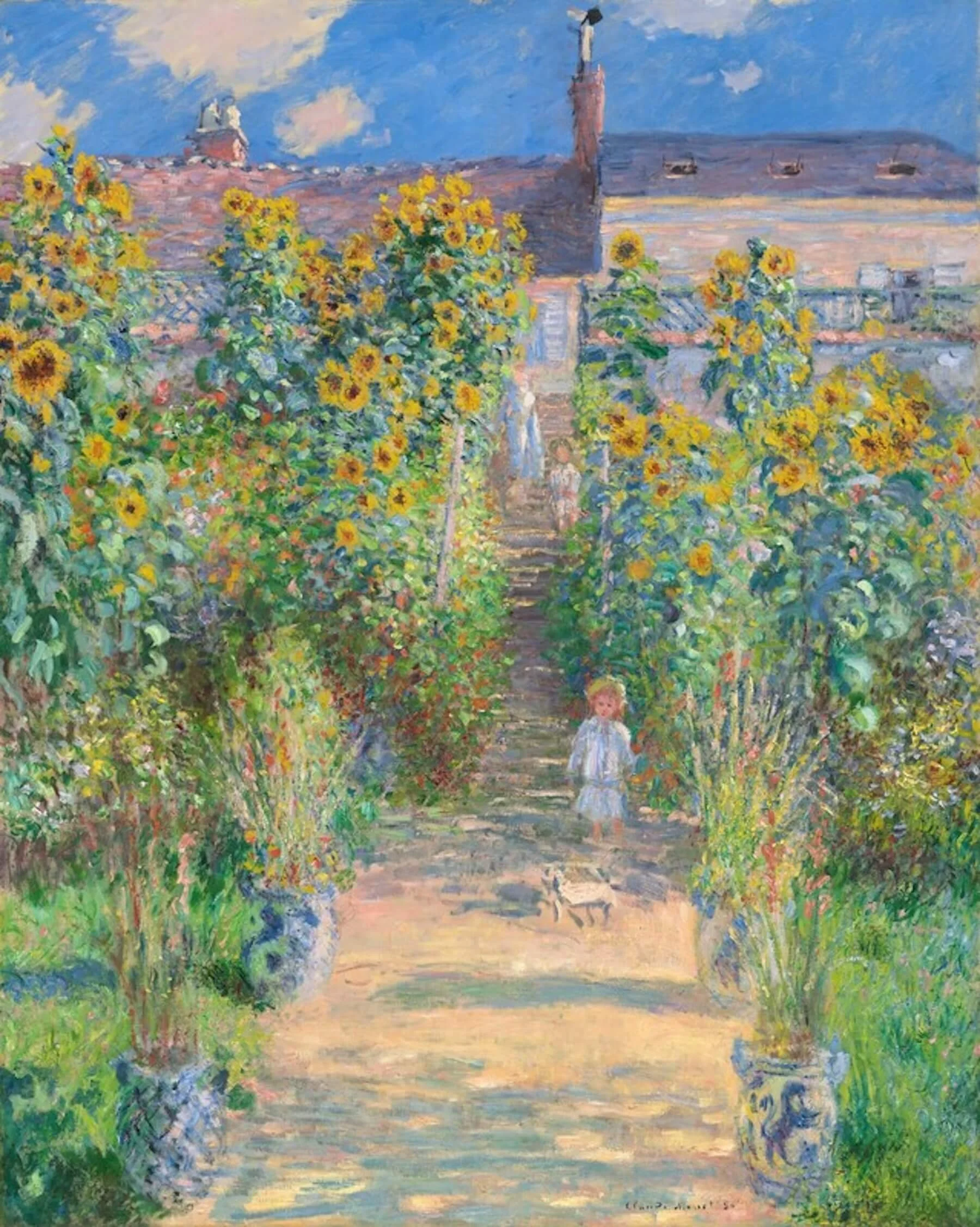
Claude Monet, The Artist's Garden, Vétheuil, 1881
Oil on canvas
39 3/8 × 32 1/4 in.
Donations to the museum, which officially separated from the Los Angeles Museum of History, Science and Art in 1961, have continued to the present day. The recently donated The Artist's Garden, Vétheuil (1881) by Monet depicts terraces that the artist himself landscaped. It presents his young son on the garden steps, surrounded by the multi-hued terraced plantings, amid sun-dappled shade.
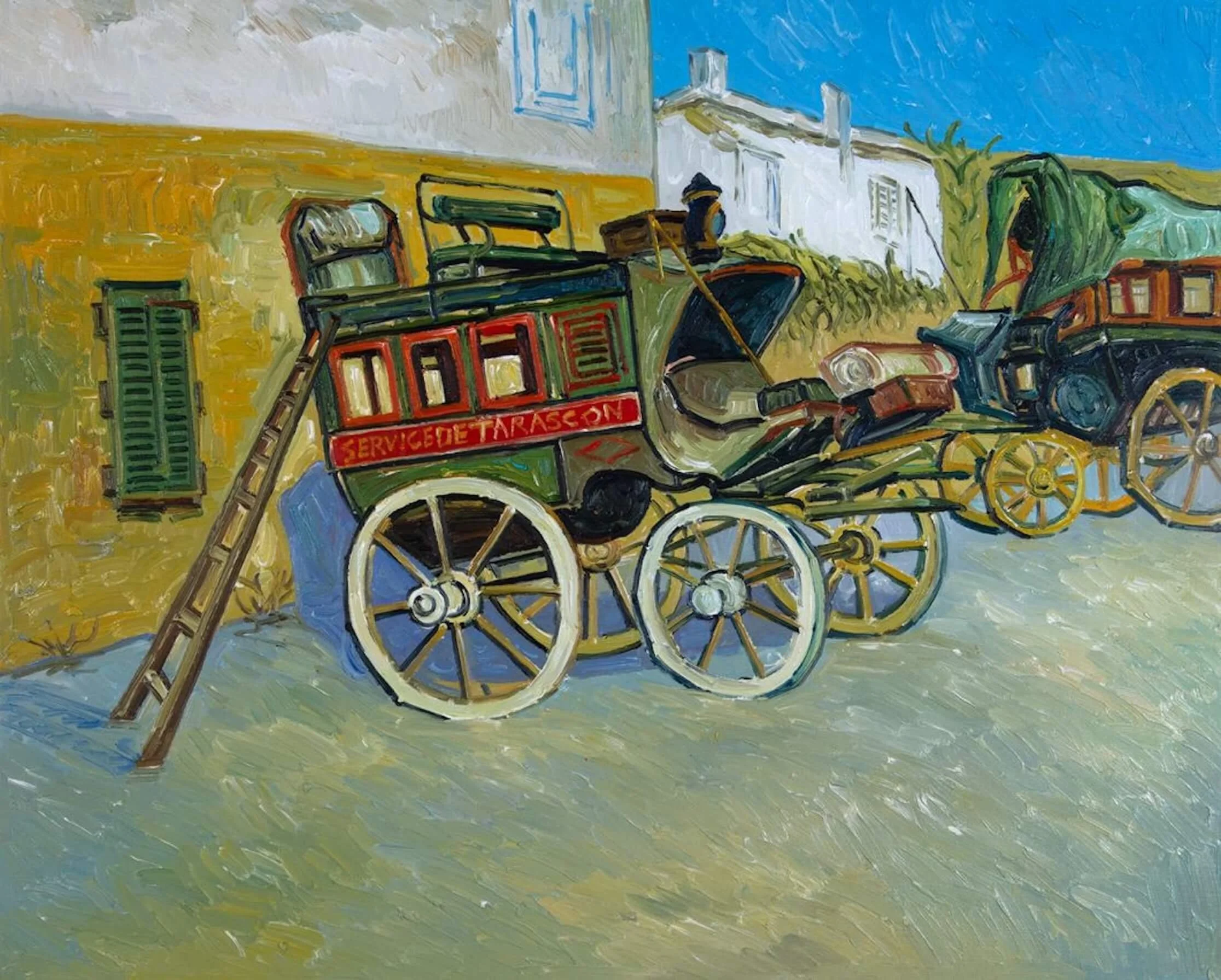
Vincent van Gogh, Tarascon Stagecoach, 1888
Oil on canvas
28 1/8 x 36 7/16 in.
The most recent Impressionist donations to LACMA were from the Henry and Rose Pearlman Foundation. The endowed institution gifted its 50-work art collection to LACMA, to the Brooklyn Museum, and the Museum of Modern Art, New York. A featured art piece is Van Gogh’s Tarascon Stagecoach (1888). The painting is based on a 1872 novel, Tartarin de Tarascon, describing an old stagecoach from Provence, France, which was used in the French colonies of North Africa. The novel by French author Alphonse Daudetdescribes the coach as being rundown and unfit for use after extensive service. Van Gogh painted it in a fairly dilapidated state, perhaps demonstrating his penchant for nostalgia.
Paintings by other masters of the Impressionist style are on display in this important collection. These include works by Pierre Bonnard, Mary Cassatt, Jean-Baptiste-Camille Corot, Paul Cézanne, Edgar Degas, Paul Gauguin, Winslow Homer, Édouard Manet, Henri de Toulouse-Lautrec, Édouard Vuillard, and many others. Photographs by Alfred Stieglitz, sculptures by Auguste Rodin, works on paper, etchings, lithographs, costumes, and decorative arts are also in this exhibition.
“Collecting Impressionism” is a tribute to the beauty and importance of the Impressionist movement. The show is curated by Leah Lehmbeck, LACMA Head of the European Painting and Sculpture and American Art Departments, and by David Bardeen, Assistant Curator, European Painting and Sculpture. It will travel to the Brooklyn Museum and to The Museum of Modern Art, museums that the Pearlman Foundation donated work to, after the LACMA show closes on January 7, 2027.
