
Chester Arnold, A Brief History of My So-Called Life, Catharine Clark Gallery
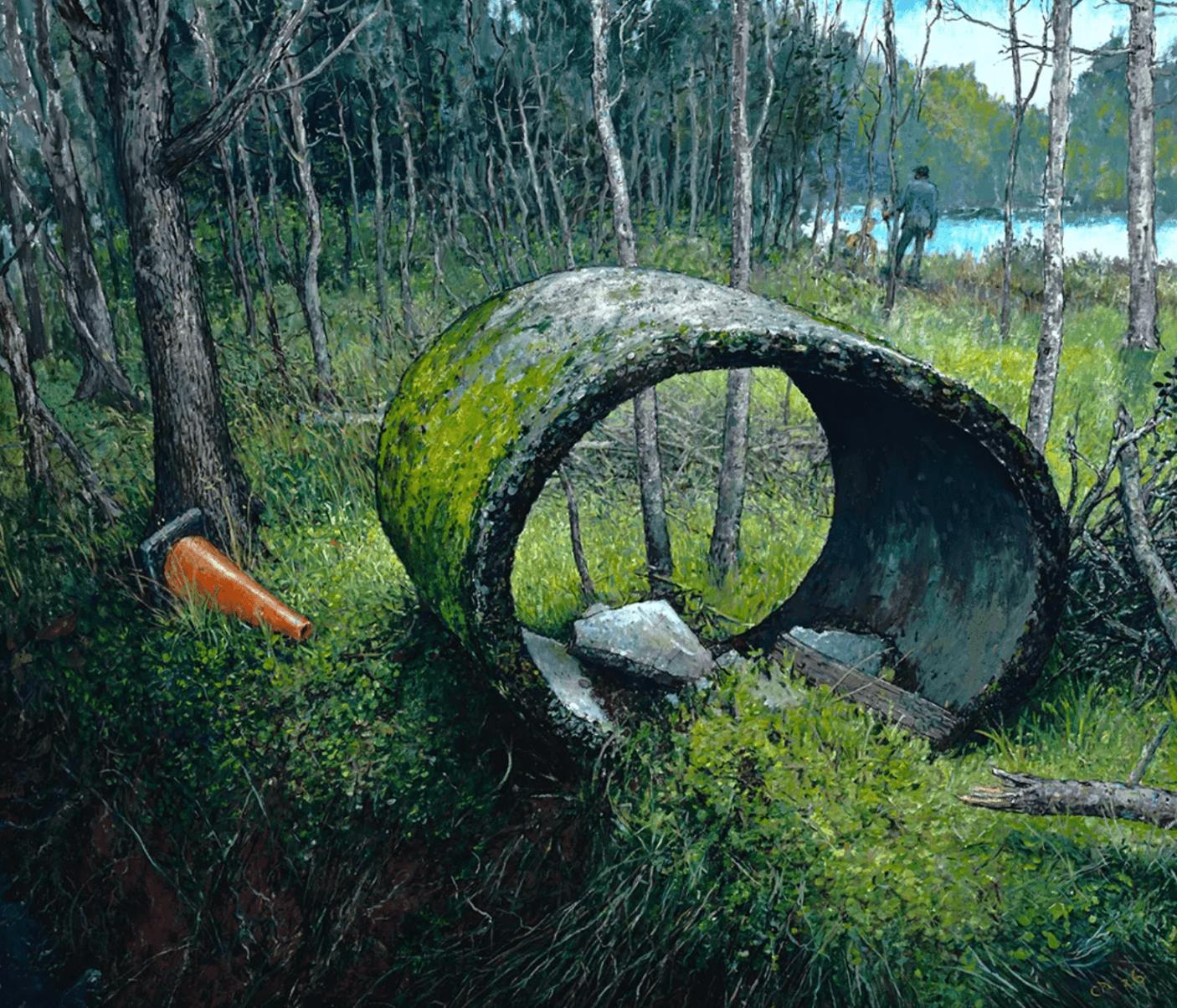
Chester Arnold, Oracle, oil on linen, 46 x 54 inches, 2026
A Brief History of My So-Called Life, a solo exhibition of new paintings by Chester Arnold, on view at the Catharine Clark Gallery from June 6 - August 15, 2026.
By: Bill Russell
Chester Arnold enters his sixth decade as an artist with a solo exhibition called A Brief History of My So-Called Life at Catharine Clark Gallery that feels markedly more inward-looking. The large canvases and small studies on display draw on memory and imagination rather than the expansive worldviews that often define his work.
You may be familiar with his complex, aerial depictions of resistance marches, where thousands of tiny figures surge across vast landscapes; or his defiant images of human intervention in the land, from garbage dumps and quarries to weather events that hint at a destabilized climate.
Many of those images and concerns persist in these paintings: gnarled trees, freshly dug plots, abandoned objects, holes breached in walls, and the murmuration of leaves. Now he offers us evidence of what he sees as a world straining for hope and meaning. Here we enter landscapes strewn with psychic debris of the artist’s own unsettled unconscious.
I’ve always known Arnold to be articulate about his life, art, and process, so I asked him to share his thoughts for this show. He says these paintings draw on the “primal elements of love, life, and death (that) have never been more vivid than in the imagery of forests, leaves, and our presence in nature.”
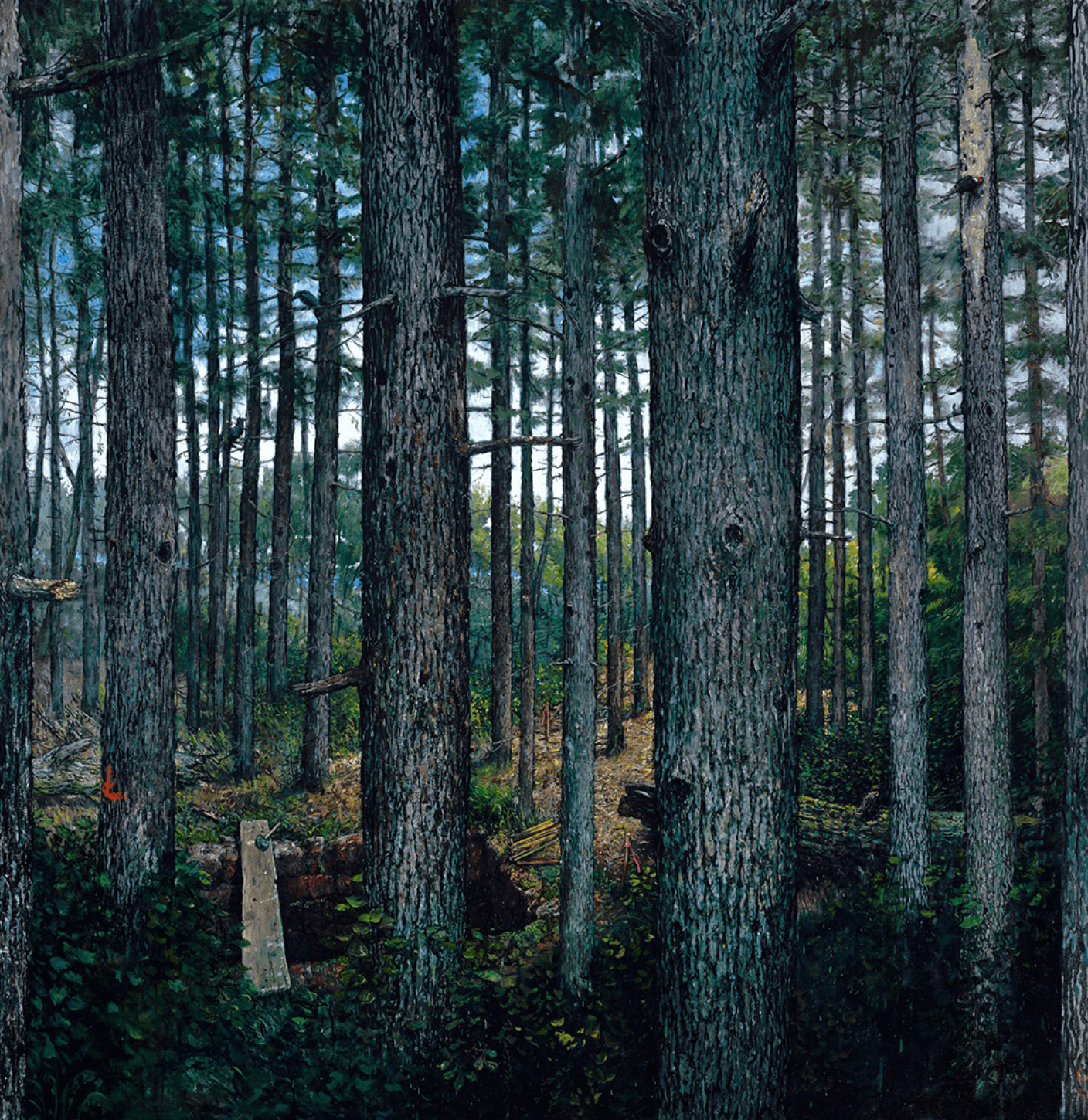
Chester Arnold, The Forest’s Edge, oil on linen, 78 x 78 inches, 2026
The signature painting is The Forest’s Edge, a work that offers a metaphor for an artist (perhaps lost) at the far end of his life. Inspired by his wanderings through West Marin, Arnold constructs a prison‑like stand of pines, a freshly dug pit, and an ambiguous clearing in the distance. From this stark arrangement he draws out both insight and a measure of optimism. “I’m living in the forest of my own creative life, finding my way through, from place to place. I’m still in the forest, but I feel like I’m getting close to the edge, looking through the trees you can now see the coast, and light beyond.”
There are other clues to find. There’s a brightly colored surveyor’s marker in the bottom left suggesting a plan to clear cut the forest, an ecological message suggesting human intervention on the landscape. Arnold offers, “Are we at the edge of our capability as a species? Are we exhausting everything? (It) seems like we're doing that?” The narratives he offers press us to reconsider our place in the world. This is his call‑to‑action: it isn’t too late for us. He hints it may be too late for him, except to keep painting. He speaks candidly about the melancholy that accompanies aging and the choices he’s making as he moves toward the final chapters of his life.
Chester Arnold's work and life contain multitudes*, imparting life wisdom, art‑historical fluency, with a generosity of spirit. It’s no surprise he taught for many years at the College of Marin, leaving behind a long line of appreciative students. (Full disclosure: I was his student for a brief time.)
*Arnold would tell you that, in his teens, his encounters with literature, particularly in the works of Walt Whitman, Thoreau, Emerson, Darwin, and Humboldt, were a critical contributor to his education.
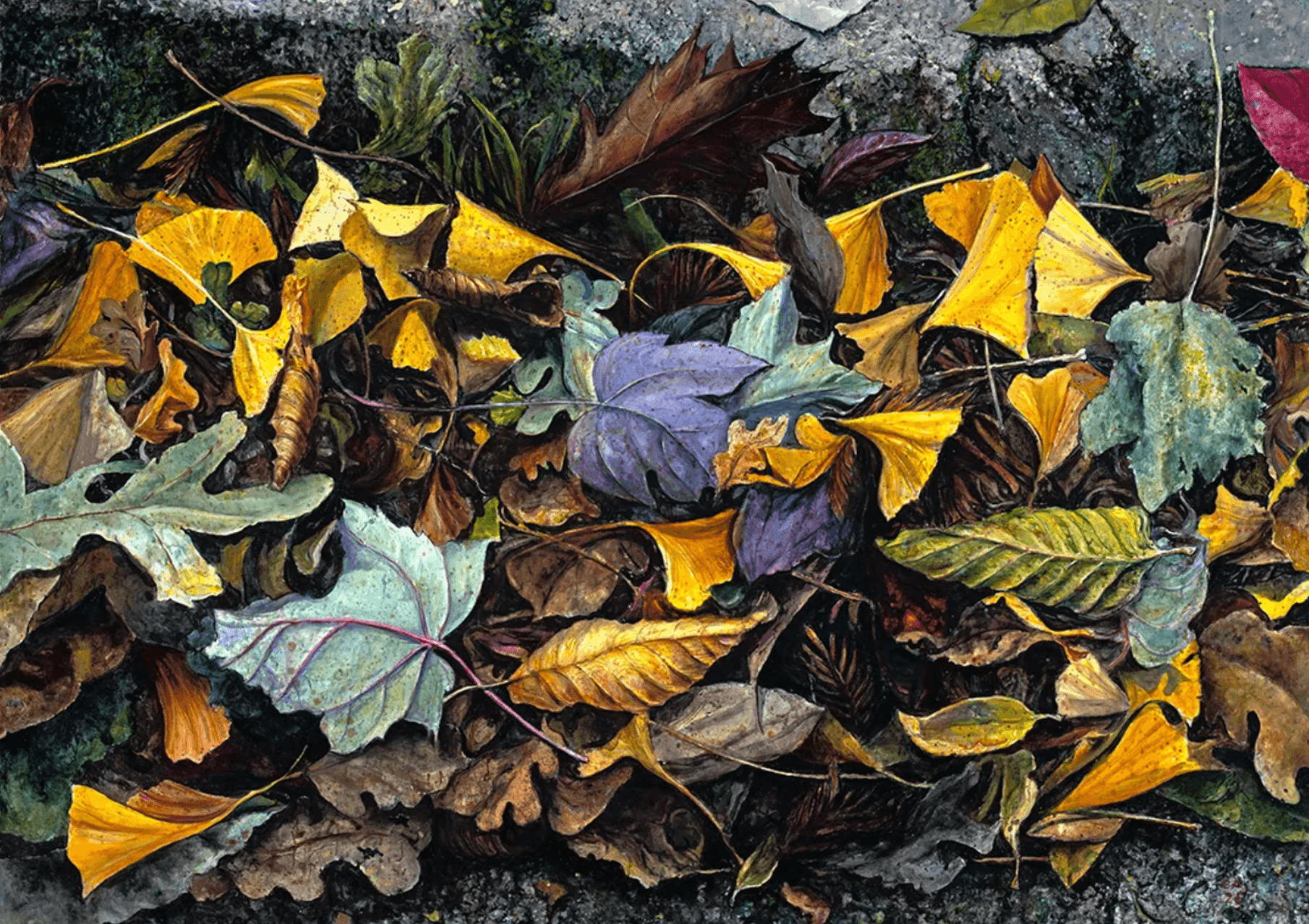
Chester Arnold, A Curbside Elegy, oil on linen, 44 x 62 inches, 2026
In A Curbside Elegy and its study, Gravity’s Long Embrace, Arnold honors the commonplace, which he clarifies, “is not meant to evoke mediocrity”. These are lyrical forms of maple, oak, and ginkgo leaves held together by close values and subtle shifts of hue. How often do we look at what’s fallen to the ground and notice the beauty and meaning in these autumn castoffs? Arnold says that collecting, sketching and painting leaves have become “an absolution for the bruised soul.” He continues. “We are all the children of gravity, as multitudes gather perpetually as our world spins its journey in the cosmos.”

Chester Arnold, A Fireside Chat, oil on linen, 30 x 44 inches, 2026
This forest reveals a car tire, a plank, and the remnants of a homeless encampment. Standing water reflects the sky, perhaps suggesting a heaven on earth. It’s not the only painting that suggests that Arnold experienced a transcendental moment in nature.
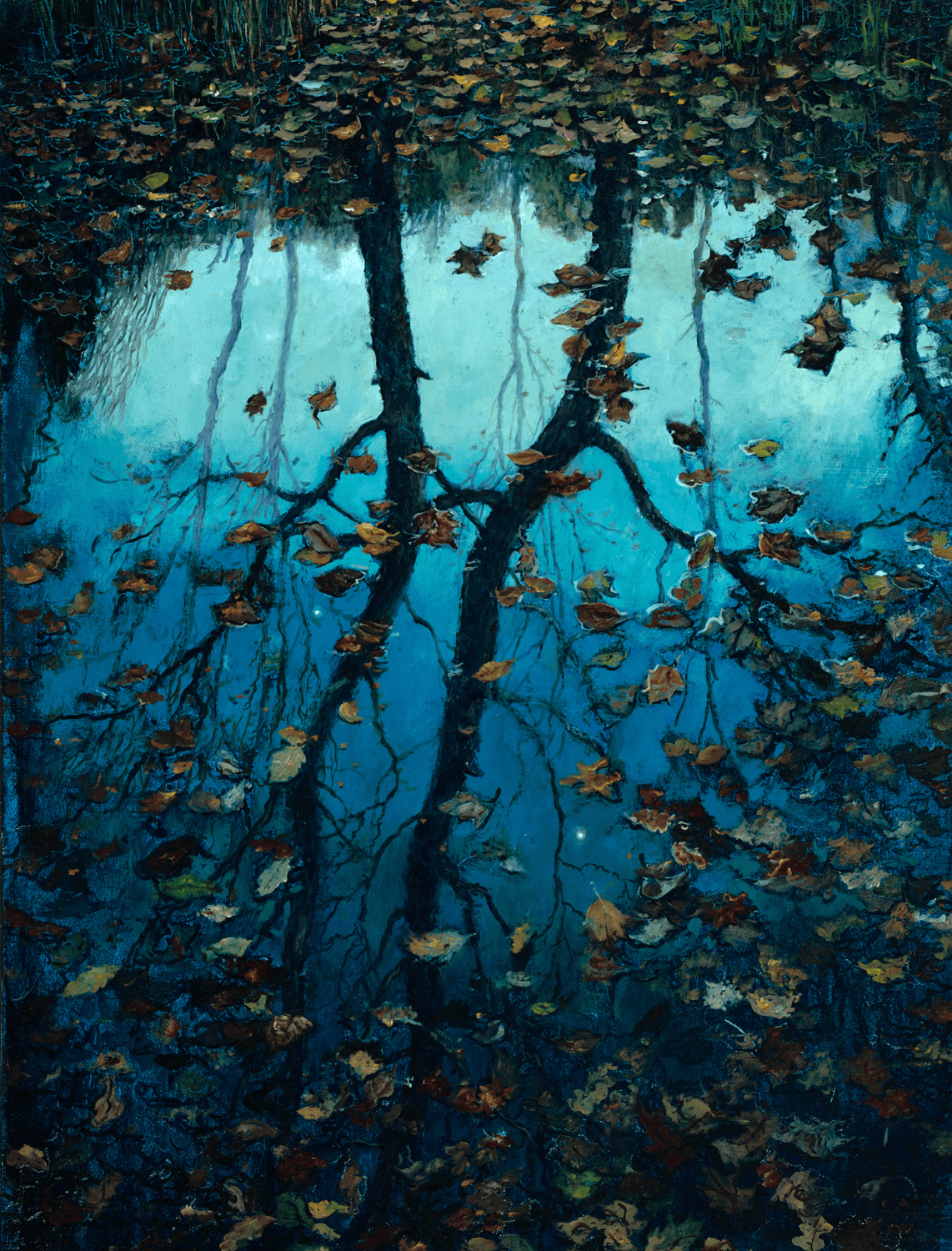
Chester Arnold, Two Stars Awake, oil on linen, 24 x 18 inches, 2026
There are a couple of paintings of water reflecting the sky. In Two Stars AwakeArnold tells us that, “when it’s neither night nor day, and the world reflects itself in the water and also two stars are shimmering in the water around the branches of the tree, one is filled with wonder. Even at my age, to feel that sense of wonder and delight is a kind of a spiritual experience, a thrill of the spirit that can’t be expressed any other way than to paint it.”
I asked Arnold about the painting of a moss-covered culvert pipe he titles Oracle (above). He often visits this place while hiking on the Overlook Trail in Sonoma. Did you ask the oracle a question, I asked? He answered, “the question is the painting. In the making (of variations) of the painting, it revealed things that I hadn't anticipated along the process. I thought there would be more transformation, but the presence of a larger image has a different kind of impact.”

Chester Arnold, Death and Transformation (for Bruce McGaw), oil on linen, 18 x 22 inches, 2026
A skull appears as offhandedly as a tossed bottle. The leaves that return to earth are painted with a lively and energetic touch. This painting is dedicated to Bruce McGaw, one of Arnold’s formative teachers at the San Francisco Art Institute. I imagine McGaw helped set him on the path to sharing his passion for making art and for teaching through shared experience.

Chester Arnold, Wolf Moon Afternoon, Tomales, oil on linen, 72 x 46 inches, 2026
In folklore, the wolf moon evokes themes of endurance, hunger and introspection. Here’s a large painting of a decaying yet still upright pine that Arnold came upon on a hike at Limantour Beach. Smaller versions and studies are arranged around it, suggesting a kind of meandering. The tree bark is falling away, revealing surfaces riddled with woodpecker holes, suggesting pride and persistence against the elements.
Why the fascination with dying trees, I ask? His response goes deeper than I expected. “It’s a recognition of their cycles, as our own as we age, rising and falling, providing venues for the exercise of elegiac metaphor. My earliest memories are filled with projection and animation, sensing that everything has feelings, a soul even, and has attracted hypnotic attachments to so-called inanimate objects in the natural world. As years have passed, the richness of such connection provides life with electric meaning, and countless opportunities for painted homages.”
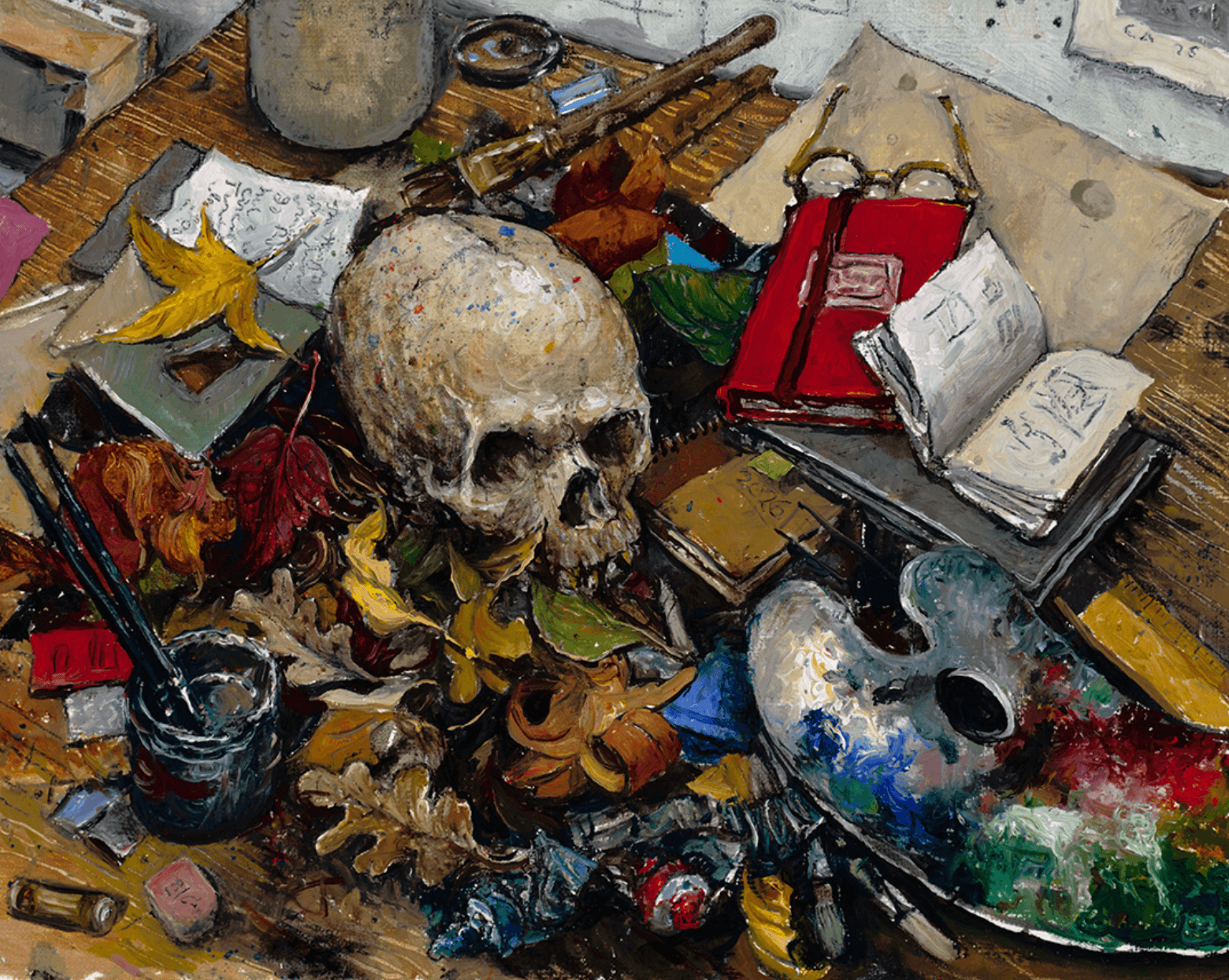
Chester Arnold, A Brief Summary Of My So-Called Life, oil on linen, 8 x 10 inches, 2006
Arnold shares his thoughts about this small yet significant painting of his studio table bearing his journals, books, materials, and more specifically, a skull.
“The presence of skulls throughout my decades of image making was never freighted by an obsession with mortality, rather it was the deep fascination with anatomy and zoology, expressed as structure in the resplendent beauty of bones. Having crossed the finish line of the proverbial three score and ten, the meanings reflected in this iconography have been expanded by the inevitable loss of friends and family. Rather than diminish my enthusiasm, however, my regard for the world and everything in it has grown ever more poignant and what I recall now is life’s radiant tincture. Drawing and painting are simply the output of paying attention to the world, and this attentiveness reaps rich harvests in the minds of practitioners. Granaries of memory filled with the abundance of joys and sorrows, balanced, upon reflection as each image appears in the mind or as it happens to occur spontaneously on a page or canvas. This little painting appeared after weeks of larger formats, a postcard to my conscious life from my unconscious, a game of juggling, of shaping forms that feel essential, and serve as an external representation of the archives accumulated in a life of...what is it again?”
The three large flat tire paintings Scenes From The Age of Gravity and Friction, Alley Flat and Whitewall are underwhelming to me, with their frontal presentation and hackneyed metaphors for deflation and impotence. Arnold is at his strongest when he turns to nature’s metaphors, gathering insight from the wanderings that carry him through it.
The North Gallery presents Al Farrow’s inventive bestiary of animal skulls and constructions are made of guns, bullets, and shell casings that function as a contemporary memento mori. Though the theme of death threads through both his work and Arnold’s paintings, Farrow’s commentary is more direct and political, while the messages in Arnold’s paintings involve more introspection.
Chester Arnold’s new paintings trace a life lived in deep attention, where forests, leaves, bones, and sky become mirrors for memory, aging, and wonder. This exhibition gathers those clues into a moving testament to an artist seeking light at the edge of the trees. These are personal, powerful pieces that hold their own within the full span of his career.
