
A Conversation with Jacqueline Francis and Trina Robinson, The 3.9 Art Collective
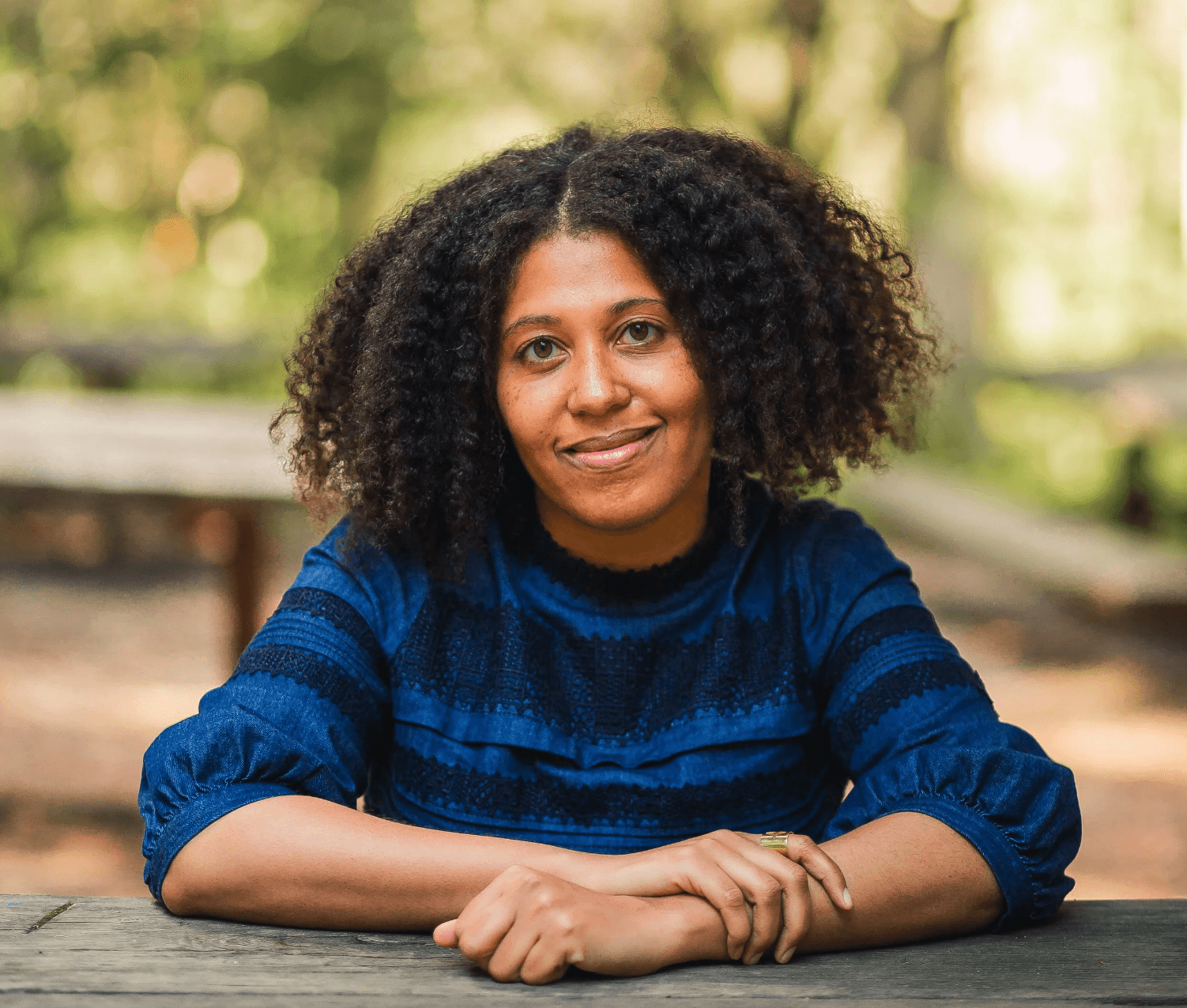
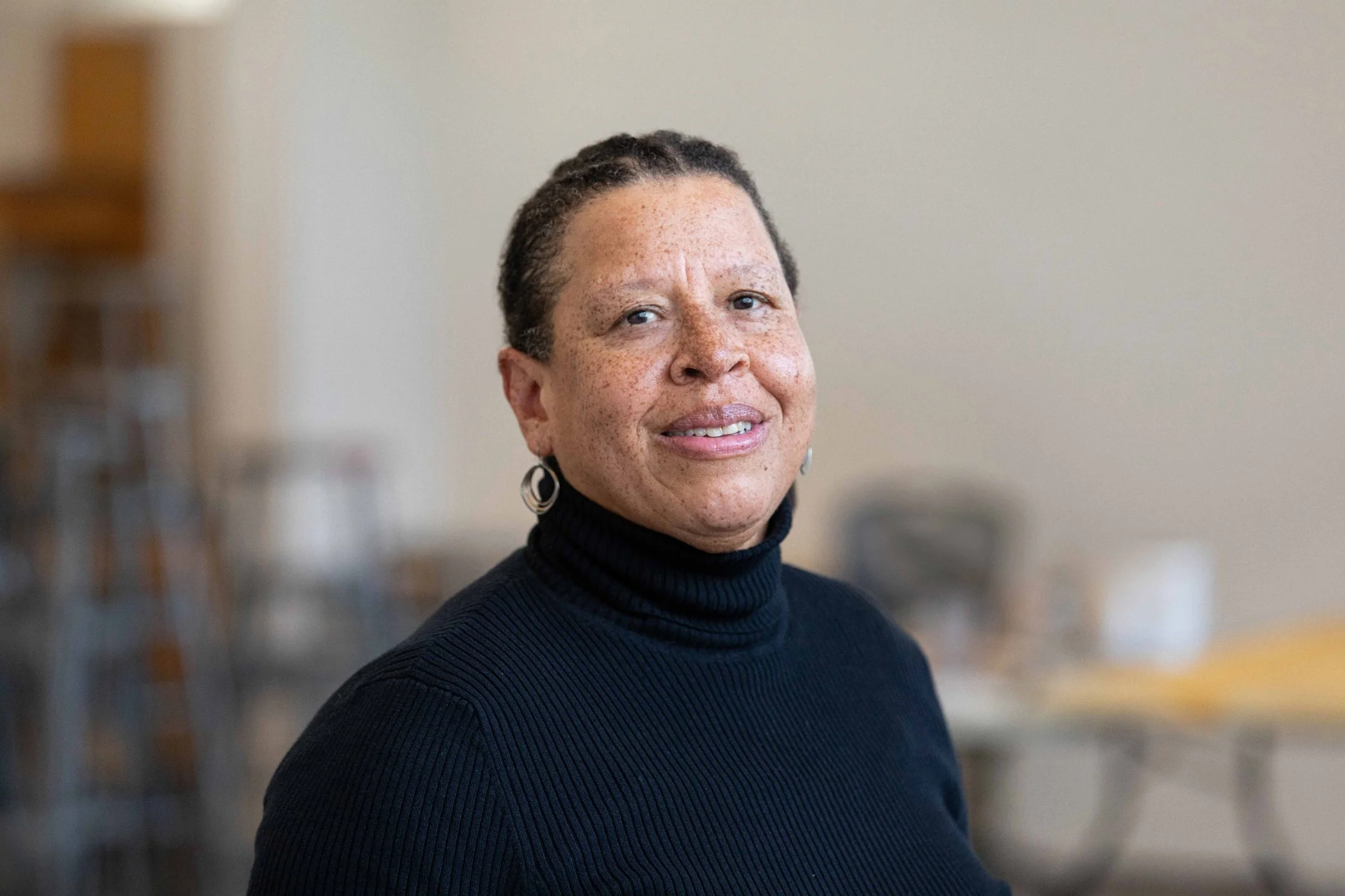
Jacqueline Francis and Trina Robinson, The 3.9 Art Collective | Interview by Hugh Leeman
The 3.9 Art Collective is an association of African American artists, curators, and art writers who live in San Francisco and came together to draw attention to the city’s dwindling black population. The 3.9 Art Collective bears witness to this phenomenon and seeks to reverse it by drawing attention to the historical and ongoing presence of black artists in the city and creative expression in its black communities. Through multiple forms of presentation and outreach, we create and claim spaces to display our artwork; nurture young artists and develop educational programs for students; and write about and curate exhibitions meant to generate productive, cross-cultural dialogues.
Jacqueline Francis is a writer, curator, and occasional artist exploring migration, identity, and cross-cultural exchange through literature, film, and visual art. Her short story collection in progress examines the bicultural lives of Black Caribbean immigrants in the United States, Canada, and the United Kingdom. Her works include the film The Visit (2009) and essays “H” Is for Hopsi (1995) and Three Friends (1990). Her projects include Outlook: No Fear (2017–18), What Can We No Longer Pretend Not to Know (2016), and Come to the Table (2017), a collaboration with photographer S. Renée Jones bringing Black San Franciscans together over meals.
Trina Michelle Robinson is a San Francisco-based interdisciplinary artist exploring time, memory, and migration through materiality, somatic inquiry, and archival research. Exhibitions include Open Your Eyes to Water, a dual-site solo presentation at 500 Capp Street and Root Division, and a solo exhibition at the Museum of the African Diaspora. In 2025, For-Site Foundation, partnering with the National Park Service, commissioned her film installation for Black Gold: Stories Untold at Fort Point. A 2024 SFMOMA SECA finalist, Robinson has shown at BlackStar Film Festival and Bay Area Now 9. She earned her MFA from California College of the Arts.
What Is the 3.9 Art Collective?
Hugh Leeman: To start us off, what is the 3.9 Art Collective? And can you share some of its history, as well as the important social context that inspired its name?
Jacqueline Francis: Maybe I can start off. The 3.9 Art Collective was established around 2010 by a handful of artists — five — who were responding to a news item in the Bay View weekly newspaper. In anticipation of the census, the newspaper said, with some anxiety, that with all of the exodus patterns in San Francisco — Black outmigration — it seemed like 3.9 percent was going to be the number of Black people in San Francisco. So that's where the name came from: this moment of anxiety, which didn't come to pass. The number never dropped to 3.9. It's around five or six percent now. However, there's a visible sense of people leaving the city for a number of reasons, which makes this number 3.9 still relevant.
Hugh Leeman: Trina, I want to go to you. In a collective named for Black displacement, as Jackie has laid out, how does your migration-centered work speak to 3.9's mission, and what has your own practice brought to the collective?
Trina Robinson: That's a great question. A large part of my art practice is talking about my family's migration to California, beginning around 1906, going back and forth between Chicago and different parts of California. Part of that back-and-forth had to do with cost of living, but I was also very drawn to the whole idea of the California dream — why people come out West, and why African Americans, especially my family, who at some point in Chicago were pretty well off. I thought, why would they come here if they seemed like they were doing well? I wanted to see what it was like here for myself.
I went to grad school here, and after grad school I noticed many people started moving to the East Bay, because you get more space for your housing there than in San Francisco. Almost everyone I knew did that. And I was like, I am not leaving. I had family in San Francisco, and I've been doing everything I can to stay here. I see the struggle in myself and in my family's history. So I'm very happy to be part of this organization, and our interest in why people are staying, how people are staying, why people are leaving, and how we can support those who are here.
The Displacement of the Arts
Hugh Leeman: You hit on a really interesting topic. For people who may not be familiar with San Francisco and the Bay Area — what exactly is happening that's causing such a displacement of the arts and artists?
Trina Robinson: One of the biggest examples I can deeply connect to is housing and affordability. I got my MFA at CCA, and a lot of people were living on campus. Pretty much everybody is now in the East Bay or South Bay, mostly the East Bay. It's wonderful out there. But people were like, I'm not in school anymore, I need a more affordable space to exist. I've seen other artists have to go out there as well, because it's hard to afford a studio and a home in San Francisco. Most people live in really cramped housing here, and you can't have your studio in your home — you can't do both. A lot of people leave for that reason. And now, with all the closing jobs, people leave for other opportunities elsewhere. Everyone I know, for the most part, tries to stay. It's just very difficult.
The Survey and Nexus Bay Area Black Art Week
Hugh Leeman: The two of you, along with a couple of other members, did a talk last fall that laid the groundwork for a research survey connected to an established, nonpartisan research data institution. What were the results of that research?
Jacqueline Francis: So actually, the survey hasn't launched yet. When we talked about it last year, we were still crafting it and working with some very generous data scientists outside of San Francisco who gave us feedback. We finalized the survey this summer. We're planning soft launches this month and next, and then to really go around during the next Black Art Week to get people to respond — it's online. We're glad you asked, because we have a lot to say about its importance, and a lot to share once we start releasing our findings in 2027.
Hugh Leeman: You mentioned Nexus Black Art Week. What is this?
Jacqueline Francis: How would you describe it, Trina?
Trina Robinson: It's an incredible event launched by Monetta White from MoAD. It's become a week-long event focused on the Black arts community in the Bay Area — a series of talks, exhibitions, studio tours, and workshops over the course of a week. People have now been traveling to San Francisco from outside to attend. Last year at the art talk we had to launch the survey at ICA SF, we met people who had come from outside California to visit. It seems to be growing much bigger each year. There are parties too — a big party at YBCA — so we can celebrate, get to know each other, and network.
We're excited to bring our survey to this event. I'm part of Black [Space] Residency, and we're going to have the survey come up at our event with a QR code, so people can participate. Part of the survey is about showing the opportunities that are there — we think some people just don't know they exist. We want to pull these resources together and make them clearer and more accessible, and sometimes it's just hard to navigate. We want to help streamline the process and create a better network.
Abundance in the Midst of Scarcity
Hugh Leeman: It's really interesting that you mention resources that people just don't know about — a positive contrast to the scarcity of high living costs and closures. What are some of the resources that people could navigate through?
Trina Robinson: As an artist myself, just knowing the number of residencies that are here — like the one I'm in with Black [Space] Residency, and others throughout the Bay Area — people just don't know, because they're not advertised in a way that's clear. A lot of times it's kind of who you know. So we want to create a network, almost like a central hub, so people can find out where these resources are, learn more about studio space — like Root Division studios, which are quite affordable, and spaces in Bayview. We're also asking where people's zip codes are, so we can know what parts of the city we truly are in. A lot of people have the stereotype that everyone is in Bayview, but we're all over San Francisco. So it might be very helpful to navigate and connect with each other in our various areas. Jackie, do you want to add to that?
Jacqueline Francis: We're thinking about the survey results being a resource for everyone — not only for artists and, broadly speaking, cultural workers who identify as Black people in San Francisco, but also for funders and institutions who are interested in knowing where Black artists are, where they are in their careers, what they need more of. Studio space, the opportunity to afford living in the city — these are concerns for everyone. But they're really, really acute concerns for Black artists in San Francisco.
A Shrinking Collective, a Complex Set of Circumstances
Hugh Leeman: Jackie, you've been with the 3.9 Collective since roughly 2012, and you often speak on behalf of the collective in public. You've noted that the collective was once around twenty members but has since contracted. What does that shrinking membership tell you about the very problem 3.9 formed to name?
Jacqueline Francis: It's a very complex set of circumstances. Part of it is people moving outside of San Francisco — literally beyond the Bay Area to other parts of the country, and in some cases other parts of the world — looking for opportunity, looking to further their careers. Even for people who stay, I think about what it means once you get beyond emerging artist to mid-career or late-career: where do you want to put your energies? Maybe the collective doesn't do everything you want to put your energies into in order to forge a solo career.
I also think about how institutions look to find artists. Sometimes it doesn't seem like institutions are looking for collectives or groups — they're looking for individuals. So a lot of those things inform the numbers, up and down and across different demographics of age and gender, for 3.9 membership over the years.
A Paper Habit She Can't Shake
Hugh Leeman: Trina, before your MFA, you worked in commercial print and digital media at places like The New York Times and Vanity Fair. What carried over from that world into your archival and ancestral practice?
Trina Robinson: It definitely came over as my love of print — even though the biggest part of my art practice is film and video, I cannot get print out of my system. I worked in magazine publishing for so many years. When I worked at Vanity Fair, we'd send the digital files to the printer, and sometimes I'd be on press watching them run. When I got to grad school, I was like, oh, wait, I can make a book, I can make a magazine with my hands, I can make paper. I had the opportunity to make paper from raw cotton with my hands, and just see that form of alchemy take place. That's the through-line, how I've kept the past with my present deeply embedded. I love film so much, but I have a paper habit, a print habit, I can't shake.
Arrival and History: Writing San Francisco
Hugh Leeman: Jackie, you've done a lot of writing and publishing, and there's a short story — "Look Away" — that grows out of your visit to San Francisco in 1987. How does your arrival and history in the city shape the way you write and think about the Black community here?
Jacqueline Francis: Everything is comparative for me. I think about being born and raised in New York City, and having lived in a lot of other places, larger and smaller. So I'm always thinking about myself in all of these different locations, both here in the U.S. and abroad, and also thinking about migration and movement. There are members of the 3.9 Art Collective who were born and raised in San Francisco, but I bring the experience of somebody who was not. So I'm trying to think about all the discoveries I've made about San Francisco and continue to make — because even though I've been here more or less without cessation since 2008, I still feel like every day I'm learning something I had no idea about.
Finding a Language Through Film
Hugh Leeman: Trina, you've told your own personal story publicly on stage, live at The Moth. How does speaking of memory aloud to an audience differ from building it into a physical work — print, video, that paper habit?
Trina Robinson: That's a great question. Before I was a practicing artist, when I was working in publishing and briefly tech, I was obsessed with my story — the fact that I was able to find all these things about my family members. It changed my identity, how I looked at myself in the world, my idea of American history and the history of slavery and how it's taught in this country. It blew my mind being able to know where I came from and their names.
Someone said, oh, just pitch it to The Moth. The first time I pitched it, I was contacted by one of the directors, we talked a couple of times, and then she kind of ghosted me. So I ended up taking a video essay class at SFAI. I brought in an archival box of documents, some original, some copies, and said, I want to make a film. Long story short, I made a film, and it started circulating at festivals. I realized I was able to process everything so much easier visually — it gave me a language I didn't have with vocal language.
I sent the video to that director, and she contacted me again and said, now you have the story. That's when I realized, oh, visually it's easier for me to articulate this kind of trauma. And that's when I did The Moth mainstage, and traveled — Lincoln Center, the Herbst here, Newmark in Portland, other places. It was all because of that film, which gave me the language to process what actually happened.
Investigation, Not Explanation: William J. French
Hugh Leeman: Your practice is effectively excavating fragments of memory and centering on ancestors. You've done something fairly specific to your great-great-uncle, William J. French. How do you decide what to reconstruct and what to leave as a gap, a fold, something left out on purpose?
Trina Robinson: My practice is pretty much about asking questions. I'm not trying to say, this is what happened — my whole practice is an investigation. With William J. French, I really wanted to understand: yeah, he passed for white. You could just say, oh, he's this guy who passed for white and took off, and then there was a big scandal when everyone found out. But I wanted to know more than the why — I wanted to know how he lived, because he still stayed in contact with my family members while he was passing, which ultimately is what undid him. If you pass, you pretty much take off. But he kept in contact.
That led to so many other questions. Why did they come to California if they were so well off in Chicago? Some of them dined with P.B.S. Pinchback at their homes. The parties they threw were written up in the society pages — in the Appeal in 1889, P.B.S. Pinchback was at the house, and it talked about the women wearing diamonds, listing what all the women wore. So I thought, why would they come all the way out here? That's why I wanted to look into it.
Now I'm looking into other stories of westward migration — James Beckwourth and people in the Lake Tahoe area. I'm obsessed with California, because people don't think about African Americans who migrated here, for many different reasons, well before 1900 or shortly thereafter. There are the people who were enslaved and became part of the Gold Rush and fought for their freedom, and pioneers like James Beckwourth. So I'm just asking questions about migration.
Making Race: The Problem of "Racial Art"
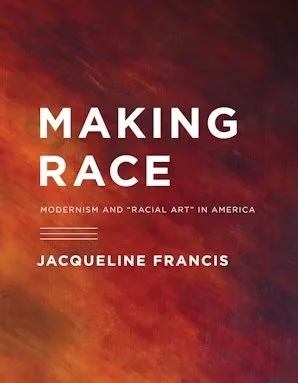
Hugh Leeman: Jackie, there's a book you published — Making Race — that interrogates the category of what qualifies as racial art in America. When you look at the work coming out of the 3.9 Collective today, how does that historical framework help you see it more clearly?
Jacqueline Francis: To be clear, the book is about the problem of the idea of racial art — that is to say, in the 1920s and 1930s, audiences, predominantly mainstream white audiences, expected artists who were Black to make something that looked very different from their non-Black peers. That happens with a lot of different artists — artists who identify as women, or Chinese, or gay and queer. There's an expectation that there's a mainstream category called art, and then all these other things that modify it.
So when we talk about what we do in the 3.9 Art Collective, it's not that we're saying this looks different in terms of medium or practice. As is the case for all artists, it's very specific to your experience and your interest. I speak for myself — I'm not saying there's anything that qualifies as the way all Black artists work. I would never make that statement. What I'm trying to talk about is the way it seems so important, both critically and to some makers, to say, yes, this is what is different. This term "Black art," which is not necessarily one I personally use, seems to be very important to a lot of makers, and certainly to people who write about their projects.
Hugh Leeman: What do you attribute that to — the importance of it to them, where it's not a term you're necessarily connected to?
Jacqueline Francis: I think it's the moment we are in history. It's part of where people see, not only in this country but maybe elsewhere, a sense of both despair and yet simultaneously a resistance — saying there are things they feel are so evidently clear in terms of histories of anti-Blackness, and pushing back against anti-Blackness that's institutionalized, not just personalized by individuals. So there are people using that phrase, Black art, as a way of self-empowerment in this moment.
The City as Material: Staying to Uncover the Stories
Hugh Leeman: Trina, you've said your proximity to the ancestors you depict is the foundation of your practice, and that you couldn't make this work if you left San Francisco. How does this specific city function as material in your art?
Trina Robinson: Because my ancestors — William French lived here in San Francisco. He came here in 1913 from Chicago, and eventually crossed the color line when he joined the military at the Presidio. He's buried in the cemetery there. It was a big court case, because they weren't going to let him be buried there when they found out he was Black. But they eventually allowed him to be buried with full military honors.
I'm drawn to uncover his story, because he was pretty much erased from my narrative. My mom had never heard of him growing up — she knew about all his ancestors, but not him. I look at him almost like my partner in crime. He's kind of redeeming, making up for what he did. That's why I feel like I can't leave — I feel like we're here doing this together. There are parts of his story, like the actual circumstances of his death, that I still want to look into.
Being in California, but specifically San Francisco — I also want to talk about how African Americans who came here had the American dream just like everybody else. They wanted to come out here, go to the beach, be around sunshine, pick their flowers, rest. Of course there was struggle, like always. But that's not what our lives were fully.
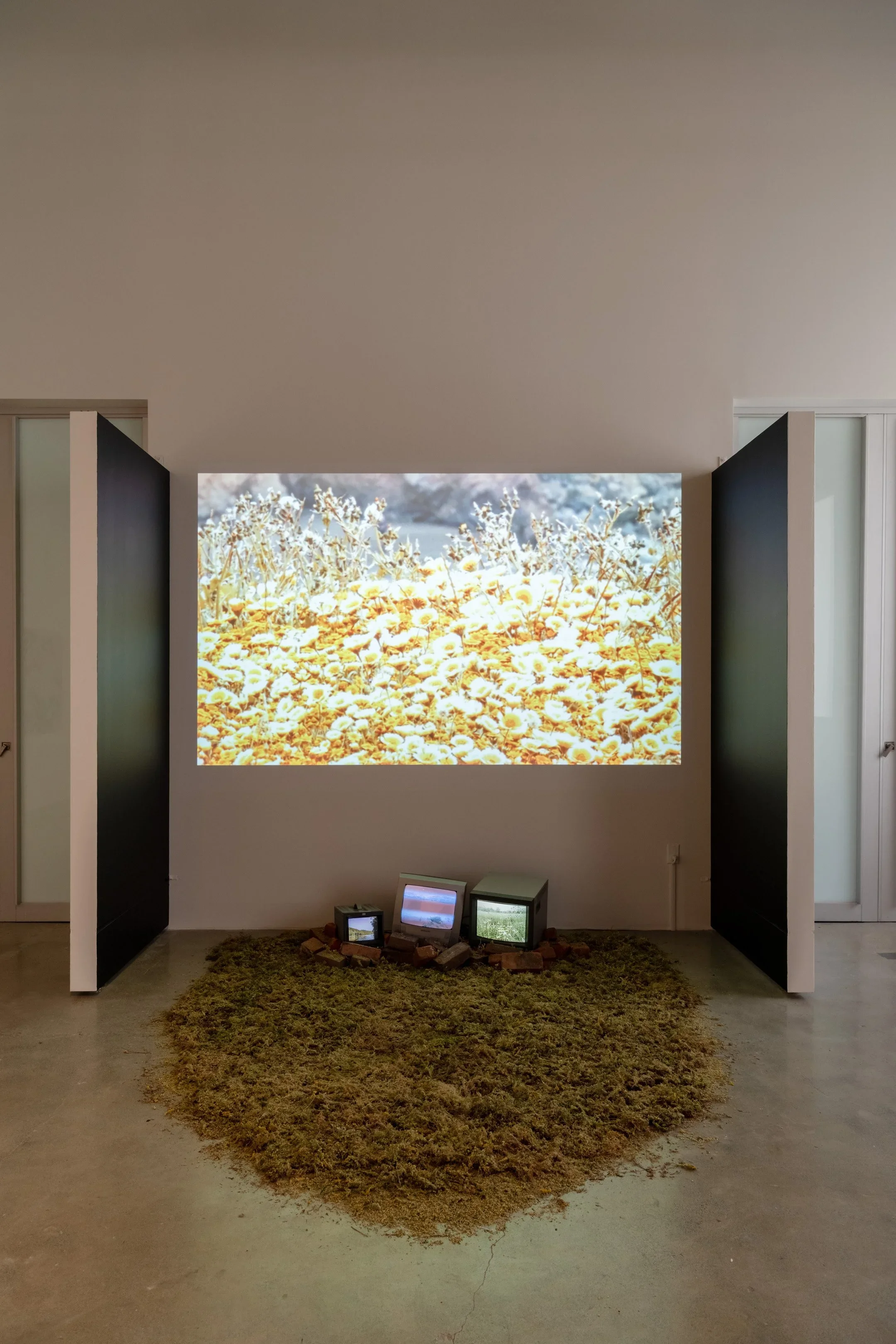
We had a screening for my film Go West, and I remember people got up and started testifying about their family's migration story. It was unexpected, and one of the most incredible moments of my life — to see people get emotional talking about when their family first came to California, the businesses they started, the history. I'm now applying to make additions to that film and do an oral history project, because it was really a testimony. That's what I need, and why I won't leave — this is where my stories are.
Collecting the Oral Histories
Hugh Leeman: Tell me about the oral histories. What would you be doing with those, and who might be contributing?
Trina Robinson: At that event at the Bayview — I think it's the Bayview [Opera House] — we had an outdoor screening, and people stood up and started identifying when their parents or ancestors came, the businesses their great-grandparents had started. Someone was saying, all the money their ancestors had made, some of it was spent and they want to build it back — where the homes were that they first built.
So with the oral histories, I'd like to collect those individual stories. I want to do a grant, finish the part of the film I didn't get to, collect more archival video footage of African Americans in California, and maybe partner with the San Francisco Public Library. I could start with those people who spoke up.
Protecting the Healing at the Core
Hugh Leeman: Your work has been described as a way to "release the trauma that lives inside," and also as celebrating forgotten moments. As your profile rises as an artist, how do you protect the intimacy and healing at the core of that practice?
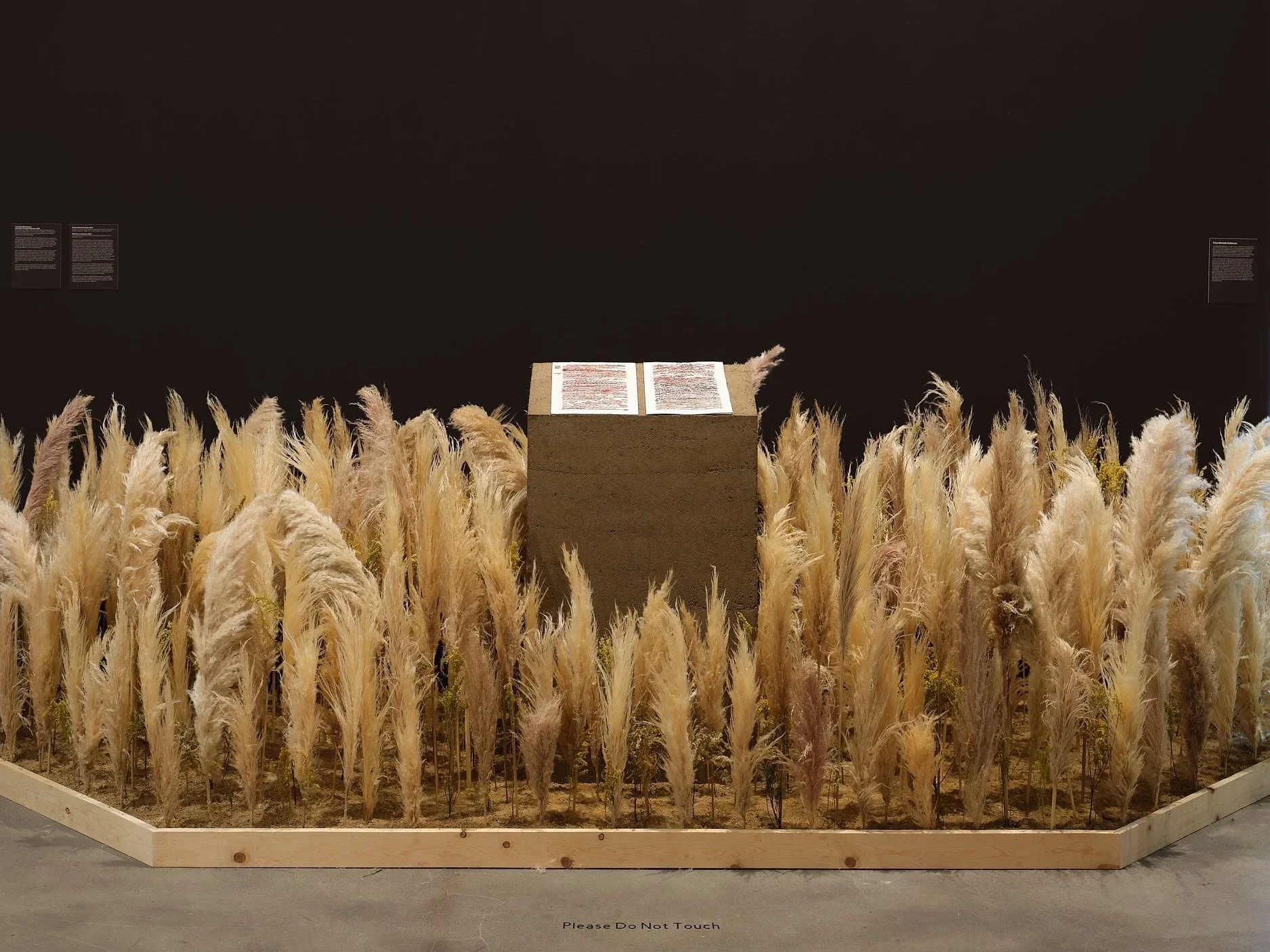
Trina Robinson: I had an amazing show at 500 Capp Street with a piece that focuses on a document listing my enslaved ancestors. It's called Liberation Through Redaction — I redact every word that has nothing to do with your humanity. When you put your work out in the world, the audience has their time with it, and you have to let that go. There were beautiful moments of hearing people connect to it and talk about their family's migration.
There were also a couple of weird moments where people were posing with it, putting it on Instagram, and not acknowledging me as the artist — like it was a "slavery to freedom" spectacle for some people. That showed how much education there still needs to be. But it's worth it, because the healing is happening. The act of making that document, the laborious process, the planting of the tall grasses — that's somatic work. There's a soundscape related to my family's migration, field recordings from Kentucky to my family's property in the rural Central Valley of California. I want people to have an immersive experience that transports them.
When I've seen other people have a healing reaction — when they feel transported in that space — that's why I do it. I used to have a whole other life, and I gave it up, because this is what I have to do.
Curating as Advocacy
Hugh Leeman: Jackie, you're also a curator. You've curated Where Is Here? at the Museum of the African Diaspora, and the Sargent Johnson show, and Fight or Flight — foregrounding Bay Area Black artists navigating precarity. In what ways is curating a form of advocacy, similar to what the 3.9 Collective is inspired by?
Jacqueline Francis: Curating is about being in conversation with artists, trying to learn what they're interested in — not only the work they talk about making, but ultimately the work they are making. I hope the exhibitions I'm part of not only show the work, but raise questions and create ground for conversation. We often talk about artworks as things that start conversations that are hard to have otherwise. Standing with an artwork, being in a screening, participating in social practice — these are things art can do: create the space to ask questions about things we might otherwise feel frustrated reading or talking about in the abstract.
The one for the Museum of the African Diaspora was about how artists who identify as people of African descent can make work about the diasporic experience without the figure of the body — to talk about movement, historical or migratory. Fight or Flight at the Museum of Craft and Design was about movement in and outside of San Francisco, because of people's affinity to the city. And the historical exhibition I did with the Huntington: Sargent Claude Johnson was an artist born in the 19th century in Boston, who made his way to San Francisco in the second decade of the 20th century to study art. Another migratory figure, moving voluntarily here for something he saw as promise and potential, and lived the rest of his life here until he died in 1967. With curation, I want people to think about these histories, these questions, these practices of art-making as something worth thinking about in our everyday lives.
What a Collective Can Do That an Institution Can't
Hugh Leeman: Oftentimes, if one's not in the art world, we think of it as some massive institution — you have to go to this museum, that's where art happens. But you've moved between grassroots collectives — 3.9, the Queer Cultural Center, a deanship at CCA. What can an artist collective like 3.9 do that a large institution structurally can't?
Jacqueline Francis: In terms of size, vision, objectives, and goals, there may be overlap with an institution. But as is the case in life, people move at different speeds. They prioritize things differently and leave aside things that aren't urgent, or that they cannot do. That's true whether it's the 3.9 Art Collective and a museum, or someone doing another thing in their life as their work. These are things that are part of the everyday that may be crowded out, or may seem especially unique or esoteric when we think about art and culture — but that's something everyone is doing. Even with social media or the internet, we know we're visual, we're interested in experiences. It's not just inside of buildings that this thing called art exists.
How Place Changes the Work
Hugh Leeman: Trina, you've had a dual-site show — Open Your Eyes to Water — and your Fort Point commission, both putting your work in charged historical sites tied to water and migration. How does the specific place where you install the work change its meaning?
Trina Robinson: Liberation Through Redaction was originally supposed to be at a Root Division site, but we got the opportunity to be in the parlor at 500 Capp Street — a beautiful historic space where you can see how the history has been preserved. Having it in that parlor room changed the meaning of that show for me forever. It revealed layers I wasn't even fully aware of. Because it was in a home, it brought out the level of domesticity with my ancestors and the institution of enslavement. It made it very much more real — imagining my enslaved ancestors in these homes, their pathway to freedom, then making their own homes as free people. David Ireland preserved that house in a way where you can see the history, see the cracks.
Same with the piece at Fort Point — Charles Young. Having it in a historic military fortress, an open-air space with an actual connection to the military, made it much more grounded in terms of Charles Young's military career, but also the Buffalo Soldiers coming to California. He was from Kentucky, like my family, so all these beats connected with my family, and it made it come to life. You could feel the ghosts in that space, because it's a Civil War–era fort. I couldn't have had that show any other place.
The Closing of CCA
Hugh Leeman: Earlier we spoke about the challenges of staying in San Francisco, and the mention of CCA, which you're both deeply connected to. What does the upcoming closing of CCA mean to you both personally?
Trina Robinson: Maybe I'll go first, because I'm the one who's gone now, and Jackie can close it out since she's going to be there to the end. I'm no longer there — I was part of that round of layoffs at the end of the summer. I thankfully did get a job teaching a class at SF State. It's devastating. My last show had four or five other artists who participated in an installation with an altar — they all went to CCA in the graduate program.
I understand people are saying there are all these other institutions, and that's true. There will be spaces opening up with classes and workshops — thank goodness. But I'm praying there's going to be a way for people to get at least a certificate program, some kind of accreditation connecting them to higher education. It's going to be such a sad void to have the last art school close here.
Jacqueline Francis: I'll leave it to everything that's been said in the press, but there will be a new art school run by Vanderbilt, opening in fall of 2027. The relationships I've built here — teaching at CCA for almost eighteen years — will be sustained if they're intentional. I never look at a commencement and say those are the last moments I'll ever see a graduating student or a colleague, because I know from my own experience going through school that I'm in touch with my mentors and my peers. That's sustained even with the closing of an institution. I look forward to being part of this active year of 2026–2027 at CCA, where we're offering classes, programs, and exhibitions, and preparing students to either graduate in spring of 2027 or continue their education elsewhere. And we look forward to artists being part of the next art and design institution here in San Francisco.
How Should the Collective Be Remembered?
Hugh Leeman: To pull things full circle — Jackie, as both a member and an art historian, how do you want the collective's work documented and remembered? What's the archive of 3.9 you'd want to exist fifty years from now?
Jacqueline Francis: It has to be a multi-platform strategy. I hope there'll still be an internet fifty years from now. I hope some of the ephemera and the visual documentation of exhibitions will be available in print material and in a San Francisco Public Library archive, or maybe one at an institution. It also has to exist in community archives — we're in a city with centers like the African American Art and Culture Complex, as well as the museum of the African diaspora. I think it has to exist in many different sites, so it's less in danger of being forgotten or dissolved. I hope it lives in people's conversations and memories, and in oral histories with the artists of the 3.9 Art Collective — both present and emeritus members.
Hugh Leeman: And Trina, you're one of the newer voices in a collective whose founding dates back to 2010. What do you hope to carry forward from them, and where might you push things that 3.9 hasn't yet gone?
Trina Robinson: I'm very happy to be part of a project that's research-focused — I'm a research-based artist, so that's part of my art practice. I'm looking forward to activities like this survey, and what we can do with the research once it's completed. The fact that 3.9 was founded through questions about data — I'm looking forward to what we're going to do with the data we collect, and how we can be involved with the city in helping answer questions for artists, and for those who could fund artists and other cultural workers. And on the visual side too — what exhibition opportunities there are in tandem with the data collection and research. There's just so much potential.
Hugh Leeman: Trina Robinson, Jacqueline Francis — thank you both so much for taking the time to share on 3.9 and beyond.
Jacqueline Francis: Thanks for having us.
Trina Robinson: Thank you.
