
Hit By News, DOX Centre for Contemporary Art, Prague

DOX HIT BY NEWS View of the exhibition photo: Toma S. Cindr
Compared to major art spaces in Paris, London, New York, and San Francisco, the art scene in Prague is — at least architecturally speaking — beholden to the past. The city's most prominent museum, the Trade Fair Palace, which houses the National Gallery Prague's modern art collection, is a minimalist, 100-year-old hulk of often-windowless gallery spaces that stack upwards for eight floors. The art itself? World class. The structure itself? A sometimes-foreboding example of "Czech Functionalist architecture" that — except for the central atrium/courtyard that offers the building some breathing room and natural light — corrals visitors into galleries that make you feel sequestered within the hull of a giant, submerged battleship.
Perhaps the entombed feeling is an inherent throughline of Prague's art scene since even the DOX Centre for Contemporary Art, a hip art center that opened in 2008, also pushes art-goers into galleries that are less than modern. The building is a century-old former factory that once produced propeller airplanes, so the past is embedded into the art center's walls. How appropriate, then, that the DOX Centre for Contemporary Art is showcasing Hit By News, a major exhibit that pays homage to a unique slice of history: Visual art that, over the past 100 years or so, says something integral about mass media and its place in people's physical lives.

Robert Rauschenberg Surface Series
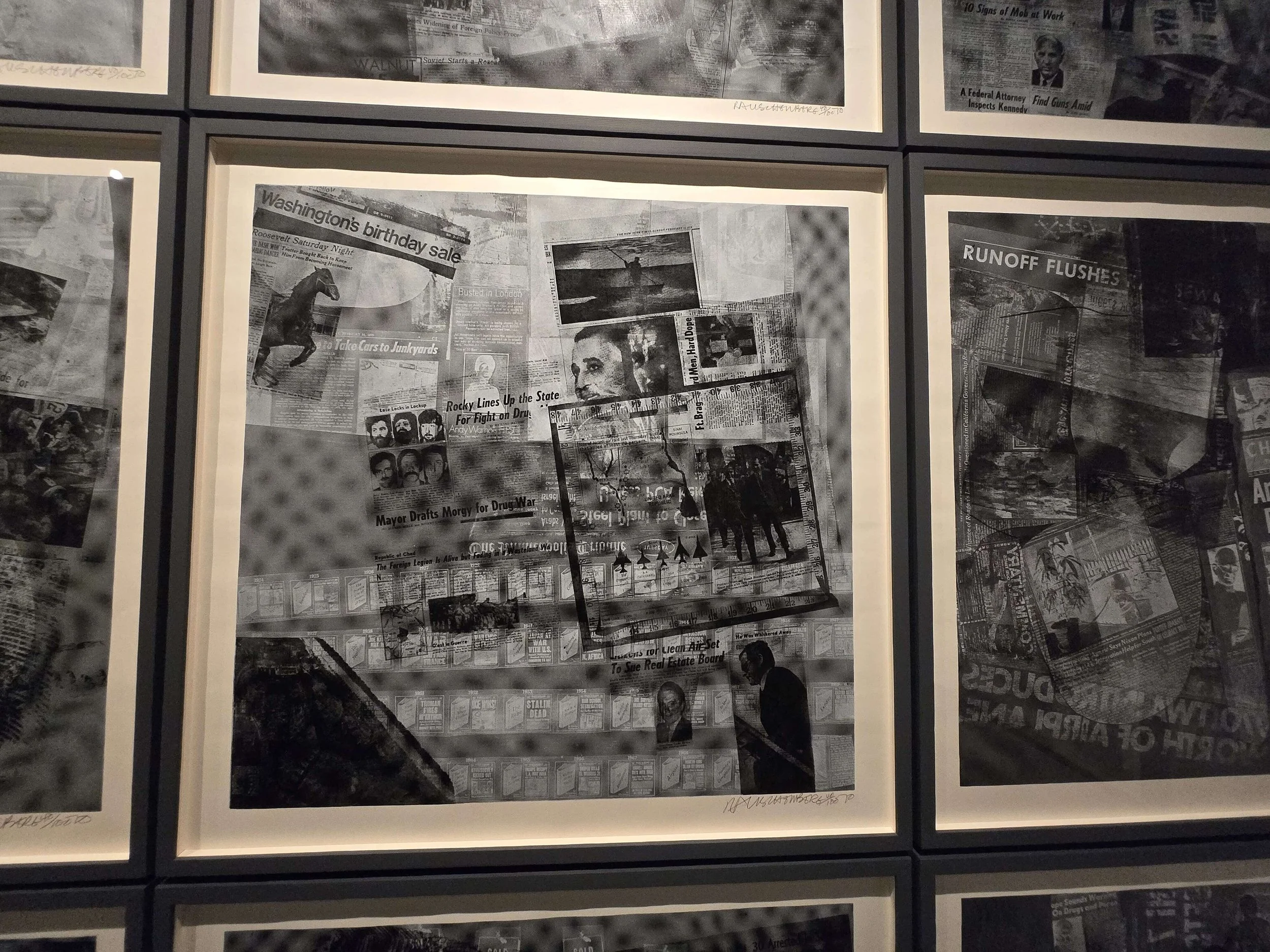
Before digital media, there was, of course, analog media — which visual artists like Robert Rauschenberg used in such innovative ways that sections of printed newspapers festooned these artists' mish-mash of canvases, as in Rauschenberg's "Collection," the 1954/1955 work that SFMOMA has displayed for years. In Hit by News, we get Rauschenberg at his uncompromising best: An 18-panel series of collaged newspaper headlines, photos, captions, and other material that he silk-screened into a black-and-white panoramic X-ray of hide-and-seek, where the closer you look, the more you find — and the more questions you have about Rauschenberg's choices of juxtapositions. "Surface Series" is from 1970, and its labyrinth of human faces, typefaces, and twisting, turned-around images means that, in one panel, Egyptian president Gamal Abdel Nasser sits next to the end of a four-foot ruler, which abuts a reference to Andy Warhol, which tops a headline about a "Drug War," which parallels a story about the foreign legion and the African country of Chad, which then leads in every direction around an artwork that's the size of a freeway billboard.
Robert Rauschenberg Surface Series
"Surface Series" is both a timeless abstraction and, on closer inspection, a specific window into a specific year that changed the world. Where SFMOMA's Rauschenberg is a colorful, dreamlike pastiche, "Surface Series" is a thunderstorm of transfixing snapshots of all sizes — and it's just one of scores of arresting pieces that anchor Hit By News.
Among the conveyor belt of artworks that give Hit By News a "must see" status:
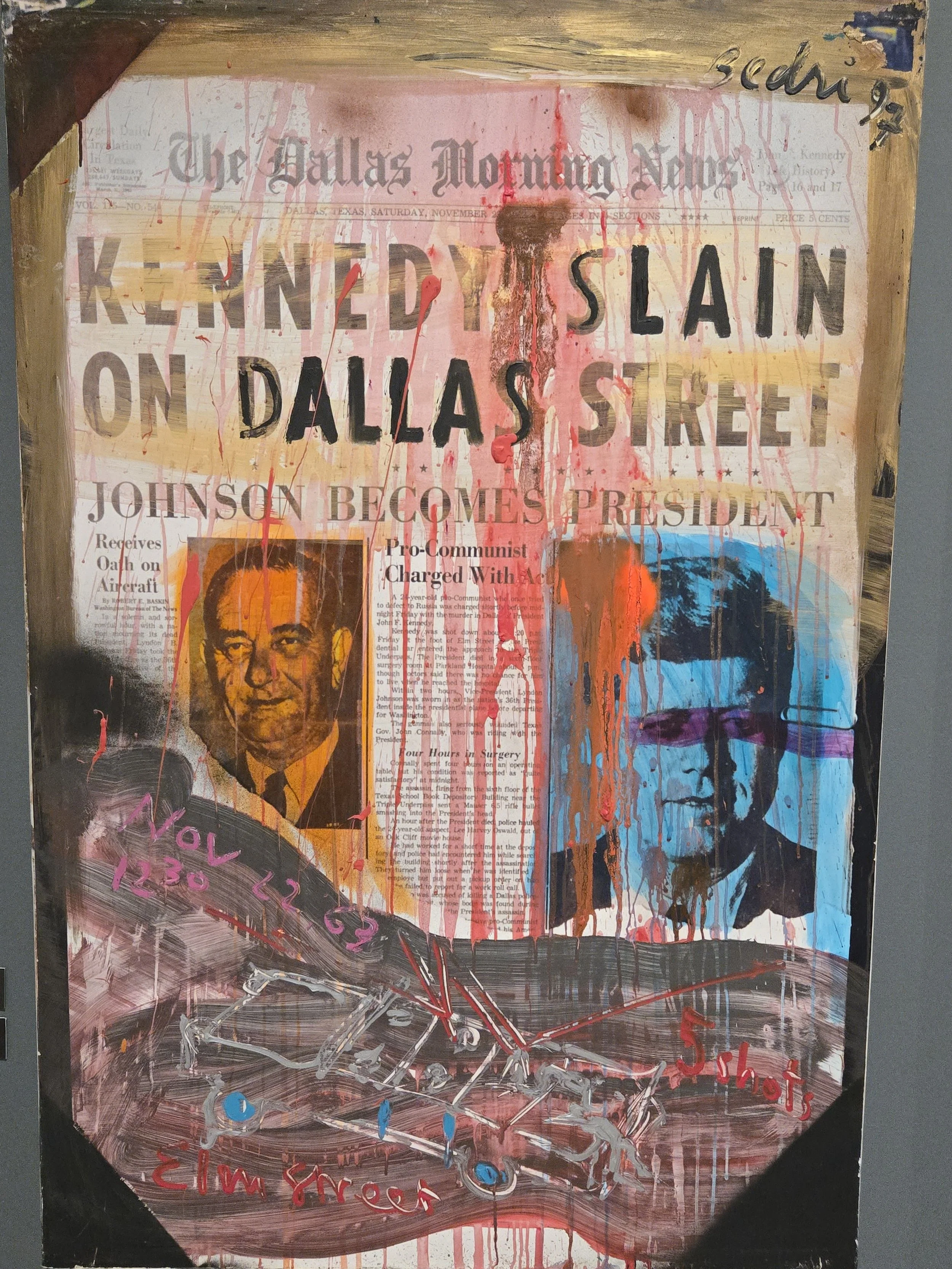
Bedri Baykam's "Kennedy Slain on Dallas Street," a 1997 work that's a spray-painted whirlpool of newsprint, acrylic paint, scribblings, and street-art dissonance that revolves around the Dallas Morning News' front page that reported John F. Kennedy’s 1963 assassination. Baykam, a Turkish artist who studied at the California College of the Arts, is a kind of Rauschenberg accolate who should be better known in American art circles."Kennedy Slain on Dallas Street" is displayed next to other Baykam canvases that are equally adorned into dreamlike states of color, conflict, and overlapping layers of newsprint, paint, and juxtaposed strangeness.
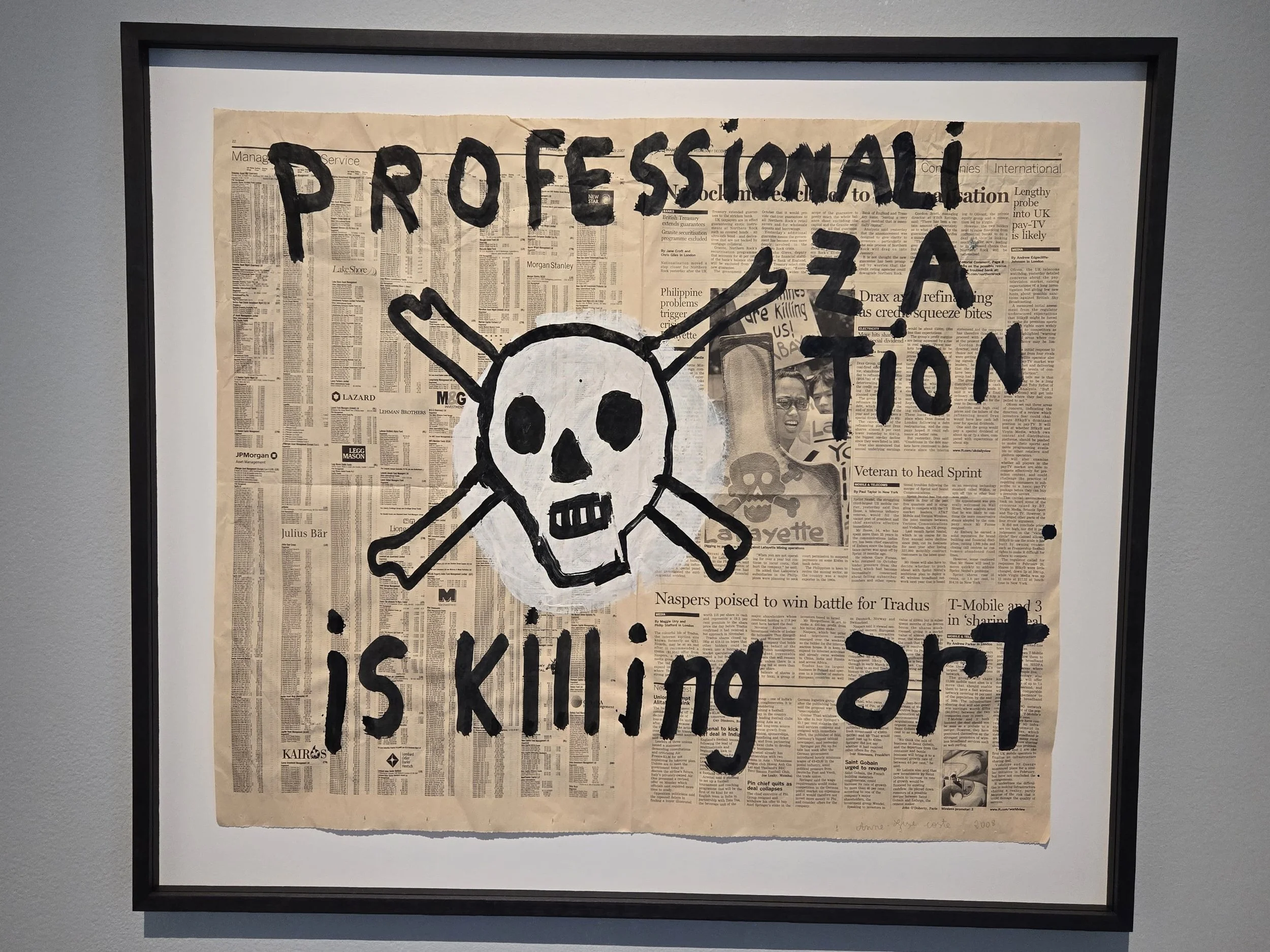
Anne Lise-Coste's "Professionalism Is Killing Art," a 2008 work that also uses newsprint in a profound way: As the backdrop for a painted skull and crossbones and the very words of the artwork's title. A French artist with a graffiti mindset, Lise-Coste makes art that turns her social commentary into the equivalent of artistic "STOP" signs that you can't look away from.
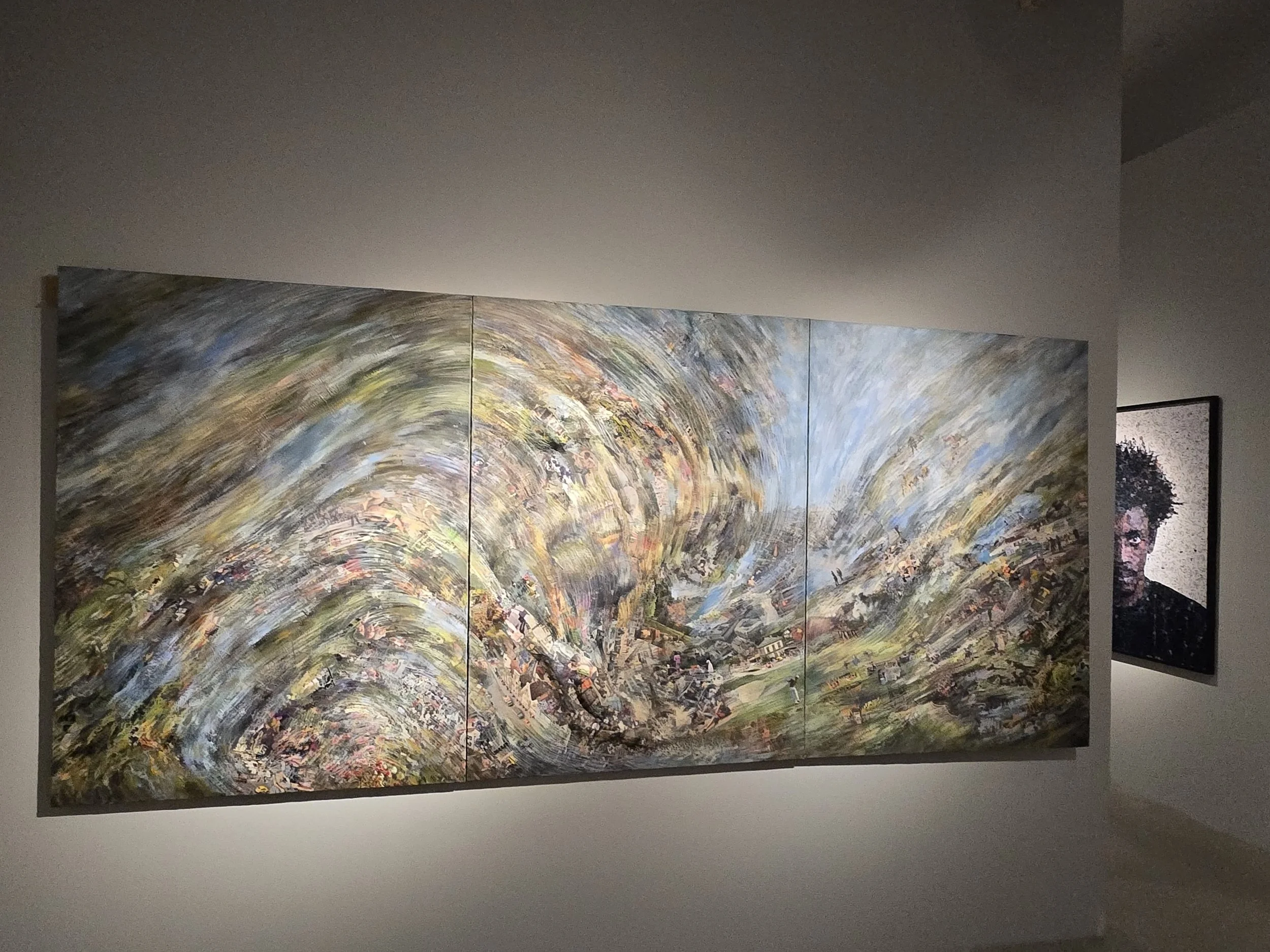
Sabine Hertig Landscape No. 8
Sabine Hertig's "Landscape No. 8," a 2013 work whose newsprint and magazine paper is subsumed into giant waves of abstraction that swirl this way and that way — turning the horizontal three-panel canvas into a kind of biblical explosion, complete with a seemingly blue and cloudy sky in the background that testifies to the scene's earthly dimensions. Based in Switzerland, Hertig produces what could rudimentarily be labeled "collage," but — as in "Landscape No. 8" — are really artworks whose swarms of miniature scenes come alive for dual purposes: As elliptical pastings and brush strokes of people and imagery worth noting, and — as you see the art from afar — as a bigger picture of a culture in flux. As Hertig has put it herself, her art is "a means of vividly thinking about a world that has itself become an information montage."
This "information montage" has loomed over the world for generations, and has inspired artists of all backgrounds and fame to check in with their feelings about what they're witnessing. At Hit By News, we see this evolution through the rarely seen art of Jacques Villeglé (numerous works from the 1960s and '70s that feature the French artist's trademark ripped-poster canvases); Willem de Kooning (an untitled 1977 work of fading newsprint that he painted over with streaks of blue, yellow, and white); Robert Motherwell (a 1977 collage called "Manchester Guardian" that uses job listings in a British paper to outline what looks to be a worker's glove hand); and Olaf Metzel (a 2011 aluminum sculpture called "Susan Sontag" that resembles a thrown-away assemblage of different media, as if the German artist has manifested Sontag's theories about culture into a playful gob of wrecked metal).
Hit By News, which is on exhibit through August 23, has a telling subtitle: Press Art From the Nobel Collection. The "Nobel" in this case refers to Zurich-based Peter Nobel and Annette Nobel, the former being a commercial lawyer who's obsessed with collecting art that uses newspapers and other media as physical objects. His pursuit is endless since many newspapers are still publishing print editions, and the media — whether digital or analog — still represents what newspapers of yesteryear represented to Rauschenberg, de Kooning, and Motherwell: The media's continuous ability to explain the world to any audience. These artists, Peter Nobel says, used sections of newspapers as opportunities to say something new in their art — about society, about technology, and about the art of making art itself. The Nobels' collection comprises more than 1,000 works by around 500 artists, so what's on display in Prague is merely a representation that, parsed into different timelines, helps visitors come to terms with the Nobels' vast archive.

DOX HIT BY NEWS View of the exhibition photo: Toma S. Cindr
As someone who has loved the printed page all my life, and who holds onto a printed newspaper from the Civil War, Hit By News was a feast for my eyes — a chance to take in a collection of art in a European city that values history differently from American standards. Prague's architectural landmarks go back centuries, so it's not surprising that the city's most celebrated art spaces make use of buildings from other eras. How effectively they use those spaces is open to debate, and it has to be mentioned that the DOX Centre for Contemporary Art celebrates its airplane-related past with something that's unconventionally modern: A giant, blimp-like structure atop its roof, called "The Gulliver Airship," where it holds literary events that give attendees the feeling of being suspended in the clouds. The airship alone is worth visiting the center beyond its multi-floor exhibits.
Speaking of being up in the air: On the plane rides home from Prague to San Francisco, which took me through Frankfurt Airport in Germany, I picked up printed versions of the Financial Times and the International New York Times. They were free atop a Frankfurt shelf of other gratis periodicals, where back in the day, these copies would have cost me multiple dollars. No one but me seemed to notice the newspapers' availability in Frankfurt, and I carried them diligently to my airline seat, where I promptly abandoned them for the familiarity of my smartphone, and the endless possibilities of knowledge acquisition from apps that bring information to the human eye in once-futuristic ways. The kind of printed media that's on the walls of the DOX Centre for Contemporary Art have lost their value in an age of cellphone immediacy. Hit By News generates a bit of nostalgia for the past, though the exhibit also features artists who are doing memorable work from digital means — most notably Rashid Rana, a Pakistani artist who produces what he calls "photo mosaics." In "Veil V" at the DOX Centre for Contemporary Art, Rana has stitched together thousands of tiny scenes of women having sex or posing sexually into a bigger panorama of women dressed entirely in Afghan burqas. As with every artwork in the exhibit, Hit By News offers no detailed explanation of "Veil V," leaving visitors to interpret Rana's stunning artwork on their own. One hint: "Veil V" is in an exhibit gallery with other art that's categorized under the rubric, "The War of Genders, the Clash of Cultures." Issues of gender and culture weren't freely discussed in the mainstream media that Rauschenberg consumed as he made a work like "Collection." Newspapers now regularly report on sexual doings and other subjects that would once would have been taboo. And artists like Rana are continuing to connect subjects around "news" with their own powerful interpretations and critiques — using the news as a jumping-off point to say something different from media that they refuse to take at face value.
