
Karla Knight
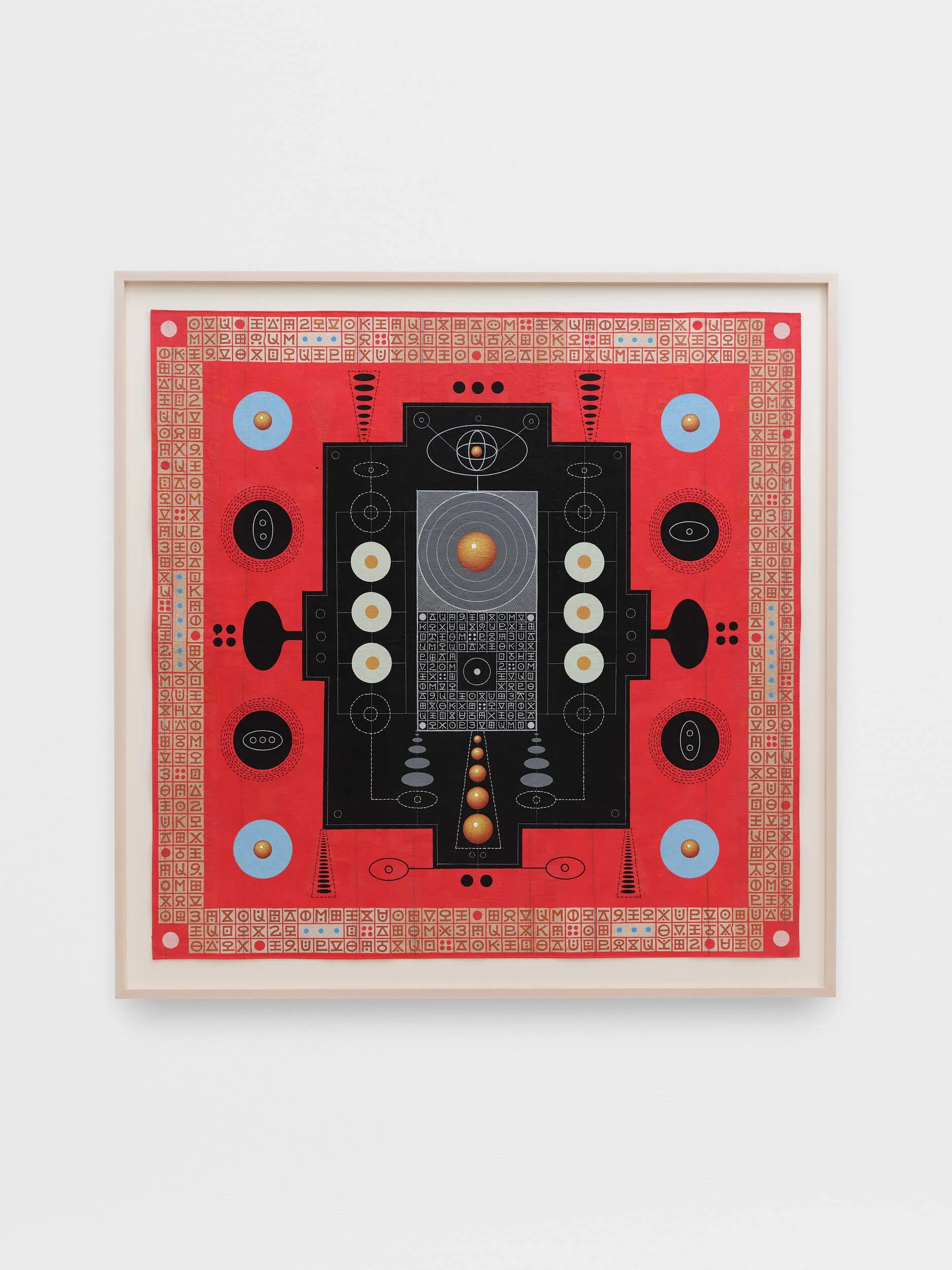
Feelers, 2025-2026
Flashe, acrylic marker, pencil, and embroidery on cotton
71 7/8 x 71 7/8 inches (framed)
Courtesy of the artist and Andrew Edlin Gallery
The biggest art event of 2026? That’s easy. It’s the British Museum’s exhibition of the Bayeux Tapestry, which has drawn sold-out crowds — including hordes of people under the age of 35 — to inspect its scenes of war and conquest. More than a million visitors are expected to see the ancient cloth during its limited run in London, which begs the question: What is it about tapestries, no matter the era, that inspires people to make them and to peruse them up close?
Karla Knight's trove of artworks at Gallery Wendi Norris includes a series of cloth pieces that are labeled "tapestries" in quotations, and that association is for good reason since her embedded scenes are — true to the history of notable tapestries — intricate and panoramic and timeless. Knight's art is meant to be viewed right now but it's not of our time. Knight's orbs, glyphs, and visual protuberances reflect her deeply felt connection to otherworldly matters, including outer space but also an unknowing internal space where language can't be expressed in traditional words or letters.
The non-English, letter-like symbols that jut across Knight's artwork don't spell out a real alphabet, even if they look arranged into patterns of sensible coherence. Instead, they help form collages of sensory motifs that seem at once prehistoric and futuristic — as if Knight has created pages of a visual dictionary that any society, at any age, could interpret as their own. In fact, Knight's exhibit features four notebooks that contain the same visual patterns of her wall-mounted work, which only reinforces what I'd call the exhibit's "edge-of-knowledge" focus. It's art as instruction into the mysteries of spaces that are often unfathomable. It's art as a kind of mystical vocabulary into the seen and the unseen.
What Knight has created in her ongoing art practice is a new kind of hybrid language — one that exudes an intense visual symbolism but deliberately retreats from assigned explanations. Call it a paradox. Call it a contradiction. It's these things even to Knight. “People can't figure it out and I know they try," Knight tells me of her art. "But I'm very clear in my written statements that I don't know what it means. . . . I like the mystery of it. I like to live with the unknown."
Still, Knight's work is easier to understand if you know about her upbringing with a father who wrote books about UFOs; a grandfather who was also a writer; and a seminal period of her parenting life. When Knight was a young mom interacting with her son, she began inventing her visual language. Knight, who's now based in Connecticut, had exhibited her work for two decades at that point, predominantly at New York galleries.
"It started 25 years ago when I was watching my kid learn to write; he was five, and when they're that age, they start to screw them up, and they transpose them," Knight says. "They enter the world of written language and make it their own. I thought it was really cool and a fascinating process and very freeing — and I thought, 'Why can't I make up my own language?' It's taken me all this time to invent symbols and letters and characters and make an alphabet of it. . . . . I write in it a lot. I use it as a tool to enter the unconscious and the unknown. And it's become second nature to me. It's not a finite alphabet. It keeps growing. . . . And I dream in it. It's not auditory for me yet. Maybe some day it will be. That would be cool."
Karla Knight
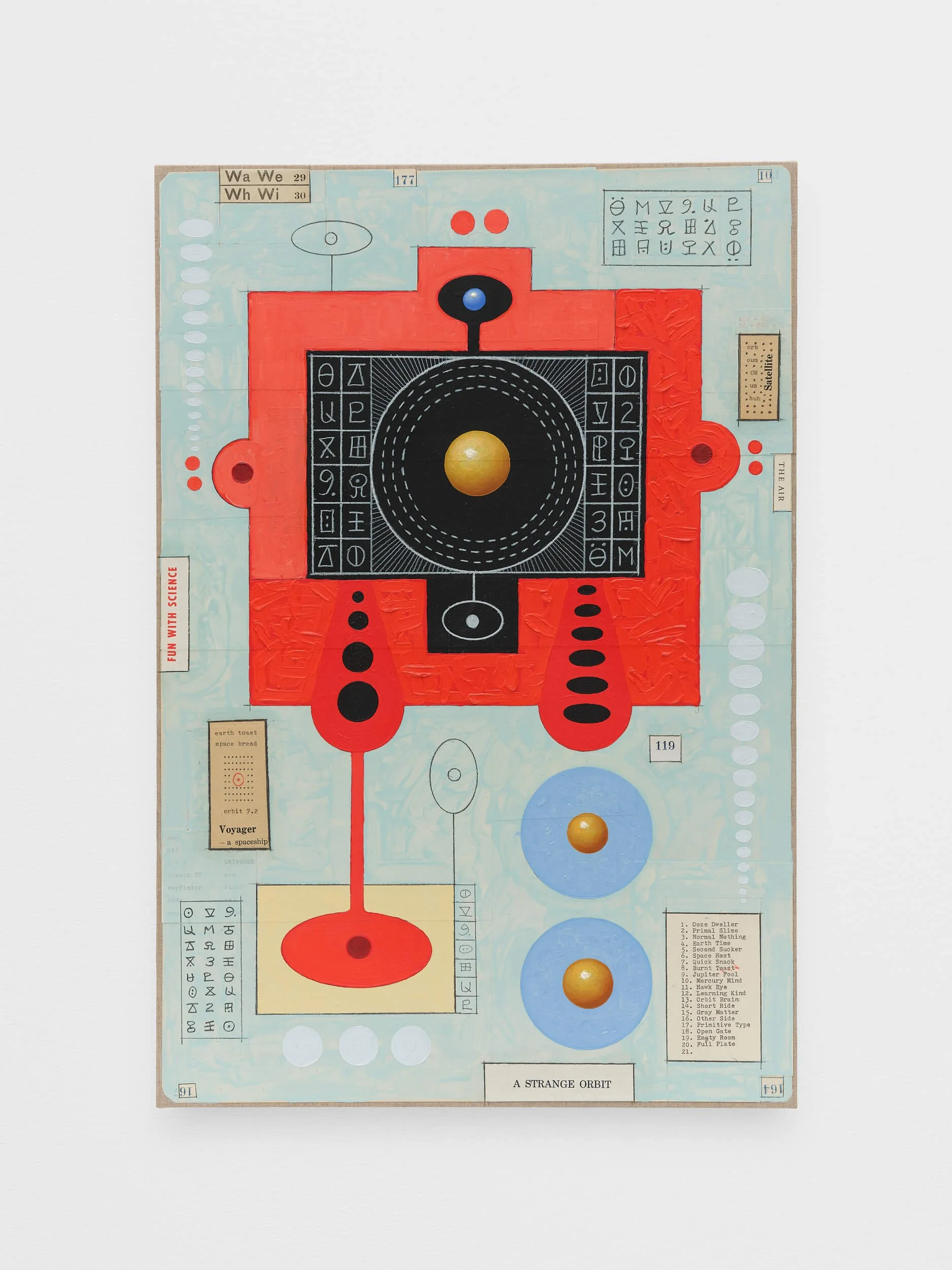
A Strange Orbit, 2024-2026
Oil, flashe, and pencil on paper mounted on linen
25 x 17 inches (63.5 x 43.2 cm)
Courtesy of the artist and Andrew Edlin Gallery
Orbs were already in Knight's art when her son was five, no doubt influenced by Knight's dad, David C. Knight, who wrote books about UFOs, extrasensory perception, and the occult. Among his titles:Those Mysterious UFO's: The Story of Unidentified Flying Objects, from 1984; UFOs: A Pictorial History from Antiquity to the Present, from 1979; and Eavesdropping on Space: The Quest of Radio Astronomy, from 1975. (For his part, Knight's grandfather wrote about communicating with the dead.) "I grew up with a lot of occult and paranormal stuff," Knight says. "We would have seances with a Ouija board. It was very accepted that there might be other realms that we can't visually see — where the soul exists, and multi-level life forces."
Karla Knight
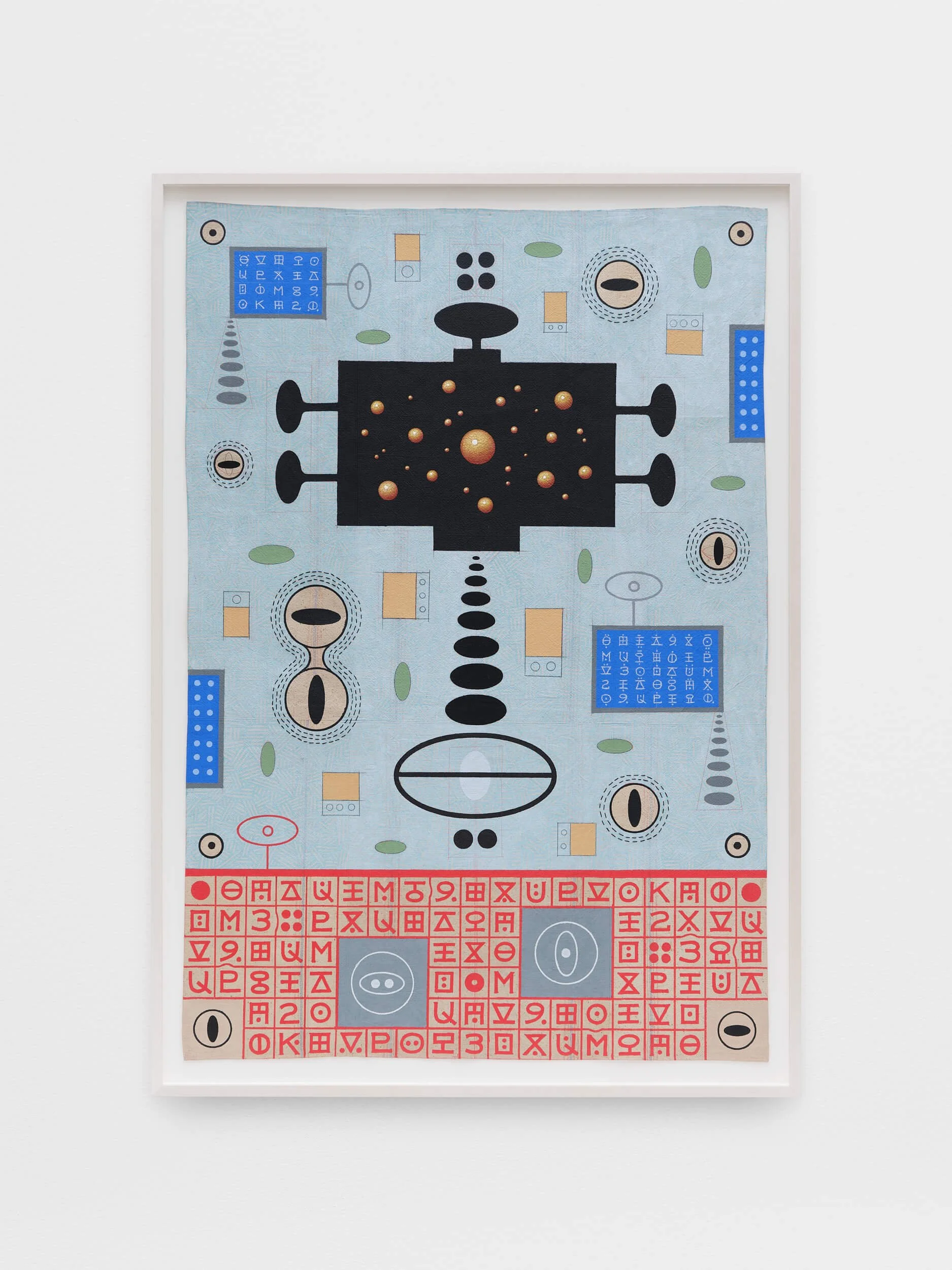
Astronomy for Everybody, 2026
Flashe, acrylic marker, pencil, and embroidery on cotton
55 1/2 x 38 inches (141 x 96.5 cm)
Courtesy of the artist and Andrew Edlin Gallery
Knight, whose "Fine Tuner" exhibit runs through December 23 and is her debut solo show on the West Coast, describes the process of making her art as "intense," and she also uses the word "obsessive." Those two words would also apply to Simon Evans' and Sarah Lannan's exhibit, "Never Better Than Later," which runs through December 19 at Rebecca Camacho Presents. The two Brooklyn artists make collages and other art that features seas of words that — almost like a coded, scribbled diary you'd find in the street — force you to look closely and inspect the undertow of meanings that appear in minute detail. Hearts, for example, narrates their feelings about San Francisco, where they once lived, and the artwork's scores of strange images are accompanied by elliptical, tiny writing in all capitals, as with the phrases "PLANTS AREN'T ASHTRAYS" and "IN THE END QUASIMODO DIES OF A BROKEN HEART." This American Dollhouse is Haunted, meanwhile, is a minefield of scribbles set amid the rendering of a three-story structure. You can't see the scribbling from across the gallery, but the writing is sheer spectacle on arriving close to the art, where words festoon its edges, as in "POST CAT FISH WORLD" and "MENTAL ILLNESS IN THIS ECONOMY!? ARE YOU CRAZY!" Evans' and Lannan's words are often funny, metaphorical riddles that speak to the world's simultaneous beauty and madness.
Rebecca Camacho Presents and Gallery Wendi Norris are just blocks apart in a fashionable part of San Francisco, and taking in the parallel exhibits — and seeing groups of people in the streets along the way, including the homeless — reminded me of something the actress Diane Keaton said to an interviewer many years ago. If my recollection of the article is correct, Keaton was in a car that went through a rough part of Los Angeles, where people in the street were talking to each other in almost manic but creative ways. Keaton — who made her own art, mainly collages — said her creative spirit was very similar to those she saw on the street. Indeed, aren't there deep similarities between acclaimed artists obsessed with lines and words and housing-challenged people like John Ratliff, a San Francisco street denizen who, for decades, scribbled vociferously on white paper in the Mission District?
Regardless, Knight calls the subject matter of her art "pretty out there," though it contains widely recognized wording (like the written words "Gone West" in a circle and the typewritten phrases "Earth Toast" and "Long Flight") that she adds not just for adornment. "I write two-word phrases on the typewriter and collage those into drawings and paintings because I like that extra element of language, and I just think it adds a whole other level of communication that the invented language doesn't," Knight tells me, adding: "And you'll find me messing with things like umlauts (the diacritical mark with two dots that German uses over vowels). I grew up with a German mother, and I like to put umlauts where they don't belong. I like to mess with language and linguistics."
As for the idea of "tapestries" and her cotton-sack works like Feelers, Blue Tuner, and Astronomy for Everybody? Knight likes that description for a format of art that she's been doing for five years by embroidering and sewing and working with agricultural seed and feed bags that are some 80 years old. Knight buys them on the internet because she likes to use repurposed materials and other "old, weird stuff" that create different textures in her art. Persian carpets are an influence on Knight's art, but it's the UFO-like orbs and spaceships that inspire particular curiosity. At her exhibits, art-goers often ask Knight whether she believes in UFOs.
"Do I believe in them? I don't know," she says, "but it seems to me that believing we're the only life form in the universe would be very condescending. I think there's something else out there. But who knows what. Some people look at the work and are suspicious of it, wondering if I'm putting one over on them or keeping a secret and not telling them what it really means."
Art-goers who are uncomfortable with the unknown find her work "not so fun," Knight says. Maybe that's why I was so drawn to her art the moment I saw it in the window of Gallery Wendi Norris. Knight's work is ineffable — so oddly familiar yet so completely different from anything I've seen in decades of encountering art. Familiar yet strange. Something you can't quite pinpoint. At a time in the culture when so many people — actors, artists, politicians, and others — posture away by proclaiming what they claim to know, and at a time when these figures' output pretends to be based on assurance, it's refreshing to encounter something that isn't quite sure what it is. Knight isn't saying, "Take it or leave it." She's saying, "Join if you want. We might be on the same visual path." Yes, we might.
