
Anthony McCall: First Light, Fort Mason Center for Arts & Culture
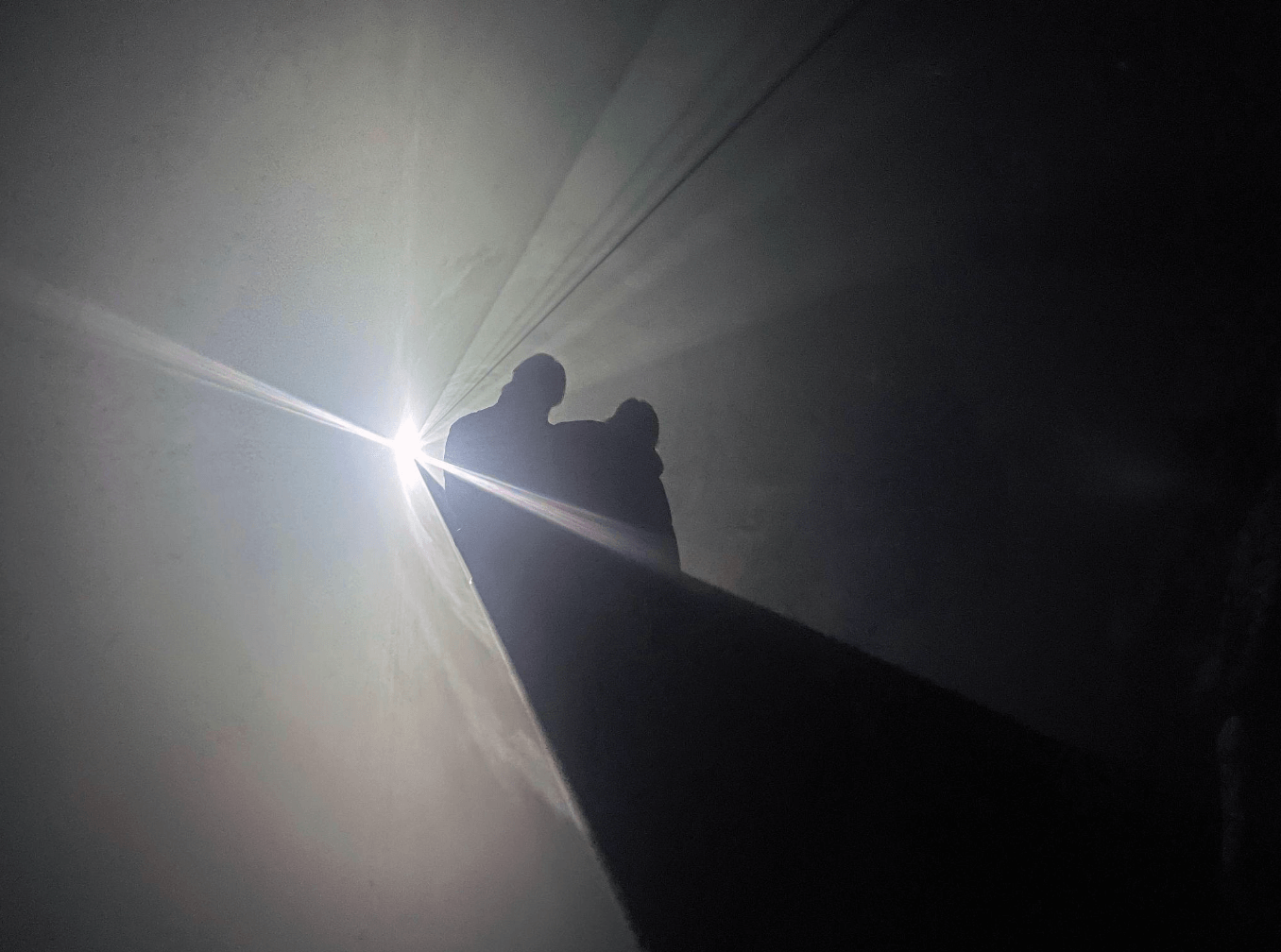
Line Describing a Cone 1973, Anthony McCall, Digital transfer from 16mm film
Anthony McCall: First Light, Fort Mason Center for Arts & Culture, through March 8, 2026
By Scott Snibbe
Robert Thurman once said that when watching a movie, we should try to remember that we are always looking at a blank screen. The people, emotions, and landscapes are all illusions—patterns of light dancing across its pure white expanse. His insight is a metaphor for our minds: that beneath the busyness of our thoughts lies a pure, calm, luminous field of awareness.
A rare, transcendental exhibition of three works of “solid light” by Anthony McCall brings these questions of mind and reality to the fore in an exhibition now on view at San Francisco’s Fort Mason Center for Arts and Culture.
In art school, I had been exposed to McCall’s work in almost mythical terms. Documented in a few mysterious still images, I learned of film animations that produced volumetric lines, cones, and sheets of light in the space between projector and screen—and the lucky 70s loft-goers danced through them on smoky New York nights.
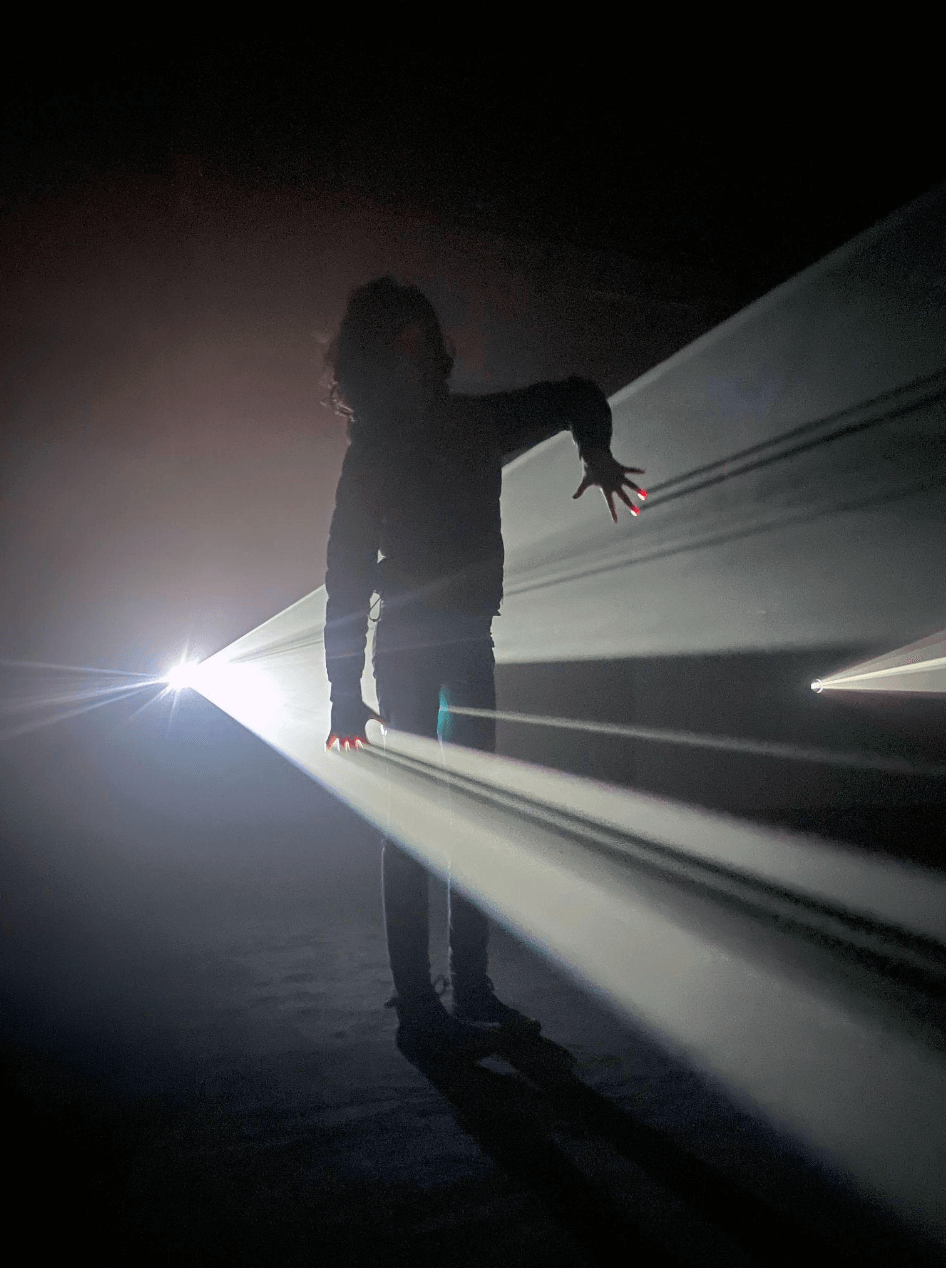
I often critique interactive art with a simple rubric: if you cannot tell how you affect the artwork, then it fails. But Anthony’s spectacularly succeeds. In the first work at Fort Mason, Cone of Variable Volume (1974), a projector shoots a cone of light from one side of the room to the other. As it cuts the perfectly calibrated haze, marbled patterns swirl across its surface. Soon you realize that the cone, gently expanding and contracting, is breathing.
Line Describing a Cone 1973, Anthony McCall, Digital transfer from 16mm film
At first, the room is so dark you can’t see your own body or those of your companions. Shuffling from the room’s entrance, you watch these light forms from a distance, clinging to the wall. But as your eyes acclimate, you see others moving through the cone, its light sliced and blocked by bodies, fingers, and faces. And you feel invited to do the same.
Anthony’s art practice, rooted in 70s minimalism and installation art, is often described as expanded cinema because it pushes moviemaking beyond its confinement within a representational rectangle. At the time, these art movements were embedded within a notoriously serious, rigorous discourse. Yet the space created for viewers is unapologetically playful, joyful—fun. Today, it’s okay to admit this, and may be why, after a multi-decade dormancy, McCall’s light work is back.
Conical Solid (1974), the middle piece in the gallery, is more jarring. Here, a luminous prism rotates at varying speed around a central, invisible axis, painting light planes that disappear and reappear at clock angles. This is the less successful of the three pieces for me, as the abrupt changes in shape leave little time for bodies to relate to the light.
The last piece at the far end of the blacked-out space, Line Describing a Cone (1973), is my favorite. In this work—an experience lasting about a half-hour—a pencil-line of light first appears, pricking your fingertip if you block it. It gradually grows into a gentle arc, a quarter-cone, half a funnel, then a tapered solid. This is the light work I found most meditative. On a second visit, I sat at its far end cross-legged to watch the cone from its widest end make its slow circuit to enclose a foreshortened tunnel—the vision so often reported by those who returned from near-death experiences.
Originally, these interactive installations relied on a fragile set of conditions. They were painstakingly created by photographing drawings onto high-contrast 16mm film. The film was spliced from front to back to loop through a projector hundreds of times, gradually destroying the fragile animations that produced it.
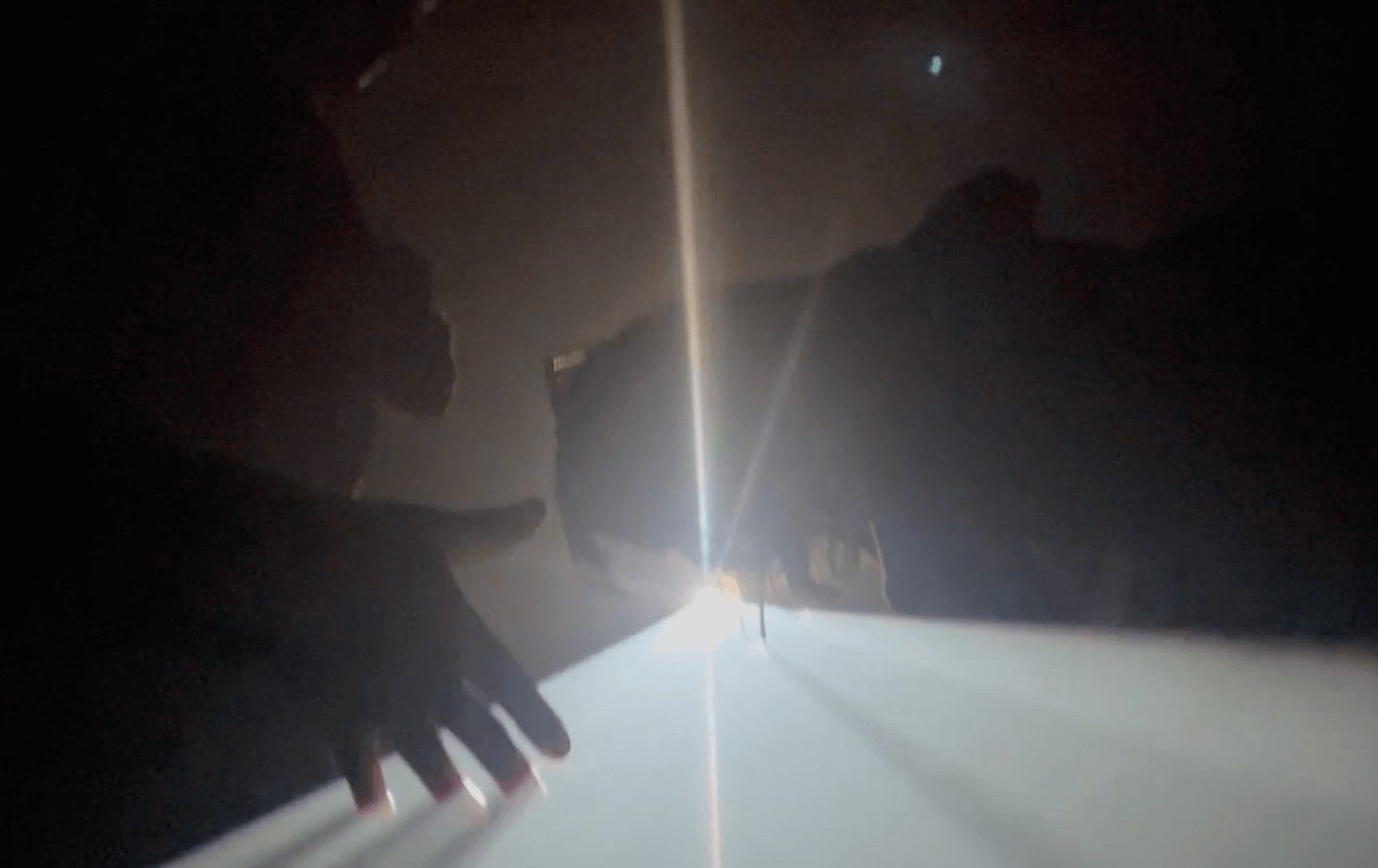
Video still from Anthony McCall’s First Light, Fort Mason Center for Arts & Culture
McCall conceived of these pieces to take advantage of the social scenes of his time: hours-long hangouts in dark rooms filled with the cigarette haze. The toxic smoke was essential to his light forms. Without it, nothing would catch his light.
I always wondered why McCall stopped showing these marvelous works. Talking to the show’s curator, I discovered the reason: as healthier habits spread through cities, people stopped smoking indoors. Without the room’s haze, his art ceased to exist.
Of course, whether McCall’s art exists in the first place is the deeper question, inviting philosophical inquiry that I think he would prize. 2500 years ago, Plato proposed that pure geometric forms—circles, spheres, triangles, cones—might genuinely exist in a real, non-physical realm of existence. These ideal forms materialize imperfectly in our realm: as scratches in dirt, marks on paper, sculpted clay, 3D prints.
McCall’s manifestations of mathematical forms in pure light come closer to their ideal: impossibly straight lines and perfect cones that seem implausible when you first see them. Yet there is something profoundly familiar about them too—shapes we learned in grade school that feel intrinsic to our inner and outer realities.
Where are these cones and planes as you encounter them in the gallery? We are instructed straightaway that they aren’t on the screen: the fact that the projector casts an image at the end of the gallery is a mere side effect of the art, mostly to be ignored. If the room lacked smoke, we would see no forms. Is it the smoke that makes these forms real? Or our eyes, brains, minds?
In Buddhism, when we study its most advanced topic of emptiness, we are instructed that there is no inherent form: all we perceive are psychological constructs from an interdependent, fundamentally invisible reality whose ultimate essence is subtle and difficult to grasp. Everything depends on everything else, and perception is built upon illusion.
This holds for McCall’s installation even more than it does for ordinary reality. Take any of its elements away and the art instantly disappears: clear the smoke, pull the projector’s plug, switch on the room’s lights. Where did the art go? Was it ever really there?
I first saw McCall’s work in person at the Whitney Museum in 2001, in the groundbreaking show, Into the Light: the Projected Image in American Art. “I want to make this sustainable,” his former assistant told me McCall had said, and he worked with curators to transfer film to computers, and arrive at a healthy fog formula stirred by quiet fans that meets today’s stringent safety standards. McCall stands apart from most of my experimental animation heroes, who hold firm that their work must only be projected through film in dim rooms to people sitting silently in orderly rows. I thank him for his flexibility.
Still, I did feel some minor disappointment at the new realization of these works. I miss the sound of a 16mm projector—an integral part of his original installations. For those of us who remember it, the projector’s whirr signals the energy, impermanence, and vigor of projected light. Many of us first encountered the sound in grade school, on the rare occasions our teacher would dim the lights to share an educational film about frogs, bombs, or sex. Now silent, the exhibition forefronts our social and inner experience, but diminishes the energy produced by the impermanence and fragility of film.
When you draw close to the projection screens, you find that the curves are made of squares: the tiny colored pixels comprising most modern media. I couldn’t help but feel disappointed, because McCall’s original works used the pure light of a quartz halogen bulb, intermediated only by transparent film through which light passes unimpeded—with infinite resolution. His original installation was more literally light. Whereas this one is mediated by a computer, digital files, and the projector’s imaging chip.
Still, letting go of film-fetish nitpicking, the actual experience remains sublime. I found it deeply spiritual, provoking both Platonic idealism and the inquiry into what is real, the nature of perception, and even, in the deep darkness of the room, stirring some of life’s deepest questions. The stars likely sparked these thoughts first in humans, confronted nightly by the simplest ideal forms: singular points of light.
McCall firmly resists a spiritual dimension to his work—at least from its creator’s point of view. Perhaps his firmly secular seventies milieu demanded so. We live in a more flexible era, where admitting to the mystery of the immaterial is no longer unfashionable. Where did we come from? Where are we going? What are we made of? What is real? Come visit this show to ask these questions in the dark with a room full of strangers.
